Compact Ca II K Brightenings Precede Solar Flares: A Dunn Solar Telescope Pilot Study
Abstract: We present a uniform analysis of compact Ca II K (3934 Å) brightenings that occur near flare kernels and assess their value as short-lead indicators of solar flare onset. Using high-cadence imaging from the Rapid Oscillations in the Solar Atmosphere (ROSA) instrument at the Dunn Solar Telescope (DST), we examine eight flare sequences (seven C-class and one B-class) obtained between 2021 and 2025. Fixed, detector-coordinate regions of interest are used to generate mean-intensity light curves, which are detrended and smoothed to isolate impulsive brightenings. In every event, a compact Ca II K brightening is detected within or adjacent to the flaring region that peaks 10--45 min before the primary kernel and the corresponding rise in GOES 1--8 Å flux. The measured temporal offsets scale with the deprojected separation between the brightening and flare kernels, implying an apparent propagation speed of $\sim$30--35 km s${-1}$ that is consistent with chromospheric reconnection. Complementary Spectropolarimeter for Infrared and Optical Regions (SPINOR) spectropolarimetry for one event shows topological reconfiguration from closed to open or extended connectivity, supporting a reconnection-driven origin. These results demonstrate that compact Ca II K brightenings are reproducible, physically meaningful precursors to flare onset. Their simplicity and cadence make them attractive chromospheric indicators, and future work will evaluate their predictive skill alongside established UV/EUV and magnetic diagnostics.
Paper Prompts
Sign up for free to create and run prompts on this paper using GPT-5.
Top Community Prompts
Explain it Like I'm 14
What is this paper about?
This paper studies tiny, short-lived “bright spots” on the Sun that show up in a specific color of light called Ca II K (a violet line at 393.4 nm). The big idea: these small bright spots often appear near where a solar flare will happen, and they light up 10–45 minutes before the main flare starts. That means they could act like early warning signs for solar flares.
What were the researchers trying to find out?
In simple terms, they asked:
- Do small, compact Ca II K brightenings consistently show up just before solar flares?
- How much earlier do they appear—minutes or seconds?
- Are these brightenings physically connected to the flare (not just random flickers)?
- Could this be a simple, ground-based way to alert us that a flare is about to begin?
How did they study it?
Think of watching a campfire: before a big flame bursts up, you might see tiny sparks popping nearby. The team looked for those “sparks” on the Sun.
Here’s what they did:
- They used the Dunn Solar Telescope (in New Mexico) to take fast, high-resolution movies of the Sun in Ca II K light and Hα light (another common solar filter). They watched 8 small-to-medium flares (seven C-class, one B-class) recorded between 2021 and 2025.
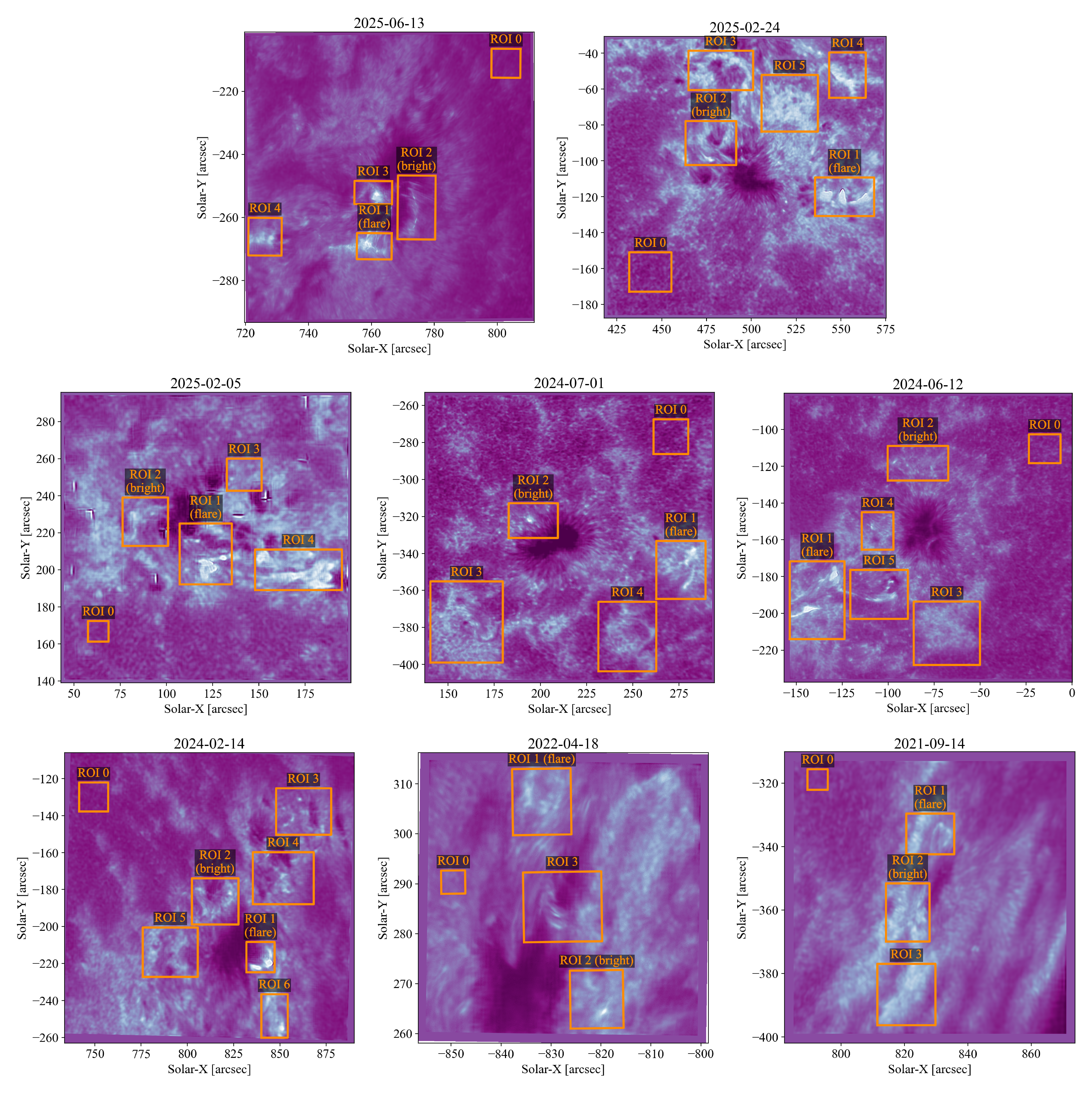
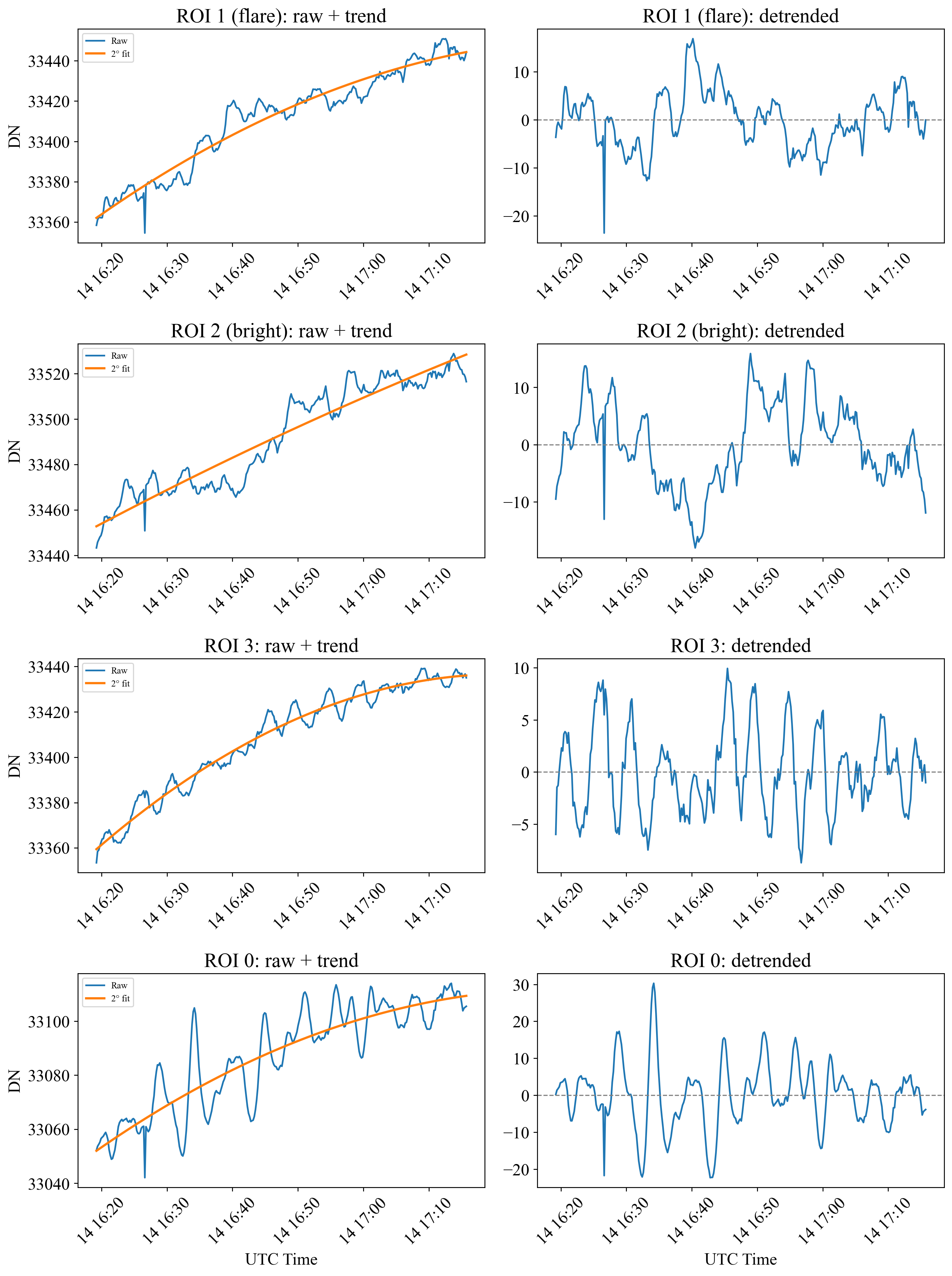
- They picked small boxes (“regions of interest,” or ROIs) on each image: one on the main flare hotspot (the “kernel”), one on nearby compact brightening(s), and one on a quiet patch for comparison.
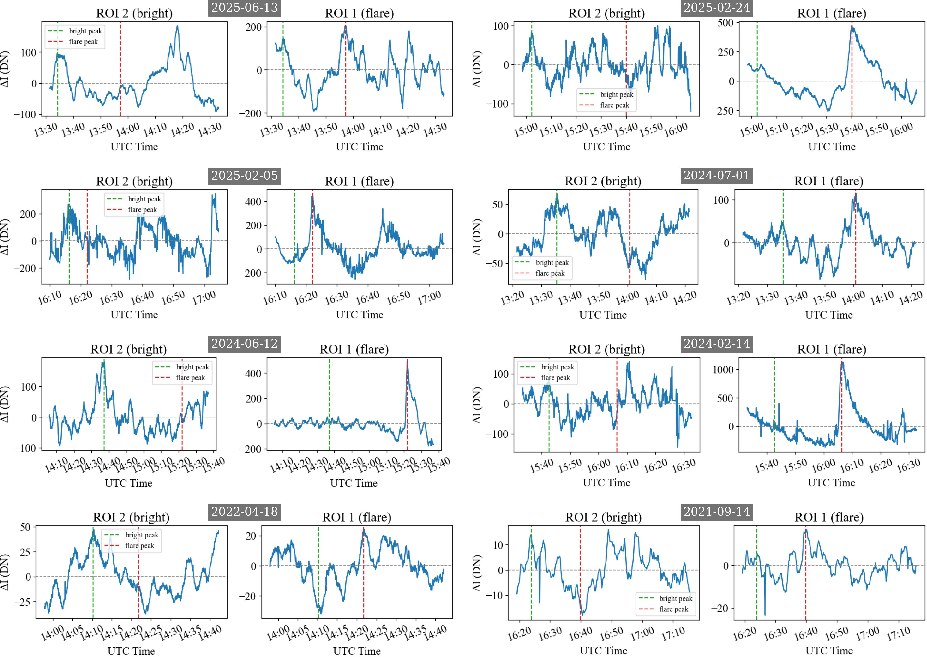
- For each box, they tracked how bright it was over time (a “light curve”). They removed slow background changes (like changes in Earth’s atmosphere) so sudden jumps in brightness stood out clearly.
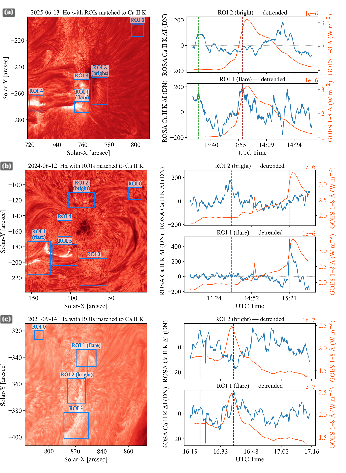
- They compared timing: when did the compact brightening peak versus when the main flare kernel peaked, and when did the GOES satellite (which watches the Sun in X-rays) see the flare rise?
- They also checked the position of the bright spots and corrected for the Sun’s viewing angle to measure true distances on the solar surface.
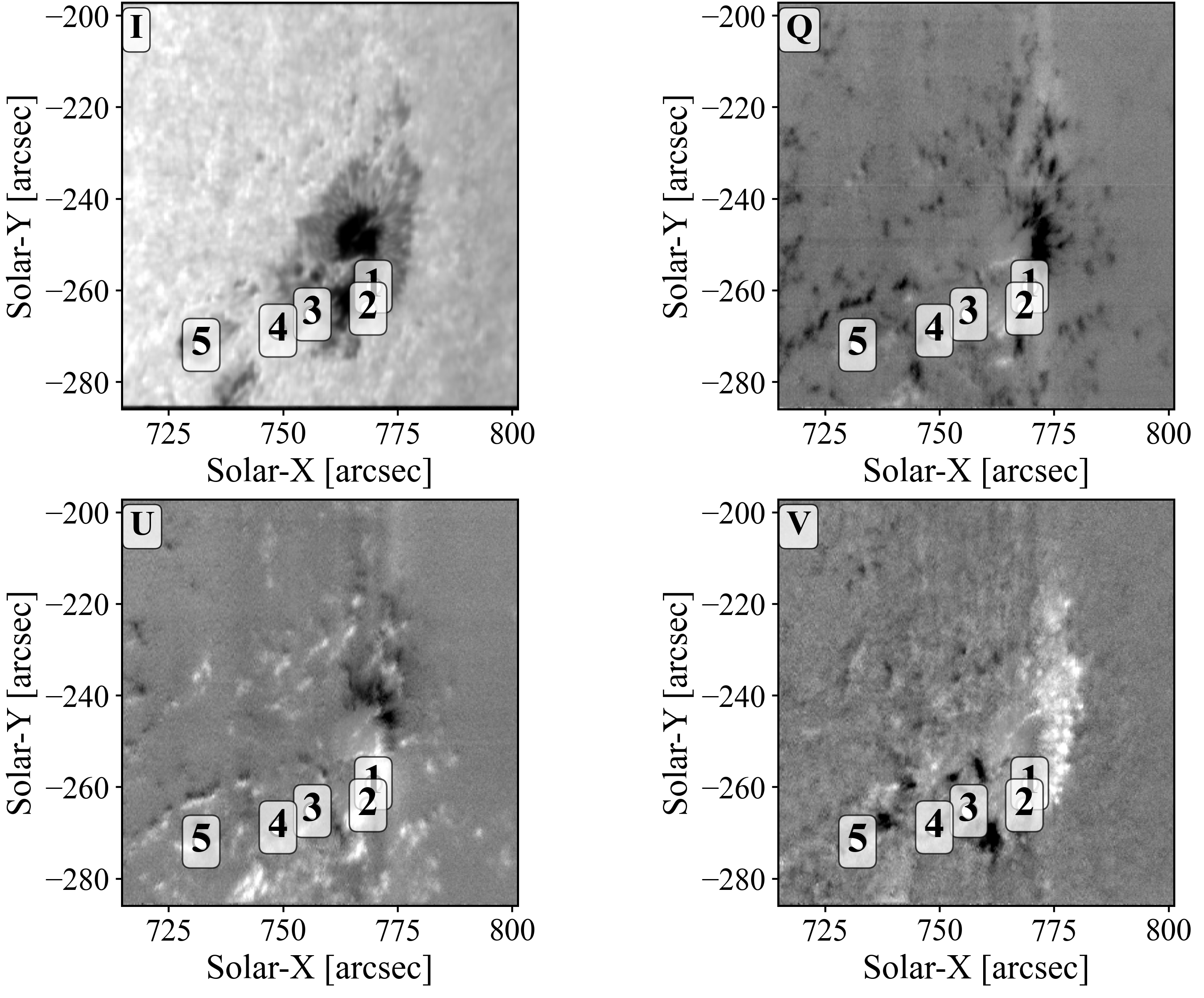
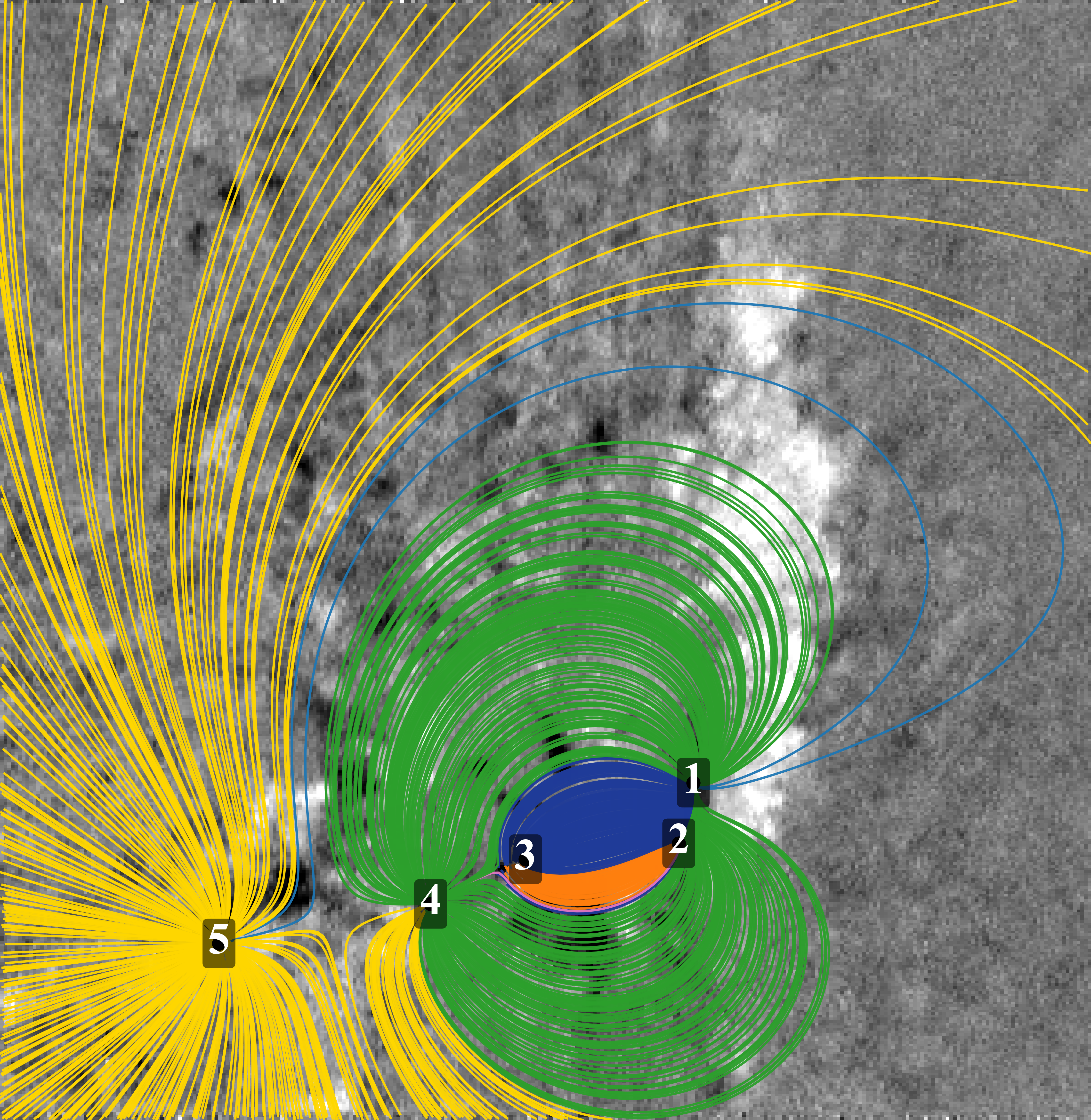
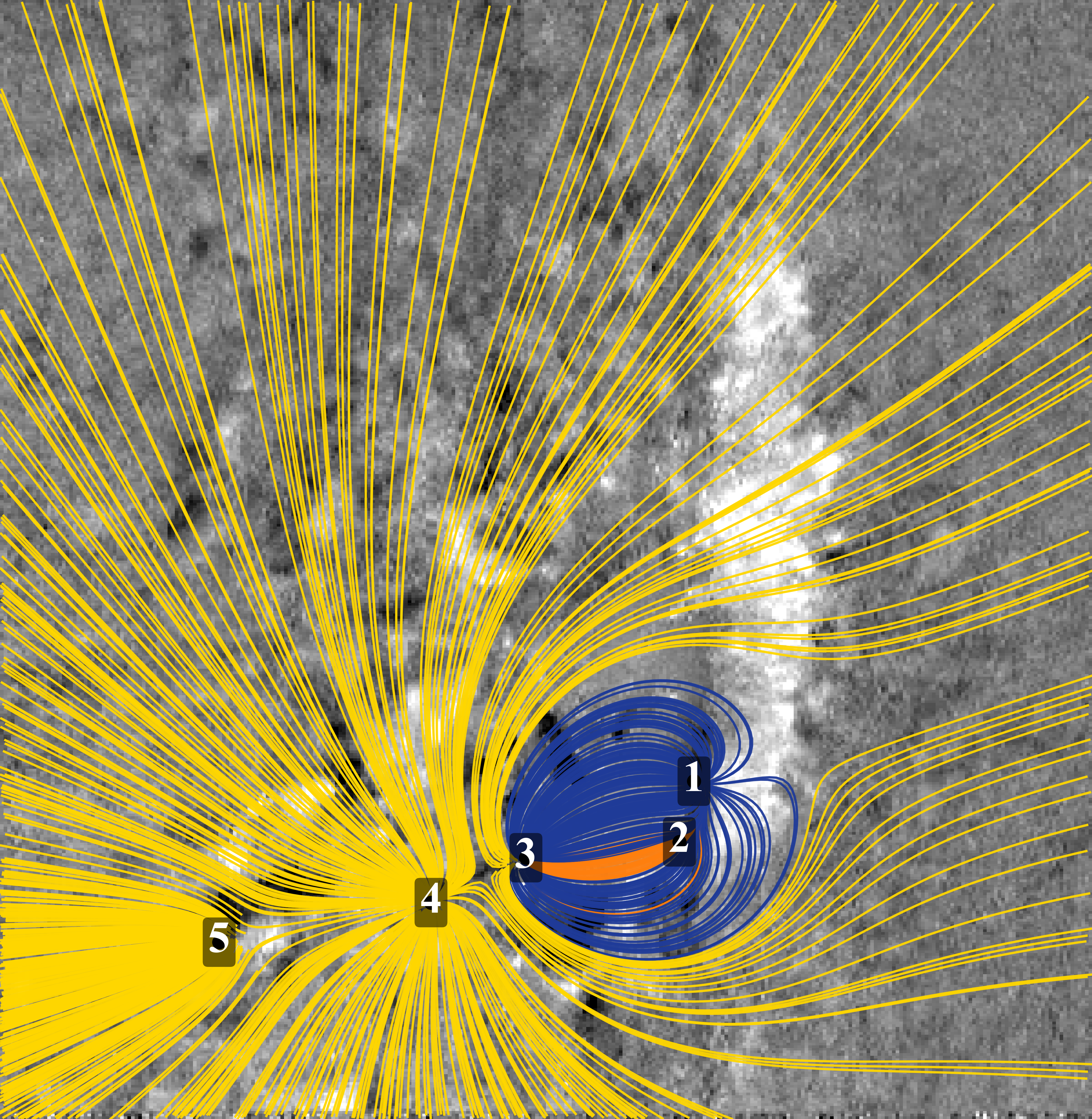
- In one event, they used a special instrument (SPINOR) that measures how the Sun’s magnetic fields are arranged. This revealed that the magnetic connections changed from short/closed loops to more open or extended ones around the time of the flare—evidence of magnetic “reconnection.”
Key idea: “Magnetic reconnection” is like two stretched rubber bands snapping and rejoining in a new way. On the Sun, this suddenly releases energy—what we see as heating and brightening.
What did they discover?
In all 8 flare sequences:
- A compact Ca II K brightening appeared right next to the eventual flare site and reached its peak 10–45 minutes before the main flare hotspot and before the rise in soft X-rays seen by GOES.
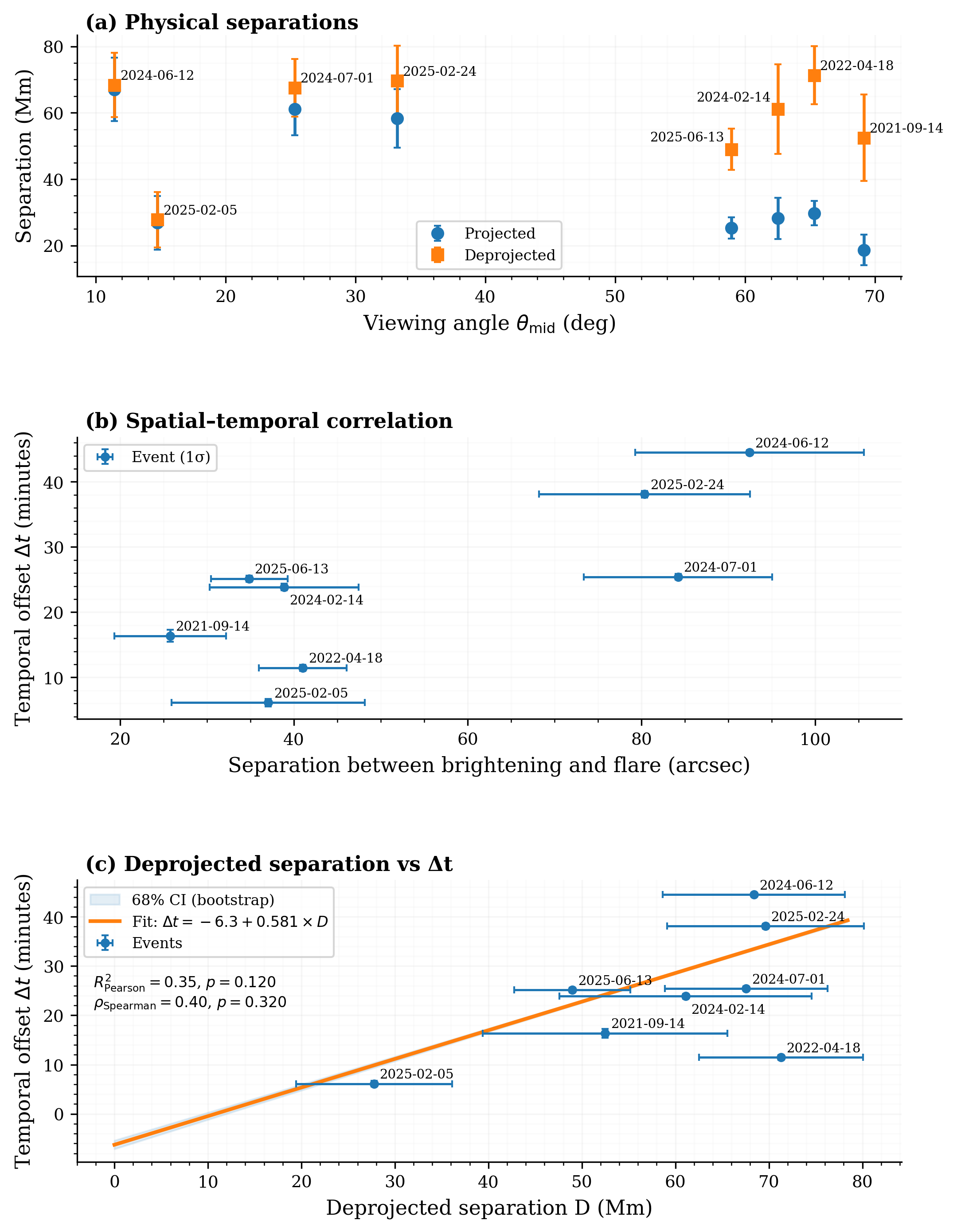
- The time gap between the early brightening and the main flare tended to increase with distance between the two spots. That trend suggests an “apparent propagation speed” of about 30–35 km/s (roughly 100,000+ km/h), which fits the idea of energy moving through the Sun’s lower atmosphere as magnetic fields reconnect.
- The SPINOR magnetic data for one event showed the region’s magnetic connections rearranging—from short, closed loops to more open or longer connections—consistent with reconnection driving both the early brightening and the later flare.
- These small Ca II K brightenings are simple to detect with ground-based telescopes at fast cadences (every few seconds), making them operationally attractive as early indicators.
Why this matters:
- Getting a 10–45 minute heads-up about a flare can help with “space weather” readiness—protecting satellites, power grids, radio communications, and future astronauts from solar radiation bursts.
What does this mean going forward?
- The results suggest that compact Ca II K brightenings are real, repeatable precursors to solar flares. They are not just random flickers; they reflect actual magnetic changes in the Sun’s lower atmosphere.
- Because this method uses simple imaging and timing—no heavy computations—it could be built into real-time monitoring systems from the ground.
- There are challenges: sometimes multiple small brightenings pop up, making it unclear which one connects to the flare. More data, automatic selection methods, and adding magnetic/context information will help sort that out.
- If refined and combined with other tools (UV/EUV measurements and magnetic maps), these Ca II K signals could become a practical, early “nowcast” trigger for flare alerts.
In short: the Sun often shows a small, easy-to-see “spark” before a flare. Watching for that spark in Ca II K light could give us useful minutes of warning before the main event.
Knowledge Gaps
Knowledge gaps, limitations, and open questions
Below is a single, concise list of what remains missing, uncertain, or unexplored in the study, framed to guide actionable future research.
- Limited sample size and flare-class coverage: results are based on eight events (seven C-class, one B-class); generalization to M/X-class flares and diverse active-region morphologies is untested.
- Selection bias: events were chosen for “clear chromospheric activity” and concurrent GOES coverage, potentially inflating precursor-detection success; a blind, comprehensive event survey is needed.
- Predictive skill unquantified: no formal assessment of detection probability, false-alarm rate, missed detections, lead-time distribution, or skill scores (e.g., ROC, precision-recall) for operational nowcasting.
- Ambiguity in multi-peak environments: multiple impulsive Ca II K peaks occur in several ROIs near flare sites; the current approach relies on manual selection, lacking automatic disambiguation based on morphology or magnetic context.
- Lack of automated ROI placement: fixed detector-coordinate ROIs and visual identification may introduce bias; automated, reproducible ROI detection/tracking tied to magnetic features (e.g., PILs, ribbons) is not implemented.
- Incomplete handling of confounders: plage variability, closely spaced sub-flares, and partial temporal coverage can mimic or obscure precursors; robust gating/filters to suppress false positives are not yet developed or validated.
- Weak distance–time correlation: the inferred apparent speed (~30–35 km s⁻¹) rests on modest correlations and linear fits; non-linear/anisotropic propagation, path-length bias, and 3D geometry are not explored.
- 2D plane-of-sky deprojection limitations: using a single heliocentric angle and ROI midpoints ignores height differences and field-aligned paths; speeds computed from D/Δt may not reflect true propagation along magnetic structures.
- Spectral ambiguity of Ca II K imaging: the 1.2 Å filter is not line-resolved; contributions from line wings and photospheric/chromospheric layers are not separated, leaving height-of-formation and thermal/nonthermal sensitivity uncertain.
- No quantitative intensity/energy metrics: precursor size, brightness contrast, duration, and radiative energy are not measured; thresholds for reliable detection are undefined.
- Minimal multi-wavelength integration: precursor behavior is not systematically compared with UV/EUV (e.g., AIA, IRIS), microwave, hard X-ray, or radio diagnostics to validate timing/causality across atmospheric layers.
- Sparse magnetic context: only one event has SPINOR data, and the connectivity analysis uses a simplified 2D point-source potential proxy; full 3D PFSS/NLFFF extrapolations, time-dependent magnetofriction/MHD, and vector inversions are missing across the ensemble.
- Causality vs. correlation unresolved: whether compact Ca II K brightenings are necessary and sufficient flare precursors is unknown; rates of “brightenings without flares” and “flares without brightenings” are not quantified.
- Link to reconnection physics unproven: no direct diagnostics of reconnection rate (e.g., ribbon flux sweep, electric fields), particle acceleration (hard X-ray), or line broadening/flows confirm the proposed reconnection-driven origin.
- Hα fibril alignment used qualitatively: fibrils are treated as directional proxies without quantitative orientation/flow analysis; documented departures from field alignment are not accounted for.
- GOES timing discretization: reliance on 1-minute cadence for SXR timing introduces uncertainty; cross-validation with higher-cadence proxies (e.g., 0.5–4 Å, other instruments) is absent.
- Sensitivity to method parameters: detrending (quadratic), smoothing windows, peak prominence (>3σ), and peak-merging (60 s) are chosen heuristically; robustness to these choices and optimal parameterization is untested.
- Real-time feasibility not demonstrated: Level-1 speckle reconstruction and manual steps may not meet operational latency; a tested, end-to-end real-time pipeline for nowcasting is not provided.
- Center-to-limb and seeing effects: systematic dependence of precursor detectability and timing on viewing angle, atmospheric seeing, and cadence differences (burst sizes, frame rates) is not characterized.
- Spatial association rules absent: quantitative criteria linking precursor sites to eventual flare kernels (e.g., minimum separation, PIL proximity, magnetic shear) are not established.
- Active-region complexity: performance in complex topologies (e.g., fan-spine, multipolar breakout) with multiple candidate sites is not evaluated with objective magnetic metrics.
- Cross-instrument/telescope generalization: portability to other ground facilities (e.g., SST/CHROMIS, DKIST/VBI) and varied filter bandpasses is untested.
- Solar-cycle dependence: precursor prevalence and lead times across different solar-cycle phases and background activity levels are unknown.
- Statistical modeling of lead times: the physical drivers of the 10–45 min offsets, their distribution, and dependence on flare magnitude or magnetic parameters are not analyzed.
- Integration with existing forecasting systems: pathways to combine Ca II K precursors with magnetogram-based predictors and machine-learning models are discussed but not implemented or benchmarked.
Glossary
- Apparent propagation speed: An effective speed inferred from how timing offsets scale with spatial separation, used to characterize how a disturbance propagates between precursor and flare sites. "implying an apparent propagation speed of 30â35\,km\,s that is consistent with chromospheric reconnection."
- Astrospheric absorption: Absorption in a star’s surrounding wind–ISM interaction region, used to infer stellar winds and activity. "via astrospheric absorption"
- Balmer diagnostics: Spectral diagnostics based on hydrogen Balmer lines that respond sensitively to flare heating and particles. "Ly and Balmer diagnostics as sensitive responders to impulsive heating and nonthermal particles"
- Breakout reconnection: A magnetic reconnection scenario in multipolar fields that can trigger eruptions by removing overlying flux. "breakout reconnection in multipolar topologies \citep{Antiochos1999}"
- Burst mode: An imaging mode that groups many short-exposure frames into bursts for speckle reconstruction. "SSODA Level~1 ROSA products are generated in ``burst mode'', in which short-exposure images are dark- and flat-corrected, grouped into bursts, and reconstructed with the KISIP speckle algorithm"
- Ca II K: The singly ionized calcium K spectral line at 3934 Å, formed in the chromosphere and sensitive to heating. "compact Ca\,ii K (3934\,\AA) brightenings"
- Chromospheric condensations: Downflowing, cooled, dense plasma packets in the chromosphere produced during impulsive flare heating. "chromospheric condensations during the rise/peak phases"
- Chromosphere: The solar atmospheric layer above the photosphere where many flare signatures and fibrils are observed. "diagnose flows across the chromosphere"
- Daniel K. Inouye Solar Telescope (DKIST): A 4-meter solar telescope providing ultra-high-resolution observations of solar fine structure. "Early Daniel K. Inouye Solar Telescope (DKIST) campaigns add ultra-high-resolution H views of flare arcades"
- Emission measure: The line-of-sight integral of electron density squared, indicating the amount of emitting plasma. "as hot coronal plasma accumulates and the emission measure grows."
- EUV (Extreme Ultraviolet): Wavelengths shorter than UV, often used to observe hot coronal plasma and flare evolution. "established UV/EUV and magnetic diagnostics."
- Fan–spine: A magnetic topology with a dome-like fan surface and spine lines, often implicated in circular-ribbon flares. "fanâspineâlike scenarios."
- Fe I 5250 Å: A photospheric iron spectral line used for magnetic and thermodynamic diagnostics. "observing the Fe~i~5250~\AA\ and Ca\,ii ~8542~\AA\ lines"
- Flare kernel: A compact brightening at a flare footpoint marking intense local energy deposition. "that occur near flare kernels"
- Flux rope: A twisted magnetic structure that can store energy and participate in eruptions. "flux rope formation above polarity-inversion lines"
- Foreshortening: Apparent shrinking of on-disk distances near the solar limb due to projection, requiring geometric correction. "correct for foreshortening using the heliocentric angle "
- FUV (Far Ultraviolet): Ultraviolet wavelengths near 1216 Å (Lyα) important for stellar/solar activity diagnostics. "hydrogen Ly is the dominant FUV line of cool stars"
- FWHM (Full Width at Half Maximum): A measure of filter or line width at half of the peak intensity. "with FWHM \,\AA"
- GOES 1–8 Å flux: Soft X-ray flux measured by GOES in the 1–8 Å band, commonly used to classify flare magnitude. "GOES 1â8\,\AA\ flux."
- GOES/XRS: The GOES X-ray Sensor instrument suite used for flare monitoring and statistics. "A recent GOES/XRS analysis of 18{,}833 events"
- Hα fibrils: Fine, thread-like chromospheric structures seen in Hα that often align with magnetic fields. "H fibrils in Figure~\ref{fig:bright_flare_goes} provide a chromospheric view of magnetic connectivity"
- Heliocentric angle: The angle between the line of sight and the local solar vertical, used in deprojection. "using the heliocentric angle at the ROI midpoint"
- Helioprojective axes: Sky-projected coordinate axes used to reference solar features in arcseconds. "helioprojective axes are in arcsec"
- Kink instability: An MHD instability of twisted flux ropes that can trigger eruptions. "the kink/torus instabilities"
- KISIP speckle algorithm: A speckle-reconstruction algorithm used to restore high-resolution solar images from burst data. "reconstructed with the KISIP speckle algorithm \citep{kisip2}"
- Lyα (Lyman-alpha): The 1216 Å hydrogen line, a dominant FUV feature sensitive to flare heating and stellar winds. "hydrogen Ly is the dominant FUV line of cool stars"
- Lyot filter: A narrowband optical filter with high spectral selectivity used in solar imaging. "The HARDcam channel uses a Lyot filter centered at 6562.8\,\AA"
- Magnetic charge topology (MCT): A framework modeling photospheric magnetic regions as point sources to study connectivity. "This follows the magnetic charge topology (MCT) formalism described by \citet{Longcope2005LRSP}"
- Magnetic reconnection: A process where magnetic field lines change connectivity and release magnetic energy. "magnetic reconnection and/or ideal MHD instabilities"
- Multipolar topology: A magnetic configuration with multiple polarity regions, relevant to breakout reconnection. "multipolar topologies \citep{Antiochos1999}"
- NLFFF (Nonlinear Force-Free Field) extrapolation: A coronal magnetic-field modeling approach assuming force-free, nonlinear conditions. "not a full PFSS/NLFFF extrapolation"
- PFSS (Potential Field Source Surface) extrapolation: A current-free coronal magnetic model assuming a radial field at a source surface. "not a full PFSS/NLFFF extrapolation"
- Photosphere: The visible surface layer of the Sun where many spectral diagnostics (e.g., Fe I lines) originate. "low photosphere"
- Plate scale: The angular size per pixel in an image, used to convert pixels to arcseconds or kilometers. "The plate scale values recorded in the SSODA headers"
- Polarity inversion line (PIL): The line on the photosphere separating regions of opposite magnetic polarity. "polarity inversion lines (PILs)"
- Quasi-separatrix layer (QSL): A region with strong gradients in magnetic connectivity, often mapping flare ribbons. "quasi-separatrix layers (QSLs)"
- Raster (dense rastering): A scanning strategy moving a slit across the target to build a 2D spectropolarimetric map. "scanning the spectrograph slit across the sunspot in a dense-rastering fashion."
- Reconnection rate: A measure of how quickly magnetic reconnection proceeds, often inferred from ribbon motion/flux. "provide standard estimates of the reconnection rate"
- Ribbon (flare ribbon): Elongated chromospheric brightenings mapping the footpoints of newly reconnected coronal loops. "Flare ribbons observed in H"
- ROSA (Rapid Oscillations in the Solar Atmosphere): A high-cadence imaging system at the DST for multiwavelength solar observations. "Rapid Oscillations in the Solar Atmosphere \citep[ROSA,] []{Jess2010}"
- Soft X-ray (SXR): X-ray emission at relatively low energies (e.g., GOES 1–8 Å), tracing hot coronal plasma. "soft Xâray (SXR) emission"
- Speckle reconstruction: A technique combining short-exposure frames to overcome seeing and restore resolution. "Fully speckle-reconstructed and co-aligned data products were accessed"
- Spectropolarimetry: Measurement of polarization across spectral lines to infer magnetic fields and thermodynamics. "SPINOR spectropolarimetry for one event shows topological reconfiguration"
- SPINOR: A DST spectropolarimeter covering infrared and optical wavelengths for magnetic diagnostics. "Spectropolarimeter for Infrared and Optical Regions (SPINOR)"
- Stokes vector: The four-component vector (I, Q, U, V) describing the state of polarization of light. "the full Stokes vector was observed"
- Tether-cutting reconnection: Reconnection within sheared arcades that can form/accelerate flux ropes and trigger flares. "tether-cutting reconnection in sheared arcades"
- Torus instability: An MHD instability where an expanding flux rope loses equilibrium due to the decay of overlying field. "the kink/torus instabilities"
- World Coordinate System (WCS): Metadata standard mapping image pixels to sky coordinates for geometric consistency. "World Coordinate System (WCS) headers"
- Zeeman lobe: The split components of a spectral line in a magnetic field, used to infer magnetic properties. "for each Zeeman lobe"
Practical Applications
Immediate Applications
The following applications can be deployed with existing instruments, data streams, and workflows, leveraging the paper’s core finding that compact Ca II K brightenings precede flare kernels by 10–45 minutes and can be detected with a simple, fast, ground-based pipeline.
- Real-time flare nowcasting add-on for observatories and space-weather testbeds
- Sector: Space weather operations; software
- What it does: Run a lightweight Ca II K “precursor detector” that uses fixed ROIs, detrending, and peak-finding to issue short-lead flare onset alerts (C-class and above) from ongoing Ca II K imaging sequences.
- Tools/products/workflows:
- CaK-Nowcast microservice: ingest near-real-time Ca II K frames, apply ROI-based time series extraction, smoothing, 3σ prominence thresholding, and publish an alert (e.g., via REST/API, CAP feed) with Δt estimate to flare onset.
- Immediate integration targets: testbeds at NOAA SWPC, NASA CCMC, ESA Space Weather Service Network; observatories with Ca II K channels (e.g., Kanzelhöhe, ChroTel, BBSO, local university telescopes).
- Optional confirmation layers: co-temporal Hα and GOES soft X-ray checks.
- Assumptions/dependencies: Access to near-real-time Ca II K imaging (few-second cadence, arcsecond scale); stable pointing and WCS; modest seeing; willingness to accept higher false positives in complex plage without magnetic gating; latency if speckle reconstruction is required (can be bypassed with raw/reduced frames).
- Operational decision support for HF radio users and aviation dispatch
- Sector: Aviation, maritime, emergency communications; policy/operations
- What it does: Provide 10–45 minutes of extra notice that an R-scale radio blackout (from SXR) may soon begin, supporting short-term adjustments to HF frequencies, scheduling, or reroutes on polar paths.
- Tools/products/workflows:
- “HF-readiness” indicator driven by Ca II K precursor alerts; automatic push notifications to ops centers and HF network managers.
- Assumptions/dependencies: Precursor indicates imminent flare, but not intensity class with high fidelity; local daylight/coverage limits; best used as an additional operational cue alongside GOES/XRS and D-RAP products.
- Satellite operations cueing for instrument modes and data-taking
- Sector: Space operations
- What it does: Short-term heads-up to adjust exposure settings, postpone sensitive calibrations, or prep contingency modes for instruments susceptible to rapid irradiance changes (e.g., CCD blooming, UV/EUV imagers).
- Tools/products/workflows:
- On-console cue in mission planning timelines; rules like “defer high-voltage ramp on detector if CaK-Nowcast alert issued for target AR.”
- Assumptions/dependencies: Most radiation hazards stem from SEPs/CMEs (hours to days lead), but SXR-driven saturation/telemetry management benefits from minutes of warning; requires mission-specific SOPs.
- Observatory targeting and cadence optimization
- Sector: Ground-based and space-based solar facilities; academia
- What it does: Use the Ca II K precursor alert to trigger rapid-cadence spectral scans, polarimetry, and coordinated multi-wavelength campaigns in the minutes before the impulsive flare phase.
- Tools/products/workflows:
- Automated “pre-flare mode” scripts at DKIST/SST/DST/BBSO to densify sampling or switch to flare-optimized line lists on alert.
- Assumptions/dependencies: Robotic/queue control support; sufficient instrument agility; clear skies.
- Low-cost regional Ca II K precursor nodes for universities and national labs
- Sector: Education/academia; regional monitoring
- What it does: Deploy modest Ca II K imagers with the paper’s simple ROI pipeline to contribute local alerts and training data.
- Tools/products/workflows:
- Turnkey package: Ca II K filter/imager, real-time ROI software, and web dashboard; student-led operations; data to SSODA/HEK.
- Assumptions/dependencies: Daytime only; weather/seeing constraints; narrowband filters and modest aperture needed.
- Data feature for ML-based short-term flare prediction
- Sector: Software/AI; academia; space weather
- What it does: Incorporate “CaK precursor flag/lead-time” as an input feature to LSTM/CNN hybrid models that already use vector magnetograms, UV/EUV, and historical flare rates.
- Tools/products/workflows:
- Training with SSODA Ca II K series; cross-validation against GOES and AIA; feature ablation to quantify skill uplift.
- Assumptions/dependencies: More events needed (especially M/X-class) to robustly quantify skill and false-alarm rates.
- Education and citizen science
- Sector: Daily life; education/outreach
- What it does: Engage amateur solar observers and university labs in generating Ca II K light curves and validating precursor detections.
- Tools/products/workflows:
- Open-source notebooks that replicate detrending/peak-finding on shared Ca II K sequences; challenge datasets and leaderboards.
- Assumptions/dependencies: Ca II K hardware is specialized; participation likely concentrated in well-equipped clubs/institutions.
Long-Term Applications
These applications require additional research, scaling, validation on larger datasets (including M/X events), automation, and/or broader infrastructure.
- Global Ca II K nowcasting network with operational SLAs
- Sector: Space weather operations; policy/infrastructure
- What it is: A distributed, 24/7, multi-site Ca II K network providing continuous precursor monitoring with cloud-based aggregation and redundancy, complementing Hα and magnetogram networks.
- Tools/products/workflows:
- Multi-node ingestion, automated ROI placement, morphological gating (plage masks, ribbon evolution), and magnetic-context gating (vector magnetograms) to reduce false positives; standardized “CaK Precursor Index.”
- Assumptions/dependencies: Funding and coordination across agencies; global daylight coverage to mitigate weather gaps; harmonized calibration and WCS; robust QA/QC and latency control.
- Integrated short-lead flare alert within official products (SWPC/ESA)
- Sector: Policy/operations
- What it is: Incorporate Ca II K precursors into official R-scale blackout nowcasts with confidence intervals and automated confidence gating from UV/EUV and magnetic diagnostics.
- Tools/products/workflows:
- Productization (metadata, versioning, ISO-compliant uncertainty); operator playbooks for actionable decisions (HF frequency plans, ATC advisories).
- Assumptions/dependencies: Demonstrated forecast skill (POD/FAR/lead-time distributions); regulatory acceptance; inter-agency data-sharing.
- SEP/CME risk augmentation via multi-sensor fusion
- Sector: Space operations; energy; aviation/crew radiation
- What it is: Use Ca II K precursors as “trigger evidence” in probabilistic SEP/CME models to slightly advance warnings (when combined with coronagraph, radio burst, and EUV diagnostics).
- Tools/products/workflows:
- Bayesian nowcasting that conditions on early chromospheric reconnection signatures; prioritized crew/EVAs delay advisories if corroborated by type II/III radio bursts and CME kinematics.
- Assumptions/dependencies: Ca II K alone does not predict CME/SEP; needs multimodal fusion and large-event validation.
- Autonomous telescope operations and dynamic scheduling
- Sector: Robotics; observatory operations
- What it is: Closed-loop control where a precursor alert re-points auxiliary telescopes, increases cadence, and tunes spectrograph settings pre-emptively.
- Tools/products/workflows:
- Event-driven schedulers; soft real-time speckle or lucky-imaging pipelines; automated AO optimization on target ARs.
- Assumptions/dependencies: Reliable, low-false-positive alerts; facility control software integration.
- High-fidelity physical modeling and reconnection studies
- Sector: Academia; software
- What it is: Use precursor timing, separation, and inferred ∼30–35 km/s apparent propagation speeds to constrain chromospheric reconnection/geometric trigger models (tether-cutting/breakout).
- Tools/products/workflows:
- Data assimilation in MHD models; joint inversions with Ca II 8542 and Hα; SPINOR/DKIST vector constraints for topology changes (closed→open).
- Assumptions/dependencies: Larger statistical samples; consistent multi-line inversions; improved uncertainty models.
- Standardized “pre-flare mode” for spacecraft operations
- Sector: Space operations; policy
- What it is: Codified SOPs that map precursor confidence and lead time to graded actions (e.g., schedule-sensitive instruments, adjust HV biases, defer star-tracker calibrations).
- Tools/products/workflows:
- Decision matrices embedded in mission timelines; thresholds tuned by risk and instrument sensitivity.
- Assumptions/dependencies: Broad validation; cost-benefit analysis to avoid excessive operational interruptions.
- High-cadence, disk-integrated chromospheric precursors for stellar flare mitigation
- Sector: Astronomy; exoplanet science
- What it is: Explore whether disk-integrated Ca II H&K or Hα precursors can flag imminent stellar flares to protect UV observations (e.g., prevent contamination in Lyα/exoplanet transit spectroscopy).
- Tools/products/workflows:
- Fast optical spectrophotometry on active M/K dwarfs; trigger rules for HST/UV missions to pause or reschedule exposures.
- Assumptions/dependencies: Unresolved-star precursors may differ from solar spatially-resolved behavior; requires targeted campaigns.
- Insurance and risk-pricing inputs for satellite and comms sectors
- Sector: Finance/insurance; industry
- What it is: Use validated precursor statistics to refine short-horizon operational risk models (radio blackout likelihood and duration).
- Tools/products/workflows:
- Parametric triggers tied to officially issued precursor-based alerts; rider clauses for operational mitigations.
- Assumptions/dependencies: Regulatory-grade validation; transparent error metrics; linkage to material loss probabilities.
- Open benchmarks and skill scores for short-lead flare prediction
- Sector: Academia; software/AI
- What it is: Community datasets and leaderboards combining Ca II K, Hα, EUV, and magnetograms to benchmark 0–60 minute flare-onset prediction.
- Tools/products/workflows:
- Shared SSODA-based corpora; standardized POD/FAR/CSI/ROC metrics; reproducible pipelines.
- Assumptions/dependencies: Data licensing and homogenization; inclusion of M/X-class events; robust cross-site generalization.
Cross-cutting assumptions and dependencies
- Data availability and latency: Continuous, near-real-time Ca II K imaging with WCS; weather/daylight gaps necessitate a multi-site network.
- Event generalization: Current sample is B/C-class; validation on M/X-class flares is required for highest-impact operations.
- Automation maturity: Multiple-peak ambiguity near active regions requires morphological/magnetic gating (plage masks, ribbon evolution, vector-field context) to reduce false alarms.
- Processing choices: Speckle reconstruction improves SNR but adds latency; operational modes may use minimally processed frames.
- Physical linkage: Ca II K precursors signal chromospheric reconnection but do not, by themselves, guarantee CME/SEP occurrence or flare magnitude—must be fused with other diagnostics.
Collections
Sign up for free to add this paper to one or more collections.