- The paper shows that nonlinear destabilization of kinetic ballooning modes (KBMs) at low beta undermines reactor viability in quasi-symmetric stellarators.
- The paper employs high-resolution nonlinear gyrokinetic simulations with the Gene code to map transitions between ITG- and KBM-driven turbulence.
- The paper highlights the risk of relying solely on macroscopic MHD and neoclassical criteria, revealing subdominant KBM activity that challenges current design frameworks.
Accessibility of Stable Reactor Operating Regimes in Quasi-Symmetric Stellarators
Introduction
The investigation addresses a fundamental question in the optimization of stellarator-based fusion reactors: whether stable, reactor-viable operating regimes are accessible within quasi-symmetric stellarator configurations when both macroscopic and microscopic instabilities are considered in detail. Despite macroscopic MHD stability and favorable neoclassical transport properties, the study demonstrates—via high-resolution nonlinear simulations with the Gene code—that quasi-axisymmetric equilibria can exhibit abrupt transitions to turbulent states dominated by kinetic ballooning modes (KBMs) at surprisingly low local β, an outcome that is inconsistent with conclusions based solely on macroscopic analysis.
Equilibrium Properties and Macroscopic Stability
The equilibrium examined is a reactor-scale, aspect ratio 6, three-field-period quasi-axisymmetric configuration optimized for low neoclassical transport, self-consistent bootstrap current, and linear MHD stability. The pressure profile is core-flattened with a strong edge gradient, resembling conditions conducive to transport barrier formation, and maintains a high on-axis magnetic field of 5.7 T.
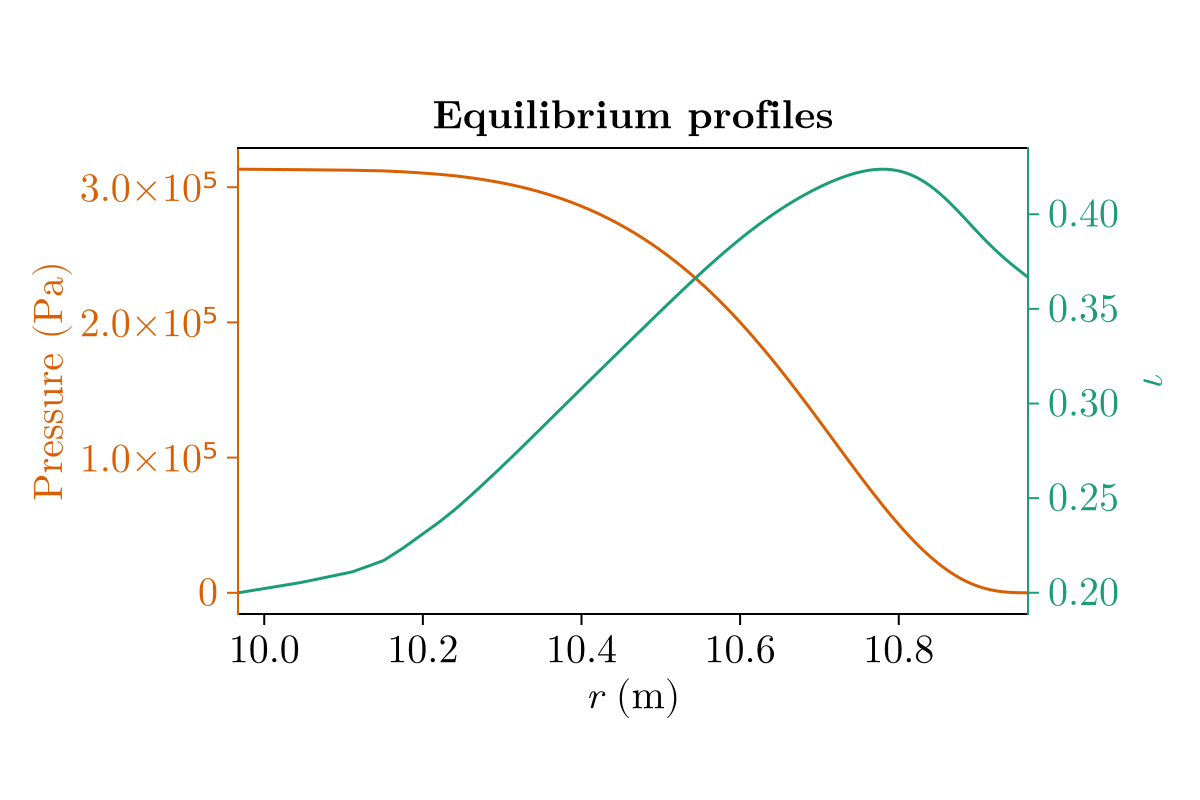
Figure 1: Pressure (left, orange) and rotational transform (right, green) profiles for the quasi-axisymmetric equilibrium under consideration.
Macroscopic stability assays (using VMEC, M3D-C1, and Mercier criterion) indicate violation of the Mercier criterion only in a narrow core region, with edge-localized ballooning instability predicted and confirmed as benign in nonlinear extended-MHD simulations—producing only a narrow magnetic island chain without global confinement degradation.
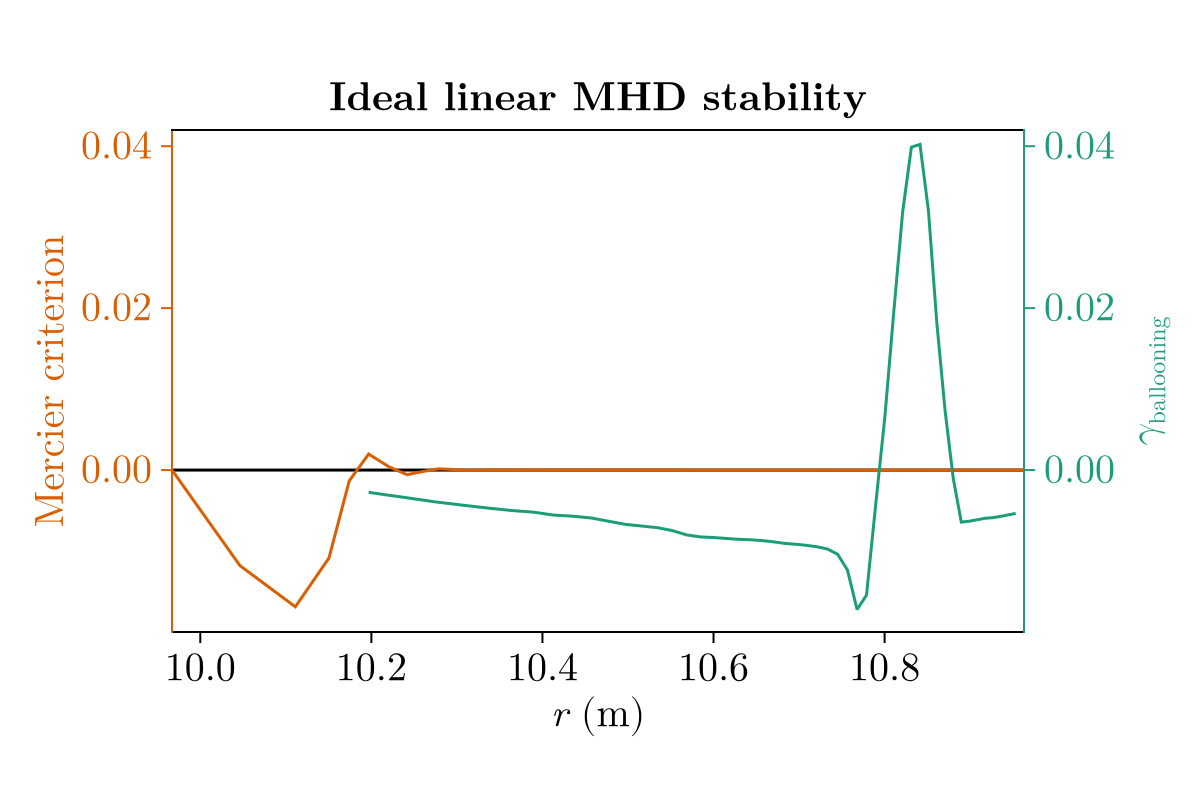
Figure 2: Mercier criterion (left) and ballooning growth rate (right) profiles showcasing overall favorable macroscopic stability aside from localized edge instability.
Micro-Instability and Nonlinear Turbulence
Linear gyrokinetic simulations (Gene code, with VMEC-derived geometry) mapped the stability boundary as a function of local plasma β using a reactor-relevant parameter regime (Te=Ti=3 keV, a/LTe=a/LTi=3, a/Ln=1). At β<0.68%, the fastest-growing modes are ITG-driven with growth rates suppressed by increasing β—consistent with axisymmetric systematics.
However, between β=0.68% and 0.85%, a pronounced transition is observed: growth rates and frequencies at low ky (ky≤1) increase sharply, with eigenmodes exhibiting even parity in A∥, characteristic of KBMs. The KBM threshold is well below the macroscopic MHD β-limit and below thresholds seen in previous quasi-axisymmetric devices (e.g., NCSX), whereas it aligns with recent W7-X findings for quasi-isodynamic geometry.
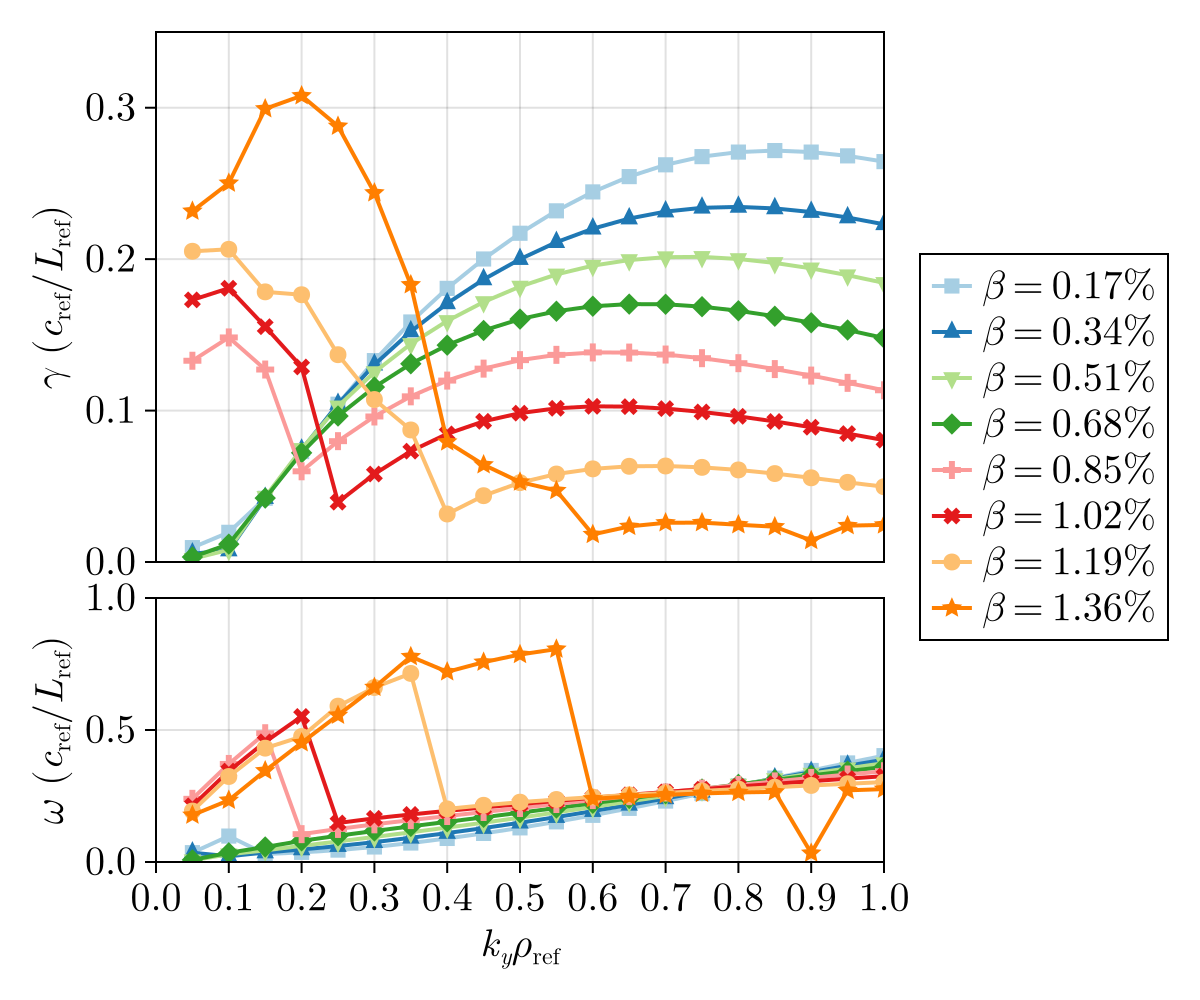
Figure 3: Most unstable linear mode growth rates and frequencies from linear Gene simulations as a function of β.
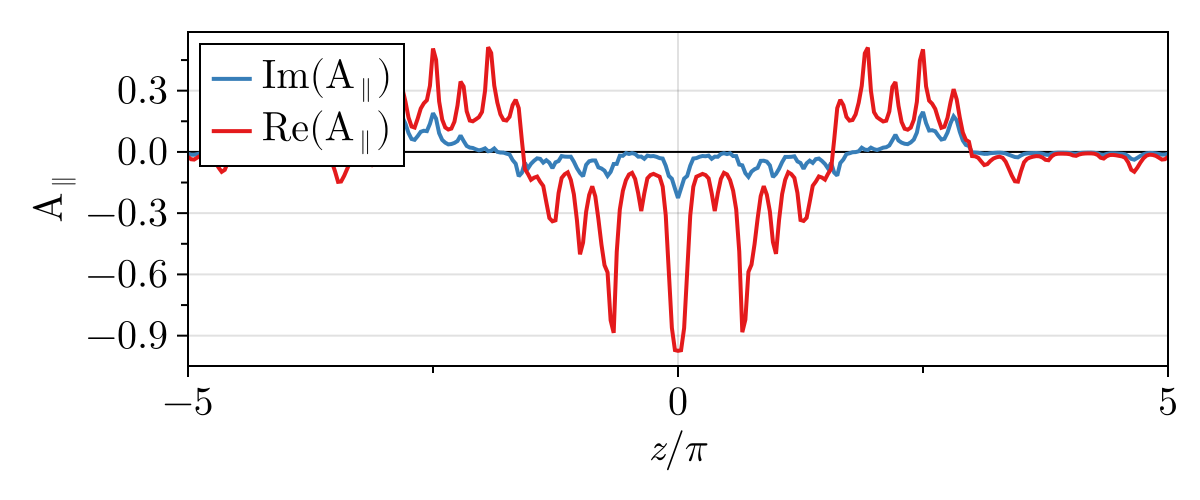
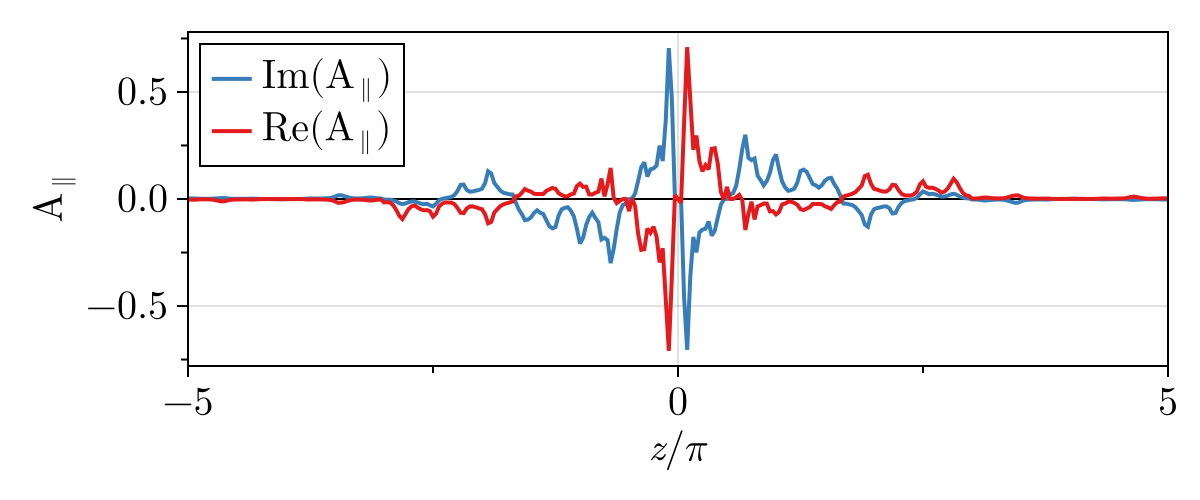
Figure 4: A∥ eigenfunctions at ky=0.05, illustrating the structural shift from ITG to KBM as β increases from 0.68% to 0.85%.
Nonlinear Transport: Emergence of Explosive Regimes
Fully nonlinear gyrokinetic simulations reveal a more restrictive constraint than the linear analysis. For β=0.68%, turbulent heat fluxes in both the electron electrostatic and electromagnetic channels exhibit explosive growth—without saturation—indicative of KBM turbulence. For β=0.51% and β=0.34%, the transport saturates, but the electromagnetic contribution is pronounced and nonlinearly driven KBM activity is detected substantially below the linear KBM threshold. These subdominant KBMs, essentially marginally stable in linear theory, are strongly excited by nonlinear coupling.
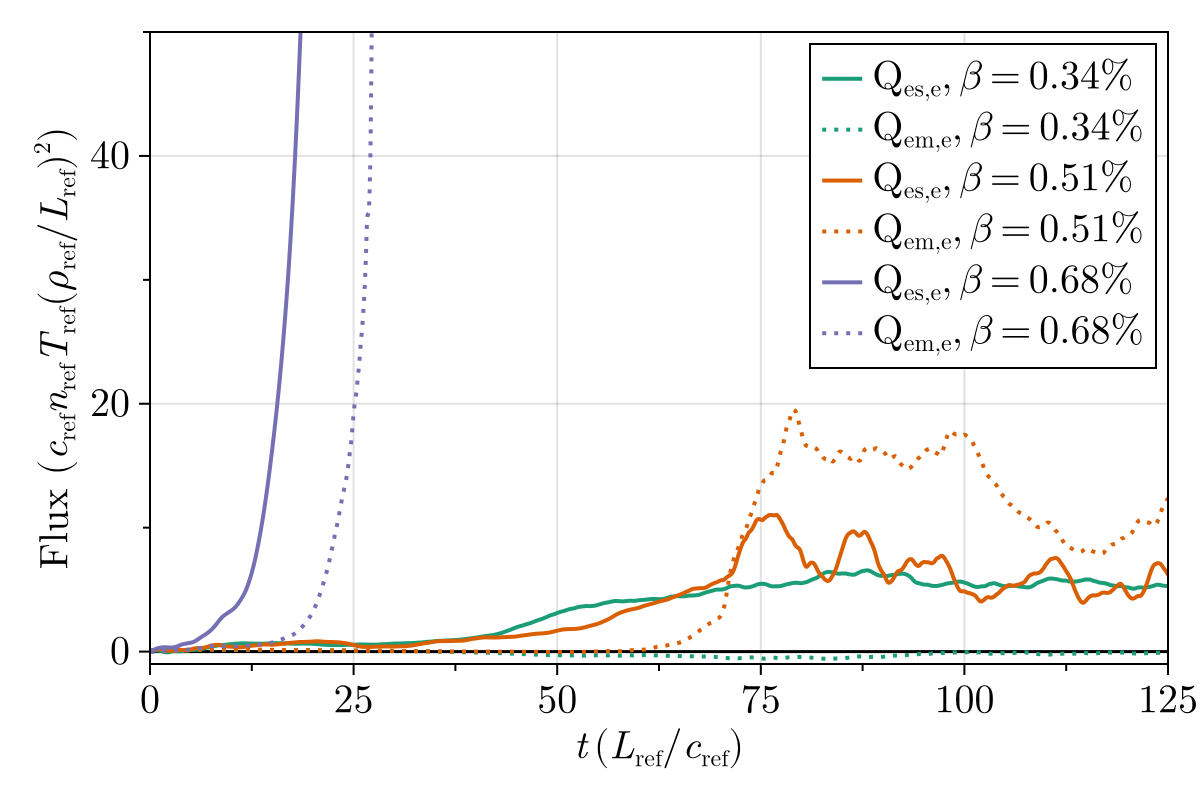
Figure 5: Electron electrostatic and electromagnetic heat fluxes as a function of time from nonlinear Gene simulations across varied β.
Spectral decomposition shows that the bulk of the heat flux is carried by the lowest ky harmonics (where linear growth rates are minimal), providing evidence for nonlinear upscatter from small to large scales—implying that linear stability alone is insufficient for device design.
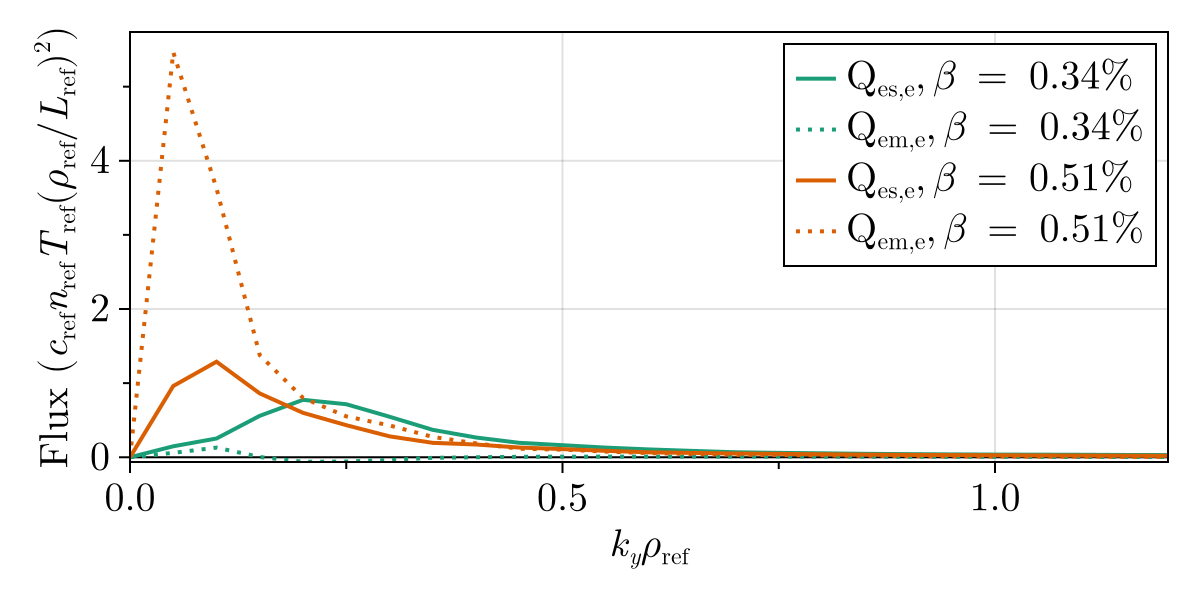
Figure 6: Heat flux decomposition by ky; the electromagnetic channel dominates at low β, with energy concentrated at subdominant, large-scale modes.
Implications for Stellarator Optimization
The results critically undermine prevailing design logic based on macroscopic MHD stability. The onset of KBM-driven electromagnetic turbulence at low β invalidates a significant operational window predicted to be robust by MHD and neoclassical optimization criteria. Furthermore, the finding that subdominant, marginally-stable modes may be nonlinearly triggered challenges conventional microturbulence assessments that treat linear thresholds as upper bounds.
These outcomes imply that:
- Microturbulence constraints, specifically associated with KBMs, must be included in reactor optimization.
- Designs based on linear MHD stability and neoclassical transport may not guarantee viability in terms of global energy confinement.
- Machine-learning or reduced-model-based turbulence surrogates must be validated for their ability to predict subdominant and nonlinearity-excited KBMs if deployed in design loops.
This compels future work to develop self-consistent multiscale modeling approaches, prioritize direct turbulence optimization (beyond even nonlinear ITG metrics), and revisit assumptions regarding the robustness of quasi-symmetric stellarator operation in high-magnetic-field, low-β regimes.
Conclusion
The study establishes that quasi-axisymmetric stellarators, even with macroscopic MHD and neoclassical constraints satisfied, may be structurally excluded from reactor-relevant operational space by the nonlinear destabilization of KBMs at surprisingly low β. The existence of subdominant, nonlinearly-excited KBMs as a potent turbulent transport driver exposes a critical limitation in current optimization frameworks. These findings set a new agenda for the inclusion of multiscale, nonlinear constraints in stellarator-based fusion reactor design and motivate further theoretical and numerical study of KBM physics in three-dimensional magnetic systems.