An asymmetric and fast Rydberg gate protocol for long range entanglement
Abstract: We analyze a new Rydberg gate design based on the original $π-2π-π$ protocol [Jaksch, et. al. Phys. Rev. Lett. {\bf 85}, 2208 (2000)] that is modified to enable high fidelity operation without requiring a strong Rydberg interaction. The gate retains the $π-2π-π$ structure with an additional detuning added to the $2π$ pulse on the target qubit. The protocol reaches within a factor of 2.39 (1.68) of the fundamental fidelity limit set by Rydberg lifetime for equal (asymmetric) Rabi frequencies on the control and target qubits. We generalize the gate protocol to arbitrary controlled phases. We design optimal target-qubit phase waveforms to generalize the gate across a range of interaction strengths and we find that, within this family of gates, the constant-phase protocol is time-optimal for a fixed laser Rabi frequency and tunable interaction strength. Robust control methods are used to design gates that are robust against variations in Rydberg Rabi frequency or interaction strength.
Paper Prompts
Sign up for free to create and run prompts on this paper using GPT-5.
Top Community Prompts
Explain it Like I'm 14
Overview
This paper is about a faster, simpler way to make two atoms “talk” to each other—so they become entangled—even when they’re not very close together. The atoms are used as tiny quantum bits (qubits), and the trick uses special “Rydberg” states (very excited states of atoms) to make a powerful logic operation called a controlled-phase gate (like a controlled-Z). The authors show how to adjust one of the laser pulses in a classic three-step sequence so the gate stays accurate even if the atoms’ interaction isn’t super strong. They also show how to fine-tune the pulse for speed and robustness.
Goals in Simple Terms
Here’s what the researchers wanted to do:
- Make a two-qubit gate that works well even when the atoms don’t strongly affect each other (so the atoms can be farther apart).
- Keep the gate fast and accurate, getting close to the best possible accuracy allowed by physics (because excited Rydberg atoms don’t live forever).
- Generalize the gate so you can set any controlled phase you want, not just a controlled-Z.
- Use clever pulse-shaping and optimization to make the gate:
- As fast as possible for different interaction strengths.
- Robust (still good) when the laser power or the atom-atom interaction isn’t perfectly known or varies a bit.
How They Did It (Explained with Everyday Ideas)
First, some simple concepts:
- Qubits: Think of each atom as a tiny switch that can be “0,” “1,” or a superposition of both.
- Rydberg state: A super excited mode of the atom; when an atom is in this state, it strongly “feels” nearby atoms.
- Blockade: If one atom is in a Rydberg state, it can prevent a neighbor from being excited because of their strong interaction—like someone hogging space so you can’t move there.
- Rabi frequency (Ω): How fast a laser can flip the atom between “ground” and “Rydberg” states—like how quickly you can press a switch.
- Detuning (Δ): Setting the laser slightly “off pitch,” not exactly on the atom’s resonant frequency, to control how the atom’s state loops around and picks up a phase without ending up in the wrong place.
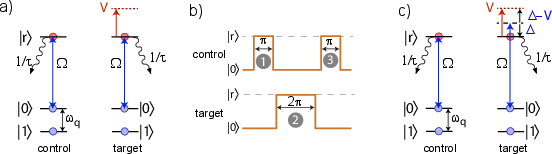
The classic three-pulse “π–2π–π” sequence:
- Pulse 1 (π): Excites the control atom (like flipping that switch once).
- Pulse 2 (2π): Drives the target atom around a full loop so it comes back to the starting state, but with a phase shift.
- Pulse 3 (π): Brings the control atom back.
What’s new here:
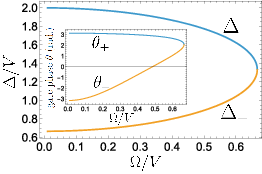
- The authors add detuning to the target’s 2π pulse. This “off pitch” nudge makes the target atom loop just right so it returns to its starting state for both cases:
- When the control atom is not excited.
- When the control atom is excited (which changes the target’s energy due to interaction V).
- By choosing Δ = V/2 and a specific pulse duration, both loops finish cleanly with no unwanted rotations. That means the only unavoidable error comes from the limited lifetime of the Rydberg state (atoms can decay while you’re doing the gate), not from imperfect blocking or rotation mistakes.
They also:
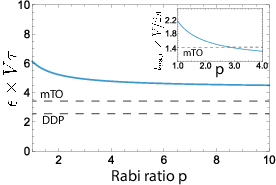
- Let the control atom be driven faster than the target (asymmetric driving). If you make the control’s laser stronger (larger Ω on control), the gate gets closer to the absolute best error limit set by physics.
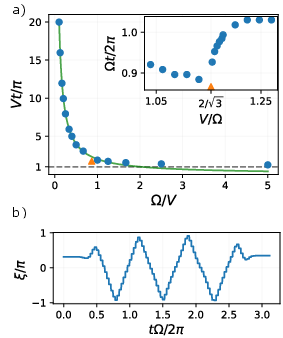
- Use an optimization method called GRAPE (Gradient Ascent Pulse Engineering) to shape the laser phase over time for:
- Shortest possible gate duration under different Ω/V ratios.
- Extra robustness against variations (like ±5%) in laser strength or interaction strength.
Main Findings and Why They Matter
- High-fidelity without strong blockade:
- The modified gate has no “rotation error” even when the interaction strength V is only comparable to the laser strength Ω.
- The remaining main error comes from Rydberg decay and scales like 1/(V × lifetime). In plain words: If your interaction is stronger and your excited state lives longer, your gate gets more accurate.
- Near the fundamental limit:
- With equal laser strengths on both atoms, the gate’s error is about 2.39 times the best possible limit set by Rydberg lifetime.
- If you drive the control atom faster than the target, you can push this down to about 1.68 times the limit. That’s very competitive with other leading gate designs.
- Works at longer distances:
- Because it doesn’t require super strong V, you can entangle atoms farther apart. That’s great for building flexible, scalable quantum computers and for error-correcting codes that connect distant qubits.
- Generalized controlled phases:
- You can tune the pulse to create any controlled phase (not just controlled-Z). This makes the gate more versatile for different quantum algorithms.
- Time-optimal design insights:
- For a fixed laser strength Ω, the simple “constant-phase” version of this gate is time-optimal when you can tune the interaction strength V. In other scenarios, the authors show how GRAPE finds waveforms that mimic “free evolution” and approach other fastest-possible limits.
- Robust pulse shapes:
- By shaping the target’s phase over time, you can make the gate robust to:
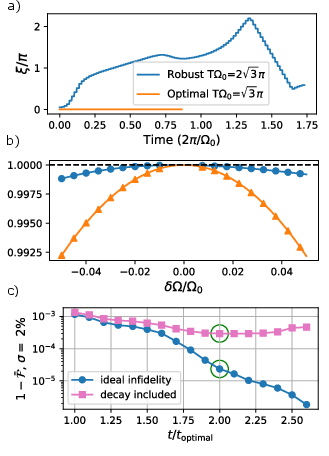
- Laser-strength errors (like ±5%), achieving about sevenfold error reduction at the extremes, with roughly double the pulse duration.
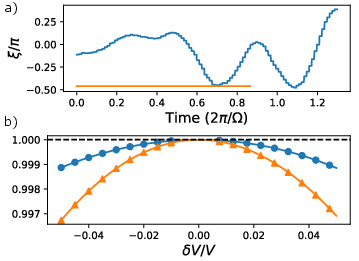
- Interaction-strength errors (like ±5%), achieving about threefold error reduction, with about 50% longer duration.
- There’s a trade-off: Robustness usually means slightly longer pulses, which increases decay-related error. The authors find sweet spots where the gain in robustness outweighs the extra decay.
- By shaping the target’s phase over time, you can make the gate robust to:
- Real-world demonstration:
- A similar asymmetric approach was performed with cesium atoms, achieving a gate fidelity of about 0.964. This suggests the method is practical with current technology.
Implications and Potential Impact
- Longer-range entanglement: This makes it easier to connect qubits that aren’t neighbors, which can simplify quantum computer layouts and help build powerful error-correcting codes that don’t require moving atoms around.
- Competitive accuracy: Being close to the fundamental limit and competitive with state-of-the-art gates means it’s a strong candidate for real devices.
- Flexibility: The gate can be tuned to different phases and made robust to common experimental imperfections. That’s useful in noisy, real-world labs.
- Practical trade-offs: Operating with weaker blockade (Ω ~ V) means sensitivity to atom spacing and potential heating if both atoms are briefly excited. Engineers have to balance these against the benefits of distance and speed.
In short, this work presents a clever tweak to a classic three-pulse Rydberg gate that keeps things accurate without demanding ultra-strong interactions. It opens up faster, longer-range, and more flexible quantum gates, and shows how to optimize and harden them against real-world imperfections—moving us closer to practical, scalable quantum computers.
Knowledge Gaps
Knowledge gaps, limitations, and open questions
Below is a single list highlighting what remains missing, uncertain, or unexplored in the paper, framed concretely for future investigation:
- Quantify leakage to neighboring Rydberg levels and intermediate states for the proposed detuned target pulse (especially with large detunings and asymmetric Rabi rates), using full multilevel atom models for specific species and excitation schemes.
- Provide a detailed sensitivity analysis (derivatives and tolerances) of gate fidelity to miscalibration in V, Ω, Δ, pulse duration, and phase errors, including closed-loop calibration protocols to maintain θ and dynamical phases across large arrays.
- Establish the parameter domain and feasibility constraints for the generalized detuning solutions Δ± with integer Bloch-sphere loop counts (n₀, n_V), including conditions for real solutions, hardware limits on detuning magnitude and slew rate, and error/fidelity trade-offs versus the Δ=V/2 analytic case.
- Analyze the impact of finite-qubit splitting (ω_q) and off-resonant coupling of |1⟩ to Rydberg states under detuned pulses, including differential AC Stark shifts and possible Autler–Townes effects, for typical two-photon excitation geometries.
- Incorporate spontaneous emission and dephasing from the intermediate state in two-photon excitation (and Doppler effects for non-copropagating beams) into fidelity and optimization, and quantify resultant shifts in the time-optimal and robust waveforms.
- Quantify double-excitation (|rr⟩) probabilities for both analytic and robust pulses, and compute motional heating and force-induced errors for realistic trap frequencies, temperatures, and separations; provide design constraints that balance recoil, heating, and blockade errors.
- Validate the claim that the constant-phase protocol is time-optimal within the considered gate family with a formal proof and clear definition of the admissible control set (e.g., phase-only versus phase+amplitude modulation, bounded detuning), and assess whether amplitude shaping or overlapping pulses can reduce error below 1.68×ε_DDP.
- Evaluate the practical limits on the control–target Rabi asymmetry p (Ω_c/Ω), including laser power, available transition strengths, unwanted coupling to other Rydberg states at large Ω_c, addressing cross-talk in arrays, and realistic upper bounds on p for different atomic species.
- Extend GRAPE optimizations to include Rydberg decay and technical noise (intensity/frequency/phase noise with realistic spectra) directly in the cost function, and determine whether the “ignoring decay” assumption shifts optimal waveforms or durations under practical conditions.
- Develop robust-control waveforms that are simultaneously resilient to combined variations in Ω and V, as well as to Doppler shifts, intermediate-state detuning drift, and laser phase noise, and quantify the trade-off between robustness gains and increased decay/error due to longer gate times.
- Provide hardware-level requirements (AWG bandwidth, phase/detuning update rate, AOM/EOM response, laser linewidth and noise spectra) to realize the proposed phase-modulated detuning waveforms, including the robust protocols with |Δ| up to ~2–3×Ω.
- Characterize the gate’s susceptibility to interaction-sign variations (Δ and V of opposite sign, near Förster resonances) and analyze how negative or tunable interactions affect return conditions and achievable θ, including the role of DC-field tuning.
- Explore scalability to large arrays: quantify spectator-atom cross-talk during detuned target pulses, unwanted interactions with non-participating Rydberg excitations, and scheduling constraints to avoid interaction collisions in parallel operations.
- Assess spatial inhomogeneity across arrays (intensity gradients, beam pointing, atom-to-atom V dispersion from spacing variations) and provide array-level calibration/compensation strategies for maintaining uniform θ and CZ fidelity.
- Detail how single-qubit Z-phase corrections are calibrated and stabilized (φ₀, φ₁ on control/target), including drift tracking and overhead; quantify the added error/time, especially in parallelized circuits.
- Compare the proposed protocol to alternative families (e.g., interaction gates, adiabatic dressing, smoothly apodized time-optimal gates) under identical hardware constraints (bounded Ω, detuning range, laser noise), to isolate intrinsic versus implementation-driven advantages.
- Investigate whether more general control (joint amplitude+phase shaping or two-color control) can close the gap to the DDP bound (2.57/(Vτ)) beyond the reported 1.68×ε_DDP limit, and determine theoretical lower bounds under realistic constraints.
- Provide species- and principal-quantum-number–dependent optimization (Rb, Cs, Sr, Yb), including blackbody-limited lifetimes at different temperatures (300 K vs. cryogenic), off-resonant level structure constraints, and optimum n for long-range operation.
- Model and experimentally validate gate robustness for realistic spacing noise (e.g., 50 nm at 6 μm → ~5% V variation) and atomic temperatures, including active stabilization or feedback to maintain interaction strength in long circuits.
- Quantify the effect of robust pulses on total integrated Rydberg population and the net error budget (decay, leakage, heating), and determine the optimal robustness level (e.g., 2×t_opt versus 1.5×t_opt) as Ω/Γ varies.
- Address implementation overhead and performance in error-correcting codes (LDPC with non-local checks): required gate parallelism, acceptable CZ error and duration at code thresholds, routing/scheduling without atom motion, and the net benefit versus strong-blockade protocols.
- Provide reproducibility details for GRAPE (cost functions, constraints, initial seeds, convergence behavior, tolerance targets) and release code/data to enable independent verification of the reported time-optimal and robust waveforms.
- Analyze the experimentally reported Cs implementation (fidelity ≈0.964) with an explicit error budget linked to the proposed protocol (laser noise, motional dephasing, amplitude/phase drift, detuning calibration), and identify the dominant technical limitations to reaching the predicted ε/ε_DDP ratios.
Practical Applications
Below is an overview of practical applications that follow from the paper’s asymmetric and fast Rydberg gate protocol, its generalization to arbitrary controlled phases, time-optimality analysis, and robust-control waveforms. Items are grouped by immediacy and annotated with sectors, concrete tools/workflows, and key dependencies that affect feasibility.
Immediate Applications
These applications can be deployed now in neutral-atom research labs and commercial quantum devices with today’s tooling.
- Deploy asymmetric CZ as a native two-qubit gate in neutral-atom platforms — sectors: hardware, cloud QC, academia
- What: Replace or complement symmetric/time-optimal CZ with the detuned-target π–2π–π protocol that achieves high fidelity in the partial blockade regime (Ω ~ V) and approaches the lifetime limit within 1.68–2.39×.
- Tools/products/workflows: Gateware updates to include a “CZ_asym” primitive; calibration routines to set Δ ≈ V/2 and Rabi-rate ratio p = Ωc/Ω; qubit-phase correction sequences; characterization reporting ε/(Vτ) vs ε/εDDP.
- Assumptions/dependencies: Accurate, stable estimation of V and τ; phase- and amplitude-stable laser/AWG control to realize constant-phase or phase-modulated target pulses; manageable coupling to nearby Rydberg levels at higher Ωc; ability to apply single-qubit Z corrections.
- Increase atom spacing to reduce crosstalk while maintaining high-fidelity entanglement — sectors: hardware design, manufacturing
- What: Exploit high-fidelity gating at moderate V to operate at larger inter-atomic separations (weaker blockade), easing optical access and reducing cross-excitation and addressing errors.
- Tools/products/workflows: Array-layout design kits targeting larger pitches; trap design and beam-shaping with lower NA; calibration of Ω/V as spacing varies.
- Assumptions/dependencies: Maintain Ω comparable to reduced V (∝ r−α, α∈{3,6}); control of double-excitation-induced forces and associated heating; sufficient trap frequencies to mitigate motional error.
- Native controlled-phase (Cθ) synthesis for algorithm compilers — sectors: software, applications (QAOA/VQE), education
- What: Use the analytic mapping Ω = V·sqrt[(π/θ)2 − 1/4], t = 2θ/V to generate native controlled phases, reducing single-qubit overhead and circuit depth in phase-heavy algorithms.
- Tools/products/workflows: Transpiler passes that target diag[1,1,1,e{iθ}] directly; parameterized gate libraries with θ→{Ω,Δ,t} conversion; calibration of θ–Ω–Δ curves.
- Assumptions/dependencies: Precise control of Δ and Ω; robust Z-phase compensation; verified phase linearity across θ range.
- Robust-control waveform libraries to suppress Ω and V variations — sectors: control software, hardware
- What: Adopt GRAPE-derived target-phase modulations that flatten fidelity vs ±5% variations in Rabi rate or interaction strength, reducing spatial inhomogeneity and slow drift sensitivity.
- Tools/products/workflows: A library of robust waveforms; auto-tuner that selects robust vs analytic pulse given measured noise; integration with hardware that supports fast phase/detuning updates (AOM/EOM, AWG).
- Assumptions/dependencies: Longer pulses increase decay error; hardware must support instantaneous detunings up to ~2–3×Ω; knowledge (or online estimation) of noise statistics to set robustness targets.
- Performance reporting aligned to lifetime-bound metrics — sectors: industry standards, academia
- What: Benchmark and publish ε/εDDP (and ε·V·τ) so devices can be compared against fundamental limits independent of geometry or species.
- Tools/products/workflows: Standardized measurement protocols to extract τ and V; reporting dashboards on cloud QPUs.
- Assumptions/dependencies: Reliable metrology for τ (temperature-dependent) and V (distance-dependent, state-dependent).
- Hardware cost and reliability improvements via relaxed optics — sectors: hardware supply chain
- What: Operate with looser focusing and lower power densities on the target while boosting control Rabi rate (p>1), easing optical complexity and thermal load.
- Tools/products/workflows: Re-optimized optical train; laser allocation favoring control beams; thermal stability protocols.
- Assumptions/dependencies: Sufficient power available to raise Ωc without driving unwanted transitions; stable detuning control.
- Curriculum and training in partial-blockade and robust control — sectors: education, workforce development
- What: Incorporate the analytic protocol and GRAPE robust designs into lab courses/simulations to teach trade-offs among speed, robustness, and lifetime limits.
- Tools/products/workflows: Open-source notebooks and simulators modeling Δ=V/2 operation, arbitrary-phase gates, and robustness to Ω/V noise.
- Assumptions/dependencies: Access to simulator toolchains; course hardware optional.
- Cloud exposure of “long-range” two-qubit connectivity — sectors: cloud QC, applications
- What: Offer logical connectivity maps with larger physical spacing and still-low error, giving users lower crosstalk and more flexible embedding for graph-based problems.
- Tools/products/workflows: Device connectivity metadata; transpiler routing that prefers long-range edges where beneficial.
- Assumptions/dependencies: Device calibration must track spatially varying V; scheduling must avoid heating via double excitation.
Long-Term Applications
These benefit from further research, scaling, tighter controls, and/or improved hardware (e.g., longer τ, better lasers, cryo operation).
- Fault-tolerant neutral-atom systems with non-local LDPC codes without atom motion — sectors: quantum computing (FTQC), software
- What: Use high-fidelity gates at moderate V to realize non-local stabilizer checks and sparse long-range parity constraints suited to modern LDPC codes.
- Tools/products/workflows: Compiler/runtime support for non-local checks; syndrome extraction circuits using Cθ primitives; automated layout co-design for array spacing vs error rates.
- Assumptions/dependencies: Gate fidelities >0.995–0.999 with low drifts; suppression of force-induced motional error; scalable calibration across thousands of qubits.
- Modular architectures with sparse long-range links across zones — sectors: hardware architecture
- What: Combine partial-blockade gates for intra-zone long-range operations with photonic or shuttling links inter-zone, simplifying zone design and wiring.
- Tools/products/workflows: Zone-aware compilers; co-optimized spacing and beam delivery; error budgeting across link types.
- Assumptions/dependencies: Stable Ω/V across larger separations (tens of μm); integrated photonic interfaces; robust-control pulse libraries tuned per zone.
- Digital-analog quantum simulation with tunable controlled-phase gates — sectors: materials/chemistry R&D, academia
- What: Implement effective Hamiltonians via programmable Cθ gates and limited analog evolutions, optimizing depth vs error in many-body simulations.
- Tools/products/workflows: Pulse-synthesis toolchains that map target couplings to {θ,Δ,t}; verification via randomized compiling and shadow estimation.
- Assumptions/dependencies: Accurate θ calibration in large systems; crosstalk management; scalability of robust pulses.
- Depth and performance gains in variational algorithms (QAOA, VQE) — sectors: finance, logistics, energy, pharma
- What: Native Cθ gates reduce single-qubit overhead and transpilation penalties, potentially enabling deeper or wider circuits within the same error budget.
- Tools/products/workflows: Problem-specific ansätze using direct phase parameters; parameter-shift rules for θ; error-aware optimizers exploiting native primitives.
- Assumptions/dependencies: End-to-end performance depends on realistic device noise and compilation; algorithmic advantage contingent on problem structure.
- Standardization and certification around lifetime-limited operation — sectors: policy, procurement, standards bodies
- What: Establish performance tiers and certification that normalize device scores to εDDP, incentivizing improvements that approach fundamental limits.
- Tools/products/workflows: Reference protocols for τ and V extraction; inter-lab round-robins; buyer guides specifying ε/εDDP thresholds.
- Assumptions/dependencies: Community consensus on metrics and procedures; independent test facilities.
- Cost and density scaling from relaxed blockade constraints — sectors: manufacturing, supply chain
- What: Larger pitches and lower NA optics can simplify packaging, lower costs, and improve thermal stability as qubit counts scale.
- Tools/products/workflows: DFM (design-for-manufacturability) kits for arrays; scalable calibration automation over inhomogeneous Ω/V distributions using robust pulses.
- Assumptions/dependencies: Maintain target fidelity at reduced V; robust control must offset increased inhomogeneity without excessive decay.
- Entanglement-enhanced sensing with spaced arrays — sectors: sensing/metrology
- What: Generate multi-atom entangled states (e.g., GHZ, graph states) across wider separations to probe fields or gradients over larger baselines.
- Tools/products/workflows: Protocols using Cθ to build metrologically useful states; spatially resolved readout and error mitigation.
- Assumptions/dependencies: Long coherence relative to gate time; control of motional heating and spatially varying V.
- Gateware SDKs with auto-robustness and self-calibration — sectors: software tooling
- What: Commercialize waveform compilers that auto-select analytic vs robust profiles based on live noise inference, optimizing duration vs decay trade-offs.
- Tools/products/workflows: Online Bayesian estimators for Ω/V drifts; reinforcement learning or model-based controllers to update pulses.
- Assumptions/dependencies: Sufficient telemetry, actuator bandwidth, and model fidelity; safe update mechanisms on production QPUs.
- Cryogenic or engineered-lifetime operation to approach DDP bounds — sectors: hardware R&D
- What: Increase τ (e.g., cryo, blackbody suppression) to push total error closer to the Doultsinos–Wesenberg limit with the asymmetric protocol’s favorable scaling.
- Tools/products/workflows: Thermal engineering for Rydberg systems; species/state selection; integrated vacuum/cryogenic packaging.
- Assumptions/dependencies: System complexity and cost; compatibility with optics and trap technology.
- Cross-platform control insights — sectors: trapped ions, superconducting qubits
- What: Port the robust phase-modulation/control-design methodology to other platforms where partial blockade analogs or cross-resonance-like dynamics benefit from detuning-phase co-design.
- Tools/products/workflows: GRAPE/GOAT/CRAB waveform toolchains; robustness criteria libraries; cross-platform benchmarking.
- Assumptions/dependencies: Platform-specific Hamiltonians and constraints; hardware support for rapid phase/detuning control.
Notes on feasibility-critical assumptions common across items:
- Accurate, stable knowledge or online estimation of V (distance-, state-, and geometry-dependent) and τ (temperature- and state-dependent).
- Hardware support for fast, precise phase/detuning modulation with sufficient bandwidth and range (|Δ|max ≈ 2–3 Ω in robust designs).
- Management of double-excitation population and force-induced heating, especially outside the strong-blockade limit.
- Avoiding leakage to nearby Rydberg levels at high Ωc and ensuring low laser phase/amplitude noise.
- Trade-offs between robustness (longer pulses) and decay error must be optimized per device (Ω/Γ, temperature, species).
Glossary
- Adiabatic Rydberg dressing gate: A two-qubit gate that uses adiabatic dressing of Rydberg states to induce interactions while minimizing excitation. "the adiabatic Rydberg dressing gate \cite{Mitra2023} achieves "
- Apodizing: Smoothly tapering a waveform to reduce abrupt changes and spectral leakage. "modifying the time-optimal profile by smoothly apodizing the sinusoidal phase variation could reach an error as low as "
- Bloch sphere: A geometric representation of a two-level quantum state as a point on a sphere. "the state of the target qubit traverses loops on the Bloch sphere."
- CZ gate: The controlled-Z two-qubit gate that flips the phase of the |11⟩ state. "we obtain the canonical gate:"
- DDP bound: A theoretical lower bound on gate error scaling with interaction strength and lifetime. "The dashed line labeled DDP shows the bound of "
- Detuning: The offset between the laser frequency and the atomic transition frequency. "detuning the pulse on the target atom by an amount "
- Dipole-dipole interaction: Interaction between atomic dipoles that typically scales as r⁻³. "as with (dipole-dipole interaction) or (van der Waals interaction)"
- Double-excitation: Simultaneous excitation of both atoms to Rydberg states, which can cause forces and heating. "susceptible to force-induced heating due to double-excitation to ."
- Dynamical phases: Phases accumulated due to energy shifts during evolution. "Here are dynamical phases from differential Stark shifts..."
- Geometrical phases: Phases arising from cyclic evolution paths in parameter space. "the minus signs on the first three states are geometrical phases from the trajectory with area in the Hilbert space."
- GRAPE (Gradient Ascent for Pulse Engineering): An optimal control algorithm for designing pulse sequences to achieve target unitary operations. "We explore gates in this family using Gradient Ascent for Pulse Engineering (GRAPE)~\cite{Khaneja_Glaser_2005_GRAPE} to optimize a piecewise-constant Rydberg laser phase"
- Hamiltonian parameter: A variable entering the system’s energy operator that influences dynamics. "Robustness against variation of a noisy Hamiltonian parameter with nominal value is obtained by optimizing the phase-modulation vector "
- Interaction gate: A gate realized by allowing states to freely evolve under interaction to accumulate a controlled phase. "the interaction gate \cite{Jaksch2000} in the limit of rapid excitation of both atoms to the Rydberg state achieves "
- Interaction strength: The magnitude of coupling between two atoms, often denoted V. "where is the two-atom interaction strength"
- Optical tweezers: Focused laser traps used to hold and position neutral atoms. "as may arise from finite temperatures in optical tweezers"
- Partial blockade limit: A regime where interaction V is comparable to excitation rate Ω, so blockade is incomplete. "even in the partial blockade limit of interaction strength comparable to Rydberg excitation rate "
- Phase gate: A gate that applies a controlled phase to a particular computational basis state. "The asymmetric protocol may also be used to implement a general phase gate with the mapping "
- Photon recoil: Momentum kick to an atom due to emission or absorption of a photon, leading to heating or decoherence. "increases the errors due to photon recoil."
- Principal quantum number: An integer labeling the energy level of an electron in an atom. "for Rydberg principal quantum number in Cs at K"
- Rabi frequency: The rate of coherent oscillation between two quantum states under a resonant drive. " is the ground-Rydberg Rabi frequency"
- Robust control: Control design techniques that maintain high fidelity under parameter variations. "Robust control methods are used to design gates that are robust against variations in Rydberg Rabi frequency or interaction strength."
- Rydberg atoms: Atoms excited to high principal quantum numbers exhibiting strong long-range interactions. "The strong interaction of Rydberg atoms provides a mechanism for entangling neutral atom qubits"
- Rydberg lifetime: The average time a Rydberg state persists before decaying. "the fundamental fidelity limit set by Rydberg lifetime"
- Rydberg scattering: Error mechanism from spontaneous emission or scattering events from Rydberg states. "To leading order the error is only due to Rydberg scattering."
- Stark shifts: Energy level shifts due to electric fields or light-induced AC Stark effect. "dynamical phases from differential Stark shifts on the qubit states due to the Rydberg pulses"
- Time-optimal gate: A gate protocol designed to minimize duration for given constraints and resources. "The time-optimal gate reaches for the parameters analyzed in Ref. \cite{Jandura2022}."
- Trap vibrational frequency: The oscillation frequency of atoms in a trapping potential, affecting motional sensitivity and heating. "Here is the atomic temperature, is the atomic separation, is the integrated population, and is the trap vibrational frequency along the interatomic coordinate."
- Two-photon approach: An excitation scheme using two photons to reach a higher-lying state such as a Rydberg level. "The level was excited using a two-photon approach with atoms spaced by "
- van der Waals interaction: A long-range interaction between neutral atoms scaling approximately as r⁻⁶. "as with (dipole-dipole interaction) or (van der Waals interaction)"
Collections
Sign up for free to add this paper to one or more collections.