- The paper demonstrates that smeared phase-space functionals can fail to certify nonclassicality, especially for weakly nonclassical states.
- It introduces a two-parameter generalization that quantifies sensitivity thresholds, with numerical evidence showing failure near w₁ ≈ 0.0122.
- The results imply that current operational phase-space methods must evolve or combine with alternative strategies for faithful quantumness certification.
Faithful Quantumness Certification in One-Dimensional Continuous-Variable Systems
Introduction
Quantitative discrimination between quantum and classical states in continuous-variable (CV) systems remains an unresolved foundational problem in quantum information science. The canonical criterion—negativity of the Sudarshan-Glauber P distribution—offers a theoretically rigorous discrimination, but its highly singular nature renders practical application infeasible for most states of physical interest. Recent approaches introduce operationally accessible phase-space functionals (notably, ξP) designed to serve as quantumness witnesses, revealing nonclassical features even in the presence of experimental noise. However, the essential requirement of faithful discrimination—where all and only quantum states are correctly identified—continues to elude researchers.
Smeared Phase-Space Distributions and Certification Functionals
The paper constructs a rigorous hierarchy of phase-space distributions, P(x,p;S), by parametrizing Gaussian convolutions of the P distribution using a smearing parameter S. This framework generalizes and interpolates between P (S=1), the Wigner function W (S=0), and Husimi's Q function (S=−1). As S decreases, the resulting distributions become smoother but increasingly lose the ability to resolve nonclassical features, such as negative regions in phase space.
The ξ(x,p) functional of Bohmann and Agudelo (\cite{Bohmann_PRL20})—previously the most sensitive operational certification tool—detects nonclassicality with the following sufficiency rule: ξ(x,p)<0 at some point in phase space implies nonclassicality. However, this property is not necessary; certain nonclassical states yield positive values everywhere in ξ(x,p). The paper generalizes ξ through a two-parameter family, S(x,p;T,ΔT), designed to compensate for normalization and peak broadening after smearing, thereby enhancing the sensitivity of the discrimination protocol.
Analytical Properties and Certification Strength
For canonical examples—such as coherent-Fock state superpositions and displaced Fock mixtures—the functional ξ(T) provides faithful discrimination; i.e., it unequivocally detects nonclassical contributions, even in the vanishing w→0 limit. The formalism is particularly robust for squeezed vacuum and squeezed thermal states, where it detects subvacuum quadrature fluctuations not discerned by standard methods.
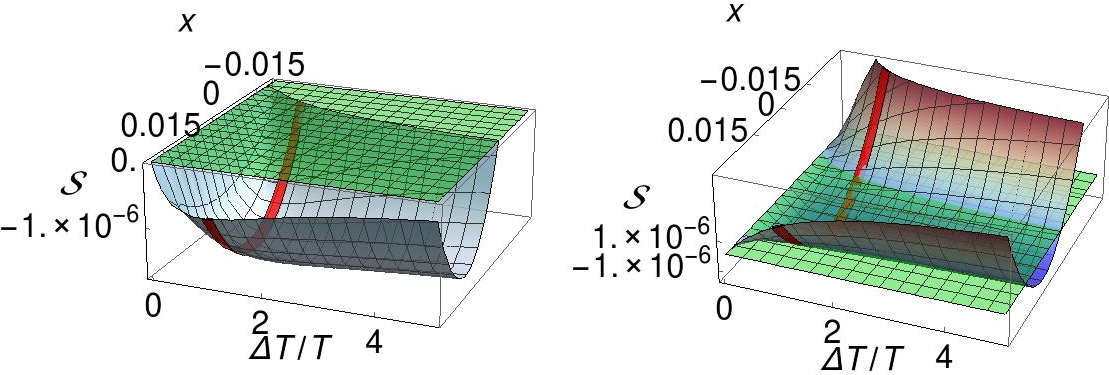
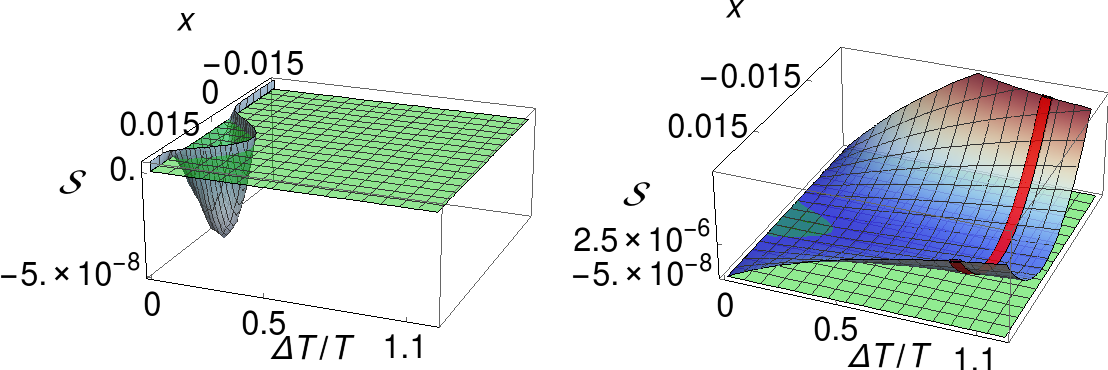
Figure 1: Behavior of ξ(T=1) and S(T=1,ΔT) for Wigner's distribution in a weakly nonclassical state; both fail to detect nonclassicality below a threshold w1.
Explicit Counterexamples and Faithfulness Limits
Crucially, the analysis provides explicit constructions where both ξ and its generalization S fail. Consider a state ρ=w1W1+(1−w1)(W0cos2s+W0′sin2s): for sufficiently small w1, neither ξ nor S assumes negative values, even though the state is provably nonclassical by construction. Numerical evidence locates the fail point for S (more sensitive than ξ) at w1≈0.0122. Below this threshold, nonclassicality cannot be certified by either method utilizing experimentally accessible (i.e., smeared) phase-space distributions.
Figure 1: Visualization of the quantitative threshold below which both ξ and S functionals fail, depicting Wigner and further smeared distributions for different w1.
Theoretical and Practical Implications
This result invalidates the conjecture that either ξ or its generalization can serve as a universally faithful quantumness certification functional for CV systems. The inability to detect weak nonclassicality in highly mixed or carefully balanced quantum-classical mixtures—especially under constraints of experimental (homodyne) tomography—shows that all operational phase-space based approaches to date suffer from lack of true faithfulness.
From a practical standpoint, this work sets a sensitivity bound for current and future quantum state certification protocols in quantum optics and CV quantum processing. It signals that the search for universally valid, operational quantumness indicators must look beyond phase-space negativities and their functionals, or accept context-dependent, hybridized strategies possibly entailing explicit use of higher-order correlations or non-Gaussian witness observables.
Conclusion
The paper establishes the limitations of phase-space-based quantumness certification in one-dimensional CV systems. Despite presenting the most sensitive family of operational functionals, none satisfy the faithfulness criterion: there exist weakly nonclassical states undetectable by any smeared (experimentally reconstructible) functional of the P distribution. Advancement in faithful certification either requires fundamentally new approaches or a breakthrough in reconstructing singular quasiprobability distributions for realistic quantum states.