OpenPBR: Novel Features and Implementation Details
Abstract: OpenPBR is a physically based, standardized uber-shader developed for interoperable material authoring and rendering across VFX, animation, and design visualization workflows. This document serves as a companion to the official specification, offering deeper insight into the model's development and more detailed implementation guidance, including code examples and mathematical derivations. We begin with a description of the model's formal structure and theoretical foundations - covering slab-based layering, statistical mixing, and microfacet theory - before turning to its physical components. These include metallic, dielectric, subsurface, and glossy-diffuse base substrates, followed by thin-film iridescence, coat, and fuzz layers. A special-case mode for rendering thin-walled objects is also described. Additional sections explore technical topics in greater depth, such as the decoupling of specular reflectivity from transmission, the choice of parameterization for subsurface scattering, and the detailed physics of coat darkening and thin-film interference. We also discuss planned extensions, including hazy specular reflection and retroreflection.











Paper Prompts
Sign up for free to create and run prompts on this paper using GPT-5.
Top Community Prompts
Explain it Like I'm 14
Overview
This paper introduces OpenPBR, a shared “material” system used by computer graphics tools to make surfaces (like metal, plastic, skin, glass, wood) look realistic and consistent across different apps. Think of it as a standard recipe for how light should behave when it hits different kinds of surfaces, so artists can create materials once and reuse them anywhere without surprises.
OpenPBR is designed for movies, animation, visual effects, and design, and is fast enough to be useful in real-time graphics too. The paper explains the ideas behind the model, how it’s built, and how to implement it correctly.
Objectives
The paper has three main goals explained in simple terms:
- Build a single, open standard for realistic materials (an “uber‑shader”) that multiple companies and tools can agree on.
- Describe the physics behind how light interacts with layered materials (like a varnish on wood, or a soap-film on metal) in a way that’s clear, predictable, and artist‑friendly.
- Share practical guidance—math, examples, and code—so different renderers can implement OpenPBR and achieve the same look.
Methods and Approach
To make the system clear and consistent, the authors define a simple, physics‑based way to think about materials:
The “layer sandwich” idea (slabs)
Imagine a material as a layered sandwich:
- Each layer (called a “slab”) has a surface on top and a substance inside.
- Light can reflect off the surface or enter the layer, bounce around inside, and come out tinted or blurred.
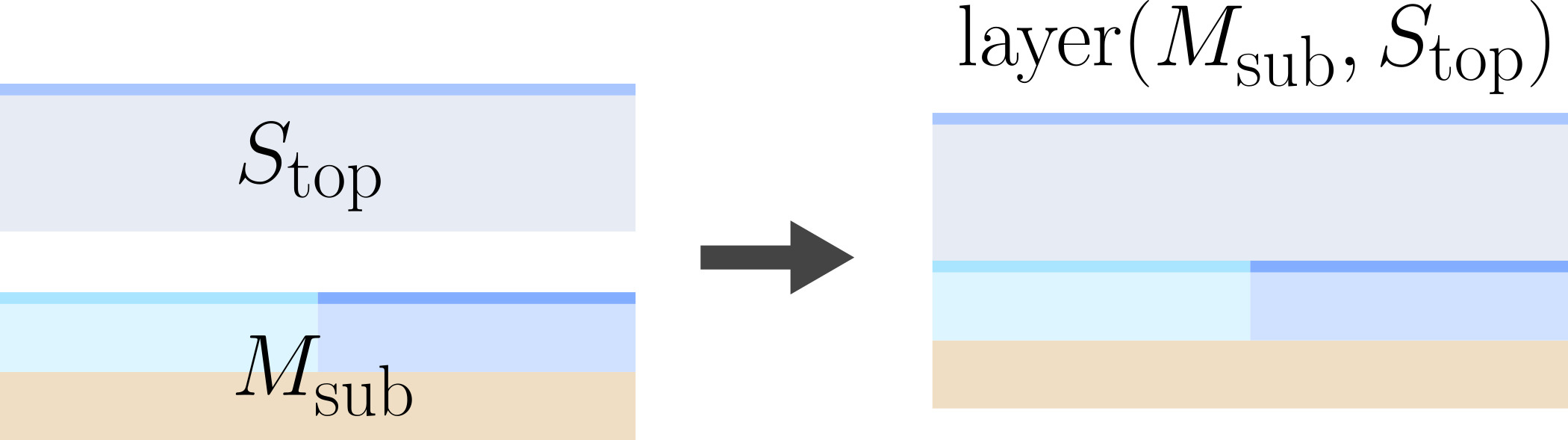
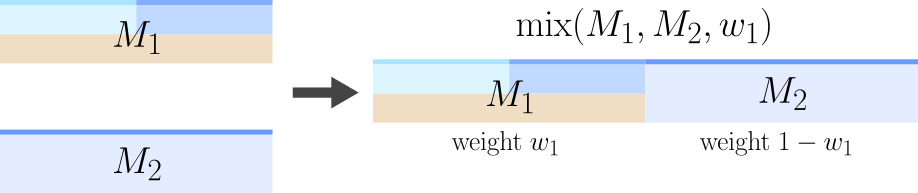
- Layers can be stacked (vertical layering) or mixed side‑by‑side (horizontal mixing), like patches of paint.
OpenPBR uses this to build materials from well-defined parts:
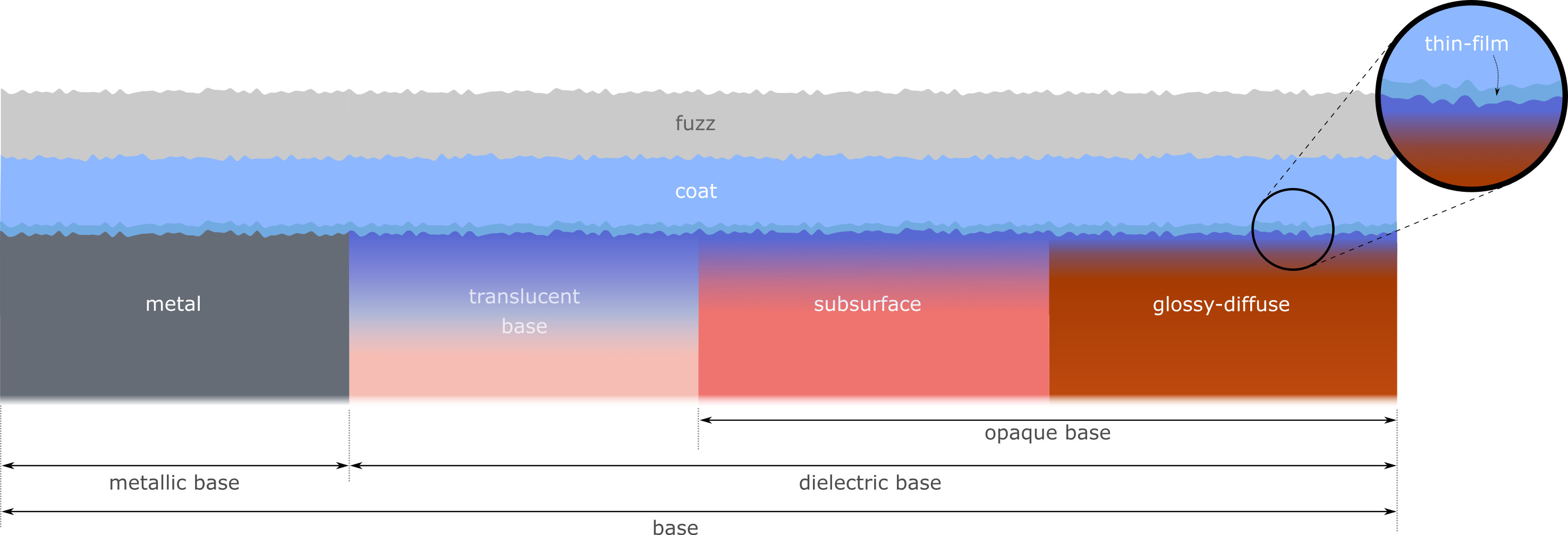
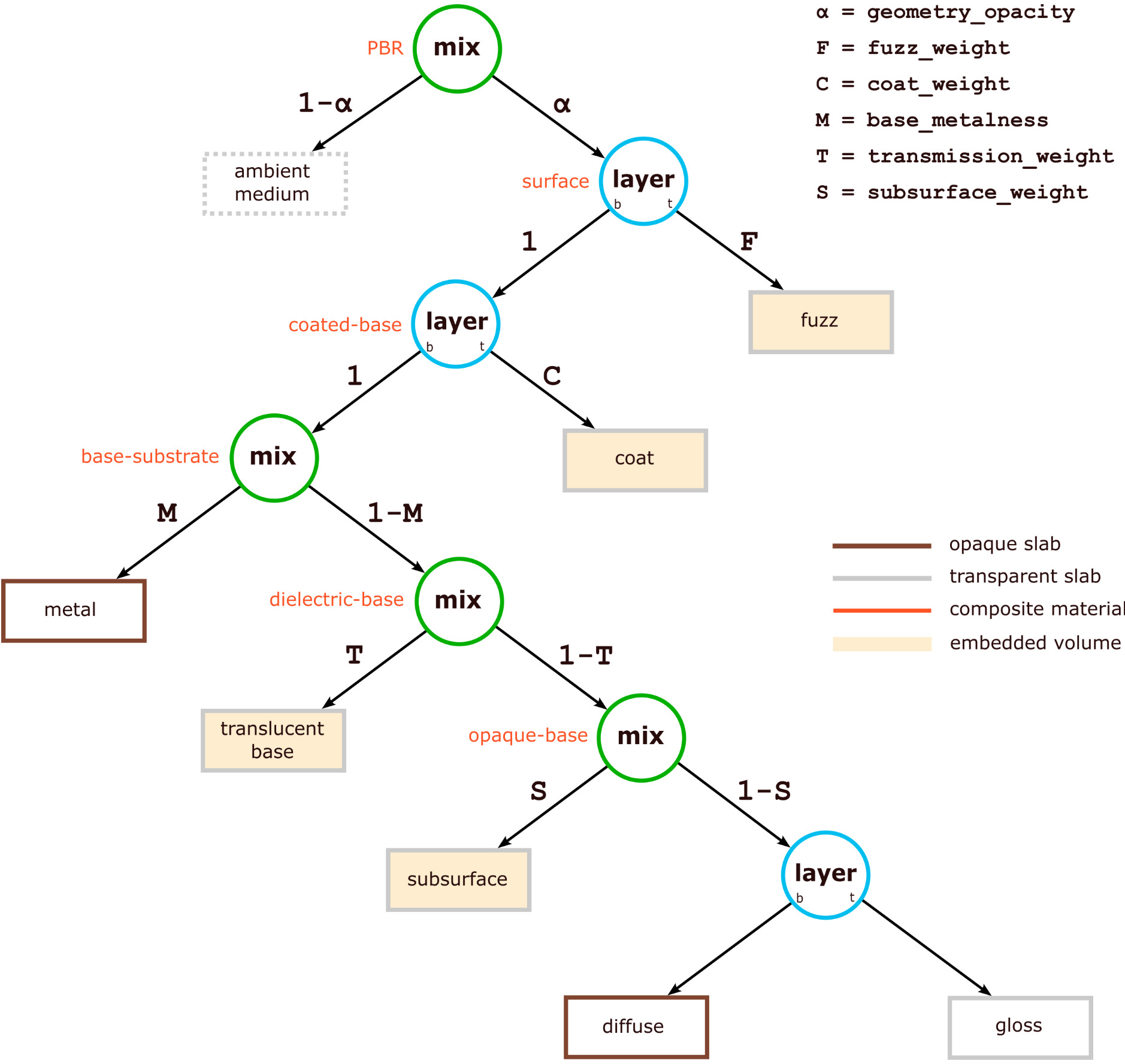
- Base substrate: metal or non‑metal (dielectric). Non‑metals can be:
- Glossy diffuse (opaque stuff like wood or concrete)
- Subsurface (light goes in and diffuses, like skin or marble)
- Translucent (see-through materials like glass or liquids)
- Thin-film (optional): a very thin layer that causes colorful iridescence (like soap bubbles or oil).
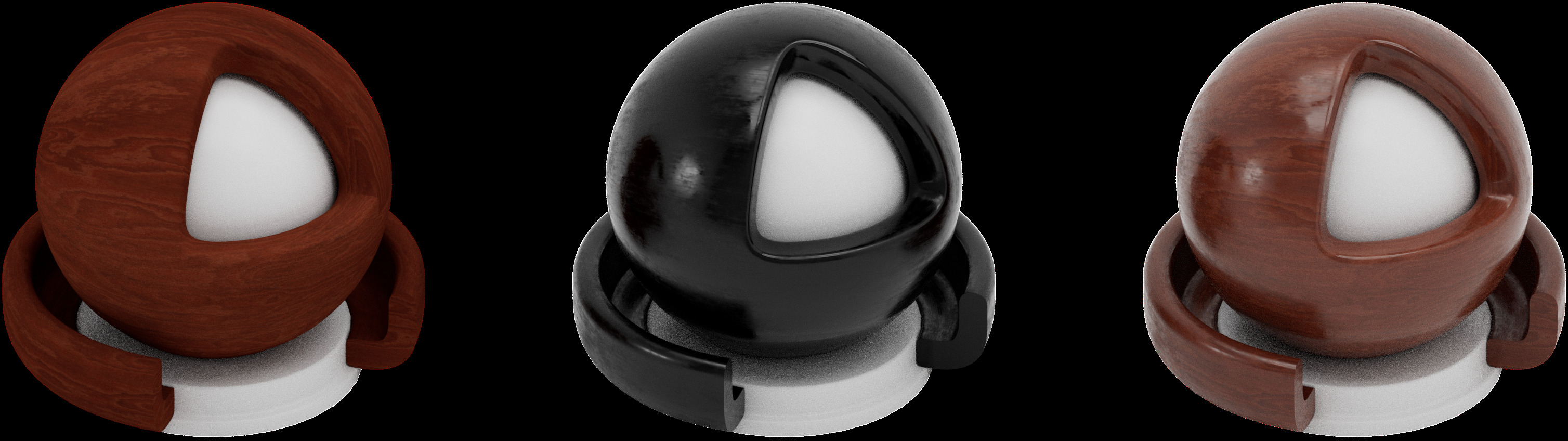
- Coat (optional): a clear or tinted protective layer (like varnish or clear coat on cars).
- Fuzz (optional): tiny fibers on the surface (peach fuzz, dust, fabric hairs).
How light bounces: BSDFs and microfacets
- A BSDF is just a rulebook for how light interacts with a surface—how much is reflected or transmitted and in which directions.
- Microfacet model: imagine the surface made of many tiny mirror-like tiles (microfacets) with slightly different tilts. The shape of the highlight depends on how these tiles are tilted and how rough the surface is.
- Roughness: controls how sharp or blurry highlights are. Low roughness = sharp shiny highlight; high roughness = broad, soft highlight.
- Anisotropy: roughness can stretch in one direction (like brushed metal). OpenPBR provides simple controls to set direction and amount so it looks intuitive.
- Fresnel: a physics rule that says surfaces reflect more at glancing angles (like looking along the surface).
- Energy conservation: the math is set up so the surface doesn’t magically create or destroy light—important for realistic rendering.
Layering approximation (fast and practical)
Accurate simulation of light bouncing between layers is complex and slow. The paper recommends a practical shortcut:
- Combine the layer lobes (their BSDFs) using smart weights. One common method is “albedo scaling,” which blends the coat and the base in a way that keeps the total energy correct.
- Absorption in the coat (tinting/darkening) and roughening effects are included with simple, efficient approximations.
Entering vs. exiting light
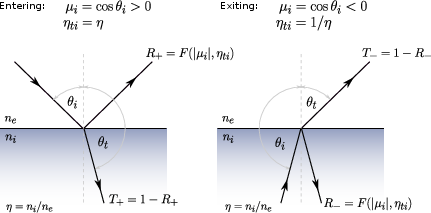
Light coming from outside (air into the surface) behaves differently than light coming from inside (light traveling within a transparent object). The paper explains how the coat and fuzz should affect light in both cases, so glass with fuzz or coatings still looks right from any angle.
Mixing materials
To make transitions smooth (like a partially coated surface), OpenPBR uses “mixing”:
- Think of tiny patches of each material statistically mixed, controlled by a weight slider (0% to 100%).
- This helps avoid harsh edges and aliasing in textures.
Main Findings and Why They Matter
- A clear, physical structure for materials: describing surfaces as layered slabs makes the target look unambiguous, so different tools can match results closely.
- Practical, fast approximations: the recommended blending formulas yield realistic behavior without needing slow, complex simulations.
- Intuitive controls for artists: roughness and anisotropy are parameterized to feel natural (e.g., turning anisotropy off still looks close to the original).
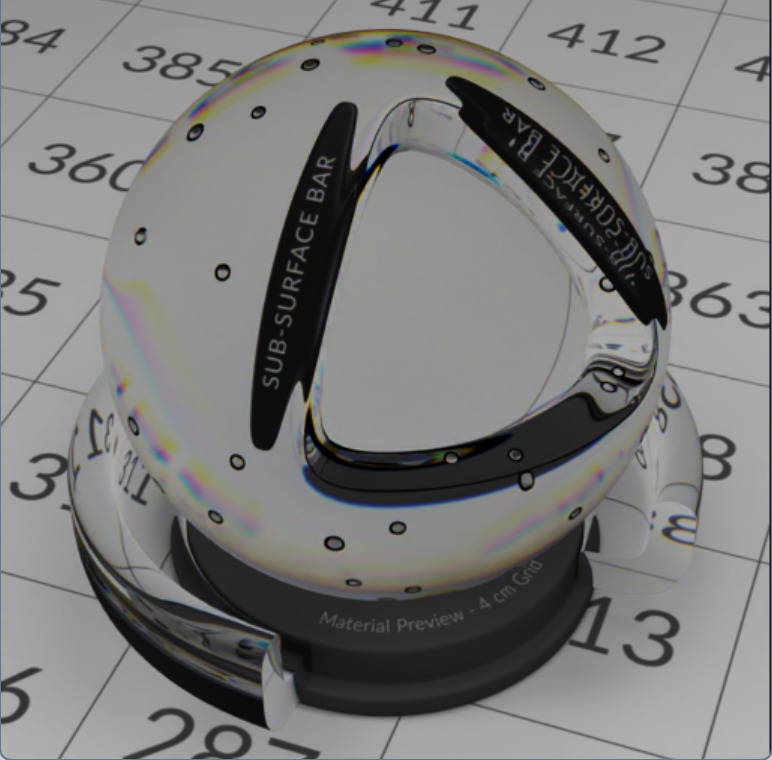
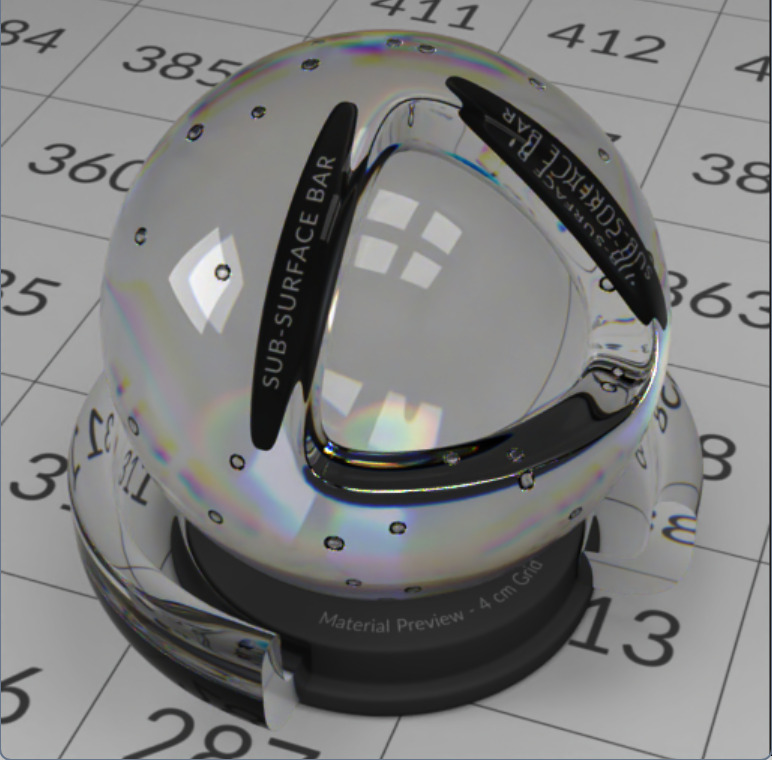
- Consistency across renderers: the same OpenPBR material looks the same in different systems (the paper shows matching renders from Autodesk Arnold and Adobe’s renderer).
- Energy‑correct shading: reflections don’t lose the “right amount” of brightness and color, especially for rough metals and dielectrics, which keeps materials looking physically plausible.
- Extensible design: the model includes advanced effects (thin‑film iridescence, coat darkening, fuzz) and plans future features (like hazy specular and retroreflection).
These results help artists trust that their materials will behave and look right, no matter where they are used.
Implications and Impact
- Easier sharing of assets: studios and apps can exchange materials without time‑consuming fixes.
- Faster workflows: artists use familiar sliders instead of rebuilding complex networks for common materials.
- Better education: a standard, predictable model reduces confusion for new users.
- Broad adoption: because OpenPBR is open and built to fit existing frameworks (like MaterialX), it can become a common language for materials in VFX, animation, and design.
- Ongoing improvements: the project is active (current version 1.1 as of August 2025), with community contributions on GitHub, so the standard can evolve as needs grow.
In short, OpenPBR turns complex material physics into a practical, shared toolkit—making realistic rendering more consistent, predictable, and accessible for artists and developers.
Knowledge Gaps
Below is a concise list of the paper’s unresolved knowledge gaps, limitations, and open questions that future work could address:
- Develop a reciprocal, energy-preserving layering BSDF that goes beyond the non-reciprocal albedo-scaling approximation and accounts for multiple interface bounces plus volumetric absorption/scattering in coats.
- Establish error bounds and validity domains for the albedo-scaling approximation by benchmarking against ground-truth RTE solutions across ranges of roughness, IOR contrasts, coat thickness, anisotropy, and absorption.
- Specify efficient methods to compute directional albedo E_coat(ω) for anisotropic GGX (including tabulation strategies, resolution, interpolation, and runtime vs precomputation trade-offs).
- Replace the
T_coat^2normal-incidence assumption with a path-length-aware transmittance model that handles oblique incidence, microfacet paths, finite coat thickness, and absorption/scattering. - Provide a physically grounded treatment for substrate-lobe roughening by a rough coat (e.g., NDF convolution, analytic approximations, and practical sampling strategies).
- Fully define how rays exiting an interior dielectric should behave when the local surface is opaque (e.g., metal over glass labels), including internal Fresnel handling, energy accounting, and consistent reflection/transmission rules.
- Clarify physically plausible semantics for horizontal mixing of incompatible bulks (metal vs dielectric vs subsurface), e.g., via flake models, stratified masks, or probabilistic morphology rather than a simple BSDF lerp.
- Offer guidance for ambient medium IOR tracking and nested dielectrics in mixed-material scenes: how
n_ambientis determined, propagated, and how the model degrades when medium tracking is absent. - Standardize the microfacet multiple-scattering compensation (Heitz 2016 vs Kulla 2017 vs Turquin 2019), documenting reciprocity/energy implications, recommended defaults, and cross-renderer conformance tests.
- Detail sampling/evaluation of anisotropic GGX BTDF for dielectrics (half-vector definition, Jacobian, normalization) to ensure energy conservation and consistent implementation.
- Validate the proposed mapping from
(roughness r, anisotropy a)to(α_t, α_b)perceptually (user studies, comparison to measured BRDFs) and quantify its behavior at extreme anisotropy. - Define rules for combining normal maps with anisotropy flow maps: constructing a consistent shading frame when normals are perturbed, and ensuring anisotropy axes rotate appropriately with the normal.
- Clarify artist-facing controls for anisotropy orientation (including rotation and handling of “negative” anisotropy) and sourcing of tangents when reliable per-vertex tangents are unavailable.
- Provide the fuzz layer’s physics and parameterization (microflake phase function, sampling scheme, energy conservation), including its masking/roughening interactions with the coat and base layers.
- Supply a concrete thin-film iridescence model (wave-optics formulation, dispersion, thickness parameterization, coupling with microfacet roughness) and practical sampling/evaluation guidance.
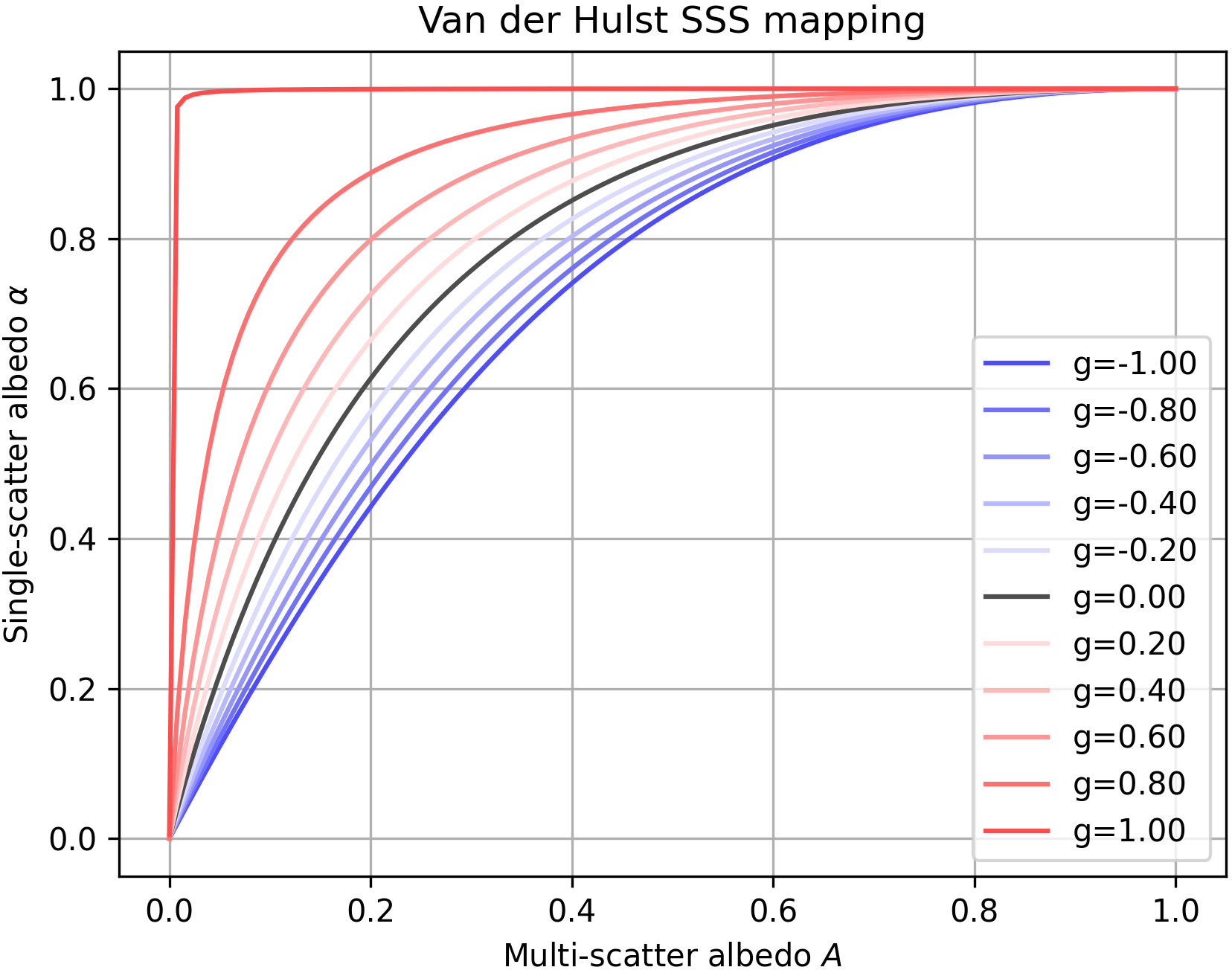
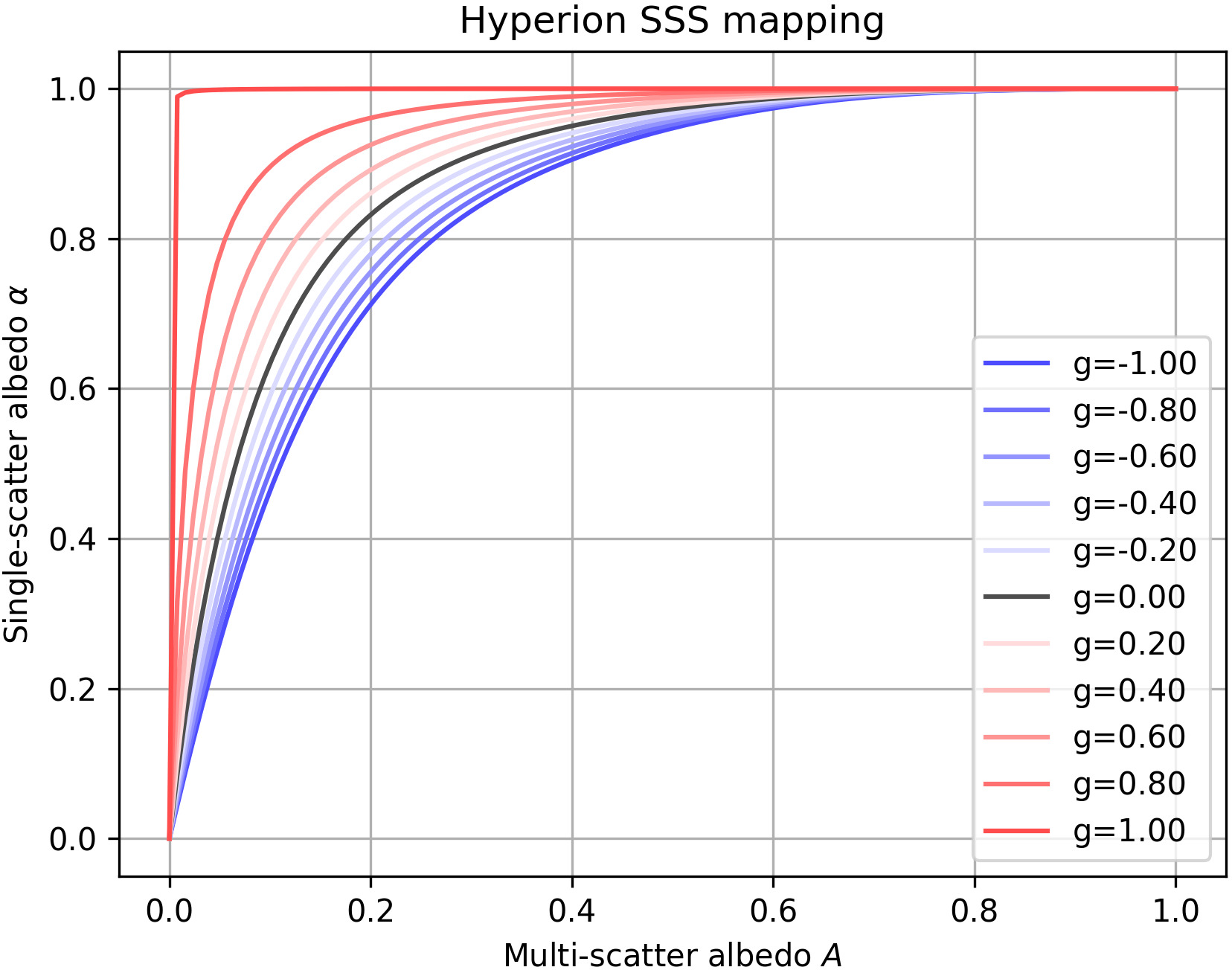
- Elaborate subsurface component parameterization (mapping artist sliders to bulk coefficients, phase functions) and the transport coupling to interfaces and other layers; define boundary conditions and mixing with glossy-diffuse.
- Specify thin-walled mode behavior with layers (coat, fuzz, thin-film) and nested dielectrics: refraction/reflection rules, thickness-based absorption, and double-sided shading edge cases.
- Address spectral treatment (wavelength-dependent IOR, thin-film interference, dispersion) in RGB vs spectral renderers, including parameterization and RGB-to-spectral conversions to avoid hue biases.
- Define “white furnace” energy-preservation criteria for the complete layered/mixed material (not only single lobes), with proofs or standardized test procedures and pass/fail thresholds.
- Identify GPU-friendly approximations and LUTs for real-time (E_coat, multi-scattering compensation, anisotropic sampling), documenting numerical stability and error budgets.
- Provide guidelines for parameter interactions and edge cases (e.g., high metalness with high transmission) to prevent physically impossible states; propose clamping or mutually exclusive regimes.
- Enumerate “break physics” modes explicitly (what is allowed, expected artifacts, and how non-physical switches are isolated from physically-based computation paths).
- Recommend cross-renderer interoperability assets: canonical scenes, unit tests, and reference images to validate consistent looks given identical parameters and approximations.
- Specify criteria for when mesoscopic slab assumptions fail (visible layer edges, chips, disbonding) and guidance for transitioning to explicit geometric modeling of layers.
- Describe data structures/APIs for carrying volumetric fields (VDFs) from surface parameters into space (filling strategy, tiling/instancing, consistency across renderers).
- Provide derivations and parameter mappings for coat darkening and roughening physics (mentioned in abstract) to enable reproducible implementation and artist control.
Practical Applications
Immediate Applications
The paper standardizes a physically based, layered uber-shader (OpenPBR 1.1) with explicit slab-based layering, statistical mixing, and microfacet parameterization, alongside practical approximations (e.g., albedo-scaling for layering), energy-preserving guidance, and implementation-ready parameter maps. The following applications can be deployed now.
- Interoperable material exchange and look-matching across DCCs and renderers
- Sectors: media & entertainment (VFX/animation), design visualization, games
- Tools/workflows: USD + MaterialX graphs using OpenPBR nodes; Arnold, Adobe proprietary renderers; Substance 3D, Maya/3ds Max/Houdini lookdev; studio asset libraries
- Assumptions/dependencies: Engines adopt OpenPBR 1.1 graph and parameters; consistent GGX + Smith + multi-scatter implementation; adherence to energy conservation and white-furnace QA; consistent IOR handling and ambient medium
- Standardized, reusable material libraries and marketplaces
- Sectors: software, ecommerce/retail visualization, automotive/industrial design
- Tools/workflows: Library SKUs authored in OpenPBR (metal, subsurface, translucent, glossy-diffuse; coat/fuzz/thin-film variants); marketplace previews rendered consistently across engines
- Assumptions/dependencies: Robust conversion from Autodesk Standard Surface and Adobe Standard Material to OpenPBR; MaterialX metadata and versioning; color management (ACES/OCIO) alignment
- Production-ready layered effects (coat darkening, thin-film iridescence, fuzz)
- Sectors: VFX/animation, advertising/product viz, automotive paints/cosmetics
- Tools/workflows: Layer presence maps (weighted layer operator), coat absorption and roughness, thin-film on base microfacets, fuzz microflake reflection for fibers/dust; shot-level control rigs
- Assumptions/dependencies: Use of recommended albedo-scaling approximation with directional albedo E_coat (precompute or MC estimate); volumetric tint via T_coat application; performance budgets for added lobes
- Real-time previs and interactive review with plausible layering approximations
- Sectors: games, virtual production, design viz
- Tools/workflows: Implement Equation (1)–(coat layering with albedo scaling and transmittance) in HLSL/GLSL/Metal; precomputed LUTs for directional reflectance; toggleable anisotropy and multi-scatter for LOD
- Assumptions/dependencies: GPU-friendly BSDF sampling; approximate reciprocity trade-offs accepted; material feature flags/LODs; platform color pipeline consistency
- Cross-team lookdev handoff and asset validation (QA)
- Sectors: M&E pipelines, software vendors
- Tools/workflows: White-furnace tests; unit tests for energy conservation; conformance scenes (anisotropy grids, coat presence wedges, thin-walled glass)
- Assumptions/dependencies: Shared reference scenes and expected metrics; MaterialX reference implementation; CI integration for renderer plugins
- Training and education in physically based shading
- Sectors: academia, studio training programs, online courses
- Tools/workflows: Curriculum modules on slab layering, microfacet GGX with anisotropy, multi-scatter compensation; parameterization pitfalls (e.g., roughness mapping, subsurface choices)
- Assumptions/dependencies: Access to OpenPBR reference graphs and sample assets; aligned terminology with MaterialX/ASWF docs
- Procedural and scanned material authoring with consistent parameter targets
- Sectors: software tools, digitization services, ecommerce
- Tools/workflows: Fit measured BRDF/BSDF to OpenPBR parameters (metalness, specular roughness/anisotropy, subsurface, thin-film); Substance Designer procedural outputs mapped to OpenPBR slots
- Assumptions/dependencies: Fitting heuristics for multi-scatter microfacet models; reliable tangent/bitangent frames for anisotropy “flow maps”
- Digital product configurators and web/AR viewers with realistic effects
- Sectors: retail/ecommerce, automotive, consumer electronics
- Tools/workflows: USD/MaterialX -> platform viewers with OpenPBR subset; thin-film for interference finishes, coat for clearcoats, fuzz for fabrics
- Assumptions/dependencies: Platform support (or translation) for OpenPBR nodes; performance-oriented LUTs; HDR lighting/environment standards on devices
- Visual continuity in virtual production (on-set + final render)
- Sectors: virtual production, broadcast
- Tools/workflows: On-set real-time engines use the same OpenPBR parameters as offline final renders; single source of truth material graphs
- Assumptions/dependencies: Engine parity for anisotropic GGX, coat/fuzz; agreed approximations for thin-walled and nested dielectric contexts
- Robotics and vision simulation domain randomization (visual-only)
- Sectors: robotics, autonomous systems (simulation), computer vision
- Tools/workflows: Generate appearance-diverse domains by varying OpenPBR parameters (roughness, anisotropy, coat presence, fuzz) for robustness testing
- Assumptions/dependencies: Visual realism focus (RGB); not a sensor-physics replacement for NIR/LiDAR; randomization bounds curated to remain physically plausible
- Pipeline simplification via unified parameter naming and behavior
- Sectors: software development, studio pipeline engineering
- Tools/workflows: One set of authoring UIs and textures (e.g., specular_roughness, specular_roughness_anisotropy) across DCCs/renderers; reduced lookdev rework
- Assumptions/dependencies: Team adoption and deprecation of legacy shader stacks; texture map conventions and packing agreements
- Sustainability and cost benefits through reduced re-render iterations
- Sectors: studio operations, cloud rendering
- Tools/workflows: Fewer look-matching passes across tools; standardized defaults minimize “fighting the shader”
- Assumptions/dependencies: Organization-wide adoption; metrics to track iteration reductions; unchanged creative requirements
Long-Term Applications
Several extensions and research directions outlined in the paper (or adjacent literature it cites) point to applications that need further R&D, scaling, or ecosystem alignment.
- Physically exact layered light transport in production (beyond albedo scaling)
- Sectors: high-end VFX, academic rendering research
- Tools/products: Monte Carlo layer solvers with multiple inter-reflections and volumetric coupling; efficient bidirectional/path-space sampling kernels for layered slabs
- Assumptions/dependencies: New sampling strategies; cache/LUT schemes; acceptable render time budgets; robust nested dielectric tracking in complex scenes
- Wave-optics-consistent microstructure and thin-film modeling
- Sectors: VFX, automotive coatings R&D, materials research
- Tools/products: Hybrid microfacet–wave models; spectral rendering with dispersion and interference beyond thin-film heuristic; measured data pipelines
- Assumptions/dependencies: Spectral pipelines; performance trade-offs; availability of measurement data; standard parameter bridges to OpenPBR
- Retroreflection and hazy-specular extensions (noted future features)
- Sectors: transportation safety, apparel/footwear, outdoor products
- Tools/products: New BSDF lobes in OpenPBR; UI parameters and sampling support; measured BRDF fitting for retroreflective textiles and hazed optics
- Assumptions/dependencies: Finalized OpenPBR spec updates; reference implementations; conformance tests and datasets
- Robust thin-walled semantics across engines and USD/MaterialX standards
- Sectors: VFX/games/design viz, web/AR platforms
- Tools/products: Standardized two-sided/transmission behaviors; consistent “entering vs exiting” logic for layered stacks; USD schema best practices
- Assumptions/dependencies: Multi-vendor consensus; edge-case definitions (mixed metal/dielectric regions); renderer conformance kits
- Automated inverse rendering to OpenPBR parameters (from photos/scans)
- Sectors: ecommerce, digital twins, cultural heritage
- Tools/products: ML + physics-based solvers targeting OpenPBR param vector; “good priors” for multi-scatter GGX, coat darkening, fuzz; uncertainty reporting
- Assumptions/dependencies: Training datasets with ground truth; standardized illumination protocols; domain gaps across capture rigs
- Generative AI material models standardized on OpenPBR
- Sectors: software tools, creative industries
- Tools/products: Text-to-material models that emit OpenPBR-compatible graphs; rating and safety filters grounded in physical plausibility
- Assumptions/dependencies: High-quality paired text–material datasets; consistent parameter semantics across vendors; IP/licensing for library augmentation
- Hardware acceleration for layered BSDFs
- Sectors: GPU/SoC vendors, real-time engines
- Tools/products: API extensions (Vulkan/DX) and SPIR-V/HLSL intrinsics for multi-scatter GGX, anisotropic sampling, coat E(ω) approximations; on-GPU LUT compression
- Assumptions/dependencies: Vendor alignment; reference kernels; performance/quality trade-off guidelines
- Cross-standard bridges (glTF, USDZ, JT/CAD) adopting OpenPBR semantics
- Sectors: manufacturing, AEC, web3D
- Tools/products: glTF/Metalness-Roughness extensions or MaterialX embedding; CAD renderers mapping to OpenPBR layering
- Assumptions/dependencies: Khronos and CAD vendor engagement; minimal viable subset definitions; material conversion reliability
- Certification and conformance programs via ASWF
- Sectors: software vendors, studios, education
- Tools/products: Open test scenes/LUTs; pass/fail thresholds for energy conservation, reciprocity tolerances, anisotropy behavior; “OpenPBR Compatible” badges
- Assumptions/dependencies: Governance and maintenance resources; community-agreed metrics; automated submission pipelines
- Provenance and authenticity of materials (C2PA-linked OpenPBR graphs)
- Sectors: ecommerce, brand compliance, archives
- Tools/products: Payloads embedding OpenPBR graphs with provenance; audit trails for material edits across pipeline
- Assumptions/dependencies: Standard metadata schemas; viewer support; privacy/IP considerations
- Multispectral and sensor-accurate extensions for simulation
- Sectors: robotics, autonomous driving, remote sensing
- Tools/products: OpenPBR-inspired spectral parameters spanning VIS–NIR/SWIR; microstructure models aligned with sensor responses
- Assumptions/dependencies: Data/model availability; departure from RGB pipelines; interoperability with physics-based simulators
- Perceptual calibration of roughness/anisotropy controls
- Sectors: UX for creative tools, education
- Tools/products: User studies yielding perceptually uniform control spaces; remapping tools that preserve OpenPBR energy behavior
- Assumptions/dependencies: Psychophysical studies; adoption by DCC vendors; backward compatibility strategies
Notes on cross-cutting dependencies and assumptions
- Standards and ecosystem: Strong ties to MaterialX and USD are assumed; renderer-specific approximations should remain energy-conserving and pass white-furnace tests.
- Performance and quality: Many real-time applications rely on non-reciprocal but energy-conserving approximations (e.g., albedo scaling); acceptance of these trade-offs is implicit.
- Data and measurement: Advanced features (retroreflection, wave-optics) depend on high-quality measured BSDF/BTDF datasets and spectral pipelines.
- Artist ergonomics: The parameter mappings (e.g., α = r²; anisotropy mapping preserving average roughness) presuppose UIs and training aligned with the paper’s guidance.
- Scene IOR and nesting: Correct results for transmissive/thin-walled cases depend on consistent ambient IOR and, ideally, nested dielectrics support in the renderer.
Glossary
- albedo-scaling approximation: A heuristic for layering that combines BSDF lobes while scaling the substrate by one minus the coat’s directional reflectance to maintain energy conservation. "A common approach is the so-called albedo-scaling approximation \cite{Smythe2016}, where the total BSDF of this layered configuration is given by summing and , with the substrate lobe weighted by a factor depending on the directional reflectance of the coat, which is designed to ensure that the resulting BSDF is energy conserving"
- anisotropy: Directional dependence of surface roughness that elongates specular highlights along a preferred direction. "The roughness goes from 0 on the left to 1 on the right, and the anisotropy goes from 0 at the top, to 1 at the bottom."
- basic radiance: The quantity used in transport to account for refractive index scaling and preserve energy across interfaces. "the so-called
basic radiance, where is the local index of refraction" - BRDF: Bidirectional Reflectance Distribution Function; the reflective portion of a BSDF describing how light is reflected. "Energy conservation of a BRDF amounts to the requirement that the directional reflectance (or directional albedo) "
- BSDF: Bidirectional Scattering Distribution Function; general function describing reflection and transmission at a surface. "Each slab has a top interface whose BSDF is a function of input and output directions ."
- BTDF: Bidirectional Transmittance Distribution Function; the transmissive portion of a BSDF for directions across hemispheres. "For dielectrics there is also a BTDF, i.e., the portion of the BSDF where the input and output directions lie in opposite rather than the same hemispheres"
- directional albedo: The integral of a BRDF over a hemisphere for a fixed outgoing direction (also called directional reflectance). "directional reflectance (or directional albedo) "
- directional transmittance: The integral of a BSDF’s transmissive component over the opposite hemisphere for a fixed direction. "directional transmittance "
- discrete ordinates methods: Numerical techniques that discretize angular space to solve the radiative transfer equation. "discrete ordinates methods \cite{Pharr2023}"
- diffusion theory: An approximation for multiple scattering in media used to solve or approximate the radiative transfer equation. "diffusion theory"
- flow map: A texture encoding a 2D vector field that defines anisotropy directions relative to a reference frame. "via a ``flow map'' that specifies a 2d vector relative to the reference ."
- Fresnel factor: The reflectance term determined by indices of refraction and angle, used in microfacet models. "The Fresnel factor is determined by the complex index of refraction (IOR) of the reflecting material of each microfacet"
- GGX distribution: A microfacet normal distribution (Trowbridge–Reitz) used to model realistic roughness. "We assume that the NDF is the so-called GGX distribution"
- half-vector: The normalized sum of incident and outgoing directions that aligns with the reflecting microfacet normal. "where is the half-vector (i.e., the micronormal)"
- index of refraction (IOR): A material property controlling refraction and Fresnel reflectance. "the index of refraction (IOR) and dispersion of the embedding dielectric medium"
- iridescence: Angle- and wavelength-dependent coloration caused by thin-film interference. "thin-film iridescence"
- Jacobian: The change-of-variables factor that appears in microfacet BRDF/BTDF formulations. "Also a Jacobian factor not shown here."
- layer operation: The constructive operation that stacks a coat slab over a substrate to form a layered material. "The layer operation generates a composite material by depositing a slab"
- masking-shadowing function: The microfacet term that models occlusion of incoming and outgoing directions by the microsurface. "The masking-shadowing function accounts for the probability that the input and output directions are occluded by the microsurface."
- MaterialX: An open standard for interoperable material definitions used to describe and exchange shading graphs. "compatible and consistent with the MaterialX framework"
- microfacet model: A surface reflectance model that treats a surface as a distribution of tiny planar facets with specified normal statistics. "assumed to be described by a standard microfacet model"
- microflake model: A volumetric scattering model using randomly oriented microscopic flakes to represent fibers or fuzz. "based on a volumetric ``microflake'' model \cite{Heitz2015}"
- micronormal: The normal of a microfacet (often the half-vector) in microfacet theory. "termed the micronormal"
- NDF (Normal Distribution Function): The distribution of microfacet normals that controls roughness and highlight shape. "The Normal Distribution Function (NDF) describes the relative probability of occurrence of micronormal on the surface"
- nested dielectrics: A scheme to track indices of refraction for surfaces embedded in dielectric volumes. "via a scheme such as ``nested dielectrics'' \cite{Schmidt:2002:SND}"
- Oren–Nayar model: A diffuse reflectance model for rough surfaces that extends Lambertian reflection. "Lambert or Oren--Nayar model"
- phase function: The angular scattering distribution of a participating medium. "phase function"
- projected solid angle measure: The cosine-weighted differential solid angle used in reflectance integrals. "with projected solid angle measure"
- radiative transfer equation (RTE): The fundamental equation governing light transport in scattering and absorbing media. "radiative transfer equation (RTE)"
- reciprocity: The symmetry property requiring a BSDF to be invariant under swapping incident and outgoing directions. "Reciprocity is the requirement that the BSDF is symmetric under interchange of the arguments"
- Smith microsurface model: A microfacet framework providing masking-shadowing and multiple-scattering corrections. "An accurate approach based on the Smith microsurface model is described"
- specular lobe: The peaked component of reflected light around the mirror direction produced by glossy interfaces. "produces the primary specular reflection lobe."
- subsurface scattering: Light transport within translucent materials involving multiple internal scattering events. "the choice of parameterization for subsurface scattering"
- thin-film interference: Wave interference in thin layers that modulates reflectance and produces color shifts. "thin-film interference"
- VDF: The set of volumetric medium properties (e.g., absorption, scattering, phase function, IOR) associated with a slab. "By VDF we mean the set of quantities (which, in general, are spatially varying fields) that define a volumetric optical medium"
- volumetric transmittance: The attenuation of light due to absorption/scattering along a path through a volume. "the effect of the volumetric transmittance through the coat"
- white furnace test: A diagnostic ensuring energy preservation by placing a material in a uniform white environment. "It also ensures that if the substrate BSDF perfectly preserves energy (i.e., ) then the layer BSDF does also, ensuring that a ``white furnace'' test would pass."
Collections
Sign up for free to add this paper to one or more collections.