- The paper introduces an analytical model that links agents' strategic withdrawal to network decay through a linear‐quadratic game framework.
- It delineates two decay regimes—local cascades under weak complementarities and global collapses when indirect influences dominate.
- The findings prescribe targeted interventions based on network spectral properties to prevent or mitigate systemic collapse.
Strategic Network Abandonment: Analytical Foundations and Regime-Dependent Network Decay
Introduction
This paper presents a rigorous model for the endogenous decay of socio-economic networks in which agent departure is determined by strategic considerations, specifically through a linear-quadratic network game. Unlike classical percolation or failure models that assume exogenous node removal, this framework captures how utility-maximizing agents gradually or abruptly abandon the network as outside opportunities improve, leading to either localized unraveling or abrupt, system-wide collapse. The critical determinant of decay dynamics is the magnitude of strategic complementarities—how much agents’ payoffs depend on the actions of others, parameterized by β. The work establishes exact analytical regimes and offers prescriptive insights for robust network interventions.
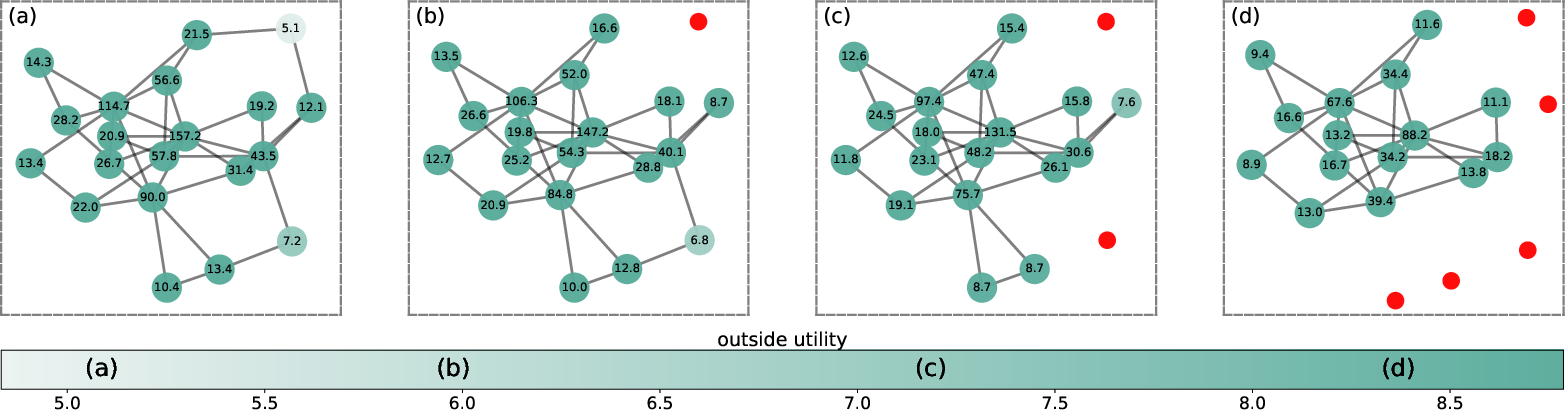
Figure 1: The Strategic Network Abandonment Model showing agent utility distribution and sequential, cascading departures triggered by increasing outside options.
The proposed model features N agents connected via a symmetric, weighted adjacency matrix A, with each agent i selecting a non-negative activity level xi to maximize the utility:
Ui=αxi−21xi2+βxij=1∑NAijxj
where α is the intrinsic incentive, β parameterizes complementarities, and activity is mutually reinforcing by virtue of network structure. Equilibrium actions are derived as x∗=α(I−βA)−11, isomorphic to Bonacich centrality. Agents remain so long as Ui∗>uout, the outside option, with iterative removal as uout increases. The process is adiabatic: after each agent exit, the system re-equilibrates before further increments in uout.
Local and Global Regimes of Network Decay
Analytical treatment reveals two fundamental parameter regimes:
Local Threshold Dynamics (βρ(A)≪1)
For weak complementarities, the equilibrium mapping can be linearized, reducing the system to a local threshold model structurally analogous to k-core percolation. Failure of a node depends on its immediate neighborhood; exit occurs when the number of failed neighbors exceeds a critical threshold θi, computable by simple formula. Cascades are possible, but require the existence of large vulnerable clusters. This regime admits clear precursors for collapse, with interventions targeting the most vulnerable periphery being effective.
In this regime, typical in real socio-economic networks, action and utility are dominated by indirect (higher-order) connections. The removal of even a peripheral agent propagates losses throughout the entire network via global feedbacks. Decay can proceed via persistent metastable plateaus followed by sharp, catastrophic collapse points, with the critical outside option highly sensitive to minor structural differences. Predictive indicators such as the resolvent norm or the inverse participation ratio (IPR) fail to anticipate collapse.

Figure 2: Empirical and simulated decay profiles. Real-world systems (e.g., crypto projects, subreddit activity, business registrations) and model realizations exhibit regime-dependent decay—abrupt cascades for small β, continuous decline for larger β. Bonacich centrality displays greater heterogeneity than degree, accentuating decentralized fragility.
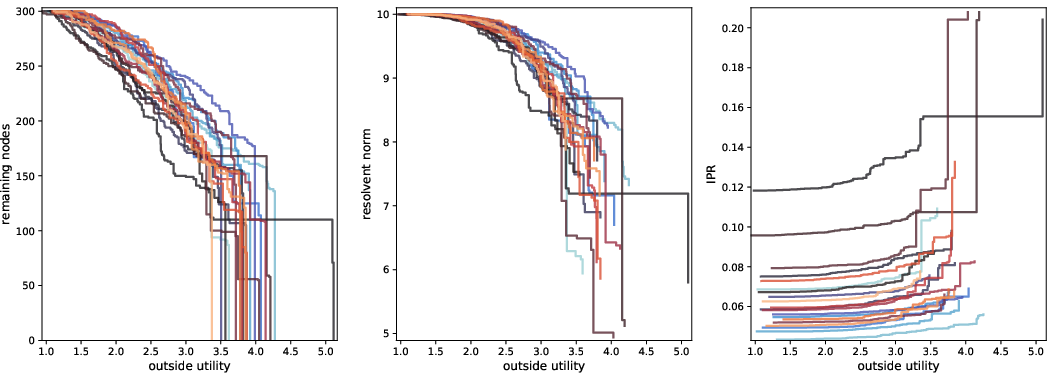
Figure 3: High-β regime yields stochastic collapse points across realizations, with standard spectral precursors offering no reliable early warning; collapse is driven by fine-grained structural idiosyncrasies.
Implications for Policy Interventions
The model offers a dual prescription for network stabilization dependent on system amplification factor βρ(A):
- Low βρ(A) (Local): Interventions must directly support marginal agents. Welfare-maximizing, centrality-based resource allocation is sub-optimal.
- High βρ(A) (Global): Efficiently targeted support at centrally positioned agents, as specified by the dominant eigenvector, diffuses through the network and maximizes stability with less total cost.
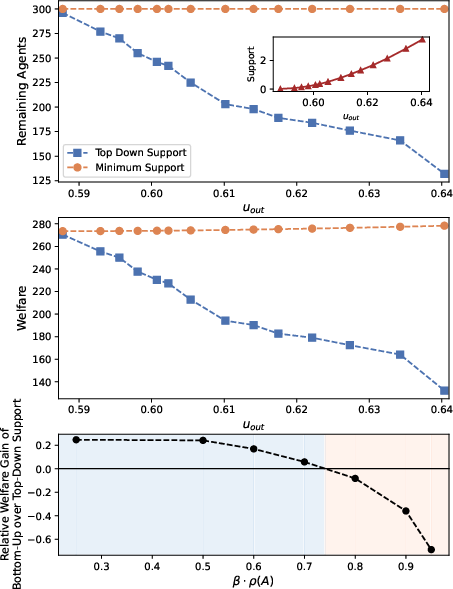
Figure 4: Bottom-Up (BU, direct marginal support) and Top-Down (TD, centrality-based) network support schemes. TD is effective only at high spectral radius, while BU robustly maintains participation and welfare for all parameterizations.
This stratification provides a diagnostic criterion for policymakers: estimate the network’s amplification factor to select between direct and central-agent-focused support for maximal effectiveness.
Theoretical and Practical Implications
A significant theoretical advance of this work is the proof that the decay process yields a unique, order-independent outcome at each stage, rigorously tying network structure (via Bonacich centrality and spectral radius) to the decay and stabilization trajectories. The model bridges the gap between local-threshold (bootstrap percolation) and globally coupled (mean-field-type rupture) descriptions of network failure, explicitly showing through analytical derivation and simulation when each limit is appropriate.
These findings nuance the design principles for real networks such as urban systems, online platforms, and institutional collaborations, with critical implications for the anticipation of systemic risk and the optimal allocation of stabilizing resources.
Conclusion
This study establishes, with analytical rigor, that the decay of strategic agent networks is not universal but exhibits a sharp transition between locally driven cascades and globally synchronized rupture, determined by the network’s spectral properties and strategic complementarities. For robust system design and policy, coarse heuristics are inadequate; the network’s amplification parameter must dictate intervention strategies. Future research can extend the model to asymmetric interactions and non-adiabatic update rules, addressing dynamic adjustment and richer topological disorder. The framework offers both predictive theoretical tools and practical heuristics for sustaining complex socio-economic systems under escalating external threats.