Inverted-Mode Scanning Tunneling Microscopy for Atomically Precise Fabrication
Abstract: Scanning Tunneling Microscopy (STM) enables fabrication of atomically precise structures with unique properties and growing technological potential. However, reproducible manipulation of covalently bonded atoms requires control over the atomic configuration of both sample and probe - a longstanding challenge in STM. Here, we introduce inverted-mode STM, an approach that enables mechanically controlled chemical reactions for atomically precise fabrication. Tailored molecules on a Si(100) surface image the probe apex, and the usual challenge of understanding the probe structure is effectively solved. The molecules can also react with the probe, with the two sides of the tunnel junction acting as reagents positioned with sub-angstrom precision. This allows abstraction or donation of atoms from or to the probe apex. We demonstrate this by using a novel alkynyl-terminated molecule to reproducibly abstract hydrogen atoms from the probe. The approach is expected to extend to other elements and moieties, opening a new avenue for scalable atomically precise fabrication.
Paper Prompts
Sign up for free to create and run prompts on this paper using GPT-5.
Top Community Prompts
Explain it Like I'm 14
Overview: What is this paper about?
This paper introduces a new way to build things atom by atom using a special microscope called an STM (Scanning Tunneling Microscope). Normally, an STM can move single atoms, but it’s hard to control exactly what the very tip of the microscope looks like, and that makes precise chemistry difficult. The authors flip the usual approach: they put carefully designed “tall” molecules on a silicon surface so the molecules can both “show” the shape of the microscope tip and then react with it on purpose. They call this inverted‑mode STM. Using it, they demonstrate a tiny, controlled chemical move: plucking a single hydrogen atom from the tip without using any electrical voltage—purely by mechanical motion.
Key questions the paper tackles
The paper focuses on a few simple but hard questions:
- How can we control the exact arrangement of atoms on both sides of the tiny gap in an STM (the tip and the surface)?
- Can we see and verify the tip’s atomic structure clearly and reliably?
- Can we trigger a chosen chemical reaction at one specific atom, on command, and repeat it many times?
- Can this be a general method for building complex, atomically precise structures, not just a one‑off trick?
How did they do it? (Methods in everyday terms)
Think of an STM like a super-sharp record player needle that “feels” the surface of a material by moving extremely close to it. There’s a tiny gap where electrons can “tunnel” across; that gap is called the tunnel junction. In regular STM, you mainly learn about the surface. In inverted‑mode, the surface molecules help you learn about the tip.
Here’s the approach, step by step:
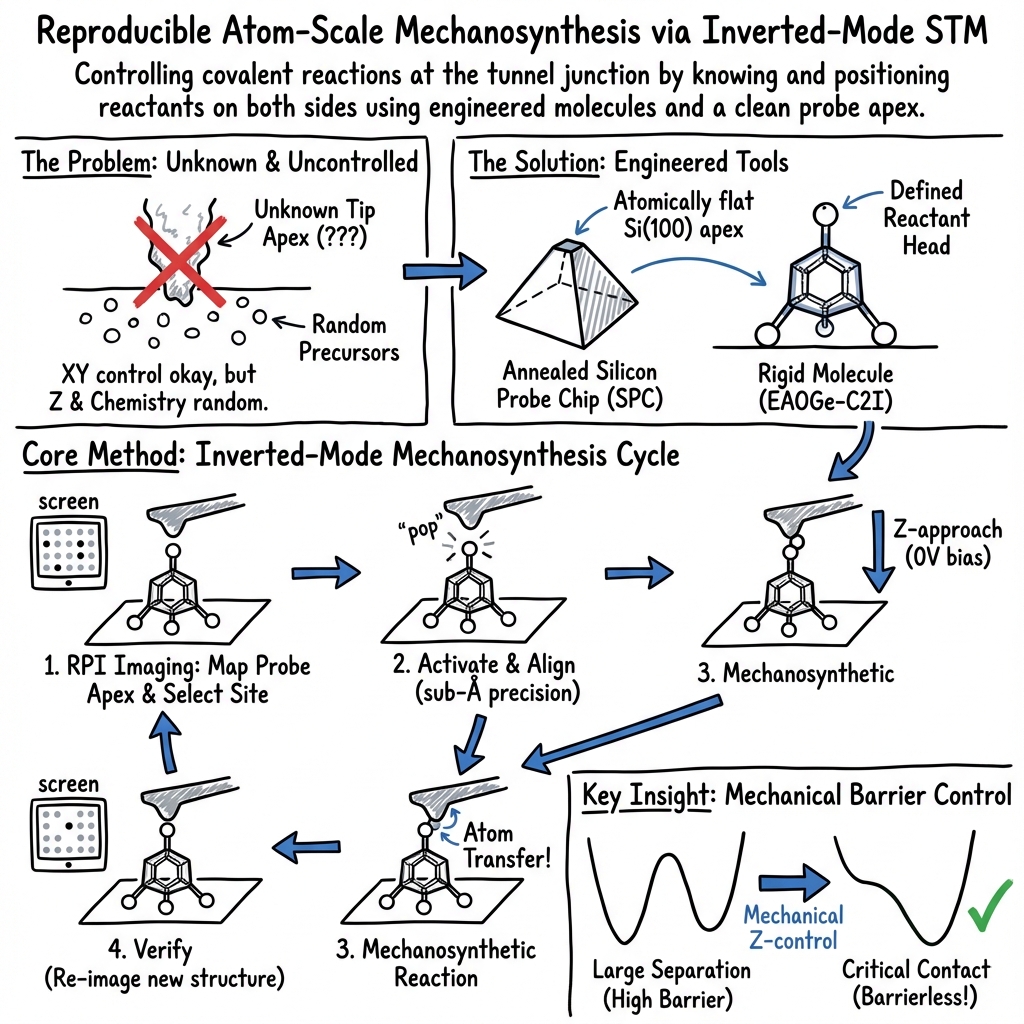
- Making an ultra-clean, flat tip: The team micro‑fabricated tiny silicon pyramids (the tips) on a chip. They then heated them very hot (about 1200 °C) in vacuum. This heat treatment made the very top “terrace” of the tip atomically flat and clean. That matters because it removes randomness and makes chemistry predictable.
- Placing special “tall” molecules on a silicon surface: They designed a rigid molecule (called EAOGe‑C2I) that stands upright on the surface like a tiny tripod. The top of this molecule has an “iodo‑alkyne” head (imagine a capped, reactive stick).
- Using molecules as mirrors of the tip: When the STM scans over one of these tall molecules, the image you get is actually a reflection of the tip’s shape. The authors call this a Reflected‑Probe Image (RPI). It’s like holding up a mirror to see your own face—here, the molecule is the mirror, and the STM tip is the face. This solves the old problem of not knowing what the tip looks like atom-by-atom.
- “Activating” the molecule: They pop off the iodine “cap” (by a brief voltage or UV light), turning the molecule’s top into a very reactive point called a radical. Think of removing a safety cap from a tiny chemical tweezers.
- Mechanically steering a reaction: With the molecule aligned over a specific hydrogen atom on the tip, they gently move the tip and molecule closer together (no voltage applied). When they get close enough, chemistry “clicks”: the molecule snatches a single hydrogen atom from the tip. This is called hydrogen abstraction. Then they pull back, and the hydrogen stays on the molecule.
- Checking the result: Because multiple molecules are on the surface, they can switch to another molecule to re‑image the same spot on the tip and confirm the change. Computer simulations (DFT) back up why the reaction happens: the hydrogen prefers to be on the molecule, and the barrier to the reaction disappears when the two are sufficiently close.
Analogy: Imagine using two pairs of ultra‑tiny chopsticks facing each other across a small gap—one chopstick is on the tip, the other on the surface. You line them up with sub‑angstrom precision (less than a ten‑billionth of a meter), and then gently move them so one can pass a grain (an atom) to the other—no electricity needed, just careful positioning.
Main findings and why they matter
- Clean, repeatable tip preparation: Heating the silicon tips makes their tops atomically flat and clean, and this can be done again and again. That’s crucial for repeatable chemistry.
- Molecules “image” the entire tip terrace: A single upright molecule can capture a clear “reflection” of the tip over areas up to ~100 nm wide. This lets the researchers see and target exact atomic sites.
- Reliable, zero‑bias chemical control: They removed a single hydrogen atom from the tip 27 times out of 28 tries using only mechanical motion (no applied voltage, so no tunneling current during the reaction). This shows tight control of a specific chemical step.
- Guided by energy and distance: Simulations show the reaction is energetically favored and becomes barrier‑free when the tip and molecule are close enough. In other words, proximity alone can make the chemistry happen predictably.
- Ready for multi‑step building: After one reaction, they can switch to a different molecule and address the same spot again. That means you can chain steps—subtracting atoms or even adding small building blocks—to build more complex structures atom by atom.
Why this is important: It solves a long‑standing STM problem—uncertainty about the tip’s exact atomic structure—and adds a new control knob: mechanical motion to drive chemistry. It also works on silicon, which is the foundation of modern electronics.
What could this lead to? (Implications)
- Atom‑by‑atom manufacturing: This is a path toward building tiny devices and materials with perfect placement of atoms, including future electronics, quantum devices, and custom materials.
- More elements and reactions: By designing different molecules, you could take away or add different atoms or small groups (like C2 or C2H) to precise spots. That’s like having a toolbox of nano‑sized parts and tools.
- Better, standardized imaging and control: Using known molecules as “imagers” could make STM experiments more consistent from lab to lab, and allow comparing views of the same tip site with different molecular “lenses.”
- 3D control of chemistry: Instead of only sliding things around on a flat surface, this method controls positions in all three dimensions. Future work could use more complex motions to steer reactions even more precisely.
- Extensible to other materials: The same idea—clean, flat tips plus tailored molecules—could work with other semiconductors, some metals, and even 2D materials, opening doors to many new nano‑fabrication strategies.
In short, inverted‑mode STM turns the STM into a highly controllable nano‑workbench where both sides of a tiny gap can be seen, aligned, and made to react on purpose—one atom at a time.
Knowledge Gaps
Knowledge gaps, limitations, and open questions
Below is a single, consolidated list of the specific uncertainties, missing elements, and open questions left unresolved by the paper that future researchers could address.
- Absolute calibration of probe–sample internuclear separation: convert piezo approach distances (referenced to tunneling setpoints) into true atom–atom separations with quantified uncertainty.
- Mechanical force metrology: directly measure forces during approach/retraction (e.g., AFM frequency-shift or QPlus) to validate the “barrierless” regime and correlate force thresholds with reaction outcomes.
- Generality beyond hydrogen abstraction: experimentally validate additive reactions (e.g., donation of C2, C2I, C2H) and other subtractive operations; identify required approach trajectories and operational windows.
- Selectivity control between abstraction and donation: determine how probe termination, local apex chemistry, approach geometry, and electric fields/bias systematically bias product formation.
- In-situ chemical verification of products: directly confirm that H is transferred to the molecule (e.g., with dI/dV signatures, tip-enhanced spectroscopy, or vibrational spectroscopy) and that the probe site is a single Si dangling bond.
- Fate of dissociated iodine: locate and quantify where iodine goes post-deiodination (adsorbed on sample, probe, or desorbed), and assess contamination/passivation effects on subsequent reactions.
- Stability and lifetime of activated imagers: measure how long activated radicals remain reactive under STM conditions and their propensity for unwanted side reactions or structural degradation.
- Control and characterization of molecule adsorption geometry: quantify the distribution of EAOGe-C2I orientations (upright vs head-down), develop methods to enforce desired alignment, and measure how orientation affects both imaging and reaction accuracy.
- Drift, hysteresis, and tilt error bounds: provide quantitative limits on lateral alignment accuracy over multi-step sequences; implement closed-loop drift compensation and axis-alignment protocols for ≤Å precision.
- Temperature dependence and operating window: determine the minimum/maximum temperatures enabling reliable reactions and low drift (beyond 4.4 K), and evaluate viability at higher temperatures for practical throughput.
- Probe durability under repeated fabrication: characterize apex morphological/electronic changes, passivation loss, and contamination after many reactions; define maintenance (repassivation/re-anneal) intervals.
- Extension to other materials: establish robust, lower-temperature protocols to prepare atomically clean, crystalline apices for other semiconductors, metals, and 2D materials and validate inverted-mode imaging/reactions on them.
- Electric field characterization at “zero bias”: quantify contact potential and stray fields in the junction and systematically study bias-dependence to understand field effects on reaction barriers and pathways.
- RPI imaging physics: build a quantitative model of how imager height/orbital symmetry and probe geometry map to RPI features; develop deconvolution methods to separate molecule vs apex contributions.
- Cross-system metrology: standardize calibration of approach depth and imaging parameters across different STM setups and quantify inter-system variability of success rates and minimal approach distances.
- Expanded statistics and failure mode analysis: collect larger datasets across probes, molecules, and sites to establish distributions of minimal approach depth, identify failure modes, and define robust operating windows.
- Demonstration of multi-step fabrication: execute and verify sequences of site-specific additive/subtractive steps that build a defined covalent structure on the apex, including error detection/correction strategies.
- Impact of crystallographic misalignment: assess performance when probe–sample tilt exceeds ~2°, develop active alignment or computational correction, and validate terrace-scale access under misalignment.
- Role of doping type and level: examine p-type Si and varied resistivities to quantify how doping affects contact potentials, imaging characteristics, and mechanosynthetic outcomes.
- Reaction dynamics and kinetics: implement time-resolved monitoring of the abstraction event to probe intermediates and distinguish purely mechanical steering from any electronic excitation contributions.
- Modeling limitations: extend DFT to larger, more realistic junction models (full apex, dopants, charge states, fields), explore different functionals/dispersion corrections, and include finite-temperature dynamics.
- Environmental robustness: test sensitivity to base pressure, residual gases, UV exposure, and less stringent vacuum conditions; define acceptable environmental windows for reliable operation.
- Molecule design space and optimization: establish criteria for “tall, rigid, sharp” imagers (height, conductivity, orbital symmetry), synthesize alternatives enabling diverse chemistries, and benchmark imaging fidelity.
- Edge/defect interactions: characterize reaction and imaging behavior near step edges, kinks, and defects, and determine safe operating distances from terrace boundaries.
- Parallel characterization modalities: integrate dI/dV mapping, Kelvin probe force microscopy, AFM frequency-shift, or tip-enhanced Raman to validate both structural and chemical changes post-reaction.
- Localized repassivation strategies: develop in-situ methods to donate single H atoms back to selected probe sites and assess control over rehydrogenation at atomic precision.
- Overlapping RPI (“double-tip”) artifacts: create detection and deconvolution algorithms or experimental protocols to avoid/mitigate multi-imager convolution in regions of overlap.
- Long-term reproducibility and annealing limits: systematically study how repeated anneals affect ROC, dopant profiles, apex conductivity, and pinch-off instability; define safe process windows and failure thresholds.
Practical Applications
Practical Applications of “Inverted-Mode Scanning Tunneling Microscopy for Atomically Precise Fabrication”
Below are the actionable, real-world applications that stem from the paper’s findings, methods, and innovations. They are grouped into immediate (deployable now) and long-term (requiring further research, scaling, or development) opportunities, with sector links, potential tools or workflows, and key assumptions or dependencies noted.
Immediate Applications
These items can be piloted or deployed in advanced labs and R&D environments now, using the methods and reagents described in the paper.
- Reproducible, atomically clean STM probe preparation via DC-annealed Silicon Probe Chips (SPCs)
- Sectors: instrumentation, semiconductor R&D, academia
- Tools/products/workflows: a commercial line of SPCs; a DC annealing probe holder; annealing control software; pyrometer-guided recipes; QA protocols (apex radius vs. anneal time)
- Assumptions/dependencies: access to UHV systems, high-temperature DC annealing capability (~1200 °C), degenerately doped Si(100) wafers; trained personnel for lithography and wet etching
- Reflected-Probe Imaging (RPI) to verify tip apex structure and reduce STM imaging artifacts
- Sectors: surface science labs, metrology, semiconductor process development
- Tools/products/workflows: “imager reagent” kits (e.g.,
EAOGe-C2I); RPI acquisition and analysis software (drift and hysteresis correction, lattice alignment); cross-lab tip certification protocols - Assumptions/dependencies: sparse deposition of tall, rigid molecules; cryogenic STM operation (~4.4 K); UHV; reproducible molecule orientation and coverage
- Mechanically controlled, zero-bias hydrogen abstraction for atomic-scale patterning on Si(100)
- Sectors: quantum devices (single-atom transistors, qubits), semiconductor R&D
- Tools/products/workflows: a standardized “mechanosynthesis” patterning workflow to create dangling bonds at targeted lattice sites; calibration routines for approach depths (e.g., 200–350 pm); after-image verification with a second molecule
- Assumptions/dependencies: precise probe–sample alignment at the sub-angstrom scale; degenerately doped n-type Si; cryogenic operation; reagent availability and activation (deiodination)
- Cross-tip imaging standards using selectable molecular imagers (height, LDOS, orbital character)
- Sectors: metrology, academic surface science
- Tools/products/workflows: a catalog of imaging molecules (e.g., s- vs. p-orbital dominance) for benchmarking tip apexes; standardized RPI-based calibration datasets
- Assumptions/dependencies: reliable synthesis and deposition of multiple imager species; shared metadata standards for imaging conditions
- Multi-imager, sequential reaction characterization at the same apex site
- Sectors: academia (chemistry, physics), materials research
- Tools/products/workflows: stepwise workflows for reaction execution and outcome verification (pre-image, reaction, post-image with a second molecule); software for lattice vector registration and piezo drift correction
- Assumptions/dependencies: stable molecular coverage; accurate return-to-target routines; low drift environments
- Fundamental chemistry studies using mechanical control (z- and 3D trajectories)
- Sectors: academia (physical chemistry, mechanochemistry)
- Tools/products/workflows: combined STM/AFM protocols to measure barrier suppression by approach; DFT-supported PES mapping; libraries of reagent pairs and approach profiles
- Assumptions/dependencies: integration with AFM frequency shift or tunneling current signals for “true” internuclear separation; availability of computational support
- Education and training modules for atomically precise fabrication
- Sectors: education, workforce development
- Tools/products/workflows: lab curricula demonstrating inverted-mode STM, RPI interpretation, zero-bias reactions; shared datasets and simulator tools
- Assumptions/dependencies: access to cryogenic UHV STM; safety and procedural training
- Early trials on 2D materials (e.g., defect engineering via in-situ exfoliation to clean apexes)
- Sectors: materials science, photonics research
- Tools/products/workflows: in-situ exfoliation procedures; imaging and mechanosynthetic steps tailored to 2D flakes; defect spectroscopy routines
- Assumptions/dependencies: successful transfer of clean 2D flakes to apex terraces; suitable reagents for 2D chemistries; cryogenic operation
Long-Term Applications
These opportunities require further method development (e.g., operation beyond cryogenic temperatures, parallelization, new reagents), engineering for throughput, and integration with industrial workflows.
- Atomically Precise Manufacturing (APM) platforms based on sequential mechanosynthesis at the probe apex
- Sectors: advanced manufacturing, robotics
- Tools/products/workflows: automated mechanosynthesis stations; CAD-to-chemistry toolchains; 3D trajectory planning; reagent libraries for subtraction and addition (e.g.,
C2,C2I,C2H, heteroatoms) - Assumptions/dependencies: stable operation at higher temperatures or with environmental isolation; robust “true separation” sensing; high-yield, repeatable reactions across many steps
- Scalable quantum device fabrication (dopant arrays, spin chains, single-photon sources)
- Sectors: quantum computing, quantum communications, photonics
- Tools/products/workflows: deterministic dopant placement beyond phosphorus/arsenic; precise defect engineering in Si and 2D materials for single-photon emission; foundry-like workflows for cryogenic patterning
- Assumptions/dependencies: demonstrated donation reactions to probe apex and surface sites for a broader set of elements; compatibility with CMOS thermal budgets; yield and uniformity across wafers or chips
- Massively parallel STM/SPM arrays for throughput
- Sectors: semiconductor manufacturing, robotics
- Tools/products/workflows: arrays of annealable SPCs; multiplexed control electronics; synchronized reagent delivery and imaging; high-throughput drift correction; in-line metrology
- Assumptions/dependencies: stable microfabrication of probe arrays; scalable UHV infrastructure; robust automation and error recovery
- Atomically engineered catalysts and energy materials
- Sectors: energy, chemical industry
- Tools/products/workflows: design of catalytic sites with precise bonding environments on metals/semiconductors; mechanosynthetic tuning of active sites; surface reconstruction control
- Assumptions/dependencies: extension of inverted-mode STM to metal probes and diverse surfaces (demonstrated in part); operation at or near ambient conditions; durability of atomic features under working environments
- Ultra-dense atomic memory and logic using dangling-bond lattices
- Sectors: data storage, computing hardware
- Tools/products/workflows: write–verify cycles at the atomic scale; readout schemes compatible with device packaging; error-correcting layouts
- Assumptions/dependencies: long-term stability of fabricated features at room temperature; reliable read/write speeds; integration with protective encapsulation
- Anti-counterfeiting and secure hardware identifiers at the atomic scale
- Sectors: security, finance, government
- Tools/products/workflows: unique atomic surface features as unclonable identifiers; verification readers; secure manufacturing protocols
- Assumptions/dependencies: scalable production on device/package surfaces; protective layers that preserve atomic patterns; standards for authentication
- Biomedical nanosensors and interfaces with atomically tuned selectivity
- Sectors: healthcare, diagnostics
- Tools/products/workflows: functionalized surfaces with precise binding sites; quantum sensors for biomolecular detection; device integration and passivation
- Assumptions/dependencies: biocompatibility; stability in aqueous/physiological environments; manufacturing scale and sterilization compatibility
- Software ecosystem for mechanosynthesis (design, simulation, control)
- Sectors: software, EDA/CAD for nanofabrication
- Tools/products/workflows: reaction pathway planners; DFT-backed reaction libraries; closed-loop control for 3D trajectories; cross-hardware APIs
- Assumptions/dependencies: validated datasets linking control inputs to reaction outcomes; standardized metadata and protocols; collaboration between computational chemistry and instrument control communities
- Standards, policy, and governance for APM
- Sectors: policy, standards bodies
- Tools/products/workflows: ASTM/ISO-like standards for tip certification, imaging protocols, reagent safety; ethical frameworks for atomic fabrication; export control guidance for APM toolchains
- Assumptions/dependencies: multi-stakeholder consensus; reproducible cross-lab benchmarks; harmonization with existing semiconductor and quantum standards
Glossary
- 6-311G(d,p) basis set: A quantum-chemistry basis set specifying functions used to approximate atomic orbitals in electronic-structure calculations. "6-311G(d,p) basis set60"
- Adamantane: A rigid, diamondoid hydrocarbon cage used as a structural core in molecular design. "rigid germanium-substituted adamantane cage."
- AFM: Atomic Force Microscopy, a scanning probe technique that measures forces between a sharp tip and a surface. "STM or atomic force microscopy (AFM) probes"
- Annealing: High-temperature treatment to modify surface morphology and remove contaminants, producing a cleaner, more ordered structure. "Annealing is performed in a custom-built probe holder (Figure 2f) that passes direct current (DC) through the SPC."
- Anisotropic KOH etching: Direction-dependent wet etching of silicon with potassium hydroxide that reveals crystallographic planes and shapes. "Anisotropic KOH etching and corner undercutting enable formation of pyramidal structures on Si(100)39."
- ATR: Attenuated Total Reflectance, an infrared spectroscopy sampling technique for probing thin films or solids. "with an ATR sampling module."
- Bath cryostat: A cryogenic apparatus that uses a liquid bath (e.g., liquid helium) to maintain low temperatures for experiments. "All STM experiments were performed at liquid-helium temperature (4.4 K) using a bath cryostat and a custom-built STM head."
- Becke–Johnson damping: A damping scheme applied to dispersion corrections in DFT to improve accuracy. "D3 version of the Grimme dispersion correction with Becke-Johnson damping61"
- B3LYP: A hybrid density functional widely used in DFT for electronic-structure calculations. "with the B3LYP hybrid density functional59"
- BOE: Buffered-Oxide Etchant, a chemical solution used to remove silicon oxide layers with controlled rates. "a 5:1 buffered-oxide etchant (BOE)"
- Bond dissociation energy: The energy required to break a specific chemical bond, reflecting thermodynamic stability. "in agreement reported bond dissociation energies25,26 ."
- Contact potential: The built-in voltage difference arising from work-function differences across a junction, influencing electric fields without applied bias. "the contact potential, and consequently the electric field, is small."
- Dangling bond: An unsatisfied valence on a surface atom (e.g., silicon) that creates a highly reactive site. "leaving a dangling bond on the probe and a terminal C2H group on the molecule."
- Degenerately doped: Doping at such high concentration that the semiconductor behaves more like a metal with very high conductivity. "degenerately doped n-type Si(100) wafer"
- Density Functional Theory (DFT): A quantum mechanical modeling method for calculating electronic structure and energies of materials and molecules. "calculated by density functional theory"
- Deiodination: Removal of an iodine atom from a molecule, often producing a radical that can undergo further reactions. "after deiodination of the molecule"
- Dimer (surface dimer): A bonded pair of surface atoms (e.g., Si dimers on Si(100)-2x1) that define reconstruction and local geometry. "Despite the activated molecule's inability to resolve dimers"
- Dissociative attachment: A surface reaction where a molecule binds and simultaneously breaks a bond, often forming a stable adsorbed fragment. "can undergo dissociative attachment on the Si(100) surface30-33"
- Double tip artifact: An imaging artifact in STM where two effective apexes cause overlapping or duplicate features. "similar to a "double tip" artifact in conventional STM."
- Effusion cell: A thermal evaporation source used in vacuum to deposit molecules in a controlled flux. "Molecules were deposited using an effusion cell in a separate chamber"
- ELSD: Evaporative Light Scattering Detector, used in chromatography to detect non-volatile analytes. "equipped with an ELSD and UV detector (254 nm)."
- Ethynyl radical: A highly reactive carbon-based radical (–C≡C•) favoring hydrogen abstraction and addition reactions. "the reactivity of the ethynyl radical, which strongly favors hydrogen abstraction36."
- FIB milling: Focused Ion Beam milling, a technique for shaping materials at the micro/nanoscale using a focused ion beam. "fabricated by focused ion beam (FIB) milling"
- FT-IR: Fourier Transform Infrared Spectroscopy, a technique to obtain IR spectra for chemical identification. "Agilent Cary 630 FT-IR spectrometer"
- Germa-adamantane: An adamantane derivative where a germanium atom is integrated into the cage framework. "The germa-adamantane cage with pendent ethynyl radical and the hydrogen atom scanned (green)"
- Grimme dispersion correction: An empirical correction (e.g., D3) added to DFT to model van der Waals/dispersion interactions. "D3 version of the Grimme dispersion correction"
- Homolytic bond scission: Bond breaking where each fragment retains one electron, forming radicals. "carbon- iodine homolytic bond scission is known to be induced by UV light34,35"
- HR-MS: High-Resolution Mass Spectrometry, used to determine accurate molecular masses and compositions. "High- resolution mass spectrometry (HR-MS) analysis was performed"
- HSQC: Heteronuclear Single Quantum Coherence, a 2D NMR experiment correlating proton and heteronuclear (e.g., carbon) signals. "HSQC (DEPT-135 modified; CD3OD): EAOGe-C2I"
- Hydrogen abstraction: Removal of a hydrogen atom from a substrate by a reactive species, forming a new bond. "Mechanosynthetic hydrogen abstraction."
- I(V) spectroscopy: Current–voltage measurements in STM to probe local electronic properties and apparent bandgaps. "I(V) spectroscopy of a probe apex after 4 minutes of annealing time"
- Iodoalkyne: An alkyne functional group bearing iodine, enabling radical generation via deiodination. "containing an iodoalkyne at its topmost point"
- Joule heating: Heating produced by electrical current flowing through a resistive material. "localizes Joule heating to ensure the highest temperature occurs at the probe location."
- KOH etching: Wet etching of silicon using potassium hydroxide, commonly used to form microstructures aligned to crystal planes. "The sample was wet etched in 30 wt% KOH at 80 ℃ to form pyramidal structures."
- Local density of states (LDOS): The energy-resolved density of electronic states at a specific location, relevant to STM imaging contrast. "electronic structure (e.g. local density of states)"
- MBE (molecular beam epitaxy): A vacuum-based crystal growth method depositing atoms/molecules in beams for precise thin-film formation. "STM lithography and MBE growth face similar thermal-budget limitations"
- Mechanosynthesis: Chemistry directed by mechanical positioning and motion to achieve specific reaction outcomes at the atomic scale. "can be called mechanosynthesis27."
- Moiety: A distinct functional part of a molecule that can be transferred or manipulated in reactions. "elements and moieties"
- Passivation: Saturation of reactive surface bonds (e.g., with hydrogen) to reduce reactivity and stabilize the surface. "hydrogen-passivated silicon probe apex (the H:Si(100)-2x1 surface)."
- Photoresist: A light-sensitive polymer used in lithography to pattern structures on substrates. "A photoresist (PR) is patterned by UV lithography"
- Piezo creep: Time-dependent drift in piezoelectric actuators after a motion, affecting precise positioning. "Sequential images of the build site are used to correct for piezo creep and drift to first order."
- Plateau–Rayleigh instability: A surface-tension-driven instability causing breakup or necking in fluid-like surfaces under diffusion. "in accordance with the Plateau-Rayleigh instability55."
- Radius of curvature (ROC): A measure of the sharpness/bluntness of a tip apex, impacting imaging and reaction geometry. "the probe apex has an average radius of curvature (ROC) < 20 nm"
- Reflected-Probe Image (RPI): An STM image produced by a tall molecule that mirrors the probe apex structure, enabling apex characterization. "we refer to as a Reflected-Probe Image (RPI)"
- Scanning Tunneling Microscopy (STM): A technique that images and manipulates surfaces at atomic resolution via quantum tunneling between tip and sample. "Scanning Tunneling Microscopy (STM) enables fabrication of atomically precise structures"
- Si(100)-2x1: A silicon (100) surface reconstruction where surface atoms form rows of dimers, doubling periodicity in one direction. "H:Si(100)-2x1 surface"
- Sputtering: Bombarding a surface with energetic particles (often ions) to remove material or modify surfaces. "and sputtering67"
- Step flow: Surface diffusion-driven migration of atoms from steps leading to terrace widening and smoothing during anneal. "leads to a 'step flow' that promotes the formation of a wide step-free topmost terrace54"
- TeraChem: GPU-accelerated quantum chemistry software used for DFT and related calculations. "in TeraChem 1.96H62,63"
- Tunneling setpoint: The target current/voltage used to control the probe–sample distance during STM, defining the reference separation. "referenced to the tunneling setpoint"
- Ultra-high vacuum (UHV): Extremely low-pressure environment (≤10-9 mbar) required to maintain clean surfaces and controlled deposition. "under ultra-high vacuum (UHV) using a custom-built receptacle"
- UV lithography: Patterning technique using ultraviolet light to expose photoresist for microfabrication. "A photoresist (PR) is patterned by UV lithography"
- Vertical manipulation: STM-driven approach where molecules or atoms are moved or reacted by controlling tip–sample distance, not just lateral position. "vertical manipulation 19,20."
- Wavefunction convergence threshold: Numerical criterion in quantum calculations specifying how tightly the electronic solution must converge. "with a wavefunction convergence threshold of 1.0e-8 a.u"
Collections
Sign up for free to add this paper to one or more collections.