Electrostatic enhancement of particle collision rates in atmospheric flows
Abstract: Collisional growth of tiny particles is a fundamental process governing the growth of cloud droplets and the aggregation of ash particles in volcanic plumes, with direct implications for precipitation formation, cloud lifetime, and ash plume dynamics. The particles in these scenarios often carry electric charges. In this study, we investigate the collision dynamics of a pair of like charged dielectric spheres subjected to a uniaxial compressional flow, an important linear flow that captures key features of atmospheric straining motions. Finite particle size leads to electrostatic interactions that deviate from the point charge approximation, resulting in far field repulsion and near-field attraction, which in turn generate nontrivial particle trajectories and critical collision thresholds. For certain combinations of charge and size, the interplay between hydrodynamic and electrostatic forces creates strong radially inward particle relative velocities that substantially alter particle pair dynamics and modify the conditions required for contact. For uncharged particles, collision efficiency increases monotonically with particle size ratio. However, in the presence of electrostatic forces with high charge ratio values, the collision efficiency exhibits a nonmonotonic dependence, attaining a maximum at small size ratios and decreasing as the ratio increases, with a crossover beyond which larger particles become less favorable for collision. These results demonstrate that the same polarity charges on finite sized atmospheric particles do not necessarily inhibit collisions. Instead, they can enhance collisional growth for specific charge and size ratio combinations, revealing counterintuitive pathways relevant to cloud microphysical processes and volcanic ash aggregation in electrified atmospheric environments.
Paper Prompts
Sign up for free to create and run prompts on this paper using GPT-5.
Top Community Prompts
Explain it Like I'm 14
Overview
This paper studies how tiny particles that carry electric charge bump into and stick to each other while moving in air flows, like inside clouds or volcanic plumes. The big idea is surprising: even when particles have the same type of charge (both positive or both negative), they don’t always repel. Because of their size and material properties, they can attract each other at close range and collide more often. This matters for how raindrops form in clouds and how volcanic ash clumps together and falls out of the air.
What questions does the paper ask?
The paper asks simple, practical questions:
- When do electric charges make particle collisions more likely instead of less likely?
- How do particle size, amount of charge, and the kind of material (like water or ash) change whether particles meet and stick?
- What happens to collision rates when particles move through a “compressing” flow (imagine the air pushing inward along one direction)?
- Can we predict collision efficiency (how often collisions happen compared to an ideal case) under different conditions?
How did the researchers study it?
The authors build a physics-based model for two charged spherical particles moving in a simple, steady flow that squeezes along one axis (called a uniaxial compressional flow). They combine several effects:
- Hydrodynamics: How the surrounding air pushes back on moving particles. They use well-known “mobility” functions (A, B, G, H) to describe how particle size and spacing change their motion in a viscous fluid.
- Lubrication at very small gaps: When particles get extremely close, a thin layer of air between them resists motion. In gases, this “lubrication” must be treated with special care because the air behaves less like a smooth fluid at tiny scales. This is handled using the Knudsen number (Kn), which compares the air’s mean free path to particle size.
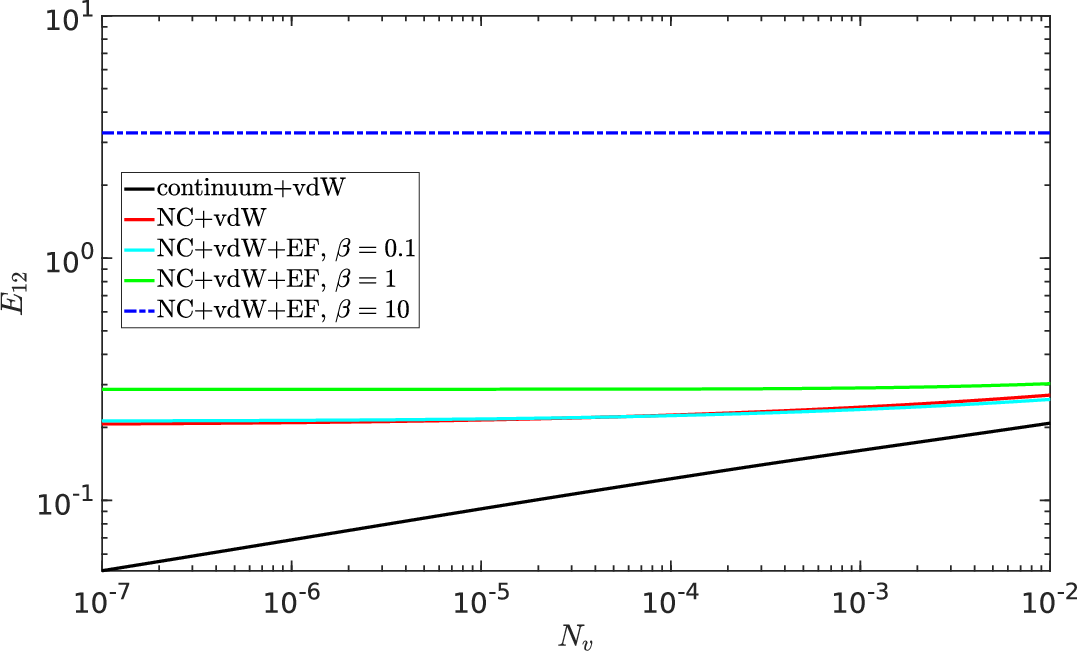
- Van der Waals forces: A short-range attraction that helps very close particles stick, like a gentle glue.
- Electrostatic forces: The force between charges. For real materials (like water droplets or ash), the particles are “dielectric” (not perfect conductors). In that case, the electric force is repulsive when they’re far apart, but can become attractive when they get very close because of polarization (the charge redistributes slightly on the particle surfaces).
To compare different situations, they use two “strength” numbers:
- Ne (electrostatic strength): How strong electric forces are compared to the squeezing flow.
- Nv (van der Waals strength): How strong van der Waals forces are compared to the flow.
Then they:
- Compute many particle paths (“trajectories”) to see which ones reach the contact distance.
- Identify the “upstream interception area” (think of it like the target zone far away from the test particle: if a particle starts inside this zone, it will end up colliding).
- Use that area to calculate collision efficiency: the actual collision rate divided by the ideal rate (if there were no extra forces or interactions).
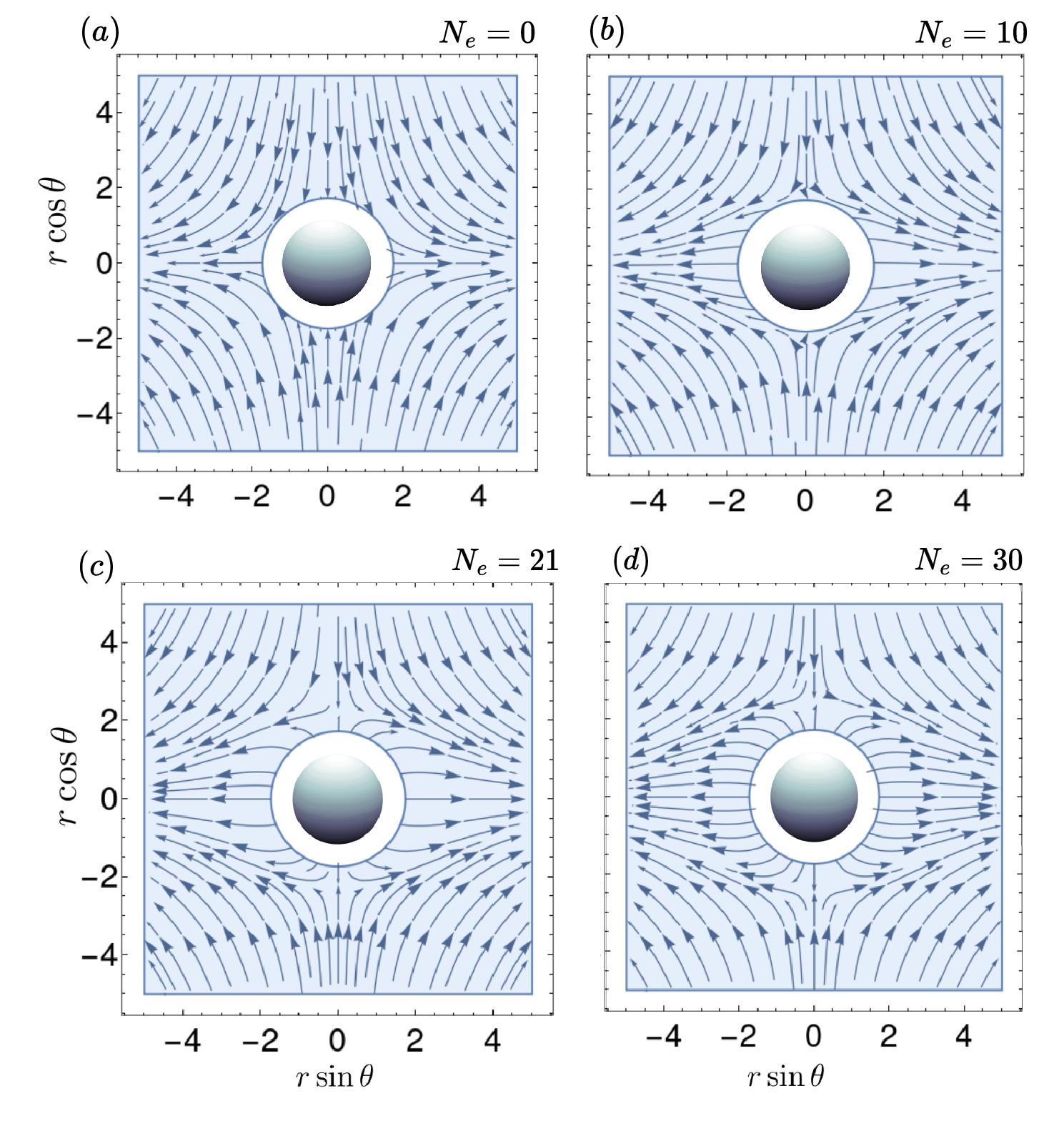
To build intuition, they also study a simplified case (“charged tracer”) where particles feel only the flow plus simple Coulomb repulsion (inverse-square law) and no hydrodynamic coupling. This toy model shows how pure repulsion can block collisions unless the flow is strong enough. It sets a baseline for understanding what changes when you include real-world electrostatics and hydrodynamics.
Helpful analogies and plain-language terms
- Uniaxial compressional flow: Imagine squeezing a sponge along one direction so things are pushed inward along that axis.
- Lubrication: A tiny cushion of air between two surfaces that resists them sliding together.
- Van der Waals forces: Weak sticky forces that only matter when things are almost touching.
- Dielectric spheres: Materials (like water droplets or ash particles) that aren’t metals; their charges don’t move freely, but they can still polarize (shift slightly under electric influence).
- Polarization attraction: Even if both particles have the same charge, the way charge spreads on their surfaces at close range can create a net pull toward each other.
What did they find?
The main results are both clear and surprising:
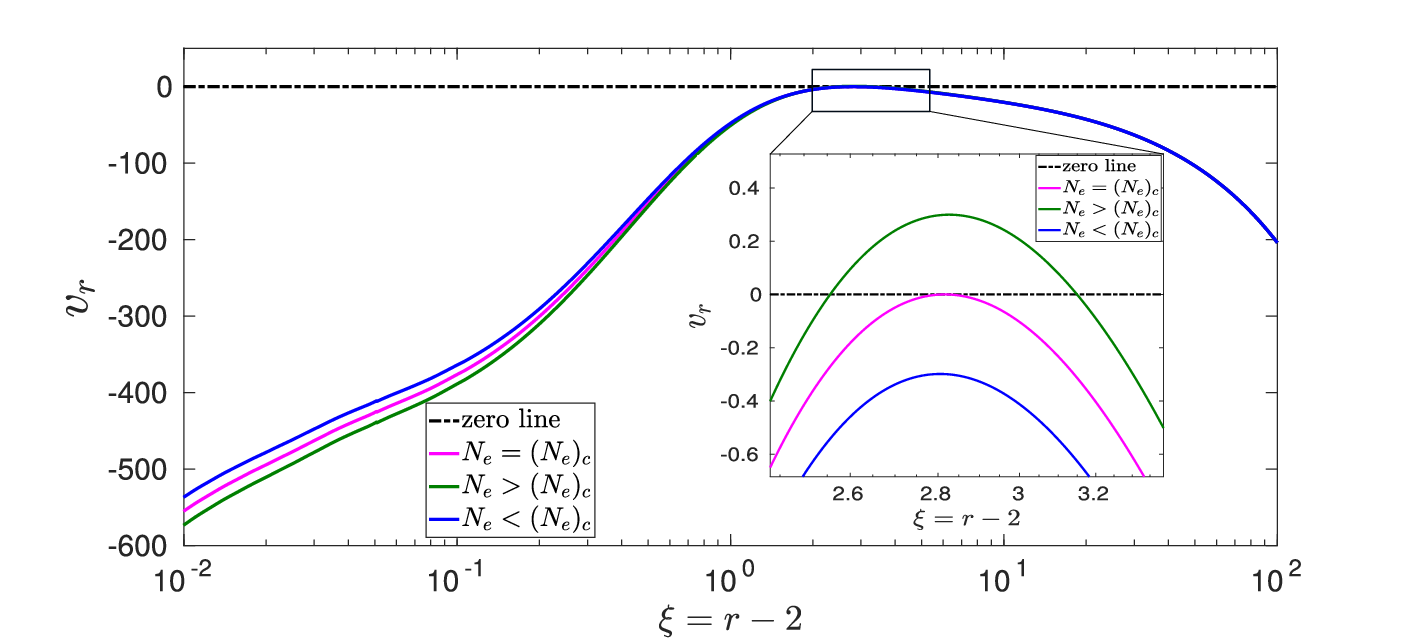
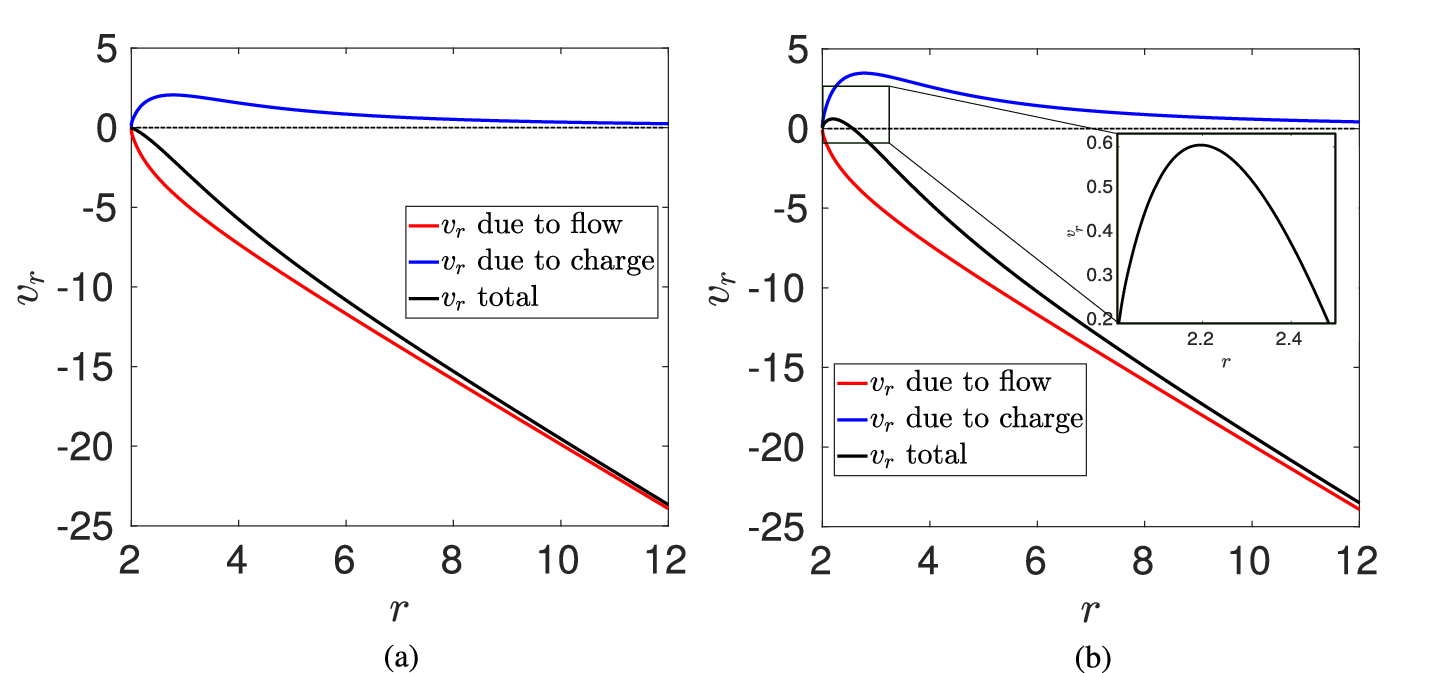
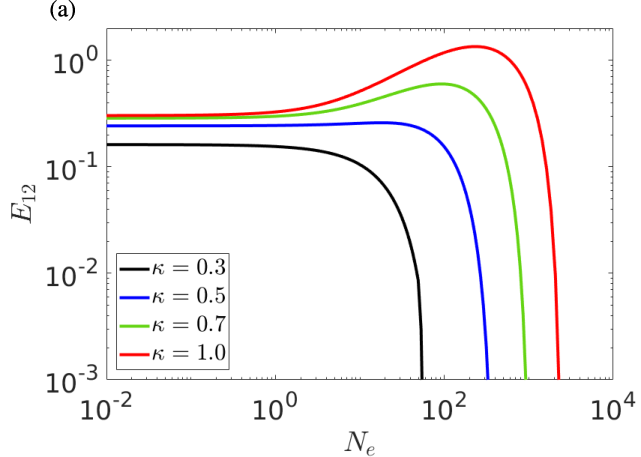
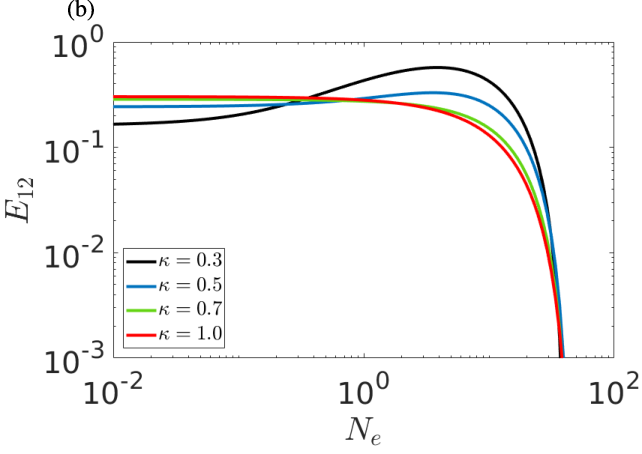
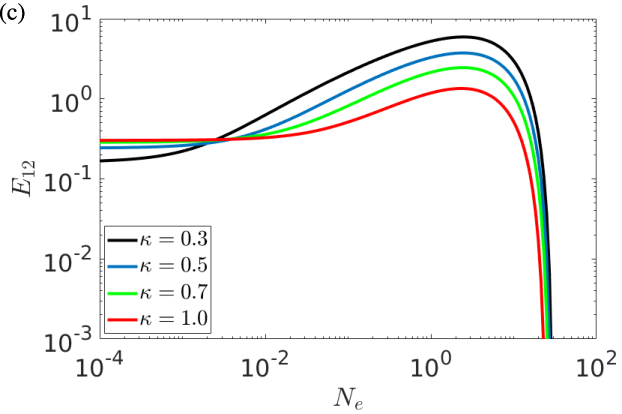
- Far away, like-charged particles tend to push each other apart (repulsion). But close up, because the particles are not point-like and are made of real materials, polarization can make them attract. This creates strong inward motion near contact and helps them collide.
- For uncharged particles, collision efficiency usually increases as the size difference grows (bigger particles sweep up smaller ones more easily).
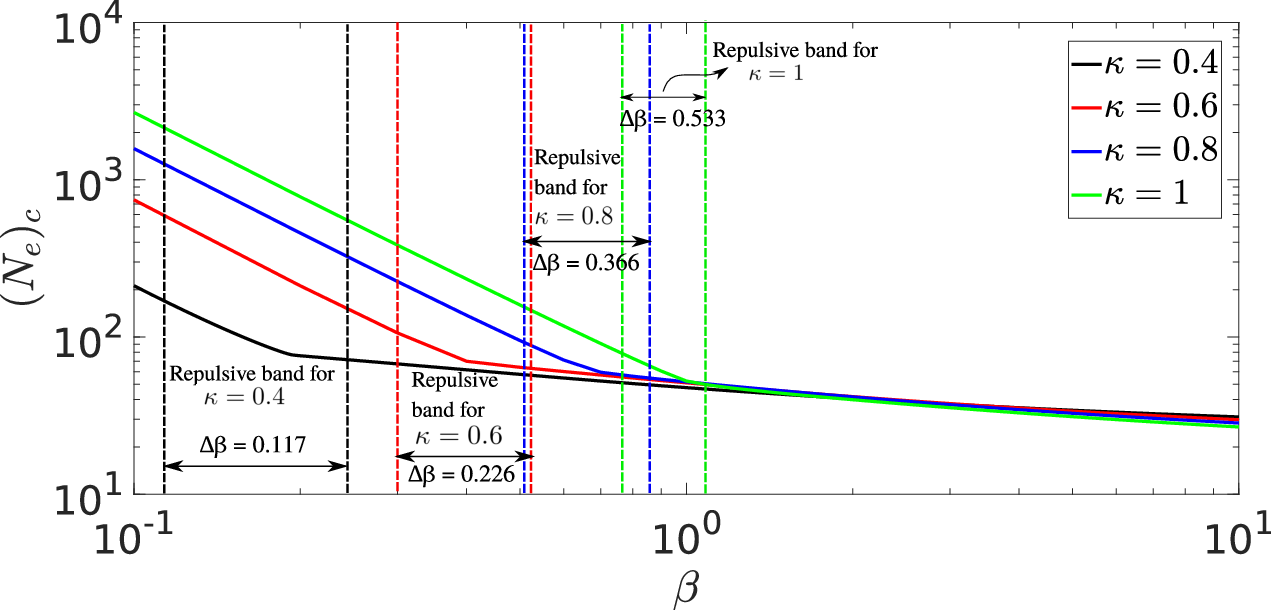
- With electrostatic forces, collision efficiency can peak at small size ratios and then drop as the size ratio increases. There’s a crossover point: beyond it, having a larger particle does not help collisions and can even reduce them.
- Same-sign charges don’t always stop collisions. In many realistic combinations of charge and size, they actually boost the chance of collision and sticking.
They also connect their model to real environments:
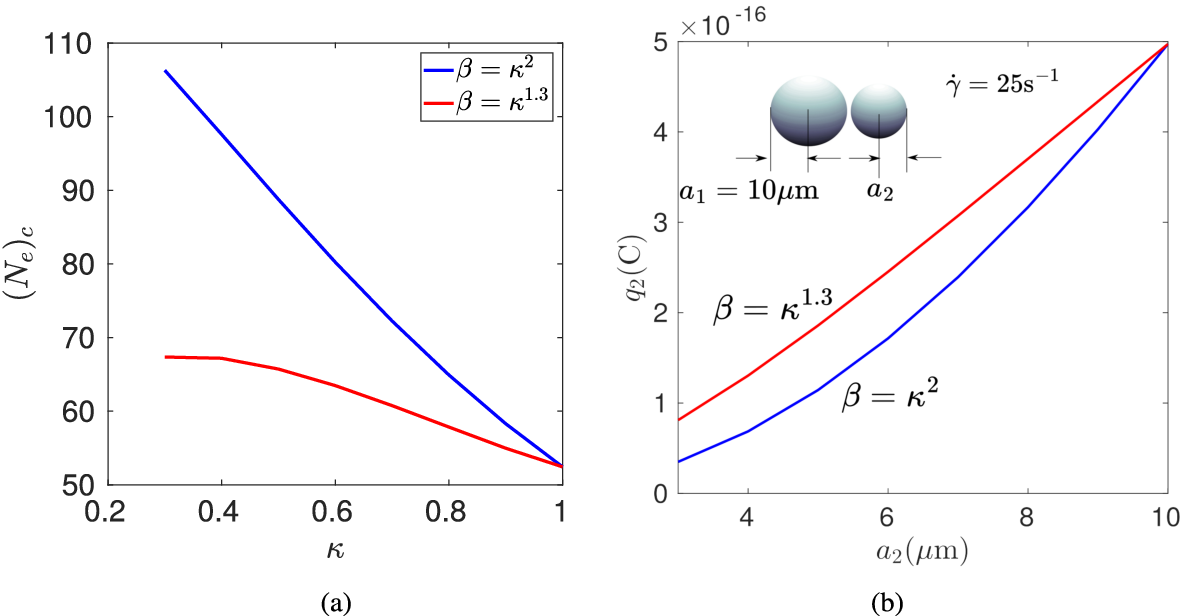
- Warm clouds: Typical charges on 10–20 µm droplets are modest. Ne is usually small (electric effects are weaker than the flow), but in some cases charges can still help droplets in the 15–40 µm “growth gap” collide and coalesce more efficiently.
- Volcanic plumes: Ash particles can carry very large charges, and Ne can be big. Here, electrostatics can dominate and strongly increase aggregation, changing how ash falls and spreads.
Why is this important?
This matters for:
- Rain formation: Droplets often need to collide and merge to grow into raindrops. Electric charges can speed this up under the right conditions, especially in the size range where neutral droplets grow slowly.
- Volcanic ash behavior: Charged ash clumps together and falls out faster, affecting the lifetime and spread of plumes, visibility, aviation safety, and ground deposits.
- Better models and forecasts: Many weather and hazard models assume that like charges always repel and reduce collisions. This paper shows that’s not always true. Including realistic electrostatics (finite-size and dielectric effects) can improve predictions of cloud microphysics and ash plume dynamics.
Bottom line
Even when particles have the same type of electric charge, their finite size and material properties can make them attract at close range and collide more often. This flips the usual “like charges repel” story and opens up new, counterintuitive pathways for droplet growth in clouds and ash aggregation in volcanic plumes. By blending fluid mechanics, short-range forces, and realistic electrostatics, this study provides a clearer picture of when and how tiny charged particles meet, stick, and change the atmosphere around us.
Knowledge Gaps
Knowledge gaps, limitations, and open questions
Below is a focused list of unresolved issues and limitations that, if addressed, would sharpen the paper’s conclusions and broaden their applicability.
- Role of external electric fields: Quantify how ambient fields (10–1000 V m⁻¹) in clouds and volcanic plumes alter trajectory topology and collision efficiency in uniaxial compression, including polarity, field strength, and temporal variability.
- Dynamic charge redistribution and leaky-dielectric behavior: Replace the fixed-surface-charge assumption with models that include Maxwell–Wagner charge relaxation, ion diffusion, finite conductivity (water and ash), and triboelectric/contact charging during approach; compare charging timescales against collision times across size ratios.
- Electrostatic screening by atmospheric ions: Incorporate Debye screening and realistic ion/aerosol concentrations (humidity, conductivity of air/steam) to determine how far-field repulsion and near-field attraction are modified; update N_e estimates under screened conditions.
- Non-continuum corrections to asymmetric hydrodynamic mobilities: Derive and assess Knudsen-number-dependent corrections for the asymmetric mobilities B and H at small gaps, and determine their impact on upstream interception areas and collision efficiency.
- Pair probability under polarization (non-solenoidal field): Compute the pair-distribution function P(r) for the full polarized interaction (not just monopole repulsion), and use it to obtain collision rates at the collision sphere when v is non-solenoidal.
- Turbulence representation beyond steady compression: Test sensitivity to time-dependent strain, rotational components, and finite lifetimes of strain events when electrostatics are present; quantify deviations from the steady linear-flow idealization.
- Inertia and finite-Reynolds-number effects: Identify regimes (e.g., larger volcanic ash in strong shear) where particle inertia (St > O(0.1)) and modest Re_p alter approach speeds/topology with electrostatics; extend the model to include these effects.
- Gravity and differential settling: Evaluate combined effects of compressional strain, electrostatics, and gravitational settling for polydisperse populations, including possible synergies or cancellations in collision efficiency.
- Collision vs coalescence outcomes: Incorporate thin-film drainage, electrostatic modification of film stability, and bounce/coalescence probabilities to convert collision efficiency into a coalescence kernel under varying charge–size conditions.
- Particle shape and dielectric heterogeneity: Replace the spherical, homogeneous-dielectric assumption with models for irregular ash particles and heterogeneous droplets; quantify how non-sphericity and heterogeneity affect polarization, lubrication, and near-field attraction.
- Population-level parameterization: Generalize from specific charge–size ratios to realistic distributions of q and a; produce parameterized collision kernels (with uncertainty bounds) suitable for cloud microphysics and ash-aggregation models.
- Experimental and field validation: Design controlled laboratory straining-flow experiments (charged droplets/ash) and targeted field measurements to validate the predicted non-monotonic collision efficiency and near-field attraction in like-charged pairs.
- Medium properties and leaky-dielectric air/steam: Assess how humidity, temperature, and air/steam conductivity (k_m frequency dependence) influence induced dipoles and polarization forces in clouds and volcanic plumes.
- Van der Waals uncertainties and interplay: Perform sensitivity analyses to Hamaker constants and retardation parameters (N_l) for water–air–ash systems; quantify the interplay with electrostatics in the lubrication regime.
- Numerical robustness: Provide a convergence/error analysis for the backward-integration method, including dependence on δ (offset from r=2), r_∞, resolution, and performance/stability when N_e ≫ 1.
- Many-body effects and clustering: Extend beyond binary interactions to explore how many-body hydrodynamic and electrostatic couplings modify local fields, trajectory topology, and aggregation in dense, electrified regions (e.g., pre-lightning clustering).
- Mixed polarity ensembles: Analyze collision enhancement/suppression for oppositely charged or mixed-polarity populations under compressional strain, and map regimes where mixed polarity dominates aggregation.
- Coupling with external-field EHD mechanisms: Include electrophoresis and dielectrophoresis in the presence of external fields, and evaluate how these electrohydrodynamic effects interact with background strain to reshape collision pathways.
- Frequency- and temperature-dependent dielectric response: Move beyond static permittivity to incorporate frequency-dependent polarization/relaxation and temperature effects; determine whether relative-motion timescales excite transient polarization regimes.
- Altitude-dependent Knudsen transitions: Systematically explore how variations in Kn with altitude (via mean free path changes) affect non-continuum lubrication and collision efficiency in the upper troposphere and stratospheric plume heights.
- Data-informed strain-rate statistics: Replace proxy strain estimates with measured/empirical distributions of turbulent strain in clouds/plumes; quantify the fraction of conditions where electrostatics dominate or are negligible.
- Charging laws and q(a) dynamics: Integrate physically based triboelectric/fracto-emission charging laws (humidity, mineralogy, contact frequency) to evolve q(a) during collisions and turbulence, rather than prescribing fixed charges.
Practical Applications
Immediate Applications
Below are near-term, actionable uses that can be piloted or deployed with current data, instrumentation, and modeling tools. Each item notes likely sectors, possible products/workflows, and key assumptions or dependencies that may affect feasibility.
- Charge-aware collision kernels in cloud and weather models (sector: weather/climate, academia)
- What to do: Incorporate size- and charge-ratio dependent collision efficiencies for like-charged droplets into bin or bulk microphysics schemes, especially for the 15–40 μm “bottleneck” range where collisional growth is critical.
- Tools/workflows: Parameterization module E12(κ, β, Ne, Kn) for WRF, ICON, COSMO; look-up tables generated from the paper’s trajectory-based solver; sensitivity studies in LES.
- Assumptions/dependencies: Uniaxial compressional flow approximates small-scale turbulence; low-Re, two-body interactions; spherical, non-deforming droplets; no external electric fields; requires in situ estimates of droplet charge-size distributions and local strain rates.
- Improved volcanic ash aggregation in dispersion and ashfall models (sector: geohazards/aviation, policy, academia)
- What to do: Add electrostatic enhancement of like-charged ash collisions in FALL3D/PUFF/ATHAM modules to better predict aggregation, fallout rates, and deposit patterns, especially when Ne ≳ O(1).
- Tools/workflows: E12 maps for ash dielectric properties; assimilation of proximal plume charge/size measurements; scenario libraries for mass eruption rate regimes.
- Assumptions/dependencies: Real ash is non-spherical and polydisperse; paper neglects external fields and charge transfer during contact; requires charge-size distributions and strain-rate estimates; sticking/fragmentation after contact must be modeled separately.
- Process control in aerosol reactors and spray dryers (sector: chemical/process, pharmaceuticals)
- What to do: Tailor corona/tribo-charging to target favorable κ–β regimes that enhance or suppress agglomeration in high-strain zones (mixers, converging ducts) to meet product PSD specs or avoid fouling.
- Tools/workflows: Design charts linking Ne to operating conditions (charge density, shear rate, humidity); inline monitoring of charge-size distributions; setpoints for ionizer voltage and residence time.
- Assumptions/dependencies: Local flow approximated by linear strain; dielectric constants and charge relaxation times known; downstream coalescence/sticking probability not guaranteed by contact alone.
- Electrostatic precipitators and wet/dry scrubbers: pre-agglomeration tuning (sector: energy, manufacturing, environmental)
- What to do: Adjust ionizer polarity/output to exploit near-field attraction of like-charged dielectric particles upstream of collection plates, increasing capture of submicron aerosols while limiting pressure drop.
- Tools/workflows: Charge–size distribution sensors for feedback control; computational mapping of E12 in converging/straining sections; retrofit guidance.
- Assumptions/dependencies: Device fields are non-negligible (paper neglects external fields); multi-particle and wall interactions important; ozone and byproduct constraints.
- Air purification and ionizer optimization (sector: consumer/indoor air, healthcare)
- What to do: Tune ionizer output and internal flow geometry to create straining zones that foster like-charge near-field attraction and aggregation of PM2.5/PM0.1 upstream of filters.
- Tools/workflows: CFD-aided redesign for uniaxial compression motifs; charge-aware performance metrics; compliance with ozone/EMI regulations.
- Assumptions/dependencies: Indoor air chemistry and humidity affect charge retention; complex flow geometries deviate from ideal linear strain; regulatory limits on ion emissions.
- Dry powder handling, EHS, and quality control (sector: manufacturing, pharma, food)
- What to do: Use humidity management, antistatic additives, and controlled charging to shift β and effective Ne to suppress undesired agglomeration (for flowability) or promote it (to reduce dustiness/ignition risk).
- Tools/workflows: On-line tribo-charge control; dielectric property tuning via additives; charge-size monitoring at hoppers and transfer points.
- Assumptions/dependencies: Irregular particle shapes and multi-body contacts dominate; flows may not provide sustained strain; interactions with solvents and coatings.
- Measurement protocols for charge–size distributions (sector: instrumentation, academia)
- What to do: Standardize in situ charge-size measurements (e.g., induction probes, charge-resolved mobility analysis, cloud probes) to estimate Ne and enable charge-aware kernel use in models.
- Tools/workflows: UAV tethered platforms for volcanic plumes; instrument packages for research aircraft in warm clouds; lab calibration with dielectric characterization.
- Assumptions/dependencies: Limited spatiotemporal resolution in field campaigns; charge can evolve during sampling; need co-measurement of turbulence dissipation (ε) to estimate strain.
- Open-source numerical module for collision efficiency (sector: academia, software)
- What to do: Release trajectory-based solver implementing dielectric electrostatics and non-continuum lubrication to generate E12(κ, β, Ne, Kn) tables.
- Tools/workflows: Python/C++ library with APIs for WRF/LES coupling; reproducible notebooks for parameter sweeps; validation against benchmark cases.
- Assumptions/dependencies: Community adoption requires documentation and test cases; extended validation for non-spherical particles and external field effects remains.
Long-Term Applications
These applications require further research, data, or engineering development (e.g., more comprehensive coupling with electric fields, particle shapes, and multi-body/turbulence effects) before operational deployment.
- Electrostatic weather modification for drizzle initiation (sector: weather/climate policy, ethics)
- Concept: Use ion sources or charged aerosols to steer κ–β toward regimes shown to enhance like-charge collisional growth in 15–40 μm droplets, potentially accelerating warm-rain onset.
- Potential products/workflows: Ground-based or airborne ionization systems; charge-aware targeting integrated with boundary-layer LES guidance.
- Assumptions/dependencies: Significant ethical/regulatory review; uncertain efficacy in fully turbulent, multi-scale environments; strong dependence on ambient electric fields, charge redistribution, and aerosol chemistry.
- Coupled volcanic lightning–aggregation nowcasting (sector: aviation safety, geohazards)
- Concept: Integrate collision-enhanced aggregation with charging/field evolution models to predict lightning potential and ash deposition in near-real time.
- Potential products/workflows: Data assimilation of LMA (Lightning Mapping Arrays), Doppler lidar, and plume charge sensors; operational guidance for aviation routing.
- Assumptions/dependencies: Requires models including external fields, charge transfer in collisions, non-spherical ash, and multi-particle clustering.
- HVAC and urban air cleaning with engineered straining–charging modules (sector: smart buildings, public health)
- Concept: Design compact flow elements producing uniaxial compression combined with controlled charging to promote aggregation of ultrafine particles in ventilation systems.
- Potential products/workflows: Modular “straining-ionizer” cartridges; adaptive control based on PM and charge sensors.
- Assumptions/dependencies: Energy/maintenance costs vs filtration gains; ozone and byproduct emissions; efficacy with complex urban aerosol mixtures.
- Additive manufacturing and powder-bed process control (sector: advanced manufacturing)
- Concept: Shape charge distributions of polymer/metal powders and exploit recoater- or nozzle-induced strain to tune agglomeration and improve layer uniformity or prevent defects.
- Potential products/workflows: Inline tribo-chargers; dielectric coatings to adjust β and charge relaxation; closed-loop monitoring of charge-size spectra.
- Assumptions/dependencies: High-temperature, non-spherical powders; mechanical contacts dominate; strong external fields present in some systems.
- Climate models with charge-aware autoconversion thresholds (sector: climate science)
- Concept: Revise bulk autoconversion and accretion schemes to include the non-monotonic, charge- and size-ratio dependent collision efficiencies and their environmental dependence (Ne, Kn).
- Potential products/workflows: Multi-scale parameterizations in Earth system models; ensemble constraints using satellite/radar metrics.
- Assumptions/dependencies: Requires climatology of cloud droplet charging and strain rates; coupling with aerosol chemistry and global electric circuit models.
- Autonomous platforms estimating Ne in situ (sector: environmental sensing)
- Concept: Drones or balloons carrying micro-instruments to retrieve charge-size distributions and turbulence dissipation for real-time Ne mapping in clouds and plumes.
- Potential products/workflows: Miniaturized electrometers, DMAs, and ε-sensors; onboard computation of collision kernel adjustments.
- Assumptions/dependencies: Sensor sensitivity and robustness; limited endurance; safety in electrified plumes.
- Enhanced scrubber/reactor designs using oscillatory straining flows (sector: process engineering)
- Concept: Use pulsatile or oscillatory flow to create repeated uniaxial compression cycles while managing charging conditions to maximize collisions among fine particulates.
- Potential products/workflows: Prototype oscillatory-strain contactors; co-optimization with ionizer/tribo-charging units.
- Assumptions/dependencies: Scale-up and pressure drop constraints; multiphase wetting/coalescence behavior needs characterization.
- Smoke and fire control via electrostatic aggregation (sector: safety, emergency response)
- Concept: Rapidly charge smoke particles and drive aggregation in designed straining zones for faster clearance in enclosed environments.
- Potential products/workflows: Deployable mobile units for tunnels/ships; integrated straining–charging nozzles.
- Assumptions/dependencies: Toxic byproduct management; power and airflow requirements; effectiveness in complex thermal plumes.
Notes on Cross-Cutting Assumptions and Dependencies
- Flow physics: The study models collisions in steady uniaxial compressional flow as a proxy for turbulent strain at Kolmogorov scales; applicability depends on turbulence structure and event lifetimes.
- Particle physics: Low-Re, two-body interactions; particles are spherical, inertialess, and non-deforming; Brownian motion neglected; near-field physics includes non-continuum lubrication, van der Waals, and dielectric electrostatics.
- Electrostatics: External electric fields are neglected in the core analysis; charges are assumed fixed over the collision timescale; air is weakly conducting (minimal screening); dielectric constants must be known.
- Outcomes: “Collision” denotes geometric contact; coalescence/adhesion probability and post-contact charge transfer are system-specific and may require separate modeling or experiments.
- Scaling: Ne can be small in warm clouds (typically ≤ 0.1) but large in volcanic plumes (O(1)–O(103)), making electrostatics far more influential in the latter; Nv is usually secondary, especially for larger ash particles.
Glossary
- aggregation: The process by which particles stick together to form larger clusters or aggregates. "Within volcanic plumes, particle collisions promote sticking and ash aggregation, accelerating fallout, altering deposit size distributions, and shaping long-range transport"
- axisymmetric mobilities: Hydrodynamic mobility functions describing symmetric motion along the line of centers between spheres. "Specifically, and are axisymmetric mobilities"
- asymmetric mobilities: Hydrodynamic mobility functions associated with tangential or non-axisymmetric motion and non-hydrodynamic forces. "while and are asymmetric mobilities corresponding to linear flow and non-hydrodynamic forces, respectively."
- bispherical coordinate system: A curvilinear coordinate system suited for problems involving two spheres, used to derive electrostatic potentials. "by deriving the potential field in a bispherical coordinate system."
- Brownian diffusion: Random motion of particles due to thermal fluctuations, significant for very small particles. "we assume that the particles are sufficiently large, so Brownian diffusion is negligible."
- Clausius–Mossotti factor: A dimensionless parameter relating dielectric contrast to polarizability in a medium. "is the ClausiusâMossotti factor characterizing the relative polarizability of the particle in its medium;"
- collision efficiency: The ratio of the actual collision rate to the ideal collision rate in a given flow. "defines the collision efficiency, denoted as :"
- collision sphere: The spherical surface of radius equal to the sum of particle radii that marks the onset of contact. "The sphere with a dimensionless radius of is referred to as the collision sphere."
- Coulombic repulsion: Electrostatic repulsive force between like charges following an inverse-square law. "(b) with Coulombic repulsion at , only a subset of trajectories reach the collision sphere, while others are deflected."
- dielectric constant: The relative permittivity of a material, determining its response to electric fields. "including water, with a dielectric constant of approximately 80."
- Fokker–Planck equation: A conservation equation for probability density used to model pair distributions without diffusion here. "the quasi-steady Fokker-Planck equation applicable to the spatial region external to the contact surface:"
- fracto-emission: Charge generation mechanism associated with the fracture or breakage of materials (e.g., ash). "extreme particle charging via fracto-emission and triboelectric effects."
- global electric circuit: The planetary-scale electrical system that maintains fair-weather electric fields influencing clouds. "embedded in the broader context of the global electric circuit, where fair-weather fields provide a persistent background potential influencing droplet interactions"
- Hamaker constant: A material-dependent constant quantifying the strength of van der Waals interactions. " (the Hamaker constant)"
- homogeneous, isotropic turbulence: Turbulence with uniform statistical properties and no preferred direction. "charged particles in homogeneous, isotropic turbulence"
- hydrodynamic interaction: Fluid-mediated coupling between particles that alters their relative motion in flow. "analysed the hydrodynamic interaction of rigid spheres in a background linear flow."
- Knudsen number: The ratio of the mean free path to a characteristic length scale, indicating non-continuum effects. "Knudsen number, defined as ."
- Kolmogorov scale: The smallest turbulent length scale where viscous effects dominate. "When particle sizes are much smaller than the Kolmogorov scaleâtypically in the order of few in atmospheric cloudsâ"
- London wavelength: A characteristic electromagnetic wavelength setting the scale for retardation in van der Waals forces. "London wavelength \textmu m"
- mean free path: The average distance a gas molecule travels between collisions, relevant to non-continuum effects. "the mean free path of the medium, denoted as ."
- method of electrical images: An analytical electrostatics technique that replaces boundaries with equivalent image charges. "Using the method of electrical images, \citet{Khain_etal_2004} obtained an approximate expression for the electrostatic force between two charged conducting spheres"
- mobility functions: Dimensionless hydrodynamic coefficients (A, B, G, H) relating forces/flows to particle velocities. "The mobility functions , , , and capture the hydrodynamic interactions."
- monopole-induced dipole attraction: Attraction arising from a charge inducing a dipole in a nearby body. "contains the monopole--monopole repulsion as well as the monopole-induced dipole attraction."
- monopole–monopole repulsion: Repulsive interaction between two point charges (or charged spheres at long range). "the monopole--monopole repulsion"
- non-continuum lubrication interactions: Corrections to near-contact hydrodynamic resistance when the gas mean free path is not negligible. "we must account for the non-continuum lubrication interactions."
- non-solenoidal relative velocity field: A velocity field with nonzero divergence, implying local sources or sinks. "The monopole-induced dipole interaction results in a non-solenoidal relative velocity field"
- pair distribution function: The probability density of finding a particle at a given separation from another in a suspension. "where denotes the pair distribution function"
- particle Reynolds number: A dimensionless number comparing particle-scale inertial to viscous forces. "The particle Reynolds number, denoted as , is defined in terms of the compression rate and the radius of the larger particle as follows: "
- polydisperse suspension: A suspension containing particles of different sizes. "We consider a dilute polydisperse suspension of charged spheres"
- retarded van der Waals potential: Van der Waals interaction modified by finite electromagnetic propagation speed at larger separations. "the retarded van der Waals potential given in \citet{zinchenko1994gravity}."
- Stokes equations: The linear equations governing viscous, low-Reynolds-number (creeping) flow. "the fluid motion around the particle pair can be accurately described using the Stokes equations."
- Stokes number: A dimensionless measure of particle inertia relative to flow time scales. "The Stokes number, represented by , captures the effects of particle inertia"
- strain rate tensor: The symmetric part of the velocity gradient describing deformation of the flow. " represents the strain rate tensor"
- tribo-electrification: Charge transfer generated by frictional contact between particles. "tribo-electrification persists far from the source"
- uniaxial compressional flow: A linear flow with compression along one axis and equal extension along the other two axes. "subjected to a uniaxial compressional flow"
- upstream interception area: The far-field area whose streamlines lead to contact; used to compute collision rates. "referred to as the upstream interception area, "
- van der Waals attraction force: Short-range intermolecular force causing attraction between bodies due to induced dipoles. "The van der Waals attraction force, $\boldsymbol{F}_{\text{vdW}$, always acts along the line connecting two spheres"
- viscous relaxation time: The characteristic time for a particle to adjust its velocity due to viscous drag. "with denoting the viscous relaxation time of the larger particle"
Collections
Sign up for free to add this paper to one or more collections.