Geometric phase of exceptional point as quantum resonance in complex scaling method
Published 31 Dec 2025 in quant-ph, hep-th, and nucl-th | (2512.24528v1)
Abstract: Non-Hermitian operators and exceptional points (EPs) are now routinely realized in few-mode systems such as optical resonators and superconducting qubits. However, their foundations in genuine scattering problems with unbounded Hamiltonians remain much less clear. In this work, we address how the geometric phase associated with encircling an EP should be formulated when the underlying eigenstates are quantum resonances within a one-dimensional scattering model. To do this, we employ the complex scaling method, where resonance poles of the S-matrix are realized as discrete eigenvalues of the non-Hermitian dilated Hamiltonian, to construct situations in which resonant and scattering states coalesce into an EP in the complex energy plane, that is, the resonance pole is embedded into the continuum spectrum. We analyze the self-orthogonality in the vicinity of an EP and the Berry phase. Our results provide a bridge between non-Hermitian spectral theory and the traditional theory of quantum resonances.
The paper demonstrates that EPs serve as quantum resonances in infinite-dimensional scattering systems via complex scaling and an inverted Rosen–Morse potential.
It employs a momentum-bin discretization method to accurately capture continuum eigenstates and reveals the breakdown of biorthogonality at EP coalescence.
The study computes a nontrivial Berry phase from encircling the EP, highlighting its implications for decay dynamics in open non-Hermitian quantum systems.
Geometric Phase of Exceptional Points as Quantum Resonance in the Complex Scaling Method
Introduction and Motivation
The paper "Geometric phase of exceptional point as quantum resonance in complex scaling method" (2512.24528) addresses a fundamental issue in non-Hermitian quantum mechanics: the precise correspondence between exceptional points (EPs) and quantum resonances in genuinely infinite-dimensional scattering systems. While non-Hermitian Hamiltonians and EPs are well-characterized in finite-dimensional or few-mode physics—such as optical resonators and engineered quantum systems—their interpretation and manifestation in unbounded, continuum, and rigorously-defined open quantum systems remain inadequately understood.
This work leverages the complex scaling method (CSM), which enables the analytic continuation of unbounded Hamiltonians so that resonance poles of the scattering S-matrix become discrete eigenvalues of a non-Hermitian, dilated Hamiltonian. The authors develop a one-dimensional scattering scenario (inverted Rosen–Morse potential) in which a resonance pole and a continuum state coalesce at an EP in the complex energy plane, and then analyze the geometric (Berry) phase structure, biorthogonality breakdown, and spectral signatures of EPs in this context.
Theoretical Framework: Resonances and Complex Scaling
CSM provides an analytic framework where physical (non-normalizable) Gamow resonance states are regularized to normalizable eigenvectors owing to the rotation of coordinates in the complex plane. The model of choice—the inverted Rosen–Morse (Pöschl–Teller) potential—admits exact solutions for both the spectrum and wavefunctions under complex scaling:
The resonance energies EnR manifest as discrete complex eigenvalues, their position dictated by the parameters λ (potential strength), β (range), and the scaling angle θ.
As θ varies, the continuum branch cut of the spectrum rotates, and at specific critical angles θn, a resonance pole EnR becomes embedded in the (complex) continuum, thus realizing an EP.
(Figure 1)
Figure 1: Schematic of the energy-plane in CSM—the rotated branch cut (blue) and resonance poles (red)—as scaling angle θ is varied. At certain critical values θn, a resonance pole merges with the continuum, realizing an EP.
The analytic conditions for embedding a resonance into the continuum (and thereby achieving an EP) are specified by root-finding equations such as:
tan2θ=−ReEnRImEnR
As θ passes through θn, the number of normalizable (regularized) states in the Hilbert space changes discontinuously—an essential feature of EPs in this setting.
Momentum-Bin Discretization and Biorthogonality
The paper addresses the technical problem of treating the unbounded continuum spectrum by introducing the momentum-bin discretization method, where continuum eigenstates are averaged over small momentum intervals ("bins"), yielding a discrete but accurate representation. This approach is generalized to the complex-scaled (i.e., non-Hermitian) Hamiltonian, with biorthogonalization required due to the lack of Hermiticity.
Normalization and orthogonality are established using both right and left eigenvectors, and the full spectral problem is represented in a basis including both regularized resonance and discretized continuum states.
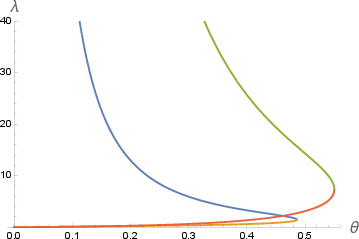
Figure 2: Admissible parameter regions for λ as a function of the scaling angle θ, showing the critical boundaries (λ0,1±) for resonance regularization. Only in specific regions does the resonance state become regularized and eligible to contribute as an EP candidate.
A key insight from this construction is the emergence of self-orthogonality at the EP: as the resonance merges with the continuum, the left–right biorthogonalization collapses and the Hamiltonian develops a Jordan block, making the spectral decomposition defective—a hallmark of EP behavior in non-Hermitian theory.
Exceptional Points and the Coalescence of Resonance and Continuum
By tuning the potential strength λ rather than θ, the authors explore the characteristic coalescence behavior at EPs. At the branch point λbp, the resonance eigenvalue collides with the analytic continuation of the continuum, and:
The resonance wavefunction morphs into a continuum scattering state.
The set of independent eigenfunctions reduces, manifesting the non-diagonalizability of the Hamiltonian.
(Figure 3)
Figure 3: Evolution of the resonance pole in the complex energy plane as λ approaches the critical value λbp. Left: Isolated resonance. Right: Resonance embedded into continuum—at the EP, the resonance pole coalesces with the continuum, and the wavefunctions become identical.
The breakdown of biorthogonality is nontrivial. Taking limits in different orders for integrals and parameter variation shows that the overlap between “resonance” and “continuum” states does not behave simply, which is a signature of non-Hermitian degeneracy.
(Figure 4)
Figure 4: Contour in the complex λ-plane encircling the EP. Different regions correspond to convergent (normalizable) resonance, divergent (non-regularized), and continuum (scattering) solutions.
Berry Phase and Geometric Structure at the EP
A significant result is the computation of the geometric/Berry phase structure associated with encircling the EP in parameter space. Using Moiseyev's ansatz for the square-root branch structure of the eigenenergy near the EP,
ECSMθ(λ)=Ebp+αλ−λbp+O(λ)
the authors show that when λ adiabatically rotates around the EP, the eigenfunction acquires a multi-valued geometric phase:
After a 4π rotation, the wavefunction picks up a sign change, indicating a nontrivial Berry (geometric) phase.
Full periodicity is 8π due to the underlying analytic structure.
(Figure 5)
Figure 5: Illustration of the analytic continuation around Ebp and connection of resonance/continuum solutions under parameter rotation. The Berry phase and multi-valuedness arise from the EP branch structure.
This multivalued structure directly extends the finite-dimensional EP Berry phase phenomena to the physically pertinent case of resonance-continuum coalescence in infinite-dimensional, rigorously defined Hamiltonians.
Implications and Future Developments
The methods and results of this work solidify the conceptual and mathematical foundations linking non-Hermitian spectral theory, EP topology, and resonance physics:
The paper demonstrates that EPs, their Jordan block structure, and geometric phases are not artifacts of finite-dimensional or effective models, but persist—and can be precisely defined—in true scattering theory.
The approach enables a systematic extension to analyze resonance-induced Berry phases, Stokes-topological features, and the role of EPs in decay, non-Markovianity, and non-Hermitian open quantum systems.
A notable implication is that the EP-induced breakdown of the spectral decomposition has physical consequences for the time evolution and observable decay characteristics of open quantum systems—precisely in settings realized in nuclear, atomic, and photonic platforms.
The momentum-bin method for discretizing the continuum is particularly promising for future numerical and analytical investigations, including the study of quantum dynamical phenomena near EPs, anomalous decay, and the emergence—or breakdown—of effective non-Hermitian descriptions in interacting field theory.
Conclusion
This paper provides a rigorous theoretical bridge between non-Hermitian topology (exceptional points, Berry phase) and the analytic machinery of quantum resonances via the complex scaling method. The analysis confirms that the topological and algebraic features of EPs survive in the spectral theory of infinite-dimensional, realistic quantum scattering systems. The explicit identification of branch points, Berry phases, and self-orthogonality at the resonance-continuum EP reveals the deep geometric and analytic structure underlying non-Hermitian physics beyond finite-dimensional toy models.
The results lay groundwork for future investigations into non-Hermitian dynamics in quantum field theory, decay and open system dynamics near EPs, and the topological structure of genuine scattering continua.