- The paper introduces Mathieu control to achieve precise, continuous tunability of ZZ couplings by leveraging selective two-photon parametric drives in superconducting qubits.
- Numerical exact diagonalization and a Schrieffer-Wolff treatment validate the monotonic, wide-range tuning of the effective coupling (Jzz) with gate fidelities above 99.9% and leakage below 10⁻⁵.
- By decoupling interaction strength from qubit state dressing, the method enables scalable architectures and programmable quantum simulation for fault-tolerant quantum processors.
Mathieu Control for Tunable Couplings in Superconducting Qubits
Introduction
The tunability and high-fidelity control of interactions between superconducting qubits are key obstacles for universal quantum computation and quantum simulation with scalable transmon architectures. Existing control methodologies—based on resonant microwave drives or static/parametric modulation of couplers—are limited by inherent trade-offs: increasing gate speed and interaction strength typically induces excessive dressing of the qubit states, enhancing leakage and crosstalk, and complicating the computational subspace structure. The work "Mathieu Control of the Effective Coupling in Superconducting Qubits" (2512.24992) introduces a new framework, termed Mathieu control, which leverages selective two-photon parametric drives to induce nonlinear, spectrally targeted frequency shifts. This decouples tunability from subspace integrity, providing continuous, in situ control over effective ZZ couplings without sacrificing logical fidelity or increasing leakage, and enabling scalable, programmable architectures for quantum simulation.
Theoretical Framework and Control Principle
Mathieu control utilizes a non-resonant, two-photon parametric drive applied to the quadratic potential of a superconducting mode (typically a SQUID loop) to enable effective, dispersive engineering of the qubit’s anharmonicity and qubit-qubit interactions. The parametric drive induces a nonlinear shift in the oscillator energy levels, which, for appropriately chosen frequencies and amplitudes, can selectively modify the anharmonic ladder structure while protecting population in the computational subspace (∣0⟩, ∣1⟩). The effective Hamiltonian under these drives contains terms of the form ϵcos(ωdt)(a^2+a^†2); under the rotating wave approximation, these couple Fock states ∣i⟩ and ∣i+2⟩ dispersively, leading to drive-tunable level repulsion and hence shifts in the effective coupling matrix elements.
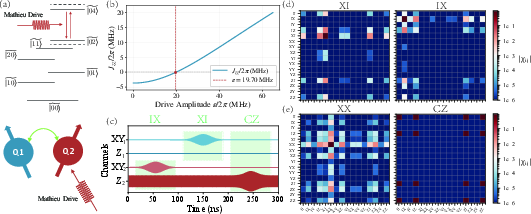
Figure 1: Schematic of two directly coupled transmons under two-photon Mathieu flux drive and drive-induced tunability of the effective ZZ interaction Jzz, as well as qubit gate pulse protocols and process matrix characterizations.
Tunable ZZ Interactions and Gate Implementation
A prototypical setting is two capacitively coupled transmons, where a non-resonant two-photon drive is applied to the second qubit. A Schrieffer-Wolff treatment yields an effective static Hamiltonian with a ZZ coupling term whose strength Jzz can be continuously tuned by the drive amplitude ϵ, even traversing through zero. Explicitly, this achieves full suppression of interaction without the requirement for bias adjustments, frequency tuning, or additional circuit components.
Numerical exact diagonalization confirms the analytic predictions and demonstrates precise, monotonic control over Jzz with a wide dynamic range. This enables unified, gate-time-programmable implementations of both single- and two-qubit gates: at the zero-crossing of Jzz, the qubits are fully decoupled, allowing simultaneous low-crosstalk single-qubit gates. For two-qubit entangling gates (e.g., controlled-phase), the drive amplitude is pulsed away from zero, inducing a conditional phase via finite Jzz. Quantum process tomography indicates fidelities above 99.9% for all gates (CZ: 99.994%, single-qubit X: 99.945–99.970%) with unitarity errors in the 10−5 regime, and leakage well below threshold for error-correction codes.
Scalable Heisenberg Interaction Engineering
The Mathieu control mechanism generalizes naturally to extensible architectures, such as qubit–coupler–qubit chains (QCQ, Figure 2), by targeting only the coupler’s mode with multi-photon drives. This generates a programmable XXZ-type Hamiltonian,
Heff=2Jxx(σx1σx2+σy1σy2)+4Jzzσz1σz2,
where the exchange (Jxx) and Ising (Jzz) components can be largely programmed independently by static coupler frequency and by the Mathieu drive parameters, respectively.
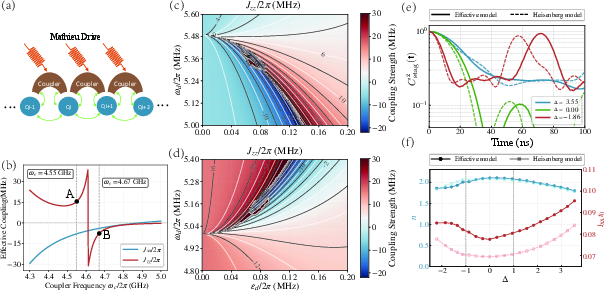
Figure 2: QCQ chain schematic (top left), static and parametric control of effective couplings, two-dimensional parameter mapping of Jzz versus drive amplitude and frequency, and nonequilibrium dynamics for simulating XXZ-phase crossover in a five-qubit chain.
By simultaneously addressing all couplers in a multi-qubit chain, the overall anisotropy parameter Δ=Jzz/2Jxx can be tuned, enabling dynamical simulation of transitions between antiferromagnetic/Ising-type and XY phases, as confirmed by the evolution of staggered σz correlators. The driven chain’s relaxation profiles closely match the exact diagonalization of the pure XXZ model, capturing both regime boundaries and quantum critical behavior, with only minor quantitative renormalization due to basis dressing and residual noise.
Numerical and Experimental Outcomes
The scheme delivers strong, quantitatively validated suppression of leakage (<10−5), high gate fidelities (>99.9%), monotonic and wide-range Jzz tunability, and minimal crosstalk for simultaneous single- and two-qubit gates. For programmable quantum simulation, faithful reproduction of phase boundaries and dynamic observables is achieved for system sizes relevant to near-term devices.
Implications and Future Outlook
Mathieu control introduces a generalizable, hardware-agnostic protocol for Hamiltonian engineering that extends beyond superconducting qubits to any nonlinear oscillator with programmable parametric coupling (e.g., trapped ions or nano/optomechanical modes). By decoupling interaction strength from qubit state dressing, it streamlines quantum control architectures and reduces calibration overhead, which is of paramount importance for both NISQ-computing and near-future quantum simulation platforms. The demonstrated programmability of local and nonlocal couplings offers a template for scalable, dynamically reconfigurable quantum simulation, and increases the viability of fixed-frequency, high-coherence device geometries for error-corrected operation.
Further research may focus on integrating Mathieu control with error-correction and compiler-level crosstalk mitigation strategies, extending protocols to higher-dimensional qubit lattices, and exporting the technique to novel physical realizations leveraging nonlinear parametric resonance.
Conclusion
Mathieu control fundamentally advances the tunable interaction paradigm in superconducting quantum circuits by leveraging spectrally selective, two-photon nonlinearities to provide independent, low-leakage, high-fidelity control over effective qubit–qubit couplings. This unifies gate control and programmable quantum simulation, with strong empirical and theoretical support for its application in large-scale, fault-tolerant quantum processing platforms.