- The paper introduces a fully integrated CSX optimization pipeline that combines electromagnetic, mechanical, and manufacturing constraints through iterative finite-build modeling.
- It achieves low QA errors, reduced effective ripple, and controlled coil strain, thereby promising improved neoclassical confinement in compact stellarators.
- The study also establishes rigorous sensitivity and tolerance analyses, guiding precision NI-HTS coil manufacturing and enabling flexible experimental configurations.
Update on the Design of the Columbia Stellarator eXperiment (CSX): Expert Summary
Project Motivation and Objectives
The Columbia Stellarator eXperiment (CSX) represents a contemporary realization of an experimental, university-scale stellarator aimed at three intersecting objectives: (1) elucidation of neoclassical transport, specifically in nearly quasi-axisymmetric (QA) configurations, (2) demonstration and advancement of non-insulated, high-temperature superconducting (NI-HTS) magnet technology in a stellarator setting, and (3) providing a practical platform for education and training in toroidal fusion science and engineering. The device embodies a hybrid approach leveraging two planar copper poloidal field (PF) coils and two interlinked (IL) NI-HTS coils within a compact vacuum vessel, with engineering reuse of legacy infrastructure from the Columbia Non-neutral Torus (CNT).
Optimization Framework and Methodological Innovations
The CSX design is driven by rigorous optimization of both physics and engineering objectives, leveraging a Boozer-surface approach for coil-plasma coupling. Critically, the optimization incorporates rotational transform, QA error, plasma volume, and engineering constraints such as coil-to-plasma separation, strain limits (0.22%) on HTS tape, coil length (<5m), and winding feasibility. Unlike prior approaches, the current work introduces automatic sampling of optimization hyperparameters via randomized selections, systematically mitigating local minima entrapment and obviating manual weight tuning.
A primary innovation is the iterative refinement process in which candidate configurations, initially selected via a single-filament coil model, are evaluated and improved via finite-build, multi-filament modeling. The latter addresses real-world coil geometry and associated electromagnetic and mechanical deviations emerging from finite conductor dimensions, validated through a convergence study on filament number.
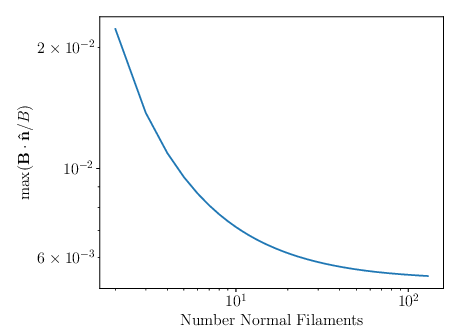
Figure 1: Scaling of normalized magnetic field error with increasing number of normal filaments, demonstrating the necessity for sufficient filament resolution in finite-build modeling.
A new geometric penalty targeting the torque-concavity interplay is included in the objective function to suppress problematic local torsion in concave coil segments, observed during prototyping to exacerbate winding tension and strain.
Finite-Build Modeling: Field and Mechanical Corrections
Finite-build modeling addresses the discrepancy between idealized filamentary coils and the constructed NI-HTS winding pack, structurally reformulated using multi-filament cross-section representations. The approach implements independent optimization of current distribution within the stack and explicit geometric modeling of each filament, directly impacting achievable field accuracy and strain distribution.
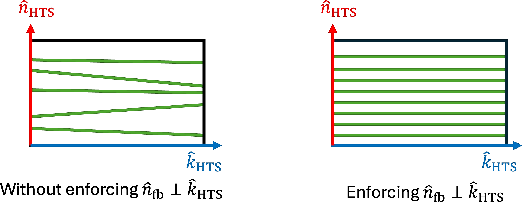
Figure 2: Comparison of HTS tape stack cross-sections with and without enforcing perpendicularity constraints in filament placement; misalignment leads to geometric incompatibility and increased local strain.
Strain analysis reflects the geometrically induced variation across the stack, following the formalism of Paz-Soldan et al., with explicit calculation of torsion and binormal curvature-induced strain. It is shown that the unconstrained projection to a finite-build model from a single-filament design often unpredictably exacerbates strain concentrations, especially near coil bends.
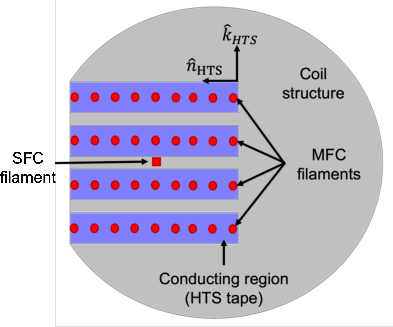
Figure 3: Visualization of filament placement for strain analysis in the finite-build model, emphasizing proper cross-section centering for accurate mechanical assessment.
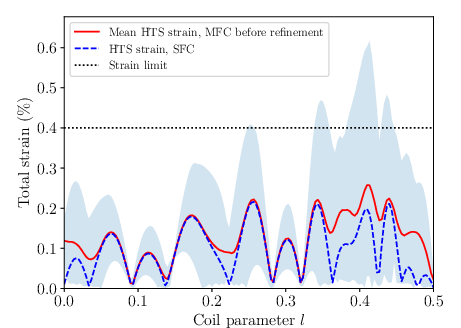
Figure 4: Strain profiles comparing SFC and MFC for the CSX coil; finite-build effects can drive certain filaments above the critical strain threshold, necessitating re-optimization.
Key metrics (QS error, maximum field error, and maximum HTS strain) are restored to acceptable values by direct finite-build-aware re-optimization, reinforcing the necessity of integrated electromagnetic and mechanical modeling early in the design loop.
A selection process evaluating 19 configurations converged on a single configuration balancing plasma performance and engineering practicality. The resultant design achieves a major radius 0.253m, minor radius 0.139m (aspect ratio 1.82), and plasma volume 0.097m3.
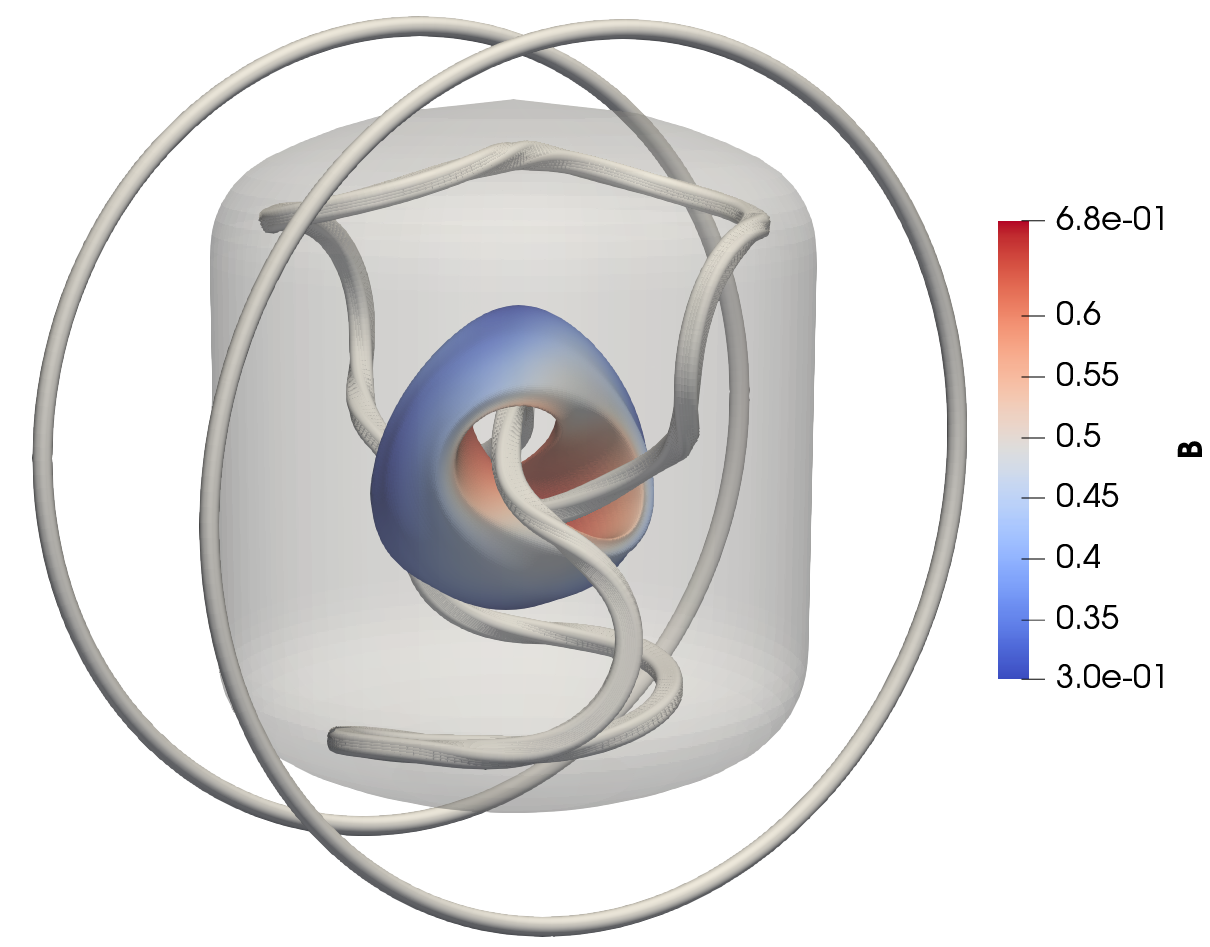
Figure 5: Three-dimensional rendering of the final CSX configuration, with plasma boundary coloration reflecting magnetic field strength and demonstrating non-axisymmetry.
Magnetically, the configuration achieves its principal targets: QA error below 8%, adequate plasma volume, and rotational transform ι∼0.27, with robust coil-to-plasma and coil-to-vessel spacing for engineering integration. Forces on coils remain under 2.2kN, and wind/strain limits are met within practical standards for NI-HTS technology.
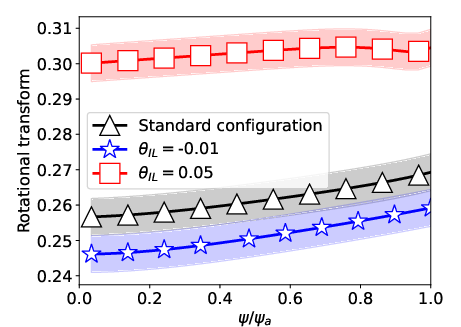
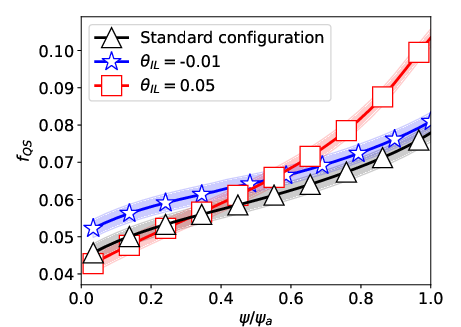
Figure 6: Rotational transform (top) and QS error (bottom) profiles for the final configuration, showing small QS error and stable transform across the volume; shading denotes manufacturing uncertainty estimates.
Notably, the effective ripple ϵeff is substantially reduced relative to CNT and comparable to other compact quasisymmetric stellarators such as HSX and CSSC, indicating strong neoclassical confinement prospects.
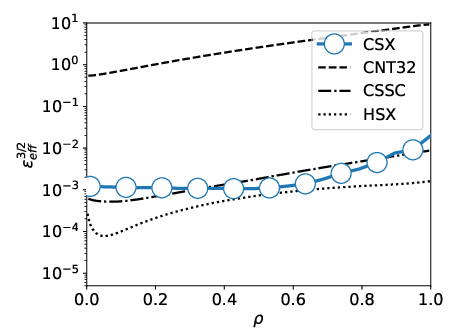
Figure 7: Comparison of ϵeff for CSX and other relevant stellarators, quantifying the anticipated improvement in neoclassical transport properties.
Engineering Sensitivity and Tolerance Analysis
A detailed Monte Carlo sensitivity study on coil geometric errors—modeling both manufacturing (via multi-scale Gaussian processes) and installation tolerances (via rigid-body perturbations)—quantifies the probability of satisfying key physics constraints (QA error, edge rotational transform) under realistic construction and alignment inaccuracies.
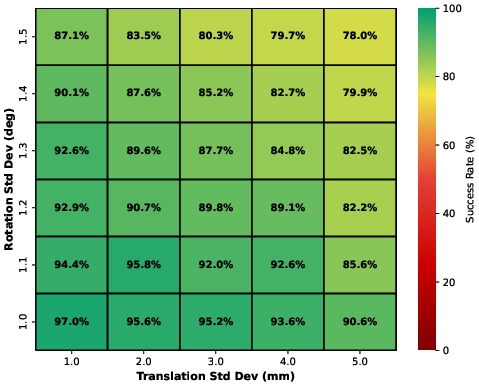
Figure 8: Success rates for perturbed configurations as a function of spatial and angular deviation, establishing tolerances necessary for experimental viability.
Statistical and shape gradient analyses yield tolerances on coil spatial positioning (∼3 mm) and rotation (∼1^\circ),andidentifyregionsofheightenedsensitivityforfocusedmetrologyandmanufacturingprecision.<imgsrc="https://emergentmind−storage−cdn−c7atfsgud9cecchk.z01.azurefd.net/paper−images/2601−00673/qsdistributionkde.png"alt="Figure9"title=""class="markdown−image"loading="lazy"></p><p><imgsrc="https://emergentmind−storage−cdn−c7atfsgud9cecchk.z01.azurefd.net/paper−images/2601−00673/iotadistributionkde.png"alt="Figure9"title=""class="markdown−image"loading="lazy"><pclass="figure−caption">Figure9:Distributionsoff_{\text{QS}}and\iota_\text{edge}underrealisticperturbations,withtheunperturbedreferenceindicated;tailssignifypotentialforbothimprovementanddegradation.</p><imgsrc="https://emergentmind−storage−cdn−c7atfsgud9cecchk.z01.azurefd.net/paper−images/2601−00673/shapegradientplot−2.png"alt="Figure10"title=""class="markdown−image"loading="lazy"><pclass="figure−caption">Figure10:ShapegradientvisualizationforedgerotationaltransformandQSerror,highlightingcoilsegmentswithhighsensitivitytogeometricerrors.</p></p><h2class=′paper−heading′id=′experimental−flexibility−and−configurational−control′>ExperimentalFlexibilityandConfigurationalControl</h2><p>CSXisdesignedforbroadconfigurationalflexibility.RotationoftheILcoils(parameterizedby\theta_{IL})andadjustablePF−to−ILcurrentratiospermitsystematicscansacrossarangeofplasmashapesandneoclassicalregimes.<imgsrc="https://emergentmind−storage−cdn−c7atfsgud9cecchk.z01.azurefd.net/paper−images/2601−00673/volumedependenceonilangle.png"alt="Figure11"title=""class="markdown−image"loading="lazy"><pclass="figure−caption">Figure11:EnclosedplasmavolumeasafunctionofIL−coilrotation,demonstratingtheimpactofgeometriccontrolonachievableoperationalregimes.</p><imgsrc="https://emergentmind−storage−cdn−c7atfsgud9cecchk.z01.azurefd.net/paper−images/2601−00673/fullprofilescombined.png"alt="Figure12"title=""class="markdown−image"loading="lazy"><pclass="figure−caption">Figure12:RotationaltransformandQSerrorprofilesforconfigurationswithvariedIL−coilangles,showingtheattainable<ahref="https://www.emergentmind.com/topics/diversity−beta−recall"title=""rel="nofollow"data−turbo="false"class="assistant−link"x−datax−tooltip.raw="">diversity</a>inplasmaresponseforplannedexperiments.</p></p><p>Thisflexibilityisessentialforcomparativestudiesofneoclassicaltransport,QAerroreffects,andforintentionallyaccessingconfigurationswithlargemagneticislandsorQS−breakingfordiagnosticpurposes.</p><h2class=′paper−heading′id=′neoclassical−physics−assessment−via−sfincs′>NeoclassicalPhysicsAssessmentviaSFINCS</h2><p>TheSFINCSdrift−kineticcodeisemployedtomodelneoclassicaltransportandflowdynamicsintheoptimizedconfiguration,employingrelevantdensityandtemperatureprofiles,andextractingthe<ahref="https://www.emergentmind.com/topics/additive−parallel−correction"title=""rel="nofollow"data−turbo="false"class="assistant−link"x−datax−tooltip.raw="">parallel</a>flow,heatflux,andneoclassicaltorqueprofiles.</p><p>Extrapolatedflowdampingtimescales(tensofms,e.g.t_{\text{fd}}\sim40msat\sqrt{\psi_N}=0.75andE_r \approx -60\,\text{V/m}$) indicate that neoclassical flow damping phenomena will be experimentally observable with standard diagnostic bandwidths. Computed neoclassical heat flux is reduced to 16% of the CNT value, and approaches parity with turbulent heat flux (estimated via gyro-Bohm scaling), suggesting that CSX will operate in a regime of competitive neoclassical and turbulent transport.
Conclusion
The finalized CSX design fulfills all primary physics and engineering constraints, delivers substantial QA quality and neoclassical confinement improvements over legacy designs, and incorporates crucial features for experimental flexibility. The integrated optimization pipeline—spanning electromagnetic, mechanical, and manufacturing tolerance considerations—serves as a practical template for future compact stellarator design. Experimental construction and auxiliary system development will proceed, with anticipatory studies on flow damping and error field correction poised to follow.
Implications and Future Prospects
The methodological advances demonstrated in CSX underscore the feasibility of university-scale, NI-HTS-based stellarators with sophisticated engineering-plasma integration. The tolerancing and sensitivity analyses, merged with finite-build-aware optimization, will inform both the precision manufacturing regimes and operational flexibility of next-generation stellarators. Results from flexibility studies will inform best practices for experimental program design, especially for studies of symmetry-breaking and low collisionality transport. Further, the approach buttresses efforts to validate predictive capabilities of modern drift-kinetic solvers and inform the scaling of neoclassical optimization in future devices.