- The paper derives a general-relativistic dynamo equation via first-order perturbation theory to model primordial magnetic field evolution.
- It employs both 3+1 Eulerian and 1+3 Lagrangian formalisms, validated with Einstein Toolkit simulations, to capture conductivity-dependent dynamics.
- Results constrain PMF strengths at recombination and connect microphysical magnetogenesis to observable cosmic expansion and the Hubble tension.
A 3+1 Perturbative Approach to the Cosmic Dynamo Equation: Summary and Implications
Context and Motivation
Magnetic fields are ubiquitous on cosmological scales, yet their origin, persistence, and amplification mechanisms remain unresolved. Primordial magnetic fields (PMFs), hypothesized to arise from processes in the early universe, offer both a probe of high-energy physics and a potential resolution to outstanding cosmological discrepancies, such as the "Hubble tension"—the discordance between H0 values inferred from the CMB and late universe measurements. PMFs influence early-universe ionization histories, and accurate modeling of their nonlinear, relativistic evolution is essential for connecting theory to observation.
This paper presents a systematic derivation and numerical study of the cosmic dynamo equation within a perturbed Friedmann-Lemaître-Robertson-Walker (FLRW) background, adopting the $3+1$ formalism of Numerical Relativity (NR). The approach connects the evolving PMF to first-order metric and fluid perturbations, linking microphysical magnetogenesis mechanisms to large-scale structure.
The study contrasts and unifies the $3+1$ (Eulerian) and $1+3$ (Lagrangian) decompositions in general relativity, specifically in the presence of electromagnetic fields. The $3+1$ formalism enables a foliation of spacetime, allowing evolution equations to be written in a form suitable for initial-value (Cauchy) problems and direct numerical integration. The $1+3$ formalism—decomposition along a fluid 4-velocity—offers a complementary physical viewpoint, especially suited for representing MHD phenomena as seen by comoving cosmological observers.
In this work, the equivalence of these formalisms is rigorously demonstrated for electromagnetic quantities and exploited to translate theoretical derivations across practical computational and conceptual frameworks.
Application to Perturbed FLRW Cosmology
A spatially flat FLRW universe is adopted as the background, with matter and radiation components evolving according to standard equations. Perturbations are introduced at first order, separating metric components into scalar, vector, and tensor modes. This treatment is capable of capturing the leading backreaction of structure formation on the PMF evolution, with the perturbed metric explicitly detailed in both formalisms.
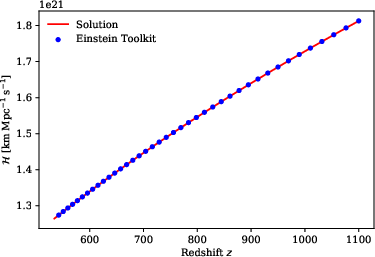
Figure 1: Evolution of the Hubble parameter for the matter-dominated era using the Einstein Toolkit, with the red line denoting the analytic evolution.
Derivation of the Relativistic Dynamo Equation
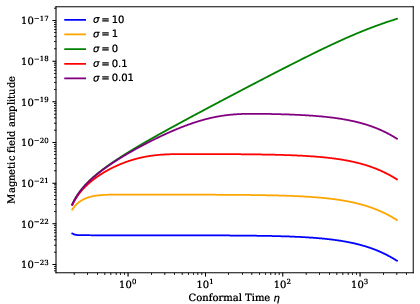
The central theoretical result is the derivation—via first-order cosmological perturbation theory—of the general-relativistic dynamo equation. The electromagnetic Maxwell equations, written for a curved, perturbed background, are combined with Ohm's law and translated into evolution equations for the comoving magnetic field. The dynamo equation captures the competition between the cosmic expansion, the growth of (velocity-driven) perturbations, and finite conductivity effects in the cosmic plasma:
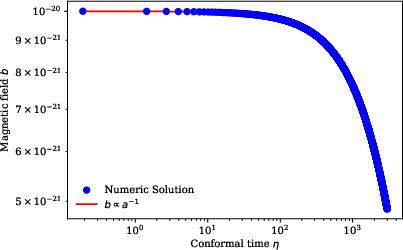
Figure 2: Numerical evolution of the background dynamo equation, showing the expected a−1 decay of the comoving field.
At first order, the dynamo equation augments the background decay law with source terms involving scalar perturbations and their induced velocity fields. The equation correctly reduces to known limits for vanishing perturbations or infinite conductivity.
Numerical integration of the derived equations is performed using the Einstein Toolkit and the FLRWSolver module. The evolution tracks the Hubble parameter and the induced velocity fields from scalar perturbation growth, using these to drive the PMF amplification in the linear regime. The method of lines is employed for time integration, with spatial differencing schemes adjusted for stability.
Strong numerical results are obtained for the amplification and decay of the PMF. Key findings:
Implications for PMF Constraints and Cosmology
The simulated field evolution constrains PMF strengths at recombination, using present-day extragalactic field lower limits (B≳3×10⁻¹⁶ G from blazars, B∼0.2 nG from Lyman-α):
- Assuming amplification saturates at linear order, initial fields at recombination must lie in the range B∼10−30 to 10−36.
These results provide a physically motivated and computationally robust connection between microphysical magnetogenesis, cosmic expansion, and observable magnetic fields. With further nonlinear extensions, this pipeline enables direct confrontation with CMB, large-scale structure, and nucleosynthesis constraints on PMFs.
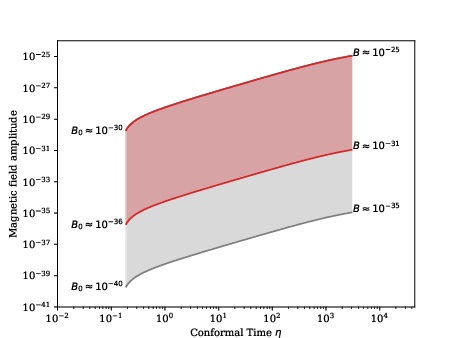
Figure 4: Limits on the magnetic field at recombination, mapped to observational constraints from current extragalactic field estimates.
Theoretical and Practical Outlook
By establishing the dynamo mechanism's sensitivity to both perturbation-driven velocity fields and conductivity, this work sharpens the requirements for PMF-based solutions to the Hubble tension and for scenarios seeking to explain galaxy and cluster-scale magnetic fields from primordial origins. The rigorous mapping between formalisms ensures that future developments—such as incorporating higher-order perturbations, non-linear mode coupling, or alternative theories of gravity (e.g., f(R) extensions)—can proceed within the same computational framework. This compatibility is essential for end-to-end pipelines connecting field theory, modified gravity, and cosmological observable calculation.
Conclusion
This paper presents a comprehensive derivation, implementation, and numerical validation of the relativistic dynamo equation for PMFs in a perturbed FLRW universe (2601.00774). The investigation confirms that scalar cosmological perturbations—via their associated fluid motions—catalyze PMF amplification, with the level of growth tightly regulated by the conductivity of the medium. These results provide a key computational and theoretical foundation for evaluating the role of PMFs in contemporary cosmology, including their proposed connection to the Hubble tension and large-scale magnetization. Future directions include non-linear evolution studies, higher-order perturbative corrections, and investigations in modified gravity scenarios.