On Cosmological Correlators at One Loop
Abstract: We study equal-time in-in correlators of massless scalar fields in flat space at one loop. Using the time-ordered decomposition of correlators together with a cosmological analogue of the Baikov representation, we systematically construct relatively simple loop integrals and make manifest why, in this setting, loop corrections to correlators are simpler than those of wavefunction coefficients. As benchmark examples, we analyse the bubble and triangle diagrams. The bubble exhibits a UV divergence that can be removed by a local counterterm, while the triangle yields a finite result, which we evaluate explicitly in terms of dilogarithms using an integral transform for the Laplacian Green's function. We classify the kinematic singularities of these diagrams using Landau analysis, identifying novel types of singular behaviour, and validate this analysis against the explicit results. Finally, we derive a factorisation property of one-loop cosmological correlators at singular kinematics, relating them to flat-space loop amplitudes and lower-point tree-level correlators.



Paper Prompts
Sign up for free to create and run prompts on this paper using GPT-5.
Top Community Prompts
Explain it Like I'm 14
Overview
This paper studies a very specific kind of “cosmic fingerprint”: equal-time correlation patterns (called correlators) of simple fields in the early universe. The authors focus on how to compute the first level of quantum corrections to these patterns, known as “one-loop” effects, in a simplified setup (flat space and massless scalar fields). They develop a way to make these loop calculations simpler, work out two classic examples (the bubble and the triangle), map out where and why these results become singular (sharp features), and show how the correlators break apart into simpler pieces in special limits, linking them to familiar particle-scattering results.
Goals and Questions
The paper aims to answer these questions:
- How can we systematically build and compute loop integrals for cosmological correlators so they’re as simple as possible?
- Why are loop corrections to correlators simpler than loop corrections to “wavefunction coefficients” (a related but different quantity)?
- What do the basic one-loop diagrams (the bubble and the triangle) look like, and can we compute them exactly?
- Where do the results develop singularities (sharp spikes or edges), and what do those mean physically?
- Do these correlators “factorize” (break into simpler parts) in special limits, and how do those parts relate to ordinary particle physics amplitudes?
Methods and Ideas (in plain language)
Think of a loop diagram as tiny particles traveling, meeting, and re-meeting along paths that form a closed circuit. The size of these effects depends on how these paths add up over all possible momenta (speeds and directions).
Here’s what the authors do:
- Time-ordered pieces: They split the overall calculation into “time-ordered pieces,” which are like considering every possible way events can be arranged in time without contradictions. Each piece is much simpler to handle.
- Clever change of variables (cosmological Baikov-like approach): Instead of integrating over the components of a momentum vector, they change variables to simple “energy-like sums” along the edges of the diagram. This is like replacing “x- and y-speed” with “how long each side of a triangle is,” which better matches the geometry of the problem.
- Reduced integrals: For equal-time correlators, the hard part of the integrand depends on fewer combinations of loop energies than you might expect. That means one of those integration variables can be “integrated out,” reducing the problem to a smaller, simpler integral on a lower-dimensional region. This is a key reason correlator loops are simpler than wavefunction loops.
- Landau analysis (finding singularities): They use a classic tool (Landau equations) that tells you when the math can become singular. Physically, these singularities happen when the diagram can be realized by classical particles that move in straight lines and meet at the same place and time while also conserving the right quantities.
- Exact evaluation tricks: For the triangle, the remaining integral involves a square root of a quadratic expression. They use a neat identity (a Whittaker integral representation of a Green’s function) to turn that square root into an angle integral. After that, the final answers come out in terms of well-known special functions called logarithms and dilogarithms.
Key terms explained simply:
- Correlator: a measure of how much two or more quantities tend to vary together at the same time.
- Loop diagram: a closed path in a particle diagram that represents a quantum fluctuation going around and coming back.
- UV divergence: an infinity coming from very tiny distance scales (ultra-violet = very high energy); it’s fixed by adjusting local parameters (“counterterms”) in a standard, controlled way.
- Dilogarithm: a special mathematical function that often appears in one-loop calculations in particle physics.
- Factorization: when a complicated result splits into a product of simpler pieces in a special limit (like snapping apart a Lego structure along a seam).
- Landau singularity: a place in “energy-momentum space” where the diagram can be realized by classical motion, causing the math to develop a singular feature.
Main Results
To make the results easy to scan, here are the two main examples and the general takeaways:
- Bubble diagram:
- The bubble has a UV divergence (an infinity from very short distances).
- This divergence can be removed by a “local counterterm,” which is a standard fix in quantum field theory—basically, you tweak a nearby parameter to cancel the bad infinity.
- After this fix, the bubble is controlled and simple in the authors’ framework.
- Triangle diagram:
- Surprisingly, the triangle is finite (no need for a counterterm).
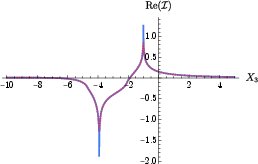
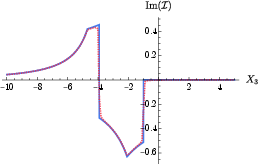
- The authors compute it exactly, expressing the answer in terms of dilogarithms (classic one-loop functions).
- They do this by turning a square-root obstacle into an angle integral (using Whittaker’s representation), then doing standard step-by-step (iterated) integrals.
- Why correlator loops are simpler than wavefunction loops:
- After the time-ordered decomposition and change of variables, the denominators in correlator integrals depend on one fewer combination of loop energies than the number of edges in the loop.
- That extra simplicity lets the authors integrate out one variable and work with a reduced integral on a surface with straight-line boundaries. This is not true for wavefunction coefficients, which stay more complicated.
- Singularity map and physical meaning:
- They classify all the kinematic singularities of the bubble and triangle using Landau analysis.
- Those singularities match where classical, time-ordered motion is possible—so the math’s spikes have a clear physical story.
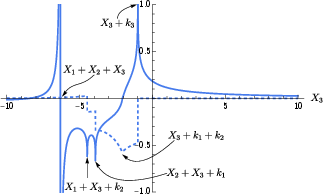
- For the triangle, besides the overall “total energy” pole, they find four physically meaningful singularities and check them against their exact formulas.
- Factorization near special kinematics:
- Near certain “partial-energy” singularities (where a particular sum of energies goes to zero), the one-loop correlator factorizes.
- It splits into a product of:
- a simple lower-point equal-time correlator (a “contact” piece), and
- a familiar flat-space loop amplitude (the triangle amplitude with one leg on-shell).
- This is a powerful bridge between cosmological correlators and ordinary scattering amplitudes.
Why This Matters
- Practical progress at loop level: Loop corrections are essential if we want trustworthy, precise predictions. The paper provides a toolkit that makes these hard integrals manageable—sometimes even elegantly simple.
- Clearer physics from singularities: Knowing exactly where and how singularities appear helps fix “integration constants” in bootstrap approaches and reveals the underlying geometric/analytic structure (important for modern programs like Kinematic Flow).
- Templates and benchmarks: Exact bubble and triangle results (with their divergence structure and dilogarithms) are clean benchmarks for future, more realistic cosmological calculations.
- Bridges to amplitudes: The factorization result strengthens the link between cosmological correlators and flat-space scattering amplitudes, hinting at shared structures that can be exploited.
- Roadmap for harder problems: The method—time-ordered decomposition, Baikov-like variables, reduced integrals, and Landau analysis—offers a clear path to tackle more complex loops and, eventually, more realistic expanding-universe settings.
In short, the paper shows that with the right viewpoint, one-loop cosmological correlators are simpler than expected, can be computed in closed form for key examples, and have a clean physical and mathematical structure that ties them to well-known results from particle scattering.
Knowledge Gaps
Knowledge Gaps, Limitations, and Open Questions
The paper advances one-loop equal-time in-in correlators in flat space for massless scalars (bubble and triangle), but several aspects remain missing, uncertain, or unexplored. The following list highlights concrete, actionable gaps for future work.
Scope and Generality
- Extend the framework beyond flat space to time-dependent cosmological backgrounds (e.g., de Sitter or slow-roll FRW), and determine how expansion modifies the loop measure, the “cosmological Baikov” change of variables, and the singularity structure.
- Generalize from massless scalars to massive fields and spinning particles (vectors, tensors, fermions), including graviton loops; quantify how masses and spins alter the denominators, the reduced-integral construction, and the function space (e.g., polylogarithmic weight, elliptic sectors).
- Analyze additional one-loop topologies (tadpole, box, pentagon) for correlators in this in-in setup and assess whether dilogarithms suffice or higher-weight polylogarithms/elliptic functions appear.
- Systematically map how interaction types (e.g., derivative couplings, non-contact vertices) affect the time-ordered decomposition and whether the “reduced integrals” persist.
Mathematical Framework: Representation and Reduction
- Provide a general proof (beyond bubble and triangle) that in-in correlator integrands depend on only linear combinations of loop energies at one loop, and specify the assumptions under which the property holds (topology, dimension , interaction type).
- Rigorously justify the reduction procedure that integrates out one linear combination : characterize boundary terms, contour deformations, and conditions ensuring no missed residues or spurious contributions when projecting onto .
- Clarify the dependence on spacetime dimension : determine for which the reduced-integral method yields closed forms, and whether new singularities or function classes appear as changes sign.
- Formalize the “cosmological analogue of Baikov representation”: derive the Jacobian and simplex-volume polynomial from first principles, and specify the general algebraic structure (degrees, Gram determinants, constraints) for arbitrary one-loop graphs.
Singularities, Analytic Continuation, and Factorization
- Complete the Landau analysis for the full correlator (after summing all time-ordered diagrams and permutations): enumerate physical and second-sheet singularities, determine their codimensions, and derive their discontinuities.
- Establish a uniform prescription for equal-time in-in loops that selects the physical sheet, resolves ambiguities between different branches, and guarantees causal analytic structure across topologies.
- Prove the factorization property at partial-energy poles for generic one-loop cosmological correlators (not only the triangle), including subleading terms; relate the leading behavior to flat-space loop amplitudes with off-shell external momenta in a precise, diagram-independent way.
- Connect the identified kinematic “letters” and singular loci to the bootstrap/Kinematic Flow alphabet; extract symbols for the triangle and higher topologies, and test closure under differential equations used in the bootstrap.
Explicit Computations and Function Space
- Provide a closed-form expression for the full triangle correlator across all permutations and branches (including explicit assignments), with a compact functional basis and a verified symbol/alphabet.
- Generalize the Whittaker integral transform approach: characterize its domain of validity, extend it to other irreducible polynomials in reduced integrals (e.g., quartics for box), and give rigorous proofs that “small” branch cuts can be shrunk without altering residues.
- Benchmark the analytic results (bubble, triangle) against direct numerical integration of the original -dimensional loop integrals, quantify errors across kinematic regimes, and test stability near singular loci.
Renormalization and Infrared Behavior
- Develop a consistent renormalization scheme for equal-time correlators: identify all required local counterterms, the renormalization scale and scheme dependence, and the relation to wavefunction renormalization and late-time boundary conditions.
- Investigate infrared (IR) behavior in expanding backgrounds within the reduced-integral framework: determine whether secular growth appears at one loop for light fields, and assess whether the method facilitates IR resummation (e.g., dynamical renormalization group or stochastic techniques).
- Analyze the bubble’s UV divergence more fully: compute the finite parts after renormalization, track dependence on and , and study how renormalization interacts with the factorization limits and the Landau singularities.
Physical Interpretation and Phenomenology
- Translate the mathematical singularities into observable features for cosmological collider signals and scalar-induced gravitational waves: produce realistic templates that include expansion, masses, spins, and standard-model loops.
- Quantify the relevance of loop-induced signals (e.g., charged heavy fields, chemical potentials) within this equal-time correlator framework, specifying parameter regimes where loop effects could be measurable.
- Clarify the relation between wavefunction coefficients and equal-time correlators at one loop: provide an explicit mapping, identify when correlators are strictly simpler (function weight, absence of hyperelliptic sectors), and determine exceptions.
Glossary
- Amplituhedron: A geometric construction that encodes certain scattering amplitudes in quantum field theory. "such as the Amplituhedron~\cite{Arkani-Hamed:2013jha}"
- Baikov representation: An integration-by-variables technique for multi-loop Feynman integrals, here adapted to cosmological settings. "a cosmological analogue of the Baikov representation"
- bubble diagram: A two-point, two-site loop Feynman graph topology contributing at one loop. "As benchmark examples, we analyse the bubble and triangle diagrams."
- classical scattering: The limit where particle trajectories and energy-momentum conservation are enforced as in classical mechanics, used to interpret Landau singularities. "the singularities of the reduced integrals have a physical interpretation in terms of the kinematic loci where time-ordered classical scattering of point particles occurs"
- codimension: The difference between the ambient space dimension and a subspace, describing the dimensionality of constraints or integration regions. "Finally, integrating out projects the original integration region onto a codimension $1$ region ."
- contact diagram: A graph where fields interact at a single spacetime point (no propagating internal lines). "where describes a contact diagram with energies and on its external legs"
- conformally coupled scalars: Scalar fields coupled to curvature so that the action is invariant under conformal transformations in appropriate backgrounds. "for conformally coupled scalars in flat space the rational functions are real"
- cosmological bootstrap: An approach that derives correlators from consistency with symmetries and physical principles rather than time evolution. "One line of research, known as the cosmological bootstrap~\cite{Arkani-Hamed:2018kmz,Baumann:2022jpr}, has bypassed many conceptual difficulties by rephrasing the question."
- cosmological collider: A paradigm using cosmological correlators to probe heavy particle physics during inflation via imprinted signatures. "In the context of the cosmological collider, for example, a neutral inflaton can couple to charged particles only through loops."
- counterterm: An additional local term added to the action to cancel divergences arising in loop computations. "The bubble exhibits a UV divergence that can be removed by a local counterterm"
- de Sitter space: A maximally symmetric spacetime with positive cosmological constant, relevant to inflationary cosmology. "a putative holographic description of de~Sitter space."
- dihedral permutation group : The symmetry group of an equilateral triangle, comprising rotations and reflections, acting on graph labels. "The loop integrand is invariant under the dihedral permutation group "
- dilogarithms: Special functions (polylogarithms of order 2) commonly appearing in one-loop integrals. "which we evaluate explicitly in terms of dilogarithms using an integral transform"
- factorisation (factorization) property: The behavior where a correlator near a singular limit decomposes into simpler lower-point objects. "Finally, we derive a factorisation property of one-loop cosmological correlators at singular kinematics, relating them to flat-space loop amplitudes and lower-point tree-level correlators."
- Feynman rules: Prescriptions for constructing integrands and integrals from a given quantum field theory’s Lagrangian and graph topology. "Starting with the Feynman rules for in-in correlators~\cite{Weinberg:2005vy}, a one-loop integral for massless scalars in flat space takes the form"
- Green's function: The propagator solving a differential operator equation with a delta-function source. "We use the integral representation for the Green's function for the three-dimensional Klein-Gordon operator due to Whittaker~\cite{Whittaker1902}"
- hyperelliptic sectors: Parts of integral results involving functions associated with hyperelliptic curves, indicating higher complexity. "wavefunction coefficients always include more complex functions (higher transcendental weight, hyperelliptic sectors, etc.)."
- hyperplanes: Codimension-1 linear subspaces that bound or intersect integration regions and singular varieties. "we can position these hyperplanes in such a way that they intersect with "
- infrared (IR) divergences: Divergences arising from contributions of low-momentum (long-wavelength) modes. "cosmological loops involving sufficiently light particles are also plagued by infrared (IR) divergences specific to cosmological backgrounds"
- prescription: A rule for displacing poles in propagators to define causal/retarded boundary conditions and contour choices. "Two distinct prescriptions have been implemented, as discussed in detail in Sec.~\ref{sec:ExplicitResults}."
- Jacobian: The determinant arising from a change of variables in an integral measure. "The corresponding Jacobian measures the squared volume, , of the simplex created out of "
- Kinematic Flow: A program uncovering geometric structures governing kinematic dependence of correlators/amplitudes. "Recent works, including Kinematic Flow~\cite{Baumann:2025qjx,Baumann:2024mvm,Arkani-Hamed:2023bsv,Arkani-Hamed:2023kig}, have provided hints in this direction"
- kinematic singularities: Non-analytic behaviors of correlators at special values of external kinematic variables. "We classify the kinematic singularities of these diagrams using Landau analysis"
- Klein-Gordon operator: The differential operator governing scalar field propagation. "Green's function for the three-dimensional Klein-Gordon operator due to Whittaker~\cite{Whittaker1902}"
- Landau analysis: The study of singularities of Feynman integrals via Landau equations and pinch singularities. "We classify the kinematic singularities of these diagrams using Landau analysis"
- Landau equations: Conditions determining when integration contours are pinched, signaling branch points/singularities of integrals. "The classical constraints are captured in the Landau equations:"
- Lorentz-invariant (structure): Invariance under Lorentz transformations; its loss complicates cosmological loop integrals. "the integrands of loop integrals lose their Lorentz-invariant structure, obstructing many of the widely used parametrisations familiar from amplitudes."
- off-shell: Refers to momenta not satisfying the mass-shell condition , used as auxiliary variables in computations. "the triangle amplitude for massless scalars with off-shell external momenta"
- partial fraction decomposition: Algebraic decomposition of rational functions into simpler fractions to facilitate integration. "allow a shortcut to the derivation of an optimal partial fraction decomposition for the loop integrals."
- renormalisation: The process of absorbing divergences into redefinitions of parameters to yield finite predictions. "In addition to the ultraviolet divergences remedied by standard renormalisation"
- residue: The coefficient of the term in a Laurent expansion, used to evaluate contour integrals. "It can be computed by picking the residue of one of the two poles of in the integrand."
- second sheet: A different branch of a multi-valued analytic function accessed via analytic continuation across branch cuts. "The values of for which these branches develop singularities are referred to as being on the second sheet."
- secular divergences: Divergences growing with time, often reflecting cumulative effects like continuous particle production. "These secular divergences reflect the build-up associated with continuous particle production in an expanding spacetime."
- simplex: A generalization of a triangle/tetrahedron; here the geometric object spanned by loop momenta whose volume enters the measure. "the squared volume, , of the simplex created out of "
- spectral decompositions: Representations of functions/propagators in terms of their spectral density or eigenmodes. "and makes it particularly well suited to spectral decompositions~\cite{Qin:2024gtr,Zhang:2025nzd,Loparco:2023rug,Qin:2023nhv,Qin:2023bjk}"
- time-ordered diagrams: Graph contributions with a specified ordering of interaction times, organizing in-in integrands. "The expansion of this product results in a sum of iterated time-integrals that is efficiently organized by a set of time-ordered diagrams."
- transcendental weight: A grading of special functions (e.g., polylogarithms) by complexity, relevant for classifying integral results. "higher transcendental weight, hyperelliptic sectors, etc."
- triangle amplitude: The one-loop three-point scattering amplitude corresponding to the triangle topology. "the triangle amplitude for massless scalars with off-shell external momenta"
- triangle diagram: A one-loop three-vertex Feynman graph topology central to the paper’s analysis. "As benchmark examples, we analyse the bubble and triangle diagrams."
- ultraviolet (UV) divergence: Short-distance/high-momentum divergence arising in loop integrals. "The bubble exhibits a UV divergence that can be removed by a local counterterm"
- unit circle (in complex plane): The contour |w|=1 used for complex integrals after variable changes. "the integral on the right hand-side becomes a contour integral over the unit circle in the complex plane of "
- wavefunction coefficients: Coefficients in the late-time wavefunctional expansion, distinct from physical correlators but related. "loop corrections to correlators are simpler than those of wavefunction coefficients"
- Whittaker (integral representation): A contour-integral representation attributed to Whittaker for Green’s functions. "due to Whittaker~\cite{Whittaker1902}"
Practical Applications
Immediate Applications
The following applications leverage methods and concrete results from the paper that can be deployed now as tools, benchmarks, and workflows in research and software.
- Rapid generation of analytic loop templates for cosmological correlators (academia; software)
- Use the explicit one-loop bubble (UV-divergent, renormalized by a local counterterm) and triangle (finite, expressed in dilogarithms) equal-time correlators as benchmark “shape” templates to test and validate numerical pipelines for CMB/LSS and primordial GW bispectrum calculations, and to train ML models for correlator reconstruction.
- Potential product/workflow: a small library of analytic kernels (Python/Julia/Mathematica) implementing the paper’s time-ordered decomposition and reduced-integral evaluations, including iε prescription handling and plotting routines.
- Assumptions/dependencies: flat-space, massless scalar toy model; equal-time correlators; observables in expanding backgrounds require generalization.
- Reduced-integral technique for one-loop correlators (academia; software)
- Adopt the cosmological analogue of the Baikov representation (change of variables from loop momenta to loop energies with simplex-volume Jacobian) and the “reduced integrals” (integrating out one loop-energy variable when correlator denominators depend on only V−1 combinations) to simplify integrand structure and accelerate analytic/numeric evaluation.
- Potential product/workflow: a symbolic/numeric module that automatically (i) constructs the loop-energy variables, (ii) cancels Jacobian factors, (iii) performs partial fractions, and (iv) emits reduced integrals suitable for quadrature or analytic evaluation.
- Assumptions/dependencies: method demonstrated for bubble and triangle; robustness for higher-topology loops and interacting spectra needs testing.
- Contour-integration workflow via Whittaker transform (software; engineering math)
- Use the Whittaker integral representation of the 3D Klein–Gordon Green’s function to convert square-root barriers into rational contour integrals with manageable branch cuts and residue evaluation; immediately applicable to other problems featuring 1/√(quadratic form) kernels (e.g., Helmholtz/Klein–Gordon Green functions in computational physics, acoustics, photonics).
- Potential tool: a “WhittakerTransform” routine for branch-cut-aware contour integration with unit-circle residues, shipped in a scientific computing library.
- Assumptions/dependencies: kernel structure must match the requisite quadratic form; careful iε management and branch-cut bookkeeping are required.
- Automated singularity analysis using Landau equations for in-in correlators (academia; software)
- Implement the paper’s Landau analysis (including the time-ordering signs and energy-conservation constraints on classical subsets) to map “physical” and second-sheet singular surfaces for loop correlators, aiding bootstrap constraints and numerical stability near singular loci.
- Potential tool: a “Singularity Atlas” that returns the set of partial-energy poles and pinch surfaces for given external kinematics; integrates with Kinematic Flow and bootstrap solvers.
- Assumptions/dependencies: currently demonstrated for bubble and triangle; generalization to higher-point correlators and more complex spectra is needed.
- Factorization-based checks and limits for correlator computations (academia)
- Use the derived factorization at partial-energy singularities (e.g., X2+X3+k1→0) to cross-check and speed up correlator calculations by reducing them to flat-space loop amplitudes times lower-point correlators in singular limits.
- Potential workflow: limit evaluators that switch to factorized expressions near singular kinematics to stabilize numerics and provide analytic guidance for bootstrap integration constants.
- Assumptions/dependencies: factorization proven for specific time-ordered configurations; verifying universality across interactions and spectra is prudent.
- Template generation for Standard-Model loop backgrounds in the cosmological collider (academia)
- Produce SM loop baseline shapes (neutral inflaton coupled via loops) to bound or subtract expected backgrounds when searching for heavy charged particles in non-Gaussian correlators.
- Potential workflow: a “Loop Background” module that outputs reference spectra under realistic survey windows for quick sensitivity estimates.
- Assumptions/dependencies: signal amplitudes are typically small; projections to expanding backgrounds and realistic inflaton couplings needed.
- PBH and scalar-induced GW (SIGW) bispectrum modeling benchmarks (academia)
- Use triangle-loop templates as immediate, controlled test cases for SIGW bispectrum pipelines and for diagnosing perturbative breakdown in PBH-friendly inflationary scenarios.
- Potential workflow: unit tests for SIGW bispectrum codes using analytic triangle shapes with tunable kinematics and iε prescriptions.
- Assumptions/dependencies: flat-space correlators are idealized; realistic inflationary dynamics and IR issues must be layered in for production analyses.
- Graduate teaching and tool-assisted visualization (education; software)
- Integrate the time-ordered “tubing rules,” reduced-integral construction, and Landau pinches into interactive notebooks that visualize Σ-surfaces, branch cuts, and factorization in kinematic space.
- Potential product: an educational toolkit with shape calculators and singularity viewers to train students in modern correlator methods.
- Assumptions/dependencies: relies on simplified models; advanced topics (IR resummation, de Sitter) can be scaffolded as extensions.
Long-Term Applications
These applications build on the paper’s innovations but require further research, extension to realistic settings, scaling, and validation.
- End-to-end loop-level cosmological correlators in expanding backgrounds (academia; software)
- Generalize reduced integrals, Landau analysis, and factorization to inflationary/de Sitter spacetimes with light fields (including IR issues), tensors/gauges, and realistic inflaton couplings, yielding observation-ready templates for CMB-S4, Euclid, Roman, SKA, and next-gen GW observatories.
- Potential product/workflow: a “CosmoLoop” platform that provides loop-corrected correlators with consistent renormalization and IR treatments, integrated with CLASS/CosmoMC/EFT-of-LSS pipelines.
- Assumptions/dependencies: handling of cosmological IR divergences (resummation/dressing), renormalization in time-dependent backgrounds, and numerical stability must be established.
- Heavy charged particle searches via loop imprints (academia; policy)
- Use refined loop templates to design targeted analyses (kinematic cuts, estimator design) for heavy charged particles beyond terrestrial reach, exploiting mechanisms that enhance production (e.g., chemical potentials).
- Potential deliverables: sensitivity forecasts guiding survey strategy and funding decisions; analysis guidelines that separate SM loop backgrounds from exotic signals.
- Assumptions/dependencies: requires enhancement mechanisms to reach observability; careful modeling of survey systematics and window functions.
- Perturbative control diagnostics in PBH formation (academia; policy)
- Develop quantitative “loop-to-tree” control metrics using the paper’s integral technology to flag regimes of secular growth and potential perturbative failure, informing theory priors and experimental interpretations in PBH studies.
- Potential deliverables: white-paper recommendations on theory readiness for PBH claims; standardized perturbativity checks in community codes.
- Assumptions/dependencies: relies on extending methods beyond flat-space toy models to realistic inflationary dynamics.
- Bootstrap and Kinematic Flow integration (academia; software)
- Use the classified singularities (letters) and factorization limits as input constraints to solve bootstrap differential systems for higher-point correlators at loop level; build a finite function basis (logarithms/dilogarithms/hypergeometric sectors) analogous to one-loop amplitude bases.
- Potential product: a solver that outputs loop correlators from symmetry/unitarity plus singularity data, reducing direct integration needs.
- Assumptions/dependencies: requires mapping the function space across topologies (box, pentagon, …) and validating completeness in cosmological settings.
- General-purpose complex-integration engines with branch-cut governance (software; finance/engineering)
- Package the paper’s branch-cut-aware contour strategies (unit-circle residues, “inside/outside” cut separation, small-cut shrinking) into robust engines for complex integrals encountered in electromagnetic scattering, acoustics, photonics, and quantitative finance (characteristic-function methods).
- Potential product: a commercial-grade complex analysis library with certified branch-cut handling and iε control for high-reliability applications.
- Assumptions/dependencies: domain-specific kernels and deformation paths vary; performance and certification demand extensive testing.
- Computational geometry–inspired integration (software; robotics/graphics)
- Leverage the simplex-volume Jacobian and loop-energy parametrization to develop faster integration schemes for geometry-heavy tasks (collision integrals, visibility computations) in robotics and graphics.
- Potential product: accelerated integral kernels for geometry processing that exploit “energy-like” variables and volume-polynomial cancellations.
- Assumptions/dependencies: mapping from physics loop-energy variables to geometry integrals is nontrivial and problem-dependent.
- Standards for loop background treatment in survey analyses (policy; academia)
- Codify best practices for including loop-level SM backgrounds and handling singular kinematics/factorization in cosmological collider and GW analyses to prevent false positives and ensure reproducibility.
- Potential deliverables: community standards and checklists adopted by collaborations; reviewer guidelines for loop-level claims.
- Assumptions/dependencies: consensus-building across collaborations; continuous method updates as theory advances.
- Extended educational ecosystems (education)
- Build curricula and interactive platforms that teach modern correlator technology (time-ordered decomposition, reduced integrals, Landau singularities, factorization) and connect to amplitude methods, cultivating cross-disciplinary fluency.
- Potential product: a MOOC or open textbook with code labs and visualization tools, fostering workforce development in theoretical and computational cosmology.
- Assumptions/dependencies: sustained community engagement and maintenance; coordination with research software to keep examples current.
Collections
Sign up for free to add this paper to one or more collections.