Abstract: The prototype of a Euclidean wormhole solution of Einstein gravity coupled to matter is the axion wormhole in four spacetime dimensions. In this primarily expository article, we spell out some details about this construction. The axion wormhole has a semiclassical description, found in the original paper [1], in which the matter system is a two-form gauge field B with three-form field strength H=dB. The two-form is dual to a massless scalar, but the wormhole does not have a semiclassical description in terms of the scalar. There is no contradiction here as the duality between the two-form and the scalar is not a simple transformation of classical fields but involves, in Euclidean signature, a Poisson resummation of the sum over fluxes. Because of the need for this Poisson resummation, the scalar field cannot be treated semiclassically in the wormhole throat. Nonetheless, it is straightforward to compute the effective action derived from the wormhole in the scalar (or two-form) language, recovering standard claims.
The paper establishes that semiclassical wormhole solutions exist exclusively in the two-form framework due to nontrivial Poisson resummation in Euclidean gravity.
It shows that the axion (scalar) description fails to yield finite wormhole throats because of uniform Weyl scaling, highlighting a key limitation in duality.
The study derives a bilocal effective action from integrating wormhole moduli, with significant implications for symmetry breaking and quantum gravity corrections.
Duality and Axion Wormholes: A Technical Overview
Introduction and Motivation
This paper provides a comprehensive and rigorous exposition of Euclidean wormhole solutions in Einstein gravity coupled to antisymmetric tensor fields—the so-called axion wormholes. The central system analyzed is Einstein gravity minimally coupled to a two-form gauge field B in four dimensions, with the three-form field strength H=dB. Such a two-form is dual to a massless scalar field (axion) ϕ, but a subtle feature, highlighted and explored in detail, is that the semiclassical wormhole solution exists only in the two-form description and not in the dual scalar description. This property is rooted in the nontrivial nature of the scalar/two-form duality in Euclidean signature, where the map between theories involves a Poisson resummation over quantized fluxes, not a straightforward classical field redefinition.
Wormhole Solutions in Gravity–Two-form Systems
In the two-form picture, an explicit, semiclassical Euclidean wormhole solution exists. The metric is topologically R×S3 with the S3 supporting a quantized three-form flux specified by an integer m,
2π1∫S3H=m,
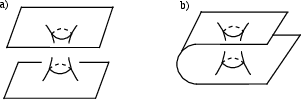
and the geometry smoothly connects two asymptotically flat regions (see also (Figure 1)).
Figure 1: (a) A wormhole connecting two asymptotically flat worlds; (b) a wormhole shortcut between different regions of the same world.
For sufficiently small coupling h, the field strengths and curvatures are small, ensuring semiclassical control. The throat's minimum radius a0 is parametrically larger than the Planck scale when f2m2≫G (with f the dual scalar coupling).
A key observation is that, although the two-form system and the scalar system are quantum-mechanically equivalent under duality, the scalar description does not admit an analogous semiclassical wormhole solution: the Einstein-scalar system's action terms scale uniformly under Weyl transformations, precluding a nontrivial balance that would yield a wormhole throat of definite size.
Axion–Two-Form Duality in Quantum Gravity
The duality between a massless scalar and a two-form gauge field in four dimensions is reviewed, with careful attention to Dirac quantization conditions (periodicity of ϕ and quantization of H-flux). The mapping in Euclidean signature, relating the canonical kinetic actions,
2f21∫g∂iϕ∂iϕ↔2⋅3!h21∫gHijkHijk,
requires h=2π/f. However, only in Lorentzian signature does the duality manifest as a simple on-shell equivalence between classical solutions. In Euclidean signature, the map involves a Poisson resummation of the sum over integral flux sectors, fundamentally precluding a classical semiclassical wormhole solution for the scalar.
A detailed account is provided for how local operators and winding/flux modes are mapped through the duality. For instance, the dual of eimϕ(x) in the scalar theory is a 't Hooft-like operator Km(x) in the two-form language, implemented by requiring a quantized flux singularity at x.
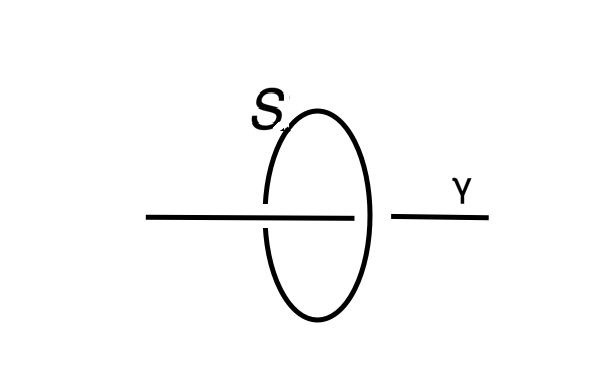
Figure 2: The two-sphere S (represented as a circle) links a closed curve γ, illustrating non-local operator duality.
A path integral with fixed asymptotic value of the axion field ϕ at infinity (a choice of vacuum angle α) is dual, in the two-form description, to weighting each flux sector with a phase eimα.
Poisson Resummation and Path Integral Structure
A practice calculation is outlined that highlights the Poisson resummation underlying the duality: the sum over integer m fluxes in the two-form theory maps to a sum over winding sectors of the axion, with an explicit relation between their partition functions,
An important technical point is that this equivalence requires careful normalization, accounting for zero-modes and determinant factors, as well as possible Euler characteristic counterterms on curved backgrounds. The duality in path integrals is subtle and non-local, especially in the presence of gravity and non-trivial topology.
Effective Actions and Bilocality
The wormhole induces a nonlocal, bilocal effective action in the low-energy field theory, manifest as an interaction between two asymptotically separated regions. The most salient property is that, when integrating out the microscopic degrees of freedom associated with the wormhole, the system generates effective bilocal operators (bilocality comes from integrating over the wormhole’s moduli, namely the positions of the two ends). In the two-form language, the leading term involves bilocal products of 't Hooft-like operators Km(x)K−m(y). Through the duality, this corresponds in the axion language to terms of the form
Ieff≃c∫d4xd4yeimϕ(x)e−imϕ(y),
with c exponentially suppressed by the wormhole action. This matches established claims regarding the impact of axion wormholes on low-energy effective potentials—specifically, that wormholes introduce randomness or break global symmetries in an effectively bilocal fashion.
Implications and Theoretical Developments
This analysis clarifies that, in quantum gravity, although the axion and two-form field theories are dual, the semiclassical description of nontrivial topological features (e.g., wormholes) may preferentially reside in one duality frame. The necessity of Poisson resummation in Euclidean quantum gravity alters the naive expectation of semiclassical equivalence. Specifically, the non-existence of a semiclassical wormhole solution in the scalar frame restricts the direct use of familiar instanton calculus for axion wormholes. Nevertheless, calculations of wormhole-induced effective actions, and their impact on global symmetries, can be consistently performed using duality and Poisson resummation arguments.
The paper also highlights technical issues pertinent to quantum gravity: the treatment of operator orderings, precise implementation of dualities on spaces with boundary or nontrivial topology, and the roles of zero-modes and their effects on the proper normalization of the path integral, determinants, and gravitational counterterms.
Future Directions
While axion wormholes embody the prototype of semiclassically controlled topology-changing fluctuations in quantum gravity, the wider implications for the landscape of consistent effective field theories and the Swampland program remain significant. Whether similar obstructions to semiclassical solutions exist for other dualities or matter content in various dimensions merits further study. The relation between wormhole physics, randomness in fundamental constants, and the quantum structure of the gravitational path integral invites continued technical analysis, especially in the context of string compactifications and the impact on axion phenomenology.
Conclusion
This exposition rigorously elucidates the duality between scalars and two-form gauge fields in the context of Euclidean quantum gravity and demonstrates that semiclassically controlled wormhole solutions manifest only in the two-form description. The resulting wormhole-induced effective actions are inherently bilocal and are consistent with the dual scalar description only via a non-trivial Poisson resummation in the quantum path integral. The consequences for the interpretation of wormhole effects and symmetry-breaking in quantum gravity are technically robust and suggest avenues for further theoretical developments in the construction and interpretation of nonperturbative phenomena in quantum gravity frameworks.