- The paper presents optimized fabrication of single-crystalline AlN microresonators achieving record intrinsic Q-factors (~5.4×10^6 at 1550 nm and ~2.2×10^6 at 780 nm).
- The paper leverages engineered mode hybridization to generate polarization hybrid Dirac solitons, enabling efficient Kerr comb formation at low pump powers (~100–150 mW).
- The paper demonstrates novel platicon microcombs via Raman-assisted four-wave mixing and realizes low-noise near-visible stimulated Raman lasers with linewidths under 220 Hz.
High-Q AlN Microresonators Enabling Nonlinear Near-Infrared and Near-Visible Photonics
Introduction and Motivation
Integration of high-Q microresonators with low-loss waveguide platforms is central to the advancement of nonlinear photonics, realizing functionalities such as microcomb generation, stimulated Raman lasers (SRLs), and frequency-agile sources in application-critical spectral bands. Aluminum nitride (AlN) holds particular promise due to its wide bandgap (6.2 eV), large transparency window, and established compatibility with piezoelectric modulation, enabling a unique confluence of χ(2) and χ(3) nonlinearities. However, achieving low-loss, high-Q AlN microresonators has lagged behind more mature CMOS-compatible platforms, notably Si3N4 and lithium niobate, thereby limiting AlN's adoption in integrated nonlinear photonics.
Fabrication and Record Q-Factor Characterization
The study presents a systematic optimization of single-crystalline AlN-on-sapphire microresonator fabrication, employing high-fidelity MOCVD for AlN film growth, electron-beam lithography, dual-step etching, and high-temperature annealing. Both racetrack and microring geometries were produced with either uniform or adiabatically varying widths, targeting efficient coupling and minimized scattering/absorption losses in both 1550 nm (telecom) and 780 nm (near-visible) bands.
In the telecom regime (1550 nm), intrinsic Q-factors reach 5.4×10⁶, a distinct improvement over prior AlN reports. In the near-visible (780 nm), the best intrinsic Q-factor obtained is 2.2×10⁶. The modal Q distributions indicate most probable Q-values of 3.1×10⁶ at 1550 nm and 1.1×10⁶ at 780 nm. These results approach the absorption-limited regime of AlN in the relevant bands, as supported by supplementary loss characterizations.
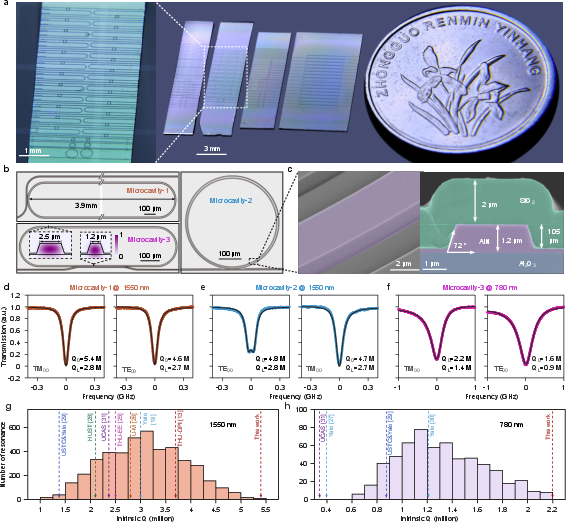
Figure 1: AlN photonic chips, microresonator optical micrographs, and Q-factor determination by resonance linewidth measurements in both 1550 nm and 780 nm bands.
Polarization Hybridized Dirac Soliton Microcombs
The study leverages spatial-mode coupling between TE00 and TM10 modes in AlN microresonators to engineer anomalous dispersion, a prerequisite for bright Kerr soliton formation, despite the normal material dispersion of AlN in the telecom regime. This is achieved by tuning the mode hybridization via engineered geometries and pump wavelengths—quantitatively, a coupling rate G/2π of 33.3 GHz far exceeding the inter-mode FSR difference.
The generated microcombs deviate from standard sech2-shaped soliton envelopes and are well-described by a Dirac soliton theory, with high-order modal dispersion captured by LLE-based simulations. Notably, polarization-resolved spectral measurements confirm that the generated soliton is hybridized, with significant TE/TM mixing particularly evident in the negative sidebands of the comb spectrum.
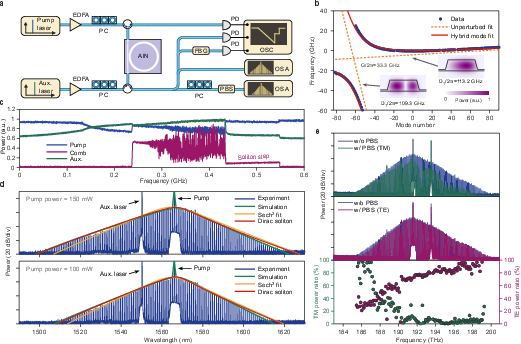
Figure 2: Experimental workflow for soliton generation, measured mode-resolved resonance shifts, and polarization-resolved microcomb spectra revealing hybridized Dirac soliton characteristics.
Numerically, the system achieves soliton formation at record-low pump power (∼100–150 mW) and repetition rates as small as 113 GHz (FSR), representing efficient Kerr comb generation by the metric of pump power × FSR.
In contrast to bright solitons, the work demonstrates for the first time the emergence of platicon (dark pulse) microcombs in normal dispersion AlN microresonators using a Raman-assisted four-wave mixing (RFWM) mechanism. This process exploits local mode-interaction-induced dispersion perturbations and can serve as a general strategy for comb generation in platforms with strong normal GVD, including across the visible region.
By detuning the pump into the microresonator resonance, the system sequentially transitions from a pure SRL state to an RFWM-mediated comb, and finally to a stabilized platicon, as corroborated by both experiment and LLE modeling. The dynamics feature asymmetric comb spectra, a direct consequence of mode interaction-induced dispersion variations. The generation threshold is achievable with accessible on-chip pump power (down to 150 mW), supporting practical deployment.
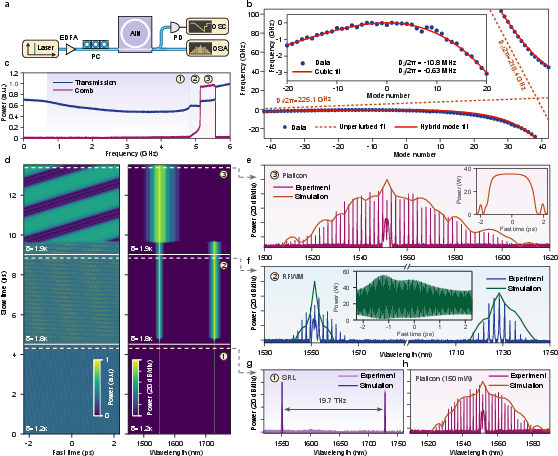
Figure 3: (a) Experimental scheme for platicon comb generation, (b) mode-interaction altered integrated dispersion measurement, and (e–g) transition of measured spectra from SRL to RFWM to platicon states.
Low-Noise Near-Visible Stimulated Raman Lasers
The high-Q, low-loss properties of these AlN microresonators are further exploited to demonstrate narrowly linewidth SRLs in the near-visible (820 nm) regime, accessible by 780 nm pump via large optical phonon frequency of AlN. The measured threshold for lasing is 50 mW, and the resulting fundamental linewidth is narrower than 220 Hz for a 5 mW output, the tightest yet reported for an integrated near-visible SRL.
Frequency noise is fundamentally limited by thermorefractive noise, as revealed by delayed self-heterodyne measurements, validating the potential of this platform for high-coherence light sources in otherwise technically challenging wavelength regions.
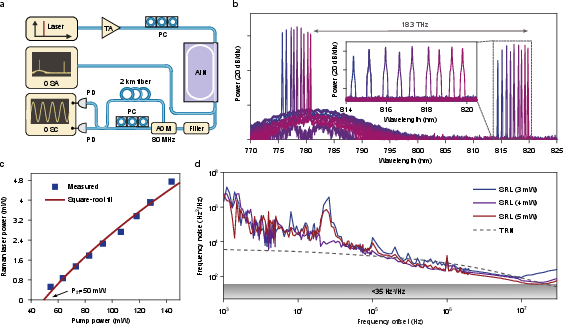
Figure 4: Experimental arrangement for near-visible SRL generation and frequency noise measurement, output power scaling, and frequency noise spectral densities as a function of output power.
Implications and Future Directions
The study achieves several pivotal advances:
- Record Intrinsic Q-factors: The demonstrated Q-factors in AlN microresonators narrow the performance gap to established Si3N4 and LN platforms, especially near-visible wavelengths, positioning AlN as a viable nonlinear PIC platform for quantum photonics, precision metrology, and low-noise microwave generation.
- Polarization Hybrid Dirac Solitons: The ability to manipulate modal hybridization and dispersion unlocks new microcomb regimes, with direct implications for integrated frequency-comb stabilization and metrological-grade sources.
- RFWM Platicon Protocol: The observation of platicon microcombs via RFWM in normal dispersion extends the toolkit for frequency comb generation into spectral regions inaccessible to traditional bright soliton schemes, facilitating on-chip combs in visible and ultraviolet bands.
- High-Coherence On-Chip Lasers: The ultralow noise SRL demonstration in the near-visible harnesses both AlN's material advantages and the advanced fabrication, suggesting immediate utility for integrated laser spectroscopy, quantum communications, and gyroscopic sensors.
These technical leaps expand the practical and theoretical landscape of nonlinear AlN photonics. On the application front, they suggest routes toward entangled photon-pair generation via engineered χ(2) processes, squeezed state microcombs, and mid-IR simulton sources—all possible given further advances in phase-matching and dispersion engineering.
Conclusion
High-Q AlN microresonators fabricated via optimized crystalline growth and waveguide engineering have enabled significant advances in nonlinear photonic functionalities, including polarization hybridized Dirac soliton microcombs, RFWM-initiated platicon states, and the narrowest on-chip stimulated Raman lasers in the near-visible band. The combination of scalable fabrication, advanced modal engineering, and record Q-factors establishes AlN as a leading material platform for integrated nonlinear optics spanning the near-infrared to the visible, with broad implications across scientific and technological domains.
(2601.02842)