- The paper develops a dictionary mapping black hole thermodynamics to open quantum systems using the Lindblad equation and modular theory.
- The paper employs algebraic methods such as the GNS construction and von Neumann algebras to rigorously derive a generalized second law across different vacuum states.
- The paper demonstrates operational work extraction from non-thermal Hawking radiation, linking chemical potential modulations to energy extraction protocols.
Black Hole Thermodynamics at Null Infinity: Open Systems, Markovian Dynamics, and Work Extraction
Introduction and Framework
The paper develops a rigorous parallel between black hole thermodynamics—anchored at null infinity—and open quantum systems exhibiting Markovian dynamics. Semiclassical gravity, implemented via the algebraic approach to quantum field theory on null hypersurfaces, naturally leads to a structure reminiscent of quantum thermodynamics in the weak-coupling limit, where the system's evolution is governed by completely positive, trace-preserving (CPTP) maps and characterized by the Lindblad equation. The theory's central pillars are the concepts of generalized entropy and the generalized second law (GSL), expressed using the formalism of modular theory, von Neumann algebras, and relative entropy.
A major advance is the construction of a dictionary mapping the elements of black hole thermodynamics at null infinity to those in open quantum system theory: late-time boundary conditions correspond to environmental reservoirs, vacuum states to steady states or fixed points of the system's evolution, and modular Hamiltonians to thermodynamic potentials. The analysis is then extended from equilibrium (Hartle-Hawking vacuum) to more realistic, non-equilibrium (Unruh vacuum) situations, including detailed treatments of soft and hard regularizations and explicit incorporation of work extraction protocols via non-thermal features of Hawking radiation.
Mathematical Structure: Algebras, Modular Theory, and the Generalized Second Law
Quantum fields on null hypersurfaces are quantized via the Weyl algebra of smeared momenta. The Gelfand-Naimark-Segal (GNS) construction assigns to each algebraic state (e.g., a vacuum defined by specific boundary conditions) a representation space. Crucially, the algebra acquires the structure of a von Neumann algebra, to which Tomita-Takesaki modular theory applies. The modular Hamiltonian KΨ arises from the modular operator ΔΨ, defined for cyclic and separating states, and becomes the generator of the modular flow intrinsic to this setup.
Relative entropy, defined per Araki, is both the information distance and the relevant thermodynamic monotonicity functional. The monotonicity of relative entropy under restriction to subalgebras (corresponding geometrically to moving the "cut" of observation along null infinity) underpins proofs of generalized second laws:
SA1(Ψ∣∣Ω)≥SA2(Ψ∣∣Ω),A2⊂A1
which translates to a monotonic decrease of an associated thermodynamic potential,
ΔGΩ≤0
for a wide class of vacua and field configurations. The exact form of GΩ depends on the choice of vacuum and the structure of the modular Hamiltonian.
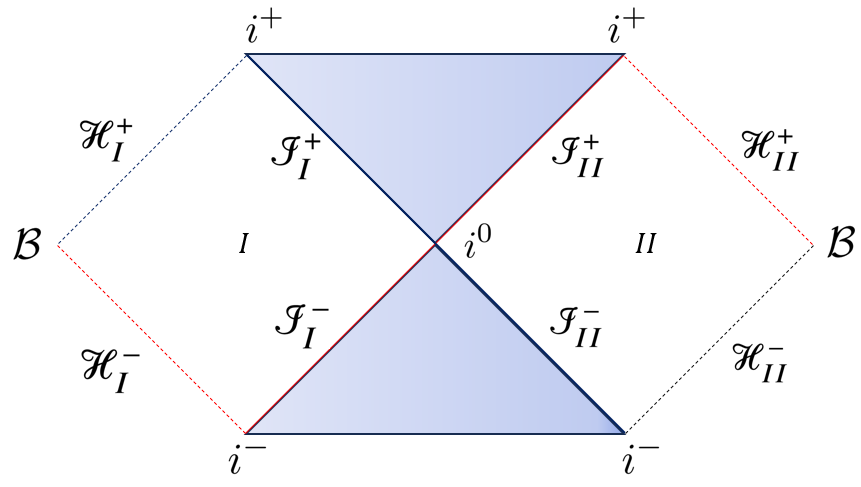
Figure 1: Conformal extension of the black hole spacetime centered on spacelike infinity.
Vacuum Structure, Regularizations, and Soft Modes
Different choices of vacua correspond to distinct physical environments:
- Hartle-Hawking vacuum: Describes a fully thermalized, equilibrium black hole, with divergent energy flux at I+ unless regulated.
- L-vacuum (hard regularization): Implements a cutoff in angular momentum, rendering the energy flux finite by discarding modes above l=L.
- κl-vacua (soft regularization): Incorporate gray-body factors via mode-dependent effective temperatures κl, modeling the realistic transmission through the black hole potential barrier.
The soft regularization is especially important as it mirrors the spectral filtering due to the gravitational potential, and yields modular Hamiltonians with explicit non-thermal, chemically modulated contributions.
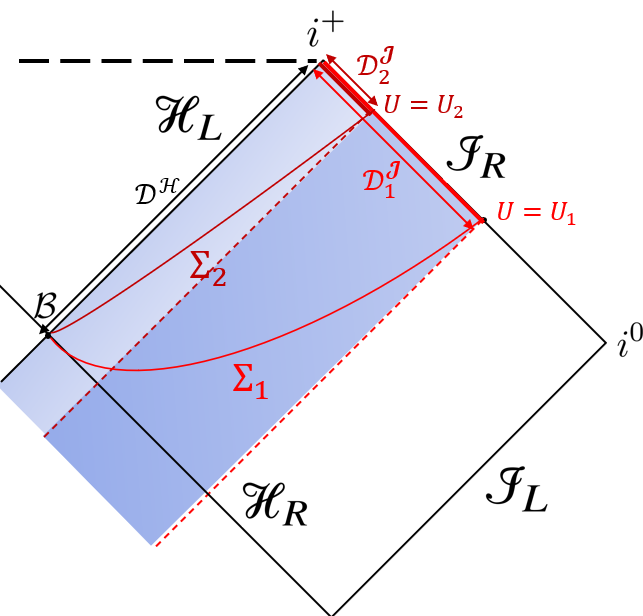
Figure 2: Setup in which the hypersurfaces Σ1 and Σ2 both start at the horizon bifurcation surface and end at different cuts on null infinity, visualizing nested algebras for the dual GSL.
Open Systems Perspective, Markovian Dynamics, and Time Scales
The Markovian approximation for open quantum systems is achieved when the system's inherent dynamics are slow compared to the reservoir correlation time. The Lindblad equation
dtdρS=−i[H,ρS]+D(ρS)
ensures CPTP evolution and underlies the connection to quantum fields on null hypersurfaces, where causality enforces strict Markovianity: information that exits the observable region cannot return, analogous to infinite, memoryless reservoirs in quantum thermodynamics.
A pivotal insight is the identification of the surface gravity κ as the inverse relaxation/correlation time, determining the onset of effective Markovianity and the regime where the GSL is valid as a monotonic statement.
Non-Thermal Radiation, Work Extraction, and Engine Protocols
The modular Hamiltonians for non-thermal vacua (e.g., κl-vacua, Unruh vacuum) contain explicit chemical potential terms, indicating the presence of non-passive states from which work can, in principle, be extracted. The population inversion across quasi-thermal sectors enables the construction of autonomous heat engines such as the Brunner-Linden-Popescu-Skrzypczyk (BLPS) engine.
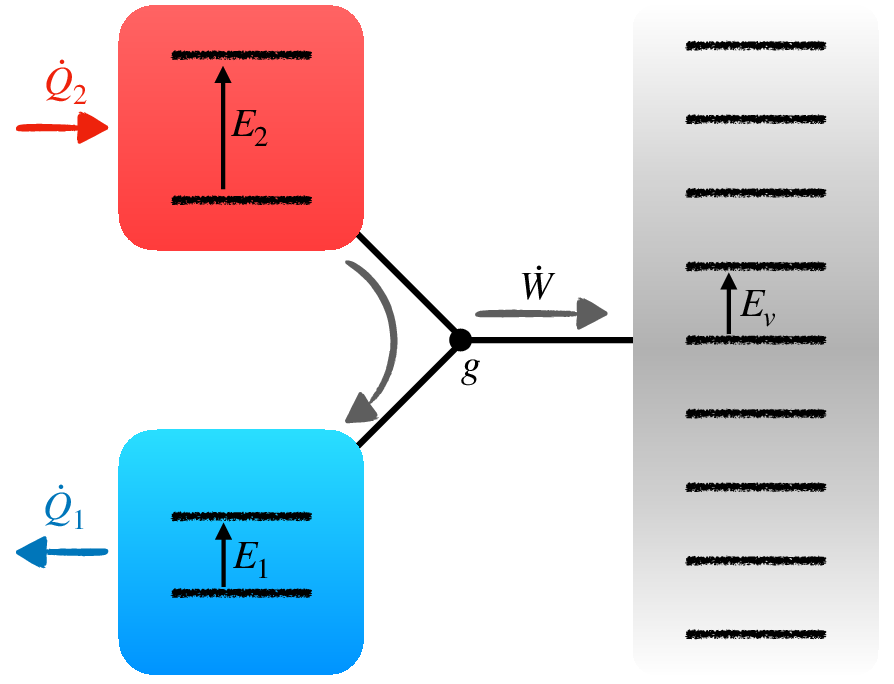
Figure 3: Schematic of the BLPS engine, illustrating energy extraction from population inversion between qubits coupled to radiation baths at different effective temperatures.
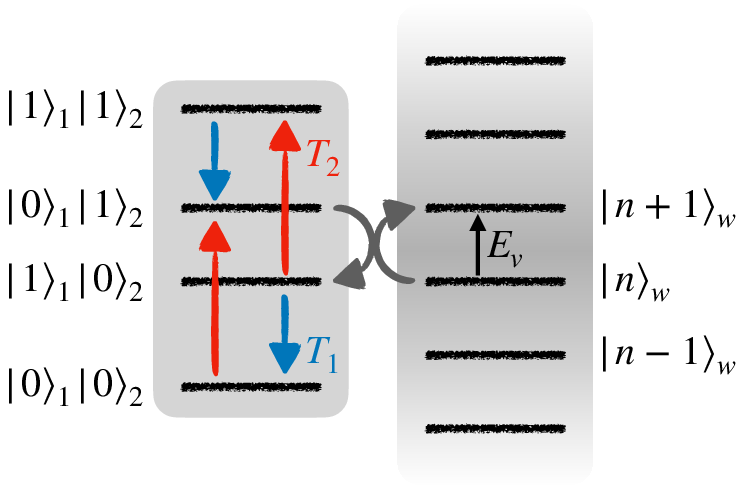
Figure 4: Tensor product structure induced by the engine, with reservoir-induced jumps and transitions up an energy ladder visualized in eigenbasis.
In this construction, coupling different field modes (with different effective temperatures) to a sequence of two-level systems allows the systematic extraction of work commensurate with the chemical potential modulations induced by the black hole's gray-body factors.
Maximal extractable work is given by:
∣Wmax∣=(TlTH−1)ω′
and corresponds precisely to the chemical contributions in the thermodynamic potentials derived from the modular Hamiltonians.
Unruh and Kerr Vacua: Generalized Law and Angular Momentum Flux
The analysis is further refined in the context of the Unruh vacuum, relevant for astrophysical evaporation, and is generalized to Kerr black holes. For the Unruh vacuum, the outgoing flux is governed by gray-body-filtered transmission coefficients, yielding effective chemical potentials:
μωl=THln1−(1−∣tωl∣2)e−βHω∣tωl∣2
The dual second law in this context is:
ΔM−lm∑∫0+∞μωl⟨Δnωlm⟩Ψdω−THΔSΨ≤0
where the first term is the change in Bondi mass, the second term is the extractable work, and the last is the entropic flux.
For the Kerr case, angular momentum flux adds a geometric work contribution, with the grand thermodynamic potential incorporating both chemical (μωlm) and rotational (ΩHΔJ) terms:
ΔM−ΩHΔJ−lm∑∫0+∞μωlm⟨Δnωlm⟩Ψdω−THΔSΨ≤0
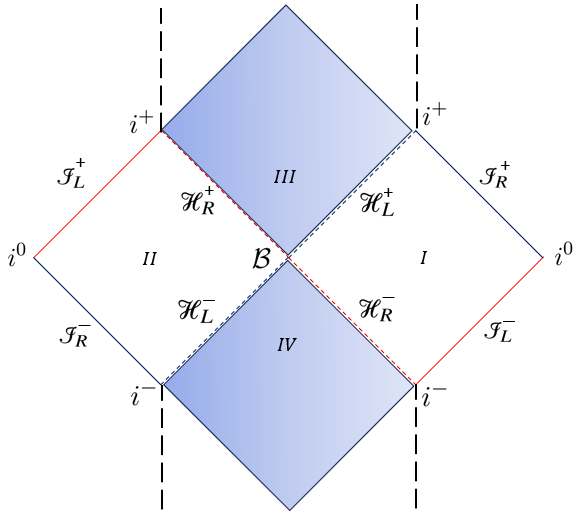
Figure 5: Penrose diagram region of the maximal extension of the Kerr solution, capturing essential causal and horizon structures relevant for the modular and thermodynamic analysis.
Implications and Outlook
The unification of black hole thermodynamics with open quantum systems research yields several conceptual and practical consequences:
- It provides a microscopic, operational basis for understanding black hole free energy, grand potential, and work extraction.
- It clarifies the role of vacuum (or late-time boundary) choices and the necessity of going beyond the Hartle-Hawking equilibrium framework for realistic scenarios.
- The Markovian structure is exact for quantum fields on null hypersurfaces; departures (e.g., on spacelike hypersurfaces or dynamical horizons) may lead to non-Markovianity, with entropy production governed by system-environment correlations rather than local fluxes.
- The approach naturally incorporates angular momentum (and charge, in other backgrounds) as work sources, directly mapping to terms in the generalized first law and the associated modular Hamiltonian.
The paper suggests future directions in clarifying the thermodynamic laws for open regions with complex causal structure, extending algebraic proofs to general non-equilibrium vacua (especially for the Unruh vacuum), and investigating the interplay between geometric (Noether charge) and non-geometric (work/chemical) terms in the quantum thermodynamics of gravity.
Conclusion
This work demonstrates that the thermodynamics of black holes as seen from null infinity is structurally equivalent to the thermodynamics of open quantum systems with Markovian dynamics, and that realistic (non-thermal) vacua allow for operational work extraction mechanisms directly tied to the quantum statistical mechanics of Hawking radiation. The algebraic modular theory framework not only undergirds generalized second law inequalities but also enables precise, physically meaningful decompositions of energy, entropy, and extractable work—including, in the Kerr case, the rotational analog of Penrose process, generalized to quantum statistical settings.
These results deepen the theoretical foundations for understanding black hole evaporation, the ultimate fate of mass and information in quantum gravity, and the practical limits of energy extraction from quantum fields in curved spacetime.