Graph energy as a measure of community detectability in networks
Abstract: A key challenge in network science is the detection of communities, which are sets of nodes in a network that are densely connected internally but sparsely connected to the rest of the network. A fundamental result in community detection is the existence of a nontrivial threshold for community detectability on sparse graphs that are generated by the planted partition model (PPM). Below this so-called ``detectability limit'', no community-detection method can perform better than random chance. Spectral methods for community detection fail before this detectability limit because the eigenvalues corresponding to the eigenvectors that are relevant for community detection can be absorbed by the bulk of the spectrum. One can bypass the detectability problem by using special matrices, like the non-backtracking matrix, but this requires one to consider higher-dimensional matrices. In this paper, we show that the difference in graph energy between a PPM and an Erdős--Rényi (ER) network has a distinct transition at the detectability threshold even for the adjacency matrices of the underlying networks. The graph energy is based on the full spectrum of an adjacency matrix, so our result suggests that standard graph matrices still allow one to separate the parameter regions with detectable and undetectable communities.
Paper Prompts
Sign up for free to create and run prompts on this paper using GPT-5.
Top Community Prompts
Explain it Like I'm 14
Overview
This paper is about finding groups (called “communities”) inside networks. A network is just a set of dots (nodes) with lines (edges) connecting them—like people connected by friendships. Communities are parts of the network where the connections are much thicker inside the group than to the rest of the network. The big idea here is to use something called graph energy (a single number you compute from all the “notes” or “vibrations” of a network’s connection matrix) to tell whether the communities in a network are actually findable or not.
Key questions the paper asks
- When a network is fairly sparse (each node has only a few connections), there’s a known “detectability limit”: below this limit, even the best algorithms can’t find the true communities better than random guessing. Can graph energy clearly show where this limit is?
- People often use only a few special numbers (leading eigenvalues) from a network’s adjacency matrix to detect communities, but these can fail on sparse networks. If we use the entire spectrum (all eigenvalues) through graph energy, can we do better at spotting the transition from “undetectable” to “detectable” communities?
How they studied the problem
Think of a network like a big musical instrument. The adjacency matrix (a table that says who’s connected to whom) has “eigenvalues,” which are like the different notes the instrument can play. Graph energy is like adding up the loudness of all those notes. Here’s what they compared:
- Two types of networks:
- Planted-partition model (PPM): A random network where the communities are “built in” (more edges within groups, fewer between groups).
- Erdős–Rényi (ER): A purely random network with no community structure.
- They changed how strongly communities were connected by adjusting how many edges go between the groups (inter-community connections). Fewer cross-group edges mean communities are stronger.
- They measured the graph energy for both PPM and ER networks with the same size and overall density, then looked at the difference between them. If that difference changes in a special way, it might reveal the detectability limit.
Two parts of their approach:
- Simulations: They generated many networks on computers (including GPUs to go faster), calculated all eigenvalues of the adjacency matrix, and summed their absolute values to get graph energy.
- Theory/approximation: They used ideas from random matrix theory (you can picture the “bulk” of eigenvalues following a smooth bell-like shape called a semicircle) and known formulas for the biggest eigenvalues to predict how graph energy should behave.
Plain-language decoder:
- Eigenvalues: the “notes” of the network.
- Graph energy: the total “loudness” when you add up the absolute value of all the notes.
- Detectability limit: the point where communities are so faint that even perfect methods can’t do better than guessing.
- Adjacency matrix: a big table telling you which pairs of nodes are connected.
What they found and why it matters
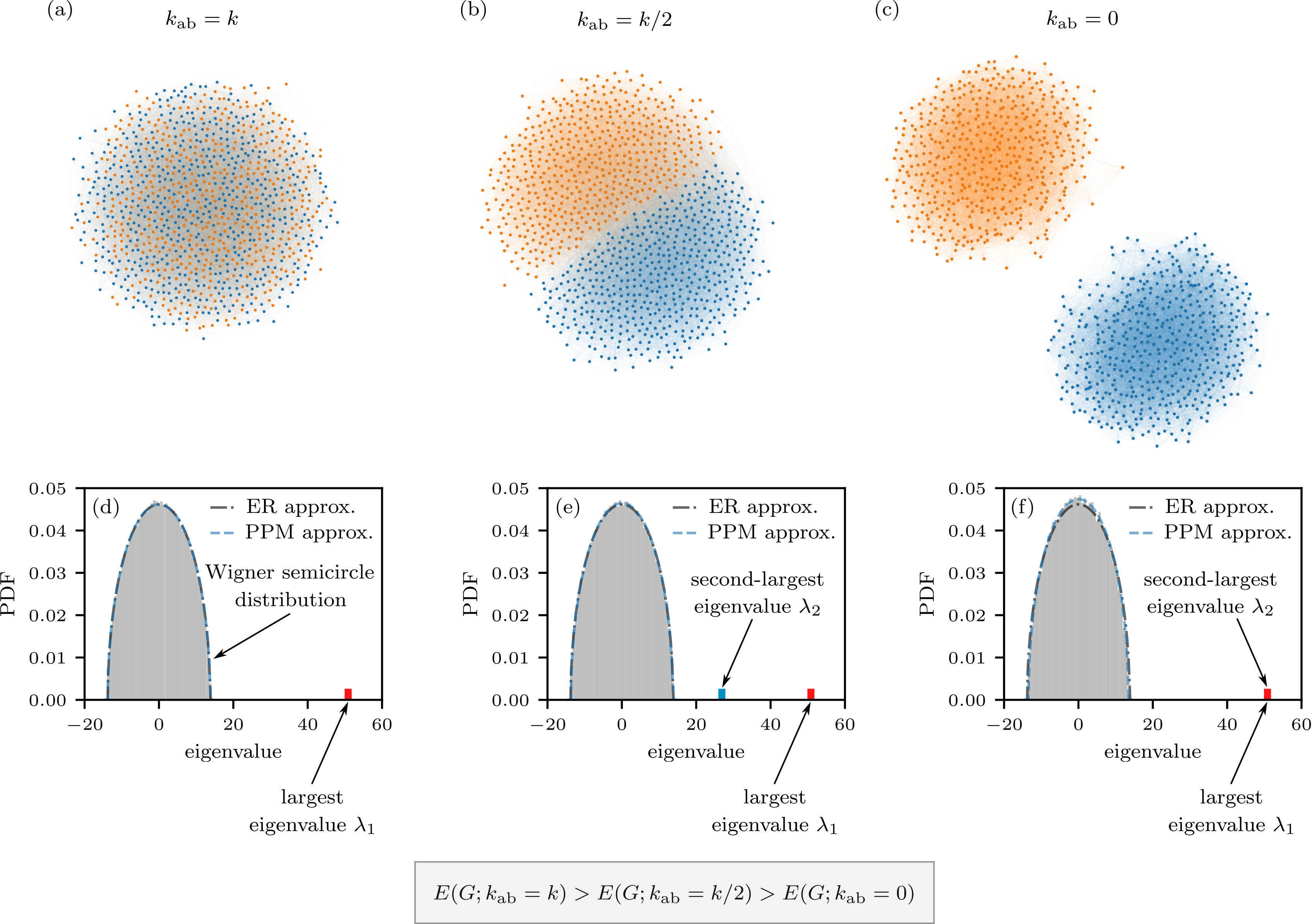
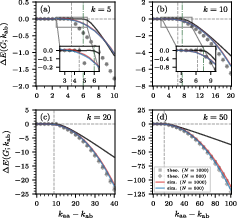
- The difference in graph energy between PPM (with communities) and ER (no communities) stays about zero when communities are too weak to detect. This means the two networks “sound” the same, and no method can reliably find the groups—exactly what the detectability limit says should happen.
- Once communities become strong enough (just above the detectability limit), the graph-energy difference starts to drop smoothly below zero. This shows a clear transition between “undetectable” and “detectable” regimes—even when using the ordinary adjacency matrix.
- Earlier, it was known that looking only at one or two special eigenvalues (like the second-largest) often fails on very sparse networks, because those eigenvalues get swallowed by the bulk (“the note you care about gets lost in the noise”). This paper shows that if you listen to the whole spectrum via graph energy, you can still see the transition.
- In short: standard matrices (like the adjacency matrix) do carry a clear signal of the detectability transition—if you use all their eigenvalues, not just the top ones.
Why this is important
- It challenges a common belief that the adjacency matrix can’t reveal the detectability limit on sparse networks. The key is to use the full spectrum (graph energy), not only a few outliers.
- It hints that “bulk” eigenvectors (not just the biggest ones) may contain useful information for community detection, which could inspire new algorithms.
- It provides a practical test: compare graph energy of your network to a matching ER network. If the difference is near zero, communities are likely undetectable; if it drops, communities are likely detectable.
Limitations and future impact
- Computing graph energy exactly is expensive because you need all eigenvalues, which gets slow for very large networks. The authors used GPUs and still mostly tested up to about a thousand nodes.
- The theory matches simulations well for moderately connected networks, but for very sparse networks, the “semicircle” approximation breaks down, so better approximations are needed.
- Future work could:
- Develop faster ways to estimate graph energy (for example, using approximation algorithms for the Schatten 1-norm).
- Design community-detection methods that make better use of bulk eigenvectors.
- Extend the theory to other random-network models and larger sizes.
In everyday terms: If you want to know whether real groups in a network can be found, don’t just listen for a couple of loud notes—listen to the whole chord. The total loudness (graph energy) tells you when the music changes from “random noise” to “recognizable melody,” marking the point where communities become truly detectable.
Knowledge Gaps
Knowledge gaps, limitations, and open questions
Below is a concise list of what remains uncertain, missing, or unexplored based on the paper’s assumptions, methods, and findings. Each point is stated concretely to guide future work.
- Provide a rigorous proof (beyond heuristic Wigner approximations) that the PPM–ER graph-energy difference exhibits a transition exactly at the Kesten–Stigum detectability threshold for sparse SBMs, including precise conditions and regularity assumptions.
- Develop finite-size scaling theory for graph energy and ΔE across the detectability transition, including explicit rates at which the “plateau ≈ 0” below threshold converges and how quickly the post-threshold descent emerges as N increases.
- Derive concentration bounds, variance, and limiting distributions for graph energy and ΔE (as linear spectral statistics with the non-smooth test function |x|), enabling confidence intervals and hypothesis tests on single networks.
- Replace the Wigner semicircle bulk approximation with a sparse-graph-appropriate spectral description (e.g., Kesten–McKay law for regular-like cases, cavity/Bethe approaches for locally tree-like graphs) to obtain accurate, provable formulas for E(G) and ΔE in the sparse regime (k = O(1)).
- Quantify and model the “effective detectability threshold” (where λ2 leaves the bulk) relative to the theoretical one, and explain why ΔE seems to align with the latter even when λ2-based methods do not; provide analytic conditions for the gap between these thresholds.
- Establish the monotonicity and smoothness properties of ΔE as a function of k_aa − k_ab (e.g., continuity, differentiability, order of the transition), and identify whether ΔE can serve as an “order parameter” for detectability in finite graphs.
- Generalize the analysis beyond q = 2 and equal-sized communities: derive ΔE predictions and thresholds for q > 2 blocks, unequal block sizes, degree imbalance between blocks, and hierarchical/community-overlap structures.
- Extend to degree-corrected SBMs with heterogeneous degrees; characterize how degree heterogeneity alters spectral bulk, outliers, ΔE behavior, and detectability thresholds.
- Examine disassortative SBMs (e.g., bipartite) and core–periphery structures to determine whether ΔE still plateaus in the undetectable phase and how the sign/shape of the ΔE curve changes.
- Replace the ER null with a more realistic null (e.g., configuration model or degree-preserving null) and study how ΔE should be redefined and calibrated under degree heterogeneity; quantify effects of the null choice on detectability claims.
- Provide a practical statistical test using ΔE for a single observed network: specify the null distribution, p-value computation, and control of Type I/II errors without knowledge of the ground-truth generating model.
- Analyze robustness of ΔE under model misspecification (e.g., clustering/triangles, edge correlations, attribute-driven ties), where Wigner-type assumptions fail; derive corrections that account for transitivity and higher-order motifs.
- Characterize how ΔE behaves with community-size imbalance and mixed membership (overlapping communities), and determine whether a plateau and transition persist.
- Investigate ΔE under directed, weighted, signed, temporal, multilayer, and hypergraph settings; define appropriate “energy” (e.g., singular-value sums for non-symmetric matrices) and detectability criteria in these broader network classes.
- Compare graph-energy transitions across different graph matrices (e.g., Laplacian, normalized Laplacian, modularity, Bethe Hessian, non-backtracking): do their energies show analogous detectability transitions and with what thresholds?
- Develop algorithms that leverage bulk eigenvectors (as suggested) for community detection, not just for signaling detectability; specify selection/aggregation of bulk eigenvectors, design objectives, and compare performance to belief propagation and non-backtracking methods.
- Create scalable estimators for graph energy (Schatten 1-norm) on large graphs (N ≫ 103) with provable accuracy and complexity (e.g., stochastic trace estimation, Lanczos/Gauss quadrature, Chebyshev expansions, randomized SVD), and benchmark their error/compute trade-offs for ΔE.
- Quantify the sample-to-sample variability of ΔE (and of E(G)) and provide minimal sample sizes for stable estimation; assess how variability scales with N, k, and (k_aa − k_ab).
- Investigate whether energy computed on the bulk alone (e.g., excluding the top one or two outlier eigenvalues) yields a sharper detectability signal than full energy, and whether partial-energy statistics improve robustness in sparse, noisy conditions.
- Establish how ΔE depends on the presence of localized eigenvectors (due to hubs/stars) in heavy-tailed degree distributions; disentangle community signals from localization artifacts.
- Evaluate sensitivity of ΔE to edge noise, missing edges (thinning), and sampling biases common in empirical network data; determine correction procedures or robustness bounds.
- Provide systematic comparisons between ΔE and alternative scalar spectral statistics (e.g., spectral radius, Estrada index, spectral entropy, trace(A2), trace(|A|)) for signaling detectability across a range of regimes.
- Clarify the role of diagonal shifts/centering (e.g., using A − p11T or adding self-loops) on graph energy and its detectability signal, particularly in sparse graphs where centering affects bulk structure.
- Extend numerical experiments to much larger networks (N ≫ 103) and sparser regimes (k < 5), where spectral peculiarities (zero eigenvalue spikes, tree-induced deltas) dominate; validate whether ΔE still aligns with the theoretical threshold and quantify deviations.
- Connect the ΔE transition to counts of even closed walks (given E(G) depends on even-walk sums): identify which walk lengths dominate near the threshold and whether short-cycle statistics can serve as faster computable proxies for ΔE with theoretical guarantees.
Practical Applications
Immediate Applications
The following bullet points summarize actionable use cases that can be deployed now, leveraging the paper’s findings that the graph-energy difference between a real network and an ER baseline serves as a clear diagnostic for community detectability.
- Pre-check for community detectability in network analysis pipelines
- Sectors: software/data science, social media, telecommunications, healthcare (bioinformatics), finance
- Description: Before running community-detection algorithms, compute the graph-energy difference ΔE between the network and an ER surrogate with the same N and mean degree k. If ΔE ≈ 0, communities are information-theoretically undetectable; if ΔE < 0 and decreasing with k_aa − k_ab, communities are likely detectable.
- Tools/Workflows: Implement GPU-accelerated eigenvalue computations using
JAXorPyTorch(as demonstrated in the paper) and bundle into a “Detectability Pre-Check” module callable fromNetworkX,igraph, orGraphTool. - Assumptions/Dependencies: Requires computing the full spectrum (O(N3)); applicable to undirected, unweighted graphs; ER is the default baseline (degree heterogeneity may require different surrogates).
- Algorithm selection gate for community detection
- Sectors: software/data science
- Description: Use ΔE to decide whether to apply heavy-duty methods (e.g., non-backtracking spectral methods, belief propagation) or skip clustering to avoid wasted computation and spurious results.
- Tools/Workflows: A wrapper that routes networks to different algorithms based on detectability signal (e.g., adjacency spectral when ΔE clearly indicates detectability; otherwise non-backtracking or probabilistic methods).
- Assumptions/Dependencies: ΔE thresholding strategy; sparse regimes may require multiple surrogates or repeated runs for stability.
- Quality assurance and overfitting audit for community-detection outcomes
- Sectors: academia, software, compliance
- Description: If an algorithm outputs strong communities but ΔE ≈ 0, flag potential overfitting or resolution-limit artifacts. Incorporate ΔE as a sanity check in model reports.
- Tools/Workflows: “Community QA” report card integrating ΔE, λ2 behavior, and modularity scores.
- Assumptions/Dependencies: Works best for two-community SBMs and adjacency-based spectra; general networks may need tailored baselines.
- Benchmark design and evaluation in research
- Sectors: academia
- Description: Use the ΔE transition as a benchmark criterion when constructing planted-partition tests, ensuring datasets span undetectable and detectable regimes objectively (even when λ2 is absorbed by the bulk).
- Tools/Workflows: Automated SBM/PPM generator with ΔE-based labeling of regimes; teaching materials for network science courses.
- Assumptions/Dependencies: Reliance on spectral bulk approximations (Wigner) is reasonable for moderate k; sparse graphs need care.
- Risk triage in cybersecurity and fraud detection
- Sectors: cybersecurity, finance
- Description: Rapidly assess whether modular structures (botnets, collusive clusters) are likely to be detectable. If ΔE indicates detectability, prioritize community-based anomaly detection; otherwise pivot to alternative signals.
- Tools/Workflows: “Detectability triage” service hooked into SIEM pipelines, pointing to cluster-based or alternative detectors.
- Assumptions/Dependencies: Graph representation must reflect actual interaction patterns; ER baseline may be inappropriate if degree distributions are heavy-tailed.
- Network privacy and disclosure audits
- Sectors: policy, data governance
- Description: For anonymized or synthetic network releases, compute ΔE to gauge whether communities could still be recovered. Tune perturbations to reduce detectability (ΔE → 0) without destroying utility.
- Tools/Workflows: “Energy-based Privacy Audit” supporting disclosure risk assessments.
- Assumptions/Dependencies: Ethical trade-offs; preserving utility while reducing detectability; ER may be a weak baseline for structured networks.
- Bioinformatics: pre-assessment of clustering feasibility in gene regulatory or protein interaction networks
- Sectors: healthcare, biotechnology
- Description: Use ΔE to assess whether omics-derived networks exhibit detectable modules prior to running time-consuming clustering and pathway inference.
- Tools/Workflows: Integration into pipelines (e.g.,
scanpy,Seuratadd-ons) for network-derived modules. - Assumptions/Dependencies: Network inference noise; weighted/directed edges may require adapted energy measures.
- Operational network monitoring
- Sectors: telecommunications, IT operations
- Description: Periodically compute ΔE on communication or dependency graphs to detect emergent modularity (e.g., partitioned behavior, subnetwork isolation) indicating shifts in system dynamics or faults.
- Tools/Workflows: Scheduled jobs with GPU acceleration; alerting dashboards showing ΔE trends.
- Assumptions/Dependencies: Scalability constraints; may require subgraph sampling or approximate energy methods for large networks.
Long-Term Applications
The following use cases depend on further research and development (e.g., scalable approximations, extensions beyond undirected/unweighted graphs, or generalization to realistic baselines like configuration models and DC-SBMs).
- Scalable approximation of graph energy (Schatten 1-norm) for large networks
- Sectors: software, cloud analytics
- Description: Develop randomized, streaming, or sketching-based algorithms (e.g., Hutchinson’s estimator, stochastic Lanczos quadrature, Chebyshev polynomials) to approximate graph energy without full eigendecompositions.
- Tools/Products: “EnergyDetect” library/service offering fast ΔE estimates at scale; cloud APIs with GPU/TPU support.
- Assumptions/Dependencies: Numerical stability and error bounds; calibration on sparse graphs where Wigner semicircle deviates.
- Community detection leveraging bulk eigenvectors
- Sectors: academia, software
- Description: Design new spectral methods that use non-extremal eigenvectors (the bulk), motivated by the paper’s evidence that bulk carries detectability signal even when λ2 is absorbed.
- Tools/Products: Bulk-aware spectral embeddings or filters; hybrid methods combining bulk eigenvectors with non-backtracking matrices.
- Assumptions/Dependencies: Theory and empirical validation across diverse network models; robust handling of localization and sparse artifacts.
- Generalized detectability diagnostics with realistic baselines
- Sectors: academia, industry
- Description: Replace ER surrogates with configuration-model or degree-corrected SBM baselines so ΔE reflects detectability relative to networks with similar degree sequences or heterogeneity.
- Tools/Products: “Baseline-aware Detectability” toolkit supporting multiple null models and automatic selection.
- Assumptions/Dependencies: Efficient generation of surrogates; analytical energy approximations for non-ER baselines.
- Directed, weighted, temporal, and multiplex extensions
- Sectors: healthcare, finance, logistics
- Description: Extend energy-based detectability to directed/weighted graphs (building on known results for directed random graphs), time-evolving networks, and multilayer systems.
- Tools/Products: Temporal ΔE trackers, layer-specific and aggregated energy differences; multiplex-aware diagnostics.
- Assumptions/Dependencies: Appropriate matrix choices (e.g., symmetrized adjacency, weighted variants), spectral density approximations for new models.
- Real-time streaming detectability monitoring
- Sectors: cybersecurity, telecommunications
- Description: Online estimation of ΔE for dynamic graph streams to detect the onset of modular structures (e.g., botnet formation) and trigger countermeasures.
- Tools/Products: Stream analytics frameworks with incremental energy approximation; alerting and automated responses.
- Assumptions/Dependencies: Low-latency approximation algorithms; resilience to concept drift and missing data.
- Policy standards for auditing community detection
- Sectors: policy, governance
- Description: Incorporate ΔE-based detectability checks into guidelines for reporting community detection in public-interest analyses (e.g., social network studies), reducing misinterpretation and bias.
- Tools/Products: Compliance checklists; reproducibility protocols requiring detectability diagnostics.
- Assumptions/Dependencies: Community adoption; training and awareness; harmonization with privacy and ethics frameworks.
- Privacy-preserving data synthesis guided by detectability
- Sectors: data governance, synthetic data providers
- Description: Use ΔE targets to modulate synthetic network generation (e.g., via SBM/DC-SBM) to balance utility and privacy by controlling detectable modularity.
- Tools/Products: Synthetic network generators with ΔE constraints; knobs for detectability vs. utility.
- Assumptions/Dependencies: Utility metrics that correlate with task performance; domain-specific calibration.
- Network health diagnostics in infrastructure (e.g., power grids, supply chains)
- Sectors: energy, logistics
- Description: Energy-based metrics to detect re-partitioning or fragmentation (communities forming due to failures or policy changes), informing maintenance and intervention.
- Tools/Products: Dashboard overlays showing ΔE over time, correlated with operational KPIs.
- Assumptions/Dependencies: Accurate graph representations; adaptation to weighted/directed edges common in these domains.
- Educational tools and curricula
- Sectors: education
- Description: Interactive modules demonstrating detectability thresholds via ΔE, highlighting the difference between theoretical and effective thresholds in sparse regimes.
- Tools/Products: Web apps using GPU-backed computation or precomputed datasets; exercises in network science courses.
- Assumptions/Dependencies: Simplified interfaces; carefully curated datasets to avoid misinterpretation.
- Analytical refinements (Stieltjes-transform and density-of-states methods)
- Sectors: academia
- Description: Improve theoretical approximations for graph energy beyond Wigner semicircle (especially for sparse graphs), enabling tighter bounds and better diagnostics.
- Tools/Products: Open-source analytical libraries and notebooks; integration with symbolic math tools.
- Assumptions/Dependencies: Advanced random matrix theory; validation against large-scale simulations.
Notes on assumptions and dependencies across applications:
- The current strongest evidence is for undirected, unweighted graphs with two equal-sized communities in SBMs/PPMs; extensions are needed for more complex, real-world networks.
- Computing graph energy exactly is O(N3); practical deployment at scale depends on approximation methods and/or sampling strategies.
- ER is a simplistic baseline; for heterogeneous degrees, configuration models or degree-corrected SBMs are more appropriate.
- Sparse graphs deviate from Wigner semicircle behavior; empirical behavior of ΔE remains promising, but theoretical guarantees require further work.
Glossary
- Bulk of the spectrum: The main mass of eigenvalues in a matrix’s spectrum, excluding outliers; often modeled by a semicircle law. "Spectral methods for community detection fail before this detectability limit because the eigenvalues corresponding to the eigenvectors that are relevant for community detection can be absorbed by the bulk of the spectrum."
- Bulk-variance correction term: A correction to the bulk spectral contribution reflecting changes in variance due to model parameters. "Based on a Wigner approximation of the spectral bulk, we demonstrate in the End Matter that depends both on the second-largest eigenvalue and on a bulk-variance correction term that is proportional to ."
- Degree-corrected SBMs: Variants of stochastic block models that incorporate node-specific degree heterogeneity. "degree-corrected SBMs"
- Detectability limit: The regime in which no community-detection method can outperform random chance. "Below this so-called ``detectability limit'', no community-detection method can perform better than random chance."
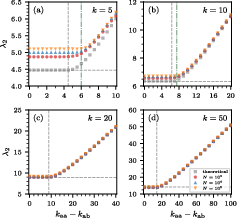
- Detectability threshold: The theoretical boundary (often ) separating detectable from undetectable community structure. "The value is the theoretical detectability threshold."
- Effective detectability threshold: An empirical threshold where spectral methods (e.g., based on adjacency matrices) begin to detect communities, which can exceed the theoretical threshold in sparse graphs. "The dash-dotted vertical lines in panels (a) and (b) mark the effective detectability threshold; below this threshold, is absorbed by the bulk of the spectrum."
- Erdős–Rényi (ER) network: A random graph model G(N,p) where each edge is independently present with probability p. "Wigner approximations for ER networks with mean degree and nodes"
- Graph energy: The sum of the absolute values of the eigenvalues of a graph’s adjacency matrix. "The graph energy is based on the full spectrum of an adjacency matrix"
- Hückel molecular orbital theory: A quantum-chemical model that inspired the definition of graph energy. "Graph energy was introduced as a generalization of the total -electron energy in H\"uckel molecular orbital theory"
- Kesten–Stigum (KS) threshold: An information-theoretic threshold for detectability in probabilistic models like SBMs. "From a mathematical perspective, the detectability threshold is an example of a Kesten--Stigum (KS) threshold"
- Ky Fan's theorem: A matrix inequality used to bound sums of eigenvalues or singular values. "including lower and upper bounds that are based on {Ky Fan's theorem~\cite{fan1951maximum}.}"
- Localization (of eigenvectors): The phenomenon where eigenvectors concentrate on small subsets, which can hinder community detection when not aligned with communities. "leading eigenvectors may not be localized on the communities"
- Mean-field approximation: An analytical approach that replaces detailed interactions with averaged effects. "quantify the accuracy of mean-field approximations in a simple disease-spreading process on networks"
- Modularity matrix: A matrix used in spectral community detection reflecting deviations from a null model of connectivity. "such as the adjacency matrix, Laplacian matrices, and the modularity matrix"
- Non-backtracking matrix: A matrix of walks that do not immediately retrace steps; its spectrum is used for community detection in sparse networks. "One can bypass the detectability problem by using special matrices, like the non-backtracking matrix"
- Non-centered Wigner matrix: A Wigner-type random matrix whose entries have nonzero mean. "For ER networks, the adjacency matrix is a non-centered Wigner matrix"
- Outlier eigenvalue: An eigenvalue that lies outside the spectral bulk and typically carries structural signal (e.g., community information). "In~\eqref{eq:energy_difference}, we see that one can approximate the difference between the PPM and ER graph energies by the sum of two contributions: (i) the outlier term "
- Planted-partition model (PPM): A simple SBM with equal-sized communities and distinct within/between edge probabilities. "planted-partition model (PPM)"
- Schatten 1-norm: The sum of singular values of a matrix (nuclear/trace norm); equals graph energy for symmetric adjacency matrices. "Schatten 1-norm (i.e., the nuclear norm or trace norm)"
- Spectral algorithms: Methods that use eigenvectors/eigenvalues of network matrices to infer structure, such as communities. "Spectral algorithms, which use eigenvectors of network matrices (such as the adjacency matrix, Laplacian matrices, and the modularity matrix)"
- Spectral clustering: A clustering technique that uses eigenvectors of matrices like the Laplacian or adjacency matrix to partition nodes. "spectral clustering that is based on standard matrices extends the undetectable phase beyond the onset in~\eqref{eq1}"
- Stieltjes-transform approach: A technique from complex analysis and random matrix theory to study spectral densities via resolvents. "or to refine our approximations of graph energy using a Stieltjes-transform approach"
- Stochastic block model (SBM): A generative model of networks with community-dependent edge probabilities. "stochastic block models (SBMs) and generalizations of them"
- Tight-binding approximation: A physics model approximating electronic structure by nearest-neighbor hopping, mapping molecules to networks. "a tight-binding approximation that represents molecules as networks"
- Wigner approximation: Approximating the spectral bulk with the Wigner semicircle law. "Using a Wigner approximation for the bulk of the spectrum"
- Wigner matrix: A real symmetric random matrix with independent (up to symmetry) entries and finite variance. "A Wigner matrix is a real symmetric random matrix"
- Wigner semicircle distribution: The shape of the limiting eigenvalue density of certain random matrices after scaling. "the bulk of the spectra resemble a Wigner semicircle distribution"
- Wigner semicircle law: The theorem stating convergence of the empirical spectral distribution of Wigner matrices to the semicircle distribution. "the empirical spectral distribution of converges almost surely to the Wigner semicircle law"
Collections
Sign up for free to add this paper to one or more collections.