- The paper demonstrates a low-loss material design using sapphire-epoxy composites that effectively blocks IR via Mie scattering while preserving GHz signals.
- It details simulations and experimental validations showing IR stop-band extinction >2/mm and pass-band loss <0.1 dB at 5 GHz in cryogenic conditions.
- The study highlights the composite’s scalability and potential to reduce quasiparticle generation, improving superconducting quantum device performance.
Low-loss Material for Infrared Protection of Cryogenic Quantum Applications
Introduction
The performance of superconducting quantum devices operating at millikelvin temperatures is decisively limited by excessive quasiparticle generation, often induced by incident high-energy infrared (IR) photons. Conventional shielding usually relies on multilayer metallic enclosures, but dielectric feedthroughs introduce avenues for IR photon leakage. Existing filter solutions predominantly utilize absorptive materials with broadband attenuation, such as Eccosorb, but these can impart excessive insertion loss in gigahertz (GHz) passbands essential for device signal integrity. This paper presents a material system—comprising high-purity sapphire spheres embedded in a non-magnetic epoxy matrix—engineered to simultaneously maximize IR attenuation via Mie scattering and minimize GHz (microwave) loss (2601.05147).
Theoretical Foundation: Scattering and Absorption Optimization
The underlying mechanism exploits Mie scattering, which is sharply resonant when the sphere diameter approximately matches the incident photon wavelength. This regime enables strong extinction of optical and IR photons, while leaving GHz signals (with wavelengths ≫100 μm) largely unaffected. Mixtures of sapphire spheres with controlled size distributions broaden the extinction bandwidth and create a robust stop-band in the IR.
Simulations employing the complete Mie theory and complex refractive index data for sapphire yield extinction cross-section curves for spheres ranging from 0.45 μm to 700 μm in diameter. For wavelengths below 10 μm, nearly wavelength-independent extinction is achieved, shifting to Rayleigh-regime behavior (∼λ4 decay) at longer wavelengths, thereby providing a well-defined low-pass filter edge.
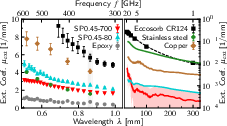
Figure 1: Extinction coefficients of sapphire-epoxy composites, Eccosorb, and epoxy resin delineate spectral regimes of efficient IR attenuation and GHz transmission.
Experimental Realization: Compound Design and Characterization
The materials investigated include epoxy-only, size-graded sapphire-epoxy composites (SP0.45-80 and SP0.45-700), pure sapphire spheres at distinct diameters, PTFE, HDPE, and conventional absorber-filled epoxies. Infrared transmission and absorption spectra were measured using a high-sensitivity FTIR spectrometer, enabling precise extinction coefficient determination over 1–1000 μm wavelengths.
Sapphire-epoxy mixtures with small sphere inclusions (<80 μm) demonstrated near-complete extinction in the MIR (mid-IR) regime, dominated by Mie scattering from the smallest grains. Mixtures spanning up to 700 μm included larger spheres which extend the stop-band well into the FIR, at the cost of reduced sphere number density and hence fewer scattering events per length. The transmission dependence on sample thickness confirms exponential attenuation as predicted by Beer–Lambert.
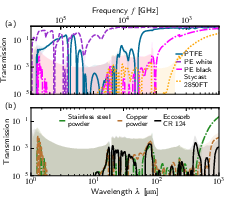
Figure 2: Comparative transmission spectra for all tested materials, highlighting the superior IR blocking capability of sapphire-epoxy composites.
Key requirements for quantum application filters are stringent: pass-band signal loss must be minimal (<0.4 dB below 10 GHz), while IR attenuation should match or exceed that of legacy absorbers. SP0.45-700 filters were implemented, impedance-matched to 50 Ω for direct integration into coaxial feedthroughs. Cryogenic transmission and reflection measurements at 15 mK validate a pass-band insertion loss of <0.1 dB at 5 GHz, with only marginal variation from room temperature metrics. The effective dielectric constant showed a minor increase from ϵr=3.75 (RT) to $3.88$ (mK), signifying temperature stability in operating regimes.
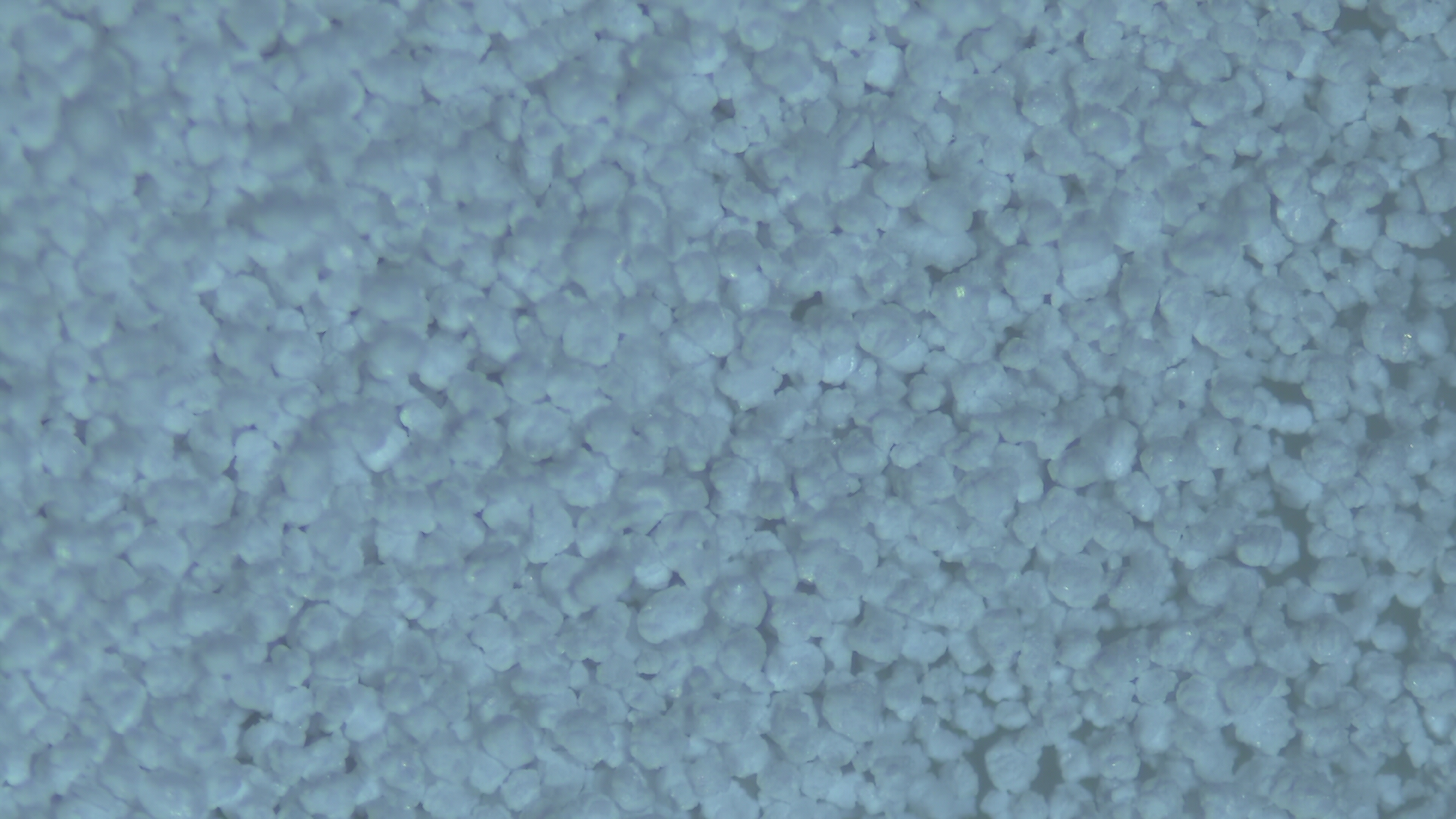
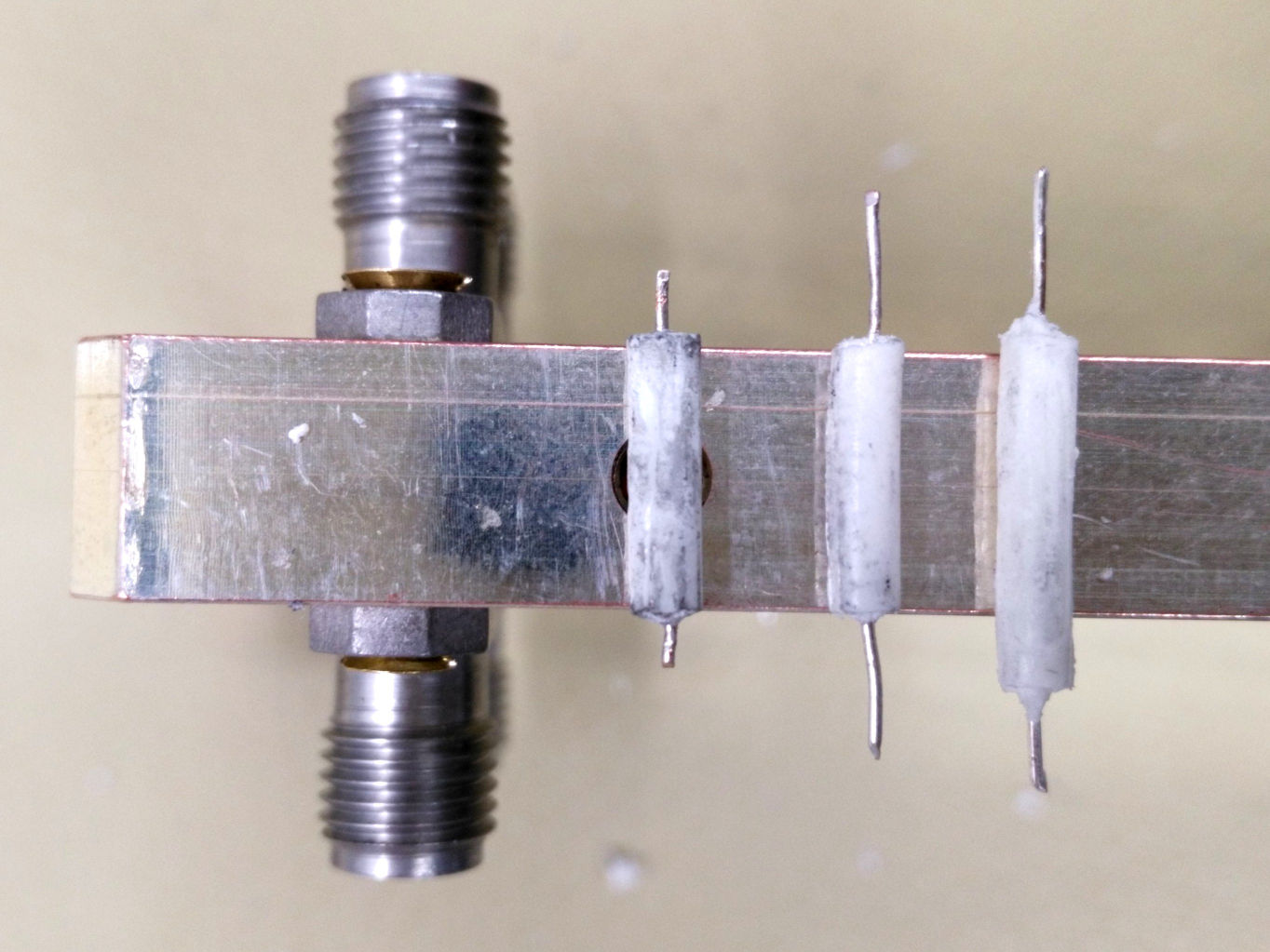
Figure 3: Microstructure of sapphire powder and microwave filter assembly, illustrating scalability to practical device formats.
Comparative Analysis to Conventional Filtering Materials
Sapphire-epoxy filters were benchmarked against PTFE, HDPE, Stycast, Eccosorb CR124, copper, and stainless steel powder composites. PTFE and transparent HDPE showed poor IR attenuation, while black HDPE and metal-filled epoxies blocked IR efficiently but also exhibited high loss in the GHz pass-band. Eccosorb CR124 delivered strong IR and microwave suppression, yet introduced over 20× more loss in the pass-band compared to sapphire-epoxy composites.
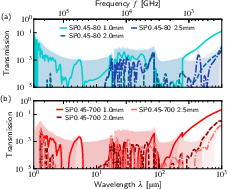
Figure 4: Transmission spectra through sapphire-epoxy filters of varying thicknesses, demonstrating scalability and tunability of extinction.
Implications and Future Directions
The demonstrated material concept enables high-fidelity infrared shielding for cryogenic quantum circuits without compromising microwave signal integrity, mitigating source-induced quasiparticle poisoning and subsequent decoherence in superconducting devices (2601.05147). The non-magnetic, non-conductive nature of the composite also facilitates compatibility with a broad array of quantum hardware.
This work opens prospects for tailored photonic engineering of filter stop-bands via sphere size distributions. Extensions may include monodisperse sphere selection for edge-sharp cutoffs, optimization of mixing ratios for mechanical stability, and hybridization with on-chip photonic crystal structures. Advanced quantum platforms—such as multi-qubit superconducting processors and high-sensitivity SQUID arrays—stand to benefit directly from these filter materials. Further quantitative studies on long-term thermal cycling, mechanical reliability, and integration with active cooling systems are warranted.
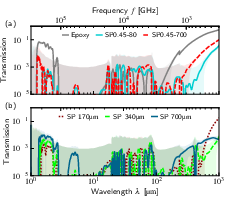
Figure 5: Sapphire sphere transmission curves under different configurations, indicating absorption edge tunability via particle size selection.
Conclusion
The synthesis and validation of sapphire-epoxy composites establish a paradigm for low-loss IR filtering in cryogenic quantum technologies. The composite achieves stop-band extinction coefficients exceeding $2$/mm up to the FIR and pass-band values ≤ 4×10⁻⁴/mm in the GHz, with a ≈40× improvement in microwave transmission over standard absorptive filters. Simulation and experimental data confirm the materials’ suitability for scalable quantum device integration, with potential for further customizability. This work contributes a generalizable framework for photonic filter design in quantum-limited applications.