- The paper introduces temperature-dependent CPT violation, showing that a T² scaling of electron-positron mass differences is consistent with early universe dynamics and terrestrial constraints.
- It utilizes a modified PRyMordial BBN code to numerically assess how mass asymmetries impact light element abundances, particularly helium-4, deuterium, and lithium-7.
- The study compares several toy models, revealing that only pairwise intersections of observational bounds are achievable while the Lithium problem poses ongoing challenges.
Temperature-Dependent CPT Violation During Big Bang Nucleosynthesis
Introduction and Motivation
The paper "Temperature-Dependent CPT Violation: Constraints from Big Bang Nucleosynthesis" (2601.06259) targets the phenomenology of CPT violation with an explicit temperature dependence—specifically, how this can manifest as electron-positron mass differences during the epoch of Big Bang Nucleosynthesis (BBN). Unlike present-day experiments, which tightly constrain such mass differences, the focus here is on models where CPT violation is negligible at low T but becomes significant at MeV-scale temperatures in the early universe. The central parameterization, b0(T)=αT2, ensures compatibility with terrestrial constraints while permitting nontrivial early-universe effects.
Theoretical Framework and Model Construction
In standard quantum field theory, CPT invariance mandates identical masses and lifetimes for particles and their antiparticles. However, if the electron-positron mass difference is driven by a temperature-dependent background field, current laboratory bounds do not constrain the early universe scenario due to the strong vanishing of b0(T) as T→0. The scaling b0(T)∝T2 is theoretically motivated both by finite-temperature field-theoretic arguments and phenomenological necessity. Scalings steeper than T2 grossly violate BBN constraints, while softer scalings produce effects that are either unobservable during BBN or in tension with experimental data.
The authors introduce several toy models that realize the desired T2 scaling:
- Cubic Potential Model: A vector field acquires a temperature-dependent VEV through a cubic term; simple in construction but ad hoc in fundamental theory.
- Scalar-Vector Coupling with Phase Transition: More natural, this mechanism utilizes a scalar field whose temperature-dependent VEV induces b0(T) via higher-dimensional operators.
- PT-Symmetric Hamiltonian: An alternative quantization where non-Hermitian but PT-symmetric potentials govern B0, also producing the necessary scaling.
Each model demonstrates that T2 scaling can be obtained without explicit fine-tuning, although embedding these mechanisms in UV-complete theories remains open.
Mass asymmetry between electrons and positrons modifies their respective Fermi-Dirac distributions only through the dispersion relations, while charge neutrality can always be enforced via an appropriate chemical potential (μ). The analytical behavior interpolates between the relativistic and non-relativistic regimes, and an approximation for μ involving modified Bessel functions is presented and validated through numerical solutions.
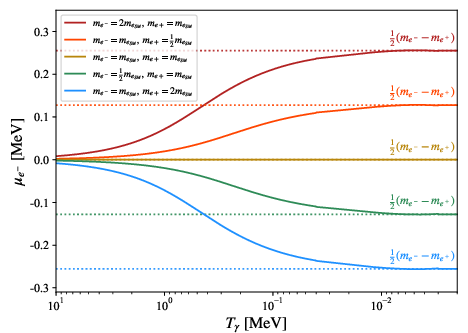
Figure 1: Change in electron chemical potential over time for several electron-positron mass combinations; μe−(T) asymptotically approaches 21(me−−me+) at low T.
Employing a modified version of the PRyMordial BBN code, the effects of electron-positron mass differences on primordial Helium-4 (Yp), Deuterium (D/H), Lithium-7, and the effective number of neutrino species (Neff) are computed. The code adjustments include dynamically solving chemical potentials, alteration of weak rates and plasma corrections to account for mass asymmetries.
Key observational values:
- Deuterium: D/H×105=(2.547±0.029)
- Helium-4: Yp=(0.245±0.003) (PDG) and Yp=(0.2370−0.0033+0.0034) (EMPRESS)
- Lithium-7: 7Li/H ×1010=(1.6±0.3)
- Neff: (2.86±0.13)
Numerical calculations reveal that the predicted abundances are highly sensitive to modifications in me− and me+.
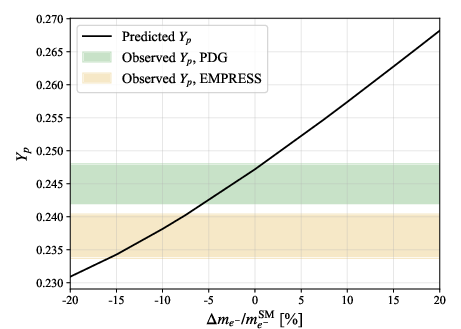
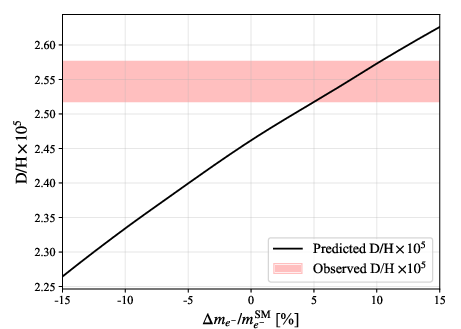
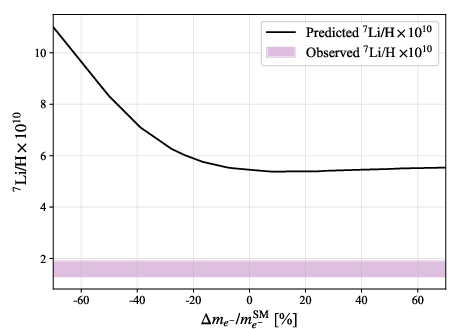
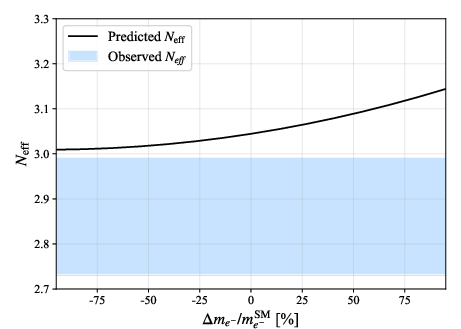
Figure 2: Change in predicted Helium-4, Deuterium, and Lithium-7 abundances, as well as Neff, under equal electron and positron mass variation.
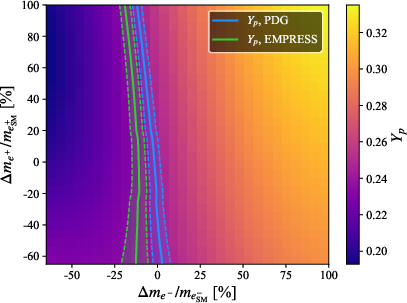
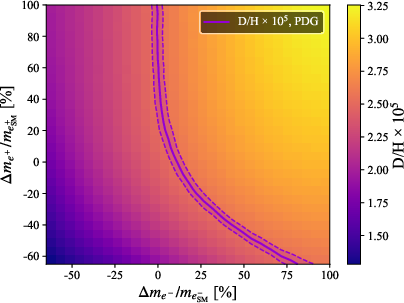
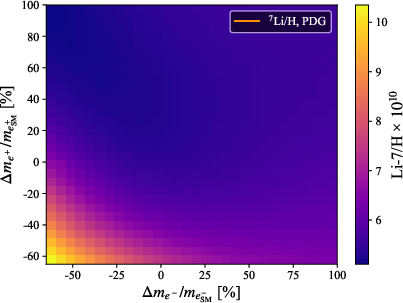
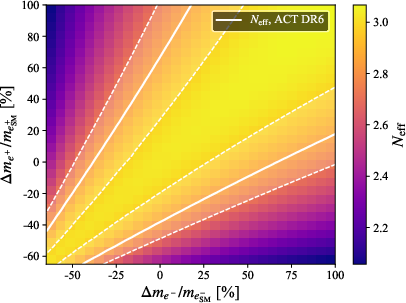
Figure 3: Predicted values of Helium-4, Deuterium, Lithium-7, and Neff as functions of me− and me+, incorporating all relevant corrections and dynamically solved chemical potentials.
Parameter Space and Constraint Intersections
Bounds from Helium-4, Deuterium, and Neff do not yield a parameter region where all three are simultaneously satisfied within 1σ, regardless of the choice of Helium-4 dataset. However, pairwise intersections exist, particularly for me− reduced by 1–4% and me+ increased by 25–60% (relative to SM values). The persistent tension in Lithium-7 abundance (the "Lithium Problem") precludes robust constraints from this observable.
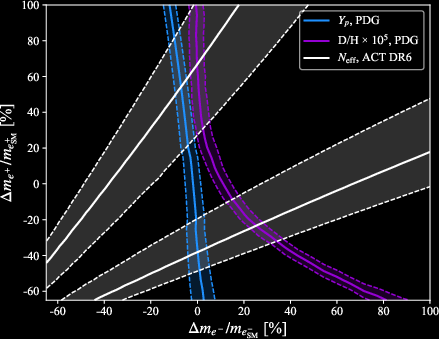
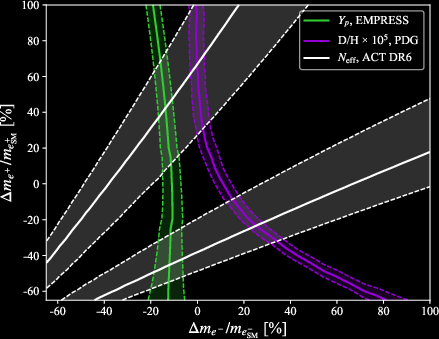
Figure 4: Overlap regions in (me−,me+) space for observational bounds on Helium-4, Deuterium, and Neff.
Astrophysical Implications
The effect of keV-scale electron-positron mass differences on high-temperature astrophysical environments (supernovae, neutron star mergers, white dwarfs, gamma-ray bursts) is negligible. Either degenerate conditions suppress any induced chemical potential, or dynamic, non-equilibrium processes dominate and erase any minor asymmetries.
Cosmological and astrophysical observations serve as complementary constraints on variations in fundamental constants. White dwarf spectroscopy [Uniyal et al.] and cosmological analyses of me variations [Khalife et al., Schöneberg et al.] provide additional, though generally less stringent, bounds compared to BBN sensitivity in the context of temperature-dependent models.
Outlook: Baryogenesis Prospects
The theoretical framework supports a baryogenesis scenario for much lower α values (∼10−10 GeV−1), allowing sufficient lepton asymmetry generation at the electroweak scale without conflicting with BBN constraints. However, this regime is physically disjoint from the large-α bounds derived here and cannot be simultaneously realized.
Conclusion
This work systematically analyzes the phenomenology and constraints of temperature-dependent CPT violation in the early universe, focusing on mass asymmetries between electrons and positrons during BBN. It finds:
- Strong constraints: Large mass differences are excluded for α≳10−6 GeV−1 by a combined analysis of He-4, D/H, and Neff, with maximal constraint sensitivity reached when adopting PDG Helium-4 values.
- No simultaneous 1σ regime: All three observables cannot be satisfied together within 1σ, although pairwise agreement is possible.
- Astrophysical irrelevance: Effects vanish in stellar and high-energy astrophysical settings due to small chemical potentials and non-equilibrium dynamics.
- Natural theory construction: Several mechanisms can produce T2 scaling needed for viable temperature-dependent CPT violation.
The framework establishes BBN as the premier probe of high-temperature CPT-violating models, sampling parameter space inaccessible to present-day experiments. Future improvements in primordial abundance measurements and resolving the Lithium Problem will sharpen constraints, with potential implications for constructing natural theories of CPT violation and the baryogenesis mechanism.