- The paper introduces a precise worldsheet quantization method for string theory in AdS3, highlighting the role of spectral flow in achieving a modular-invariant spectrum.
- It computes explicit worldsheet correlators and partition functions, emphasizing the balance between discrete and continuous representations.
- The study bridges the SL(2,R) WZW model with AdS3/CFT2 holography, providing detailed insights into the tensionless limit and higher spin symmetry enhancement.
Strings in AdS3 from the Worldsheet: Algebra, Spectral Flow, and Holography
Overview
The study systematically develops the worldsheet formalism of string theory in AdS3 backgrounds supported by NSNS flux, providing a technically focused account of both classic and modern advances. Core to the analysis is the explicit computation of worldsheet correlators involving spectrally flowed representations, essential objects for a consistent quantization due to the non-compactness of AdS3 and the structure of the SL(2,R) WZW model. The work rigorously connects technical results on spectral flow, the partition function, and correlation functions to the structure of the conjectured AdS3/CFT2 duality.
SL(2,R) WZW Model Spectrum and Worldsheet Dynamics
Quantization of strings on AdS3 with NSNS fluxes results in a worldsheet theory governed by the SL(2,R)k WZW model. The Hilbert space is built from a combination of discrete and continuous representations, with the continuous series becoming critical when including spectrally flowed images to preserve modular invariance and unitarity. Geodesic analysis in global AdS3 demonstrates the necessity of these representations: discrete ("short string") states correspond to strings bound to the interior, while spectrally flowed ("long string") configurations, reaching into the boundary, require flow by arbitrary w∈Z units. The global charges, especially the spectral flow quantum number (interpreted semiclassically as winding), directly map to quantum numbers in the target CFT.
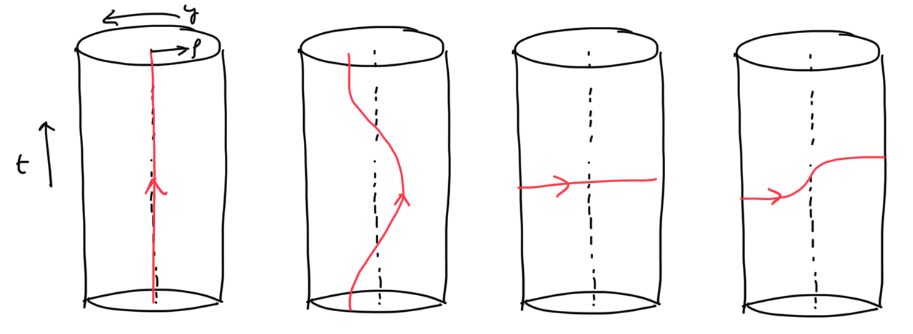
Figure 1: Timelike and spacelike geodesics in global AdS3, as well as their spectrally flowed images realizing the "short" (oscillatory/bound) and "long" (scattering/unbound) string solutions.
The Wakimoto free field representation, valid near the boundary, makes explicit contact with spacetime operators and facilitates the computation of local symmetries’ generators on the worldsheet. The central role of spectral flow is manifest: it not only provides new representations but fundamentally modifies the algebraic structure such that physical states cannot be captured by unflowed (w=0) representations alone.
Partition Function and Modular Invariance
The diagonal partition function of the SL(2,R) WZW model is nonunitary and non-modular-invariant unless all spectral flow sectors are incorporated. Each value of w∈Z contributes a nontrivial sector, leading to an overall partition function that, while highly divergent, exhibits modular covariance after proper analytic regularization. The spectral flow sectors are related by precise series identifications and, in the continuous representations, support the presence of long string states propagating to the AdS boundary.
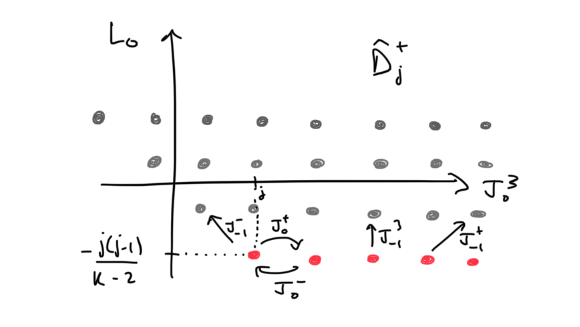
Figure 2: Weight diagram for the lowest-weight unflowed representation, showing the truncation due to null states at high spin and the necessity to extend the module via spectral flow.
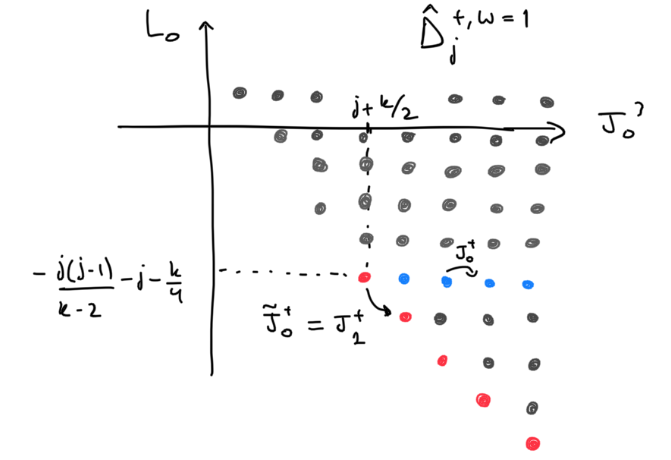
Figure 3: The structure of the lowest-weight representation after one unit of spectral flow, showing the shifted lattice of J3 charges compared to the unflowed sector.
Correlation Functions: Spectral Flowed Sectors
The computation of correlation functions involving spectrally flowed operators is nontrivial due to the altered OPE structure and the presence of higher order poles. The lectures review and extend powerful recursive techniques (Ward identities, Knizhnik-Zamolodchikov constraints) to relate correlators with arbitrary winding to a finite set of seeds. The m-basis and x- (spacetime) basis decompositions allow both for the explicit analytic continuation of correlators and for unambiguous mapping to boundary operators. Recent work allows these recursions to be formulated as systems of partial differential equations in auxiliary variables conjugate to the charges, mapping the computation to an effective covering map problem.
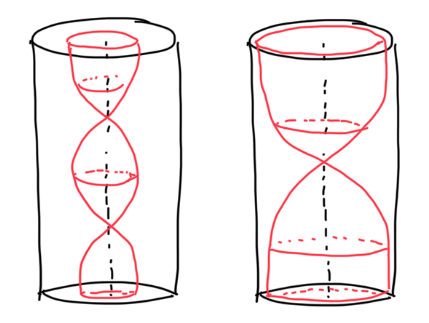
Figure 4: Classical string solutions in AdS3 with and without spectral flow; the left illustrates a "short string," while the right depicts a "long string" with nontrivial spectral flow.
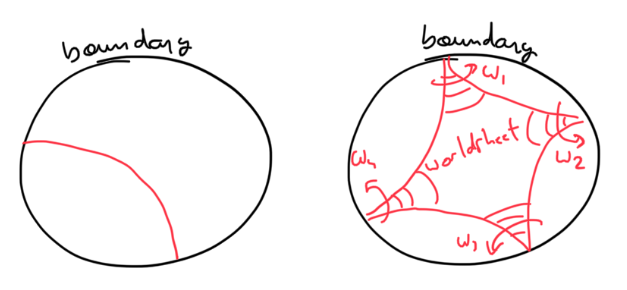
Figure 5: Left: Geodesic describing the classical path for an unflowed two-point function. Right: Configuration appropriate to a four-point function with spectrally flowed insertions, relevant for multiwound string contributions.
A major outcome is the demonstration that, in the tensionless limit (k=3 bosonic), all worldsheet correlators of spectrally flowed primaries localize precisely on the moduli space loci where a genus zero holomorphic covering map exists between the worldsheet and the spacetime. This matches exactly the covering map technology used in the computation of symmetric orbifold CFT correlators, yielding a direct non-perturbative worldsheet realization of the orbifold CFT at this special point.
Holographic Implications and Nonprotected Observables
In the critical NS5-F1 regime, the dual CFT (the D1D5 symmetric orbifold) is a deformation of a symmetric product orbifold with a Liouville internal factor, parameterized by the Liouville background charge related to k. Three-point functions of BPS operators, computed using these spectral flow techniques, exactly match the protected chiral ring coefficients of the dual CFT, as predicted by nonrenormalization theorems.
For generic k>3, while short and long string contributions reflect the expected protected and unprotected structure of CFT2 single- and multi-cycle operators, nonrenormalization breakdowns and the necessity of incorporating Liouville-like dynamics appear in nonprotected (long string) sectors.
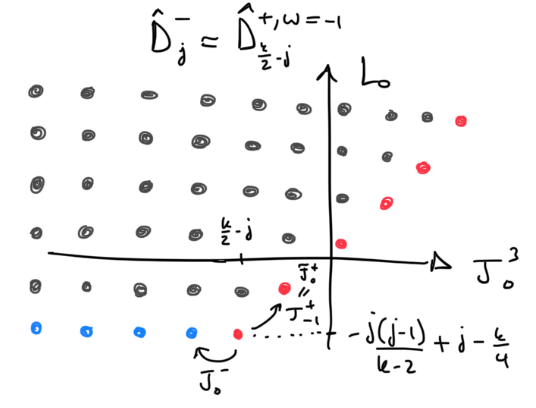
Figure 6: Equivalence of representations under SL(2,R) spectral flow, explicitly showing how modules with large spin and winding are isomorphic to unflowed representations at lower spin.
Tensionless Limit and Higher Spin Symmetry Enhancement
At k=3, all short string (discrete representation) states decouple (excepting subtle points at the boundary of the allowed interval), and the correlators of long string states localize entirely on covering maps—precisely as in the symmetric product orbifold CFT. This "tensionless string" regime supports an infinite tower of massless higher-spin fields, in direct correspondence with the expected spectrum of SymN(T4) at the free point. The worldsheet calculation is both explicit and fully tractable: all correlation functions, not just chiral primaries, can be matched to orbifold CFT predictions, and the structure of null vectors perfectly enforces the precise chiral ring selection rules.
Outlook, Open Problems, and Theoretical Implications
This approach substantiates the construction of AdS3/CFT2 at the stringy level and demonstrates that, with NSNS flux, the worldsheet approach provides unparalleled calculational control. The precise role of the grand canonical ensemble, the global structure of the moduli space, and the correlator behavior under large deformation (e.g., away from k=3) are now accessible to explicit calculation. These lecture notes provide both a comprehensive technical resource and a basis for further mathematical and physical exploration, including extensions to non-AdS holography via irrelevant deformations and applications to black hole microstate counting and the fuzzball proposal.
Conclusion
The lectures deliver a comprehensive, rigorous treatment of strings on AdS3 with NSNS flux: the worldsheet quantization necessarily invokes the full machinery of spectral flow, the detailed structure of flowed correlation functions is controlled via Ward identities and covering map techniques, and the AdS3/CFT2 dictionary becomes, in the tensionless limit, a concrete computational identity. The program establishes a new benchmark for string-theoretic explorations of holography and highlights the role of exact worldsheet solvability in unraveling nonperturbative AdS/CFT.