The motivic class of the space of genus $0$ maps to the flag variety
Abstract: Let $\operatorname{Fl}{n+1}$ be the variety of complete flags in $\mathbb{A}{n+1}$ and let $Ω{2}β(\operatorname{Fl}{n+1})$ be the space of based maps $f:\mathbb{P}{1}\to \operatorname{Fl}{n+1}$ in the class $f_{*}[\mathbb{P}{1}]=β$. We show that under a mild positivity condition on $β$, the class of $Ω{2}β(\operatorname{Fl}{n+1})$ in $K_{0}(\operatorname{Var})$, the Grothendieck group of varieties, is given by [ [Ω{2}β(\operatorname{Fl}{n+1})] = [\operatorname{GL}_{n}\times \mathbb{A}{a}]. ] The proof of this result was obtained in conjunction with Google Gemini and related tools. We briefly discuss this research interaction, which may be of independent interest. However, the treatment in this paper is entirely human-authored (aside from excerpts in an appendix which are clearly marked as such).
Paper Prompts
Sign up for free to create and run prompts on this paper using GPT-5.
Top Community Prompts
Explain it Like I'm 14
Overview
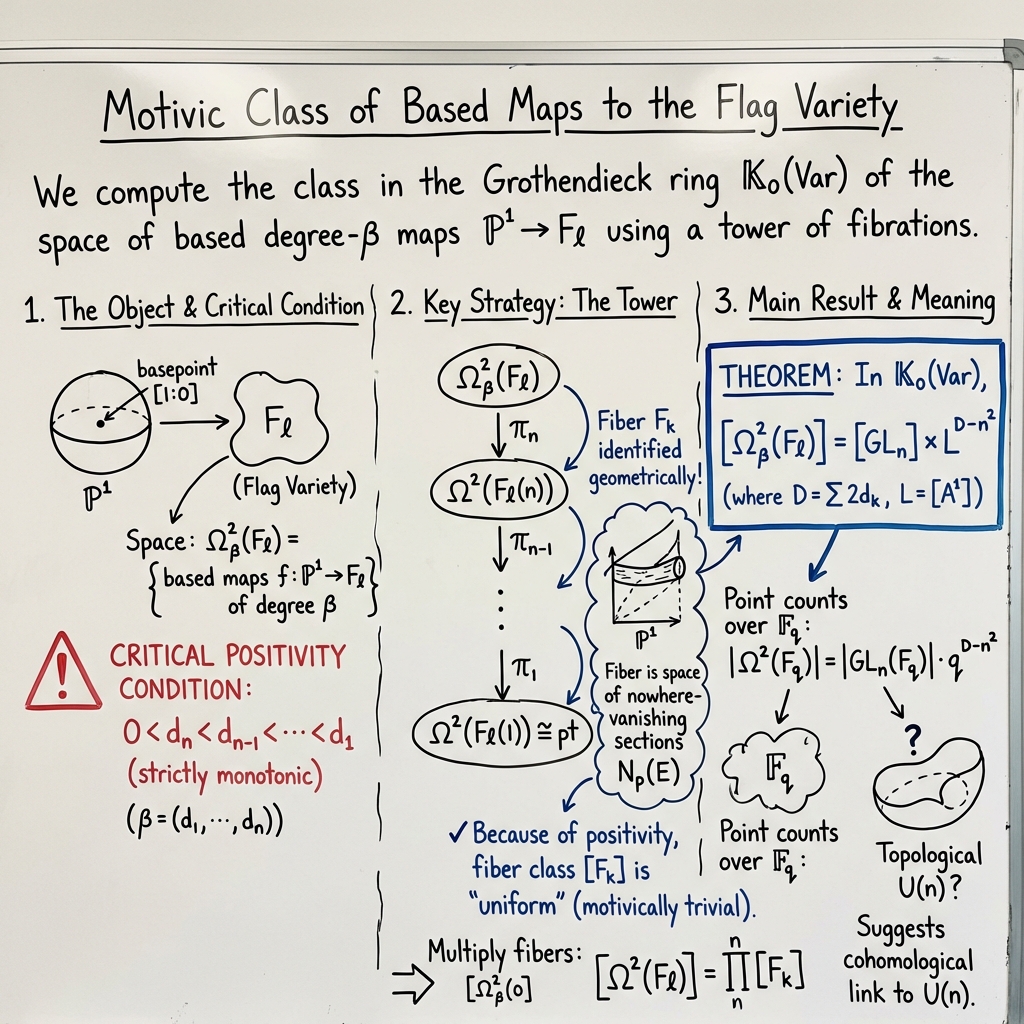
This paper studies a very specific “space of maps” from a simple curve (a copy of the Riemann sphere, written as ) into a geometric object called a flag variety. A flag variety is a way of organizing subspaces of a vector space in a neat, nested order—think of it like a tidy set of folders inside folders, each one larger than the last. The authors find a clean, surprising formula for an algebraic fingerprint of this space of maps, called its motivic class. Even though the space of maps looks complicated, its motivic class turns out to be the same as the motivic class of something much simpler: a product of the group of invertible matrices, , and a plain -dimensional space, .
The paper also explains how this question connects to topology (the study of shapes up to stretching and bending), and how modern AI tools helped in discovering the proof strategy, though the final writing and checking are by the human authors.
Key Questions and Goals
Here are the main things the paper aims to do:
- Understand the space of “based maps” that fix a chosen base point, and have a given “degree” (which is really a list of integers measuring how much each piece of the flag twists along the curve).
- Compute the motivic class of this space in the Grothendieck group . This group is like a universal bookkeeping system for algebraic varieties where cutting and gluing become algebraic operations.
- Relate that motivic class to something concrete: .
- Use the result to deduce a simple formula for counting points over finite fields (worlds with elements).
- Explore how this algebraic picture connects to topological “double loop spaces,” and consider what might match or fail to match in terms of homotopy (shape) information.
Methods and Approach
The central idea is to break a complicated problem into smaller, more manageable steps, and analyze each step carefully.
- The authors work with “partial flags,” which are like flags with fewer steps. Starting from the simplest case, they build up to complete flags one step at a time.
- At each step, they consider a “forgetful map” that drops one layer of the flag, and analyze the fiber (the set of all ways to put that layer back in). This fiber turns out to be the space of special sections of a vector bundle on that never vanish and satisfy a basepoint condition.
- A vector bundle on always splits into simpler pieces (line bundles). This is a powerful fact in algebraic geometry known as the Birkhoff–Grothendieck theorem. It lets the authors reduce complicated objects to sums of simpler ones.
- They compute the motivic class of the fiber by counting nowhere-vanishing sections in a way that doesn’t depend on the exact splitting type, provided the degrees are “positive enough.”
- Although the fibers at different points might not be isomorphic (so the fibration is not locally trivial in the usual geometric sense), the authors prove something weaker but sufficient: the fibration is “motivically trivial.” That means there’s a stratification of the base where on each stratum the fiber varies in a controlled way, and all fibers have the same class in the Grothendieck group.
- Finally, multiplying the motivic classes of the fibers step by step gives the motivic class of the whole space of maps. This inductive computation produces the main formula.
Main Results and Why They Matter
The headline theorem says:
- If the degree is “strictly monotonic,” meaning , then the motivic class of the space of based maps equals
In words: even though is a subtle and intricate space, from the motivic point of view it behaves just like a simple product of and an affine space of dimension .
- A key consequence is a clean counting formula over finite fields: if you work over , then the number of -points of the space is
- The result also suggests that (at least for these degrees) certain “weight polynomials” and possibly compactly supported cohomology might match those of , hinting that the cohomology rings could align with those of the unitary group .
- The paper gives context from topology: the algebraic double loop space approximates the usual topological double loop space of , which has homotopy type closely related to . The authors note precise matches in special cases and for very large degrees, and they state a natural conjecture about cohomology matching in the strictly monotonic range.
- Importantly, they also provide simple “negative examples” showing that, for some finite degrees, the actual homotopy type can differ from . This sets realistic expectations: the motivic match does not automatically imply a shape (homotopy) match in every case.
Implications and Impact
- Conceptual clarity: The motivic class formula turns a complicated moduli space into something with a clean algebraic fingerprint. It gives a powerful way to compute and compare spaces using the Grothendieck group.
- Bridge to topology: The results strengthen the relationship between algebraic geometry (flags, bundles, motivic classes) and topology (loop spaces, unitary groups), by aligning invariants and suggesting cohomological matches.
- Practical counting: The finite-field point counts are simple and exact, which is useful both theoretically and for testing conjectures computationally.
- Research method: The paper highlights a productive human–AI collaboration. AI helped suggest promising strategies and intermediate steps, while the authors ensured correctness, generalized ideas, and presented the final proofs. This is a case study in how AI can assist, without replacing, rigorous mathematical work.
A few key ideas in everyday terms
- Flag variety: A structured way to organize nested subspaces, like Russian dolls or folders inside folders, each bigger than the previous.
- Based maps: Functions that send a chosen point to a fixed location (like always starting at “home base”).
- Degree: A number that measures how much a bundle “twists” along the curve—higher degree means more twisting.
- Vector bundle sections that don’t vanish: Think of drawing a smooth field of arrows all along the curve that never disappear. Such sections are the “nowhere-vanishing” ones.
- Grothendieck group : A universal ledger for shapes in algebraic geometry where you can add and subtract spaces in a formal, consistent way.
- Motivically trivial fibration: Even if the fibers don’t look the same geometrically everywhere, their entries in the universal ledger are the same across suitable pieces of the base.
Overall, the paper shows that, under a mild positivity condition on the degrees, a complicated moduli space has a beautifully simple motivic class, tying together algebraic geometry, topology, combinatorics, and modern computational assistance.
Knowledge Gaps
Unresolved gaps, limitations, and open questions
Below is a consolidated list of what remains missing, uncertain, or unexplored, framed to be actionable for future work:
- Remove the strict monotonicity (positivity) hypothesis:
- Determine whether the motivic class formula [Ω2_β(Fl)] = [GL_n × A{D − n2}] extends to weakly monotone (some d_i = d_{i+1}), zero, or partially negative degrees.
- Generalize the key “nowhere vanishing based sections” computation to bundles with zero or negative splitting summands, where dependence on the basepoint becomes subtle (cf. the remark following the proposition on [N_p(E)]).
- Unbased maps and moduli quotients:
- Compute the motivic class (and point counts) for the space of unbased maps P1 → Fl, including the quotient by Aut(P1) (as a variety or stack), and compare with the based case.
- Study the effect of multiple marked points/evaluation constraints at several points and the corresponding motivic formulas.
- Targets beyond complete flags:
- Extend the result from Fl = GL_{n+1}/B to partial flag varieties Fl(n+1; r_1,…,r_k), Grassmannians, and more generally G/P for other reductive groups (types B, C, D, exceptional). Identify the precise positivity/monotonicity conditions needed in each case.
- Systematically relate the degree data (d_i) to the simple coroot/weight lattice for G/B and characterize when an analogue of D = ∑ 2d_i appears.
- Higher-genus domains and stability:
- Investigate whether analogous motivic class identities hold for maps from higher-genus curves to Fl (and to G/P), and for compactifications such as (stable maps/quasimaps). Specify the positivity assumptions that ensure vanishing of H1 and allow a similar fiber analysis.
- Compare motivic classes of open mapping spaces with their stable-map/quasimap compactifications; identify corrections coming from boundary strata.
- Strengthening from K_0(Var) to finer invariants:
- Determine whether the equality in K_0(Var) lifts to equality of motives in the Grothendieck ring of (Chow) motives or to equality of E-polynomials/mixed Hodge polynomials (not just weight polynomials).
- Establish whether compactly supported cohomology (as a graded vector space and as a ring with cup product) agrees with that of GL_n × A{D − n2}, i.e., verify or refute the conjectured isomorphism H*(Ω2_β(Fl), Q) ≅ H*(U(n), Q) under the strict monotonicity hypothesis.
- Topological comparison and rational homotopy:
- Give necessary and sufficient conditions on β for Ω2_β(Fl) to have (rational) homotopy type of U(n); classify degrees for which it fails (beyond the provided counterexamples).
- Quantify connectivity/stabilization ranges in the algebraic–topological comparison, refining existing “k(β) → ∞” statements with explicit bounds and optimal growth.
- Geometry of the tower maps and fibers:
- Provide a finer classification of fiber isomorphism types of π_k (not just their motivic classes), describe monodromy along strata, and determine when fibers are rationally or stably equivalent.
- Seek stronger local triviality (e.g., piecewise isomorphism or piecewise trivial bundles) or explain obstructions; determine whether equality in K_0(Var) can be upgraded to piecewise isomorphism or stable birational equivalence.
- Smoothness, irreducibility, and singularity structure:
- Determine when Ω2_β(Fl) is smooth/irreducible and compute its singular loci; relate these properties to positivity of the differences d_k − d_{k+1}.
- Compute tangent spaces/obstructions systematically via deformation theory to confirm expected dimensions and to locate sources of singularities.
- Canonical stratifications and functoriality:
- Develop an intrinsic, functorial stratification (e.g., via Harder–Narasimhan–type data for P1-bundles and “depth” filtrations) that makes the motivic triviality transparent and potentially uniform across targets G/P.
- Analyze how stratifications behave under change of basepoint and under operations on degrees (e.g., concatenation/additivity).
- Rationality and birational models:
- Determine whether Ω2_β(Fl) is rational or stably rational for all strictly monotone β; construct explicit birational parametrizations when possible.
- Investigate whether Ω2_β(Fl) is (stably) birational to GL_n × A{D − n2}, given the equality in K_0(Var).
- Finite field refinements:
- Beyond cardinalities, compute zeta functions and Frobenius eigenvalues; test purity/mixedness of cohomology and compare with GL_n × A{D − n2}.
- Construct explicit, definable bijections over finite fields (or piecewise bijections) realizing the counting identity, and identify obstructions to genuine isomorphisms.
- Equivariant and operadic structures:
- Establish equivariant refinements (e.g., T-equivariant motives/cohomology) compatible with the T-action on Fl and on mapping spaces.
- Investigate E_2-algebra structures on the disjoint union over β and whether the motivic identities interact multiplicatively (e.g., via generating series or convolution formulas).
- Dependence on basepoint choices:
- Prove basepoint independence (up to canonical isomorphism or canonical equivalence of classes) for different choices in Fl and domain P1; quantify any residual dependence when positivity fails.
- Characteristic and foundational issues:
- Clarify which parts of the argument rely on characteristic 0 (e.g., comparisons with earlier results) and provide characteristic p proofs where needed (e.g., avoidance of resolution of singularities).
- Examine whether all uses of “special groups” and local triviality persist over arbitrary fields and for more general targets.
- Negative phenomena and transitions:
- Systematically study “topology jumps” across strata (as splitting types vary), quantifying how homotopy type and cohomology change and how that correlates with the failure of local triviality of π_k as fibrations of varieties.
- For Fl = P1 (n = 1), classify the homotopy types of Ω2_d(P1) across d completely, extending the d = 2 counterexample and identifying patterns.
- Connections to Schubert calculus and representation theory:
- Relate the motivic stratifications and class computations to Schubert–type decompositions on mapping spaces, and explore representation-theoretic interpretations of the degree data and the resulting identities.
These items collectively chart directions to generalize the main result, strengthen it to finer invariants, and clarify its geometric and topological implications.
Practical Applications
Immediate Applications
Below are practical uses that can be deployed now, drawing from the paper’s mathematical results and its AI-augmented research workflow.
- Academic mathematics: fast point-counts and motivic invariants for mapping spaces
- What: Closed-form formulas for the motivic class and finite-field point counts of Ω²β(Fl), and the fiber-class computation [Np(E)] that is independent of splitting type under mild positivity.
- Use: Rapid computation/verification of E-polynomials, weight polynomials, and point counts for moduli of maps to homogeneous spaces; cross-checking conjectures and simulations in enumerative geometry and arithmetic statistics.
- Tools/products/workflows:
- Implement a Sage/Macaulay2 module that:
- Builds the partial-flag fibration tower, stratifies by splitting type and basepoint depth, and applies “motivically trivial fibration” factors.
- Computes [Ω²β(Fl)] and finite-field counts for strictly monotone β, and extends to Grassmannians and other flag types where possible.
- A benchmark dataset of moduli-space point counts across q and degree profiles for testing algorithms and models.
- Sector: Academia (algebraic geometry, representation theory, arithmetic geometry).
- Assumptions/dependencies: Strict monotonicity/positivity (e.g., H¹(E(−2)) = 0) and the “special group” Zariski-local triviality framework; finite fields for counting applications.
- Arithmetic statistics and testbeds for finite-field algorithms
- What: Exact counts |Ω(Fl)(Fq)| = |GLn(Fq)| qD−n² in a nontrivial family.
- Use: Calibration and stress-testing of counting algorithms, random sampling procedures, and heuristic models (e.g., random matrix heuristics for higher-dimensional varieties).
- Tools/products/workflows:
- Synthetic datasets of known counts for algorithm validation.
- Scripts to generate random instances and verify against the closed-form counts.
- Sector: Software (scientific computing), Academia (number theory, computational AG).
- Assumptions/dependencies: Accurate finite-field arithmetic and sampling; support for large q.
- AI-augmented research workflow (“scaffolding” and specialized math agents)
- What: A concrete, reproducible methodology that decomposes a research problem into graded subproblems, uses targeted prompting and hinting, and iterates with human oversight to reach publishable results.
- Use: Boosts productivity in theorem discovery, counterexample search, and proof refinement in advanced mathematics; reusable pattern for research teams.
- Tools/products/workflows:
- “Proof Scaffolder” platform integrating LLMs with CAS (Macaulay2, Sage) and typesetting (LaTeX), featuring:
- Subproblem graphing and hint injection.
- Re-usable prompt libraries for standard techniques (stratifications, special groups, Birkhoff–Grothendieck).
- Provenance tracking and disclosure exports for papers.
- Specialized math agents (à la “FullProof”) tuned for algebraic geometry and topology.
- Sector: Software/AI, Academia.
- Assumptions/dependencies: Capable LLMs; human-in-the-loop validation; institutional norms for AI-use disclosure.
- Graduate education and advanced training
- What: The paper’s scaffolded approach translates to teachable modules (e.g., building towers of fibrations, motivic equivalences, stratification by splitting type).
- Use: Interactive exercises where students practice decomposition, local triviality arguments, and reduction-to-fibers techniques, augmented by LLM hints.
- Tools/products/workflows:
- Courseware with structured prompts and solution-checkers.
- Tutor bots that demonstrate “hinted” proof development.
- Sector: Education.
- Assumptions/dependencies: Careful moderation to prevent overreliance on AI; vetted content.
Long-Term Applications
These rely on further development, scaling, or extension beyond the strictly monotonic setting or beyond current AI capabilities.
- Automated mathematics platforms with deep domain tooling
- What: Generalize the paper’s AI-driven methodology to a broader class of moduli problems and to integration with formal proof assistants (Lean/Coq/Isabelle).
- Use: End-to-end pipelines: conjecture generation → guided proof search → CAS verification → formal certification.
- Tools/products/workflows:
- Domain-tuned LLMs integrated with tactic languages and proof states.
- Libraries encapsulating patterns (motivically trivial fibrations, special-group torsors, depth filtrations).
- Sector: Software/AI, Academia.
- Assumptions/dependencies: Advances in neuro-symbolic integration; reliable formalization of AG/topology libraries.
- Quantum information and control (indirect/topological insights)
- What: The Ω²-topological perspective and links to U(n) suggest algebraic models that approximate double loop spaces; potential structural insights for unitary control landscapes.
- Use: Informing long-term strategies for path planning and homotopy-aware optimization in unitary groups (e.g., quantum gate synthesis under constraints).
- Tools/products/workflows:
- Prototype algorithms that exploit algebraic approximations to homotopy types for search and optimization.
- Sector: Quantum computing/control.
- Assumptions/dependencies: Bridging algebraic approximations to numerically stable control methods; validation on practical systems.
- Mathematical physics (2D sigma models, quantum cohomology, mirror symmetry)
- What: Holomorphic maps P¹ → flag varieties are central in sigma models; motivic/point-count data can inform generating functions and BPS state counts.
- Use: Contribute to exact computations in quantum cohomology and to cross-characteristic checks via point counts over Fq.
- Tools/products/workflows:
- Symbolic-numeric pipelines generating partition-function components from motivic inputs.
- Sector: Theoretical physics.
- Assumptions/dependencies: Extension of results beyond strictly monotone classes; compatibility with physical compactifications and anomalies.
- Coding theory and network coding via flag/Grassmannian geometries
- What: Flag and Grassmannian varieties over finite fields underpin subspace codes; refined counting of structured map spaces could inspire new ensembles or decoding heuristics.
- Use: Design of subspace codes with algebraic constraints derived from mapping-space geometry; testing ensembles with predictable cardinalities.
- Tools/products/workflows:
- Code constructors parameterized by motivic or finite-field count templates; performance simulations.
- Sector: Communications/coding theory.
- Assumptions/dependencies: Concrete translation from mapping-space counts to code performance metrics.
- Topological robotics and motion planning on manifolds with Lie-group structure
- What: If algebraic models approximate key homotopy invariants of configuration spaces (e.g., U(n)-related), they may seed new motion-planning heuristics.
- Use: Long-term development of homotopy-aware planners exploiting algebraic stratifications for path deformation.
- Tools/products/workflows:
- Prototype planners combining symbolic stratifications with numerical optimization.
- Sector: Robotics.
- Assumptions/dependencies: Effective computational extraction of homotopy data; bridging to real-world constraints and noise.
- Research policy and governance for AI-assisted discovery
- What: The paper’s clear disclosure of AI contributions provides a template for transparency, crediting, and responsibility assignment.
- Use: Institutional and journal policies standardizing:
- Disclosure of AI use and artifacts.
- Data/provenance retention for reproducibility.
- Risk controls (hallucination detection, human validation).
- Tools/products/workflows:
- Policy toolkits and disclosure checklists.
- Repositories linking prompts, outputs, and finalized proofs.
- Sector: Policy, Research governance.
- Assumptions/dependencies: Community adoption; alignment with data and IP policies.
Key assumptions and dependencies across applications
- Mathematical scope: Strict monotonicity of β and positivity assumptions (e.g., H¹(E(−2))=0) are crucial for the current formulas; extension beyond this regime is nontrivial.
- Field dependence: Finite-field point-count applications require q-power arithmetic; cohomological parallels in characteristic 0 remain conjectural.
- AI reliability: Effective deployment of scaffolding tools requires expert oversight, robust prompt design, and provenance tracking.
- Generalization limits: Motivically trivial fibrations do not imply isomorphism or homotopy equivalence; negative examples in the paper highlight boundaries that matter for downstream interpretations.
Glossary
- Additive group G_a: The algebraic group whose k-points are the underlying additive group of the field; often denoted G_a. Example usage: "the additive group is special,"
- Algebraic double loop space: The moduli of algebraic maps from the 2-sphere (identified with P1) into a variety, with a basepoint condition; an algebro-geometric analogue of the topological double loop space. Example usage: "the algebraic double loop space of can be viewed as a homotopy approximation"
- Automorphism group: The group of automorphisms of an object (e.g., a vector bundle), here denoted Aut(F_r). Example usage: ""
- Based map: A map that sends a chosen basepoint in the domain to a chosen basepoint in the target. Example usage: "the space of based maps "
- Birkhoff–Grothendieck theorem: The result that every vector bundle on P1 splits as a direct sum of line bundles; used to stratify by splitting type. Example usage: "using Birkhoff--Grothendieck"
- Chow group A_1(Fl): The group of 1-cycles modulo rational equivalence on a variety; here used to classify curve classes on the flag variety. Example usage: ""
- Complete flag variety: The homogeneous variety parameterizing full flags of subspaces (or quotients) in a vector space. Example usage: "the complete flag variety"
- Compactly supported cohomology: Cohomology theory for non-compact varieties using cochains with compact support. Example usage: "the compactly supported cohomology"
- Depth filtration: A filtration on a fiber induced by the splitting of a bundle, measuring how deep a vector sits with respect to degrees. Example usage: "the depth filtration"
- Double loop space: The space of based maps from S2 into a topological space; here considered in both algebraic and topological settings. Example usage: "double loop space"
- Fiber class: The class in the Grothendieck ring of varieties of the fiber of a fibration. Example usage: "with fiber class "
- Grothendieck group of varieties: The K_0 ring of varieties, generated by isomorphism classes with scissor relations and product by Cartesian product. Example usage: "the Grothendieck group of varieties"
- Homotopy equivalence: A map inducing a mutual homotopy inverse, showing two spaces have the same homotopy type. Example usage: "a homotopy equivalence"
- Homotopy type: The equivalence class of spaces under homotopy equivalence, capturing topological “shape.” Example usage: "the homotopy type of "
- k(β)-connected map: A map that is an isomorphism on homotopy groups up to degree k(β)−1 and a surjection in degree k(β). Example usage: "-connected"
- Lefschetz class L: The class of the affine line A1 in K_0(Var), often denoted L. Example usage: ""
- Locally closed stratification: A decomposition of a variety into locally closed subvarieties used for piecewise triviality arguments. Example usage: "a locally closed stratification"
- Mapping torus: A space obtained from a homeomorphism by identifying the ends of a cylinder; used to describe certain bundles up to homotopy. Example usage: "the mapping torus of the antipodal map"
- Moduli space: A parameter space representing isomorphism classes of geometric objects, such as flags or maps. Example usage: "denote the moduli space of partial flag quotients"
- Motivically trivial fibration: A map that is Zariski locally trivial on a stratification and whose fibers all have the same class in K_0(Var). Example usage: "motivically trivial fibration"
- Partial flag: A flag missing some steps (not necessarily complete), parameterized by partial flag varieties. Example usage: "partial flag"
- Principal G-bundle: A fiber bundle with structure group G acting freely and transitively on the fibers. Example usage: "principal -bundles "
- Projectivized vector: A nonzero vector taken up to scalar, i.e., a point in the projectivization of a fiber. Example usage: "projectivized vector"
- Rational homotopy type: The homotopy type after tensoring homotopy groups with Q; captures “rational” topological information. Example usage: "The rational homotopy type of the double loop space is known"
- Special (algebraic) group: An algebraic group all of whose principal bundles are Zariski locally trivial. Example usage: "is called special"
- Stabilizer: The subgroup of a group action fixing a given point. Example usage: ""
- Symmetric product: The quotient of a product by permutation action; here the space of unordered pairs of points. Example usage: ""
- Unipotent group: An algebraic group whose elements are unipotent (all eigenvalues 1), often appearing as extensions in automorphism groups. Example usage: "a unipotent group"
- Universal sequence of vector bundle quotients: The tautological sequence over a flag variety whose fibers are the quotients in the corresponding flag. Example usage: "There is a universal sequence of vector bundle quotients on "
- Vector bundle splitting type: The degrees of the line bundle summands in the splitting of a vector bundle on P1. Example usage: "splitting type of "
- Weight polynomial: The generating function encoding weights in the (mixed) Hodge structure on cohomology; related to point counts and motivic classes. Example usage: "the weight polynomial of"
- Zariski locally trivial: A property of a fiber bundle that becomes a product after restricting to Zariski open sets. Example usage: "Zariski locally trivial"
- Zariski open cover: A cover by Zariski open subsets used to trivialize bundles or define local data. Example usage: "a Zariski open cover"
Collections
Sign up for free to add this paper to one or more collections.

