Merging multidimensional equations of state of strongly interacting matter via a statistical mixture
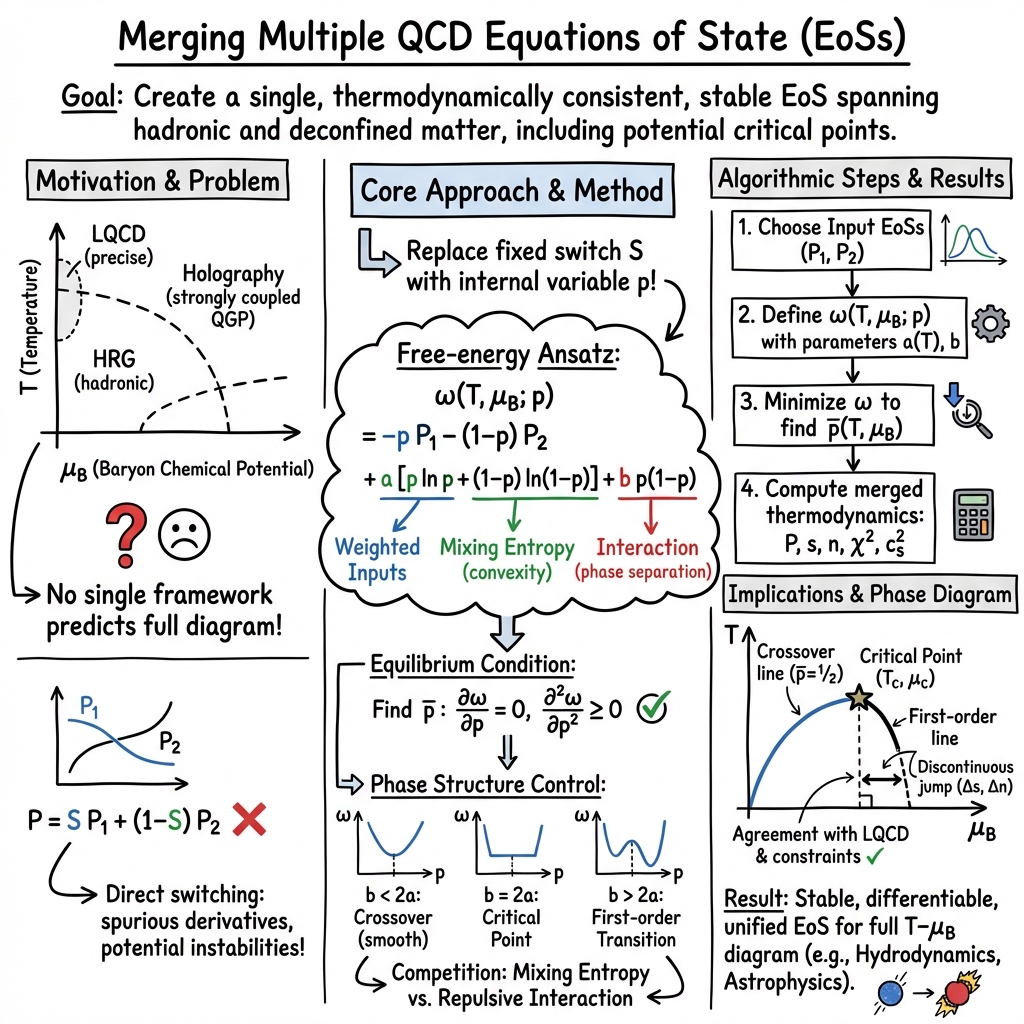
Abstract: We introduce a general method to merge multidimensional equations of state (EoSs) by combining them in a two-fluid equilibrium statistical mixture in the grand canonical ensemble. The merged grand potential density $ω$ is built directly from the input EoSs and the fluid fractions are fixed by minimizing $ω$ at fixed temperature $T$ and baryon chemical potential $μ_B$. Thermodynamic consistency and stability are guaranteed as all thermodynamic quantities are consistently derived from a single merged grand potential $ω(T,μ_B)$ with the correct convexity properties. Our method can accommodate a first-order phase transition and a critical endpoint with mean-field critical exponents. We use this method to merge a van der Waals Hadron-Resonance-Gas EoS with a holographic Einstein-Maxwell-Dilaton EoS that has a critical point and a first-order line. The result is a single EoS, spanning hadronic and deconfined matter over a broad range in $(T,μ_B)$, which can be readily used in heavy-ion hydrodynamic simulations. Our merging method can be generalized to consider a higher dimensional phase diagram (e.g., by considering more chemical potentials) and more than two input EoSs.
Paper Prompts
Sign up for free to create and run prompts on this paper using GPT-5.
Top Community Prompts
Explain it Like I'm 14
Overview
This paper is about building a single, reliable “equation of state” (EoS) for matter that interacts very strongly—like the stuff inside neutron stars or created in particle colliders. An EoS tells you how pressure, energy, and density relate to temperature and other conditions. Because no single theory works perfectly everywhere, the authors combine two different EoSs—one for colder, hadron-based matter and one for hotter, quark–gluon plasma—into a smooth, stable, and physically consistent whole.
Key objectives
The paper asks:
- How can we merge different EoSs so the result behaves correctly across a wide range of temperatures and densities?
- Can the merged EoS handle both smooth changes (crossovers) and abrupt changes (first-order phase transitions), including a “critical point” where things change suddenly?
- Can the merged EoS match results from lattice QCD (a first-principles computational method) where those exist, and be usable in real simulations (like heavy-ion collision hydrodynamics)?
Methods explained simply
Why merging EoSs is hard
Think of two recipes for making a drink: one for a cold smoothie (hadronic matter) and one for hot tea (quark–gluon plasma). If you just average them with a “switch” that slides from smoothie to tea, you might end up with weird lumps when you take derivatives (like “rate of change”) needed in physics. Those lumps can cause unphysical spikes or even unstable behavior in simulations.
In technical terms, a common “weighted-average” merge makes derivatives depend on how fast the switch changes, which can introduce artificial bumps in quantities like density and susceptibilities. That can break thermodynamic stability.
The new idea: a smart mixture
Instead of forcing a switch, the authors treat the system like a statistical mixture of two fluids and let the physics decide the blend. They introduce an internal “mixing dial” p between 0 and 1:
p = 0means pure hadronic matter (the cold smoothie).p = 1means pure quark–gluon plasma (the hot tea).- Values in between are mixtures determined by the system’s conditions.
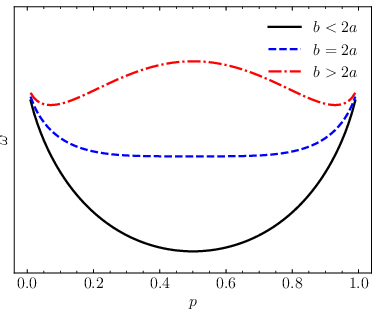
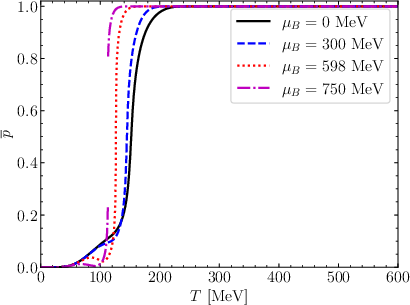
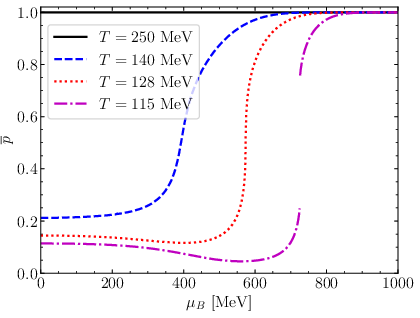
They build a single “grand potential” function (think of it as a score the system tries to minimize) that depends on temperature T, baryon chemical potential μ_B (which controls the balance of baryons vs. antibaryons), and p. Then they find the p that makes this potential smallest at each (T, μ_B).
Two key terms guide the mixture:
- A mixing entropy term (it likes blending), which depends on temperature and encourages a smooth crossover.
- An interaction term between the two fluids (it likes separating), which can create a double-well shape in the potential—this is what allows a first-order phase transition.
By balancing these, the model naturally avoids artificial bumps and ensures all thermodynamic quantities (pressure, entropy, density, and their derivatives) come from one consistent source.
Handling phase changes
This mixture can produce:
- A crossover: a smooth change from hadrons to quark–gluon plasma when blending wins.
- A first-order phase transition: an abrupt jump (like water suddenly boiling) when separation wins.
- A critical point: the special “tipping point” where the smooth change turns into an abrupt jump. The model reproduces mean-field Ising-like behavior at this point (a standard mathematical pattern for critical phenomena).
The two input models
To demonstrate the method, the authors merge:
- A van der Waals Hadron–Resonance–Gas (HRG) EoS, which includes attractive and repulsive forces between hadrons and reproduces known nuclear matter features like the liquid–gas transition.
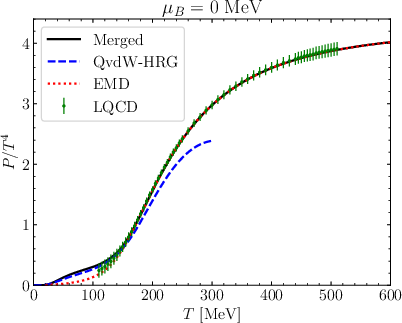
- A holographic Einstein–Maxwell–Dilaton (EMD) EoS, a gravity-based model that effectively describes the strongly coupled quark–gluon plasma and includes a first-order line and critical point. It’s calibrated to match lattice QCD at zero baryon chemical potential.
Main findings
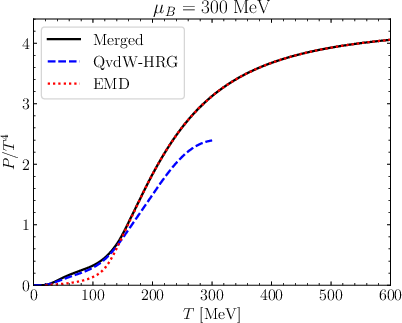
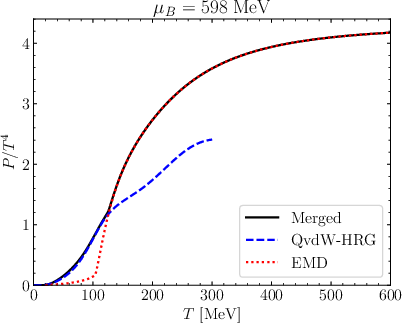
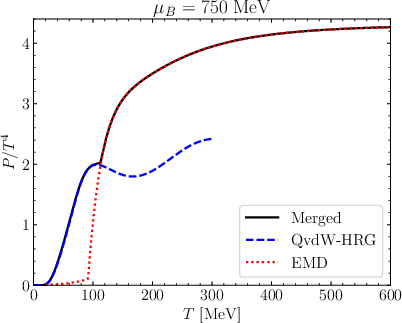
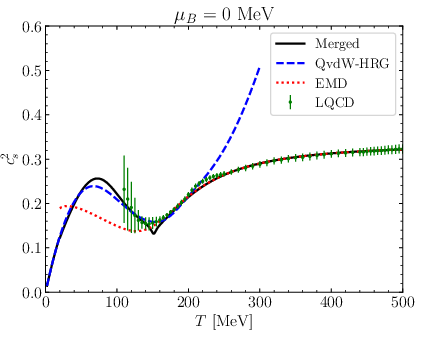
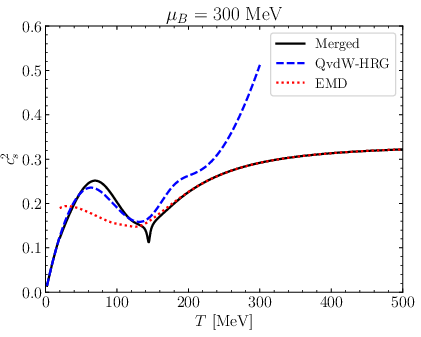
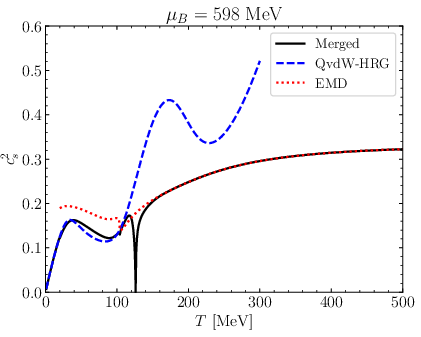
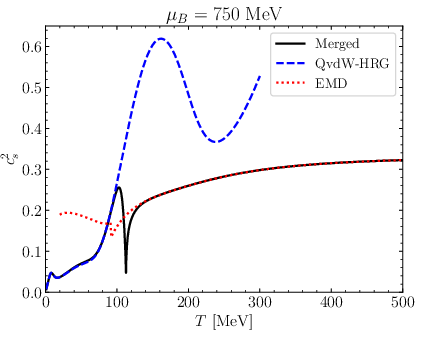
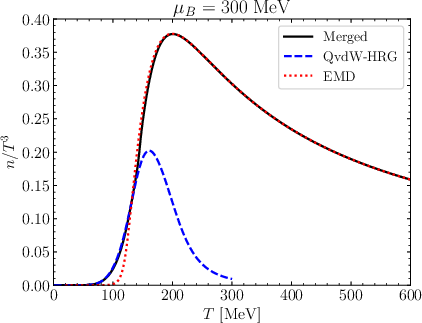
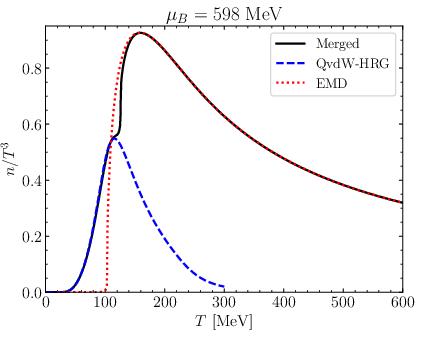
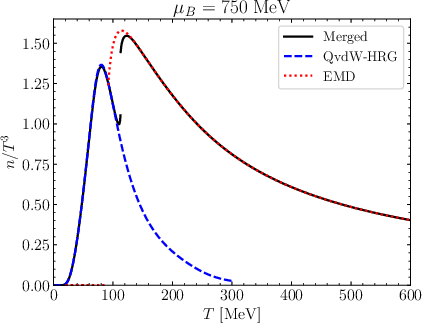
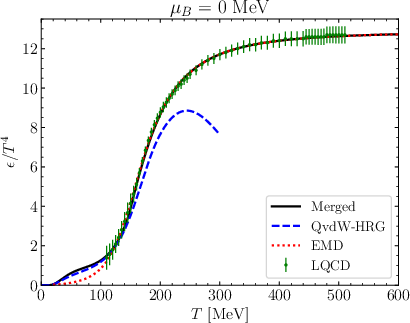
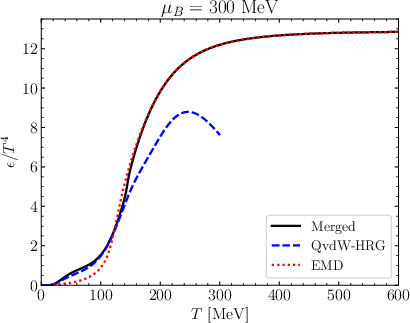
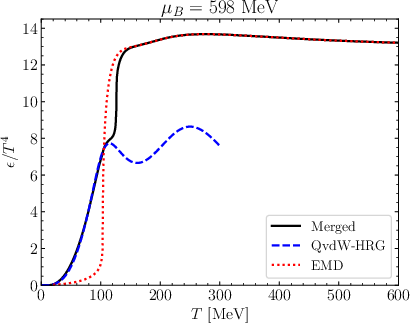
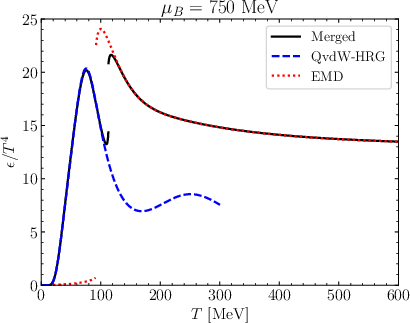
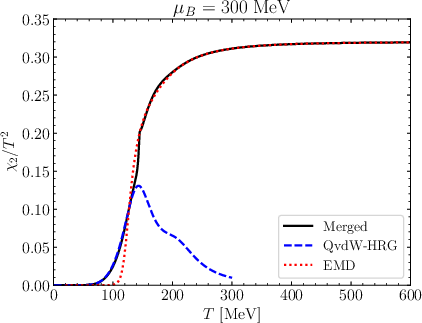
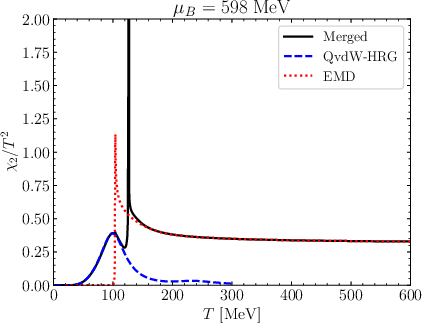
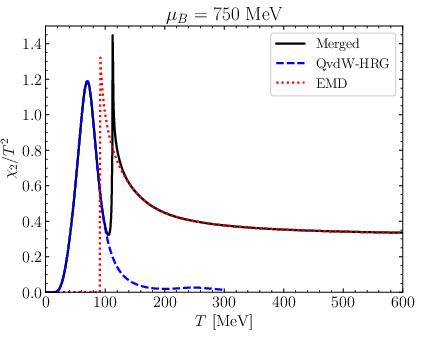
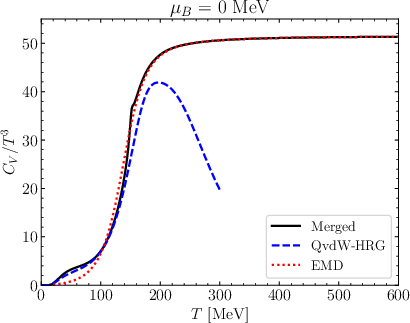
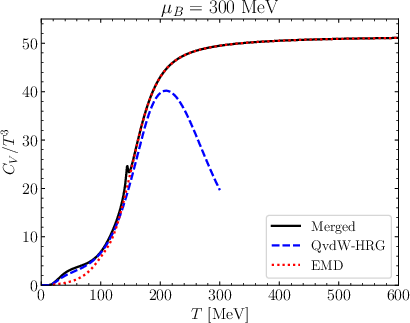
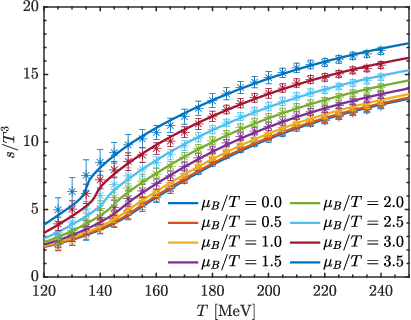
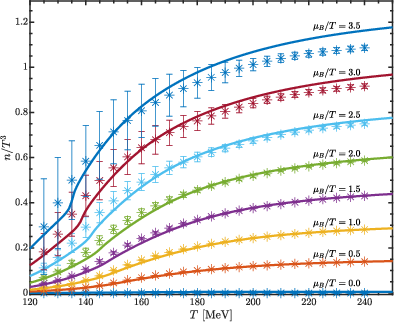
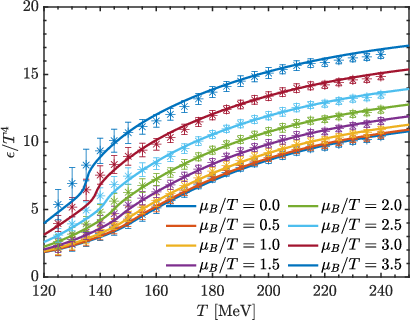
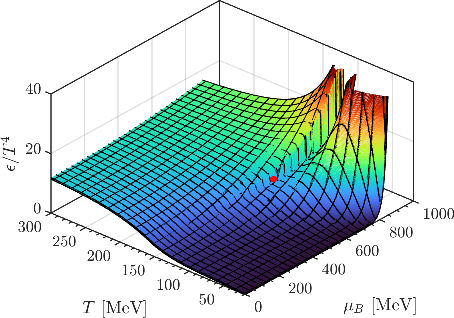
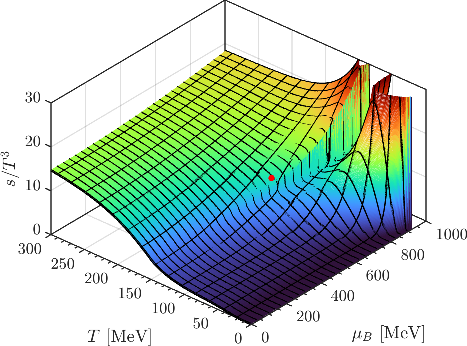
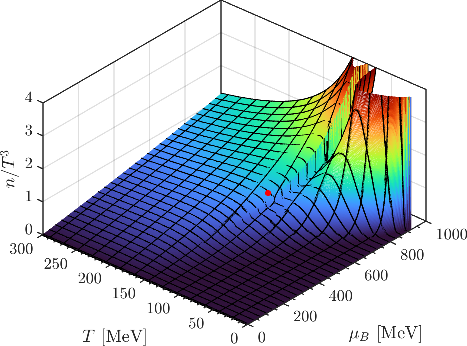
- The merged EoS smoothly matches the hadronic HRG description at low temperatures and the holographic QGP description at higher temperatures.
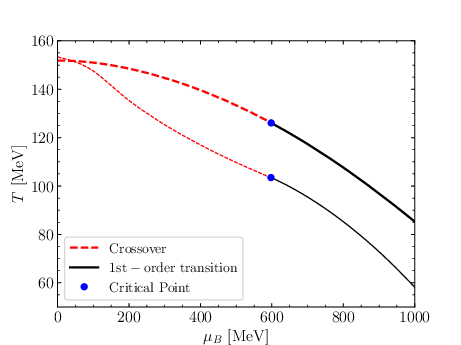
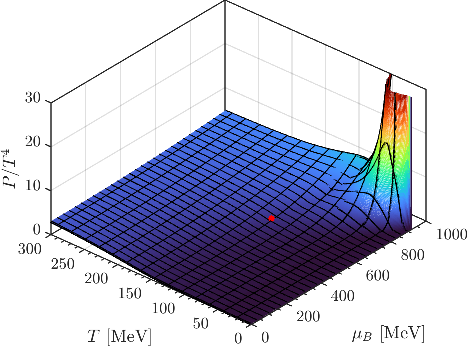
- It reproduces a crossover at low
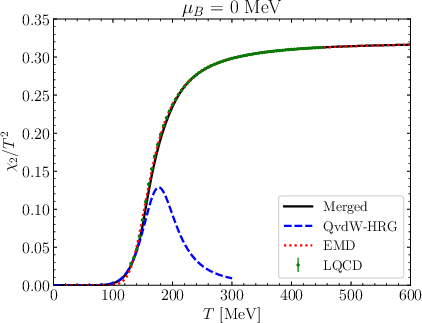
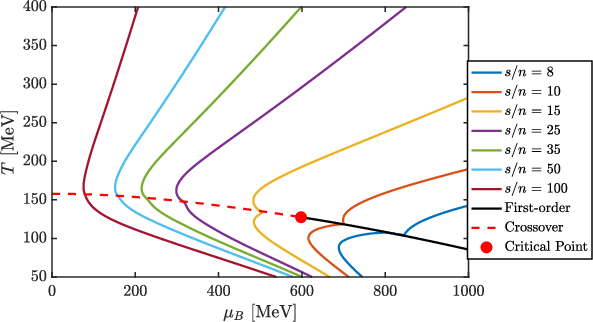
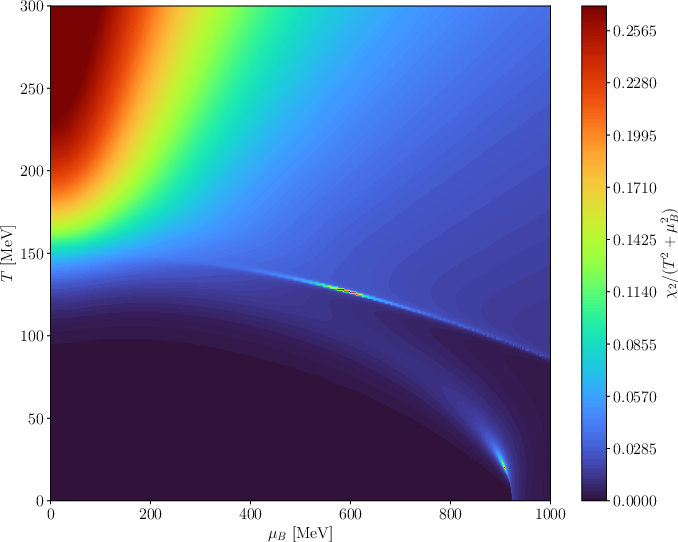
μ_B(as expected from QCD) and a first-order phase transition with a critical endpoint at higherμ_Band lowerT. - The merged results agree with state-of-the-art lattice QCD thermodynamics where lattice data is available (notably at
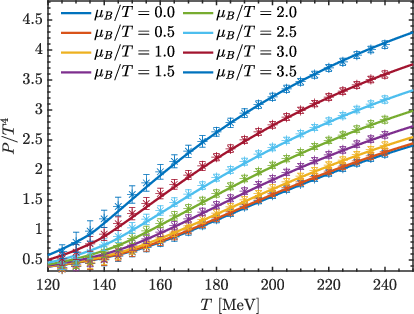
μ_B = 0). - The method guarantees thermodynamic consistency and stability because all quantities are derived from one grand potential with the right “curvature” (no unphysical wiggles).
- The final EoS covers a wide range, roughly up to
μ_B ~ 1000 MeVandT ~ 600 MeV, making it suitable for heavy-ion hydrodynamic simulations. - The approach is general: it can merge more than two EoSs and include more chemical potentials (like strangeness or electric charge) if needed.
- The authors provide open-source code so other groups can apply the method to their favorite models.
Why it matters
This work gives physicists a robust tool to simulate matter under extreme conditions, like in:
- Heavy-ion collisions (to study the QCD phase diagram and search for the critical point).
- Neutron stars and their mergers (especially when generalized to include isospin asymmetry and other conserved charges).
Because the merged EoS is consistent, stable, and matches reliable lattice QCD benchmarks, it can help produce more trustworthy simulations and guide future experiments. It also creates a shared framework where different theoretical models can be combined without breaking the physics, helping the community compare and improve their understanding of strongly interacting matter.
Knowledge Gaps
Unresolved gaps, limitations, and open questions
Below is a concise list of concrete knowledge gaps and limitations left open by the paper, phrased to guide follow-up research:
- Calibration and uncertainty of the merger parameters: the choices a(T)=T/ΔV and b=2Tc/ΔV are phenomenological. There is no systematic calibration procedure for ΔV or Tc against first-principles data, no uncertainty quantification, and no sensitivity analysis of observables to these parameters.
- Pressure normalization and offset control: the holographic EMD pressure is obtained by integrating dP=s dT+n dμB with an arbitrary low-T reference point (unrenormalized model). The impact of this offset on the inequality P1>P2 needed for correct phase selection, and on the location of the crossover/first-order boundaries in the merged EoS, is not quantified.
- Convexity and stability guarantees in (T, μB): while the construction ensures convexity in p, a general proof or numerical audit that the full Hessian of P(T, μB) is positive semidefinite across the domain (i.e., all susceptibilities and heat capacities remain nonnegative) is not provided.
- Mean-field critical exponents: the method enforces mean-field Ising critical behavior; it does not reproduce the non-mean-field 3D Ising critical exponents expected for QCD. A path to incorporate correct static (and dynamic) critical exponents is not developed.
- Critical-region mapping and scaling window: the nonuniversal mapping between (T, μB) and Ising variables (r, h) is not constructed. The shape, orientation, and size of the critical region, as well as the scaling window in which critical behavior is realized, are not constrained or validated.
- Dynamic critical phenomena absent: the framework is purely thermodynamic. It does not include dynamic critical scaling, critical slowing down, or transport coefficient behavior near the critical point required for realistic heavy-ion simulations.
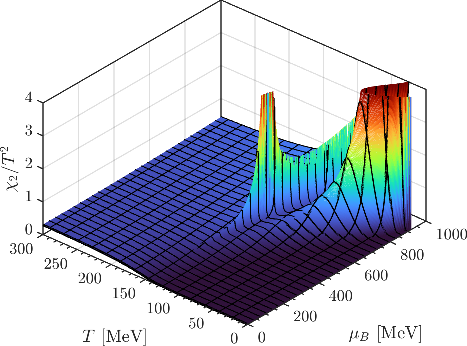
- Higher-order fluctuations: only χ2 is discussed analytically. Systematic validation of higher-order susceptibilities (χ4, χ6, etc.) against LQCD at μB=0 and effective-theory constraints at finite μB is missing, including checks for sign changes and magnitude near the crossover.
- Double counting and overlap consistency: the additive “mixing fluctuations” introduced by the statistical mixture may double count fluctuations already encoded in the component EoSs; a procedure to diagnose and avoid double counting in the overlap region is not given.
- Robustness to input-model choices: the merged EoS inherits model artifacts from both QvdW-HRG and EMD. There is no exploration of how results change if one varies the hadron spectrum, includes/excludes resonance widths, or swaps in alternative deconfined EoSs (e.g., different holographic calibrations or quasiparticle/pQCD inputs).
- Ad hoc meson excluded volume and neglected cross terms: the mesonic excluded-volume parameter bM is chosen to “tame” high-T pressure, and all meson–(anti)baryon and baryon–antibaryon cross terms are neglected. The quantitative impact of these choices on susceptibilities and on the merged crossover is not assessed.
- Limited charge sector: the study is restricted to μB with μQ=μS=0. Realistic heavy-ion conditions (strangeness neutrality nS=0 and fixed charge fraction, e.g., Q/B≈0.4) are not implemented; extensions to multi-charge EoSs and noncongruent phase transitions are left for future work.
- Neutron-star matter not treated: isospin-asymmetric cold dense matter (μB with β-equilibrium, leptons, charge neutrality) is not included, precluding direct astrophysical applications and constraints from neutron-star (NS) observations.
- High-T and high-μB asymptotics: there is no matching to perturbative QCD at asymptotically high T or μB, nor to credible cold dense EoSs at T≈0 and μB≫1 GeV. The regime of validity boundaries and matching strategy to weak-coupling limits are unspecified.
- Maxwell construction and phase coexistence details: while the p-minimization yields coexistence, the construction does not address surface tension, finite-size effects, or pasta phases. The Clapeyron slope, latent heat, and binodal/spinodal structures are not quantified.
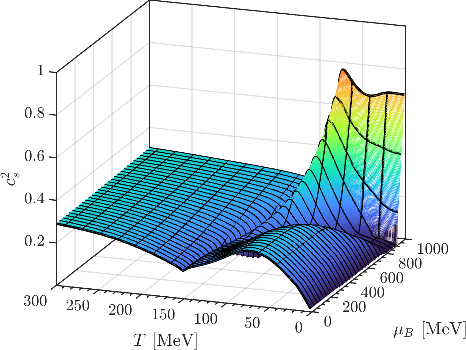
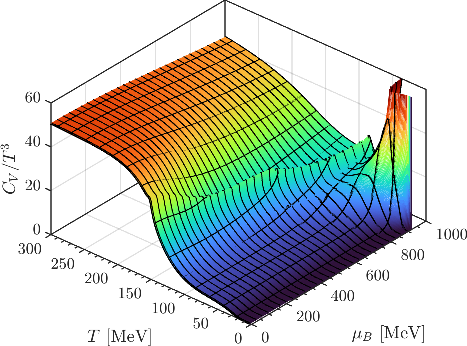
- Causality and acoustic stability: the speed of sound c_s2 is given, but systematic checks that 0≤c_s2≤1 across the domain (especially near the critical point and first-order line) are not presented.
- Invertibility and tabulation for hydrodynamics: heavy-ion hydrodynamics typically needs P(e, n) tables and stable invertible mappings between (T, μB) and (e, n). The paper does not document the construction, monotonicity, and numerical robustness of these mappings or the tabulated grids.
- Sensitivity of phase boundary and critical point: the critical point is fixed to the EMD prediction; associated uncertainties from the EMD Bayesian posterior and from ΔV/Tc choices are not propagated to the merged EoS or to phenomenological observables.
- Finite-volume and coarse-graining interpretation of ΔV: ΔV is interpreted as a coarse-graining volume, but its relation to hydrodynamic cell size, physical correlation lengths, and system-size effects is not established. The behavior of ΔV near the critical region (where correlation lengths grow) is not addressed.
- Ensuring correct phase dominance: the method requires P1>P2 (and vice versa) in the respective domains. A general calibration procedure to enforce this across T–μB when pressures come from heterogeneous sources (with different normalization and uncertainties) is not specified.
- Extension beyond two components: although the approach is said to generalize to more than two EoSs, the formulation with multiple internal variables, uniqueness of minima, and stability/convexity constraints for multi-component mixtures are not developed.
- Consistency with experimental constraints: no confrontation with heavy-ion observables (e.g., freeze-out curves, fluctuation systematics, beam-energy trends) or NS constraints (e.g., 2 M⊙, tidal deformability, MR curves) is attempted to bound the merged EoS.
- Holographic model limitations: the EMD sector is unrenormalized and lacks UV completion to pQCD and IR confinement/HRG degrees of freedom. The influence of these limitations on merged results (especially at very low T or very high T) is not quantified.
- Numerical aspects near the first-order line: procedures for handling multiple minima, metastable branches, and numerical selection of the global minimum (and their implications for constructing EoS tables without discontinuities/artefacts) are not detailed.
- Generalized thermodynamic consistency under constraints: with additional conserved charges or constraints (e.g., nS=0), it is unclear whether p-minimization at fixed T, μB, μQ, μS commutes with imposing constraints, and how to ensure full Legendre-consistent stability in the reduced manifold.
Practical Applications
Practical Applications of “Merging multidimensional equations of state of strongly interacting matter via a statistical mixture”
Below are actionable, real-world applications that leverage the paper’s thermodynamically consistent EoS-merging framework, its demonstration merging QvdW-HRG with a holographic EMD EoS (with a critical point and first-order line), and the accompanying open-source implementation (Zenodo links; within the MUSES framework). Applications are grouped by immediacy, annotated with sectors, potential tools/workflows, and key assumptions/dependencies.
Immediate Applications
- Boldly stable EoS tables for heavy-ion hydrodynamics and transport
- Sectors: software, high-energy/nuclear physics
- What: Drop-in EoS tables and code that ensure convexity, monotonicity, and consistent derivatives across hadronic and deconfined regimes; avoids spurious oscillations and instabilities from ad hoc switches.
- Tools/workflows:
MUSESintegration; plug intoMUSIC,vHLLE,SONIC,CLVisc(hydro) andSMASH,UrQMD,JAM(transport); use in Cooper–Frye particlization pipelines; EOS lookups via table interpolation. - Assumptions/dependencies: Validity inherited from HRG/EMD models; trained to LQCD at μB=0; stable for T ≲ 600 MeV, μB ≲ 1 GeV; user must choose ΔV, Tc consistent with target models; pressure normalization for EMD handled via pressure differences.
- BES-II/FAIR/NICA physics forecasting with a single EoS across phases
- Sectors: academia, experimental HEP
- What: Consistent modeling of beam-energy dependence of observables (flows, yields, fluctuations) using a unified EoS with a tunable critical endpoint and first-order line.
- Tools/workflows: Event-by-event hybrid simulations; Bayesian inference pipelines for parameter scans; sensitivity studies of fluctuation observables.
- Assumptions/dependencies: Mean-field critical exponents in current implementation; position of the critical point controlled via Tc and calibrated to holographic predictions; requires matching transport coefficients.
- Robust susceptibility and derivative observables for data-model comparisons
- Sectors: academia
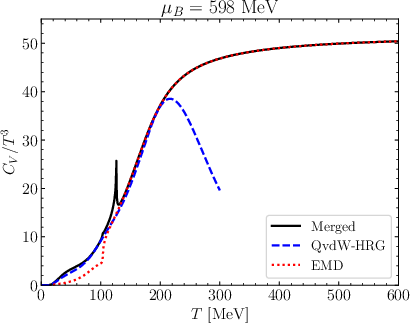
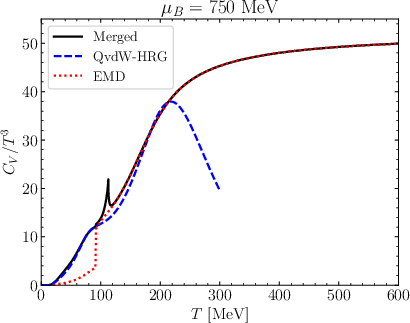
- What: Reliable computation of χn (baryon number susceptibilities), cV, cs² without interpolation artifacts—critical for comparison to LQCD (μB/T ≤ 3.5) and experimental fluctuation data.
- Tools/workflows: Post-processing of EoS tables with derivative-aware interpolation; UQ on χn inputs to cumulant analyses.
- Assumptions/dependencies: Accuracy limited where input models are validated; derivatives derived from a single grand potential ensure Maxwell consistency.
- Thermodynamically consistent multi-model blending template beyond QCD
- Sectors: aerospace/energy (combustion, real-gas CFD), chemical engineering (mixture thermodynamics), materials (phase-field)
- What: Use the “internal-variable mixture” Ansatz to merge models across regimes (e.g., low-/high-T combustion mechanisms; real-gas vs ideal-gas EoS) while guaranteeing convexity and avoiding derivative spikes.
- Tools/workflows: Integrate ω(T, μ; p) minimization into CFD/phase-field codes; swap in domain-specific pressures/models; tune a = T/ΔV, b = 2Tc/ΔV for desired crossover vs first order.
- Assumptions/dependencies: Requires model pressure comparability and crossing; adaptation to domain-specific intensive variables (replace μB with appropriate chemical potentials).
- Faster, safer hydrodynamics numerics via convex EoS closure
- Sectors: software/HPC
- What: Improved stability in Riemann solvers and implicit schemes due to convex thermodynamic closures; fewer unphysical negative susceptibilities.
- Tools/workflows: Tabulated EoS with monotone thermodynamic derivatives; integration into conservative solvers; regression tests for convexity.
- Assumptions/dependencies: Solver must query derivatives consistently; EoS tables generated at adequate resolution.
- Reproducible research and teaching modules
- Sectors: education, academia
- What: Use the open-source code and tables to teach phase transitions, Flory–Huggins-style mixing, and the role of convexity/Legendre structure in thermodynamics.
- Tools/workflows: Classroom notebooks demonstrating ω minimization, crossover vs first order by varying Tc and ΔV; side-by-side HRG/EMD/EoS merges.
- Assumptions/dependencies: Access to Zenodo datasets/MUSES; basic scientific Python/C++ stack.
- Rapid prototyping of merged EoS for new model pairs
- Sectors: academia, software
- What: Swap in alternative hadronic (e.g., EV-HRG variants) or QGP (HTLpt, quasiparticle, other holographic) EoS and obtain a merged, stable EoS without bespoke switching-function tuning.
- Tools/workflows: Replace P1, P2; re-tune ΔV and Tc; run automatic ω-minimization and derivative checks; generate EoS tables.
- Assumptions/dependencies: Each input model must be thermodynamically consistent and supply P(T, μ) and derivatives; ensure domain overlap and pressure crossing.
- EOS repositories and FAIR data practices for multi-model physics
- Sectors: data infrastructure, policy (research data management)
- What: Curate EOS tables with provenance, versioning, and metadata (domains of validity, calibration sets) in community repositories.
- Tools/workflows: Zenodo/DOI issuances; CI that confirms convexity and derivative consistency; MUSES-compatible packaging.
- Assumptions/dependencies: Community standards for thermodynamic validation; sustained maintenance.
Long-Term Applications
- Neutron-star and merger simulations with hot, dense, isospin-asymmetric matter
- Sectors: astrophysics, energy (fusion R&D indirectly through EOS methods), HPC
- What: Extend to include charge and strangeness chemical potentials and β-equilibrium to supply a unified hot/cold EoS for supernova and binary neutron-star simulations (finite T, Y_e, μS, μQ).
- Tools/workflows: Couple to numerical relativity codes (
Einstein Toolkit,BAM,SpEC) with neutrino transport; generate 3D/4D EoS tables. - Assumptions/dependencies: Generalization to additional conserved charges; calibration to nuclear many-body EOS at low T and holography/perturbative QCD at high T/low T extremes.
- Dynamic order-parameter extensions for phase separation and critical dynamics
- Sectors: academia, software
- What: Promote p to a field p(x, t) with Cahn–Hilliard/Landau–Khalatnikov dynamics and couple to hydrodynamics with noise to model spinodal decomposition and critical fluctuations.
- Tools/workflows: Stochastic hydro solvers; phase-field modules; validation against Ising/FRG benchmarks.
- Assumptions/dependencies: Beyond-mean-field fluctuations; transport coefficients for p-dynamics; numerical stability at small interface widths.
- Global Bayesian inference of the QCD critical point from collider data
- Sectors: academia, experimental HEP
- What: Treat Tc, ΔV, and model weights as inference parameters; constrain the EoS and critical-point location using BES-II, FAIR, NICA observables (flows, yields, cumulants).
- Tools/workflows: Emulator-assisted parameter scans; multi-observable likelihoods; nested sampling.
- Assumptions/dependencies: Systematic control of freeze-out, hadronic afterburners, acceptance corrections; model discrepancy quantification.
- Multi-model couplings: EoS with transport coefficients and kinetics
- Sectors: software, academia
- What: Consistently merge not just P(T, μ) but η/s, ζ/s, κB, and kinetic rates from different theories while retaining stability and smoothness.
- Tools/workflows: Multi-field convexification strategies; interpolation on thermodynamic manifolds; code-generation for hydro modules.
- Assumptions/dependencies: Availability of transport data with consistent calibration; thermodynamic–kinetic consistency constraints.
- Industrial CFD/thermochemistry: convex multi-regime closures
- Sectors: aerospace, energy, chemical/process engineering
- What: Stable model blending across low-/high-T combustion regimes, humid-air/real-gas transitions, or polymer blend free energies to avoid spurious instabilities in design simulations.
- Tools/workflows: Implement ω-based merging in solvers (
OpenFOAM, in-house codes); certify convexity via automated checks. - Assumptions/dependencies: Domain-specific pressures/EoS present and crossing; mapping from μB to relevant potentials; adaptation of mixing entropy scale ΔV.
- EOS-aware uncertainty quantification and digital twins
- Sectors: software/HPC, R&D
- What: Embed convex, differentiable EoS merges in digital twins for accelerators, detectors, or astrophysical sources; reduce numerical pathologies in UQ loops.
- Tools/workflows: Surrogate modeling; adjoint differentiation leveraging smooth, convex EOS closures.
- Assumptions/dependencies: Differentiable table interpolation; coverage of operational parameter space.
- LQCD-informed multi-charge EOS across wider μB/T
- Sectors: academia
- What: Incorporate new LQCD expansions (μB/T > 3.5), imaginary μ methods, and functional approaches to tighten calibration of merged EoS.
- Tools/workflows: Joint fits of P, s, χn across charges; cross-validation with HRG at low T and perturbative QCD at high T.
- Assumptions/dependencies: New lattice results with controlled systematics; consistent scale setting across inputs.
- Discovery-optimized scan planning and policy for future facilities
- Sectors: policy (program planning), experimental HEP/astrophysics
- What: Use merged EoS families to design beam-energy scans and astrophysical observing strategies that maximize sensitivity to the critical region.
- Tools/workflows: Experimental design optimization; scenario analyses for detector upgrades.
- Assumptions/dependencies: Agreement on prior ranges for Tc, μc; integration with detector performance models.
- Cross-disciplinary “model-merging” methodology for complex systems
- Sectors: finance (regime switching risk), climate (multi-model blends), biology (metabolic state models)
- What: Apply internal-variable mixture with convexity guarantees to blend regime-specific models where naive switches cause instability.
- Tools/workflows: Replace ad hoc switching functions with ω-minimization; enforce convexity of objective surfaces.
- Assumptions/dependencies: Requires meaningful “pressures”/objective functions and well-defined regime-crossing; adaptation of mixing entropy and interaction terms.
- Toward non-mean-field critical behavior
- Sectors: academia
- What: Augment the merging framework to reproduce 3D Ising exponents via coupling to critical fluctuations (FRG or effective field theories) while keeping global thermodynamic consistency.
- Tools/workflows: Hybrid mean-field + fluctuation matching; renormalization-group-informed parameterizations.
- Assumptions/dependencies: Additional degrees of freedom; careful numerical treatment of diverging correlation lengths.
General Assumptions and Dependencies (cross-cutting)
- The merged EoS inherits the validity limits of the input models; pressure crossings and scale choices (ΔV, Tc) must be physically calibrated.
- Current implementation yields mean-field critical exponents; non-mean-field behavior requires further development.
- Holographic EMD calibration agrees with LQCD at μB=0 and predicts a critical point; pressure normalization is handled via pressure differences.
- Extension to additional conserved charges (μQ, μS), isospin asymmetry, and neutrino physics is feasible but not yet completed in the public artifacts.
- Numerical stability depends on adequate table resolution and consistent derivative-aware interpolation in downstream solvers.
Glossary
- AdS (Anti-de Sitter): A spacetime of constant negative curvature used in holographic dualities to model strongly coupled field theories. "asymptotically Anti-de Sitter (AdS) spacetime"
- AdS₅: Five-dimensional Anti-de Sitter spacetime commonly used as the gravitational background in holographic QCD models. "an asymptotically charged black-brane Ansatz"
- Asymptotic freedom: The property of non-Abelian gauge theories where interactions become weaker at high energies. "Asymptotic freedom only renders perturbative QCD calculations reliable at energy scales that are typically much larger than those relevant for either astrophysical phenomena or collision experiments"
- Bayesian analysis: A statistical inference method that updates model parameters using prior information and observed data. "The parameter space for this model, as well as the location of the predicted critical point, was further constrained by a recent Bayesian analysis"
- Beam Energy Scan: A program at RHIC that varies collision energies to explore the QCD phase diagram and search for the critical point. "relativistic heavy-ion collisions at beam energies probed by the RHIC Beam Energy Scan"
- Baryon chemical potential: A thermodynamic variable controlling the baryon number in a system, denoted μ_B. "baryon chemical potential "
- Baryon number susceptibility (χ₂): A measure of the response of baryon density to changes in baryon chemical potential; the second derivative of pressure with respect to μ_B. "For instance, for the second order baryon susceptibility, one finds"
- Black brane: A black-hole solution with planar horizon in AdS spacetime, dual to a thermal state of a field theory with translational symmetry. "a charged black brane"
- Black hole: A gravitational object with an event horizon; in holography, black-hole solutions encode thermal properties of the dual field theory. "the QGP is described through black-hole solutions within a non-conformal Einstein-Maxwell-Dilaton (EMD) model"
- Bottom-up model: A phenomenological holographic construction where bulk potentials are tailored to reproduce boundary field theory observables. "the bottom-up model developed in"
- Breit–Wigner mass distribution: A resonance line shape used to model the finite width of unstable particles. "a relativistic Breit-Wigner mass distribution"
- Crossover: A smooth change between phases without a discontinuity in thermodynamic quantities. "the change of phases occurs through a crossover"
- Critical endpoint: The terminus of a first-order phase transition line beyond which the transition becomes a crossover. "a critical endpoint with mean-field critical exponents"
- Critical exponents: Numbers characterizing the power-law behavior of physical quantities near a critical point. "mean-field critical exponents"
- Critical point: A point in the phase diagram where a phase transition changes its nature, often marked by diverging susceptibilities. "a critical point and a first-order line"
- Critical temperature (): The temperature at which a system reaches a critical point for given parameters. "The critical point for is then found at the critical temperature "
- Deconfined regime: The phase where quarks and gluons are not bound into hadrons, forming the quark–gluon plasma. "a strongly-coupled quark-gluon plasma (QGP) is found which cannot be accurately described in terms of hadronic degrees of freedom"
- Dilaton: A scalar field in the holographic bulk used to break conformal symmetry and model the running coupling of QCD. "a dilaton field "
- Einstein–Maxwell–Dilaton (EMD): A holographic model combining gravity, a U(1) gauge field, and a dilaton to describe hot and dense QCD. "Einstein--Maxwell--Dilaton (EMD)"
- Equation of state (EoS): A relation between thermodynamic variables (e.g., pressure, temperature, chemical potential) characterizing a system. "The equation of state (EoS) of quantum chromodynamics (QCD)"
- Excluded-volume repulsion: A modeling of repulsive interactions by reducing available volume due to finite hadron size. "repulsive and mean-field effects can be incorporated via excluded-volume or van der Waals interactions"
- Flory–Huggins solution theory: A framework for polymer mixtures whose free energy includes entropy of mixing and interaction terms, inspiring the mixture Ansatz here. "in the spirit of Flory-Huggins solution theory"
- Gauge/gravity correspondence: A duality relating strongly coupled quantum field theories to classical gravity in higher dimensions. "via the holographic gauge/gravity correspondence"
- Gauge–dilaton coupling: A coupling between the bulk gauge field and dilaton that tunes baryonic responses in holographic models. "a gaugeâdilaton coupling "
- Gibbs–Duhem relation: A thermodynamic identity connecting changes in pressure, entropy, and particle densities. "by integrating the Gibbs-Duhem relation "
- Grand canonical ensemble: A statistical ensemble with fixed temperature and chemical potentials, allowing particle-number fluctuations. "in the grand canonical ensemble"
- Grand potential density: The thermodynamic potential per unit volume in the grand canonical ensemble, ω = −P. "grand potential density "
- Hadron Resonance Gas (HRG): A model treating confined QCD matter as a mixture of known hadrons and resonances. "The hadron resonance gas (HRG) model"
- Hawking’s relations: The holographic identification of temperature and entropy with horizon properties of black holes. "via Hawkingâs relations"
- Ising universality class: A category of phase transitions sharing critical behavior with the Ising model, often with mean-field exponents in holographic settings. "mean-field Ising universality class"
- Lattice QCD (LQCD): A first-principles numerical approach to QCD discretized on a spacetime lattice. "lattice QCD (LQCD)"
- Legendre structure: The set of thermodynamic relations ensuring potentials and their derivatives are consistent and convex. "its Legendre structure holds, i.e. , , "
- Maxwell construction: A method to enforce phase coexistence by equalizing thermodynamic potentials across phases in first-order transitions. "allow for a Maxwell construction in equilibrium"
- Maxwell relations: Symmetry relations among second derivatives of thermodynamic potentials that follow from exact differentials. "(Maxwell relations are satisfied; heat-capacity and susceptibility matrices are nonnegative)"
- Mean-field: An approximation where fluctuations are neglected and interactions are averaged, yielding characteristic critical exponents. "mean-field critical exponents"
- Nonconformal: Lacking scale invariance; in holography, implemented via potentials that deform AdS in the infrared. "nonconformal holographic EMD EoS"
- Order parameter: A quantity distinguishing phases, often changing value across a phase transition. "plays the role of an order parameter interpolating between the hadronic and QGP phases"
- Partition function: The central quantity in statistical mechanics from which thermodynamics is derived. "we find a partition function "
- Planar horizon: A horizon with planar topology (ℝ³) appropriate for infinite-volume, translationally invariant plasmas. "with a planar horizon (with topology)"
- Quark–gluon plasma (QGP): A deconfined state of matter consisting of quarks and gluons. "quark-gluon plasma (QGP)"
- Renormalization group flow: The evolution of a theory’s couplings with energy scale; holographically mapped along the radial direction. "the extra holographic direction may be interpreted as a geometrization of the energy scale of the renormalization group flow"
- RHIC: The Relativistic Heavy Ion Collider, a facility exploring QCD matter at high energy densities. "RHIC Beam Energy Scan"
- Ricci scalar: A curvature scalar in general relativity appearing in the gravitational action. "the Ricci scalar"
- Shannon-type entropy: An entropy term of the form p ln p representing mixing or information-theoretic contributions. "a Shannon-type entropy contribution arising from the entropy increase in mixing the two EoSs"
- Specific heat at constant volume: The amount of heat required to raise temperature at fixed volume; denoted C_V. "the specific heat at constant volume"
- Speed of sound: The propagation speed of small perturbations in a medium; in QCD, derived from thermodynamic derivatives. "the speed of sound and the specific heat at constant volume"
- Thermodynamic convexity: The requirement that thermodynamic potentials have positive semidefinite Hessians, ensuring stability. "with the correct convexity properties"
- Thermodynamic consistency: The property that merged quantities obey exact thermodynamic identities and derivatives. "Thermodynamic consistency and stability are guaranteed"
- Thermodynamic stability: The condition that susceptibilities and heat capacities are nonnegative, preventing unphysical instabilities. "most do not ensure thermodynamic stability"
- Trace anomaly: The deviation from conformal behavior indicated by a nonzero trace of the energy-momentum tensor. "as signaled by the trace anomaly"
- U(1) gauge field: A bulk field sourcing a conserved charge (baryon number) in the boundary theory. "a bulk gauge field "
- Ultraviolet expansions: Near-boundary (large-radius) series used to extract field-theory data from bulk solutions. "from the near-boundary, ultraviolet expansions of the EMD fields"
- van der Waals interactions: Effective attractive and repulsive interactions used to model hadronic matter and nuclear liquid–gas transitions. "van der Waals interactions"
Collections
Sign up for free to add this paper to one or more collections.