Modified gravity at large scales on quantum spacetime in the IKKT model
Published 12 Jan 2026 in hep-th and gr-qc | (2601.08031v1)
Abstract: The gravitational dynamics of 3+1 dimensional covariant quantum spacetime in the IKKT or IIB matrix model is studied at one loop, combining the Yang-Mills-type matrix action with the induced Einstein-Hilbert action. This combined action leads to interesting modifications of the gravitational dynamics at long distances, governed by modified Einstein equations including an extra geometrical tensor interpreted as ''mirage matter''. In particular we find extra non-Ricci flat geometric modes with a non-standard dispersion relation, with features reminiscent of dark matter.
The paper derives effective gravitational dynamics from one-loop corrections in the IKKT matrix model, leading to a mirage matter effect akin to dark matter.
It combines the classical Yang-Mills sector with an induced Einstein-Hilbert action, resulting in modified Einstein equations with non-local corrections.
Analysis of higher-spin and non-local modes reveals IR modifications that can explain flattened galactic rotation curves and altered gravitational lensing.
Modified Gravity on Quantum Spacetime in the IKKT Model: An Expert Analysis
Overview and Motivation
The paper "Modified gravity at large scales on quantum spacetime in the IKKT model" (2601.08031) presents a rigorous derivation of effective gravitational dynamics arising from the IKKT (IIB) matrix model, focusing on quantum spacetimes with noncommutative geometry. The author works within a one-loop approximation, combining the classical Yang-Mills sector of the matrix model with the quantum-induced Einstein-Hilbert (E-H) action. This synthesis yields modified gravitational equations at cosmological distances, characterized by an additional non-local tensor sector—interpreted largely as "mirage matter"—reminiscent of dark matter phenomenology.
Covariant Quantum Spacetime and Matrix Model Structure
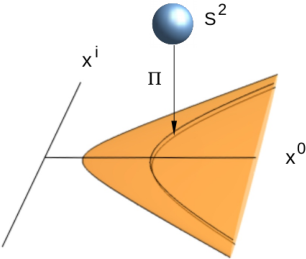
The study employs minimal covariant quantum spacetime backgrounds, constructed from irreducible "doubleton" representations of SO(4,2), resulting in a background compatible with global SO(3,1) symmetry. This background structure is realized as a fiber bundle 3,1×S2, ensuring only a finite number of degrees of freedom per unit volume, thereby resolving ultraviolet pathologies in the matrix model.
Figure 1: Sketch of the bundle space 3,1×S2 indicating a hyperbolic spatial slice with internal S2 fiber structure.
The emergent spacetime possesses a k=−1 FLRW geometry, dynamically obtained in nonperturbative studies and substantiated via semi-classical analysis. The local description leverages a Poisson algebra structure for generators corresponding to spacetime coordinates and internal momentum-like degrees of freedom, enabling explicit construction of frames and effective metrics intrinsic to the quantum geometry. Divergence-free frames are realized via matrix potentials, encapsulating all gravitational degrees of freedom.
Induced Gravity and Modified Einstein Equations
Gravity in this formulation is fundamentally a quantum effect, arising from the one-loop effective action [Steinacker:2023myp]. The classical Yang-Mills-type action is fundamentally non-local when expressed in terms of the frame fields, in contrast to standard general relativity (GR). The induced E-H action complements the Yang-Mills sector, leading to generalized Einstein equations:
8πGN1Gμν=Tμν+Tμν[C]−GμνΛ~
where Tμν[C] is the "anharmonicity tensor" capturing non-local geometric contributions (mirage matter), and Λ~ is the induced vacuum energy, modulated by the dilaton field arising naturally in the matrix background.
The derivation yields a distinctive set of extra modes: non–Ricci flat geometric perturbations exhibiting non-relativistic dispersion relations, with weak couplings to local matter but substantial impact on large-scale structure. This sector breaks manifest local Lorentz invariance, though tensorial covariance is preserved for the classical sector.
Non-Local Mirage Matter and Large-Scale Gravitational Modification
A salient result of this framework is the emergence of an effective "halo" of mirage/dark matter encasing localized sources, leading to substantial modification of metric perturbation dynamics at IR scales. The non-local equation for linearized metric fluctuations takes the form:
(1−m2□~−1)δGμν≈8πGNTμν
where m2 defines a dynamical crossover scale, demarcating Einsteinian and Yang-Mills regimes. For distances exceeding m−1, gravity shows screening behavior effectively truncated in range. For sub-crossover distances, standard linearized GR is recovered.
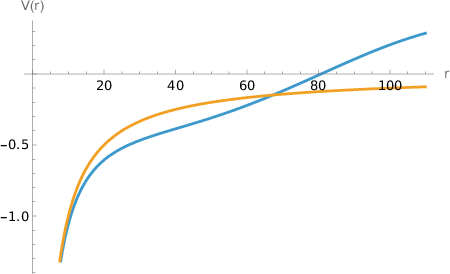
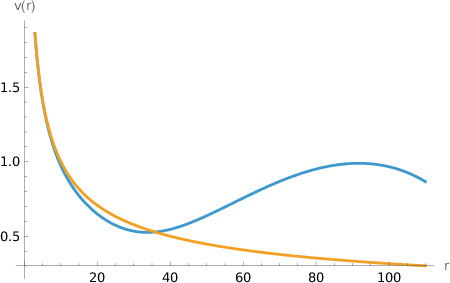
Numerical solutions reveal the static halo profile generated for a point mass, with mirage energy-density distributions displaying oscillatory but screening behavior at large distances. These features produce flattened galactic rotation curves and enhanced gravitational lensing, closely aligning with observations attributed to dark matter halos.
Figure 2: Gravitational potential (left) and rotation curves (right) for a point mass (yellow) and including the mirage halo (blue).
Higher-Spin Modes and Stability of IR Sectors
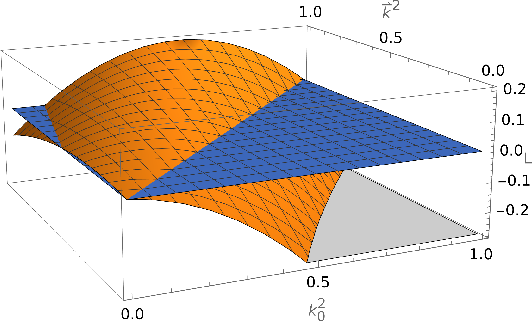
Beyond the classical tensor sector, the analysis incorporates the higher-spin (hs) components intrinsic to covariant quantum spacetimes. Mode expansion demonstrates that six physical on-shell fluctuation modes survive gauge fixing, corresponding to would-be massive gravitons and axionic scalars. The quadratic action for these fluctuations exhibits IR instabilities (tachyonic behavior), but introducing dilaton and vacuum energy contributions facilitates stabilization.
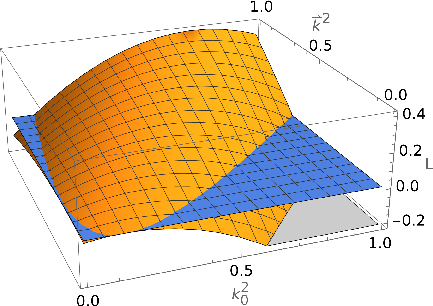
Figure 3: Kinetic action and unstable modes for A(−k02+k2)(k02−k2/5+0.1)A illustrating IR tachyonic regimes.
Figure 4: Kinetic action for stabilized modes A((−k02+k2)(k02−k2/5+0.1)−0.015+0.355k02)A, showing restoration of stability in the IR.
The propagating extra modes are non-relativistic and, while appearing ghost-like at the classical level, are quantum-generated and only relevant for background geometry modifications. The inclusion of hs components is crucial to the physical viability of the modified gravity sector.
Implications and Future Directions
Theoretical Impact
Quantum gravity mechanism: The IKKT matrix model offers a concrete realization where gravity emerges nonperturbatively as a quantum effect, rather than being put in by hand via a classical metric action. The graviton sector intertwines with higher-spin fields, with symmetry breaking of local Lorentz invariance confined to the non-local sector.
Mirage matter and dark sector: The identification of a geometric halo effect as mirage matter provides an IR structure for gravity capable of generating flattened galactic rotation curves without invoking additional particle species. The "screening" of gravity at cosmological scales offers a distinct solution to the dark matter and potentially dark energy puzzles in a unified matrix-model context.
Practical Prospects
Phenomenological constraints: The crossover scale Lcross between GR-like and Yang-Mills-like gravity is dynamical and may be set at galactic or larger scales depending on matrix background properties (e.g., dilaton value and compactification details). Experimental bounds on graviton mass do not straightforwardly constrain this model due to the presence of cancellation mechanisms.
Astrophysical applications: The theory predicts the presence of dynamical halos and modified lensing signatures; a detailed fit against empirical dark matter halo profiles (e.g., NFW) becomes feasible once the model parameters are specified.
Speculation and Future Developments
Further progress will require detailed understanding of the vacuum energy sector, stabilization of internal spaces, and a systematic treatment of axion and dilaton dynamics. The model's higher-spin modes may offer new avenues for resolving gravitational singularities (e.g., black hole interiors). Extension to more generic noncommutative backgrounds within the IKKT model is a promising direction, potentially revealing further modifications to the gravitational dynamics.
Conclusion
This paper establishes a technically robust framework for emergent modified gravity on quantum spacetime backgrounds in the IKKT matrix model. The combined matrix model and quantum-induced Einstein-Hilbert action yield non-local corrections that manifest as effective dark (mirage) matter distributions, with distinctive IR modifications to gravitational propagation. The presence of higher-spin degrees of freedom and explicit mode stabilization mechanisms solidify mathematical rigor and physical viability. The model retains local GR at accessible scales and naturally extends to accommodate observed large-scale gravitational anomalies. Future research into matrix model backgrounds, vacuum structure, and observational signatures is warranted to fully develop and test the theory's astrophysical relevance.