The CFT Distance Conjecture and Tensionless String Limits in $\mathcal N=2$ Quiver Gauge Theories
Published 13 Jan 2026 in hep-th | (2601.08909v1)
Abstract: We initiate the study of infinite-distance limits on (complex) multi-dimensional conformal manifolds of 4d SCFTs and their bulk interpretation as tensionless-string limits in AdS/CFT. In particular, we focus on 4d $\mathcal{N}=2$ $SU$ quiver gauge theories with hypermultiplets in the bifundamental and fundamental representations. In the overall-free limit, we compute the large-$N$ Hagedorn temperature $T_H$, which governs the stringy exponential growth of the density of states at high energies. We argue that this quantity determines the type of stringy ultraviolet completion in the bulk: it captures the type of string theory in which the bulk physics is embedded while remaining insensitive to detailed geometric data. For linear quivers, we find that $T_H$ depends only on the quiver length, which is tied to the number of NS5-branes in the underlying brane construction and, in turn, to the string theory in which the bulk is embedded. For holographic quivers, where we impose that the two central charges $a$ and $c$ coincide in the large-$N$ limit, we show that $T_H$ coincides with that of $\mathcal{N}=4$ SYM, which befits the 10d Type IIB description of their gravitational duals. We also analyze the exponential rate $α$, which controls how the leading tower of higher-spin currents becomes conserved in these limits, as suggested by the CFT Distance Conjecture. In the large-$N$ regime, we derive sharp bounds on the minimal rate, $1/\sqrt{2}\le α_{\min}\le \sqrt{2/3}$, attained in the overall-free limit. Moreover, we prove that the universal lower bound $α\ge 1/\sqrt{2}$ holds, including at finite $N$. Finally, we go beyond the overall-free ray by characterizing the convex hull of the $\vecα$-vectors that encode the exponential rate of the higher-spin towers along any (partial) weak-coupling limit.
The paper proves precise bounds on the exponential decay rate (α) and its relation to central charge ratios in N=2 quivers.
It establishes the universality of the large-N Hagedorn temperature T_H, independent of quiver details, through matrix model analysis.
The study employs convex geometry to map emergent operator towers, providing insights into both holographic and non-holographic UV completions.
The CFT Distance Conjecture and Tensionless String Limits in N=2 Quiver Gauge Theories
Introduction and Overview
This paper delivers a systematic analysis of infinite-distance limits on multi-dimensional conformal manifolds, focusing on 4d N=2SU quiver gauge theories with fundamental and bifundamental hypermultiplet content. It elucidates the bulk interpretation of these limits as tensionless-string limits within the AdS/CFT paradigm and concretely connects the CFT Distance Conjecture [Perlmutter et al., (Perlmutter et al., 2020)] to the emergent string sector in the bulk. The study targets the behavior of the large-N Hagedorn temperature TH, central charge ratios, and exponential decay rates α for towers of higher-spin (HS) operators, extracting robust universality patterns and bounding relations that govern how UV physics organizes in these theories.
CFT Distance Conjecture and Infinite-Distance Limits
The CFT Distance Conjecture provides a precise map between infinite-distance points on the conformal manifold and the emergence of an infinite tower of states with anomalous dimensions exponentially approaching the unitarity bound. For 4d SCFTs, this manifests as infinite towers of HS currents at weak-coupling limits, with the overall scaling rate parameterized as γJ∼g2∼exp(−2αd), with d the Zamolodchikov distance. Crucially, the parameter α is bounded from below, with the strongest conjectural bound α≥1/2 realized in all known weak-coupling CFTs [Perlmutter et al., (Perlmutter et al., 2020)]. This is rigorously proved for N=2 quivers at both large and finite N in this work.
The anomalous dimensions in weak-coupling CFTs are highly constrained by conformal perturbation theory and supersymmetry, with the rate α directly tied to central charge data:
α=dimGfree2c
and, in the overall-free limit, further to the ratio a/c or nh/nv. This identifies universality classes through their anomaly coefficients, reflecting deep geometric and group-theoretic properties of the parent quiver.
Universality of Hagedorn Temperature and Stringy UV Completion
The large-N Hagedorn temperature TH encodes the stringy exponential growth of the high-energy density of states:
ρ(E)∼exp(THE)
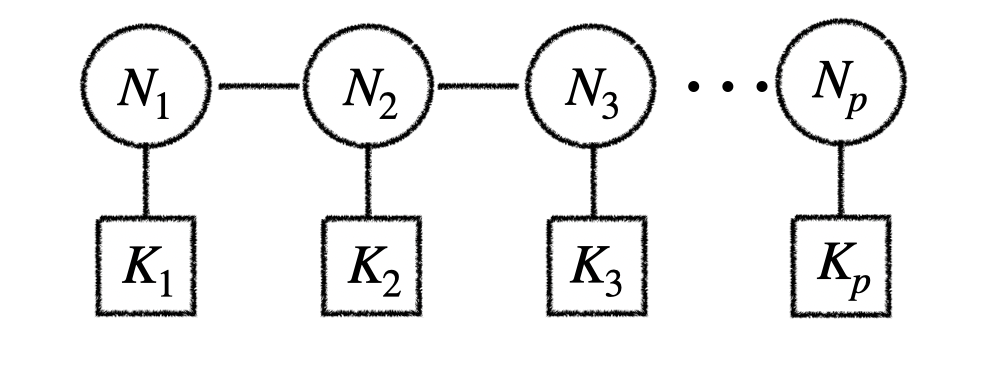
A principal claim of the paper is the universality of TH for N=2 linear quivers:TH is solely a function of the quiver length p, independent of local ranks or fundamental matter (when IR divergences are factored out). Explicit computation, via the matrix model analysis of the partition function on S3×S1, demonstrates this dependence.
Figure 1: A linear quiver with fundamental flavor multiplets, cartooning the type of quivers for which universality of TH is established.
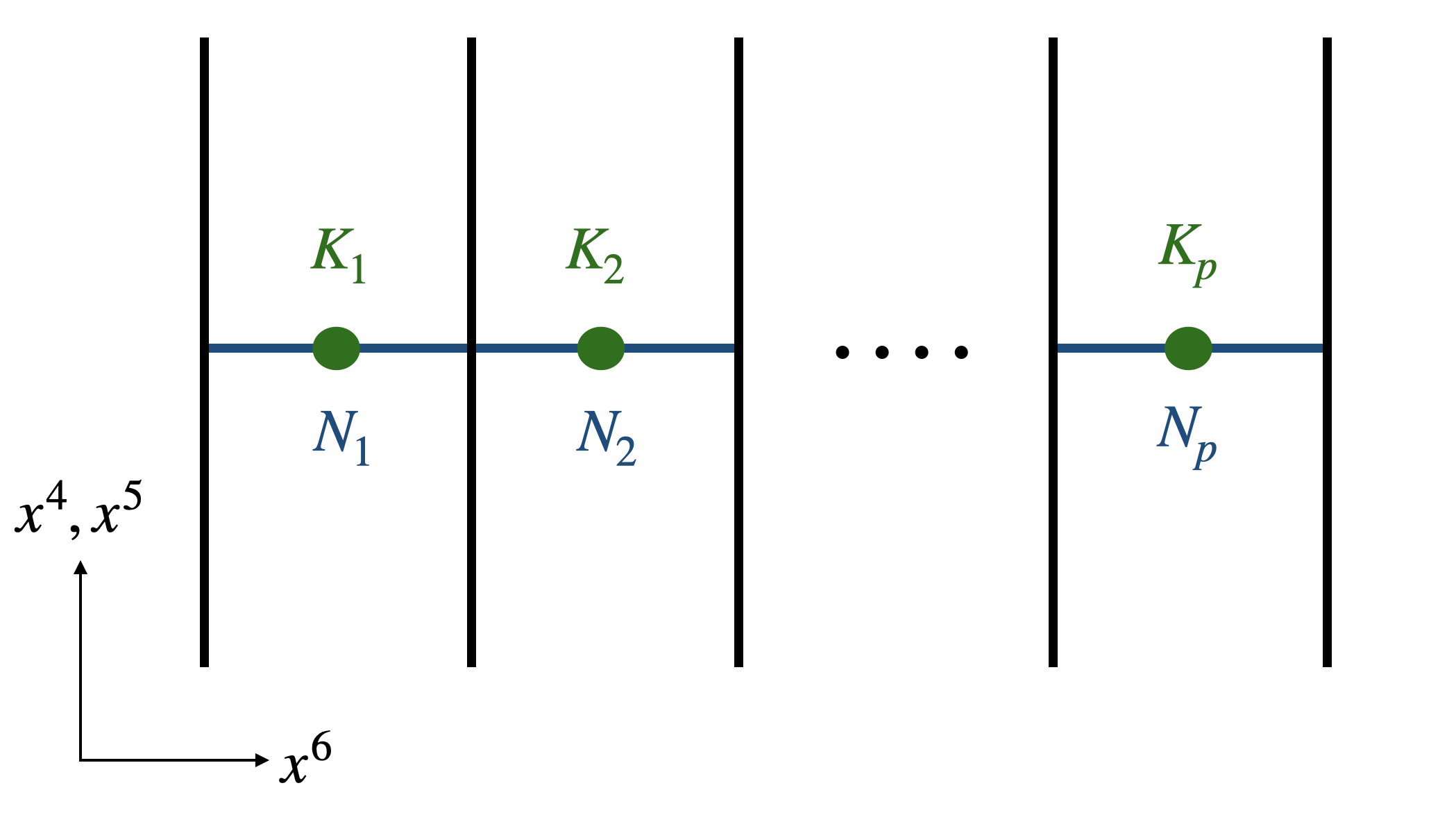
This result is naturally interpreted through the Hanany–Witten brane engineering:
Figure 2: Type IIA Hanany–Witten setup, where the number of NS5-branes (black) determines the quiver length and thereby the embedding string theory.
In this construction, the quiver length matches the number of parallel NS5-branes, dictating the near-horizon background and thus the stringy UV completion, fortifying the claim that Hagedorn data is a robust coarse diagnostic of dual string type.
For holographic quivers (those with a≃c at large N), the authors prove that TH always matches that of N=4 SYM, universally linking these to known Type IIB superstring duals on AdS backgrounds.
Bounds on Exponential Towers: α and Convex Hull Geometry
A substantial contribution of the analysis is the establishment of sharp two-sided bounds on the minimal exponential decay rate for anomalous dimensions:
21≤αmin≤32
for quivers at large N, where the lower bound is saturated precisely for ADE quivers (affine diagrams, i.e., Ki≪Ni for all i).
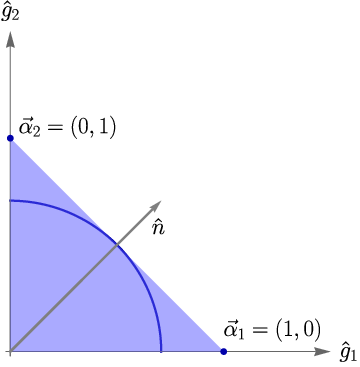
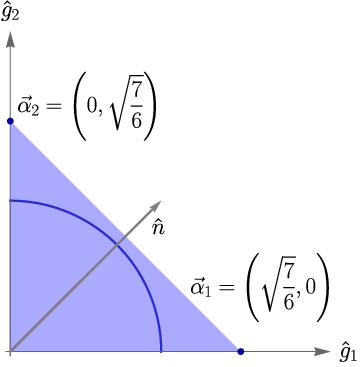
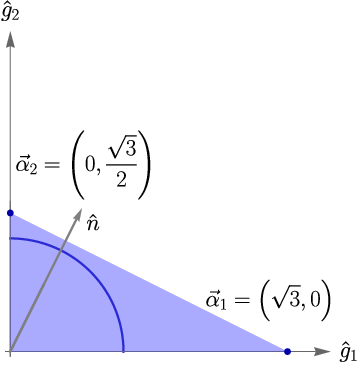
The structure of possible α-vectors for partial weak-coupling limits is mapped using convex geometry, yielding “frame simplices” in the space of possible decay rates, fully characterized by αmin and a unit normal vector. This construction applies to any composite gauge group quiver, with the simplex oriented along the vector of ranks N subject to balancing constraints.
Figure 3: Convex hulls in α-space for multiple quiver types, with the overall-free direction marked; the α≥1/2 ball is shown for reference.
This “convex hull” approach aligns with recent developments in Swampland distance taxonomy [Calderón-Infante et al., (Calderón-Infante et al., 2020); Etheredge et al., (Etheredge et al., 2024)], identifying all towers accessible in each weakly-coupled regime and directly relating geometric data to tower emergence patterns.
Non-Equivalence of α and TH: Bulk Implications
A surprising result is that the mapping between α and TH is not bijective for general non-holographic quivers: theories with the same Hagedorn temperature (and hence UV completion) can have distinct minimal exponential decay rates to the unitarity bound, and vice versa. This demonstrates that, unlike in flat space where the string scale and lightest tower always coincide, AdS/CFT can have towers not associated with the dominant Hagedorn growth. The TH parameter is set by the sector with densest large-N spectrum at high energy (potentially not the most rapidly vanishing mass scale).
This distinction arises because, in AdS/CFT, tensionless-string limits do not generally cause all higher-spin towers to become massless compared to the AdS scale, and several extended objects may remain light. Only for the gs→0 IIB string duals (holographic quivers) does a one-to-one mapping between TH and α reappear.
Explicit Calculations: ADE Quivers and Operator Densities
The paper provides explicit algebraic and combinatorial evaluations for the Hagedorn transition in type D, E6-8, and other affine quivers:
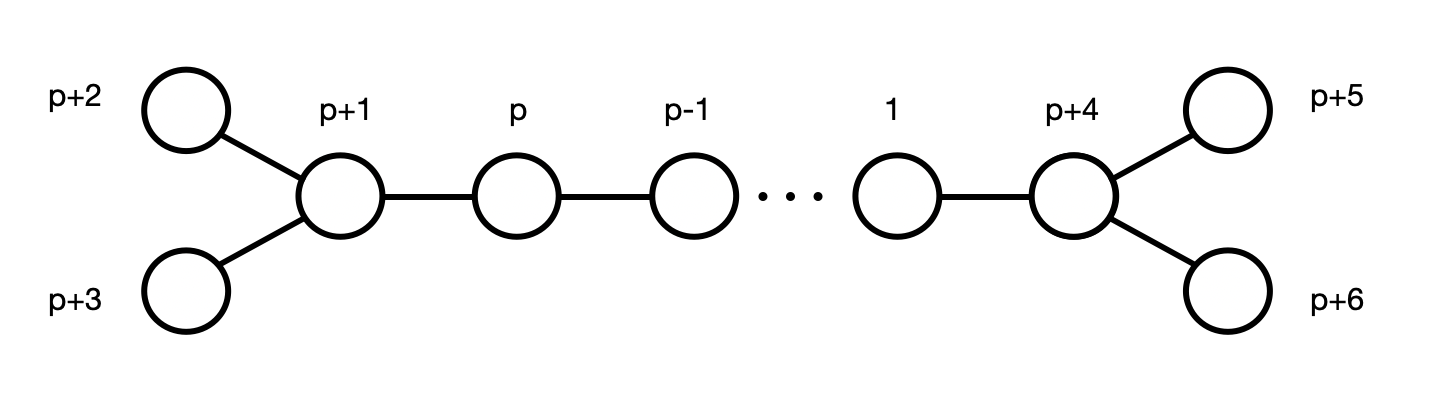
Figure 4: A quiver of type D.
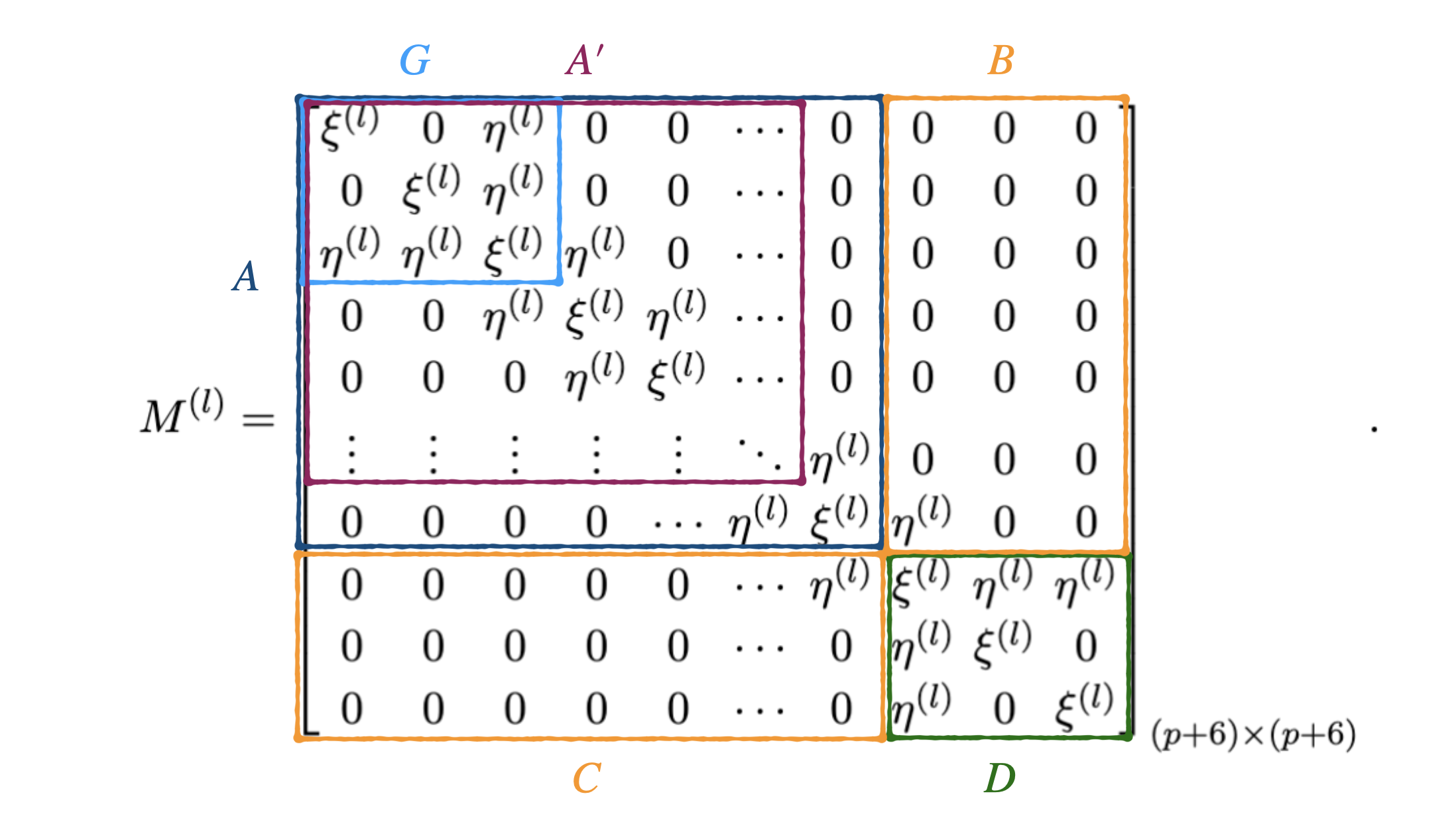
Figure 5: Block structure and Schur-complement analysis for determinant calculations in the partition function.
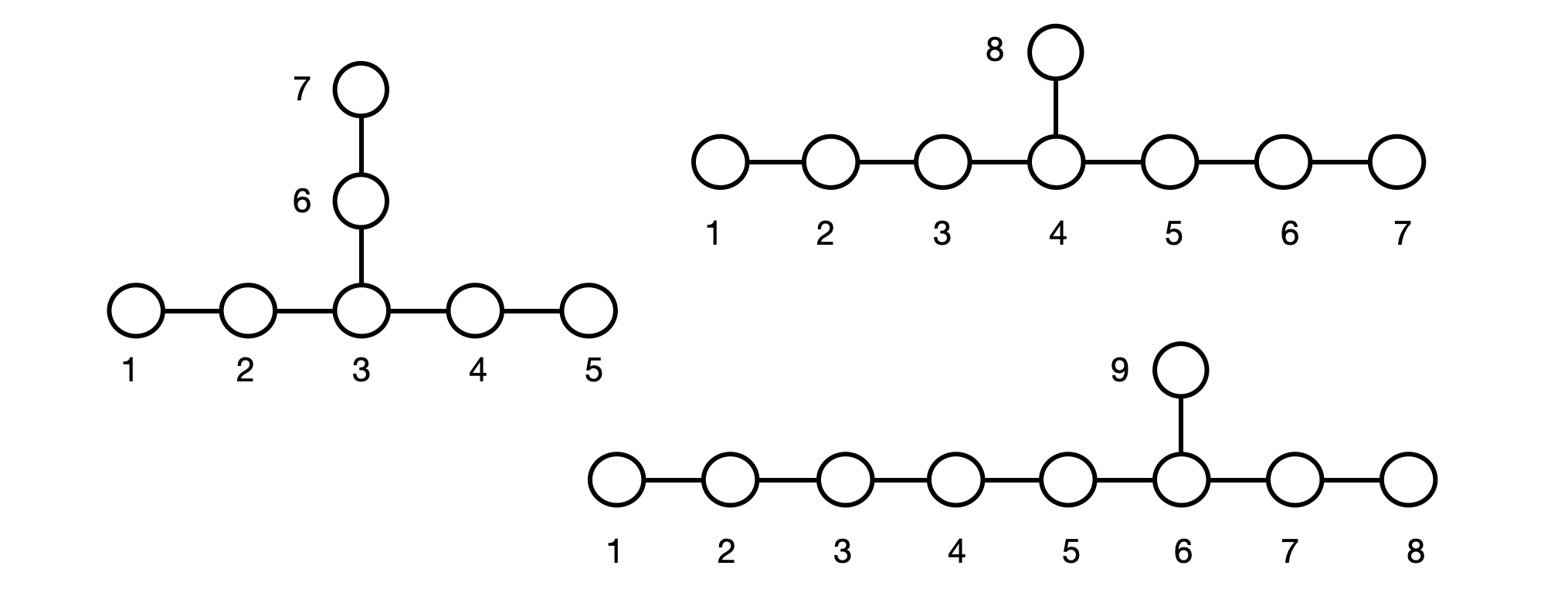
Figure 6: E6, E7, and E8 quiver diagrams, with computations showing their Hagedorn temperature coincides with N=4 SYM in the infinite rank limit.
It is also established that the tower of light higher-spin states in AdS has a non-exponential density (scaling as JlogJ at high spin in N=4 SYM), much sparser than string or KK towers in flat space, and thus cannot serve as the sole probe for emergent string type.
Implications, Future Directions, and Open Questions
The results constrain possible CFT moduli space trajectories consistent with AdS quantum gravity, refine the taxonomy of emergent towers at infinite distance, and clarify the limitations and possibilities of holographic UV completions for general SCFTs. The universality results for holographic quivers strengthen the status of the IIB string as the unique weakly-coupled bulk dual in all such cases.
Immediate extensions include treating quivers with orthogonal, symplectic, (anti)symmetric matter, explicit calculation of non-singular frame convex hulls for S-duality orbits, and the inclusion of motion in "central charge" directions (modifying c or AdS radius). Classification of all allowed α-simplices would further enhance the landscape/swampland dictionary in AdS. Finally, understanding the operator-level mapping of towers to string sectors remains a crucial open problem for distinguishing UV completions in non-holographic cases.
Conclusion
This work rigorously explores the interplay between infinite-distance CFT limits and tensionless-string/bulk physics in N=2 quiver gauge theories. It establishes strong bounds and universality classes for decay rates and Hagedorn temperatures, clarifies when and how the emergent string UV completion is encoded in weak-coupling CFT data, and extends the landscape/swampland dictionary for AdS/CFT through a detailed geometric characterization of emergent towers. The framework provided here underpins further explorations of non-holographic CFT dualities, tower taxonomies, and infinite-distance limits in higher-dimensional field and string theory.