Non-invertible Nielsen circuits and 3d Ising gravity
Published 14 Jan 2026 in hep-th | (2601.09534v1)
Abstract: We extend Nielsen's formulation of quantum circuit complexity to include intrinsically non-invertible operations. Such gates arise from fusion with topological defect operators and remove a basic limitation of symmetry-based circuits: the inability to change superselection sectors, or in two-dimensional CFTs, conformal families. We realise fusion operations as completely positive, trace-preserving quantum channels acting between sectors, with consistency ensured by the fusion and associator data of an underlying unitary modular tensor category. In contrast to standard Nielsen circuits, non-invertible circuits lead to an optimisation problem that is no longer governed by geodesics on a continuous group manifold but instead reduces to a discrete shortest-path problem on the fusion graph of superselection sectors. We illustrate the framework in representative rational conformal field theories. Finally, we interpret fusion-induced transitions as discrete changes in boundary stress-tensor data, corresponding to shock-like defects in AdS$_3$ gravity.
The paper extends Nielsen’s circuit complexity framework by incorporating non-invertible operations using categorical fusion techniques.
It develops a discrete optimization on fusion graphs where non-invertible gates cause abrupt transitions, contrasting continuous geodesic methods.
The framework is applied to AdS₃ gravity and the Ising model, revealing shock-like defect transitions and new insights into quantum gravity.
Non-invertible Nielsen Circuits and Their Implications for 3D Ising Gravity
Introduction and Motivation
This paper establishes a comprehensive extension of Nielsen's geometric circuit complexity framework to accommodate non-invertible operations, focusing on rational two-dimensional conformal field theories (CFTs) and their bulk AdS3 gravity duals. The motivation arises from the realization that standard complexity constructions built from symmetry operations—such as those generated by the Virasoro group—are fundamentally limited by invertibility, confining circuits within single superselection sectors (i.e., conformal families). In contrast, topological defect operators in rational CFTs effect non-invertible operations governed by fusion rules, naturally changing superselection sectors and necessitating a generalized circuit framework.
Categorical Foundations for Non-invertible Gates
The approach deploys the formalism of unitary modular tensor categories (UMTCs) to rigorously encode fusion processes as quantum channels. These non-invertible gates act between Hilbert space sectors, with their consistency and associativity strictly controlled by categorical fusion and associator (F-symbols) data. Unlike invertible Nielsen circuits, which are described as geodesics on Lie group manifolds, non-invertible circuits are identified with discrete shortest-path problems across the nodes of the fusion graph representing sector connectivity.
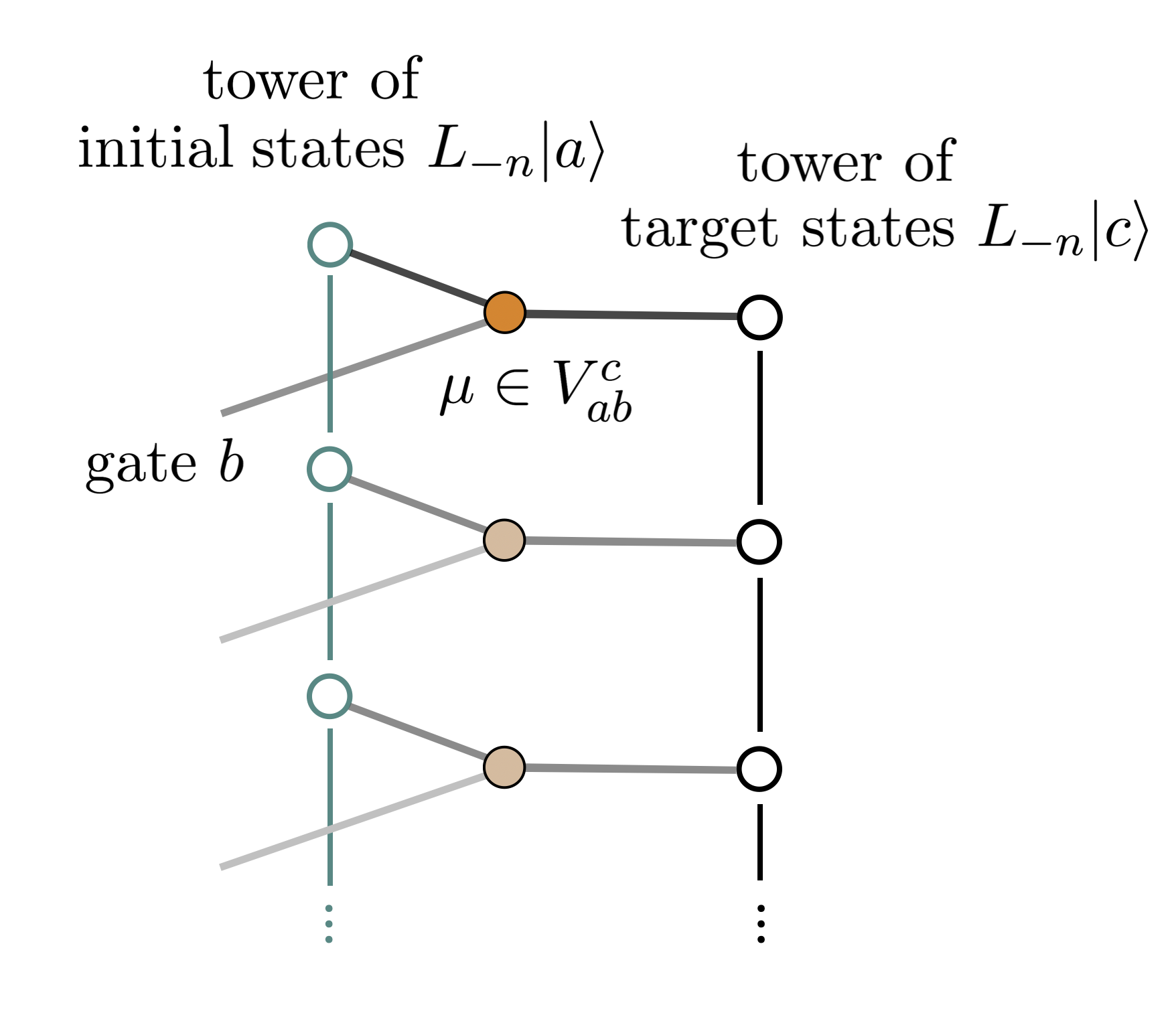
The action of a typical fusion gate is schematized by the map:
HaDbc:Nabc=0⨁Hc⊗Vabc
where a and b label the input sector and fusion defect, c labels admissible outputs, and Vabc encodes fusion multiplicity.
Figure 1: A fusion gate labeled by b maps an initial conformal family a to admissible outputs c, with fusion channel data μ∈Vabc retained as an auxiliary degree of freedom.
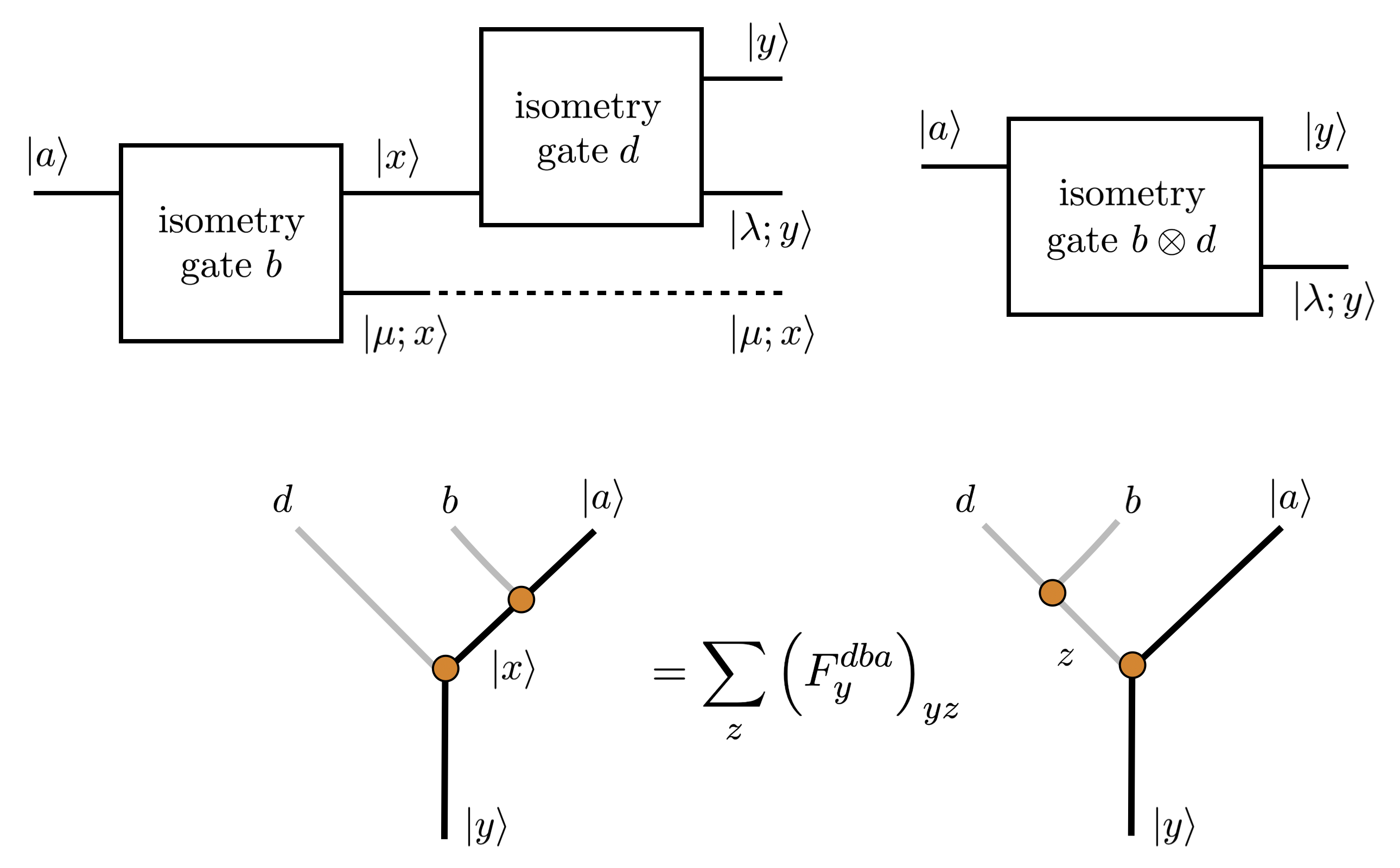
This formulation is realized by a Stinespring isometry, producing completely positive, trace-preserving (CPTP) channels, with Kraus operators determined by the fusion intertwiners and quantum dimensions. The mapping between circuit-theoretic and categorical data is made explicit, and full associativity is proven at the quantum channel level by F-symbols, ensuring categorical coherence.
Cost Functionals and Optimization Geometry
The complexity cost associated with non-invertible circuits is fundamentally different from that of unitary ones. Since fusion gates may admit multiple outcomes, the optimization problem is naturally discrete. For each fusion, the intrinsic gate cost is framed as a geodesic distance in projective space (Fubini-Study metric), constructed from the vector of canonical fusion weights:
Cgategeom(a,b)=arccos(c∑p(c∣a,b)qref,c)
where p(c∣a,b) are quantum-dimension-weighted fusion probabilities, and qref,c is an unbiased reference distribution in channel space.
Additionally, energy-weighted costs are introduced, incorporating the conformal weight changes induced by the fusion outcomes, and their cost functionals are integrated over an artificial "inverse temperature" parameter, producing channel weight vectors pc(β) that energetically bias the cost towards high or low conformal weight channels. The selection cost—associated with enforcing a specific fusion outcome—is defined as a Fubini-Study distance between the categorical fusion output vector and the chosen deterministic channel.
The upshot is that the overall circuit complexity in the presence of both invertible and non-invertible gates is a combined optimization problem: continuous geometric path length for invertible, and discrete shortest-path for non-invertible transitions. The reachable configuration space becomes the fusion graph of simple objects, and complexity is obtained via shortest-path algorithms.
Figure 2: Each non-invertible action branches the evolution of the state into multiple possible outcomes, and associator data controls the consistency of different fusion paths to a target sector.
Applications to AdS3 Gravity and the Ising Model
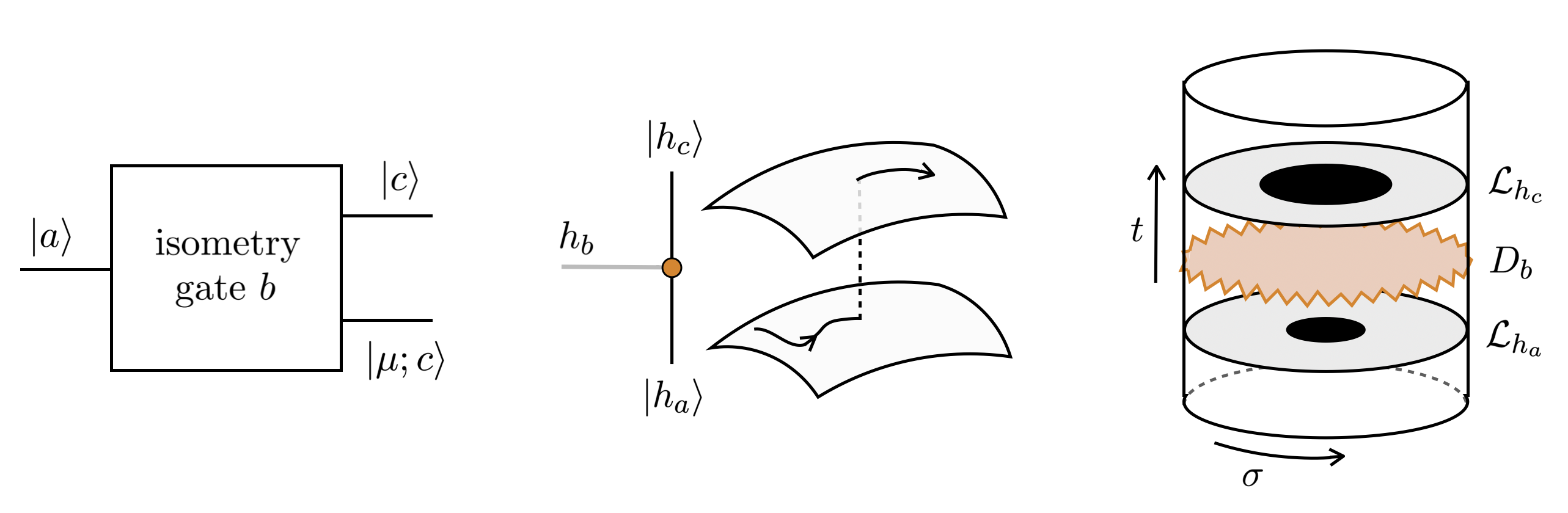
The bulk dual interpretation aligns each conformal family with a distinct Ba~nados geometry in 3D AdS gravity, characterized by its holonomy class in SL(2,R)×SL(2,R). Standard unitary circuits yield continuous evolution within a given holonomy class; non-invertible fusion gates produce discrete, instantaneous jumps between such classes—interpreted as "shock-like" defects or localized modifications of boundary stress-tensor data.
The rational Ising model is taken as a concrete example. Fusion gates constructed out of topological defect operators (e.g., fusing σ with σ) realize transitions between the three primary sectors (1, σ, ε), corresponding, via the AdS3/CFT2 dictionary, to transitions among global AdS, light BTZ, and heavy BTZ-like geometries. Explicit conformal weight shifts, fusion multiplicities, and quantum dimensions are computed to check that, while selecting particular negative-energy channels is allowed, the channel-average always satisfies the averaged null energy condition (ANEC), and thus the construction is consistent with the requirements of quantum gravity.
Figure 3: Multi-level visualization—topological fusion gate as an isometry (left), branching among conformal families (middle), and instantaneous bulk defect insertion altering holonomy classes (right).
Contrasts with Topological Quantum Computation
The promotion of fusion itself—not just braiding—to the status of a circuit operation distinguishes this framework from conventional topological quantum computation, where fusion is generally associated with state preparation or measurement and computational processes are exclusively unitary (via braiding). In the present setting, fusion acts directly as a non-unitary, order-dependent circuit element—fundamentally expanding the paradigm for circuit-based complexity in QFTs.
Implications and Outlook
Bold claim: The paper establishes that circuit complexity in rational CFTs with non-invertible symmetries is not a geodesic problem on a group manifold but a discrete optimization over fusion graphs. This sharply contradicts the universality of the geometric group-manifold approach for symmetry-generated complexity.
This non-invertible paradigm compels new mathematical techniques for circuit optimization (e.g., shortest-path graph algorithms [GoldbergHarrelson2005]) and raises practical consequences in the study of quantum gravity: the circuit complexity of a gravitational transition cannot be computed via standard geometric means if non-invertible defects are present.
Possible future directions include development of hybrid circuit optimization algorithms for large fusion graphs, investigation of which Nielsen-type complexity properties survive in non-invertible extensions (such as switchback effects), and exploration of how these ideas generalize beyond rational CFT settings and to higher dimensions, perhaps demanding new categorical structures replacing UMTCs (e.g., non-semisimple or higher categories).
Conclusion
This paper rigorously advances the field by transplanting non-invertible symmetry operations into the domain of circuit complexity, employing categorical, representation-theoretic, and quantum information-theoretic tools. The developed framework robustly models physical processes—such as sector transitions and shock-like defects in 3D gravity—that are inaccessible to invertible circuit complexity. These developments illuminate the structure of quantum operations in field theory and gravity, and frame a new class of discrete optimization problems central to quantum information in strongly correlated and topological phases.