- The paper demonstrates that increasing nested hyperedge overlap lowers critical infectivity thresholds, enabling earlier onset of collective transitions.
- It employs a closed mean-field theory and center-manifold reduction to reveal how motif density ratios shift transmission from external to group-based channels, reducing bistability.
- The findings suggest that engineering nested structures in hypergraphs can effectively control contagion and synchronization dynamics in complex systems.
Nested Hyperedges: Tuning the Onset and Nature of Collective Transitions in Higher-Order Networks
Introduction and Theoretical Framework
The effect of higher-order interactions—beyond dyads—on collective network phenomena has become central in understanding multistability and nonlinear transitions in complex systems. This paper focuses on the impact of nested hyperedges in such networks, specifically how their microscopic inter-order organization modulates both the onset and qualitative nature of macroscopic collective transitions in contagion and synchronization dynamics. The key analytical advance is a closed homogeneous mean-field theory for Susceptible–Infected–Susceptible (SIS) dynamics on regular hypergraphs, inclusive of tunable inter-order hyperedge overlap. Nestedness is measured by a parameter α, interpolating between independent dyadic and triadic interaction layers (α=0) and fully nested simplicial complexes (α=1).
The overlap α quantifies the proportion of dyadic (pairwise) edges structurally embedded within triads (three-body hyperedges). This structural control allows the disentanglement of contagion pathways, providing mechanistic insight into how overlap systematically reallocates transmission routes from external links to group-embedded channels.
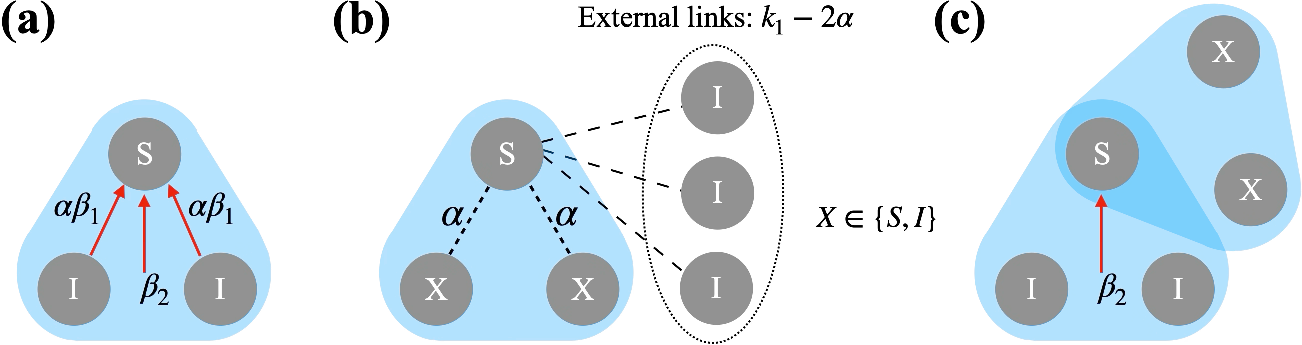
Figure 1: Schematic illustration of higher-order contagion with nested hyperedges, showing how inter-order overlap α reallocates transmission between external and intra-group pairwise interactions.
Analytical Results: Anticipation of Onset and Suppression of Explosive Behavior
The model introduces a coupled dynamical system tracking node, pair, and group-state motif densities. By incorporating α into both the system definition and mean-field closures, the dynamical equations capture how overlap influences probabilities of transmission along internal (intra-hyperedge) or external (inter-hyperedge) link channels.
The calculation of the epidemic threshold reveals that increasing α (nestedness):
- Lowers the critical pairwise infectivity λ1∗, thus anticipating the onset of the collective transition.
- Suppresses subcritical (explosive) transitions by increasing the threshold for group infectivity λ^2 required to induce backward bifurcation and bistability.
The dual effect is formalized via a center-manifold reduction of the dynamics near the epidemic threshold. The sign of the cubic nonlinear coefficient h governs the nature of the transition: h<0 yields a continuous onset, h>0 produces a saddle-node bifurcation and accompanying bistability. Analytical and numerical analyses show h decreases monotonically with α, leading to a critical overlap αc above which discontinuous transitions vanish.
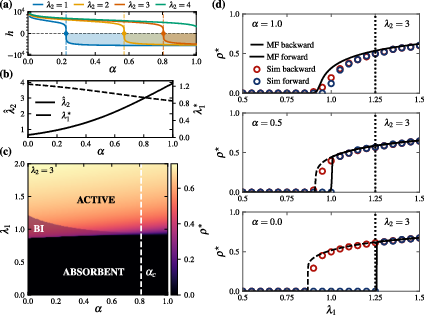
Figure 2: Effects of nested hyperedges on the nonlinear coefficient governing the transition, phase diagrams, and epidemic thresholds as functions of α.
Microscopic Mechanisms and Pathway Decomposition
A central innovation is identifying the fast variables—ratios of motif densities (e.g., Π=ρSI/ρI, δ=ρISIΔ/ρSI)—which equilibrate rapidly near the disease-free state, and showing analytically how α controls their values and, thus, the position and sharpness of the onset. Nestedness exclusively amplifies internal pairwise contagion within groups, directly raising the early presence of mixed infection motifs (ISI triangles), which reduces the epidemic threshold.
Further, the dynamical redundancy between dyadic and triadic channels grows with α, suppressing the nonlinear feedback loop necessary for explosive bistability: as overlap increases, dyadic and triadic pathways target increasingly redundant subsets, weakening their joint amplification and quenching the bistable region. Disentanglement of infection channel statistics (external pairwise, internal pairwise, and group-based transmission) quantifies this redistribution, with simulations and mean-field theory in tight agreement.
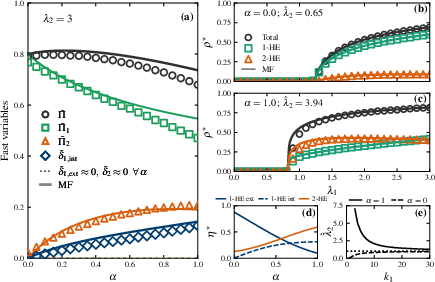
Figure 3: Microscopic mechanisms: fast-variable values, pathway decompositions, and the shrinking of the bistable region as a function of nestedness α and pairwise degree k1.
Extension to Synchronization: Universal Mechanism in Nonlinear Dynamics
The paper establishes the generality of these structural effects by examining Kuramoto oscillator dynamics on hypergraphs with varying overlap. Increasing α again anticipates the onset of synchronization and suppresses explosive (first-order) synchronization transitions, as determined by numerically extracting critical couplings (σ1∗ for pairwise, σ^2 for three-body interactions) and tracking the order parameter's behavior across forward and backward continuations.
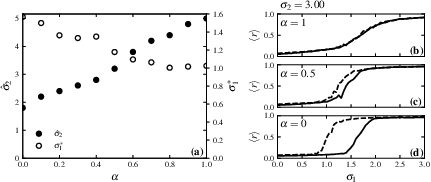
Figure 4: Critical coupling strengths and suppression of explosive synchronization transitions in Kuramoto dynamics as α increases.
Implications and Future Directions
Practically, these findings reveal that microscopic organization of higher-order interactions—specifically nestedness—provides a powerful lever to control not only when but how collective phenomena emerge in networked systems. Theoretical implications extend to a universal structural principle: cross-order motif correlations (nestedness) regulate both the threshold and qualitative nature (continuous vs. explosive) of nonlinear transitions in spreading and synchronization, and likely in other classes of higher-order processes (e.g., social reinforcement, opinion dynamics, cooperative games).
This work opens avenues for future research, including:
- Quantitative exploration of nestedness effects in empirical dynamic hypergraphs (e.g., temporal social or biological systems).
- Extending the framework to non-regular structures, higher-order (M>2) interactions, and modular or heterogeneous nested architectures.
- Application to control strategies, where engineered nestedness could regulate critical transitions in interdependent infrastructures or epidemic containment.
Conclusion
The paper provides a rigorous mechanistic and mathematical framework demonstrating that nested hyperedge structure systematically promotes the early onset of collective transitions while suppressing the explosive, bistable behavior classically associated with nonlinear higher-order dynamics. These results, validated by mean-field theory, bifurcation analysis, and stochastic simulations, are robust across contagion and synchronization processes, indicating a universal route by which higher-order motif organization tunes both the sensitivity and stability of macroscopic phase transitions in complex systems.