Extrinsic Vector Field Processing
Abstract: We propose a novel discretization of tangent vector fields for triangle meshes. Starting with a Phong map continuously assigning normals to all points on the mesh, we define an extrinsic bases for continuous tangent vector fields by using the Rodrigues rotation to transport tangent vectors assigned to vertices to tangent vectors in the interiors of the triangles. As our vector fields are continuous and weakly differentiable, we can use them to define a covariant derivative field that is evaluatable almost-everywhere on the mesh. Decomposing the covariant derivative in terms of diagonal multiple of the identity, anti-symmetric, and trace-less symmetric components, we can define the standard operators used for vector field processing including the Hodge Laplacian energy, Connection Laplacian energy, and Killing energy. Additionally, the ability to perform point-wise evaluation of the covariant derivative also makes it possible for us to define the Lie bracket.
Paper Prompts
Sign up for free to create and run prompts on this paper using GPT-5.
Top Community Prompts
Explain it Like I'm 14
Overview
This paper is about a new, simple way to describe and work with “arrow fields” on 3D shapes made of triangles (called triangle meshes). An “arrow field” (a vector field) assigns a tiny arrow to every point on a surface, showing a direction and size (like wind blowing across a surface). The authors present a method that makes these arrows vary smoothly across the whole surface and lets computers measure how the arrows change from place to place. With this, they can build important tools used in computer graphics and geometry processing.
What questions does the paper ask?
- How can we represent arrows on a triangle mesh so they don’t “jump” or break across triangle edges?
- Can we make this representation simple enough to evaluate arrows and their changes at any point on the surface?
- With such a representation, can we build standard tools (energies and operators) that help with tasks like smoothing, transporting, and analyzing vector fields?
- Can we also define the Lie bracket (a way to measure how two arrow flows interact) directly on a mesh?
How did they do it? (Methods in simple terms)
Think of a 3D model like a statue approximated by many flat triangles. Each triangle has a direction pointing outward (a normal), but because triangles are flat, those directions jump from one triangle to the next. That jump makes arrows across edges misbehave and makes “smoothness” hard to define.
The authors fix this in three steps:
- Smooth the surface directions (normals)
- They start with a normal at each vertex (corner) of the mesh.
- They smoothly blend these normals inside each triangle using Phong interpolation. This gives a smooth “up” direction at every point, not just at corners or on flat faces.
- Transport arrows smoothly using rotation
- At a vertex, you can choose two perpendicular arrows that lie along the surface (a local “arrow basis”).
- To move (transport) such an arrow from the vertex into the triangle, they rotate it so that it stays tangent to the surface’s smoothly changing “up” direction. They use a standard minimal-rotation formula called the Rodrigues rotation. You can think of it like twisting the arrow just enough so it keeps hugging the surface as the surface tilts.
- Blend contributions with barycentric weights
- Inside a triangle, every point can be expressed by how close it is to each corner (these are barycentric coordinates—like saying “40% from corner A, 30% from B, 30% from C”).
- They scale and blend the transported arrows from each corner using those weights. The result is a continuous arrow field across the triangle and, importantly, across the whole mesh.
Because the arrow field is continuous and “weakly differentiable” (in everyday terms: smooth enough), you can measure how it changes as you move along the surface. This change is called the covariant derivative; it’s like measuring how much the arrow twists, stretches, or diverges when you take a small step on the surface.
Building tools with finite elements and quadrature:
- The authors assemble global systems (matrices) from per-triangle pieces using the finite element method (FEM). Imagine adding up each triangle’s contribution to get a big system that describes the whole shape.
- They compute required integrals numerically (quadrature), which is like averaging values at a few smartly chosen sample points inside each triangle.
With this setup, they can define classic energy measures for vector fields (e.g., “how rough is this field?”) and operators (like different Laplacians) that are widely used in geometry processing.
What did they find, and why is it important?
Main technical outcomes:
- A continuous, pointwise-evaluable vector-field basis: Their arrows are smooth across triangles and can be evaluated and differentiated almost anywhere on the mesh.
- Standard vector-field tools become easy to define:
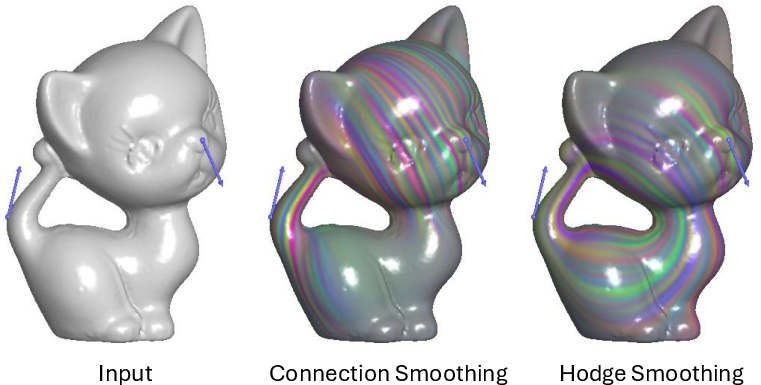
- Connection Laplacian and Hodge Laplacian energies: measure smoothness in ways that match classic geometry tools.
- Killing energy: measures how close a field is to representing a perfect symmetry (like rotating a perfectly round object).
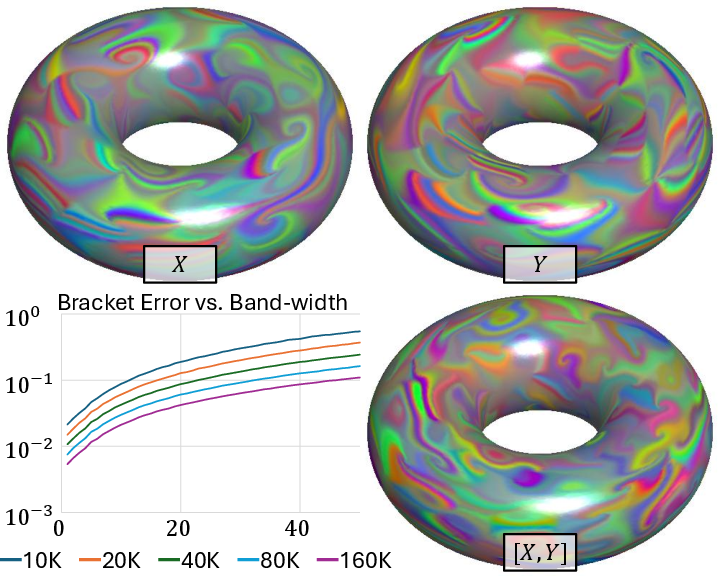
- Lie bracket: they can compute how two arrow flows interact locally (think “do these flows help or fight each other?”), and project the result back into their arrow space.
Evidence it works well:
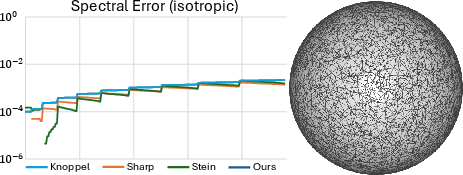
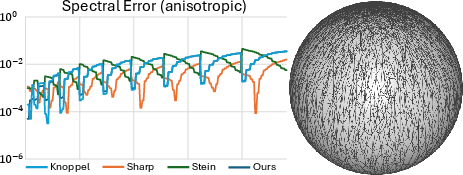
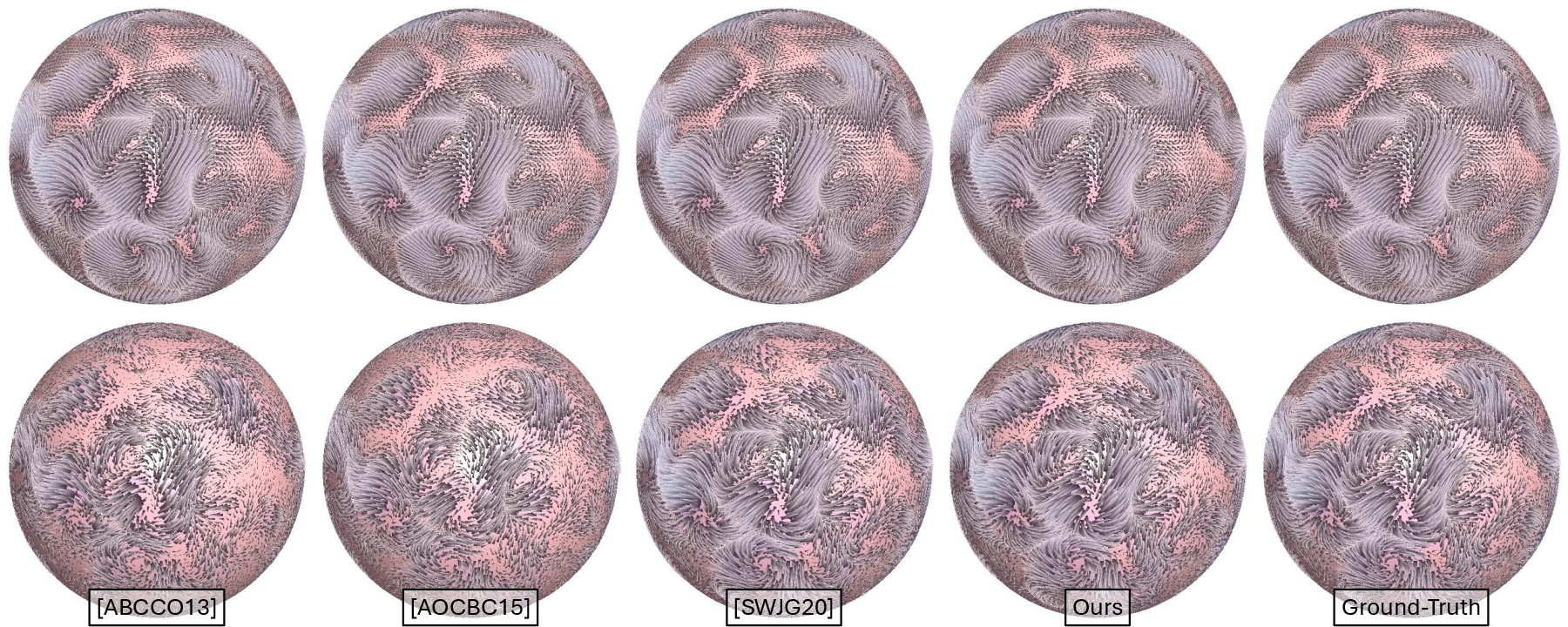
- On spheres, the “natural frequencies” (eigenvalues) of their operators closely match the known mathematical answers, and the results are competitive with or comparable to prior leading methods.
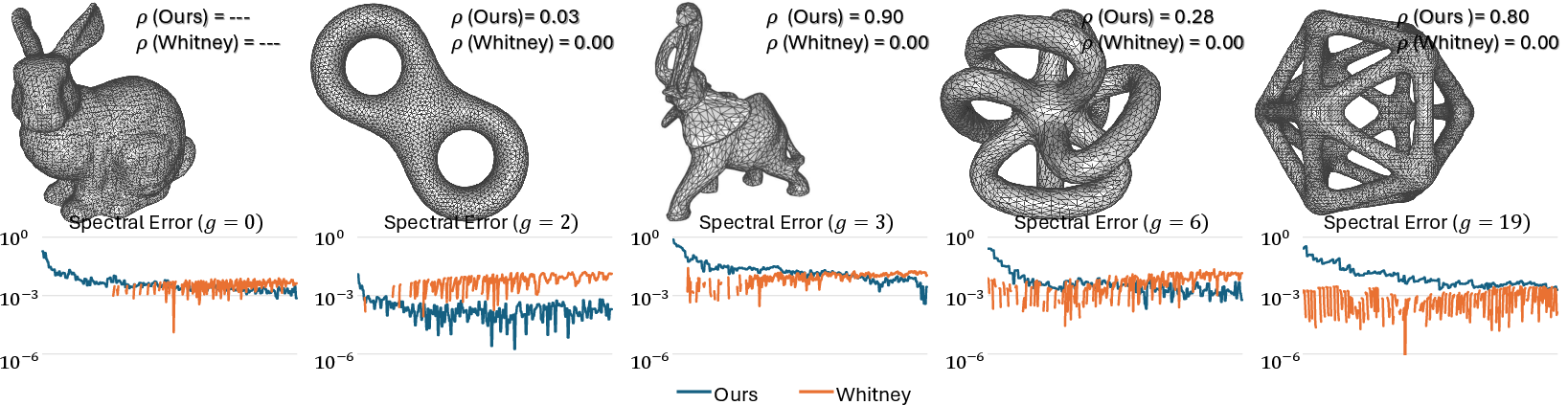
- For Hodge-related analyses, their method compares favorably, especially at higher frequencies, while classic Whitney-based methods tend to be stronger at lower frequencies. This tells practitioners which method to pick for their needs.
- Applications:
- Smooth interpolation: Given a few target arrows placed by a user, their method finds the smoothest field matching those constraints.
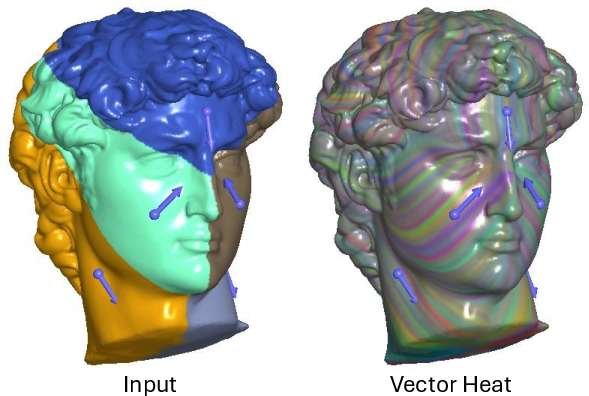
- Vector heat method: It transports arrows along shortest paths on the surface efficiently.
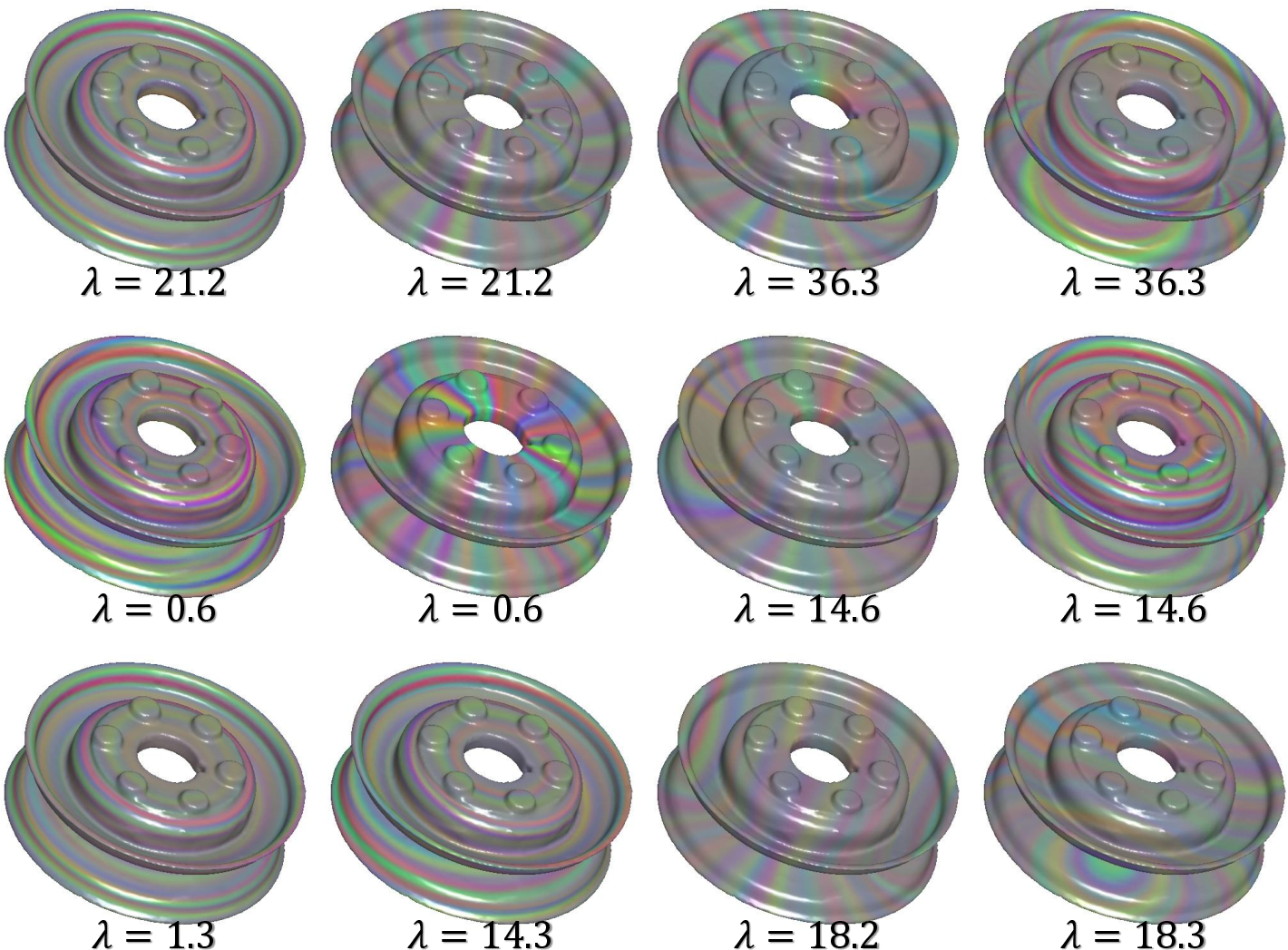
- Spectral fields: It finds natural “modes” of arrow patterns, which reveal structure like flows around holes or near rotational symmetries.
Why it matters:
- Continuity and pointwise differentiation are key for robust, flexible processing of vector fields on meshes. Many earlier methods were either discontinuous (making some operations tricky) or didn’t allow easy evaluation at any point. This method gives both.
Practical note:
- They provide a C++ implementation where you can plug in functions that evaluate fields at any point (triangle index + barycentric coordinates). The code uses quadrature and finite element assembly to build the needed matrices for real tasks.
What’s the bigger impact?
This approach makes it easier and more reliable to work with arrow fields on 3D shapes in computer graphics, geometry processing, and related areas. Because the fields are continuous and differentiable almost everywhere, you can:
- Smoothly edit and interpolate directions (useful for deformation, texture directions, hair/flow direction fields).
- Transport vectors consistently across a surface (useful for animation and mapping).
- Analyze shapes through vector-field spectra to detect symmetries and patterns.
- Define and compute advanced mathematical operations (like the Lie bracket) that were hard to evaluate directly on meshes.
In short, the paper offers a practical, accurate, and conceptually clean toolkit for “arrow-on-surface” problems, which can improve tasks in visual effects, 3D modeling, simulation, and scientific visualization.
Knowledge Gaps
Knowledge gaps, limitations, and open questions
Below is a focused list of what remains missing, uncertain, or unexplored in the paper, framed as concrete items future researchers can act on:
- Convergence analysis: Provide rigorous proofs and rates of convergence for the proposed discretizations (connection/Hodge/Killing energies and Lie bracket) under mesh refinement, including error bounds relative to intrinsic operators.
- Intrinsic vs extrinsic transport error: Quantify the deviation between the proposed extrinsic transport (Rodrigues rotation of normals) and intrinsic Levi-Civita parallel transport; characterize when they coincide and provide error estimates in terms of curvature and mesh quality.
- Handling Rodrigues singularities: Design robust strategies for cases where vertex and interpolated normals become (near-)antipodal (e.g., fallback rotations, regularization, or normal smoothing), and quantify the impact on stability and accuracy.
- Normal field dependence: Systematically study how the choice and computation of per-vertex normals (e.g., Loop subdivision smoothing, area-weighted vs angle-weighted, denoised vs raw) affect the assembled operators, spectra, and downstream tasks; derive guidelines for normal estimation.
- Boundary and non-orientable surfaces: Extend the formulation to surfaces with boundaries (Dirichlet/Neumann conditions, flux constraints) and to non-orientable manifolds; analyze implications for the 90°-rotation pairing and operator definitions.
- Mimetic properties: Assess and, if possible, enforce discrete conservation laws (e.g., Stokes’ theorem analogues, exactness/closedness of operators) that DEC preserves but the extrinsic basis does not; quantify the impact on applications such as geodesics and flow.
- Lie bracket closure and algebraic consistency: Measure the error when projecting the Lie bracket onto the finite-dimensional space; test discrete versions of the Jacobi identity and develop bases/operators that make the vector-field space closer to closed under the bracket.
- Harmonic vector fields identification: Investigate why the Hodge energy sometimes fails to produce exactly 2g harmonic modes; propose modifications (e.g., constraints, alternative mass/stiffness assembly, normalization choices) to guarantee the correct null-space dimension.
- Mass matrix choice: Establish principled criteria for choosing lumped vs unlumped mass matrices (and for 0-forms vs vector fields), including their effect on eigenvalue accuracy and stability across isotropic/anistropic meshes.
- Quadrature accuracy: Analyze and improve numerical quadrature for non-polynomial integrands (due to Rodrigues and normalization), providing adaptive schemes or higher-order quadrature rules with certified error bounds.
- Higher-order/curved elements: Explore quadratic or higher-order geometric and vector-field elements (or curved elements) to better capture curvature and reduce discretization error compared to per-triangle constant metrics.
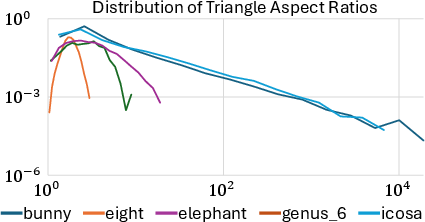
- Mesh quality sensitivity: Quantify how aspect ratio, anisotropic sampling, and degeneracies (skinny/near-collapsed triangles) affect conditioning of mass/stiffness matrices and spectral accuracy; propose mesh-improvement or preconditioning techniques.
- Sharp features and normal discontinuities: Develop treatments for creases and feature edges where normals are intentionally discontinuous (e.g., per-edge normal models), ensuring that transport and energies respect intended sharp features.
- Stability of normal interpolation and normalization: Address numerical instabilities when the interpolated normal sum is near zero (before normalization), including robust normalization strategies or alternative normal field constructions.
- Per-corner frame selection: Evaluate how the choice of tangent frames at vertices influences numerical conditioning and accuracy, and provide practical guidelines or canonical frame choices (e.g., principal curvature directions, consistent orientations).
- Spectral pairing and rotation invariance: Theoretical explanation for observed 90°-rotation eigenvector pairing and conditions under which pairing holds or breaks (e.g., near boundaries or non-orientable surfaces).
- Operator calibration across methods: Systematically compare to DEC/Whitney and edge-based FEM beyond the sphere (e.g., general curved geometries), including theoretical reasons for low-frequency superiority of Whitney and high-frequency advantages of the proposed basis.
- Vector Heat accuracy: Provide quantitative error analysis of the vector heat method implemented with the extrinsic basis versus intrinsic/Delaunay-based approaches, especially on non-Delaunay triangulations and anisotropic meshes.
- Implementation scalability: Report time/memory complexity and scalability of the C++ functional programming paradigm (assembly, differentiation of Rodrigues/normalization), and propose parallelization or GPU acceleration strategies.
- Robustness to noise: Evaluate performance with noisy meshes and normals (e.g., scanning data), propose normal denoising/regularization tailored to this discretization, and quantify downstream effects on energies and spectra.
- Closure under gradient: Since the gradient of scalar basis functions is not in the span of the tangent basis, design hybrid/discretizations that allow consistent coupling of scalar and vector fields (e.g., for mixed formulations), or quantify the practical impact of this limitation.
- Discrete topology guarantees: Develop procedures to enforce topological consistency (e.g., correct harmonic subspace dimension, cycle-based constraints) within extrinsic FEM frameworks without reverting to DEC.
- Error in bracket-driven applications: For tasks using the Lie bracket (e.g., flow composition), derive error measures and correction schemes to mitigate projection-induced distortions.
- Generalization beyond embedded meshes: Explore extending the approach to point-cloud surfaces, volumetric meshes, or implicit surfaces (including consistent normal/transport definitions), and assess the extrinsic basis’ applicability and limitations in these settings.
Practical Applications
Immediate Applications
The following applications can be deployed now using the paper’s C++ implementation and the described extrinsic finite-element formulation. They leverage the continuous, weakly differentiable tangent vector field basis, pointwise covariant derivative evaluation, and quadrature-based assembly of mass/stiffness matrices.
- Smooth interpolation of sparse tangent constraints on meshes (software, VFX/animation, game development, CAD)
- Use case: Grooming hair/fur orientations, guiding brush strokes, anisotropic texture orientation, ridge/valley direction fields.
- Workflow: Place sparse tangent constraints at vertices; solve for a smooth field using the Connection or Hodge energy (Dirichlet minimization with equality constraints); export field per vertex for downstream tools.
- Tools/products: Plugin or module for Blender/Maya/Houdini; C++ pipeline integrated in geometry processing libraries.
- Assumptions/dependencies: Mesh has per-vertex normals; Phong interpolation yields a continuous normal field; numerical quadrature accuracy; choice of energy affects qualitative behavior (Connection vs Hodge).
- Parallel transport of vectors via the Vector Heat method (software, graphics, CAD)
- Use case: Consistent mapping of tangent directions across the surface along geodesics (e.g., transferring brush direction, UV frame alignment, fiber orientations).
- Workflow: One step of vector heat diffusion (connection Laplacian) plus two scalar heat steps (cotangent Laplacian) to propagate vectors to Voronoi regions of seed points.
- Tools/products: Integration with existing mesh libraries (e.g., GeometryCentral-like); visualization modules for direction transport.
- Assumptions/dependencies: Requires scalar Laplacian; mesh quality matters; their extrinsic approach avoids Delaunay prerequisites used by alternative methods.
- Spectral analysis of vector fields: eigenfields of Connection/Hodge/Killing energies (software, CAD, AR/VR, 3D scanning)
- Use case: Symmetry detection (via small Killing eigenfields), segmentation, feature extraction, basis construction for compression/denoising.
- Workflow: Assemble mass/stiffness matrices; solve generalized eigenproblems; analyze eigenpairs (divergence/curl components; pairing by 90° rotation in oriented manifolds).
- Tools/products: “Spectral Field Analyzer” for CAD/scan processing; post-processing filters for vector fields; AR/VR asset quality checks.
- Assumptions/dependencies: Unlumped vs lumped mass matrix choice affects eigenvalue bias; mesh genus influences harmonic fields; quadrature precision.
- Geodesic-related computations requiring pointwise differentials (software, robotics, AR/VR)
- Use case: Compute normalized differentials and geodesic distances on surfaces; path-guided effects or navigation on manifold assets.
- Workflow: Use pointwise covariant derivatives for normalized gradient evaluation; integrate with heat method geodesics.
- Tools/products: Navigation/path planning on surfaces in simulation; surface-aware brush/path tools in content creation.
- Assumptions/dependencies: Accurate normal field and derivative evaluations; robust handling of high aspect ratio triangles.
- Surface flow visualization and analysis (geoscience, product design, education)
- Use case: Visualize divergence/curl on curved surfaces; analyze directional fields (wind/water over terrain-like meshes in demos or educational settings).
- Workflow: Decompose the covariant derivative into divergence/curl/traceless symmetric components; render glyphs/streamlines.
- Tools/products: Lightweight analysis dashboards for manifold surfaces; educational tools demonstrating discrete differential geometry.
- Assumptions/dependencies: Appropriate scaling and normalization; meaningful physical interpretation requires mapping field to real data.
- Building custom FEM-based vector-field energies (academia, engineering)
- Use case: Rapid prototyping of new energies/operators (e.g., tailored regularizers, constraints for novel algorithms).
- Workflow: Define basis via transported vertex tangents; evaluate covariant derivatives; assemble mass/stiffness using quadrature; optimize.
- Tools/products: C++ “Extrinsic FEM Vector Field” API; research codebases for new operators (Lie bracket fitting, mixed energies).
- Assumptions/dependencies: Functional programming approach requires functors evaluable at triangle index + barycentric coordinates; reliable quadrature schemes.
- Cross-field smoothing for quadrangulation and meshing (meshing software, CAD)
- Use case: Generate smooth, orientation-consistent fields for quadrangulation/remeshing, guiding mesh anisotropy.
- Workflow: Formulate smoothing with Connection/Hodge energies; enforce alignment constraints at feature lines; feed into quadrangulation pipeline.
- Tools/products: Meshing tool plugin; batch processing for CAD models.
- Assumptions/dependencies: Cross-field alignment needs additional constraints; basis continuity simplifies edge handling compared to discontinuous methods.
- Anisotropic texture filtering and shading orientation fields (software, VFX/animation)
- Use case: Create continuous direction fields for anisotropic BRDFs, brushed metal effects, hair/fur shading on complex meshes.
- Workflow: Solve for smooth tangent field; export per-vertex directions; use in shader pipelines.
- Tools/products: Shader-ready field exporters for DCC tools; render engine integrations.
- Assumptions/dependencies: Consistent per-vertex normals crucial; field smoothness tied to chosen energy.
- Educational modules for discrete differential geometry (academia)
- Use case: Teaching continuous vector fields and operators (covariant derivative, Lie bracket) on meshes.
- Workflow: Use the library to build interactive notebooks/demos that evaluate fields and their derivatives pointwise; visualize energy decompositions.
- Tools/products: Classroom materials, interactive visualization apps.
- Assumptions/dependencies: Wrappers for Python/Julia recommended; mesh curation for pedagogical clarity.
- Surface registration and alignment using field constraints (healthcare imaging)
- Use case: Align anatomical surfaces (e.g., cortical, cardiac) using tangent directions; detect symmetry via Killing eigenfields to assist registration.
- Workflow: Specify directional constraints; solve smoothing; compare spectral signatures; refine alignment.
- Tools/products: Plugins for 3D Slicer or medical mesh pipelines.
- Assumptions/dependencies: High-quality meshes; careful interpretation of energies in biomedical context.
Long-Term Applications
These applications require further research, scaling, or engineering effort (e.g., GPU implementations, integration with ML/controls, validation in domain-specific pipelines).
- Real-time, GPU-accelerated vector-field processing for interactive content creation (VFX/animation, games)
- Potential products: GPU kernels for Rodrigues rotation and quadrature; real-time grooming/cloth orientation solvers; viewport previews of vector-field edits.
- Dependencies: Efficient parallel quadrature and derivative evaluation; robust handling of dynamic meshes; GPU-friendly data structures.
- Geometry-aware machine learning with extrinsic vector-field layers (AI/ML, computer vision)
- Use case: Learn directional patterns on surfaces (e.g., shape descriptors, flow prediction on meshes) with operators (Connection/Hodge/Killing) acting as differentiable layers.
- Products/workflows: PyTorch/TF layers wrapping FEM assembly; Lie bracket regularizers; spectral bases for manifold neural networks.
- Dependencies: Differentiable quadrature; batching across varying mesh topologies; stability of gradients on anisotropic tessellations.
- Thin-shell/Surface multiphysics driven by manifold vector fields (engineering, simulation)
- Use case: Surface fluids, transport on membranes, direction-dependent diffusion on shells using connection Laplacian; couple to structural response.
- Products: Simulation engines with extrinsic tangent field solvers; CAD-integrated analysis tools.
- Dependencies: Physical validation; coupling strategies to volumetric solvers; adaptive quadrature for stiff problems.
- Fiber orientation optimization in composite manufacturing (manufacturing, CAD/CAM)
- Use case: Optimize layup direction fields to reduce defects and improve mechanical performance; enforce divergence/curl constraints tied to manufacturability.
- Products: CAD/CAM plugins for fiber path planning; design optimization workflows.
- Dependencies: Mapping vector fields to machine instructions; manufacturability constraints; domain-specific material models.
- Clinical analysis via symmetry and spectral field signatures (healthcare)
- Use case: Detect pathology or growth by symmetry-breaking patterns (Killing energy); compare eigenfield “fingerprints” across patient cohorts.
- Products: Diagnostic pipelines for mesh-based anatomy; statistical analysis tools using spectral features.
- Dependencies: Clinical validation; robust acquisition-to-mesh pipelines; regulatory considerations.
- Surface-aware manipulation and locomotion planning using Lie bracket composition (robotics)
- Use case: Compose surface flows (contact forces, sliding directions) via Lie brackets to plan complex maneuvers on curved objects.
- Products: Controllers integrating extrinsic Lie bracket evaluation with projection to the vector-field basis; planners for curvature-aware tasks.
- Dependencies: Real-time computation; robust projection (mass-matrix fit) since bracket is not closed in the basis; sensing and feedback on surface normals.
- Standards and asset formats for vector fields on meshes (policy/standards, software)
- Use case: Define portable representations for continuous tangent fields and associated energies/operators; ensure interoperability across DCC/CAD/tools.
- Products: glTF/OBJ extensions supporting per-vertex frames and field coefficients; best-practice guidelines for normal computation.
- Dependencies: Community consensus; reference implementations; backward compatibility.
- Terrain and infrastructure surface analysis (energy, civil engineering)
- Use case: Interpolate wind/water direction fields over complex terrain meshes; evaluate divergence/curl for planning (erosion, drainage, siting).
- Products: Planning tools coupling GIS meshes with extrinsic vector-field solvers.
- Dependencies: Accurate mapping from raster/point data to surface meshes; domain calibration of energies.
- Metrology and QA via eigenfield fingerprints (manufacturing)
- Use case: Compare parts by spectral signatures of surface vector fields; detect deviations in shape or orientation patterns.
- Products: QA dashboards for mesh-based inspection; automated acceptance criteria.
- Dependencies: Sensitivity analyses; standardization of acquisition and meshing; robust normalization.
- Advanced quadrangulation and topology-aware remeshing (meshing software)
- Use case: Combine smooth extrinsic fields with topology constraints for high-quality quadrangulation under strong curvature and anisotropy.
- Products: Next-gen meshing tools using energy decompositions and Lie bracket guidance.
- Dependencies: Research into field-line topology control; handling of singularities; scalable solvers.
Cross-cutting assumptions and dependencies
- Mesh prerequisites: Per-vertex normals and a quality triangulation (handling high aspect ratios, avoiding antipodal normal artifacts in Rodrigues rotation).
- Numerical considerations: Quadrature accuracy; choice of lumped vs unlumped mass matrix (affects eigenvalue bias); stability under anisotropic sampling.
- Basis properties: The Lie bracket is not closed in the proposed basis; projection via mass matrix (Equation: Mω * z = b) is required for representability.
- Implementation: Current reference in C++ (functional paradigm) requires functors evaluable at triangle index + barycentric coordinates; wrappers (Python/Julia) and GPU ports are beneficial for broader adoption.
- Domain calibration: Physical interpretability (geoscience/engineering/healthcare) demands mapping between mathematical energies (divergence/curl/Killing) and measurable quantities, with validation.
Glossary
- almost-everywhere: A measure-theoretic notion meaning “at all points except on a set of measure zero,” used to indicate where a quantity can be evaluated on the surface. Example: "a covariant derivative field that is evaluatable almost-everywhere on the mesh."
- antipodal: Refers to points on a sphere that are diametrically opposite; in rotations, the case where two unit vectors differ by 180°. Example: "Given (non-antipodal) unit vectors v,w∈S{d−1}, the Rodrigues rotation formula..."
- anti-symmetric: A linear map L is anti-symmetric if it reverses sign under inner-product exchange; in 2D, corresponds to infinitesimal rotation. Example: "anti-symmetric endomorphisms."
- barycentric coordinate: Coordinates expressing a point in a triangle as convex weights of the vertices; used to blend quantities over elements. Example: "vertex's barycentric coordinate."
- co-differential: The adjoint of the exterior derivative with respect to the Hodge inner product; appears in discrete exterior calculus operators. Example: "differential, co-differential, and Hodge star operators"
- co-tangent Laplacian: The standard discrete Laplace–Beltrami operator on meshes built from cotangent weights. Example: "co-tangent Laplacian"
- Connection Laplacian: A Laplacian acting on tangent vector fields that incorporates the surface connection (parallel transport). Example: "Connection Laplacian energy"
- covariant derivative: The derivative of a vector field along the surface that accounts for the changing tangent spaces; generalizes directional derivatives on manifolds. Example: "we can use them to define a covariant derivative field that is evaluatable almost-everywhere on the mesh."
- Crouzeix-Raviart: A nonconforming finite element with degrees of freedom at edge midpoints, often used for vector fields and fluxes. Example: "Crouzeix-Raviart"
- Dirichlet energy: An energy measuring the squared norm of a field’s gradient (or covariant derivative) integrated over the domain; drives smooth interpolation. Example: "corresponding to the Dirichlet energy defined by the covariant derivative"
- Discrete Exterior Calculus (DEC): A framework discretizing differential forms and operators (d, δ, Hodge star) on meshes. Example: "Discrete Exterior Calculus (DEC) techniques"
- endomorphism: A linear map from a vector space to itself; here, linear operators on tangent spaces. Example: "The subsets of symmetric/anti-symmetric endomorphisms form linear subspaces"
- finite element assembly: The process of assembling local (per-element) matrices into a global system for the whole mesh. Example: "finite-element assembly required to construct system matrices and vectors"
- Frobenius inner-product: The inner product of matrices given by the sum of elementwise products (trace of AᵀB). Example: "equivalent to the Frobenius inner-product"
- Gauss map: A map assigning to each surface point its unit normal direction on the unit sphere. Example: "We assume that we are given a Gauss Map:"
- geodesic: The shortest path along a surface; used for measuring intrinsic distances and transporting quantities. Example: "geodesic distances using the Heat Method"
- Hodge Laplacian: The Laplacian defined via exterior calculus acting on differential forms (e.g., 1-forms for vector fields). Example: "Hodge Laplacian energy"
- Hodge star: An operator mapping k-forms to (n−k)-forms, enabling inner products of forms in exterior calculus. Example: "differential, co-differential, and Hodge star operators"
- holomorphic component: The part of the covariant derivative corresponding to complex-linear (Cauchy–Riemann) behavior on oriented surfaces. Example: "Considering just the holomorphic component of the covariant derivative"
- intrinsic Delaunay triangulation: A mesh re-triangulation based on intrinsic edge lengths to improve numerical properties like Laplacian positive semidefiniteness. Example: "intrinsic Delaunay triangulation"
- Killing energy: An energy measuring deviation from being a Killing field, i.e., an infinitesimal isometry with zero symmetric strain. Example: "Killing energy"
- Lie bracket: The commutator [X,Y] measuring how two vector fields fail to commute; defined via covariant derivatives. Example: "define the Lie bracket."
- Loop subdivision: A subdivision scheme for triangle meshes producing smooth limit surfaces and normals. Example: "Loop subdivision"
- mass matrix: The FEM matrix representing L² inner products of basis functions; used in generalized eigenproblems. Example: "where M is the mass matrix"
- mimetic: Property of a discretization that preserves key identities and invariants of the continuous differential operators. Example: "have the advantage of being mimetic, preserving certain symmetries/invariants"
- parallel transport: Transporting a vector along the surface while keeping it tangent and as direction-preserving as possible. Example: "parallel transport"
- Phong interpolation: Interpolation of normals across a triangle using vertex normals to define a smooth normal field. Example: "Using Phong interpolation, we obtain a continuous normal field over the mesh (center)."
- quadrature: Numerical integration technique for approximating integrals via weighted sums of function evaluations. Example: "numeric quadrature"
- Raviart-Thomas: A mixed finite element family designed for H(div) fields, commonly used for flux-conforming discretizations. Example: "Raviart-Thomas"
- Rodrigues rotation: A closed-form formula giving the minimal-angle rotation mapping one unit vector to another. Example: "the Rodrigues rotation taking the vertex's normal to the interior point's normal"
- stiffness matrix: The FEM matrix representing inner products of derivatives (e.g., gradients or covariant derivatives); encodes smoothness energies. Example: "the stiffness matrix"
- tangent space: The 2D linear space of directions tangent to a surface at a given point. Example: "The tangent space at n∈S2"
- trace-free (symmetric): The symmetric part of a linear operator with zero trace; corresponds to pure shear without isotropic scaling. Example: "trace-free (symmetric) endomorphisms"
- Vector Heat method: A technique using heat diffusion to compute parallel transport and related vector-field operations on surfaces. Example: "Vector Heat method"
- Whitney basis: Finite element basis for differential forms corresponding to DEC, enabling pointwise evaluation within FEM. Example: "Whitney basis functions"
- Whitney 1-forms: The Whitney finite element basis specialized to 1-forms, used to discretize vector fields in DEC. Example: "Whitney 1-forms"
Collections
Sign up for free to add this paper to one or more collections.