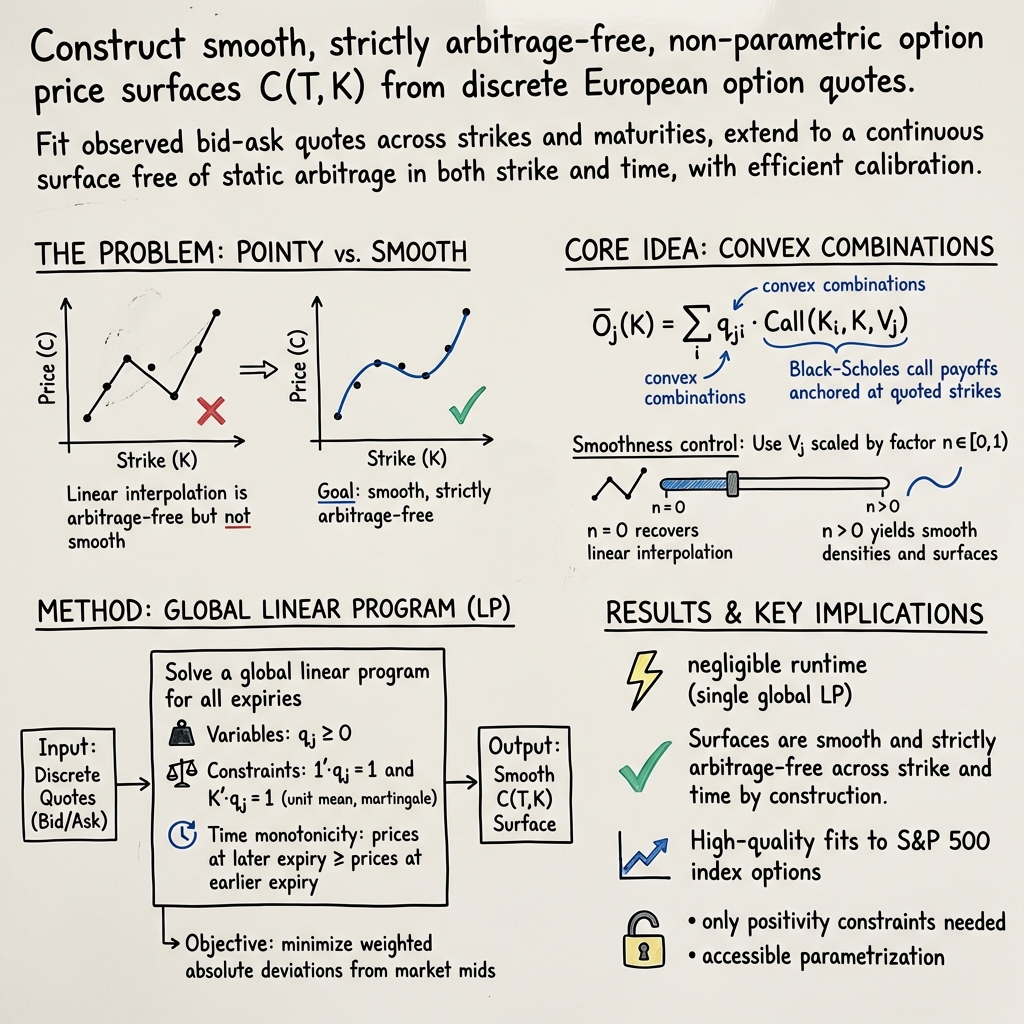
- The paper introduces a non-parametric framework that ensures smooth and strictly arbitrage-free option price surfaces using martingale densities.
- It leverages convex combinations of Black-Scholes payoffs and discrete local volatilities within a global linear programming approach to enforce no-arbitrage conditions.
- Empirical results on S&P 500 options demonstrate high calibration accuracy, computational efficiency, and practical applicability in market scenarios.
SANOS: Smooth Strictly Arbitrage-Free Non-Parametric Option Surfaces
Introduction and Motivation
The construction of option price surfaces that are both arbitrage-free and smooth is a central problem in quantitative finance, particularly for risk management, pricing, and calibration of derivatives. Existing methodologies often face a trade-off between efficiency, smoothness, and the enforcement of no-arbitrage conditions. Many parametric models, while interpretable, exhibit limited flexibility and calibration difficulty, especially in the presence of market anomalies. Non-parametric approaches, especially those based on linear interpolation across strikes and maturities, guarantee arbitrage-free surfaces but lack smoothness and often yield implausible option values between quoted strikes.
The SANOS framework ("Smooth strictly Arbitrage-free Non-parametric Option Surfaces") introduces a non-parametric, numerically efficient methodology to address these longstanding challenges. The framework generalizes linear interpolation to yield arbitrage-free and smooth option price surfaces, with significant implications for practical calibration and simulation tasks.
Theoretical Framework
SANOS fundamentally relies on representing option prices at arbitrary strikes K and expiry Tj as convex combinations of Black-Scholes call payoffs, anchored at quoted strikes and variances. The weights, qj, serve as discrete-space transition densities and are interpreted in the context of martingale theory. The resulting call price is given by:
C^(Tj,K)=i=1∑Nqj,iCall(Ki,K,Vj)
for quoted strikes K1,…,KN, and variances Vj. These densities are calibrated such that the resulting surface is arbitrage-free in both strike and time.
This representation is further extended to the full surface C^(T,K) for arbitrary T, using increasing and smooth interpolation in time to maintain the absence of calendar arbitrage.
Arbitrage-Free and Smoothness Conditions
Key to the SANOS construction is rigorously enforcing all minimal necessary and sufficient conditions for arbitrage-free pricing surfaces:
- Call convexity (∂KKC(T,K)≥0)
- Monotonicity in expiry (∂TC(T,K)≥0)
- Proper boundary behavior (C(T,0)=1, limK→∞C(T,K)=0, ∂KC(T,0)=−1)
- Discrete local volatility representation ensuring only positivity constraints on parameters
These conditions collectively guarantee existence of an underlying martingale representation for the fitted call prices.
Model Construction and Numerical Methods
Option surface calibration in SANOS is formulated as a global linear program, efficiently solvable even for dense grids and large sets of market instruments. The procedure accommodates real market constraints such as bid-ask spreads, which can be handled either as target penalties or hard constraints in the cost function.
A critical innovation is the introduction of a smoothness parameter n∈[0,1): as n→0, the model reduces to the purely linear (piecewise) interpolation, while increasing n enforces greater smoothness (by wider distribution of transition densities and variances). At all settings, the resulting prices are strictly arbitrage-free.
An alternate and practically significant parameterization expresses the surface directly by "Discrete Local Volatilities" as in [BR15]. This achieves the first known construction of arbitrage-free, smooth option surfaces where all parameter constraints are reduced to mere positivity. Practically, this simplifies integration into generative simulators and statistical learning frameworks, where strict parameter constraints are otherwise a bottleneck.
Traditional spline-based or local volatility surface fitting—while occasionally smooth and efficient—often requires either difficult global nonlinear optimization or admits residual arbitrage, especially at the boundaries or in sparse regions. SSVI and other parametric approaches (e.g., [GJ14]) provide arbitrage-free families but at the cost of limited market fit.
Gaussian mixture models (e.g., [BM00, BMR02]) impose fixed weights and lack the flexibility required to precisely fit complex bid/ask grids. SANOS, by contrast, matches observed data across all strikes and maturities without restriction—provided the bid/ask spread is non-trivial—delivering a quantifiable improvement in fit while retaining strict arbitrage constraints and numerical tractability.
Empirical Results
Application to S&P 500 options demonstrates that the SANOS model provides high-quality fits to market surfaces, measured both by absolute fit (relative to bid-ask) and absence of systematic biases across the entire surface. The approach exhibits robust performance from short-dated to long-dated maturities and handles both dense and sparse strike grids.
The numerical complexity remains negligible compared to standard techniques: a single global LP solves for all cross-sectional prices across expiries essentially instantaneously.
Practical and Theoretical Implications
SANOS has several substantive implications:
- Market practice: Practitioners can now calibrate daily (or even intraday) surfaces with minimal computational overhead, retaining full arbitrage-free guarantees.
- Model risk: Theoretical soundness (by minimal constraints) means reduced risk of unintentional arbitrage, even when interpolating/extrapolating beyond the quoted grid.
- Machine Learning and Simulation: The parametrization by positive local volatilities opens avenues for data-driven or generative modeling frameworks—such as deep hedging architectures or scenario generators—while retaining strict market consistency.
- Theoretical extensions: The method can be generalized to alternate background martingales (e.g., Heston or jump-diffusion processes), at some computational cost, and extended to the simulation of dynamic, arbitrage-free family of surfaces, crucial for risk and capital simulations.
Limitations and Future Directions
The main practical limitation lies in the application to American-style options, as the analysis focuses on European options. Future directions include generalizing the approach to accommodate American payoff features, further exploring dynamic models free of "dynamic arbitrage," and integrating SANOS parameterizations with advanced neural or generative architectures for end-to-end risk management systems.
Conclusion
SANOS introduces a numerically efficient, strictly arbitrage-free, and smooth non-parametric framework for modeling and calibrating option price surfaces. This is achieved via a novel use of martingale densities and discrete local volatilities, eliminating the need for complex parameter constraints and enabling high-accuracy market fitting. The methodology is directly applicable to production environments and also supports integration with simulation and data-driven methods, setting a strong foundation for theoretical and practical advances in option surface modeling.