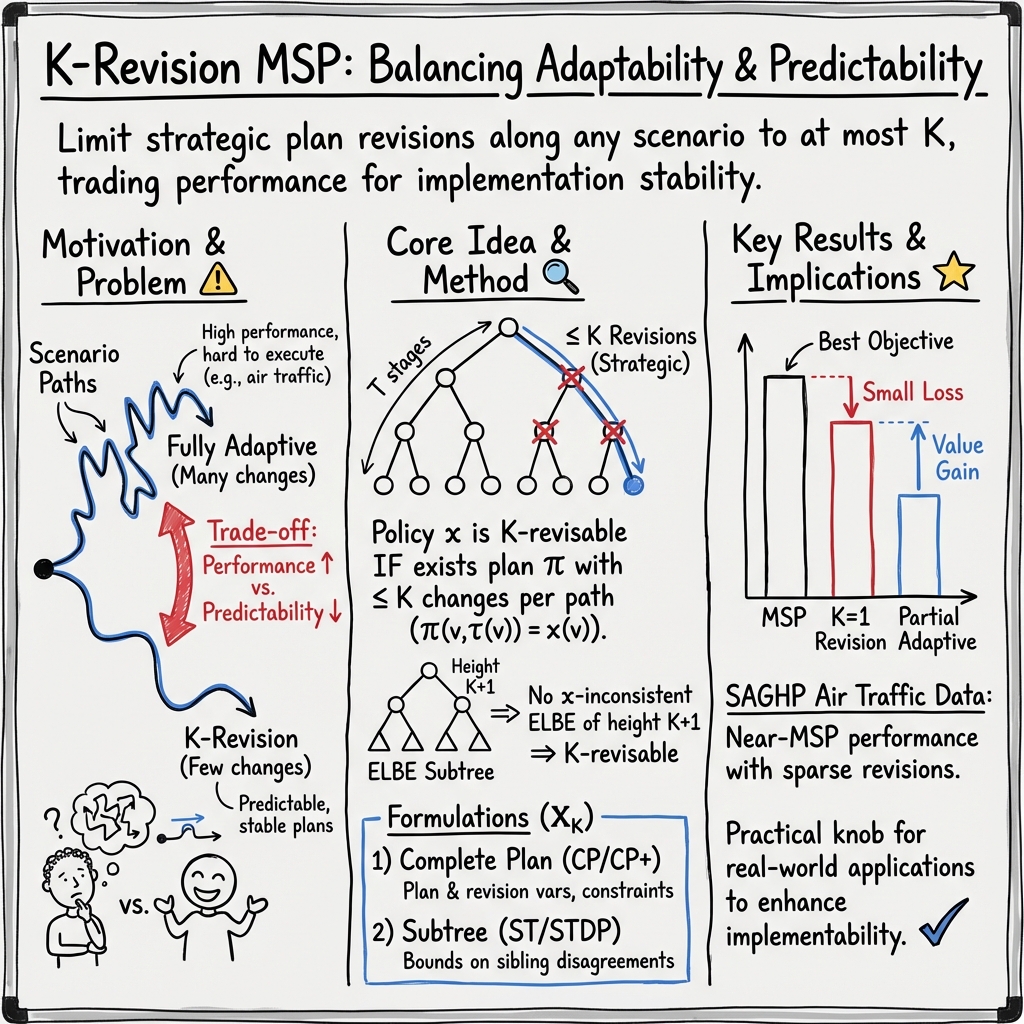
- The paper introduces a K-revision method that limits revision frequency in MSP to balance adaptability with predictability.
- It develops two mixed-integer programming formulations (CP and ST) along with a subtree DP approach to improve computational efficiency.
- Numerical experiments in applications like airport ground-holding and lot-sizing show that the method maintains strategic consistency with minimal optimality loss.
Balancing Adaptability and Predictability: K-revision Multistage Stochastic Programming
Introduction
"Balancing adaptability and predictability: K-revision multistage stochastic programming" (2601.12166) addresses significant challenges in multistage stochastic programming (MSP) frameworks. MSP is instrumental in sequential decision-making under uncertainty, allowing for adaptability in decisions based on newly unfolded information. However, the high variance in MSP-generated policies across different scenarios presents practical challenges, necessitating a more consistent decision-making strategy.
This paper introduces the K-revision approach that constraints the flexibility of decision policies by restricting the number of strategic plan revisions to at most K times within the decision horizon. This constraint aims to balance decision adaptability with predictability, crucial for strategic planning and resource allocation.
The K-revision Approach
The K-revision strategy modifies standard MSP by first establishing a strategic plan at the initial stage, which can be revised no more than K times as more information becomes available. This approach aligns with typical human strategic planning processes where decisions are initially set and only occasionally revised.
Their work demonstrates the potential application of the K-revision approach in real-world problems like single airport ground-holding program (SAGHP) and dynamic lot-sizing problems. For instance, in SAGHP, managing flight delays with minimal changes to plans can greatly ease operational logistics and communication between airlines and ground operations.
Computational Complexity
The paper proves that determining the feasibility of a K-revision policy for a strategic plan is an NP-hard problem even for simple cases, indicating intrinsic computational complexity. However, when the number of revisions K is small, efficient algorithms can evaluate strategic plans, leveraging scenario tree structures.
The authors develop two primary mixed-integer programming formulations for the K-revision constraint: Complete Plan (CP) formulation and Subtree (ST) formulation. While the CP formulation is more directly interpretable, leveraging strategic and revision plan variables, the ST formulation employs a combinatorial approach, leveraging subtree embeddings to encapsulate revision constraints.
The paper further introduces enhancements like subtree DP formulation, which improves computational efficiency by enabling dynamic programming techniques for constraint generation.
Numerical Results
Computational experiments demonstrate the effectiveness of the K-revision method in modeling consistency without significant loss in optimality. This is evidenced in application domains like capacity planning and lot-sizing, where the K-revision constraints provided strategic solutions comparable to fully adaptive ones, with additional benefits of enhanced predictability.
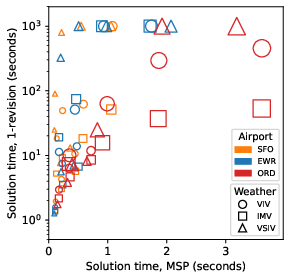
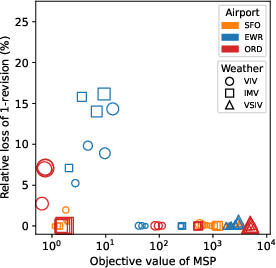
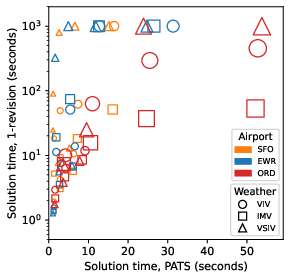
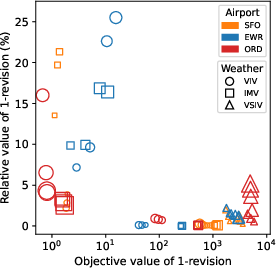
Figure 1: Computational results on SAGHP.
Implications and Future Work
The K-revision approach presents theoretical and practical advancements in MSP by integrating revision limits within strategic decision frameworks. It has potential implications in various domains requiring dynamic decision-making under uncertainty. The approach bridges the gap between theoretical flexibility and practical enforceability of MSP solutions, making it a valuable contribution to both academic research and industry applications.
Future developments could focus on exploring K-revision models across more diverse industries and scenarios. Additionally, improvements in algorithmic efficiency for large-scale applications and incorporating machine learning techniques for scenario generation and strategic forecasting could further enhance the utility and impact of the K-revision strategy.
Conclusion
The K-revision method enhances traditional MSP by instilling valuable consistency and predictability into strategic planning. By allowing a limited number of revisions, decision-makers can craft solutions that are both adaptive to new information and robust against scenario variability. This balance is crucial for effective and operationally feasible decision-making in the face of uncertainty.