- The paper introduces a theoretical framework linking strain-induced Nieh–Yan action to surface phonon Hall viscosity, thereby controlling phonon chirality in magnetic TI films.
- It employs symmetry-respecting electron-phonon models to demonstrate how parallel and anti-parallel magnetization yield reciprocal and nonreciprocal acoustic modes respectively.
- Numerical analyses predict a T² scaling thermal Hall conductivity, with magnon-polaron coupling enhancing the effect nearly tenfold compared to pure phonon contributions.
Surface Phonon Hall Viscosity and Control of Phonon Chirality in Magnetic Topological Insulator Films
Introduction and Theoretical Foundation
The study delineates the consequences of surface phonon Hall viscosity (PHV) in three-dimensional magnetic topological insulator (TI) films, explicitly focusing on its acoustic analog to surface electronic topological phenomena such as axion electrodynamics and the half-quantum Hall effect. In TI systems, axion electrodynamics is induced by gapping the Dirac surface states via surface magnetization, resulting in quantized topological responses. Analogously, this work demonstrates that strain, serving as the vierbein for bulk Dirac fermions, induces a Nieh–Yan-type PHV term at the surface, entangling phonon polarization properties with the local magnetization configuration.
The effective electron-phonon model is constructed respecting the D3d crystal symmetry and appropriate anti-unitary symmetry (T for doped TI sandwiches, S=Tτ1/2 for the AFM MnBi2Te4). Integrating out the massive Dirac electrons yields the Nieh–Yan action for the strain response, a gravitational analog to the axion term, whose coefficient η0 exhibits continuous dependence on the Dirac mass and ultraviolet momentum cutoff (Figure 2a).
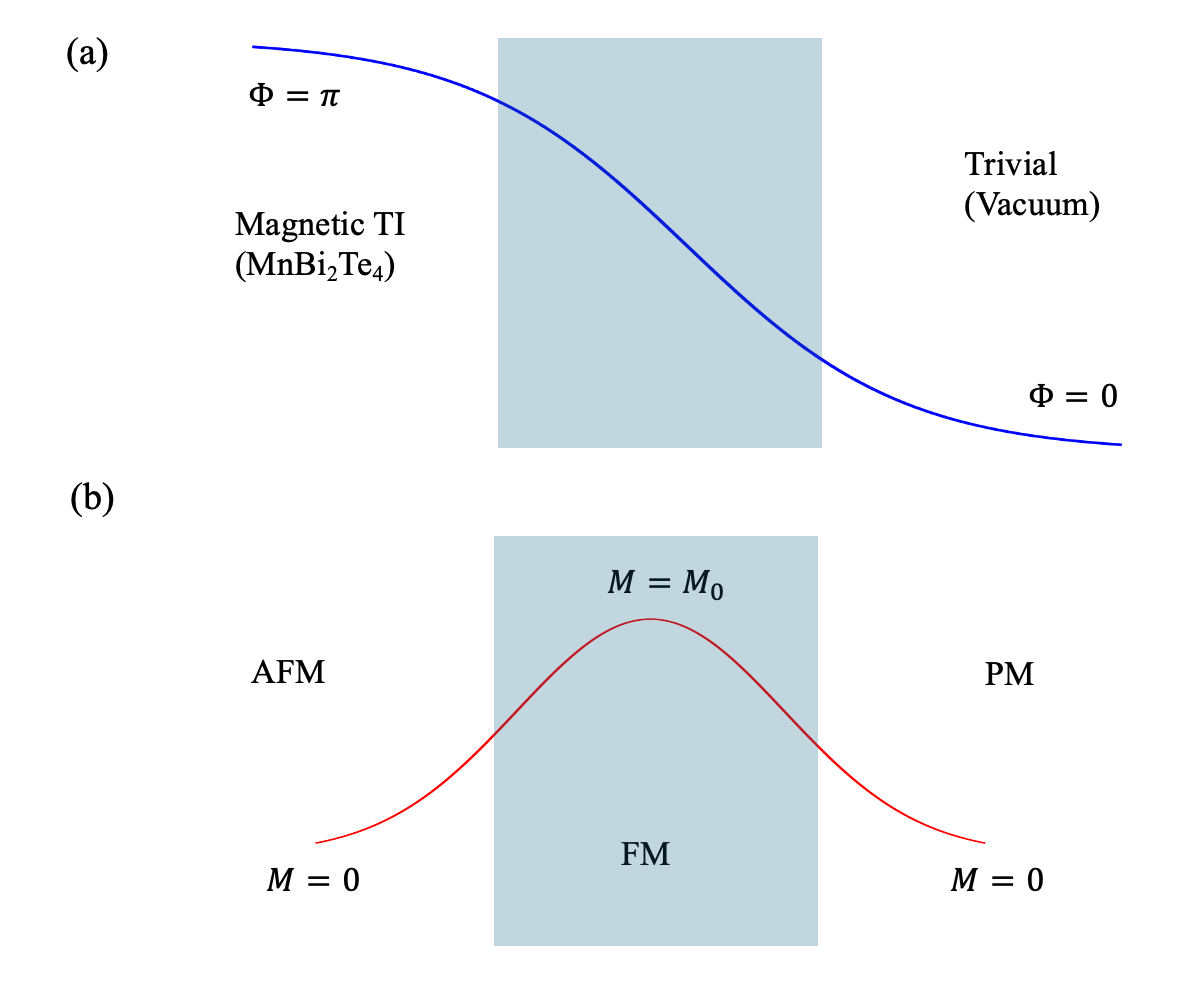
Figure 2: Illustration of how axion electrodynamics and Nieh–Yan action generate, respectively, surface Hall conductivity and surface phonon Hall viscosity in 3D magnetic topological insulators.
Phonon Chirality and Nonreciprocity: Surface Magnetization Dependence
Within thin TI films, the surface PHV induces pronounced effects on acoustic phonon dynamics contingent on the relative orientation of surface magnetizations. For parallel (FM) alignment, the PHV parameters on both surfaces are equal (ηt=ηb), leading to surface modes with finite phonon angular momentum (chirality) but reciprocal propagation (ωk=ω−k). Conversely, anti-parallel (AFM) alignment (ηt=−ηb) results in nonreciprocal surface phonons (ωk=ω−k) but vanishing angular momentum.
Numerical solutions of the derived equations of motion, considering realistic elastic moduli, elucidate the dispersion and spatial profiles of these modes. Surface acoustic modes are localized near the interfaces, exhibiting frequencies beneath the lowest bulk phonon band. Notably, the surface angular momentum—computed via Li(k)=u0†Miu0—is sharply controlled by PHV; increasing η0 amplifies chirality before saturation is observed (Figure 2f).
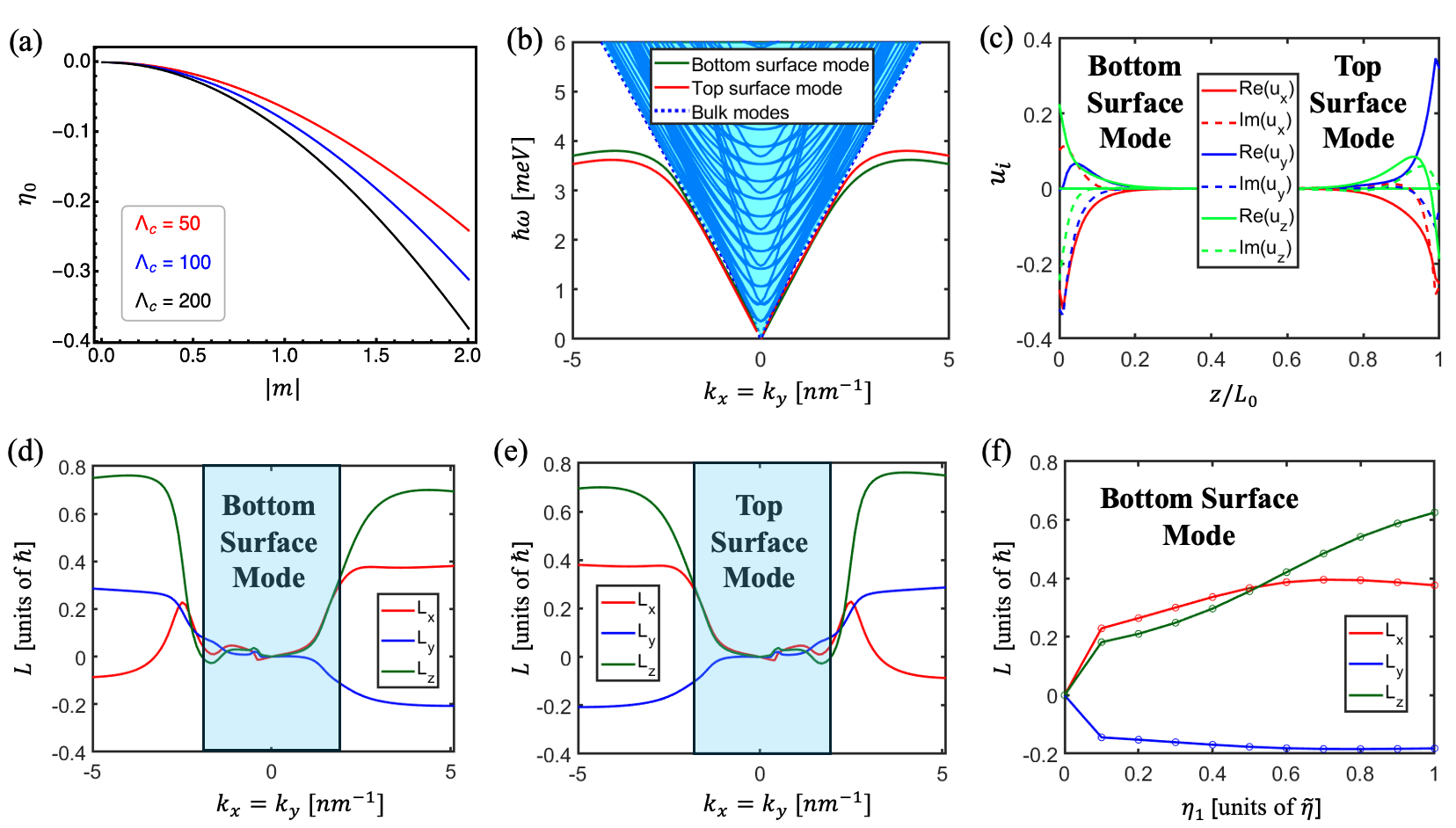
Figure 1: (a) Variation of Nieh–Yan coefficient η0 with Dirac mass ∣m∣, (b) surface mode dispersion for the FM configuration, (c) spatial distribution of interface-localized displacement fields, (f) dependence of angular momentum Lx,y,z on Hall viscosity strength.
The nonreciprocal and chiral behaviors are symmetry-protected: phonon chirality requires breaking either inversion P or time-reversal T/S, whereas nonreciprocity necessitates both. Only at surfaces is inversion symmetry naturally broken, and surface magnetization further disrupts anti-unitary symmetry, enabling these effects.
Thermal Hall Response and Magnon-Polaron Enhancement
The phonon Hall viscosity gives rise to a surface-specific phonon thermal Hall effect. Bulk phonons, protected by time-reversal or combined inversion-time-reversal symmetry, do not contribute owing to vanishing Berry curvature. Consequently, low-temperature thermal Hall conductivity is dictated solely by surface modes and displays quadratic temperature scaling κxy∼T2, distinguishing it from the cubic dependence in conventional 3D magnetic insulators.
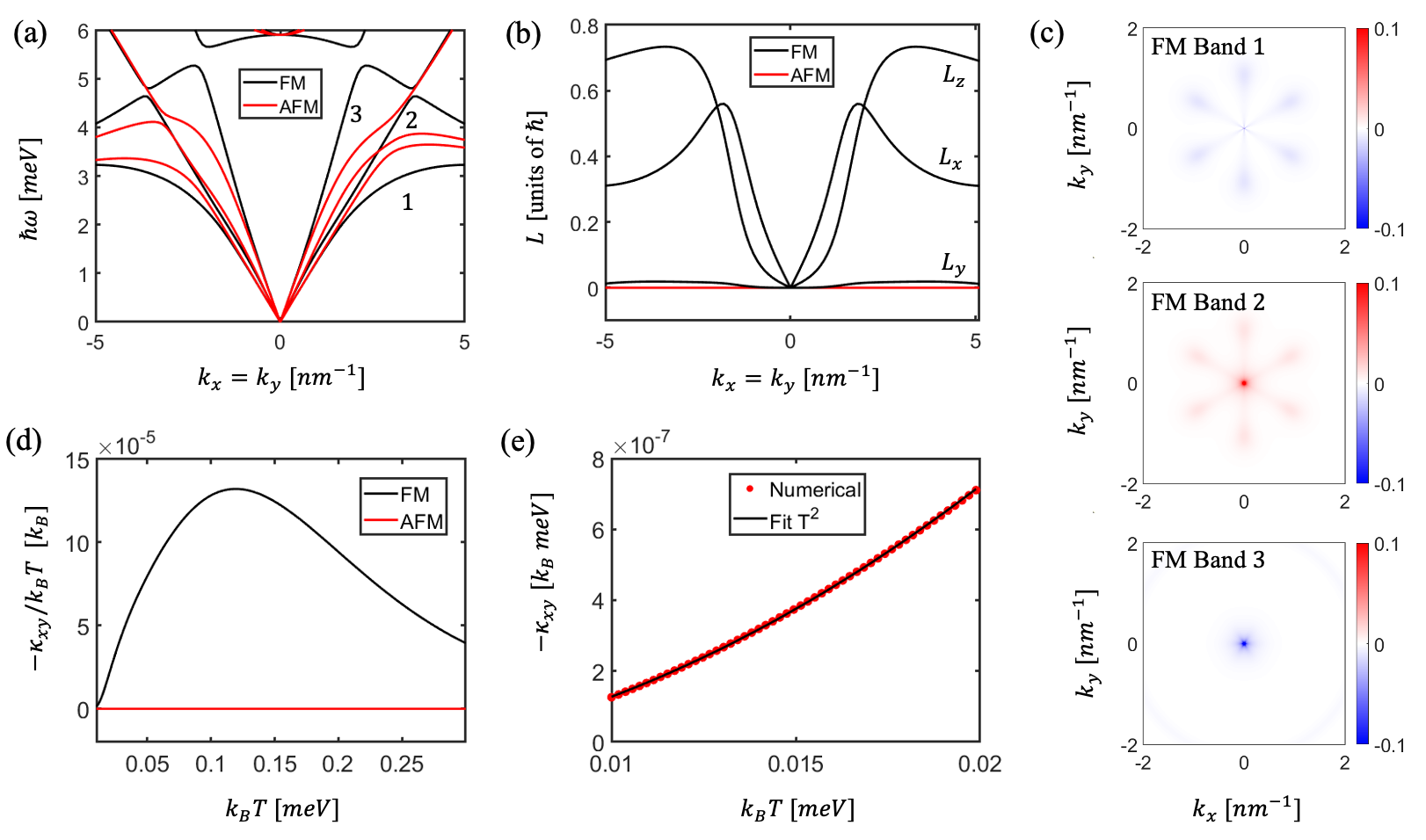
Figure 3: (a) Acoustic mode dispersion for FM (black) and AFM (red) configurations in a thin film, (b) angular momentum comparison, (c) momentum-resolved Berry curvature, (d,e) thermal Hall conductivity as a function of temperature and T2 fit.
Furthermore, coupling between surface phonons and magnons results in magnon-polaron hybrid modes, observable as anticrossings in the spectrum and significant Berry curvature enhancement near avoided crossings. This hybridization amplifies the thermal Hall effect by nearly an order of magnitude compared to pure phononic contributions. Theoretical calculations yield κxy∼10−3kB2T/ℏ per unit layer at the FM configuration, a magnitude comparable to electronic contributions in 2D magnetic systems (Figure 4).
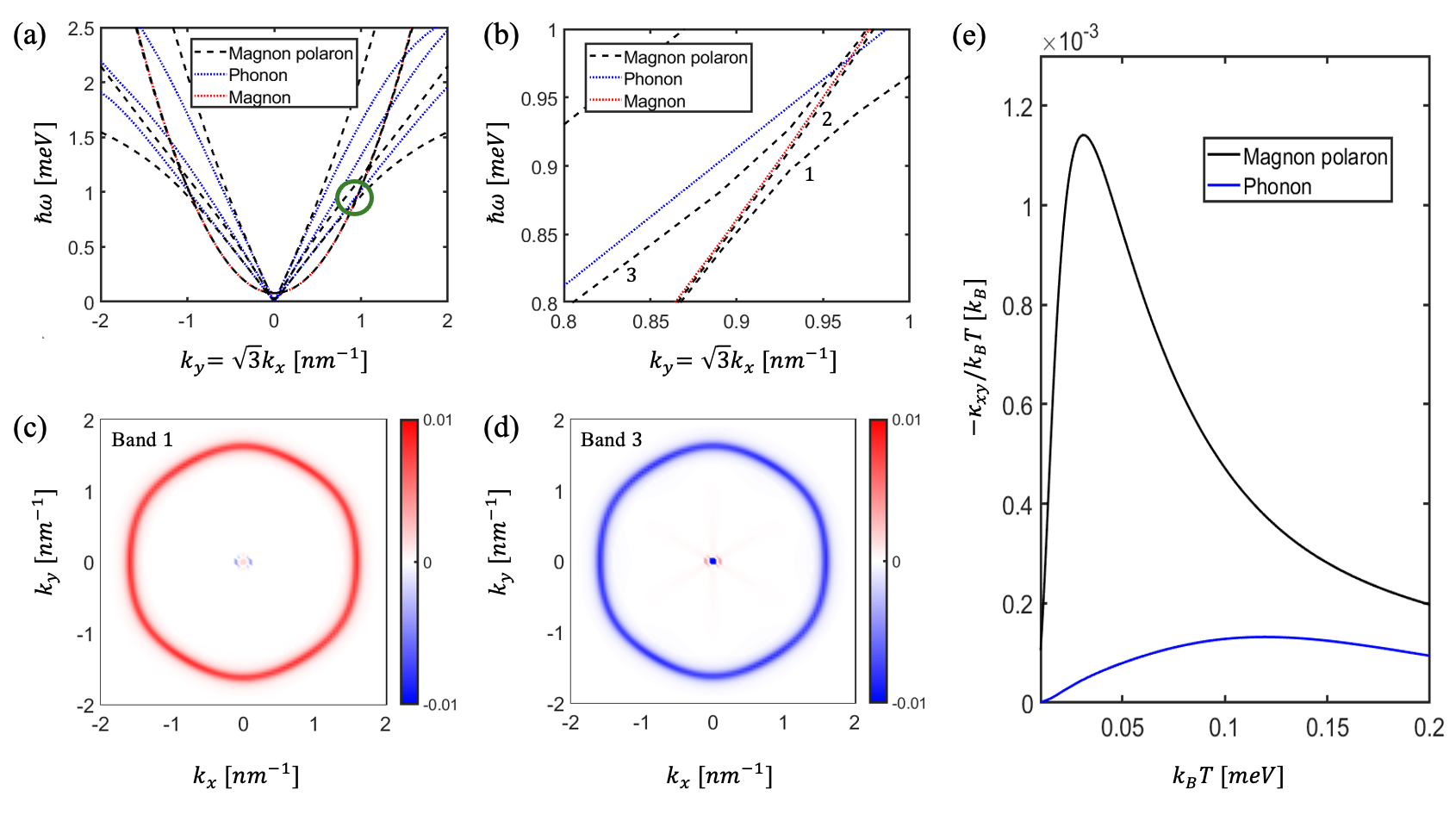
Figure 4: (a) Dispersion of magnon-polaron (black), bare phonon (blue), and bare magnon (red) modes, (b) detailed anticrossing, (c,d) Berry curvature for magnon-polaron branches, (e) thermal Hall conductivity comparison illustrating magnon-polaron enhancement.
Implications and Future Research Directions
This work substantiates a direct link between surface magnetization configuration and tunable phononic behavior in magnetic TIs, effectively switching between chiral and nonreciprocal acoustic phonon transport via manipulation of the Hall viscosity tensor. The predicted robust thermal Hall effect, scaling as T2 and enhanced by magnon-polaron coupling, provides a feasible experimental probe for surface PHV.
Practical implications span thermal management and phononic device engineering, leveraging magnetization-controlled nonreciprocal acoustic transport and surface magnon–phonon hybridization for advanced caloritronic functionality. Theoretically, these results reinforce the correspondence between topological gravitational responses (Nieh–Yan action, Hall viscosity) and observable acoustic phenomena, expanding the paradigm of topological response beyond conventional electronic transport.
Future research may pursue direct measurement protocols for phonon angular momentum and Hall conductivity, monolayer or heterostructure engineering in magnetic TIs and related symmetry-protected materials, and further integration of magnons, phasons, or other collective excitations in surface-dominated thermal transport schemes. Extensions to non-Hermitian and driven systems may reveal additional control modalities for phonon chirality and nonreciprocity.
Conclusion
Surface phonon Hall viscosity, rooted in the Nieh–Yan topological strain response, is shown to enable magnetization-controlled chirality and nonreciprocity of acoustic modes in magnetic topological insulator films. The resultant thermal Hall effect is governed by surface physics and displays an anomalous T2 scaling, with pronounced amplification via hybridization with magnon excitations. This framework provides a unified topological and symmetry-based approach for manipulating phononic transport and opens avenues for experimental validation, phononic device applications, and theoretical generalizations to broader quantum materials platforms.