Group Fourier filtering of quantum resources in quantum phase space
Published 20 Jan 2026 in quant-ph | (2601.14225v1)
Abstract: Recently, it has been shown that group Fourier analysis of quantum states, i.e., decomposing them into the irreducible representations (irreps) of a symmetry group, enables new ways to characterize their resourcefulness. Given that quantum phase spaces (QPSs) provide an alternative description of quantum systems, and thus of the group's representation, one may wonder how such harmonic analysis changes. In this work we show that for general compact Lie-group quantum resource theories (QRTs), the entire family of Stratonovich-Weyl quantum phase space representations-characterized by the Cahill-Glauber parameter $s$-has a clear resource-theoretic and signal-processing meaning. Specifically, changing $s$ implements a group Fourier filter that can be continuously tuned to favor low-dimensional irreps where free states have most of their support ($s=-1$), leave the spectrum unchanged ($s=0$), or highlight resourceful, high-dimensional irreps ($s=1$). As such, distinct QPSs constitute veritable group Fourier filters for resources. Moreover, we show that the norms of the QRT's free state Fourier components completely characterize all QPSs. Finally, we uncover an $s$-duality relating the phase space spectra of free states and typical (Haar-random) highly resourceful states through a shift in $s$. Overall, our results provide a new interpretation of QPSs and promote them to a signal-processing framework for diagnosing, filtering, and visualizing quantum resources.
The paper establishes that Stratonovich–Weyl kernels function as group Fourier filters, enabling a tunable shift from low-pass to high-pass filtering of quantum resource modes via the parameter s.
It leverages group harmonic analysis to map quantum operators into phase-space functions, connecting irreducible component purities with systematic resource detection and classification.
The framework offers explicit operational implications, including resource diagnostics, state-independent norm bounds, and designable filter responses across various quantum resource theories.
Group Fourier Filtering of Quantum Resources in Quantum Phase Space
Introduction
This work investigates the interplay between group harmonic analysis and quantum resource theories (QRTs), unveiling the signal-processing perspective of quantum phase spaces (QPSs) via Stratonovich–Weyl (SW) correspondences parametrized by the Cahill–Glauber parameter s. The main result establishes that SW kernels serve as group Fourier filters for irrep components of quantum operators, where tuning the parameter s interpolates between low-pass and high-pass filtering actions on resource modes. This framework systematically connects the harmonic decomposition of quantum states with resource detection and classification, thus positioning QPSs as operational diagnostic tools for quantum resources.
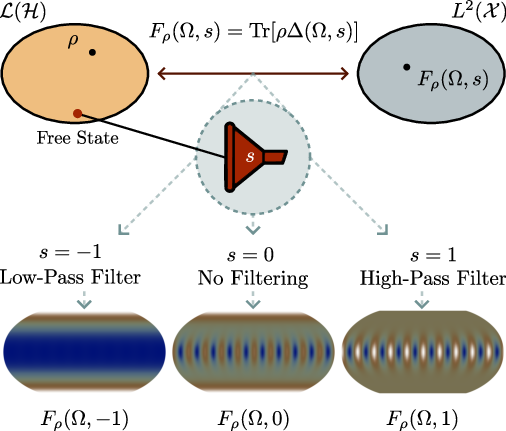
Figure 1: The SW kernels Δ(Ω,s) behave as signal-processing-like Fourier filters over irrep components, with s tuning the filter and the kernel determined by the QRT's free states; visualization shown for the GHZ state in spin coherence QRT.
Theoretical Framework
The formalism begins by leveraging the intrinsic group-theoretic nature of QRTs, where free states and free operations are generated via a compact Lie group G acting unitarily on a Hilbert space H. The operator space L(H) is decomposed into irreducible representations (irreps), and the group Fourier decomposition (GFD) quantifies how state support is distributed across these symmetry modes.
The SW phase space correspondence then realizes a mapping from quantum operators to real-valued functions on the homogeneous space X=G/K (with K the stabilizer of the reference free state). The parameter s in the SW kernel Δ(Ω,s) selects among the family of covariant quantization schemes (Wigner, Husimi Q, Glauber P, etc.), each with distinct operational and signal-processing properties.
The main result of the paper is an explicit quantitative link: the phase-space representation's (QPS) modal (irrep) spectra are determined by group Fourier filtering of the operator's GFD purities, with the filter coefficients fully fixed by the free state's modal support. This filter is controlled by s, implementing a smooth trade-off between classical (free-like) and quantum (resource-sensitive) response.
Signal-Processing Interpretation of QPSs
For any QRT defined by (G,T,∣hw⟩), the GFD purities of the free state ∣hw⟩ completely determine all filtering structures applied by the SW kernel. The coefficient τλ associated with irrep λ is calculated as τλ=dλPλ(∣hw⟩), where dλ is the irrep dimension (see Proposition 1). In the QPS representation, irrep purities are modulated multiplicatively:
Pλ(Fρ(⋅,s))=τλ−sPλ(ρ)
where Pλ(ρ) is the irrep purity in operator space.
For s=−1 (Husimi Q), the kernel acts as a low-pass filter, accentuating free/near-free (low-resource) sectors and suppressing high-dimensional (resourceful) irreps.
For s=0, phase space spectra are unchanged from operator representation: neutral filtering.
For s=+1 (Glauber P), the kernel is high-pass: resourceful, high-dimensional irreps dominate.
Duality and Rigidity of QPS Filtering Structure
An s-duality is shown to connect free states and Haar-random resourceful states. The QPS GFD purity of a Haar-random pure state at parameter s is proportional to the free state's purity at s+1, up to a normalization set by the total Hilbert space dimension (Proposition 5):
EH[Pλ(FψH(⋅,s))]=d(d+1)Pλ(Fhw(⋅,s+1))
where ψH denotes a Haar-random state. This universal duality holds independently of the group or QRT in question.
Exemplars: Spin Coherence, Multipartite Entanglement, and Fermionic Gaussianity
SU(2) Spin-Coherence QRT
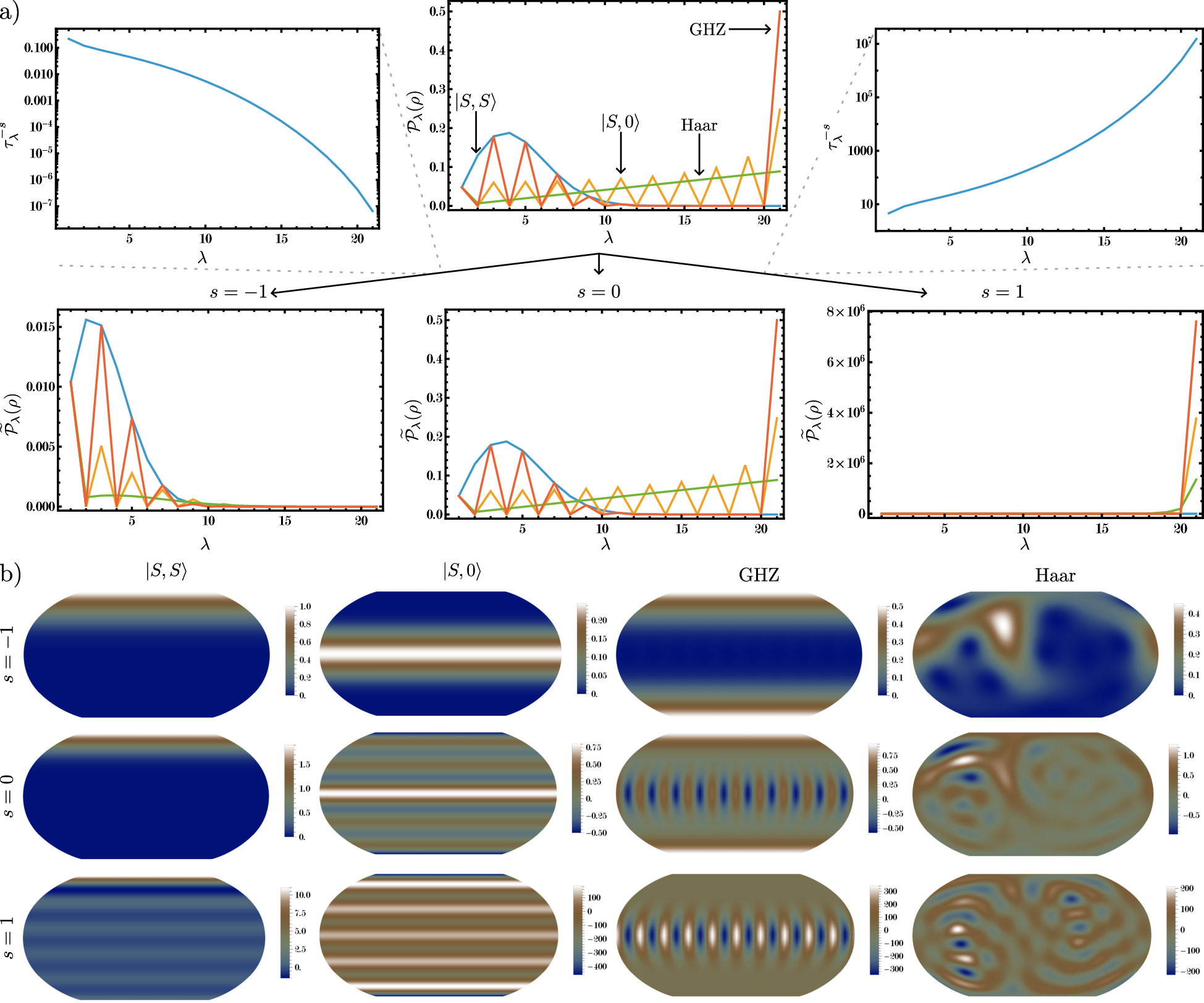
The classical model system of SU(2) spin coherence illustrates the effect of filtering. Free states (spin-coherent) exhibit support concentrated in low-λ irreps, while resourceful states (e.g., GHZ, Haar-random) span larger irreps. QPS representations (for s=−1,0,1) demonstrate selective enhancement or suppression of high-frequency phase-space features as a function of s.
Figure 2: Spin-coherence QPS for S=5 and benchmark states showing modulation of irrep purities and phase-space structure for different s.
The geometric structure of the QPS (the sphere S2 for SU(2)) allows visualization of the transition from smooth, classically-interpretable QPSs for s=−1 to highly oscillatory, resource-sensitive representations for s=1.
Multipartite Entanglement
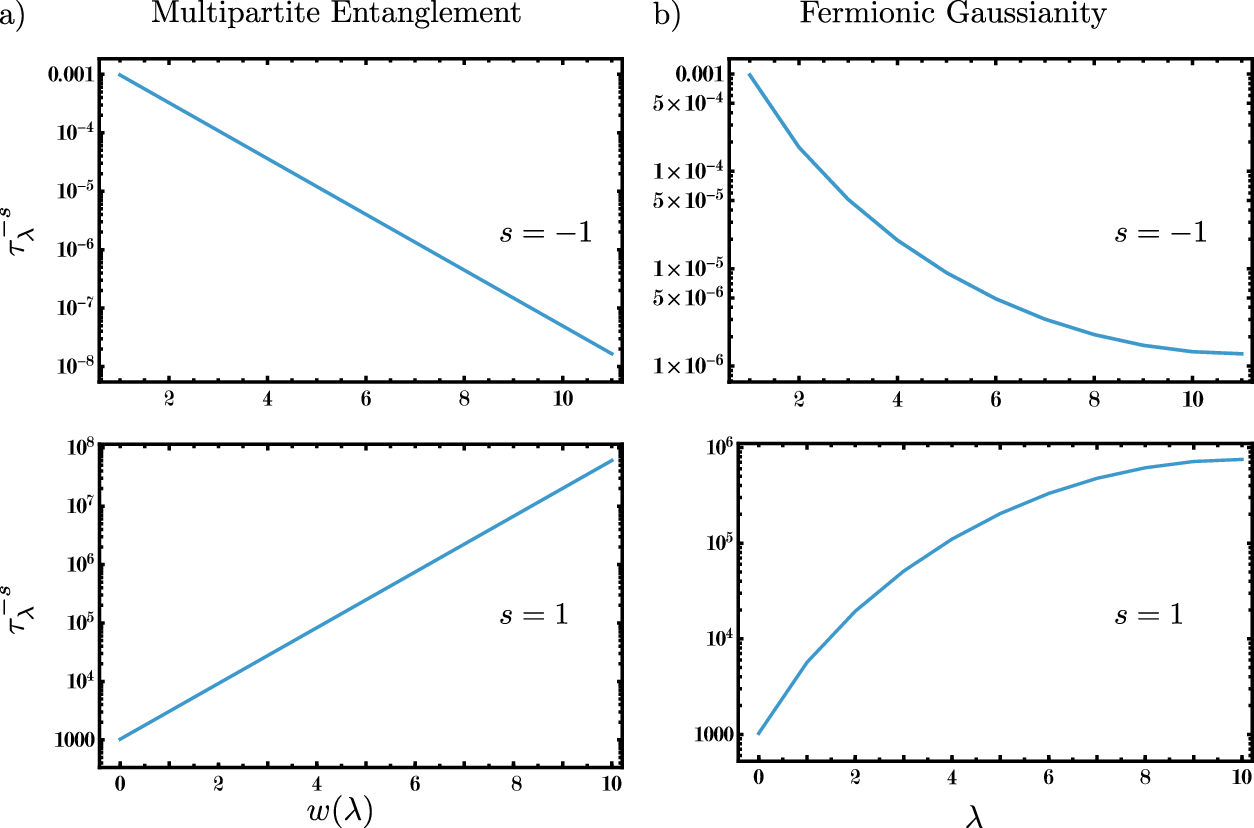
For n-qubit multipartite entanglement (local SU(2)⊗n), the irrep decomposition is indexed by bit-strings, with the weight controlling filter strength. As with spin-coherence, s=−1 suppresses high-Hamming-weight irreps (more entangled/more resourceful), while s=1 accentuates them.
Fermionic Gaussianity
In the matchgate/fermionic Gaussian setting, operator space on n qubits is decomposed in terms of products of Majorana operators. The kernel filter again amplifies or suppresses irrep sectors according to the free state (Slater determinant) purity profile. Notably, for this QRT only even order irreps contribute due to parity superselection.
Figure 3: Irrep-based filter coefficient τλ−s for multipartite entanglement (left, versus Hamming weight) and fermionic Gaussianity (right, versus number of occupied modes).
Implications for Quantum Resource Theories and QPS Calculi
Filter Designability: The operational trade-off between classical interpretability and quantum resource sensitivity is now an explicit design choice in QPS representations—it can be tuned via s or generalized even further via convolutional kernels.
Resource Diagnostics: Since s=−1 QPSs correspond to (squared) fidelities against free states and s=1 accentuates nonfree sectors, families of resource witnesses and monotones can be constructed by modulating s.
Norm Bounds and Symbol Calculi: The L2(X) norm of QPS representations is tightly bound by τλ−s, offering state-independent constraints and avenues for analysis of operator algebraic properties (star/twisted product operations are governed by the same purity filter structure).
Discussion and Prospective Developments
This study exposes a rigorous rigidity: once the purity profile of the reference free state is specified, the signal-processing and filtering behavior of the entire family of QPSs over all s is fixed at the irrep level. This implies that the representation-theoretic structure governing resource organization in Hilbert space is faithfully inherited—without further degrees of freedom—by all associated QPSs.
The established s-duality linking free and maximally resourceful Haar states further cements the role of the SW kernel parameter as a fundamental axis within resource analysis.
Potential extensions include:
QPS adaptation for noncompact/discrete groups.
Development of resource-aware QPS-based simulation and learning algorithms.
Generalized diagnostic/witness constructions via non-SW convolutional filtering.
Applications to classical simulability boundaries and quantum advantage characterization.
Conclusion
The paper provides a unified representation-theoretic foundation for the treatment of QPSs as group Fourier filters. The presented framework elevates QPSs from visualization tools to systematic, tunable signal-processing platforms for diagnosing, filtering, and visualizing quantum resources. The explicit dependence of the QPS modality on the GFD purities of the free state brings theoretical, numerical, and practical resource characterization into a coherent group-theoretic light.