Dark Energy Survey Year 6 Results: Cosmological Constraints from Galaxy Clustering and Weak Lensing
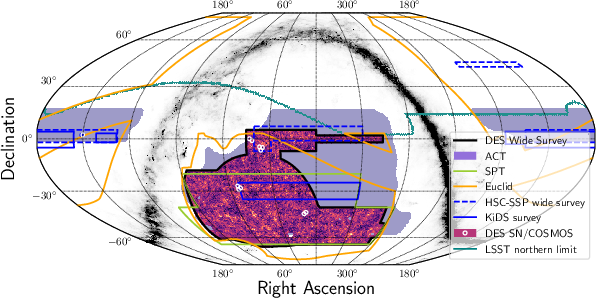
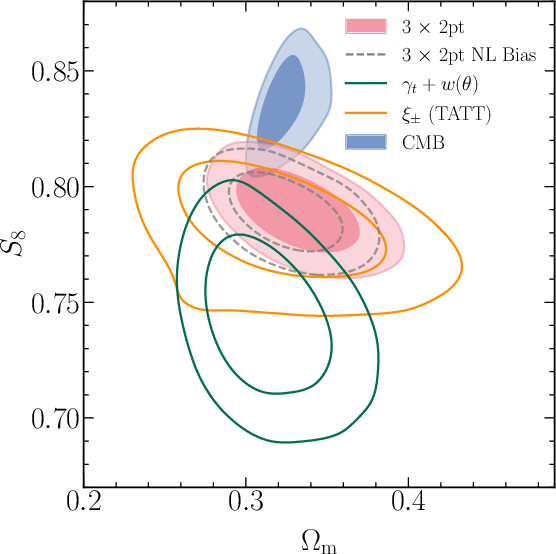
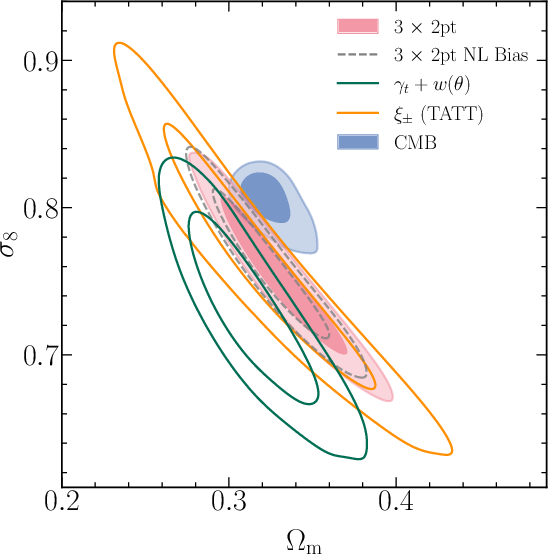
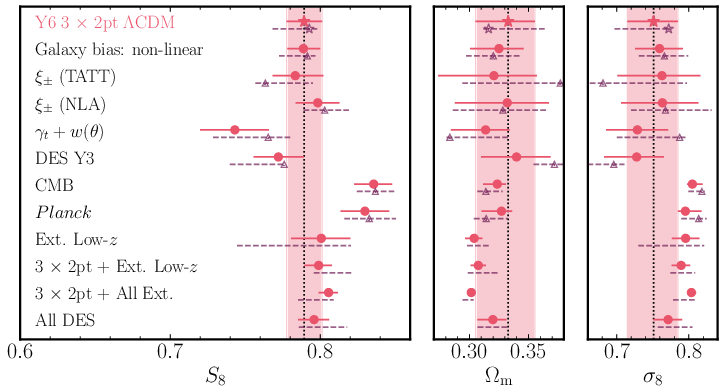
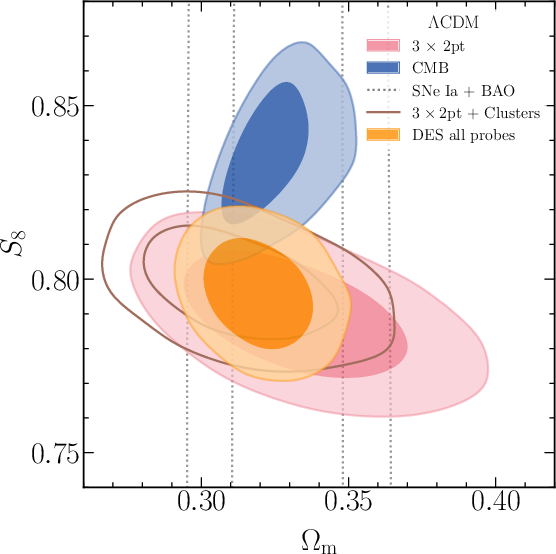
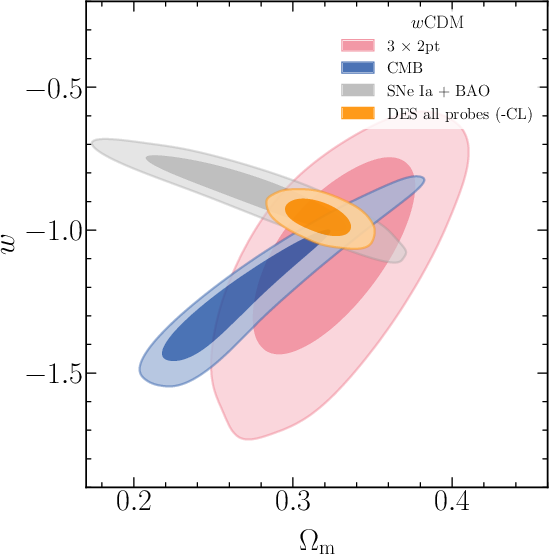
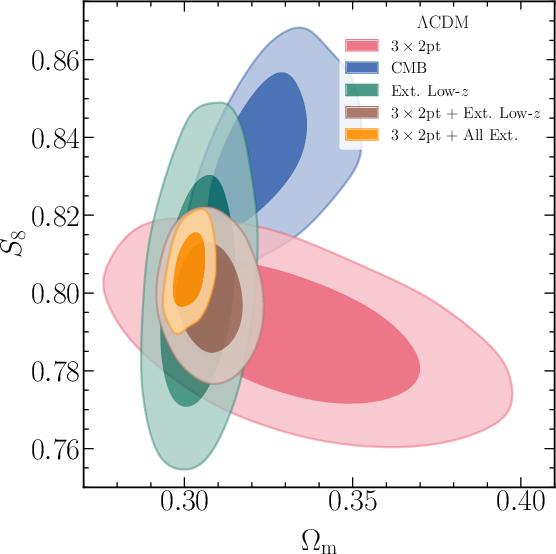
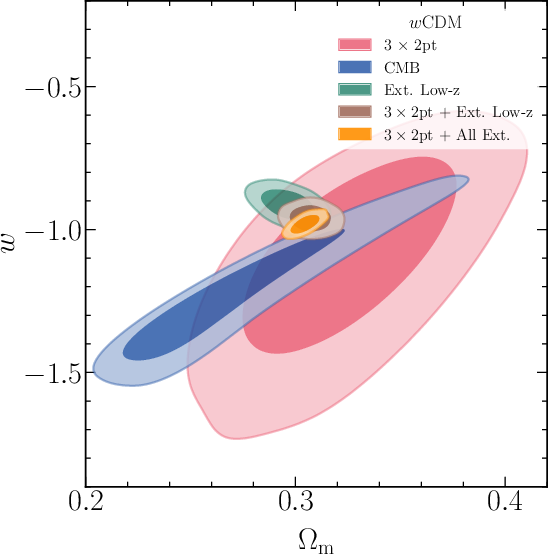
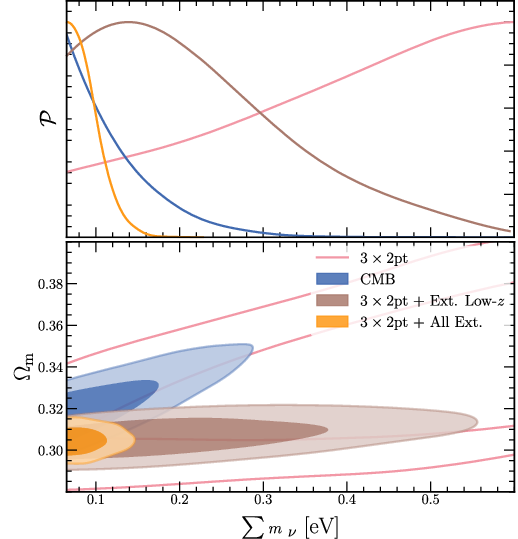
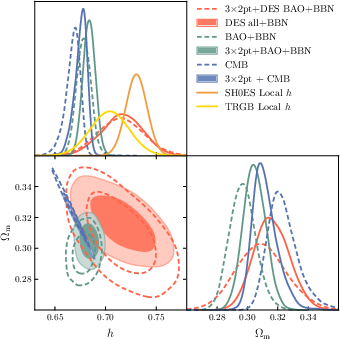
Abstract: We present cosmology results combining galaxy clustering and weak gravitational lensing measured in the full six years (Y6) of observations by the Dark Energy Survey (DES) covering $\sim$5000 deg$2$. We perform a large-scale structure analysis using three two-point correlation functions (3$\times$2pt): (i) cosmic shear from 140 million source galaxy shapes, (ii) galaxy clustering of 9 million lens galaxy positions, and (iii) galaxy-galaxy lensing from their cross-correlation. We model the data in flat $Λ$CDM and $w$CDM cosmologies. The combined analysis yields $S_8\equiv σ8 (Ω{\rm m}/0.3){0.5} = 0.789{+0.012}_{-0.012}$ and matter density $Ω{\rm m} = 0.333{+0.023}{-0.028}$ in $Λ$CDM (68\% CL), where $σ8$ is the clustering amplitude. These constraints show a (full-space) parameter difference of 1.8$σ$ from a combination of cosmic microwave background (CMB) primary anisotropy datasets from Planck 2018, ACT-DR6, and SPT-3G DR1. Projected only into $S_8$ the difference is $2.6σ$. In $w$CDM the Y6 3$\times$2pt results yield $S_8 = 0.782{+0.021}{-0.020}$, $Ω{\rm m} = 0.325{+0.032}{-0.035}$, and dark energy equation-of-state parameter $w = -1.12{+0.26}_{-0.20}$. For the first time, we combine all DES dark-energy probes: 3$\times$2pt, SNe Ia, BAO and Clusters. In $Λ$CDM this combination yields a $2.8σ$ parameter difference from the CMB. When combining DES 3$\times$2pt with other low-redshift datasets (DESI DR2 BAO, DES SNe Ia, SPT clusters), we find a 2.3$σ$ parameter difference with CMB. A joint fit of Y6 3$\times$2pt, CMB, and those low-redshift datasets produces the tightest $Λ$CDM constraints to date: $S_8 = 0.806{+0.006}_{-0.007}$, $Ω{\rm m} = 0.302{+0.003}{-0.003}$, $h = 0.683{+0.003}_{-0.002}$, and $\sum m_ν< 0.14$ eV (95\% CL). In $w$CDM, this combination yields $w = -0.981{+0.021}_{-0.022}$.
Paper Prompts
Sign up for free to create and run prompts on this paper using GPT-5.
Top Community Prompts
Explain it Like I'm 14
Dark Energy Survey Year 6: What the Universe Is Made Of and How It Grows
Overview
This paper reports new results from the Dark Energy Survey (DES), a project that used a powerful camera in Chile to take pictures of the sky for six years. The team studied how galaxies are spread out and how their shapes get slightly stretched by gravity. Their goal was to learn more about dark matter and dark energy—the invisible stuff that makes up most of the universe—and to test our best current model of the universe, called the CDM model.
The Big Questions
The researchers focused on a few simple but important questions:
- How “lumpy” is matter in the universe? (This relates to how strongly matter clumps together into structures like galaxies and clusters.)
- How much of the universe is made of matter versus dark energy?
- Does dark energy behave like a constant force (with ), or something different?
- Are their measurements consistent with other major experiments, especially those that study the early universe using the cosmic microwave background (CMB)?
How They Did It (In Everyday Terms)
The team analyzed images covering about 1/8 of the sky (roughly 5,000 square degrees). They used:
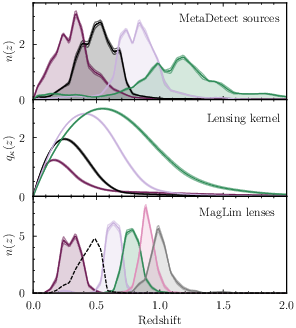
- About 140 million “source” galaxies whose shapes can be slightly distorted by gravity.
- About 9 million “lens” galaxies whose positions map where matter is located.
They measured three patterns in the sky, often called “3×2pt” because there are three types of pairwise (two-point) correlations:
- Cosmic shear: how galaxy shapes line up together across the sky because gravity from matter bends light a tiny bit. Think of it like a gentle funhouse mirror stretching many distant galaxies in a coordinated way.
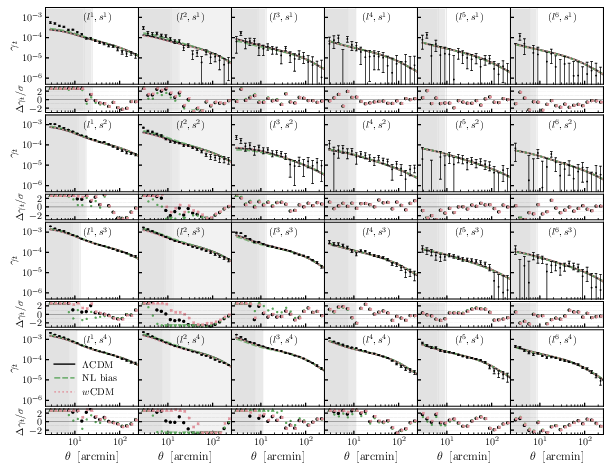
- Galaxy-galaxy lensing: how the positions of nearby (“lens”) galaxies are related to the stretching of background (“source”) galaxies. It’s like using known “weights” (lens galaxies) to probe the invisible mass around them.
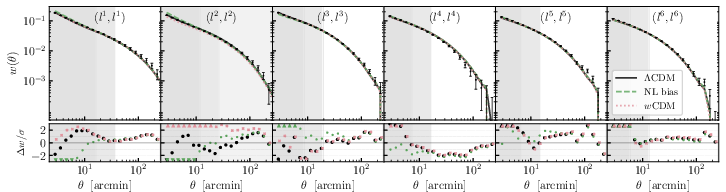
- Galaxy clustering: how galaxies are bunched together, like raisins in bread. This tells us how matter clumps over different distances.
To estimate how far away each galaxy is, they used its color to get a “photometric redshift” (a distance estimate based on how light is stretched to redder colors as the universe expands).
They compared the measured patterns to predictions from cosmological models:
- CDM: the standard model, where dark energy is a constant () and space is flat.
- CDM: a slightly more flexible model where dark energy’s behavior is described by a number that could differ from .
To avoid bias, they used a “blinding” process—hiding the final answers from themselves until all choices and checks were done—so they wouldn’t subconsciously steer the results toward what they expected.
What They Found and Why It Matters
Key results in simple terms:
- The universe’s lumpiness: They measure in CDM. You can think of as a score for how clumpy matter is today. Their value is very precise.
- Matter content: They find , meaning about one-third of the universe is matter (most of that is dark matter), and the rest is dark energy.
- Testing dark energy: In the CDM model, they get . This is consistent with , which means dark energy still looks like a constant force (a “cosmological constant”).
- Agreement with other experiments: When compared to measurements of the early universe from the CMB (Planck, ACT, SPT), there’s a mild mismatch—about overall (and if you only look at ). In plain language, that’s a small tension—not a discovery, but something scientists are watching closely.
- Combining many data sets: When they combine DES with other powerful, low-redshift (nearby universe) data, and also with the CMB, they get the tightest constraints yet on the standard model:
- (this relates to how fast the universe expands)
- Total neutrino mass eV (a strong upper limit)
- In CDM, —again very close to
Why this is important:
- Precision: Compared to their previous results (DES Year 3), the constraints improved by about a factor of two. That’s big progress and helps narrow down the possibilities for what dark energy and dark matter could be.
- Cross-checks: Their measurements of the present-day universe can be compared to the CMB (the baby picture of the universe). Small differences could hint at new physics—or just reflect that we need even better data or modeling.
- Dark energy still looks like a cosmological constant: No strong evidence yet that differs from .
What This Means Going Forward
These results strengthen the standard picture of the universe (CDM) while leaving a bit of room for surprises. The mild tension with the CMB keeps things interesting: it could fade with better measurements, or it could grow and point to new physics about how structure forms or how dark energy behaves. The tight limit on neutrino masses also helps particle physicists by narrowing the range for future experiments.
In short, DES Year 6 shows:
- The universe is about one-third matter and two-thirds dark energy.
- Structures like galaxies form a little less strongly than some early-universe predictions suggest, but not by much.
- Dark energy still acts like a constant force.
- When many top datasets are combined, we get the most precise picture yet of our cosmos.
Knowledge Gaps
Unresolved limitations, knowledge gaps, and open questions
Below is a concise list of the main gaps and uncertainties that remain based on the paper’s scope, assumptions, data, and modeling choices. Each item is phrased to be actionable for follow‑up work.
- Restricted cosmological model space: analysis limited to flat CDM and constant‑ CDM; curvature, time‑varying (e.g., –), modified gravity, and other extensions (e.g., early dark energy) are deferred.
- Origin of the DES–CMB parameter differences: the reported 1.8–2.8 full‑space differences (2.6 in ) remain unexplained; require targeted tests (tomographic, scale, sky-region splits; systematics reweighting; alternative modeling choices) to isolate whether residual systematics or new physics drive the offset.
- Small‑scale modeling limitations: conservative scale cuts to avoid nonlinear and baryonic uncertainties reduce constraining power; need validated nonlinear matter and galaxy models (e.g., hydrodynamics‑calibrated emulators) to safely include smaller scales in 3×2pt.
- Baryonic feedback uncertainty: current marginalizations likely insufficient to robustly recover unbiased parameters when pushing to smaller scales; quantify which baryonic parameters most impact and implement priors anchored to diverse hydro simulations.
- Intrinsic alignment (IA) modeling sufficiency: the validity of the assumed IA model across redshift (), luminosity, and color for DES Y6 galaxy populations is uncertain; requires direct IA calibration (e.g., with spectroscopic subsets) and testing of extended IA models (e.g., tidal alignment + tidal torquing with redshift and SED dependence).
- Photometric redshift (photo‑) calibration at high : source and lens photo‑ at (extending to –1.2) remain a key systematic; need expanded cross‑correlation redshifts and spectroscopy (e.g., DESI overlap) to constrain bin‑wise biases and redshift tails to 0.002–0.005 accuracy.
- Dependence on the DNF photo‑ method: potential biases from SED/morphology‑dependent errors and training‑set incompleteness are not fully quantified; compare against template methods and machine‑learning alternatives, and propagate method‑to‑method differences as systematics.
- Shear calibration residuals: metadetect response calibration depends on image simulations; remaining biases (selection, blending, correlated noise, detection threshold effects) need validation across the full range of seeing, depth, and galaxy properties represented in Y6.
- PSF modeling limitations and chromatic effects: despite improvements, ‑band shapes are excluded and residual chromatic PSF errors remain; implement multi‑band, SED‑aware shear inference and enhance star catalogs/PSF color modeling to further reduce additive and multiplicative biases.
- Source–lens clustering and boost/contamination control: physically associated sources can dilute galaxy–galaxy lensing, especially at high ; require robust, tomographic measurements of boost factors and contamination using spectroscopy or high‑precision photometry in deep fields.
- Magnification and selection effects: lens magnification alters lens number counts and selection (MagLim++); current treatment may rely on nuisance parameters with broad priors; develop end‑to‑end forward models (Balrog‑based) to quantify and correct selection–lensing coupling per bin.
- Galaxy bias modeling: use of simple (often linear/scale‑independent) bias within scale cuts may be insufficient over extended ; incorporate scale‑dependent and nonlinear bias, stochasticity, and HOD‑informed models; validate on mocks tuned to the MagLim++ sample.
- Covariance accuracy: analytic covariances may not fully capture non‑Gaussian terms, super‑sample covariance, and mask‑induced mode coupling for Y6; calibrate against large suites of mocks that reproduce survey geometry, depth/seeing variations, and selection.
- Sensitivity to neutrino mass assumptions: DES‑only parameter posteriors can shift with priors; quantify the impact of allowing vs fixing , and test robustness of and when marginalizing with broader neutrino priors.
- Consistency across 1×2pt, 2×2pt, and 3×2pt: while internal PPD checks are referenced, any residual, scale‑ or redshift‑dependent inconsistencies among probes should be localized and traced to specific systematics (e.g., IA vs photo‑ vs shear calibration).
- Joint modeling with external low‑ probes: combined results with SNe Ia, BAO, and clusters may depend on external systematics (e.g., cluster mass calibration, BAO reconstruction systematics); adopt hierarchical joint likelihoods with shared nuisance parameters and cross‑probe systematics control.
- Treatment of B‑modes and null tests: a clear accounting of residual B‑modes and other null statistics (star–galaxy correlations, curl modes) and their parameter impact is not summarized; quantify any non‑zero signals and propagate into parameter uncertainties.
- Spatial systematics mitigation: residual correlations of galaxy density with observing conditions (depth, seeing, sky background) can bias clustering; improve mode deprojection/templatization and validate with injected‑systematic recovery tests.
- Catalog cross‑mapping limitation: the metadetect shear catalog does not map one‑to‑one to the Y6 Gold catalog; this complicates per‑object cross‑probe analyses; produce robust cross‑matching and assess selection‑function mismatches.
- Estimator and configuration‑space choices: reliance on 2‑point real‑space statistics may leave information on the table; incorporate complementary summary statistics (e.g., Fourier‑space pseudo‑, bispectrum, lensing peaks/voids, shear‑position‑shear) to break degeneracies and stress‑test systematics.
- Scale‑ and redshift‑dependent tension mapping: the paper reports global tensions, but does not localize which angular scales, tomographic bins, or cross‑correlations contribute most; perform differential tension mapping to target the most informative diagnostics.
- Forecasted systematic‑control targets: the analysis demonstrates a factor‑of‑two improvement vs Y3, but does not quantify the specific systematic‑reduction goals needed to resolve the DES–CMB differences (e.g., shear bias < 0.2%, per‑bin photo‑ bias < 0.002, IA model error budget); provide a prioritized roadmap.
- Robustness to alternative nonlinear prescriptions: test multiple nonlinear matter models (e.g., HMCode variants, cosmology‑dependent emulators) and propagate the spread into the parameter posteriors.
- Edge/mask effects at large scales: ensure unbiased large‑angle correlations in the presence of complex masking; cross‑validate configuration‑space and pseudo‑ pipelines and verify covariance consistency.
- Data splits and repeatability: expand blinded stress‑tests using independent sky patches (e.g., NGC vs SGC), observing condition quartiles, and galaxy property splits to ensure parameter repeatability and isolate latent systematics.
These items identify where additional data, calibration, modeling, and cross‑checks would most productively reduce uncertainties and clarify the mild but persistent DES–CMB parameter differences.
Practical Applications
Immediate Applications
The following applications can be deployed now, leveraging the paper’s findings, workflows, and tools.
- Multi-probe cosmology workflow adoption for next-generation surveys
- Sectors: Academia, Space/Observatories (Rubin/LSST, Euclid, Roman), Software/Data Engineering
- Tools/Products/Workflows: 3×2pt joint analysis (cosmic shear, galaxy-galaxy lensing, clustering), self-calibration of systematics, end-to-end blinding protocols, survey masks, Wiener-filter mass maps, internal consistency via posterior predictive distribution (PPD)
- Dependencies/Assumptions: Access to high-quality shear and lens catalogs; model assumptions (flat ΛCDM or CDM); instrument-specific PSF behavior; robust photo- calibration; computational resources for large-scale inference
- Chromatic PSF modeling to improve precision imaging
- Sectors: Astronomy, Earth Observation/Remote Sensing, Biomedicine/Microscopy, Industrial Vision Systems
- Tools/Products/Workflows: PiFF PSF models with chromatic dependence to reduce modeling errors and improve shape measurements and photometry
- Dependencies/Assumptions: Instrument throughput and bandpass characterization; calibration stars and stable observing conditions; adaptation to camera/sensor specifics
- Synthetic source injection for calibration and QA
- Sectors: Astronomy, Computer Vision/Autonomous Systems, Medical Imaging
- Tools/Products/Workflows: Balrog-style synthetic source injection to characterize selection functions, detection biases, and pipeline performance; image simulations (Y6Imsim)
- Dependencies/Assumptions: Realistic simulators and noise models; representative deep field seeds; alignment between simulation and operational pipelines
- Robust shape measurement via MetaDetect and cell-based coadds
- Sectors: Astronomy, Computational Imaging, Vision
- Tools/Products/Workflows: MetaDetect shear estimation with per-axis synthetic shears for response calibration; cell-based coadd processing to scale shape measurement
- Dependencies/Assumptions: Stable shear response across tomographic bins; accurate PSF deconvolution; adequate S/N and imaging depth
- Photo- calibration and uncertainty marginalization frameworks
- Sectors: Astronomy; ML/Data Science (distribution shift calibration), Finance (model calibration)
- Tools/Products/Workflows: DNF photo-, clustering redshifts (WZ), marginalization of redshift uncertainty (Y6Mode) in downstream inference
- Dependencies/Assumptions: Availability of spectroscopic anchors or clustering proxies; representative training sets; assumptions about redshift distributions and priors
- Blinding protocols for bias mitigation in large analyses
- Sectors: Academia (all data-intensive disciplines), Policy/Regulatory Science, Industry (A/B testing, model governance)
- Tools/Products/Workflows: Rigorous design of blinded data vectors, parameters, and decision points to prevent confirmation bias; documented unblinding criteria
- Dependencies/Assumptions: Cultural and procedural buy-in; predefined governance; tracking of all analysis choices
- Internal consistency checks via PPD and cross-probe validation
- Sectors: Academia, Climate Science, Finance (model risk), Healthcare (epidemiology)
- Tools/Products/Workflows: Posterior predictive distribution diagnostics; probe subset consistency testing; multi-dataset joint fitting
- Dependencies/Assumptions: Well-specified likelihoods and priors; reliable summary statistics; careful treatment of shared systematics across probes
- Open data products and training resources for education and ML
- Sectors: Education, ML/AI, Citizen Science
- Tools/Products/Workflows: Y6 Gold catalog, DR2 coadds, survey masks and systematics maps for coursework, benchmarking, and algorithm development
- Dependencies/Assumptions: Clear data documentation; reproducible pipelines; licensing and data access policies
- Planning inputs for particle physics and cosmology programs
- Sectors: Policy/Funding, Particle Physics
- Tools/Products/Workflows: Use of DES constraints (e.g., , , ) and the upper bound eV to prioritize neutrino and dark energy experiment portfolios and collaborations
- Dependencies/Assumptions: Acceptance of baseline cosmological model and cross-consistency with CMB/external probes; continued community updates
Long-Term Applications
The following applications require further research, scaling, or domain adaptation before broad deployment.
- Real-time, multi-probe cosmological inference at survey scale
- Sectors: Space/Observatories, HPC/Cloud
- Potential Products: Streaming “CosmoOps” pipelines combining shear, clustering, lensing, SNe, BAO, and clusters to continuously update parameters (, , ) during survey operations
- Dependencies/Assumptions: Scalable inference engines; robust automation of calibration steps (PSF, photo-, masks); standardized cross-survey data formats
- Cross-domain imaging improvements via chromatic PSF modeling
- Sectors: Biomedicine (fluorescence microscopy), Remote Sensing (multispectral satellites), Industrial Metrology
- Potential Products: Generalized chromatic PSF correction libraries for multi-band sensors to improve shape/feature fidelity
- Dependencies/Assumptions: Sensor-specific optical characterization; validation datasets; adaptation beyond astronomical PSF regimes
- Simulation-based calibration and digital twins for complex pipelines
- Sectors: Climate/Weather, Autonomous Vehicles, Healthcare Imaging
- Potential Products: Balrog-like synthetic injection and pipeline stress-testing for large, complex systems (e.g., segmentation, detection)
- Dependencies/Assumptions: High-fidelity simulators; end-to-end integration; consistent performance metrics; domain-specific physics models
- Multi-modal self-calibration frameworks for decision-making under uncertainty
- Sectors: Energy (grid forecasting), Finance (market risk), Public Health (epidemiological modeling)
- Potential Products: 3×2pt-inspired multi-signal fusion frameworks that jointly constrain models and nuisance parameters, with PPD consistency gates
- Dependencies/Assumptions: Well-characterized systematics across data streams; modular joint likelihoods; governance for model revisions
- Advancing dark energy and modified gravity tests
- Sectors: Academia, Policy (science strategy)
- Potential Products: Extended models (time-varying , modified gravity) tested with DES-like multi-probe datasets; stronger constraints guiding experimental priorities
- Dependencies/Assumptions: New theory development; enhanced datasets (depth, area, redshift reach); improvements in systematics control
- Neutrino physics synergy with cosmological bounds
- Sectors: Particle Physics, Policy/Funding
- Potential Products: Joint design of neutrino experiments factoring in cosmological mass limits; integrated pipeline for cosmology–lab cross-validation
- Dependencies/Assumptions: Stability of cosmological bounds under extended models; improved low- probes; agreed cross-calibration standards
- Public engagement and workforce development through citizen science and open tooling
- Sectors: Education, Non-profits, Science Communication
- Potential Products: Interactive platforms using DES mass maps and catalogs; curricula on bias mitigation, blinding, and uncertainty quantification
- Dependencies/Assumptions: Sustained support; accessible tooling; privacy and licensing considerations
- Transfer of redshift calibration and uncertainty marginalization to ML distribution-shift problems
- Sectors: ML/AI, Safety-Critical Systems
- Potential Products: Photo--style semi-supervised calibration and Y6Mode-like uncertainty marginalization in deployed ML systems
- Dependencies/Assumptions: Reliable proxies for latent variables; labeled anchors; clear uncertainty propagation into downstream decisions
- Standardization of blinding and consistency protocols across research and industry
- Sectors: Academia, Regulatory Science, Industry (model governance)
- Potential Products: Playbooks and compliance standards for blinded analyses, unblinding criteria, and PPD diagnostics
- Dependencies/Assumptions: Institutional adoption; harmonized reporting; tooling for audit trails
In all cases, feasibility depends on data availability, reproducible pipelines, community standards for model and systematic assumptions, and the ability to adapt astronomy-specific tools (e.g., PSF modeling, photo-, shear estimation) to other domains with appropriate validation.
Glossary
- 3×2pt: A joint analysis combining three two-point correlation functions from galaxy clustering and lensing to constrain cosmological parameters. "three two-point correlation functions (32pt)"
- amplitude of matter fluctuations (): The rms strength of matter clustering on 8 Mpc/h scales, a key parameter for structure growth. "where is the clustering amplitude"
- auto-correlation: The correlation of a field with itself as a function of separation, used to quantify clustering. "auto-correlations of the spatial distribution of 9 million lens galaxies"
- baryon acoustic oscillation (BAO): A standard-ruler feature in the distribution of galaxies from early-universe sound waves, used to measure cosmic distances. "baryon acoustic oscillation (BAO)"
- blinding protocol: A procedure that conceals key results during analysis to prevent bias. "a rigorous blinding protocol"
- coadded images: Images produced by stacking multiple exposures to increase depth and signal-to-noise. "cell-based coadded images"
- cold dark matter (CDM): A form of dark matter that is non-relativistic and weakly interacting, central to the ΛCDM model. "cold dark matter (CDM)"
- cosmic microwave background (CMB): The relic radiation from the early universe, whose anisotropies provide precise cosmological constraints. "cosmic microwave background (CMB) primary anisotropy datasets"
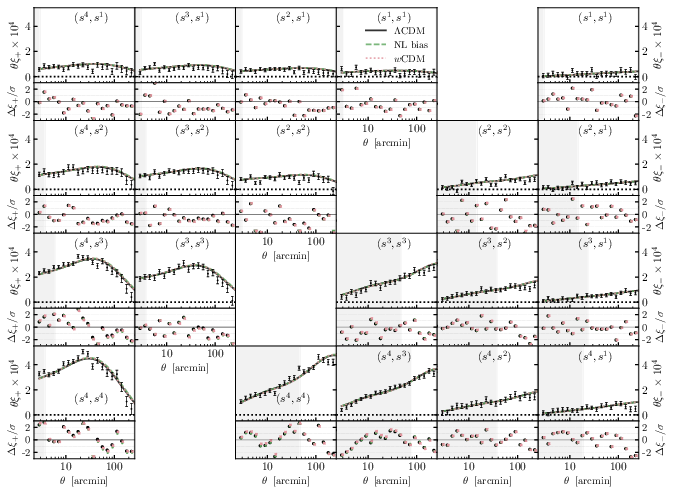
- cosmic shear: Correlated distortions in galaxy shapes caused by weak gravitational lensing by large-scale structure. "cosmic shear measuring correlations among the shapes of 140 million source galaxies"
- cosmological constant (): A constant energy density (dark energy) driving cosmic acceleration in ΛCDM. "a cosmological constant ()"
- convergence map: A reconstructed map of projected mass density (lensing convergence κ) from weak lensing data. "convergence map using the Wiener filter reconstruction method"
- cross-correlation: The correlation between two different fields (e.g., galaxy positions and shear), used to probe their relationship. "cross-correlation between lens positions and source shapes"
- Dark Energy Camera (DECam): A 570-megapixel wide-field camera used by DES to image the sky. "DECam field-of-view"
- dark energy equation-of-state parameter : The ratio of dark energy pressure to density, determining its dynamics. "dark energy equation-of-state parameter "
- Directional Neighbourhood Fitting (DNF): A machine-learning method for estimating photometric redshifts from multi-band data. "Directional Neighbourhood Fitting (DNF;"
- effective number density (): The lensing-effective surface density of source galaxies after weighting and selection. "the effective number density galaxies/arcmin"
- ellipticity dispersion: The intrinsic scatter in galaxy shapes that contributes to noise in shear measurements. "intrinsic ellipticity dispersion"
- flat ΛCDM: The standard cosmological model with zero spatial curvature and a cosmological constant. "baseline 6-parameter {flat} CDM model"
- galaxy angular overdensity field (): The fractional fluctuation in galaxy number counts on the sky relative to the mean. "galaxy angular overdensity field "
- galaxy-galaxy lensing: The correlation of foreground galaxy positions with background galaxy shear to probe matter around galaxies. "galaxy-galaxy lensing from the cross-correlation between lens positions and source shapes"
- large-scale structure (LSS): The cosmic web of matter distribution on megaparsec scales, traced by galaxies and lensing. "large-scale structure (LSS)"
- lens magnification: The increase in apparent brightness/size of background sources due to gravitational lensing by foreground mass. "Characterising lens magnification"
- matter density parameter (): The present-day fraction of the critical density contributed by matter (baryons + dark matter). "matter density "
- MetaDetect: A shear-measurement pipeline that estimates selection and measurement response by shearing images. "MetaDetect shear catalog"
- neutrino mass sum (): The total mass of the three neutrino species, which affects structure formation. " eV (95\% CL)"
- nuisance parameters: Non-cosmological parameters (e.g., systematics) included in modeling and marginalized over. "astrophysical and nuisance parameters"
- photo- (photometric redshift): A redshift estimate derived from multiband imaging rather than spectroscopy. "Source photo- calibration"
- point spread function (PSF): The response of an imaging system to a point source, modeling atmospheric and instrumental blurring. "Point spread function (PSF) models"
- posterior predictive distribution: A Bayesian diagnostic comparing observed data with data simulated from the posterior. "posterior predictive distribution"
- response factor : The calibration factor relating a measured shear estimator to the true shear, derived by image shearing. "response factor "
- S8 parameter (): A parameter combining and to capture the lensing amplitude degeneracy. ""
- shear (): The weak-lensing distortion field that alters galaxy shapes. "shear field "
- shape noise: Noise in shear measurements due to intrinsic galaxy shapes and measurement errors. "shape noise"
- spectroscopic: Pertaining to measurements from spectra (e.g., precise redshifts), often used for calibration or validation. "spectroscopic 2-degree Field Lensing Survey (2dFLenS)"
- spin-2 axes: The two-component nature of shear/ellipticity fields, typically labeled and . "spin-2 axes; , "
- tangential shear (): The component of shear measured tangentially around lens galaxies, used in galaxy-galaxy lensing. ""
- tomographic bin: A redshift-sliced subsample of galaxies used to exploit distance information in lensing/clustering. "in each tomographic bin"
- two-point correlation function: A statistic quantifying the excess probability of finding pairs at a given separation compared to random. "three two-point correlation functions"
- weak gravitational lensing: The small, coherent distortion of background galaxy shapes by the gravitational field of foreground structure. "weak gravitational lensing"
- Wiener filter reconstruction method: An optimal linear filter used to reconstruct fields (e.g., convergence) by minimizing mean-square error. "Wiener filter reconstruction method"
- xi-plus/minus (): The pair of shear correlation functions (ξ+ and ξ−) used to quantify cosmic shear. ""
Collections
Sign up for free to add this paper to one or more collections.