- The paper establishes a rigorous, quantitative framework for chiralization in periodic materials, drawing an analogy to the modern theory of polarization.
- It introduces novel multipole descriptors and chiral phonon analyses to address gaps in traditional chirality quantification methods.
- The proposed theory enables systematic classification of ferrochiral phase transitions and paves the way for engineering advanced chiral materials.
Towards a Modern Theory of Chiralization
Introduction
The paper "Towards a Modern Theory of Chiralization" (2601.16042) systematically argues for the establishment of a rigorous, quantitative framework for describing structural chirality in periodic materials, drawing a direct analogy to the Modern Theory of Polarization. The absence of a quantitative descriptor for chirality, both at the local and bulk level, constitutes a significant challenge for theory, computation, and application. The work synthesizes existing conceptual gaps, assesses previous attempts at chirality quantification, and proposes multidimensional routes to a genuinely modern theory of chiralization, potentially enabling new material functionalities and phase classification.
Conceptual Framework for Chiralization
The paper posits that a complete theory must include a local measure of chirality—analogous to the magnetic or electric dipole—as well as a bulk thermodynamic chiralization per unit volume, conceptually paralleling magnetization and polarization in ferroic systems. Importantly, the chiralization order parameter (χ) should map the phase transitions between achiral and chiral states in periodic crystals, thereby enabling Landau-type descriptions and thermodynamic analyses.
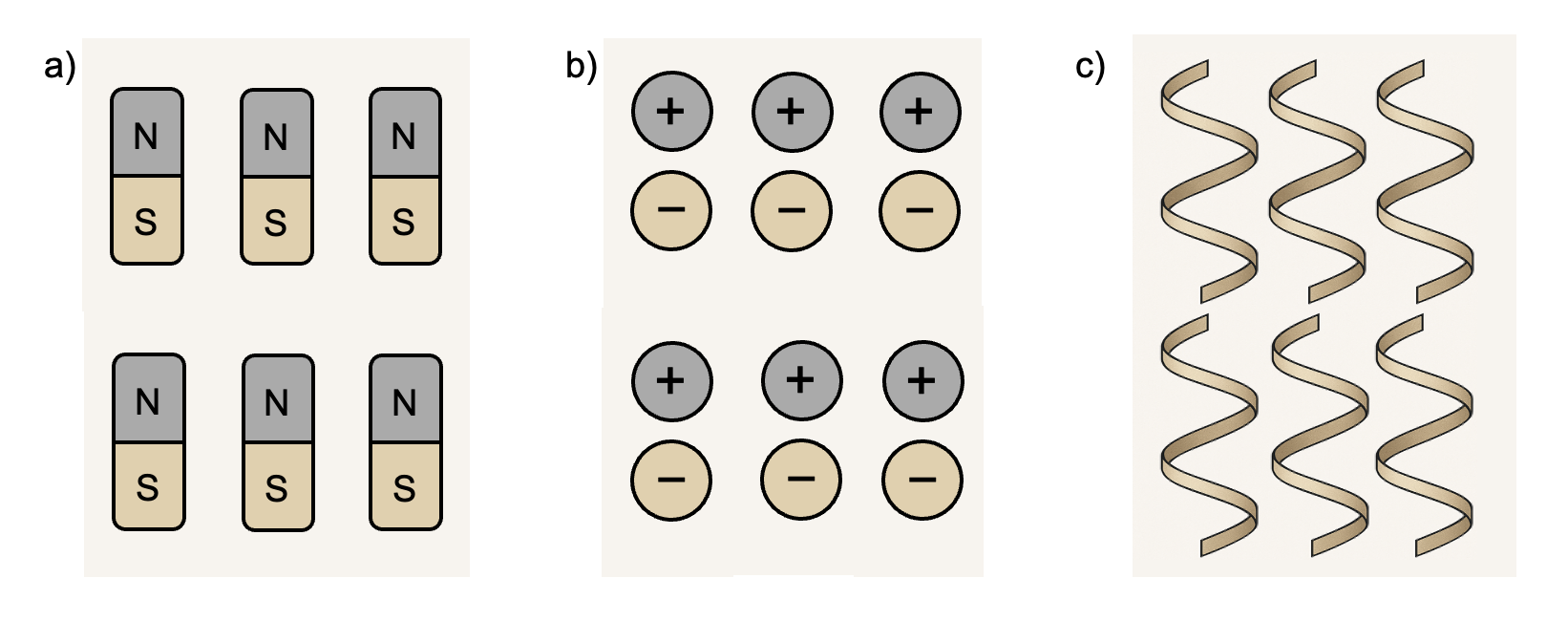
Figure 1: Analogies among local and bulk magnetic, electric, and chiral quantities illustrate the conceptual gap for chirality.
An essential aspect is the identification of the conjugate field (Z) to chiralization, generalizing the energy expression to E=−χ⋅Z, reminiscent of field-coupled order parameters in other ferroic phenomena. This would facilitate domain selection via external chiral field annealing, a practical tool for ferrochiral material engineering.
Implications for Ferrochirality and Phase Transitions
Ferrochiral materials exhibit transitions from achiral (high-symmetry) to chiral (low-symmetry) phases. By analogy to ferroelectricity, where double well potentials describe phase stability as a function of polarization, the proposed chiralization order parameter χ likewise encodes a double well profile governing ferrochiral transitions.
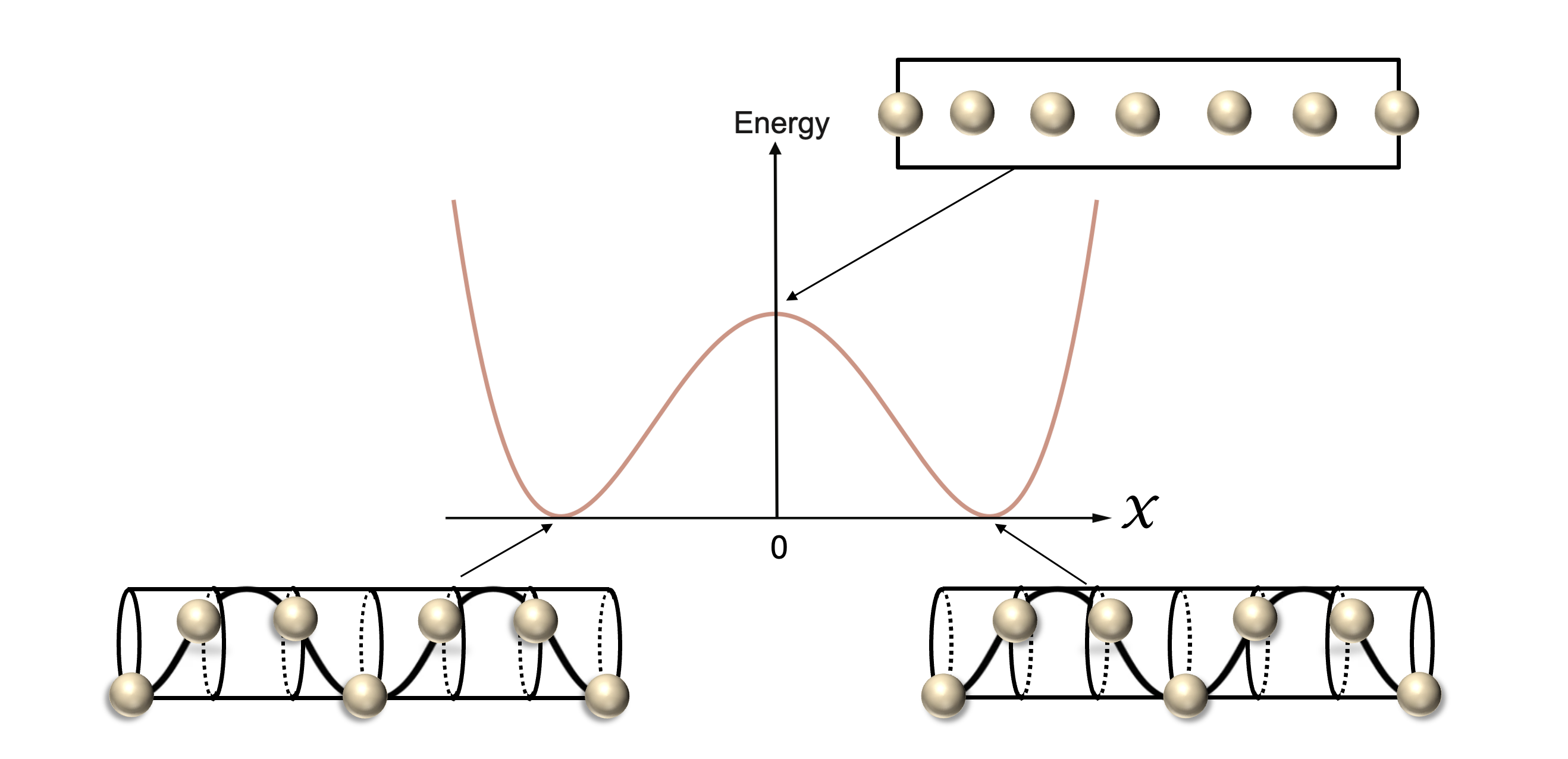
Figure 2: Double well potential anticipated for ferrochiral phase transitions, with χ=0 at the achiral high-energy peak and minima at opposite chiral domains.
The existence of such a double well is critical for classifying ferrochiral transitions and predicting the stability, switching behavior, and the symmetry-dictated energetic landscape of chiral domains.
Assessment of Previous Quantification Attempts
Historical definitions include "asymmetry products" correlating with optical rotation, "chirality functions" for crystal class comparison, similarity measures between enantiomers, and continuous symmetry measures. More recently, the helicity integral H=∫v⋅[∇×v]d3r, transposed from fluid dynamics, was explored as a candidate for structural chirality. However, these approaches suffer from several conceptual shortcomings:
- Dependence on knowledge of the achiral reference structure
- Lack of sign change between enantiomers in some formulations
- Absence of rigorous bulk interpretations and conjugate fields
None satisfactorily provide a formal order parameter or the necessary theoretical infrastructure for bulk chiralization in periodic solids.
Routes Toward a Modern Theory
Modern Theory of Polarization: Analogy and Challenges
The polarization in crystals is not simply the dipole per unit cell, due to the position operator's ill-definition under periodic boundary conditions. The theory's advancement came via polarization differences (adiabatic current integrals) and lattice ambiguity resolved by surface termination. For chiralization, analogous difficulties arise: There is not yet even a rigorous local chiral moment definition for finite systems.
Multipole Descriptors
The electric toroidal dipole (G1), established as an order parameter for ferroaxials, offers an instructive starting point. Its pseudoscalar monopole (G0) has been proposed for chirality quantification:
G0=∫V∇⋅G1d3r
Despite its correct transformation properties under symmetry operations, G0 suffers from false zeroes and sign ambiguities across chiral paths. Solutions may lie in higher-order multipoles (G2, G4) or composite charge multipoles, though practical and theoretical implementation remain unresolved.
Chiral Phonons
Chiral phonons—quanta of lattice vibrations possessing angular momentum—have emerged as promising candidates for chiral order parameters. Unstable chiral phonons in achiral structures may indicate propensity for spontaneous symmetry breaking into stable chiral phases, analogous to polar soft modes in ferroelectrics. The established phonon chirality parameter (S), specifically
Sz=m=1∑n(∣⟨rm,z∣ϵm⟩∣2−∣⟨lm,z∣ϵm⟩∣2)
provides a potential base for defining mode-level chirality, though its adaptation to static displacements and primary ferrochiral transitions requires further elaboration.
Theoretical and Practical Implications
Establishment of a rigorous modern theory of chiralization will partition chiral phenomena into quantifiable domains, enable systematic phase transition classification, and facilitate direct computation in electronic structure codes. Practically, this will enhance the engineering of energy-efficient nanoelectronic devices leveraging chiral features (e.g., chiral-induced spin selectivity) and the design of advanced functional materials where chirality plays an essential role (e.g., pharmaceuticals, sensors, display technologies).
Theoretically, such a framework may unify structural chirality with exotic forms (e.g., chiral spin systems, topological chirality), potentially uncovering unexpected connections among electronic, lattice, and symmetry-driven properties in quantum materials. Critically, a modern theory would underpin new experimental approaches for chiral domain manipulation and probing novel surface or interfacial chiral phenomena.
Conclusion
The commentary systematically motivates and frames the necessity of a modern, computation-compatible theory of chiralization analogous to the Modern Theory of Polarization. The synthesis of prior quantitative approaches, analysis of symmetry-appropriate multipoles, and exploration of lattice dynamics routes lay the groundwork for future theoretical and experimental advances. Success in this direction promises deep impact in phase classification, property prediction, and functional control of advanced materials, potentially bridging disparate forms of chirality under a unified framework.