What is nonequilibrium?
Abstract: Lecture notes on elements of nonequilibrium statistical mechanics: (1) a characterization of the nonequilibrium condition, largely by contrast to equilibrium; (2) a retelling of some of the great performances of the more distant past, including the perspectives of Boltzmann and Onsager; and (3) more recent methods and concepts, from local detailed balance and the identification of entropy fluxes to dynamical fluctuation theory, and the importance of dynamical activity.
Paper Prompts
Sign up for free to create and run prompts on this paper using GPT-5.
Top Community Prompts
Explain it Like I'm 14
Explaining “What is Nonequilibrium?” by Christian Maes
Overview
This paper is an easy-to-read set of lecture notes about nonequilibrium physics — the study of systems that are being driven or are constantly changing because energy, matter, or momentum is flowing through them. Think of the difference between a calm lake (equilibrium) and a flowing river (nonequilibrium). The author explains what makes nonequilibrium special, why it’s hard, and which tools scientists use to understand it.
Key goals and questions
The notes are organized around three simple goals:
- What is nonequilibrium, and how is it different from equilibrium?
- What can we learn from classic ideas by scientists like Boltzmann and Onsager about order, randomness, and flows?
- What modern tools help us study nonequilibrium today, such as local detailed balance, entropy flow, and dynamical fluctuation theory (including the “frenetic” or activity part)?
How the paper approaches the topic
To make the ideas clear, the author:
- Uses everyday pictures and analogies. For example, equilibrium is like a still lake; nonequilibrium is like a river with currents and cycles.
- Explains three “levels” of description:
- Microscopic: individual particles and basic laws (like billiard balls or molecules).
- Macroscopic: large-scale behavior (like temperature, pressure, and fluid flow).
- Mesoscopic: “in-between” small systems that feel randomness strongly (like pollen grains in water or molecular machines).
- Shows how equilibrium is well-understood using “snapshots” (static pictures) and energy-based rules (Gibbs distributions, free energy).
- Explains that nonequilibrium usually requires watching “movies” of how a system evolves over time (trajectories), because a single snapshot doesn’t capture the ongoing flows.
- Introduces key ideas with simple models and probability:
- Path probabilities (how likely a whole time-history is).
- Local detailed balance (tiny steps obey energy bookkeeping, like heat in = work out + stored energy).
- Dynamical fluctuations and “frenesy” (how busy or active the system is, not just how much it dissipates).
Main ideas and results, in simple terms
Here are the core takeaways the paper develops:
- Equilibrium vs. nonequilibrium
- Equilibrium isn’t just “not changing” — it’s also time-reversible in a statistical sense. If you watched a movie of an equilibrium system backward, it would still look physically reasonable.
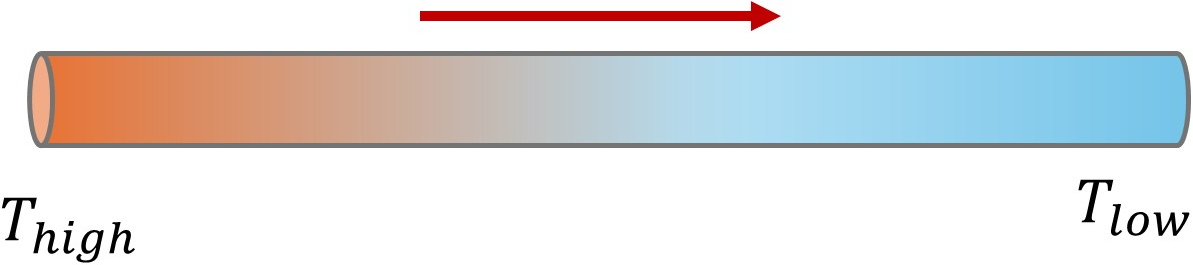
- Many nonequilibrium systems can look steady from far away (like a river’s average flow), but under the surface there are continuous currents, cycles, and energy use. If you play their movie backward, the flows would look wrong — this “time-reversal breaking” is a key signature.
- Nonequilibrium is usually maintained by driving forces (like pumps, batteries, gravity, or differences in temperature or chemical concentration).
- Dissipation, currents, and time-symmetry
- Dissipation is the “cost” of keeping flows going — often heat is released to the surroundings. In steady nonequilibrium, currents and dissipation are closely linked.
- But there are subtleties:
- Memory effects can hide where time-asymmetry is happening; parts you don’t see may carry the real currents.
- Superconductors and superfluids can carry persistent currents without dissipation.
- Bottom line: currents, fluctuations, and dissipation are deeply connected, but the details can be surprising.
- Three levels: micro, meso, macro
- Microscopic: laws of motion of particles.
- Macroscopic: averaged laws like fluid equations and thermodynamics.
- Mesoscopic: small systems where randomness matters a lot. This is where “stochastic” (random) thermodynamics lives and where modern nonequilibrium ideas are very powerful.
- Equilibrium is governed by energy landscapes and static probabilities
- In equilibrium, we can predict how likely different states are using Gibbs distributions (probabilities that depend on energy and temperature).
- The Maxwell distribution tells us how particle speeds are spread out in a gas.
- Free energy explains both how systems relax and how likely unusual snapshots are. A quantity called “relative entropy” acts like a “surprise score” for how unlikely a snapshot is compared to the usual one.
- Big picture: in equilibrium, static fluctuations (the way snapshots vary) have clear, testable meanings tied to energy and free energy.
- Nonequilibrium needs movies, not snapshots
- There’s no general, simple “Gibbs-like” formula for how likely a nonequilibrium snapshot is. Instead, we study path probabilities — how likely whole time-histories are — and use dynamical fluctuation theory.
- Local detailed balance keeps energy accounting correct at small scales.
- It’s not just dissipation (time-antisymmetric part) that matters. The time-symmetric part — the “frenetic” or activity sector, which measures how busy the system is — also shapes behavior, selection, and stability in nonequilibrium.
- Concepts like temperature and entropy are straightforward in equilibrium, but out of equilibrium they can be tricky and may depend on how you measure them. That’s why activity/frenesy can be a more reliable handle in many cases.
Why these ideas are important
- Many real systems in nature and technology are nonequilibrium: living cells, climate, traffic, granular materials, plasmas, micro-robots, and more.
- Understanding nonequilibrium helps explain pattern formation, self-organization, stability, and control — how complex behavior appears and persists.
- It also shows why some “equilibrium instincts” can mislead us for driven systems, and points to the right tools to use instead.
Implications and potential impact
This framework helps scientists and engineers:
- Design and control small machines (like molecular motors) and soft-matter devices that operate in noisy, driven environments.
- Understand and manage flows in materials, biology, and climate systems.
- Build new theories that unify complex phenomena by focusing on trajectories, energy bookkeeping, and activity (not just static energy landscapes).
- Revisit big questions — from how dissipation organizes matter to how time’s arrow emerges — with modern, testable ideas.
In short, the paper maps out how to think about systems that are always “doing” something: where motion, memory, and randomness constantly interact. It shows why we need to watch the movie, not just look at the picture, to understand the physics of our lively, driven world.
Knowledge Gaps
Knowledge gaps, limitations, and open questions
Below is a concise list of concrete gaps and open problems that remain unresolved or are identified as limitations in the text; each item suggests a direction for future research.
- No Gibbs-like theory for static fluctuations in steady nonequilibrium: Identify classes of driven many-body systems admitting a tractable, operationally meaningful “static potential” (analogue of free energy) governing fixed-time profiles, or prove its nonexistence under broad conditions.
- Lack of operational thermodynamic potentials far from equilibrium: Design measurement protocols that link static fluctuation functionals in driven systems to experimentally accessible work/response quantities, analogous to equilibrium free energy.
- Time-symmetric (frenetic) sector is under-characterized: Develop a general quantitative framework for the role of dynamical activity in selection, stabilization, and response; derive predictive, testable formulas including frenetic contributions beyond linear response.
- Dissipation vs. time-reversal symmetry breaking with memory/hidden variables: Establish necessary and sufficient conditions (and inequalities) relating dissipation, time-reversal asymmetry, and hidden currents; devise diagnostics to detect dissipation under partial observation.
- “Nonequilibrium can only be inherited and cannot be created” is unproven: Formalize this claim, specify its domain of validity, and construct counterexamples or proofs under explicit dynamical and boundary conditions.
- Effective temperature ambiguity: Provide a unifying theory of effective temperatures (conditions of equivalence across observables and timescales), or criteria to reject temperature-like parametrizations in favor of activity-based descriptors; propose robust experimental tests.
- Nonequilibrium entropy for interacting macroscopic systems: Give a rigorous, computable definition compatible with the Second Law (including environment) without relying on dilute-gas assumptions; clarify its relation to Shannon/Gibbs/Boltzmann entropies and identify empirical proxies.
- Domain of validity of local detailed balance (LDB): Characterize when LDB holds or breaks (e.g., active matter, long-range interactions, strong driving, memory), and quantify consequences for entropy flux identification and fluctuation relations.
- Nonlocal equal-time statistics induced by dynamics: Systematically quantify how path-ensemble projections generate spatial nonlocality at fixed time; identify measurable signatures and reconstruction methods from time-series data.
- Micro–meso–macro derivations far from equilibrium remain incomplete: Provide rigorous scaling limits (thermodynamic limit, hydrodynamic limit with driving, memory, or activity), demonstrate when reservoirs can be constructed, and quantify failures (e.g., long-range correlations, lack of locality).
- Large-system benchmarks and nontrivial model calculations are missing: Develop solvable or numerically tractable many-body models that exhibit the paper’s core claims (frenetic control, selection beyond landscapes, long-range correlations) for quantitative validation.
- Selection and control mechanisms unique to nonequilibrium lack a unifying framework: Classify nonequilibrium stabilization/selection modes (e.g., via activity modulation, kinetic constraints, nonconservative forcing) and link them to control-theoretic design principles.
- Fluctuation–dissipation violations beyond linear response: Derive generalized FDTs incorporating frenetic terms for strongly driven, memoryful, or non-Markovian systems; specify experimental protocols to test them.
- Inference of dissipation with hidden degrees of freedom: Develop bounds and estimators for entropy production and currents under partial information; quantify biases from coarse-graining and propose correction schemes.
- Reservoir engineering and time-scale separation: Provide criteria and error bounds for finite-size and finite-time reservoirs; analyze how deviations from ideal baths alter fluctuation theorems and measured entropy production.
- Geometry of nonequilibrium dynamics is unspecified: Make precise proposed geometric structures (e.g., Finsler-like) that capture directionality and nonreciprocity in driven systems; relate to optimal transport and control costs.
- Reconciliation with dissipationless persistent currents (superconductors/superfluids): Clarify how such systems fit into the proposed nonequilibrium classification; identify which aspects of the framework survive in the presence of topological constraints and quantum coherence.
- Data-driven reconstruction of path measures: Create statistically consistent methods (and identifiability conditions) to infer pathspace probabilities, entropy fluxes, and activities from finite, noisy trajectory data; validate on experimental systems.
- Hydrodynamics far from equilibrium with memory/activity: Develop closure schemes and constitutive relations that retain dynamical activity and memory; test against simulations and experiments (e.g., active suspensions, driven colloids).
- Maximum entropy production principles remain unsettled: Determine precise regimes (near vs. far from equilibrium, specific constraints) where such principles hold or fail; connect to dynamical large deviations or rule them out via counterexamples.
- Quantitative characterization of long-range correlations: Derive how driving and conservation laws shape correlation tails; provide scaling predictions and identify experiments to discriminate mechanisms.
- Bridging to quantum nonequilibrium: Extend path-ensemble and frenetic concepts to open quantum systems, define operational nonequilibrium potentials and entropies, and test for quantum-specific signatures (coherence, entanglement) in fluctuation and response.
- Robust diagnostics distinguishing equilibrium from stationary nonequilibrium: Design reliable, finite-sample statistical tests (e.g., time-reversal asymmetry metrics, cycle affinities) that remain valid in the presence of memory and hidden variables.
Practical Applications
Immediate Applications
Below are concrete, deployable uses that follow directly from the paper’s framing of nonequilibrium via path-ensembles, local detailed balance, entropy flux, and the time-symmetric “frenetic” sector.
- Bold: Trajectory-based irreversibility meters for monitoring driven systems
- What: Real-time detection of nonequilibrium driving by testing time-reversal symmetry breaking in time series (via forward–backward path-likelihood ratios; entropy-production estimators).
- Use cases: Early-warning diagnostics in rotating machinery, semiconductor fabs, battery health, financial markets (market-making imbalance), and climate subsystems (e.g., ocean currents).
- Tools/workflows: Sliding-window estimators of entropy production; estimators of detailed-balance violation; libraries for Markov/Langevin model fitting and hypothesis tests of time-reversal symmetry.
- Assumptions/dependencies: Sufficient temporal resolution; stationarity over the window or known driving protocol; approximate Markov/coarse-grained model; proper handling of hidden variables/memory. (Sectors: energy, manufacturing, finance, climate analytics, software)
- Bold: Mesoscale experimental analysis pipelines grounded in local detailed balance (LDB)
- What: Convert single-trajectory data into physical heat/entropy flux estimates; separate time-antisymmetric (dissipative) and time-symmetric (frenetic) contributions to interpret anomalous responses.
- Use cases: Characterizing molecular motors, ion channels, colloidal heat engines, run-and-tumble active particles; benchmarking micro/nano devices.
- Tools/workflows: Single-particle tracking → HMM/Langevin inference constrained by LDB → entropy-production and dynamical-activity quantification; validation via response measurements beyond fluctuation–dissipation.
- Assumptions/dependencies: Time-scale separation (system vs. bath); calibrated noise; identifiable reservoirs and coupling; accurate tracking. (Sectors: healthcare/biophysics, materials, micro/nano-engineering)
- Bold: Control protocols that leverage frenetic (activity) control, not just potential shaping
- What: Stabilize/steer patterns by modulating transition activities (escape/tumble rates) rather than only energy landscapes; exploit “stabilization by noise/driving.”
- Use cases: Soft robotics gait/pattern selection; swarm robotics coordination; stabilizing biochemical circuits in microfluidics.
- Tools/workflows: Identify activity knobs (e.g., agitation frequency, tumbling rate, feedback on attempt rates) → synthesize control that targets time-symmetric sector for robustness and selection.
- Assumptions/dependencies: Actuators to modulate rates; inferred transition graph; safety constraints under continual driving. (Sectors: robotics, synthetic biology, process control)
- Bold: Data-consistent surrogate models with physical constraints
- What: Fit effective Markov/Langevin models that respect LDB when appropriate; detect when equilibrium proxies (Gibbs, FDT) are invalid for driven data.
- Use cases: Coarse-grained simulators for crowded-cell environments; catalytic surface reactions; turbulent subgrid closures; financial microstructure modeling with explicit driving.
- Tools/workflows: Bayesian inference with LDB/detailed-balance toggles; model selection using pathspace likelihoods; validation via currents and irreversibility metrics.
- Assumptions/dependencies: Adequate coarse-graining; identifiable scope of LDB; careful treatment of memory effects. (Sectors: chemical engineering, biology, climate modeling, finance)
- Bold: Simulation QA and verification against nonequilibrium criteria
- What: Automated checks that steady states with currents are not analyzed using equilibrium static functionals; ensure expected FDT breakdown under driving.
- Use cases: CFD/MD post-processing; multiphysics solvers; agent-based simulations of traffic/markets.
- Tools/workflows: Regression tests comparing static vs dynamical fluctuation characterizations; path-ensemble diagnostics (currents, entropy production, long-range correlations).
- Assumptions/dependencies: Access to trajectory data; reproducible seeds; transparent boundary/driving conditions. (Sectors: software, HPC/CAE, automotive/aerospace)
- Bold: Training and curriculum for engineers and scientists
- What: Introduce path-ensemble thinking, local detailed balance, and frenetic effects to practitioners who currently rely on equilibrium proxies.
- Use cases: Short courses for R&D teams (battery, materials, biotech); graduate modules; internal method playbooks.
- Tools/workflows: Notebooks demonstrating empirical distribution vs. path-ensemble methods; case studies of response anomalies far from equilibrium.
- Assumptions/dependencies: Institutional buy-in; curated datasets; minimal mathematical prerequisites. (Sectors: education, industrial R&D)
- Bold: Policy-facing diagnostics that avoid over-reliance on maximum entropy production
- What: Provide checklists emphasizing explicit drivings, fluxes, reservoirs, and time scales when reasoning about complex systems (e.g., climate, ecosystems, supply chains).
- Use cases: Review of Earth-system model rationales; risk assessments for “self-organization” claims in sustainability and infrastructure.
- Tools/workflows: Qualitative audit templates; quantitative irreversibility dashboards on public time series.
- Assumptions/dependencies: Access to transparent model assumptions; acknowledgment of path-dependent dynamics. (Sectors: public policy, sustainability)
- Bold: Entropy-production as a biomarker from imaging/time-series
- What: Estimate dissipation in cellular processes from microscopy trajectories; detect altered nonequilibrium signatures in disease states.
- Use cases: Comparing metabolic states of cancer vs healthy cells; assessing effects of drugs on active transport.
- Tools/workflows: Trajectory extraction → LDB-based inference → entropy-production/irreversibility maps; cross-condition comparisons.
- Assumptions/dependencies: LDB is an approximation in living systems; hidden-reservoir effects can mask irreversibility; careful controls. (Sectors: healthcare, diagnostics, pharma R&D)
Long-Term Applications
These applications are plausible extrapolations of the paper’s methods and concepts but require further research, scaling, or new infrastructure.
- Bold: Materials by design via programmed dissipation and kinetic selection
- Vision: Use steady driving and activity shaping to stabilize desired phases (e.g., chiral selection, defect engineering) that are inaccessible at equilibrium.
- Potential outputs: Active metamaterials with adaptive stiffness/shape; deposition/annealing protocols that exploit nonequilibrium selection.
- Dependencies: Scalable actuators to modulate activity; multiscale models linking path-ensemble kinetics to macroscopic properties. (Sectors: materials, manufacturing)
- Bold: Robust control architectures based on time-symmetric activity modulation
- Vision: Control frameworks that treat “frenesy” as a primary design knob for robustness/resilience under continuous driving; path planning with non-Euclidean (Finsler-like) costs that encode nonequilibrium effort.
- Potential outputs: New RL/control algorithms with pathspace regularizers; planners for nonreciprocal dynamics.
- Dependencies: Theory-to-algorithm translation; validation on real robot swarms/soft bodies. (Sectors: robotics, autonomy, AI)
- Bold: Standardized metrology for entropy production and dynamical activity
- Vision: Measurement standards, calibration protocols, and reporting guidelines for irreversibility and activity in experiments and simulations.
- Potential outputs: Reference datasets, NIST-like standards, compliance toolkits.
- Dependencies: Community consensus; inter-lab reproducibility; instrumentation advances. (Sectors: metrology, regulation, publishing)
- Bold: Grid and market stability monitors using irreversibility metrics
- Vision: Deploy network-level entropy-production/irreversibility dashboards to detect stress, incipient instabilities, or hidden drivings (arbitrage loops, feedback amplifications).
- Potential outputs: Control-room tools; market surveillance analytics.
- Dependencies: High-frequency, high-quality data; adaptation to memory/nonstationarity; cybersecurity. (Sectors: energy, finance)
- Bold: Climate risk quantification via dynamical fluctuation theory
- Vision: Replace equilibrium-derived proxies with path-based risk estimates for abrupt transitions; quantify how continuous drivings alter rare-event pathways.
- Potential outputs: Decision tools for adaptation planning; insurance/reinsurance models sensitive to nonequilibrium forcings.
- Dependencies: Validated coarse-grained dynamics; scalable rare-event computation; transparent uncertainty quantification. (Sectors: climate, insurance, policy)
- Bold: Therapeutics and bioengineering targeting nonequilibrium homeostasis
- Vision: Interventions that modulate cellular/activity kinetics to restore healthy nonequilibrium steady states (e.g., metabolic control, organelle transport).
- Potential outputs: Drug regimens or stimuli that “retune” activity rather than only binding energetics.
- Dependencies: Safe actuators; robust inference of hidden reservoirs; ethical/regulatory pathways. (Sectors: healthcare, biotech)
- Bold: Quantum stochastic thermodynamics for low-dissipation control
- Vision: Extend LDB/path-ensemble tools to quantum devices to design control that minimizes dissipation while accounting for measurement back-action.
- Potential outputs: Low-error quantum gates; quantum heat engines; thermodynamics-aware error mitigation.
- Dependencies: Decoherence modeling; experimental feedback at cryogenic scales. (Sectors: quantum computing/sensing)
- Bold: Intensified chemical reactors exploiting kinetic (nonequilibrium) selectivity
- Vision: Boundary-driven/feedback-operated reactors that enhance yield via controlled currents and activity rather than equilibrium catalysis alone.
- Potential outputs: Flow-chemistry platforms with adaptive driving; selectivity-boosted synthesis pathways.
- Dependencies: Real-time sensors; closed-loop control informed by entropy/flux/activity; safety certification. (Sectors: chemicals, pharma manufacturing)
- Bold: Software ecosystems for nonequilibrium analytics-at-scale
- Vision: Enterprise-grade toolkits that unify trajectory inference, entropy-production estimation, frenetic analysis, and control synthesis with ML integration.
- Potential outputs: Open-source cores with commercial support; cloud services for path-ensemble computation; benchmarks.
- Dependencies: Investment in libraries and standards; compute resources; talent upskilling. (Sectors: software, cloud/HPC)
Notes on cross-cutting assumptions and dependencies
- Local detailed balance (LDB): Many proposed analyses rely on LDB or its appropriate generalization; validity requires identifiable reservoirs and time-scale separation.
- Data quality and coarse-graining: Accurate inference of path-ensemble observables requires sufficient sampling, correct discretization, and careful treatment of hidden degrees of freedom and memory.
- Beyond equilibrium proxies: Static, Gibbs-like descriptions typically fail under driving; applications must be rooted in dynamical ensembles and currents.
- Safety and ethics: Actively driven systems can be fragile; control protocols should account for stability, robustness, and ethical deployment, especially in healthcare and public infrastructure.
Glossary
- baryogenesis: The hypothetical processes that produce an asymmetry between matter and antimatter in the early universe. "Classic problems such as stabilization, homochirality, baryogenesis, homeostasis, self-assembly, “unusual” response, the naturalness of torsion or Finsler geometry, and (why not) the emergence of time may now be revisited from fresh nonequilibrium perspectives."
- Boltzmann–Gibbs weight: The equilibrium probability weight of a microstate, proportional to exp(−βE), relating energy to probability via temperature. "They give probabilities of states that follow the Boltzmann-Gibbs weight for a system in contact with a heat bath at inverse temperature and in a state with energy ."
- Clausius relation: The thermodynamic identity linking entropy change to reversible heat and temperature. "Entropy is a protean concept in equilibrium physics, where that same quantity is related to heat (via Clausius relation ), to fluctuations (via Boltzmann relation ) and to statistical/thermodynamic forces (via Onsager's current-force relation )."
- dynamical activity: A time-symmetric component of the path-ensemble that quantifies the level of microscopic motion or reactivity, relevant for nonequilibrium selection. "The introduction of dynamical activity and frenesy \cite{fren}, {\it e.g.} in Section \ref{pif}, may be viewed as an attempt to break away from that tradition to reach a fresher and more powerful perspective for nonequilibrium physics."
- dynamical ensembles: Probability measures over trajectories (paths) rather than static states, used to describe nonequilibrium processes. "In this context, pathspace probabilities (the plausibility of system trajectories, encapsulated through dynamical ensembles and fluctuation theory) have emerged as central elements in a Gibbs-like formalism for states and configurations on spacetime."
- Finsler geometry: A generalization of Riemannian geometry where the metric can depend on both position and direction, suggested as useful for nonequilibrium phenomenology. "Classic problems such as stabilization, homochirality, baryogenesis, homeostasis, self-assembly, “unusual” response, the naturalness of torsion or Finsler geometry, and (why not) the emergence of time may now be revisited from fresh nonequilibrium perspectives."
- fluctuation-dissipation relations: Near-equilibrium identities connecting spontaneous fluctuations to linear response to perturbations. "Time-symmetry breaking\footnote{which is sometimes realized in terms of memory effects.} is, in fact, the main characteristic of nonequilibrium and manifests itself in the violation of standard response and fluctuation-dissipation relations."
- fluctuation theory: The study of statistical deviations from typical behavior, including their probabilities and scaling, in equilibrium and nonequilibrium. "In this context, pathspace probabilities (the plausibility of system trajectories, encapsulated through dynamical ensembles and fluctuation theory) have emerged as central elements in a Gibbs-like formalism for states and configurations on spacetime."
- frenesy: The time-symmetric part of dynamical fluctuations (also called dynamical activity) relevant for nonequilibrium selection and control. "The introduction of dynamical activity and frenesy \cite{fren}, {\it e.g.} in Section \ref{pif}, may be viewed as an attempt to break away from that tradition to reach a fresher and more powerful perspective for nonequilibrium physics."
- Gibbs distributions: Equilibrium probability measures over microstates that maximize entropy subject to constraints or minimize free energy. "The probability distributions characterizing the static fluctuations in thermodynamic equilibrium are known as Gibbs distributions\footnote{The notion of Gibbs distribution is in many ways subtle, and it is built around the idea of well-defined relative energies.}"
- Helmholtz free energy: The thermodynamic potential F = E − TS minimized at equilibrium for systems at fixed temperature and volume. "For example, for a system at fixed volume and particle number in thermal contact ({\it i.e.}, allowing energy exchanges) with a large heat bath fixed at a certain temperature, equilibrium is characterized from minimizing the Helmholtz free energy, a functional of the relevant state characteristics such as density or energy profile."
- homochirality: The predominance of a single molecular handedness (e.g., L-amino acids) in biological systems. "Classic problems such as stabilization, homochirality, baryogenesis, homeostasis, self-assembly, “unusual” response, the naturalness of torsion or Finsler geometry, and (why not) the emergence of time may now be revisited from fresh nonequilibrium perspectives."
- hydrostatic equilibrium: The balance between pressure gradients and body forces (like gravity) in fluids at rest. "In that way, the hydrostatic equilibrium condition (where is the density) remains consistent with thermodynamic equilibrium: the entropy is maximized subject to the external constraints."
- irreversible thermodynamics: A macroscopic framework describing nonequilibrium processes under the assumption of local equilibrium, focusing on fluxes and entropy production. "The first and widely-used instance appears in irreversible thermodynamics and is directly related to the assumption of local equilibrium, \cite{gas2,dGM}."
- large deviations: A mathematical theory quantifying the exponentially small probabilities of atypical fluctuations in stochastic systems. "General references about the Gibbs formalism and large deviations include \cite{vanEnterFernandezSokal1993,Varadhan1984,MartinLof1979,denH,Dorlas1999,LanfordLargeDeviations,Ellis1985}."
- Le Chatelier–Braun principle: The statement that an equilibrium system responds to disturbances in a way that counteracts the change, leading to a new equilibrium. "This view may have been inspired by the stability of equilibrium itself — famously formulated in the Le Chatelier–Braun principle (1884–1887): when an equilibrium system is disturbed by a change in temperature, pressure, or concentration, it responds in a way that counteracts the disturbance, settling into a new equilibrium."
- local detailed balance: A microscopic condition relating forward and backward transition rates to thermodynamic forces, ensuring consistent entropy accounting. "While a unified theoretical framework for nonequilibrium physics remains elusive, systematic progress was made over recent decades, particularly in systems that satisfy the condition of local detailed balance."
- Maxwellian velocity distribution: The equilibrium distribution of molecular speeds in an ideal gas, derived by Maxwell. "In that paper\footnote{...}, he introduces the Maxwellian velocity distribution for molecules in a gas, and clearly states that temperature measures the average kinetic energy of molecules."
- maximum entropy production principle: A proposed variational principle stating that systems settle into states that maximize entropy production, subject to constraints. "That intuition is sometimes invoked as a motivation for the so-called maximum entropy production principle \cite{Paltridge1979}, proposed as a way to characterize nonequilibrium steady states; see \cite{Bruers_2007,minep} for critical discussions."
- mesoscopic systems: Systems of intermediate scale (e.g., colloids, molecular motors) where fluctuations and stochastic effects are prominent. "The image above can be generalized to mesoscopic systems where noise invariably enters."
- nonperturbative: Not obtainable by small deviations or expansions around equilibrium; requiring fundamentally different driving or conditions. "The steady far-from-equilibrium condition is nonperturbative with respect to equilibrium; it cannot be created by a spatiotemporally local stimulus."
- nonequilibrium entropy: An extension of the entropy concept to macroscopic systems out of equilibrium, often requiring dynamical definitions and reservoir accounting. "we give a more general definition \eqref{be} of a nonequilibrium entropy for a macroscopic system with nontrivial interactions; of course, it is compatible with the Second Law when adding the change of entropy in the environment but to have a consistent picture, we need the condition of local detailed balance, explained in Section \ref{dlbb}."
- path-ensembles: Probability measures over entire trajectories used to quantify dynamical fluctuations in nonequilibrium. "When speaking about the probability of dynamical fluctuations, we also refer to trajectory- or path-ensembles."
- pathspace probabilities: Probabilities assigned to trajectories (paths) of a system, central to dynamical fluctuation descriptions. "In this context, pathspace probabilities (the plausibility of system trajectories, encapsulated through dynamical ensembles and fluctuation theory) have emerged as central elements in a Gibbs-like formalism for states and configurations on spacetime."
- quasilocal interaction: An interaction defining a Gibbs measure via conditional probabilities that depend continuously on configurations in finite regions. "In probabilistic terms, they are described by their finite conditional distributions, in terms of a quasilocal interaction."
- relative entropy: A measure of deviation between two probability distributions; in equilibrium contexts, it equals β times a free-energy difference. "For that finite state space, the relative entropy of a probability distribution with respect to is"
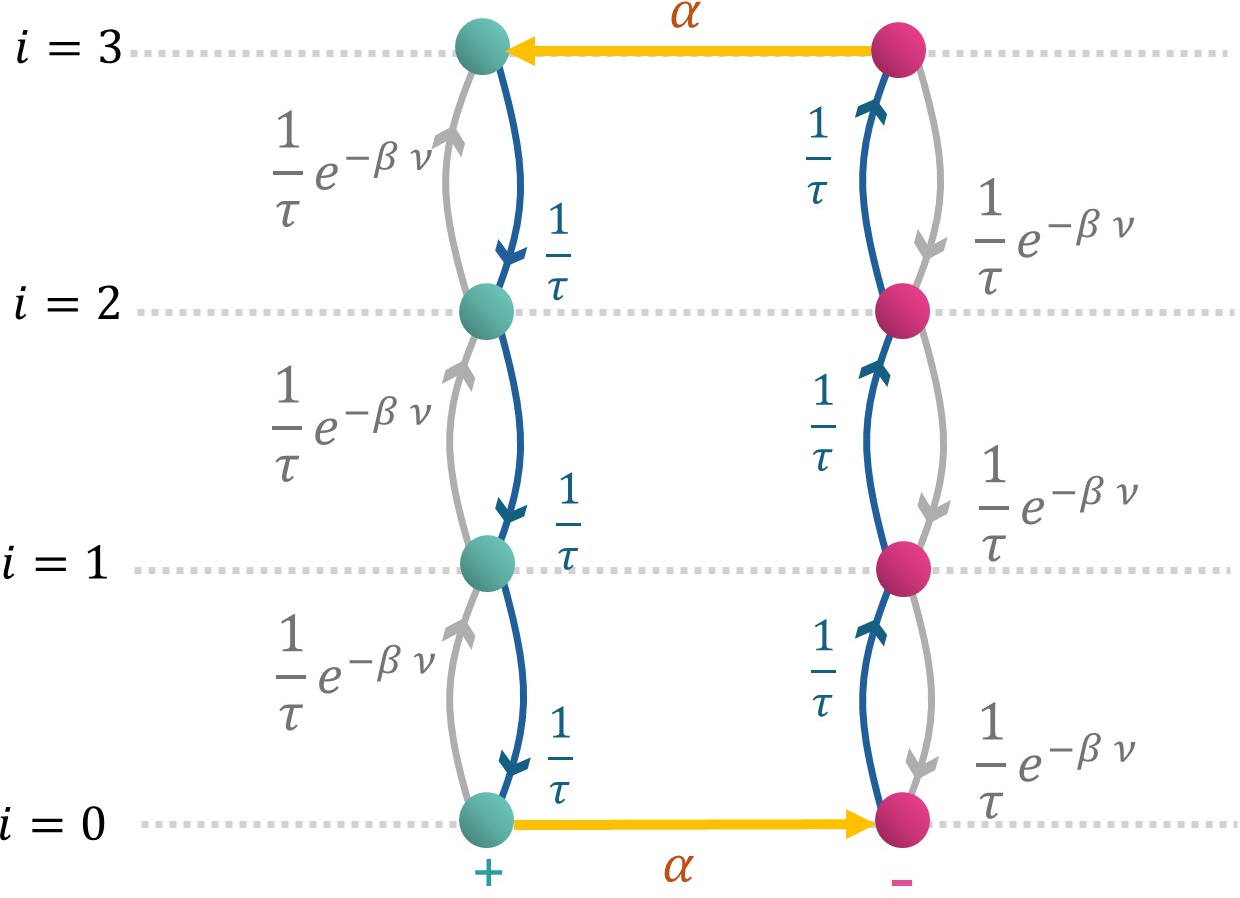
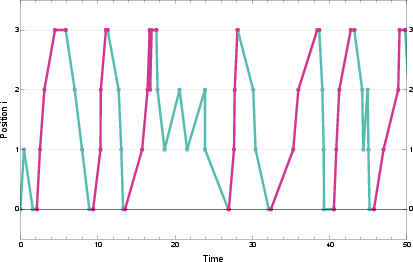
- run-and-tumble particles: Active matter particles alternating between straight runs and random reorientation (tumbles), used to illustrate dissipation with memory. "A simple illustration is the position dynamics of one-dimensional run-and-tumble particles; see \cite{Demaerel2018}."
- Shannon entropy: The information-theoretic entropy of a probability distribution, often coinciding with Gibbs/Boltzmann entropy in equilibrium. "with Shannon entropy }\; S(\mu) = - \sum_x \mu(x) \log\mu(x) \geq 0\notag"
- spontaneous symmetry breaking: The emergence of ordered macroscopic states that do not share the symmetry of microscopic laws. "This is also the regime in which we study phase transitions and spontaneous symmetry breaking."
- steady nonequilibrium: Stationary states maintained by driving or fueling, characterized by persistent currents and time-symmetry breaking. "Rather, steady nonequilibrium refers to driven or fueled systems, possibly agitated in time by memory and external fields, component-wise or globally, via bulk rotational forces or via thermodynamically-frustrating boundary conditions."
- thermodynamic limit: The limiting behavior of macroscopic systems as size goes to infinity, used to justify reservoir and open-system assumptions. "In particular, the thermodynamic limit and time-scale separation are essential ingredients in constructing and interpreting thermal reservoirs and open-system behavior."
- time-reversal invariance: Symmetry under reversing the direction of time; typically broken in nonequilibrium steady states with currents. "Compared to equilibrium processes, the breaking of (statistical) time-reversal invariance for typical trajectories of steady nonequilibria obviously comes with many drastic changes in phenomenology, and it has interesting and important effects."
Collections
Sign up for free to add this paper to one or more collections.