- The paper introduces a frequency-domain reinterpretation of 3D reconstruction kernels, highlighting the Jinc kernel’s near-ideal low-pass filtering property.
- It conducts a detailed analysis of kernels’ spectral leakage by comparing classical Gaussian and Student’s t distributions with a novel modulation strategy.
- Empirical evaluations reveal notable PSNR, SSIM, and LPIPS gains, confirming the practical efficacy of the modulated kernel approach in reducing aliasing.
Revisiting 3D Reconstruction Kernels as Low-Pass Filters: A Signal Processing Perspective
Introduction and Motivation
This paper introduces a foundational signal processing interpretation to 3D reconstruction, focusing specifically on the spectral characteristics of reconstruction kernels used in explicit scene representations. The central observation is that sampling continuous 3D signals into discrete 2D pixels incurs inevitable spectral aliasing, resulting in the overlap of high and low-frequency components due to periodic extension in the frequency domain. Consequently, the principal challenge for anti-aliased, high-fidelity 3D reconstruction is the design of effective low-pass filters—i.e., kernels that can ideally isolate the baseband and suppress aliased frequency components.
The paper investigates the commonly employed 3D kernels such as Gaussians, Exponential, and Student’s t-distributions, systematically analyzes their inherent limitations as low-pass filters, and introduces novel alternatives rooted in Fourier analysis. The authors make strong claims regarding the frequency optimality of their proposed Jinc kernel, theoretically eliminating aliasing at the cost of increased spatial support.
Frequency Analysis of 3D Reconstruction Kernels
A comprehensive frequency domain analysis is provided for several canonical reconstruction kernels:
- Point Clouds: Conceptualized as delta functions; have flat frequency responses and no low-pass filtering effect, associated with poor visual quality due to the complete lack of spectral suppression.
- Gaussian Kernels: Both spatial and frequency domains have Gaussian forms, providing limited suppression but allowing “leakage” of high-frequency components.
- Exponential and Student’s t-distributions: Trade off spatial decay and spectral selectivity; the Student’s t offers heavier tails in spatial decay but does not suppress high frequencies sufficiently.
A comparative summary of frequency and spatial characteristics is provided for five representative kernels, illustrating the essential trade-offs in energy concentration and decay properties.
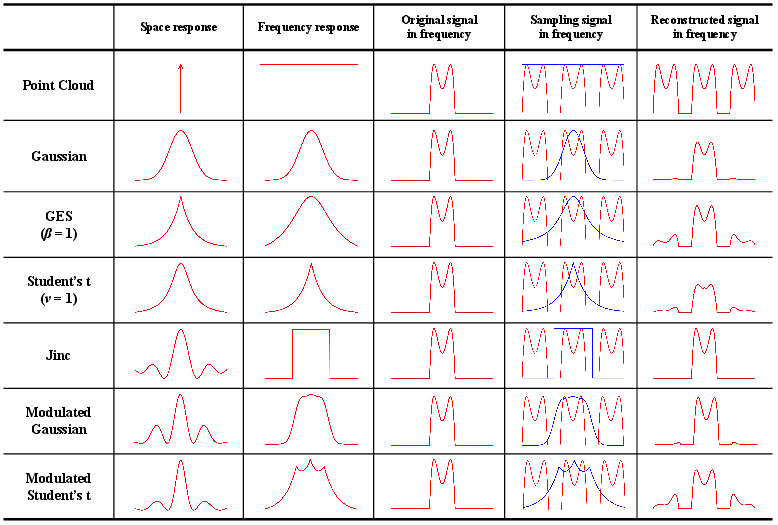
Figure 1: Frequency analysis and qualitative comparison of five 3D reconstruction kernels, highlighting differences in spectral isolation and spatial decay.
The paper notes that while existing kernels suppress some high-frequency energy, their frequency responses have slow rolloffs, invariably leading to aliasing artifacts after sampling.
Ideal Low-Pass Filtering with the Jinc Kernel
The key technical contribution is the introduction of the Jinc kernel, constructed as the inverse 3D Fourier transform of the ideal (spherical) low-pass filter. The Jinc kernel exhibits a frequency response with an instantaneous drop to zero at the cutoff frequency, in direct correspondence to the mathematical ideal low-pass filter. This property theoretically guarantees the elimination of high-frequency aliasing. The spatial form of the kernel, involving the spherical Bessel function j1, demonstrates slow decay (∝r−1) and unavoidable ringing artifacts from the Gibbs phenomenon.
Through rigorous derivation, the authors present analytic expressions for coordinate transformations, ray integration, active kernel footprint, and backward gradients—enabling differentiable rasterization in practical settings.
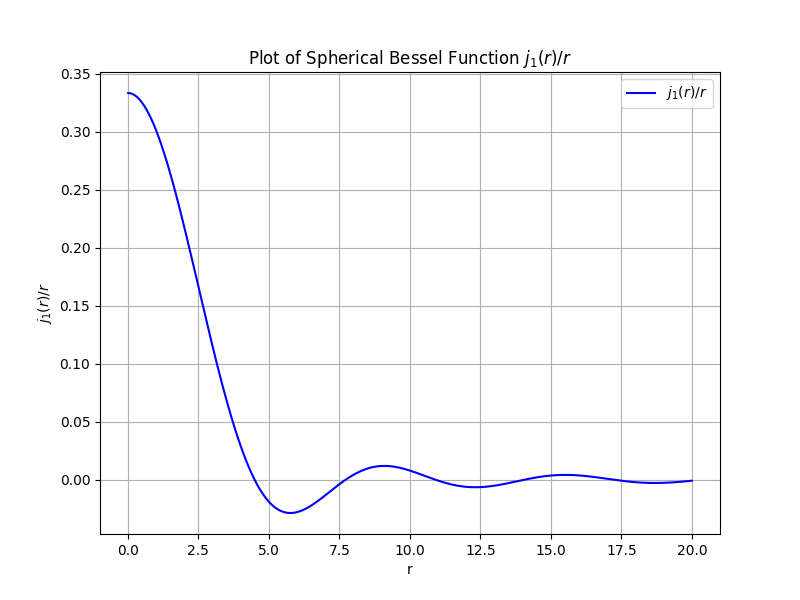
Figure 2: The spatial structure of the Jinc kernel, visualizing the central lobe and oscillatory sidelobes introduced by ideal low-pass filtering.
Spatial Efficiency and the Modulated Kernel Strategy
The practical deployment of the Jinc kernel in 3D rendering encounters two primary hurdles: (1) the slow spatial decay requires large spatial support, resulting in excessive memory and compute, and (2) truncating the kernel in the spatial domain introduces deterministic artifacts (rectangular patterns) due to discontinuities.
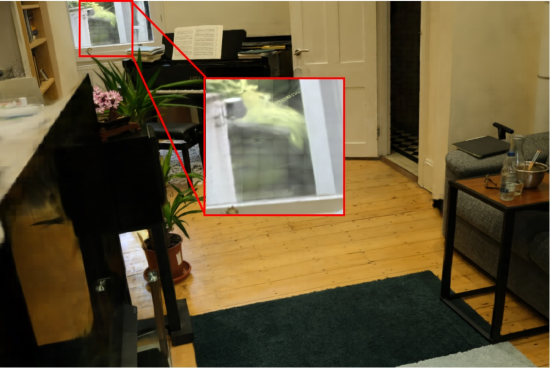
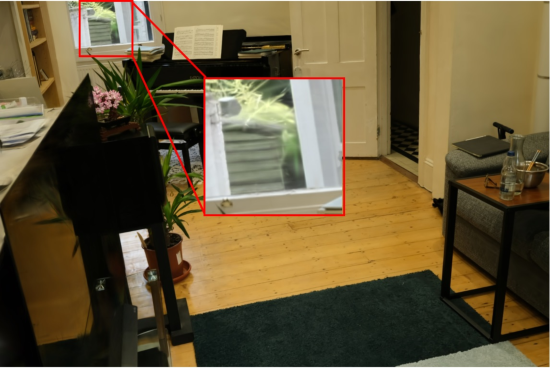
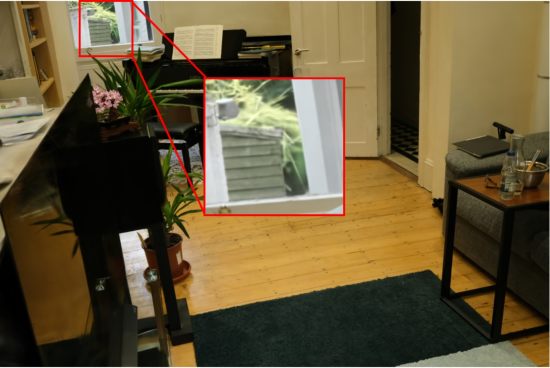
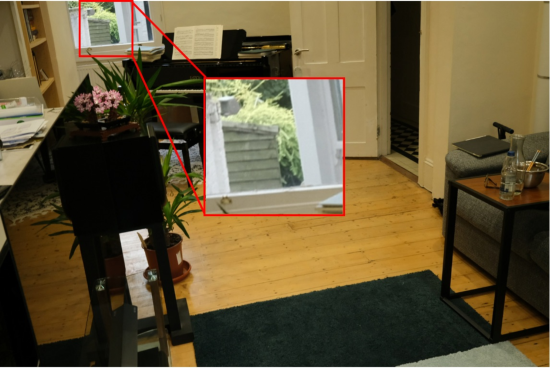
Figure 3: Impact of spatial decay speed: Jinc-based kernels cause visible rectangular artifacts under practical truncation, while Gaussian-based kernels achieve smooth decay, and modulated kernels offer a balanced compromise.
To address these, the paper proposes modulated kernels. By frequency modulation—multiplying a base (Gaussian or Student’s t) kernel by a cosine—followed by kernel accumulation, the spatial base kernel’s fast decay is preserved, and the frequency response is reshaped to approximate the ideal low-pass profile. Analytical derivations for modulation parameters are provided, including frequency shifts related to the FWHM of the base kernel.
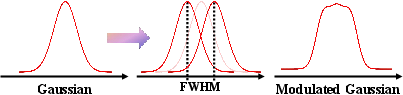
Figure 4: Frequency modulation of a Gaussian kernel: proper frequency shifting enables the kernel to better approximate the ideal filter response in the frequency domain.
This approach yields kernels that inherit the computational efficiency of explicit Gaussians or Student’s t-distributions but with substantially reduced high-frequency leakage.
Empirical Results and Quantitative Evaluation
The experimental evaluation validates both low-resolution and high-resolution 3D reconstruction scenarios. The Jinc kernel demonstrates dominating PSNR, SSIM, and LPIPS scores in low-resolution settings, achieving up to 0.7 dB PSNR improvement on synthetic datasets compared to the best baselines. However, at high resolutions, the practical cost of large spatial support and associated memory usage limits its utility.
Conversely, modulated kernels provide consistent improvements on top of both 3D Gaussian Splatting and Student Splatting baselines across multiple public datasets (Mip-NeRF360, Tanks and Temples, Deep Blending). For example, modulated 3DGS yields up to 0.72 dB PSNR gain and 0.012 SSIM improvements over vanilla kernels. Qualitative renderings show sharper boundaries, improved color fidelity, and reduced blurring vis-à-vis non-modulated approaches.
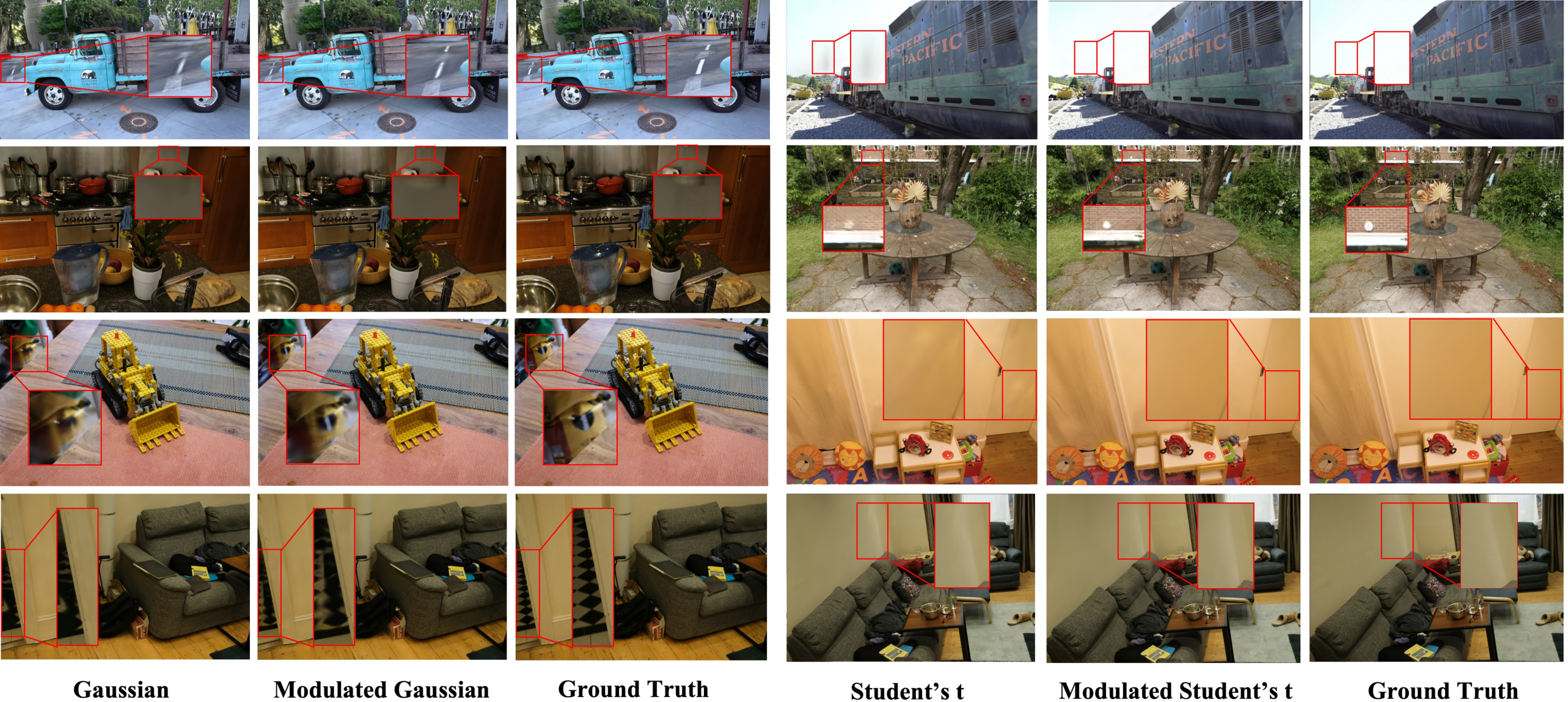
Figure 5: Qualitative rendering comparisons: baseline and modulated kernels visualized side-by-side, underlining improvements in texture sharpness and background detail.
Theoretical and Practical Implications
This work robustly demonstrates that a frequency-domain analysis is essential for kernel design in 3D reconstruction. The Jinc kernel stands as a mathematically optimal anti-aliasing filter; however, spatial inefficiency and ringing make it an imperfect solution in practice. The modulation-based approach leverages spectral tailoring to achieve most of the ideal kernel’s benefits without incurring intolerable computational overhead.
These results imply that explicit 3D representations (such as splatting-based techniques) can be systematically improved via principled signal processing, rather than through heuristic kernel engineering. The modulation methodology is generic and can be extended to other explicit or feed-forward pipelines.
Future Directions
While the modulation strategy partially mitigates the limitations of the Jinc kernel, challenges such as ringing artifacts and the need for ever-broadening spatial support persist. Further research should address the construction of spatial filters that approach spectral optimality while controlling for spatial compactness and artifact formation—potentially via adaptive or data-driven kernel design. The extension to dynamic and 4D settings, as well as generative scene priors for increasing effective sampling rates, are compelling directions for future work.
Conclusion
By reframing 3D reconstruction as a frequency-domain signal recovery problem, the authors rigorously interrogate the design space of reconstruction kernels, demonstrating both theoretical and empirical advances. The Jinc kernel achieves frequency optimality at a practical cost, while the proposed modulation strategy strikes a pragmatic balance between spectral fidelity and rendering efficiency, setting a new benchmark for anti-aliased 3D view synthesis.