- The paper presents an analytical solution for the Schrödinger equation with 1/r^3 and 1/r^2 potentials, capturing universal Efimov scaling in mixed-dimensional dipolar systems.
- The derived framework via quantum defect theory distinguishes repulsive and attractive cases, detailing wavefunction behavior and short-range effects.
- Numerical validations confirm the analytical predictions, offering practical guidance for experiments in ultracold atom-molecule mixtures.
Analytical Solution of the Schrödinger Equation with 1/r3 and Attractive 1/r2 Potentials for Mixed-Dimensional Efimov States
Introduction and Physical Motivation
The study systematically addresses analytical solutions of the Schrödinger equation with 1/r3 and attractive 1/r2 potentials, germane to universal three-body phenomena in ultracold atomic and molecular systems. Particularly in mixed-dimensional geometries where two heavy dipolar particles are confined quasi-one-dimensionally and interact with an unconfined light particle, this potential structure naturally emerges via the Born-Oppenheimer approximation. The derived framework captures the Efimov effect, manifesting discrete scale invariance in the spectrum of bound states, and enables a rigorous analysis of the associated three-body parameter governing universality.
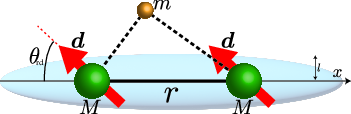
Figure 1: Schematic illustration of the three-body system studied; two confined dipolar heavy particles interact with an unconfined light particle.
Analytical Solution via Quantum Defect Theory
The paper extends quantum defect theory (QDT) to solve the Schrödinger equation with 1/r3 and attractive 1/r2 potentials and details both repulsive and attractive 1/r3 cases:
- Repulsive 1/r3: The solutions for binding energies and wave functions exhibit suppression of the wavefunction at short interparticle distances, rendering three-body observables insensitive to short-range physics. Specifically, the three-body parameter is set solely by the dipole length scale β3=2μ∣C3∣.
- Attractive 1/r3: Here, the wave function extends into the short-range region, and the binding energies explicitly depend on the short-range phase shift via the QDT parameter Kc, encoding details beyond the universal dipolar scale.
These findings are validated by exact agreement with numerics across relevant parameter regimes.
Discrete Scale Invariance and Efimov Universality
The analytical approach leads to discrete-scale-invariant energy spectra for mixed-dimensional Efimov states. For repulsive interactions,
En∝μβ321exp(−∣s∣2nπ)
reflects universality in the three-body parameter, independent of microscopic details. In contrast, for attractive interactions, the spectrum includes explicit dependence on Kc, and thus on short-range physics, yet universal relations persist if Kc is linked to low-energy two-body scattering observables. This is formally analogous to van der Waals universality in three-body problems.
Numerical Validation: Wavefunction Structure
Numerical solutions corroborate the analytical predictions. For repulsive dipolar interactions, the ground and excited Efimov states are exponentially suppressed at short interparticle separations, matching the QDT-derived wavefunction. For attractive dipolar interactions, prominent oscillatory behavior and penetration into short-range regimes is observed, consistent with analytical outcomes.
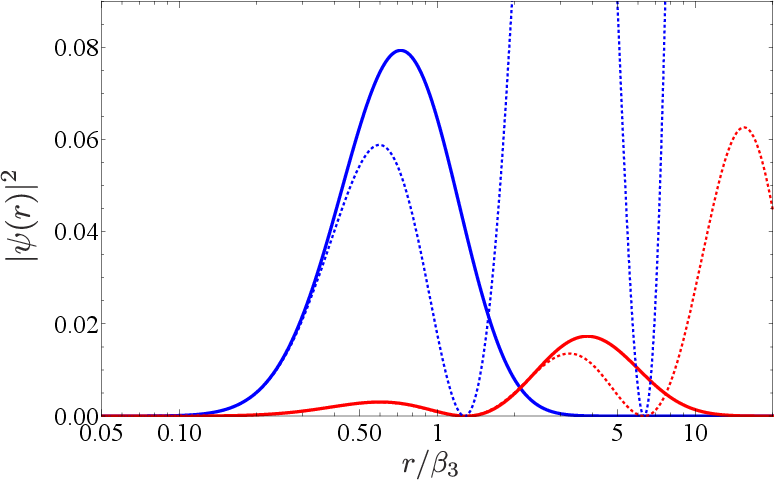
Figure 2: Efimov states’ wave function for a repulsive 1/r3 potential, showing suppression at short distances due to dipole repulsion.
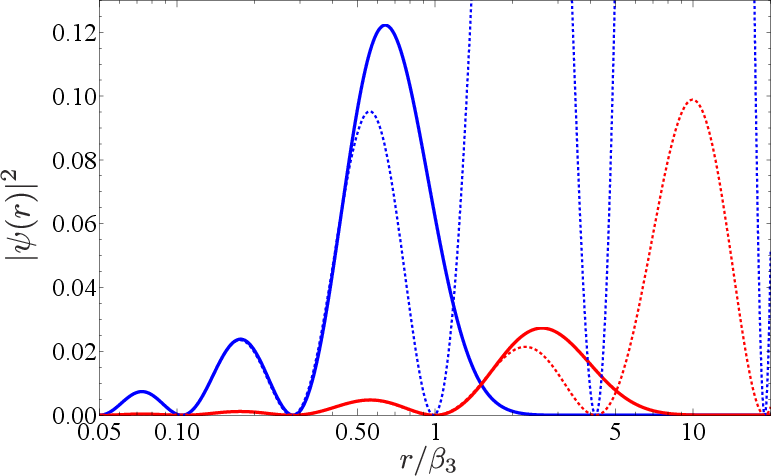
Figure 3: Efimov states’ wave function for an attractive 1/r3 potential, exhibiting oscillatory behavior and penetration into short-range regions.
Influence of Axial Confinement and Experimental Realizability
Finite transverse confinement alters the effective interactions, and the degree to which one-dimensional analytical results remain valid is systematically assessed. The analytical solutions remain quantitatively accurate under tight cigar-shaped trapping—parameters achievable for polar molecules such as 23Na40K, but more challenging for dipolar atoms. The discrete scaling persists robustly for low-energy states, as long as the condition l/β3≪1 is met, where l is the harmonic oscillator length of the transverse trap.
Theoretical and Practical Implications
- Universality Mechanism: The results highlight two contrasting universality mechanisms. For repulsive dipolar interactions, universality stems from wavefunction suppression at short range. For attractive interactions, universality is conditional upon a universal mapping of the short-range QDT phase to the low-energy two-body scattering length, as in mass-imbalanced van der Waals trilogies.
- Experimental Probes: These analytical predictions are directly testable in contemporary ultracold molecule-atom mixtures with Feshbach tuning; Efimov state signatures can be isolated via three-body loss spectroscopy, RF association, or coherent oscillation observables.
- Quantum Information Relevance: A microscopic understanding of three-body correlations in such dipolar systems could inform loss mitigation and entangling gate fidelity in quantum information architectures based on polar molecules.
Outlook for Future Research
The analytical machinery here may be extended to multi-channel, anisotropic, or quasi-one-dimensional problems involving Rydberg states or strongly correlated systems, and possibly facilitate the design of synthetic lattices with tunable Efimov scaling. Refinements incorporating full three-dimensional treatment or higher-order confinement effects remain an open theoretical direction.
Conclusion
This work presents a rigorous analytical solution to the Schrödinger equation with 1/r3 and attractive 1/r2 potentials within the quantum defect theory framework, providing explicit formulae for Efimov state energies and wave functions in mixed-dimensional dipolar systems. The findings clarify the universal and non-universal mechanisms governing three-body parameters and demonstrate strong alignment with numerical solutions. These results are immediately applicable to contemporary cold atom and molecule experiments and offer a foundation for further investigations into quantum few-body and many-body physics in dipolar systems.