- The paper introduces a Green's function-based framework to enclose Poisson's equation solutions with rigorously defined sub- and super-solutions.
- Utilizing the Method of Fundamental Solutions, it achieves sharp pointwise error bounds even in non-convex or singular domains.
- Numerical experiments validate quadratic convergence for smooth sources and demonstrate the framework's applicability to complex geometries.
Green's Function-Based Enclosure Framework for Poisson's Equation
Overview
This paper introduces a rigorous and versatile framework for enclosing solutions of the Poisson equation through generalized sub- and super-solutions constructed from fundamental (i.e., Green’s) functions. Unlike classical approaches relying on variational inequalities — which are not always sufficiently general for natural function classes or polygonal domains lacking H2 regularity due to singularities — the proposed methodology enables pointwise solution bounds via a "Green-representable" formulation. This is achieved by employing analytical kernels derived from fundamental solutions within the weak solution setting, together with test functions configured via the Method of Fundamental Solutions (MFS).
Motivation and Limitations of Classical Methods
The Poisson equation under Dirichlet boundary conditions,
−Δu=f in Ω,u=0 on ∂Ω,
is foundational in mathematical physics and engineering. Established numerical methods — finite element and finite difference — typically utilize variational sub- and super-solutions to bound errors. However, in non-convex domains with reentrant corners or discontinuous source terms, classical regularity results (H2) fail, leading to technical and theoretical obstacles. Standard variational super-solution definitions are not universally applicable to piecewise linear or discontinuous functions, as explicitly demonstrated by counterexamples (Figure 1).
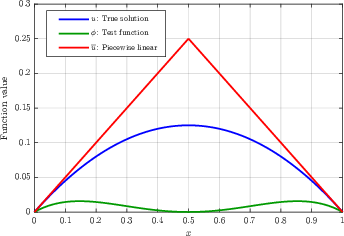
Figure 1: Linear functions do not satisfy the super-solution condition. Blue: true solution of Poisson's equation; Red: piecewise linear function fails the conventional bound.
Green-Representable Solutions: Theory and Construction
The paper introduces the concept of Green-representable solutions, wherein the solution at a fixed point is expressed as a sum of fundamental solution integrals and boundary terms:
u(s)=∫Ωf(x)ϕs(x)dx+⟨∂n∂u,γ(ϕs)⟩,
where ϕs is a test function constructed as the fundamental solution centered at s, augmented by linear combinations of additional harmonics to approximate boundary conditions.
For one dimension, the kernel is piecewise linear; in higher dimensions and polygons, the MFS is used to build ϕs using external singularities and collocation points (see Figure 2).
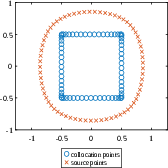
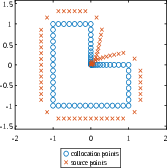
Figure 2: Distribution of collocation and source points for domains; both square and L-shaped have 69 points.
Green-representability is established for u∈H01(Ω)∩W1,q(Ω) (q>N), including non-convex polygons where H2 regularity fails but pointwise evaluation remains valid. Enclosures do not require explicit construction of canonical Green's functions; rather, pointwise bounds follow using test kernels.
Generalized Sub- and Super-Solutions
The framework generalizes sub- and super-solution definitions within the Green-representable regime. For u, a super-solution, and mapping s↦ϕs,
⟨∇u,∇ϕs⟩≥⟨f,ϕs⟩+∫∂Ωu∂n∂ϕsdS,
and u≥0 on ∂Ω; analogous inequalities hold for sub-solutions. This enables construction of rigorously pointwise and local solution bounds, which prior approaches cannot provide.
Numerical Results in 1D and 2D
Extensive numerical experiments demonstrate the proposed method's error behavior and enclosure properties.
One-Dimensional Case
For constant and discontinuous sources, Algorithm 1 repeatedly adjusts a discretized RHS to enforce test kernel inequalities on grid intervals, using a boundary shift parameter c. Enclosure error analysis shows quadratic (O(h2)) convergence for smooth sources and linear (O(h)) for discontinuous ones (Figures 2, 3, 7, 8).
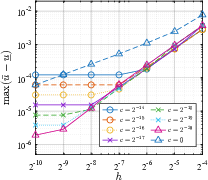
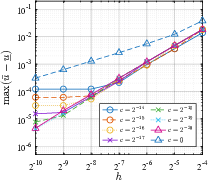
Figure 3: Enclosure error versus mesh size h for various boundary shifts c (f=1 left, f=5 right).
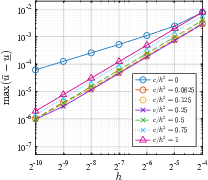
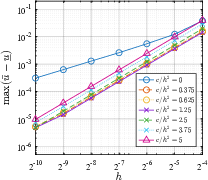
Figure 4: Error behavior as a function of mesh size for different C=c/h2 values (f=1 and f=5).
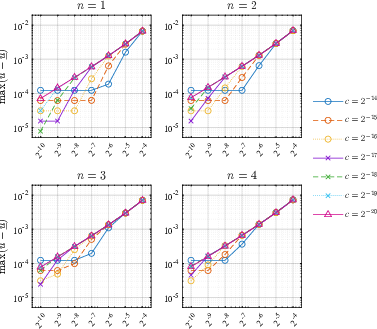
Figure 5: Error vs. mesh size for discontinuity at a=0.25, showing O(h) scaling.
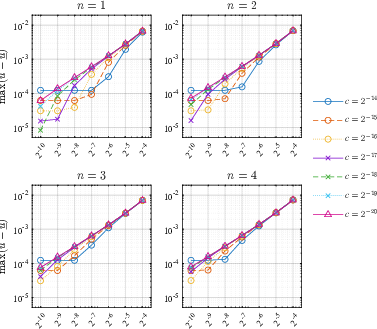
Figure 6: Error vs. mesh size for discontinuity at a=0.5; optimal scaling with c observed.
For f=1, u(x)=x(1−x)/2 is sharply enclosed by the computed sub- and super-solutions depending on boundary shift c (Figure 7, 5).
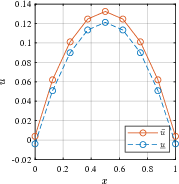
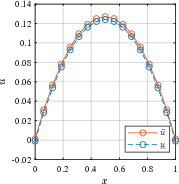
Figure 7: Visualization of solution enclosures for f=1; computed bounds tightly sandwich the exact solution.
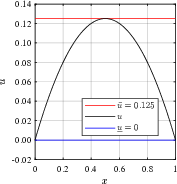
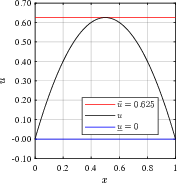
Figure 8: Exact solution and optimal constant sub- and super-solutions; bounds match supremum/infimum of u.
For discontinuous f, the method maintains optimal bounds despite kinks in the solution profile (Figure 9).
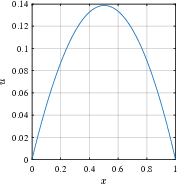
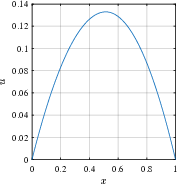
Figure 9: Approximate solutions for discontinuous sources; kink is rigorously enclosed.
Two-Dimensional Polygonal Domains
For square and L-shaped domains, test functions constructed via MFS (Figure 2) yield pointwise enclosures for constant, polynomial, and rapidly oscillating source terms. The enclosure intervals for the square are extremely sharp (10−6−10−8 errors); those for the L-shaped domain are wider due to corner singularities, but remain valid even where H2 regularity is lost (Figure 10).
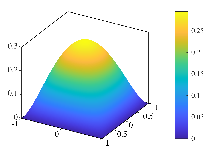
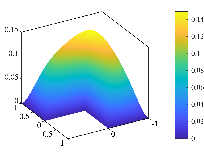
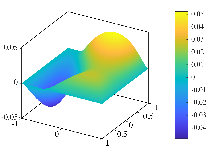
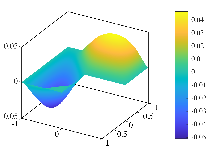
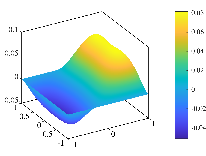
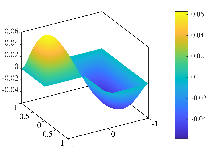
Figure 10: Computed solution enclosures for square domain Ω□.
Impact of Boundary Regularity and Source Term Smoothness
A strong result is the ability to maintain rigorous pointwise evaluation and enclosures in domains and for source terms that traditionally defeat variational methods due to lack of regularity. Error analysis is consistent with regularity-theoretic predictions: optimal O(h2) rates in smooth contexts, loss to O(h) in the presence of discontinuities.
Implications and Future Directions
The framework enables verified local and pointwise bounds for the Poisson equation in arbitrary domains and for possibly discontinuous sources, thereby extending the applicability of rigorous numerical PDE methods to previously inaccessible regimes. The accuracy of an enclosure is shown to be quantitatively related to the MFS approximation quality, providing a new lens on MFS performance in verified computation.
Potential extensions include:
- Global error bands in high-dimensional domains: Generalizing pointwise bounds to uniform domain-wide solution intervals requires further control of kernel parameterization and uniform boundary value minimization.
- Optimization of kernel construction: Employing algorithmic strategies (e.g., gradient-based search, machine learning heuristics) may yield sharper enclosures by optimizing kernel placement and coefficient selection.
- Extension to broader PDE classes: The approach is applicable to linear elliptic equations admitting fundamental solutions, e.g., Helmholtz, Advection-Diffusion.
Conclusion
This research provides a robust, Green's function-based enclosure technique for Poisson's equation that generalizes conventional error bounding methods, requires only local regularity, and is practically implementable. It is proven to produce sharp, rigorous solution intervals even under non-smooth geometric and source conditions, with controlled complexity. The approach’s sensitivity to MFS construction motivates further algorithmic research at this intersection of numerical analysis and verified computation.