A Cool Earth-sized Planet Candidate Transiting a Tenth Magnitude K-dwarf From K2
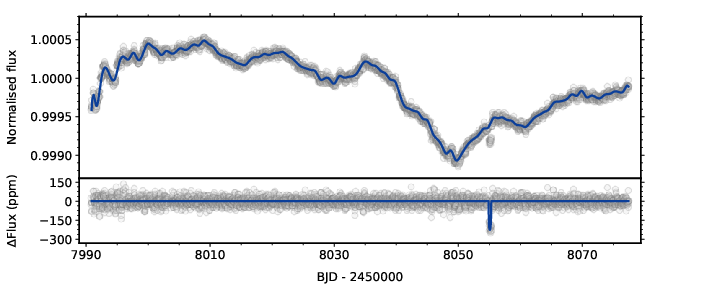
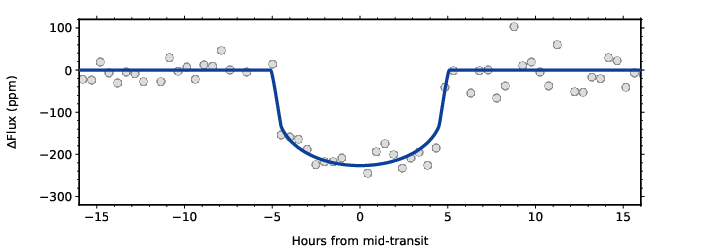
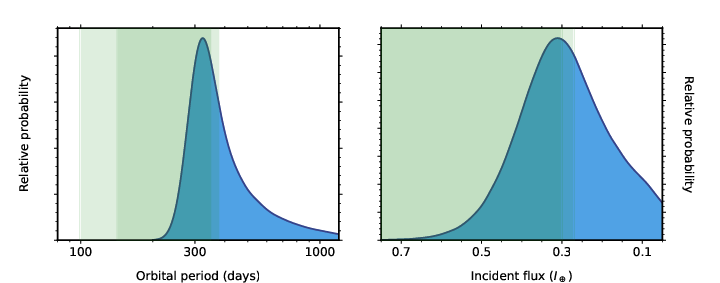
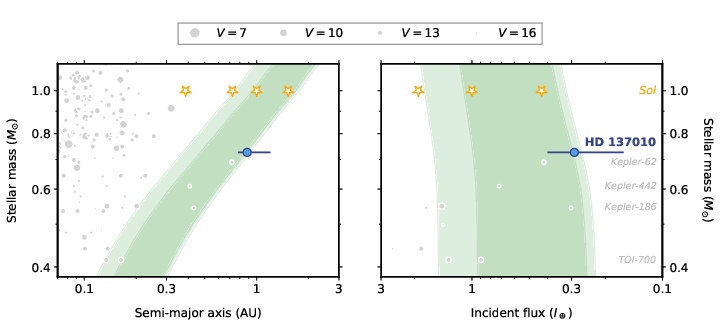
Abstract: The transit method is currently one of our best means for the detection of potentially habitable "Earth-like" exoplanets. In principle, given sufficiently high photometric precision, cool Earth-sized exoplanets orbiting Sun-like stars could be discovered via single transit detections; however, this has not previously been achieved. In this work, we report a 10-hour long single transit event which occurred on the $V=10.1$ K-dwarf HD 137010 during K2 Campaign 15 in 2017. The transit is comparatively shallow ($225\pm10$ ppm), but is detected at high signal-to-noise thanks to the exceptionally high photometric precision achieved for the target. Our analysis of the K2 photometry, historical and new imaging observations, and archival radial velocities and astrometry strongly indicate that the event was astrophysical, occurred on-target, and can be best explained by a transiting planet candidate, which we designate HD 137010 b. The single observed transit implies a radius of $1.06{+0.06}_{-0.05}$ $R_\oplus$, and assuming negligible orbital eccentricity we estimate an orbital period of $355{+200}_{-59}$ days ($a=0.88{+0.32}_{-0.10}$ AU), properties comparable to Earth. We project an incident flux of $0.29{+0.11}_{-0.13}$ $I_\oplus$, which would place HD 137010 b near the outer edge of the habitable zone. This is the first planet candidate with Earth-like radius and orbital properties that transits a Sun-like star bright enough for substantial follow-up observations.
Paper Prompts
Sign up for free to create and run prompts on this paper using GPT-5.
Top Community Prompts
Explain it Like I'm 14
What is this paper about?
This paper describes the discovery of a likely Earth-sized planet that passed in front of (transited) a nearby, Sun-like star called HD 137010. The team saw just one 10-hour-long “dip” in the star’s light during NASA’s K2 mission in 2017. Even though it was only a single event, the dip’s shape and tiny depth match what you’d expect from a small planet. If their interpretation is right, this planet—named HD 137010 b—has a size similar to Earth and an orbit that’s probably close to one year. It receives less sunlight than Earth, putting it near the outer edge of the star’s habitable zone.
What questions were the researchers trying to answer?
They focused on three simple questions:
- Did the brief dimming of the star’s light really happen on HD 137010, and was it caused by a planet?
- If it was a planet, how big is it and how far does it orbit from the star?
- Are there any other objects (like a second star or background eclipsing systems) that could explain the dip instead of a planet?
How did they study it?
Think of watching a porch light at night and noticing it gets the tiniest bit dimmer for a few hours. If a moth flies across the light, it causes a small, smooth, U-shaped dip in brightness. That’s the basic idea of the “transit method.”
Here’s how they approached the problem:
- Using precise K2 data: K2 measured the star’s brightness very accurately over 88 days. The team saw a 10-hour dimming that was only about 225 parts per million deep (that’s like the light dimming by 0.0225%). The data were so clean that even such a tiny change stood out clearly.
- Checking the signal’s strength: They calculated the “signal-to-noise ratio,” which tells you how strong the dip is compared to random wiggles in the data. It was high enough to be considered statistically significant.
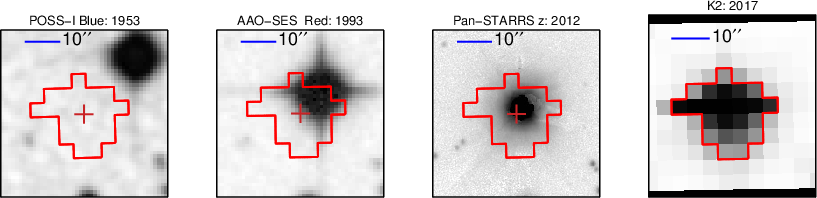
- Ruling out impostors: They checked images of the sky, including old photos and new high-resolution pictures, to make sure there wasn’t a hidden background star or nearby eclipse causing the dimming. They also looked at the star’s motion data (astrometry) and its wobble measured by starlight spectra (radial velocities) to see if a big companion star could be responsible. These tests did not support the false-positive scenarios.
- Estimating the orbit from a single transit: Because K2 only watched the star for about three months, there was no second dip to give a definite period. Instead, they used the dip’s duration, the star’s size and density, and a reasonable assumption that the orbit isn’t very stretched (low eccentricity) to estimate the orbital period. A shorter dip on a smaller star can still match an Earth-like year if the geometry lines up.
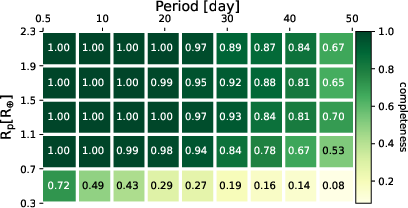
- Searching for other planets: They ran “injection and recovery” tests—adding fake planet signals of different sizes and periods to the data to see what would be detectable. This showed they would have found any other Earth-sized planets with short orbits, so the system probably doesn’t have additional close-in transiting planets.
What did they find, and why does it matter?
Their main results are:
- Planet size: The dip’s depth suggests a planet about 1.06 times Earth’s radius—very close to Earth-sized.
- Orbit and distance: The best estimate for the time it takes to go around the star is about 355 days (with large uncertainties), and the distance from the star is roughly 0.88 times Earth’s distance from the Sun.
- Star and temperature: The star is a K-dwarf (a bit smaller and cooler than the Sun). Given the star’s lower brightness and the planet’s likely distance, the planet receives about 29% of the sunlight Earth does. That places it near the outer edge of the habitable zone, where liquid water could be possible under the right conditions (for example, with a greenhouse atmosphere).
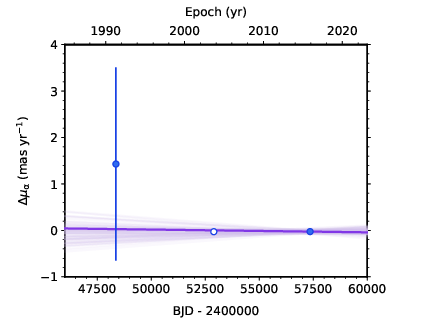
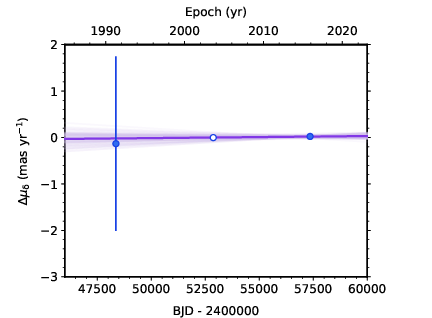
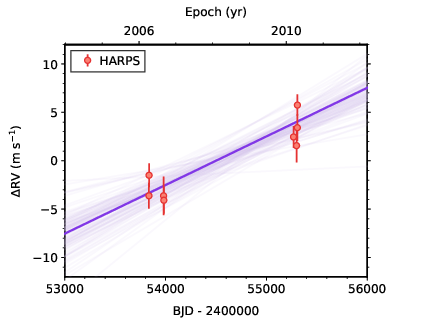
- Clean environment: They found no evidence of nearby or background stars bright enough to fake the signal, and no signs of a big, bound companion star that could cause similar dimming. They did notice a small long-term change in measured radial velocity years apart, which might hint at a distant, lower-mass companion (like a giant planet or brown dwarf), but more data are needed to know for sure.
Why it matters: This is the first candidate of its kind—a truly Earth-sized planet with an Earth-like year transiting a bright, Sun-like star—bright enough for future detailed follow-up. Most earlier finds of small, temperate planets orbit bright stars have been around much smaller M-dwarfs, and planets with Earth-like orbits around Sun-like stars are extremely hard to catch because their transits happen only once a year and are very shallow.
What’s the bigger picture?
Finding Earth-like planets around Sun-like stars is one of the toughest and most exciting goals in astronomy. This discovery shows that single-transit events, when seen with very precise data, can reveal such planets even if we only catch one “blink.” It also points the way for future missions (like PLATO) and careful follow-up work:
- Because the star is relatively bright, telescopes can try to watch for the next transit to confirm the orbital period.
- If confirmed, future instruments could study the planet’s atmosphere (if it has one) or search for more planets in the system.
- It adds to the small but growing list of cool, Earth-sized worlds near Sun-like stars—key targets for the long-term search for potentially habitable planets.
In short, this paper presents a strong planet candidate that looks a lot like Earth in size and orbit, around a nearby, Sun-like star. It’s a promising step toward finding worlds that might be similar to our own.
Knowledge Gaps
Knowledge gaps, limitations, and open questions
Below is a consolidated list of what remains uncertain or unexplored in the paper, framed as concrete, actionable items for future work:
- Single-transit limitation and ephemeris uncertainty:
- No repeat transit observed; the orbital period posterior ( d) yields large timing uncertainties. Publish and maintain a Monte Carlo–based ephemeris forecast (windows and probabilities over the next 5–10 years) to coordinate multi-facility follow-up.
- Identify optimal facilities (e.g., CHEOPS, PLATO fields, long-baseline ground networks) capable of capturing the next transit with sub-minute cadence.
- Eccentricity and period degeneracy:
- The transit model assumes zero eccentricity; eccentric solutions could substantially alter , , and incident flux. Perform a full eccentricity–period joint inference (e.g., with Beta priors from Kipping 2013/2018) and quantify how allowed modifies ephemeris forecasts and HZ placement.
- Ingress/egress and impact parameter are poorly constrained:
- K2 long-cadence (29.4 min) smears ingress/egress; impact parameter and transit chord geometry remain degenerate. Design high-cadence photometry for the next event to resolve ingress/egress and break degeneracies among , , and .
- Statistical validation framework for single transits:
- No formal false-positive probability (FPP) is computed (vespa/TRICERATOPS not directly applicable to single transits). Develop or apply a Bayesian single-transit FPP framework that integrates priors on background populations, speckle/Gaia limits, centroid constraints for saturated K2 targets, and transit-shape diagnostics.
- Instrumental/systematic false-alarm assessment:
- While nearby K2 stars were checked and matched-filter SNR was computed, an empirical false-alarm probability was not quantified. Perform bootstrap/permutation tests and independent detrendings (e.g., EVEREST, K2SC, K2SFF variants) to estimate the FAP of a 10 hr, ~225 ppm dip under realistic red-noise conditions.
- Examine correlations with K2 thruster fire times, roll-angle systematics, and known artifact flags specific to saturated targets.
- Centroid analysis constraints due to saturation:
- Standard difference-image centroiding was limited. Apply specialized centroid/halo-photometry techniques for saturated Kepler/K2 targets to bound off-target scenarios at the sub-pixel level.
- Background contamination deeper than archival limits:
- Archival imaging rules out background stars to ~19th mag; fainter sources remain possible in principle. Obtain deep, modern imaging (e.g., 8–10 m AO in the optical/NIR) at the sky position corresponding to the 2017 K2 aperture to >23–24 mag to exclude ultra-faint background EBs or blends.
- Bound companion architecture not fully closed:
- The RV acceleration (+1.7±0.4 m s⁻¹ yr⁻¹) may indicate an additional companion; linearity is unproven due to sparse RV sampling (two short epochs). Acquire a multi-year, uniform, high-precision RV time series (and contemporaneous activity indicators) to confirm/characterize the trend, search for curvature, and refine limits on stellar/brown-dwarf companions.
- Targeted high-contrast AO imaging in the NIR to search for substellar companions at 5–100 AU that could explain the RV trend and to further constrain blend scenarios.
- Gaia astrometry not yet fully exploited:
- Current HGCA shows no significant tangential acceleration, but sensitivity improves with future Gaia releases. Plan to re-evaluate with Gaia DR4/DR5 non-single-star solutions and RUWE/time-series astrometry to tighten constraints on wide companions and accelerations.
- Additional transiting planets not excluded at longer periods:
- Injection–recovery was limited to P ≤ 50 d; completeness rapidly declines beyond ~30 d. Extend searches for (a) additional single-transit events in the same light curve and (b) longer-period periodic signals using tailored long-period transit search methods.
- TESS and other survey data not checked:
- Investigate TESS FFIs/2-min data (if available), KELT/ASAS-SN/ZTF light curves for repeats or additional single-transit-like events and to better characterize stellar variability and rotation.
- Stellar rotation and activity characterization:
- The K2 light curve shows low-level variability on week timescales; no rotation period or activity–RV coupling is quantified. Derive a robust rotation period from K2/TESS/ground photometry and use archival/future spectra to model activity-induced RV noise that could complicate trend detection.
- Limb-darkening and stellar-parameter systematics:
- Limb-darkening coefficients were fit with broad uncertainties; stellar parameter priors dominate Rp and . At the next transit, obtain multi-band, high-cadence photometry to constrain limb darkening and reduce Rp and impact-parameter systematics.
- Mass and composition remain unconstrained:
- For an Earth-sized, ~1-yr planet around a K-dwarf, RV semi-amplitudes are likely below current practical detection limits. Explore alternative mass constraints (e.g., photoeccentric effect with resolved ingress/egress, joint astrometry + RV if a measurable signal emerges, or statistical mass–radius frameworks) and quantify feasibility.
- Habitability assessment is preliminary:
- Incident flux and depend strongly on and . Use climate models with K-dwarf SEDs and varying albedo/greenhouse assumptions to map the posterior over conservative/optimistic HZ boundaries and assess surface habitability likelihood.
- Predictive follow-up roadmap not provided:
- Provide concrete observing windows, required precision/cadence, and decision trees (e.g., what new constraints each dataset would deliver) to maximize the probability of recovering the next transit and validating the planet.
- General completeness and selection effects:
- The detection came via visual inspection; the paper does not quantify survey completeness for single transits of Earth-size planets in K2. Conduct a population-level completeness and false-alarm study for similar K2 targets to assess how many analogous candidates may be undiscovered.
Practical Applications
Overview
The paper reports the discovery and vetting of a single-transit, Earth-sized planet candidate (HD 137010 b) around a bright K-dwarf using K2 data, and introduces a robust, multi-modal workflow that integrates high-precision photometry, red-noise-aware matched filtering, single-transit period inference with priors, injection–recovery completeness mapping, archival imaging, high-resolution speckle imaging, and joint radial-velocity (RV) plus Hipparcos–Gaia astrometric acceleration constraints. These methods, and the finding itself, enable a variety of practical applications across astronomy, software/data analytics, education, and policy.
Immediate Applications
The following applications can be deployed now with existing data, instruments, and workflows:
- Exoplanet vetting pipeline for single-transit events (Academia, Software; Astronomy industry)
- What: Package the paper’s end-to-end vetting workflow—joint systematics+transit modeling (K2SFF-style), red-noise-aware matched filtering, centroid checks, transit-shape diagnostics to reject hierarchical triples, archival imaging crossmatch, Gaia DR3 non-detection limits, and speckle-imaging constraints—into a reproducible pipeline for K2/TESS archival data and ongoing surveys.
- Tools/products/workflows:
- Python/R package and CLI that integrates K2SFF-like detrending, Gilbert-style matched filtering, BLS scans, injection–recovery modules, Gaia/archival imaging API queries, and RV+astrometry acceleration calculators.
- Web dashboard for candidate triage with audit trails for validation decisions.
- Assumptions/dependencies: Access to high-quality light curves (e.g., K2/TESS), Gaia DR3, archival surveys (POSS, Pan-STARRS), speckle or AO imaging time, and at least sparse RV data.
- Follow-up planning for single-transit candidates (Observatories, Mission Ops; Software)
- What: Use duration- and stellar-density-informed period posteriors (Kipping single-transit prior) to predict next-transit windows, prioritize targets, and schedule photometric and RV follow-up.
- Tools/products/workflows: Ephemeris forecaster that returns probability-weighted transit windows and integrates network schedulers for small/medium telescopes and EPRV facilities.
- Assumptions/dependencies: Stellar-density priors and a sensible eccentricity prior; rapid dissemination to follow-up networks.
- RV–astrometry–imaging fusion to exclude false positives and constrain tertiaries (Academia; Observatories)
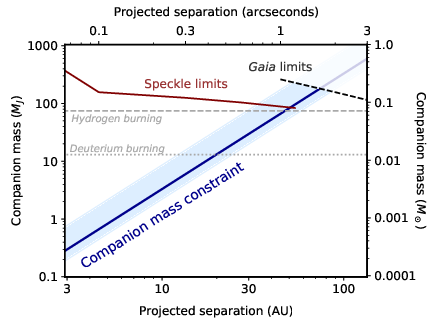
- What: Apply the paper’s joint linear-acceleration model (RV + Hipparcos–Gaia) and contrast curves to map allowed mass–separation space and exclude companions that could mimic transits.
- Tools/products/workflows: Open-source “acceleration-to-mass” calculator (equation workflow) with Gaia+RV inputs; automatic overlay of speckle/Gaia contrast limits.
- Assumptions/dependencies: Linear-acceleration approximation may break for short baselines or curved trends; requires at least two RV epochs and HGCA values.
- Completeness reporting via injection–recovery (Academia; Mission performance assessment)
- What: Use the paper’s injection–recovery framework to generate detectability maps for planets across radius/period, informing null-result constraints and occurrence-rate studies.
- Tools/products/workflows: Modular code to inject, detrend with splines, BLS search, and tally recoveries; reportable figures for proposals/papers.
- Assumptions/dependencies: Representative detrending; robust signal-to-pink-noise thresholding; characterization of red noise.
- Citizen-science–assisted discovery and quality control (Education, Daily life; Academia)
- What: Integrate visual inspection tools (e.g., LcTools) into Zooniverse-like platforms, with automated triage and expert confirmation that mirror the paper’s process.
- Tools/products/workflows: Training datasets derived from paper’s labeled examples; tutorials on transit-shape identification and centroid checks.
- Assumptions/dependencies: Curated data and feedback loops; a moderation pipeline to prevent bias and manage false positives.
- Archival imaging crossmatch service to exclude background eclipsing binaries (Software; Academia)
- What: Service/API that overlays proper-motion tracks and K2/TESS apertures on historical plates (POSS/AAO), Pan-STARRS, and Gaia to set flux-contrast limits on blends.
- Tools/products/workflows: Web tool to automate plate retrieval, compute epoch-specific aperture positions, and estimate contrast limits.
- Assumptions/dependencies: Digitized archives and accurate astrometric solutions; saturation handling for bright targets.
- Red-noise-aware matched filtering for rare-event detection in time series (Software/Data analytics; Cross-domain)
- What: Adapt the matched-filter approach used to boost transit SNR for detecting rare, single-epoch anomalies in other data (e.g., power-grid glitches, IoT sensor failures, finance shock detection).
- Tools/products/workflows: General-purpose matched-filter library with red-noise modeling and significance calibration; templates for domain-specific events.
- Assumptions/dependencies: Availability of event templates or learned kernels; labeled events for calibration.
- Educational modules for data science and astrophysics (Education, Daily life)
- What: Create undergraduate lab units on single-transit detection, CDPP estimation, BLS and matched filtering, injection–recovery, and multimodal vetting.
- Tools/products/workflows: Open Jupyter notebooks, sample K2/TESS light curves, and assessment rubrics.
- Assumptions/dependencies: Open data use and basic programming skills.
- Target catalogs and dashboards for temperate, bright-star candidates (Academia; Mission prep)
- What: Curate and maintain a catalog of single-transit candidates near the habitable zone (HZ) on bright stars with predicted windows, readiness level, and follow-up status for JWST/ELT/PLATO.
- Tools/products/workflows: Public dashboard with filters (brightness, HZ likelihood, window uncertainty); integration with observation planning tools.
- Assumptions/dependencies: Community submissions, regular updates, and agreed prioritization metrics.
Long-Term Applications
These applications require further research, scaling, instrument development, or future mission data:
- Confirmation of Earth analogs via single-transit discovery + multimodal follow-up (Academia; Observatories)
- What: Systematically confirm temperate Earth-sized planets around Sun-like stars by combining single-transit detection (PLATO/ET), extreme-precision RV (cm/s), long-baseline astrometry (GaiaNIR), and direct imaging.
- Tools/products/workflows: Coordinated observing campaigns; global scheduler that fuses posteriors from transit, RV, astrometry, and imaging.
- Assumptions/dependencies: Availability of PLATO/ET data, next-gen EPRV (<10 cm/s), Gaia successor, and high-contrast imagers; stable spectrographs and long baselines.
- Survey strategies optimized for single-transit detection (Space missions; Policy, Mission design)
- What: Design survey cadences and pointing strategies that trade long stare for wide coverage + targeted follow-up informed by single-transit pipelines.
- Tools/products/workflows: Yield simulators that incorporate the paper’s completeness and vetting efficiencies; policy frameworks for time allocation on follow-up networks.
- Assumptions/dependencies: Willingness to alter mission paradigms; robust community follow-up capacity.
- ML-based single-transit classification with multimodal data fusion (Software; Academia)
- What: Train models to classify single-transit candidates and rank false-positive likelihood using light curves, imaging, astrometry, and RVs.
- Tools/products/workflows: Training sets labeled by the paper’s vetting rules; feature extraction (transit shape, centroid drift, contrast limits, acceleration vectors).
- Assumptions/dependencies: Sizable labeled datasets and shared negative examples; explainability requirements for adoption.
- Population and occurrence-rate studies of long-period terrestrial planets (Academia; Policy)
- What: Use single-transit detections and completeness maps to constrain the frequency of HZ Earth-sized planets around FGK stars and refine yield forecasts for future missions.
- Tools/products/workflows: Hierarchical Bayesian models that ingest single-transit posteriors and detection biases.
- Assumptions/dependencies: Larger samples; standardized completeness reporting; careful eccentricity priors.
- Next-gen detectors and photometry algorithms for bright-star saturation (Instrumentation; Software)
- What: Improve detector designs and aperture-handling algorithms to retain ppm-level precision for saturated bright stars (as handled in this paper’s K2 analysis).
- Tools/products/workflows: Novel readout modes, adaptive apertures, drift-aware detrending algorithms.
- Assumptions/dependencies: Instrument R&D cycles and on-sky validation.
- Global networks to catch uncertain next-transit windows (Observatories; Policy)
- What: Build coordinated networks of mid-size telescopes to continuously cover the large time windows predicted for long-period single-transit candidates.
- Tools/products/workflows: Dynamic scheduling platforms; incentive structures for community science and time exchange.
- Assumptions/dependencies: Sufficient geographic coverage; reliable weather redundancy; sustained funding.
- Commercial analytics for rare-event detection in diverse sectors (Industry; Software/Data analytics)
- What: Productize red-noise-aware matched filtering, injection–recovery-based sensitivity calibration, and multi-sensor vetting for rare events in finance, energy, and industrial IoT.
- Tools/products/workflows: SaaS platform offering anomaly templates, uncertainty quantification, and “false-positive killer” modules using auxiliary data (analogous to imaging/astrometry).
- Assumptions/dependencies: Sector-specific data access and privacy considerations; domain-adapted templates.
- Integrated HZ target lists for life-detection roadmaps (Policy; Academia)
- What: Maintain vetted catalogs of temperate terrestrial candidates as long-term targets for spectroscopy and direct imaging, informing national/international prioritization.
- Tools/products/workflows: Cross-mission data fusion; public prioritization criteria (brightness, accessibility, confirmation status).
- Assumptions/dependencies: Policy alignment across agencies; sustained support for open catalogs.
- Direct imaging synergy to break period/eccentricity degeneracies (Academia; Observatories)
- What: Use astrometric orbits and direct-imaging astrometry/photometry to narrow single-transit period/eccentricity posteriors for long-period planets.
- Tools/products/workflows: Joint orbital solvers that integrate transit duration, imaging separation, and acceleration constraints.
- Assumptions/dependencies: Availability of high-contrast imaging detections and precise astrometry.
- Standardized vetting and reporting policies for single-transit candidates (Policy; Academia)
- What: Establish community standards for false-positive tests, reporting of acceleration limits, and completeness maps for single-transit publications.
- Tools/products/workflows: Consensus checklists and data-release formats; journal/pipeline compliance.
- Assumptions/dependencies: Community buy-in; alignment across missions and archives.
Notes on Cross-Cutting Assumptions and Dependencies
- High photometric precision and proper red-noise modeling are critical for reliable single-transit detection (CDPP-scale ppm for bright stars).
- Period inference from a single transit depends on priors (stellar density, eccentricity) and benefits from multi-modal constraints (RV, astrometry, imaging).
- Background/nearby-source rejection requires archival imaging, Gaia DR3 (or successors), and often speckle/AO imaging.
- RV–astrometry acceleration methods assume quasi-linear trends over the baseline; curvature or sparse sampling limits mass–separation inference.
- Citizen-science participation is effective when paired with automated triage and expert validation.
- For cross-domain anomaly detection, domain-specific event templates and auxiliary data (side channels) are needed to emulate false-positive suppression achieved here with imaging and astrometry.
Glossary
- albedo (α): The fraction of incoming stellar light reflected by a planet; used to estimate equilibrium temperature. "Equilibrium temperature () for "
- astrometric acceleration: A change in a star’s sky-plane motion over time, often due to gravitational influence from a companion. "There is no significant evidence for an astrometric acceleration in the Hipparcos-Gaia astrometry"
- Barycentric Julian Date (BJD): A time standard that corrects observation times to the solar system barycenter. "occurred at BJD2458055.1"
- Basis Spline: A smooth, piecewise polynomial function used here to detrend light curves. "We then use a Basis Spline \citep{Vanderburg2016} to detrend the light curve"
- Box Least Squares (BLS): A periodogram algorithm optimized to detect periodic box-shaped dips from transits. "We use the Box Least Square algorithm \citep[BLS;] []{Kovacs2002} implemented in the Vartools package"
- combined differential photometric precision (CDPP): A metric of photometric noise on transit timescales used to assess detectability. "the 6.5~hr combined differential photometric precision (CDPP) is 8.5~ppm"
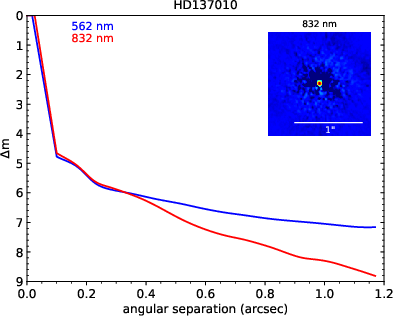
- contrast limit (Δ magnitude): The maximum brightness difference at a given separation for which a companion can be ruled out in imaging. "Our observations achieve a contrast limit of ~mag at 0.1\" separation"
- deuterium-burning limit: The approximate mass threshold (~13 Jupiter masses) separating planets from brown dwarfs. "we find that the companion mass lies under the canonical deuterium-burning limit (13~)"
- eclipsing binary (EB): A binary star system in which one star passes in front of the other, causing periodic light dips. "An unassociated eclipsing binary could be the source of the transit if it lies sufficiently close to HD 137010."
- equilibrium temperature: The temperature a planet would have if it were a blackbody in radiative balance with its star. "Equilibrium temperature () for "
- false positive (hypothesis): A non-planetary scenario that mimics a transit signal (e.g., eclipsing binaries, blends). "we consider the following false positive hypotheses which could potentially reproduce the observed transit of HD 137010"
- habitable zone (HZ): The circumstellar region where conditions may allow liquid water on a planet’s surface. "orbiting in the circumstellar habitable zone (HZ), where liquid water could potentially exist,"
- hierarchical triple: A gravitationally bound system of three stars, often a close binary with a distant third companion. "Hierarchical triple: This scenario requires a blended eclipsing binary which is gravitationally bound to the system."
- Hipparcos-Gaia Catalog of Accelerations (HGCA): A catalog combining Hipparcos and Gaia data to identify changes in stellar proper motion. "We extract the astrometric data from the Gaia~EDR3 version of the Hipparcos-Gaia Catalog of Accelerations \citep[HGCA;] []{Brandt2018, Brandt2021}."
- Hipparcos-Gaia tangential velocity anomaly: A deviation in a star’s sky-plane velocity between missions, indicative of acceleration. "We therefore set a 3 upper limit of ~ on the net Hipparcos-Gaia tangential velocity anomaly"
- hydrogen-burning limit: The mass threshold (~75 Jupiter masses) above which an object can sustain hydrogen fusion (i.e., is a star). "and under the hydrogen-burning limit (75~) within 50~AU."
- impact parameter: The sky-projected distance between the center of a star and the transit chord, in stellar radii. "if the impact parameter is low."
- incident flux (I⊕): Stellar energy received by a planet compared to Earth’s insolation. "We project an incident flux of "
- ingress/egress: The phases of a transit when the planet begins to cover/uncover the star, marking the start/end of the transit. "we can determine that it possesses a curved flux minimum and short ingress/egress"
- injection and recovery analysis: A test that adds synthetic signals to data to measure detection completeness. "We then perform an injection and recovery analysis to estimate the parameter space of transiting planets that could be detected in the K2 photometry."
- isochrones (MIST isochrones): Stellar evolution model tracks of constant age used to infer stellar properties. "We use the MIST isochrones \citep{Dotter2016, Choi2016} to model the physical parameters of HD 137010"
- limb darkening: The effect where a star’s disk appears dimmer toward the edge; modeled with coefficients. "Linear limb darkening "
- line bisector: A spectroscopic diagnostic of line profile asymmetry used to check for stellar activity or blends. "we do not observe a correlation between the RVs and the width of the line bisectors"
- local standard of rest (LSR): A reference frame averaging the motion of nearby stars in the Galaxy. "we find absolute motions relative to the local standard of rest"
- matched filter analysis: A detection technique that correlates data with a template to enhance signal-to-noise in colored noise. "A more realistic estimate of the true SNR of the event, taking into account red noise in the light curve, can be obtained by performing a matched filter analysis."
- median absolute deviation (MAD): A robust statistic for dispersion used to estimate noise levels. "we may estimate as the median absolute deviation (MAD) of the out-of-transit light curve"
- parallax: The apparent shift in a star’s position due to Earth’s orbit, used to measure distance. "Given that is known from Gaia parallax,"
- photocentre: The intensity-weighted center of light of an image; shifts can indicate off-target signals. "we do not observe any coherent changes in the photocentre position during the event at the pixel level."
- proper motion: The apparent angular motion of a star across the sky due to its true space motion. "the star has a relatively large proper motion of 340~ \citep{GaiaDR3}"
- radial velocity (RV): The line-of-sight speed of a star, measured via Doppler shifts, used to detect companions. "The HARPS RVs do not show any evidence of short-term RV variability,"
- red noise: Correlated noise in time series data that can affect detection significance. "taking into account red noise in the light curve"
- signal-to-pink-noise ratio: A detection statistic like SNR but accounting for correlated (“pink”) noise. "We do not detect any signals with a BLS signal-to-pink-noise ratio above 9,"
- single transit: A solitary observed transit event without repeats within the observing baseline. "we report a 10-hour long single transit event"
- speckle imaging: High-resolution imaging technique using short exposures to overcome atmospheric turbulence. "We obtained new high-resolution speckle imaging observations of HD 137010"
- thin disk: The younger, kinematically cooler component of the Milky Way’s disk population. "report an 89\% or 95\% probability that HD 137010 belongs to the thin disk"
- transit depth: The fractional dimming during a transit, proportional to the square of the planet-to-star radius ratio. "The event has a depth of 225~ppm"
- transit method: Detecting exoplanets by measuring periodic dips as a planet crosses its star’s disk. "The transit method is currently one of our best means for the detection of potentially habitable “Earth-like” exoplanets."
- transit probability prior: A prior that weights model periods by their a priori likelihood of producing a transit. "we opt to directly fit for the period while applying the \citet{Kipping2018} single transit probability prior."
- white Gaussian noise: Random, uncorrelated noise with a normal distribution, often assumed in SNR calculations. "assuming classical white Gaussian noise,"
Collections
Sign up for free to add this paper to one or more collections.