Jellyfish exist
Abstract: We show the existence of infinitely many geometrically distinct homothetic expanders (jellyfish) for the elastic flow, epicyclic shrinkers for the curve diffusion flow, and epicyclic expanders for the ideal flow.

Paper Prompts
Sign up for free to create and run prompts on this paper using GPT-5.
Top Community Prompts
Explain it Like I'm 14
Overview
This paper is about special “self-similar” shapes of smooth loops (closed curves) in the plane that change over time according to rules that depend on how bent the loop is. The authors show there are infinitely many such shapes for three different rules. They nickname these shapes:
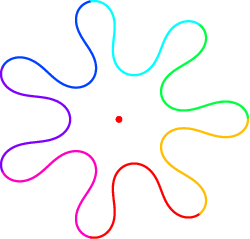
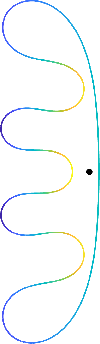
- Jellyfish expanders for the elastic flow (they grow bigger while keeping the same overall shape and have tentacle-like features),
- Epicyclic shrinkers for the curve diffusion flow (they shrink while keeping a petal-like pattern), and
- Epicyclic expanders for the ideal flow (they grow with many petal-like loops).
These shapes are new and different from the most famous self-similar shapes people already knew, like circles and the “lemniscate” (a figure-eight).
Key Questions
The paper asks simple but deep questions:
- Can we find many closed loops that evolve by just scaling up or down (getting bigger or smaller) without changing their shape, under three different bending-based rules?
- Can we build these loops systematically, not just by guessing?
- Can we ensure these loops close neatly, look symmetric, and are all different from each other?
- Do these loops exist in infinite families (so lots of them), not just a few isolated examples?
How They Did It (Methods in Everyday Terms)
Think of drawing a fancy snowflake by starting with a small wedge and then repeatedly reflecting and rotating that wedge around a center. The authors do something similar with a “fundamental arc,” which is a carefully designed small piece of curve:
- Start from a simple, well-understood base piece:
- For jellyfish: half of a classical “elastica” curve (a shape that balances bending energy, like a strip of springy metal).
- For epicycles: a semicircle.
- Nudge this base piece slightly using a tiny parameter (like turning a dial just a bit) to create a new arc that’s almost like the base but just different enough.
- Impose special “smooth seam” conditions at the ends of the arc:
- The arc must meet a certain line through a chosen center at a right angle (orthogonally).
- The bending should match smoothly across that end (so when you reflect the piece, there’s no kink).
- Use a math tool called the Implicit Function Theorem (IFT). It’s like having two knobs (parameters) that you adjust until you hit both target seam conditions exactly. This guarantees such arcs exist and depend smoothly on your tiny dial.
- Glue the arcs:
- Reflect the arc across the seam line to double it.
- Rotate this doubled arc around the same center by a fixed angle.
- If that angle is a rational fraction of π (say p/q times π), then after q rotations you come back exactly to the starting point and get a smooth, closed curve.
- Energy scaling explains why each flow grows or shrinks:
- Length scales linearly with size,
- Bending energy scales inversely with size,
- A higher bending energy (“ideal” energy) scales even more strongly.
- This tells you which flow tends to expand and which tends to shrink when the shape evolves self-similarly.
In short: pick a base piece, tweak it so its ends meet “just right,” reflect and rotate to close up, and you get a whole family of self-similar shapes.
Main Findings and Why They Matter
- Infinite families of new self-similar shapes:
- Jellyfish expanders (elastic flow): For all sufficiently large symmetry orders m (think “the number of tentacles or spokes”), you can build distinct jellyfish-like curves that expand over time.
- Epicyclic shrinkers (curve diffusion flow): For all sufficiently large orders, you get petal-like curves that shrink self-similarly.
- Epicyclic expanders (ideal flow): Similarly, you get petal-like curves that expand.
- Dihedral symmetry:
- These curves have a mix of mirror and rotational symmetry (like many snowflakes do). The order tells you how many repeats the shape has around the center.
- Geometric distinctness:
- The authors prove that the shapes for different symmetry orders are not the same up to any rotation, scaling, or reflection. In other words, they really are all different shapes.
- Seam-angle control:
- They show how a small parameter controls the angle between the “seam lines,” ensuring the rotation closes in exactly q steps when the angle is p/q times π. This gives lots of choices (and thus lots of shapes).
- Beyond symmetry:
- Numerically, they also see strange, non-symmetric “one-sided” jellyfish that their reflection-rotation method can’t produce, hinting at even more richness.
Why this matters: Before this, known self-similar shapes for these flows were very limited (mostly circles and a special figure-8 for one flow). This paper shows there are lots more. That changes how we think about the possible behaviors of these flows and the shapes they can reveal.
Implications and Future Impact
- Richer dynamical picture:
- The existence of many self-similar shapes suggests that the long-term behavior of curves under these flows can be much more complex than “it always becomes a circle.”
- Stability questions:
- The authors suspect most of these fancy shapes are not stable (small perturbations don’t return to them). They conjecture that only very simple shapes (circles and certain lemniscates) are dynamically stable.
- Classification challenge:
- A big goal is to classify all self-similar shapes for these flows. This paper is a major step by constructing infinite families systematically.
- Open problems:
- Finding and proving the existence of an “ideal lemniscate” (a self-similarly expanding figure-8 for the ideal flow) is still open.
- Describing which initial curves evolve toward which self-similar shapes (basins of attraction) could map out the dynamics.
In short: this work expands the catalog of known self-similar shapes, provides a powerful construction method, and points the way toward understanding which shapes are truly stable and how curves evolve in the long run.
Knowledge Gaps
Knowledge gaps, limitations, and open questions
The paper advances the existence theory for dihedrally symmetric homothetic solutions to elastic, curve diffusion, and ideal flows. The following concrete gaps and unresolved questions remain for future work:
- Explicit quantitative thresholds: Theorems guarantee existence only for “sufficiently large” symmetry order m (or large q). No explicit bound, estimate, or computable criterion for the minimal m0 (q0) is provided for any of the three families.
- Small-order regimes: The existence (or non-existence) of jellyfish/epicyclic homothetic solutions at low symmetry orders (small m or small q) is not addressed.
- Embeddedness vs. immersion: The closed curves are constructed as immersed; conditions ensuring embeddedness (absence of self-intersections), the number and structure of intersections, and convexity properties are not analyzed.
- Uniqueness and multiplicity: For a given symmetry order and turning number, the paper does not determine whether the constructed homothetic solutions are unique or whether multiple distinct branches/families exist.
- Non-symmetric branches: Numerically observed “one-sided” (non-dihedral) jellyfish are not covered by the method, and no analytic existence theory is provided for non-symmetric homothetic solutions.
- Classification within fixed turning number: Even for a fixed rotation index, a classification of homothetic solutions (EF, CDF, IF) is left open.
- Full classification problem: A complete classification of homothetic solutions for EF, CDF, and IF—beyond the constructed dihedral families—is not attempted; criteria that would characterize or exhaust all solutions are unspecified.
- Stability of new solutions: No linear or nonlinear stability analysis is provided for jellyfish or epicyclic solutions; conjectured instability is unproven.
- Basins of attraction: The dynamical basins of attraction (or repulsion) for the new homothetic families under their respective flows remain unidentified.
- Ideal lemniscate existence: The existence of a self-similarly expanding “ideal lemniscate” (figure-8 type for IF) is a stated prerequisite for the stability classification conjecture but is not established.
- Convergence of immortal EF/IF trajectories: The conjectured exponential convergence of generic immortal EF/IF trajectories to multiply covered circles or lemniscates is not proved.
- Quantitative asymptotics: Beyond leading-order expansions (e.g., σ(ε) ~ const·ε²), higher-order asymptotics for seam angles, scaling coefficients, energies, and lengths as functions of ε, p, q, and m are not derived.
- Global (non-perturbative) continuation: The existence theory is perturbative near special base arcs (rectangular elastica half-period or semicircle); it is unknown whether these branches continue globally in parameters or bifurcate further away from the base solutions.
- Spectrum and linearization: The spectral properties of the linearized EF/CDF/IF operators around the new homothetic curves are not computed; no eigenvalue or mode structure is given to substantiate (in)stability.
- Explicit shrink/expand rates: For CDF shrinkers, finite-time extinction rates and constants; for EF/IF expanders, explicit expansion rates and energy decay profiles are not quantified beyond the general scaling law.
- Energy and geometric invariants: Systematic evaluation of energy functionals L, E, I for the constructed solutions (dependence on q, p, m), and comparison across families is missing.
- Turning number for jellyfish: While rotation index is computed for epicyclic shrinkers, the turning number structure for jellyfish expanders is not explicitly analyzed or parameterized.
- Hidden symmetries and rigidity: The “no extra reflection axes” argument ensures maximal dihedral symmetry, but potential rotational or glide-reflection symmetries (or near-symmetries) are not investigated.
- Seam-angle range and density: The seam-angle rationality condition ensures countably many closures; whether all rational angles in a given interval are realized, and how densely these families populate the shape space, is not clarified.
- Robustness of gluing: The reflection/rotation gluing relies on k_s(L)=0 and orthogonality; the sensitivity of smoothness at seams to perturbations and higher-order matching conditions is not fully quantified.
- Dependence on initial curvature sign: The reflection symmetry “up to the choice of initial curvature sign” raises questions about branch equivalence and whether sign choices generate distinct geometric solutions.
- Numerical validation and reproducibility: Figures report ε values to five significant figures, but numerical methods, error controls, and reproducibility protocols for simulations are not documented.
- Generalization of base arcs: Only two base arcs (rectangular elastica half-period and semicircle) are used; the potential for other base profiles to generate additional families is unexamined.
- Irrational seam angles: The behavior of solutions when seam angles are irrational multiples of π (e.g., quasi-periodic concatenations or non-closure phenomena) is not explored.
- Higher-dimensional and network extensions: Analogous homothetic solutions in higher dimensions, for space curves, or for curve networks (junctions) are not considered.
- Invariants under similarity: Besides rotation index and dihedral symmetry order, a systematic set of similarity invariants distinguishing families (e.g., normalized energies or curvature signatures) is not developed.
- Rigorous bounds for “no interior seams”: The proof for epicyclic shrinkers uses continuity from the semicircle; uniform quantitative bounds preventing interior radial seams for broader parameter ranges are not supplied.
- Impact of self-intersections on flow: The effect of self-intersections on well-posedness, regularity, and long-time evolution of EF/IF/CDF trajectories starting from homothetic solutions is not analyzed.
- Extension to translators/rotators: Possible existence of homothetic-like solutions featuring translation or rotation (rather than pure dilation) for these flows is not addressed.
Practical Applications
Overview
This paper introduces infinite families of closed, self-similar solutions (“jellyfish” expanders for elastic flow, “epicyclic” shrinkers for curve diffusion flow, and “epicyclic” expanders for ideal flow) and a general construction workflow based on:
- A perturbative ODE boundary-value problem (BVP) for a fundamental arc solved via the Implicit Function Theorem.
- A dihedral reflection-rotation “gluing” principle that closes arcs into smooth, immersed, highly symmetric curves.
These findings provide new exact solutions and a reusable methodology for symmetry-driven solution construction in geometric evolution problems.
Immediate Applications
Below are actionable uses that can be deployed now, with sector linkages, candidate tools/workflows, and key assumptions or dependencies.
- Benchmarking and verification for geometric-PDE solvers (software, academia)
- Use the new self-similar curves (with known scaling law λ(t) = (4σt+1)1/4 for elastic flow) as regression tests and convergence benchmarks for numerical solvers of elastic flow, curve diffusion flow (CDF), and ideal flow.
- Tools/workflows: implement the 5D ODE initial-value problem and boundary map from the paper to generate “fundamental arcs,” then dihedral gluing to produce closed test curves; integrate into FEniCS/Firedrake/Julia packages, level-set/parametric solvers, and FEM codes.
- Assumptions/dependencies: accurate ODE/BVP solvers and parameter continuation (α, ε) near base solutions; numerical implementation of reflection/rotation seams; appropriate discretization of curvature and its derivatives; stability of integration for large symmetry orders.
- Procedural curve generators for graphics/CAD (software, graphics, design)
- Provide a parametric generator for smooth, closed curves with tunable dihedral symmetry and turning number (via p/q), producing families such as jellyfish-like expanders or epicyclic shapes for ornamental design, logos, and procedural modeling.
- Tools/workflows: plugins/scripts for Blender, Rhino/Grasshopper, or CAD kernels that solve the ODE and export NURBS/Bezier approximations; options for symmetry order m,q, seam angles, and family choice.
- Assumptions/dependencies: robust numeric generation of fundamental arcs and exact seam matching; collision/self-intersection handling in design tools.
- Education and training modules in differential geometry and numerical analysis (education, academia)
- Use these families to teach elastica, curvature-driven flows, implicit function theorem applications, and symmetry-based solution construction; provide interactive notebooks demonstrating dihedral gluing and seam conditions.
- Tools/workflows: Jupyter/Colab notebooks implementing the ODE, seam functional, and reflection principles; visualization libraries (Matplotlib, Plotly).
- Assumptions/dependencies: none beyond standard scientific Python/Julia stacks.
- Shape-regularization test cases in computer vision and image processing (software, healthcare/biomed imaging)
- Employ the explicit families as stress tests and calibration targets for contour regularization pipelines (e.g., elastica-based segmentation, vectorization of planar contours) to tune weights on curvature and curvature-variation penalties.
- Tools/workflows: synthetic datasets of curves under CDF/elastic/ideal flow evolutions for evaluating denoising, inpainting, and active contour algorithms.
- Assumptions/dependencies: existing pipelines that incorporate elastica or curvature-variation regularization; transferability from planar test shapes to real images.
- Robotics and motion-planning path fairing (robotics, autonomy)
- Leverage ideal-flow energy (∫ k_s2 ds) and elastic energy (∫ k2 ds) as path fairness costs; deploy epicyclic curves as canonical stress tests for planners that penalize curvature and curvature variation.
- Tools/workflows: integrate fairness-penalized smoothing into path planners; validate numerical stability and smoothness constraints on challenging symmetric test curves.
- Assumptions/dependencies: robot-specific curvature bounds and nonholonomic constraints; numerical optimization with high-order smoothness terms.
- Symmetry-based BVP construction pattern for other boundary value problems (academia, applied math)
- Adopt the “fundamental arc + dihedral gluing” workflow as a template for constructing symmetric solutions in other ODE/PDEs (e.g., elastic rods with constraints, certain reaction-diffusion or pattern-forming systems).
- Tools/workflows: adapt the reflection principle and seam functionals to other problems; use implicit divisions to remove trivial branches.
- Assumptions/dependencies: existence of appropriate reflection symmetries and smooth seam conditions; solvability of the associated linearized problems.
Long-Term Applications
These require additional research, scaling, integration, or engineering to realize.
- Shape-morphing and soft robotics via energy-shaping (robotics, materials)
- Design actuated systems that approximate gradient descent of bending energy (elastic flow) or curvature-variation energy (ideal flow), realizing self-similar expanders/shrinkers as target morphing trajectories for deployable structures or soft robots.
- Potential products: morphing shells/filaments whose control laws are derived from curvature-flow energetics; self-similar “breathing” motifs with dihedral symmetry.
- Assumptions/dependencies: physical systems that can realize these flows (or controlled approximations); stability challenges (paper conjectures most new solutions are dynamically unstable); real-time control to track saddle-like trajectories.
- Biophysics and biomedical shape analysis (healthcare, biology)
- Use elastica-informed models for planar filaments (e.g., cilia, flagella, actin bundles) and adopt epicyclic/jellyfish families as interpretable modes or priors for analyzing filament contours and their dynamics.
- Potential workflows: segmentation priors for microscopy, statistical shape models that include dihedrally symmetric modes.
- Assumptions/dependencies: mapping of biophysical forces to model energies (E, I) and to flows; validation with experimental data; 2D applicability limits.
- Architected/programmable materials with dihedral curve motifs (manufacturing, materials)
- Design 2D patterns composed of dihedrally glued arcs to tune mechanical response (e.g., stiffness, deployability, auxetic behavior) in kirigami/origami-like sheets or cut lattices.
- Potential products: compliant mechanisms, energy-dissipating lattices, tunable metamaterials defined by “epicyclic” petal counts.
- Assumptions/dependencies: reliable mapping from curve geometry to bulk mechanical properties; manufacturing tolerances; multi-physics effects not captured by planar curvature models.
- Scalable benchmark datasets and ML surrogates for geometric flows (software, AI for science)
- Generate large datasets of exact or high-fidelity self-similar evolutions for training/testing neural surrogates, PINNs, or operator learners for curvature flows; use parametric variability (p/q, m, ε) to assess generalization.
- Potential tools: automated pipeline that solves the ODE-BVP, performs dihedral gluing, and simulates flows to provide time-series labels and invariants (e.g., scaling factor).
- Assumptions/dependencies: computational cost to cover diverse shape families; careful handling of parametrization invariance; benchmarks adoption by community.
- Stability maps and classification-informed algorithms (academia, software, vision/CAD)
- Build practical “basin-of-attraction” maps around the new solutions to guide smoothing/denoising pipelines—e.g., biasing toward provably stable shapes (circles, lemniscates) while avoiding unstable saddles that cause artifacts.
- Potential workflows: bifurcation/continuation toolkits that incorporate the paper’s normalized matching conditions to trace nontrivial branches; algorithmic constraints derived from conjectured stability.
- Assumptions/dependencies: rigorous stability analyses (paper conjectures need proof); discovery of missing building blocks (e.g., “ideal lemniscate”); computational continuation robustness.
- Standardization of geometric-flow benchmarks (industry/academia communities)
- Propose and curate a public benchmark suite “Geometric PDE Benchmarks” featuring the new families, with documented seam angles, symmetry orders, and invariants for solver validation across platforms.
- Potential outcomes: cross-code comparability, reproducibility standards, shared datasets and scripts.
- Assumptions/dependencies: community coordination and adoption; open-source implementations of the ODE/BVP and gluing steps.
- Compact shape encodings and generative design (software, graphics, fonts)
- Use the (p/q, m, ε) parametrization to build compact encodings of planar silhouettes and generative models for iconography, fonts, or procedural assets that require smoothness and symmetry control.
- Potential products: shape libraries, font families with tunable “petal” counts and smoothness.
- Assumptions/dependencies: robust parameter-to-geometry mappings; handling of self-intersection constraints in design pipelines.
Cross-cutting assumptions and dependencies
- Mathematical assumptions: results pertain to smooth, closed, immersed planar curves; existence proven for sufficiently large symmetry orders; many constructed solutions are likely dynamically unstable (as conjectured).
- Numerical prerequisites: high-order ODE integrators, reliable boundary matching (seam functional), and rotation/reflection operations; careful control of parameter regimes (small ε, α(ε) from IFT).
- Physical applicability: direct physical realization of these flows is system-dependent—additional modeling (viscous damping, inertia, constraints) may be required for real materials or robots.
- Tooling gaps: the paper provides the equations and methodology; practical deployment benefits from open-source reference implementations of the fundamental-arc solver and dihedral gluing pipeline.
Glossary
- arc-length gauge: A choice of parametrization where the curve’s parameter equals its arc length, simplifying geometric PDEs. "Throughout we work in arc-length gauge."
- basins of attraction: Sets of initial conditions in phase space whose trajectories converge to a particular attractor (e.g., a self-similar solution) under the flow. "identify (even partially) the basins of attraction of the epicyclic expanders and jellyfish"
- Bernoulli's lemniscate: A classic figure-8 shaped curve; here, a known self-similar solution archetype. "outside of circles and Bernoulli's lemniscate"
- bifurcation problem: A problem analyzing how solution branches emerge or change as parameters vary. "a non-degenerate bifurcation problem"
- boundary-value problem: An ODE/PDE problem where values or conditions are specified at endpoints/boundaries of the domain. "pose a boundary-value problem for a fundamental arc"
- curve diffusion flow: A fourth-order geometric evolution for planar curves that is the H{-1}-gradient flow of length; tends to shrink curves. "The curve diffusion flow is the steepest descent H{-1}(ds) (normal graphical) gradient flow of length."
- dihedral gluing: A construction that uses reflections and rotations to assemble a closed curve from a fundamental arc. "Fundamental arcs and dihedral gluing"
- dihedral group: The symmetry group generated by reflections and rotations of a regular polygon; here, the symmetry group of the constructed curves. "invariant under the dihedral group generated by ρ and σ_{ℓ0}"
- dihedral reflection-rotation gluing: A symmetry-based procedure to produce closed curves by alternating reflections and rotations. "a dihedral reflection-rotation gluing produces a smooth closed curve"
- dihedral symmetry: Symmetry under a dihedral group, typically involving m-fold rotational symmetry and reflections. "have dihedral symmetry of order m"
- elastic energy: The integral of curvature squared along a curve; the functional whose L2-gradient flow is elastic flow. "elastic energy"
- elastic flow: The L2-gradient flow of elastic energy that evolves curves by curvature-driven fourth-order dynamics. "the (free) elastic flow"
- epicycle: A curve formed by tracing a point on a circle rolling around another circle; used here descriptively for multi-petaled shapes. "resemble epicycles, with many 'petals'"
- epicyclic expander: A self-similarly expanding solution with epicyclic geometry, here for the ideal flow. "epicyclic expanders for the ideal flow"
- epicyclic shrinker: A self-similarly shrinking solution with epicyclic geometry, here for the curve diffusion flow. "CDF epicyclic shrinker"
- Euclidean reflection: Reflection across a line in the plane; used to mirror curve segments while preserving the governing equations. "Invariance of \eqref{eq:intro:homot} under Euclidean reflections yields that the reflected arc satisfies the same equation."
- Euler's rectangular elastica: Special solutions to the Euler–Bernoulli elastica problem; used as base arcs for perturbation. "a half-period of Euler's rectangular elastica"
- Frenet system: The differential relations (Frenet–Serret formulas) linking tangent, normal, and curvature along a curve. "higher regularity follows by differentiating the Frenet system."
- fundamental arc: A single curve segment solving a boundary-value problem that can be reflected/rotated to build a closed solution. "A fundamental arc is a solution S(·;α,ε) of (3) for which there exists L>0 such that B(L,α,ε)=(0,0)."
- gradient flow: An evolution equation that moves a configuration in the direction of steepest descent of an energy functional. "The steepest descent L2(ds)-gradient flows of E and I are, respectively, the (free) elastic flow and the ideal flow."
- H{-1}(ds): A negative Sobolev metric used to define the gradient flow of length; yields the curve diffusion flow. "The curve diffusion flow is the steepest descent H{-1}(ds) (normal graphical) gradient flow of length."
- homothety: A uniform scaling about a point; solutions evolving purely by homothety change only by scale. "For solutions evolving purely by homothety"
- homothety coefficient: The scalar parameter controlling the rate and direction (expansion/shrinking) of self-similar scaling. "the homothety coefficient σ(ε) maintains a sign"
- homothetic shrinker equation: The stationary profile equation for curves that evolve self-similarly by shrinking under a given flow. "the homothetic shrinker equation \eqref{eq:intro:homot}"
- ideal energy: The integral of the squared derivative of curvature; drives the ideal flow as its L2-gradient flow. "ideal energy are as follows ... I[γ]=½∫γ k_s2 ds."
- ideal flow: The L2-gradient flow of ideal energy (sometimes called the “ideal” curve flow), producing higher-order dynamics. "the ideal flow"
- Implicit Function Theorem: A theorem guaranteeing locally unique smooth solution branches under a nondegeneracy condition. "an application of the Implicit Function Theorem produces a one-parameter family of fundamental arcs"
- immortal: A solution that exists for all forward time. "All solutions to \eqref{EF} and \eqref{IF} are immortal"
- Inverse Function Theorem: A theorem ensuring a locally invertible smooth map when its derivative is nonsingular. "each has a C\infty inverse by the Inverse Function Theorem"
- jellyfish expanders: Self-similarly expanding elastic-flow solutions with a “body and tentacles” shape and dihedral symmetry. "jellyfish expanders"
- multiply-covered circles: Curves that trace a circle multiple times; appear as stable or limiting configurations in these flows. "multiply-covered circles"
- normal velocity: The component of the curve’s velocity in the normal direction; determines geometric evolution. "its normal velocity satisfies"
- ODE: An ordinary differential equation; used to formulate the profile problem for fundamental arcs. "ODE formulation and boundary map"
- orthogonality condition: A boundary condition requiring the tangent to be orthogonal to a given line/ray at the seam. "is the orthogonality condition"
- reflection principle: A method to extend solutions smoothly across a symmetry line by reflection, preserving the governing equation. "Reflection principle for the CDF homothetic ODE"
- rotation index (turning number): The total number of full rotations made by the tangent vector along a closed curve. "the rotation index (turning number)"
- seam angle: The angle between the two “radial seam lines” used when reflecting/rotating fundamental arcs to close the curve. "the seam angle is close to π"
- self-similar: Evolving by scaling (and possibly reparametrization) so shapes remain geometrically similar over time. "Representative closed self-similar solutions"
- shooting function: A scalar function used in a shooting method to satisfy an endpoint condition by tuning parameters. "Define the scalar shooting function"
- similarity transformation: A composition of scalings, rotations, and translations; used to compare curves up to geometric similarity. "by similarity transformation"
- stationary base arc: An exact, unperturbed solution segment used as a starting point for perturbative construction. "We begin with a stationary base arc for the relevant profile problem"
- steepest descent: The direction of fastest decrease of an energy functional with respect to a given metric. "The steepest descent L2(ds)-gradient flows of E and I"
Collections
Sign up for free to add this paper to one or more collections.