Irrationality of rapidly converging series: a problem of Erdős and Graham
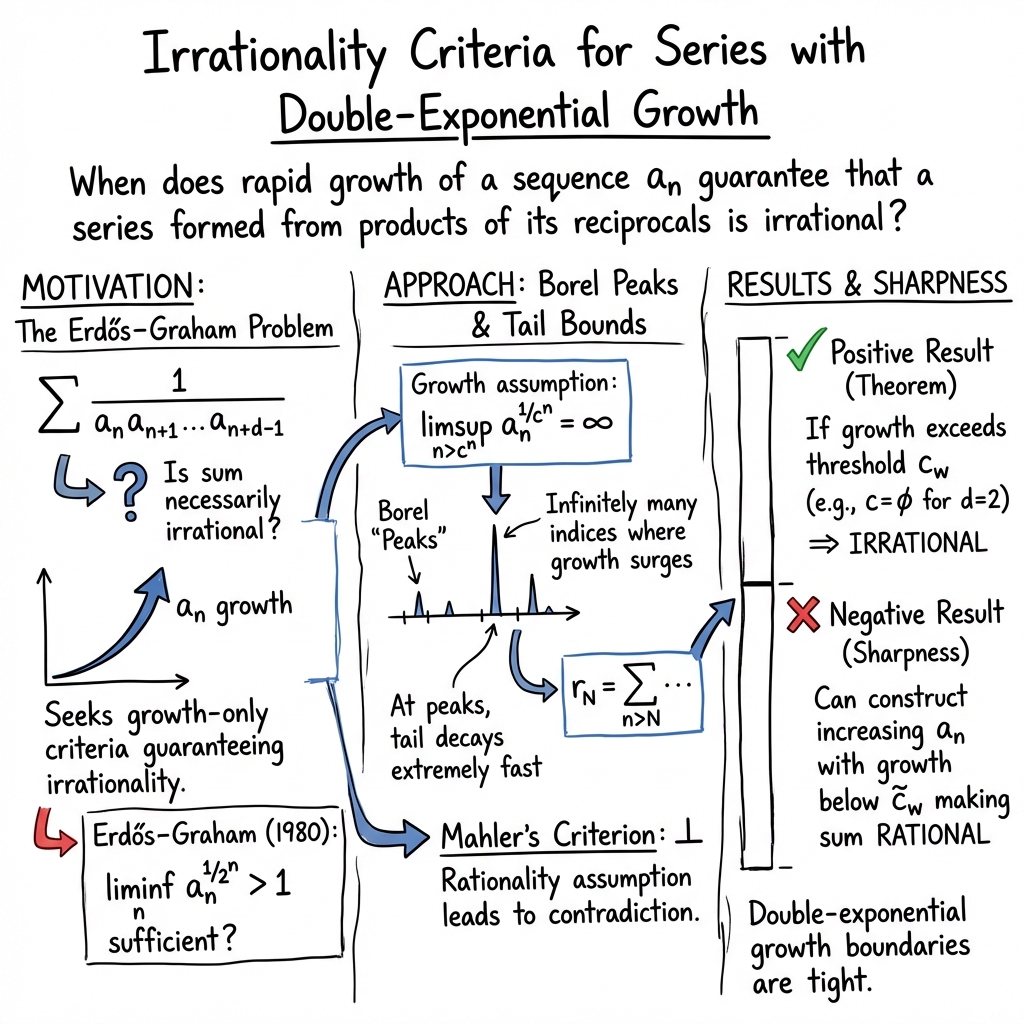
Abstract: Answering a question of Erdős and Graham, we show that the double exponential growth condition $\limsup_{n\to\infty}a_n{1/φn}=\infty$ for a monotonically increasing sequence of positive integers ${a_n}{n=1}\infty$, together with the bound $a_n a{n+1}\geq n{1+τ}$, is sufficient for the series $\sum_{n=1}\infty 1/(a_n a_{n+1})$ to have an irrational sum; here $φ$ denotes the golden ratio $(1+\sqrt{5})/2$ and $τ>0$. We also provide a positive generalization to $\sum_{n=1}\infty 1/(a_n{w_0}\cdots a_{n+d-1}{w_{d-1}})$, and a negative result showing that some of its instances are essentially optimal. The original problem was autonomously solved by the AI agent \emph{Aletheia}, powered by Gemini Deep Think, while the remaining material is largely a product of human-AI interactions.
Paper Prompts
Sign up for free to create and run prompts on this paper using GPT-5.
Top Community Prompts
Explain it Like I'm 14
Irrationality of rapidly converging series: a problem of Erdős and Graham — explained simply
Overview: What is this paper about?
This paper studies when a special kind of infinite sum (a series) must be an irrational number. The series looks like this:
where each is a positive whole number and the grow very fast. “Irrational” means the sum cannot be written as a fraction of two whole numbers, like .
The paper answers a question posed by famous mathematicians Paul Erdős and Ronald Graham in 1980: under what growth conditions on the does this sum have to be irrational? The authors not only solve this original problem but also prove stronger, more general results. Interestingly, an AI agent named Aletheia (built on Google’s Gemini) discovered a key solution, and the humans expanded, checked, and sharpened it.
The key questions in simple terms
The paper focuses on questions like:
- If the numbers grow extremely fast, does the infinite sum become irrational?
- What is the exact “speed of growth” that guarantees irrationality?
- Can we generalize this to sums that use longer products, like (multiplying consecutive terms), or even add small integer weights and coefficients?
- Are these results the strongest possible, or is there a sharp boundary beyond which the sum can still be rational?
How they approached the problem (methods, with simple analogies)
Think of the series like adding up tiny pieces: each term is a fraction whose denominator is the product of big numbers, so the terms get small very quickly. The main idea is to show that if the grow fast enough, then the total sum cannot be a simple fraction.
Here are the core tools and strategies, explained in everyday language:
- A classic “tail test” for irrationality:
- Suppose you add the first terms and then look at the leftover “tail” (everything after ). If you can multiply the partial sum by a certain large integer and always get a whole number, then—if the full sum were rational—the tail cannot shrink too quickly. The authors prove that in their setting the tail does shrink too quickly, forcing the full sum to be irrational.
- This is based on a simple lemma sometimes attributed to Mahler: it connects “integer-multiple partial sums” with how fast the leftover part can get small.
- Picking “peak moments” where the growth really spikes:
- They use a trick (often credited to Borel) to find infinitely many points where jumps faster than before. These “peak moments” let them bound the tail very strongly.
- Splitting the tail and bounding it in two different ways:
- The tail is split into two parts: a “near” part and a “far” part. Each part is controlled with different estimates, depending on whether the are at least exponential () or just polynomially large ().
- A carefully chosen constant from a polynomial:
- In the generalized theorems, a special constant is defined as the positive root of a certain polynomial that depends on the “weights” of the denominator. This acts like a precise growth threshold. Choosing this way makes key inequalities work out, letting the authors turn bounds on into tail bounds.
- Constructing counterexamples:
- To show their results are sharp (best possible), they build explicit sequences right at the boundary growth rate where the sum can still be rational. This proves you really need growth faster than that boundary to guarantee irrationality.
The main findings and why they matter
Here are the central results, stated simply:
- For the classic two-term product case:
- If the grow “double-exponentially fast” in a sense tied to the golden ratio , and if the product is at least about (for some ), then the sum
is irrational. “Double-exponential” here means the size of behaves like for some large —a growth much faster than , more like stacking exponentials. - They also show this is essentially the exact threshold: if the only barely meet a weaker version of this growth (approaching a fixed constant at the threshold), it’s possible to make the sum rational. So the boundary between guaranteed irrationality and possible rationality is sharp.
- A broad generalization:
- They consider sums of the form
where the are nonnegative integer “weights” telling you how many times each consecutive term appears in the denominator, are small positive integers (like ), and is how many consecutive terms you multiply. - They define a special threshold number based on the weights (it’s the positive root of a certain polynomial). If grow faster than in a specific way and the product in the denominator is not too small (at least ), then this sum is irrational. - Again, they prove sharpness: at the matching “tilde-” threshold, you can construct sequences where the sum is rational.
Why this matters:
- It solves an old problem of Erdős and Graham and pinpoints the exact growth boundary for irrationality in these series.
- It unifies and extends several earlier results on so-called Ahmes and Cantor series (special types of infinite sums studied since the 1800s).
- It demonstrates a successful collaboration between human mathematicians and AI, with the AI discovering key ideas and humans expanding and proving the most general statements.
Simple discussion of the impact
- In number theory, understanding when an infinite sum is irrational is important because it tells us how complicated the sum is—whether it can be captured by a simple fraction or not.
- These results give clear, easy-to-check growth conditions on the sequence that guarantee irrationality. That makes them practical tools for future problems.
- The sharp boundary (and matching counterexamples) is especially valuable: it tells mathematicians precisely how fast must grow to force irrationality, and where rational sums can still occur.
- The human-AI workflow shown here is a promising model for mathematical research—AI can help spot patterns or propose solutions, and humans ensure rigor, generalization, and clarity.
Extra notes to make terms friendlier
- “Irrational”: a number that can’t be written as a simple fraction .
- “Series”: an infinite sum, like .
- “Rapidly converging”: the terms get tiny very fast, so the sum settles down to a limit quickly.
- “Double exponential growth”: numbers explode faster than —think something like ; in this paper, the growth is controlled by powers like .
- “Tail”: the part of the series after you’ve added the first terms; it should be small if the series converges quickly.
- “Weights ”: how many times each shows up in the denominator.
- “Golden ratio ”: about $1.618$, a famous constant that appears in nature, art, and mathematics. Here it marks a precise growth rate threshold.
Overall, the paper nails down a long-standing problem, makes a powerful generalization, proves the results are best possible, and shows how AI can contribute to deep math—wrapped in carefully designed, elementary tools and clever estimates.
Knowledge Gaps
Knowledge gaps, limitations, and open questions
Below is a concise list of specific gaps and directions that remain unresolved by the paper and could guide future work:
- Optimal threshold for general weights: For integer weights with some , the paper proves sufficiency at and constructs counterexamples at , but does not determine the exact critical constant. Close the gap by characterizing the optimal threshold (i.e., whether is necessary, or identify the true critical constant between and ).
- Borderline growth at the claimed threshold: Determine whether the condition (at the exact threshold) suffices for irrationality, or whether is genuinely needed. Provide either a proof or counterexample at the borderline .
- Necessity of monotonicity: All main results assume is strictly increasing. Investigate whether this can be weakened to eventual monotonicity, bounded multiplicative oscillations, or suitable averaged growth, or removed entirely.
- Minimal decay/growth assumptions in the general weighted case: Theorem 1.2 assumes (and ). Identify the weakest possible tail-decay/growth conditions on (e.g., logarithmic or averaged conditions) under which irrationality still follows.
- Numerator growth beyond polynomial: Extend the hypothesis to larger classes (e.g., for fixed , or more general subexponential envelopes), and characterize sharp boundaries on admissible growth.
- Extension to non-integer weights/exponents: The analytic core (Proposition 3.1) does not use integrality of , yet the theorems assume integer weights. Develop versions for real weights and specify the correct replacement for (e.g., the unique positive root of an appropriately generalized polynomial/functional equation).
- Removal of the integrality constraint on : The Mahler-style integrality device requires integer . Explore criteria or alternative arguments (e.g., -adic or modular reductions) to treat rational or real sequences with comparable growth.
- Quantitative irrationality: The method establishes irrationality but provides no irrationality measure. Derive explicit lower bounds on rational approximations in terms of and the growth data (or prove transcendence under stronger hypotheses).
- Explicit constructions of rational counterexamples: The rationality counterexamples (Theorem 1.4) are obtained non-constructively via interval coverings. Produce explicit/algorithmic constructions of strictly increasing sequences with prescribed asymptotics that yield rational sums.
- Classification of rational values under growth envelopes: The existence proof shows the set of achievable sums is a finite union of non-degenerate closed intervals. Characterize these intervals explicitly (endpoints, lengths), their dependence on the envelope , and the density of rational values achieved.
- Beyond consecutive windows: Generalize from consecutive blocks to sparse or patterned windows with fixed gaps . Identify the right “critical constant” (e.g., via roots of a modified polynomial depending on and ) and the corresponding sufficiency/necessity results.
- Tradeoffs with arithmetic/divisibility conditions: Prior Cantor-series results use divisibility and relative growth conditions. Systematically map tradeoffs: which arithmetic conditions allow weakening or removal of the polynomial lower bound on , or allow weaker growth than ?
- Signed or conditionally convergent series: The proofs rely on non-negative terms. Extend irrationality criteria to signed numerators (allowing cancellations) and to conditionally convergent variants.
- Linear (in)dependence questions: Go beyond single-series irrationality to linear or algebraic independence over of families of such series associated to different sequences or weight patterns, in the spirit of references like HS03.
- Variable window length or weights: Analyze sums with window length or weights varying with (e.g., , ). Formulate and prove analogues of the main theorems and identify the appropriate growth thresholds.
- Optimization of analytic lemmas: The dyadic-block estimates (Lemma 3.5) and peak arguments are effective but possibly conservative. Refine these bounds to push the admissible parameter ranges (e.g., reduce , relax , improve constants in the Case (A)/(B)/(C) analysis).
- Clarify minimal hypotheses for the case: The abstract states a condition including , while Theorem 1.1(i) for appears to omit this. Precisely identify the weakest hypothesis for and reconcile the statements (or state the strongest currently proved and the gap to the conjectured minimal one).
- Empirical/numerical mapping of thresholds: Systematically compute and across parameter regimes to identify when (where older results already apply) and where the new results are genuinely stronger, guiding conjectures about the optimal threshold in the regime.
Practical Applications
Immediate Applications
The paper delivers both new mathematical criteria for irrationality of certain fast-converging series and a concrete methodology for human–AI collaboration in mathematical research. The following items can be deployed now, with modest engineering or curricular effort.
- Math research workflows: AI-assisted problem selection and solution prototyping
- Sector: software (research tooling), academia (mathematics and theoretical CS)
- Use case: Deploy agents like Aletheia/Gemini Deep Think to mine open-problem repositories, triage problems by solvability likelihood, propose candidate generalizations, and draft proof sketches that humans refine.
- Tools/products:
- A “math-research copilot” that ingests problem lists (e.g., OEIS notes, problem books, curated sites), ranks targets, and iteratively proposes lemmas/conjectures.
- A protocol template for human–AI interactive theorem discovery (as used in the paper steps 2–6).
- Dependencies/assumptions: Access to curated problem databases; human oversight for proof validation; compute resources for iterative search; institutional norms to accept AI-enabled contributions.
- Irrationality checkers for Ahmes/Cantor series under growth constraints
- Sector: software (CAS), academia (number theory), education (advanced courses)
- Use case: Implement a module that verifies the irrationality of sums of the form S = ∑ b_n / (a_n{w_0} … a_{n+d-1}{w_{d-1}}) by checking the paper’s sufficient conditions (e.g., monotone integers a_n, product lower bound a_n…a_{n+d-1} ≥ n{1+τ}, and limsup growth thresholds based on the root c_𝐰).
- Tools/products:
- CAS plugin (Sage/Maple/Mathematica) that computes c_𝐰, tests the / hypotheses, and certifies “irrational under Theorem X”.
- Python library for researchers to auto-generate certificates in preprints.
- Dependencies/assumptions: Users must provide or verify monotonicity and growth bounds; numerical approximations to are stable; edge cases (near-sharp thresholds) are flagged.
- “Nothing-up-my-sleeve” constant generation with provable irrationality
- Sector: standards, software engineering, cryptography (non-secret, public constants)
- Use case: Define public constants as sums of the paper’s series meeting sufficient conditions for irrationality; this deters simplistic rational backdoors and aids auditability.
- Tools/products:
- A reference generator that takes seed parameters and outputs a documented, auditable irrational constant with growth proofs.
- Dependencies/assumptions: While irrationality ≠ randomness, it provides transparent construction; must avoid implying cryptographic strength; needs reproducible generation and archival of conditions.
- Pedagogy: Curriculum modules on irrationality and human–AI collaboration
- Sector: education
- Use case: Course materials and interactive notebooks demonstrating Mahler’s criterion, the Borel-style “peak” trick, and the new thresholds (, ) in practice, paired with an AI-in-the-loop proof exploration.
- Tools/products:
- Jupyter notebooks with examples of sequences meeting/failing thresholds; auto-checkers for conditions.
- Case-study unit on “AI in mathematical discovery” including authors’ explicit timeline and best practices.
- Dependencies/assumptions: Instructor familiarity with number theory; access to LLMs in classroom settings and institutional guidelines for AI usage.
- Policy and publishing practice: AI-usage declarations and attribution patterns
- Sector: policy, academic publishing
- Use case: Adopt a standardized AI-usage declaration section for research articles, modeled on this paper’s “Declaration of AI usage.”
- Tools/products:
- Journal policy templates and checklists for AI contribution disclosure, versioning of AI outputs, and human verification.
- Dependencies/assumptions: Editorial board buy-in; community consensus on disclosure granularity.
- Benchmark datasets for automated theorem discovery and verification
- Sector: AI research, software
- Use case: Create benchmarks composed of (i) solvable open problems similar to Erdős–Graham #1051 variants; (ii) positive/negative instances (sharpness) generated by Theorem 1.3 and Theorem 1.5; (iii) verifiable proofs via Mahler’s criterion/Borel-peak strategy.
- Tools/products:
- Public GitHub repos with problem statements, parameterized instances, ground-truth labels (irrational vs rational), and proof scripts.
- Dependencies/assumptions: Clean licensing for problem sources; reliable numerical approximations or formalized proofs where feasible.
Long-Term Applications
The following opportunities require further research, infrastructure, or community standardization before full deployment.
- Formal verification pipelines for AI-generated proofs in number theory
- Sector: software (formal methods), academia
- Use case: Integrate LLM-driven conjecture generation with Lean/Coq/Isabelle for end-to-end verified proofs of series irrationality and generalizations (beyond Ahmes/Cantor types).
- Tools/products:
- Tactics encoding Mahler-type criteria and the paper’s lemmas (e.g., Lemma 2.1, 2.2) as reusable libraries.
- Automated checking of growth assumptions in formal environments.
- Dependencies/assumptions: Formal libraries for analytic number theory; new tactics for handling limsup/liminf and asymptotics; significant engineering effort.
- General-purpose open-problem mining and triage platforms across disciplines
- Sector: cross-domain R&D, software
- Use case: Expand the “autonomous narrowing” used by Aletheia to physics, CS theory, and operations research to match problem difficulty with model capability and propose pathways to solution.
- Tools/products:
- A cross-field “Problem Navigator” that scores problems by tractability, suggests generalizations, and tracks provenance of ideas.
- Dependencies/assumptions: Domain-specific corpora; evaluation metrics for partial progress; mixed-initiative interfaces for expert feedback.
- Advanced constant design and auditing in standards bodies
- Sector: standards, cryptography, finance
- Use case: Commission curated families of provably irrational constants with transparent construction for protocols (e.g., “beacon” constants, hash-round constants) that avoid simple rational structure.
- Tools/products:
- Standards-track documents outlining selection criteria, reproducibility, and audit procedures based on growth conditions and sharpness theorems.
- Dependencies/assumptions: Community agreement that irrationality and construction transparency are desirable properties; clear communication that this is not a security property per se.
- Heuristic and structural detectors for rationality/irrationality in symbolic systems
- Sector: CAS, AI4Math
- Use case: Extend the paper’s thresholds into learned or rule-based detectors that recognize when unfamiliar series are likely irrational, guiding simplification and preventing misleading rational approximations in numerical pipelines.
- Tools/products:
- Hybrid rule/ML models integrated into CAS that suggest applicable criteria (e.g., compute , estimate growth of ) and warn users when the series is near sharp thresholds.
- Dependencies/assumptions: Robustness of growth estimation from sampled terms; calibration to avoid false positives; user-interface design for explainability.
- Cross-pollination to transcendence and Diophantine approximation
- Sector: academia
- Use case: Explore whether analogous growth-threshold methods and peak-leap arguments yield new criteria for transcendence or for irrationality of more general series/integrals (e.g., with dependent terms or stochastic perturbations).
- Tools/products:
- Research programs extending -based reasoning; workshops on AI-guided conjecture patterning for Diophantine problems.
- Dependencies/assumptions: Nontrivial theoretical advances; interplay with existing results (e.g., Baker theory, Mahler’s method).
- Stress-testing and red-teaming of math-reasoning AI via “sharpness” counterexamples
- Sector: AI safety/reliability
- Use case: Use the paper’s near-optimal negative examples (Theorem 1.5) to create adversarial test suites that probe LLMs’ susceptibility to over-generalization in proofs.
- Tools/products:
- Unit tests that systematically vary and growth rates across vs regimes; scorecards tracking failure modes.
- Dependencies/assumptions: Robust pipelines for generating and verifying labeled instances; collaboration with benchmark maintainers.
- Curriculum on responsible AI in pure mathematics
- Sector: education, policy
- Use case: Develop joint curricula that teach (i) classical techniques (Fourier/Mahler criteria), (ii) modern AI collaboration protocols, and (iii) ethics/attribution standards.
- Tools/products:
- Co-developed syllabi across math and CS departments; case-study repositories; assessment rubrics for AI usage disclosure and validation.
- Dependencies/assumptions: Institutional policy alignment; faculty development; access to AI tools with audit logs.
Key mathematical assumptions and dependencies (affecting feasibility)
- Monotone growth and lower bounds
- must be a monotonically increasing sequence of positive integers; often with product constraints such as and (with ).
- Double-exponential/threshold growth conditions
- Sufficient conditions reference ; for , thresholds involve the golden ratio ; for general , the critical constant is the unique positive root of .
- Negative (sharpness) results hinge on , the largest positive root of .
- Edge-case sensitivity
- Near-critical growth (approaching from below) can flip the outcome (rational vs irrational); tools must surface uncertainty when hypotheses are tight.
- Human oversight for AI contributions
- The methodology presumes rigorous human validation of AI-discovered statements and proofs; reproducibility and attribution practices are integral for adoption.
These applications leverage both the paper’s mathematical advances (general irrationality criteria and sharpness) and its demonstrated human–AI research process, enabling immediate tooling and curricular upgrades and charting a path to more ambitious, formally verified and cross-domain AI research platforms.
Glossary
- Ahmes series: A class of series consisting of reciprocals of a strictly increasing sequence of positive integers, studied in relation to irrationality questions. "Series of the form for a strictly increasing sequence of positive integers are sometimes called Ahmes series."
- Cantor series: Series of the form with , used to represent real numbers; their irrationality properties have been widely studied. "for some positive integer sequences and with for every are known as Cantor series."
- Descartes' rule of signs: A polynomial root-counting rule that bounds the number of positive real roots by the number of sign changes in its coefficients. "and applying Descartes' rule of signs to , we easily conclude that $P_{\mathbf{w}$ has precisely one root in ."
- double exponential growth condition: A growth regime where grows roughly like , here expressed via an unbounded of . "double exponential growth condition "
- dyadic blocks: A technique partitioning indices or ranges into blocks whose sizes are powers of two, often used to control sums. "We prove it by splitting positive integers into dyadic blocks."
- golden ratio: The constant , which appears as a threshold in growth conditions for the sequences considered. "here denotes the golden ratio "
- irrationality criterion: A general method or lemma that provides conditions under which a sum cannot be rational, often using denominator clearing and tail estimates. "We utilize a classical irrationality criterion that dates back to at least Fourier's proof of the irrationality of the number "
- liminf: The limit inferior of a sequence, i.e., the greatest lower bound of its subsequential limits. ""
- limsup: The limit superior of a sequence, i.e., the least upper bound of its subsequential limits. ""
- Mahler's criterion: A lemma giving a positive lower bound on scaled tails of rational series when the total sum is rational, used to deduce irrationality by contradiction. "Mahler's criterion (Lemma~\ref{lem:mahler}) can be applied to the series"
- peak-index set: A set of indices where a derived sequence exceeds all previous values by a controlled multiplicative margin; used in the proof strategy. "the peak-index set in Lemma~\ref{lem:borel} is infinite"
- Sylvester sequence: The rapidly growing integer sequence defined by and , classical in Egyptian fraction theory. "the well-known Sylvester sequence provides an explicit example of a sequence as in Part \eqref{it:T2}"
- Vinogradov notation: The analytic number theory notation meaning , i.e., for some constant . "This is the Vinogradov notation for ."
Collections
Sign up for free to add this paper to one or more collections.