- The paper presents uncertainty-quantified third and fourth density and acoustic virial coefficients for neon using high-fidelity ab initio potentials and PIMC.
- It employs advanced three-body and four-body potential models with rigorous uncertainty propagation to achieve subdominant error levels essential for metrology.
- The methodology validates theoretical predictions against experimental data, setting a new benchmark for using neon in temperature and pressure standards.
First-Principles Path-Integral Monte Carlo Calculation of Higher-Order Virial Coefficients for Neon
Introduction and Background
The accurate determination of thermophysical properties of noble gases is central to gas-based temperature and pressure metrology. Helium, with its low electron count, permits exceptionally precise ab initio descriptions. Neon, while more complex due to its higher electron number and lack of isotopic purity, is attractive for metrological applications owing to its higher mass and polarizability, which yield reduced sensitivity to impurities. However, previous treatments of neon’s virial coefficients have not reached the uncertainty levels necessary for metrology, especially in the higher-order (third, fourth) virial coefficients and their acoustic analogues, due to limitations in interatomic potential construction and treatment of many-body interactions.
This study addresses the calculation of the third and fourth density and acoustic virial coefficients for neon over 10K to 5000K, utilizing high-fidelity ab initio potentials, with rigorous uncertainty quantification. The methodology leverages the pair potential of Hellmann et al., extended via new nonadditive three- and four-body potentials, and applies the path-integral Monte Carlo (PIMC) formalism for quantum statistical evaluation.
Methodology: Interatomic Potentials and Uncertainty Propagation
Pair and Nonadditive Three-Body Potentials
For the pair potential, the work employs the Hellmann et al. potential, constructed from CCSDTQ(P) calculations with up to octuple-zeta basis sets and explicit inclusion of relativistic, retardation, and B-O effects. The functional form is a modified Tang–Toennies model, fit across a wide span of interatomic separations.
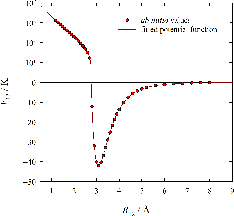
Figure 1: Ab initio neon pair potential as reported by Hellmann et al. (2601.21721).
Nonadditive three-body interactions are treated by constructing a potential energy surface from 2550 high-level CCSDT(Q)/CBS ab initio data points, representing a comprehensive sampling of three-body geometries.
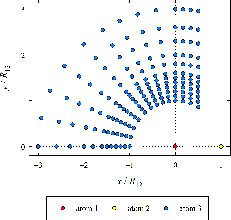
Figure 2: Distribution of the 156 triangular arrangements sampled in the three-body ab initio calculations.
The functional parametrization incorporates both dispersion (ATM) asymptotics and exponential short-range exchange interactions. The fit demonstrates high fidelity to ab initio data across the relevant configurational space.
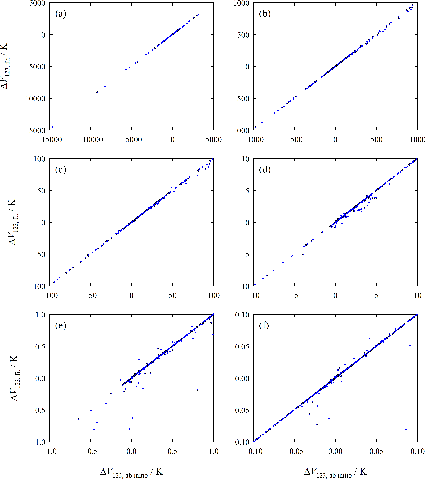
Figure 3: Comparison of fitted vs. ab initio three-body energies across energy ranges, demonstrating near-diagonal correspondence and residuals mainly at negligible energy magnitudes.
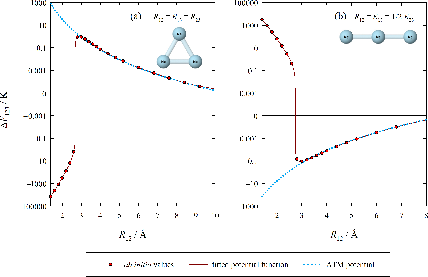
Figure 4: Three-body energies for representative geometries (equilateral and linear), highlighting the departure from ATM at short range and necessity of explicit exchange terms.
Four-Body Nonadditivity
Four-body effects, evaluated to be negligible in contribution yet essential for completeness, are incorporated via supermolecular CCSD(T)/CBS computations at regular tetrahedral configurations, fit by an extended Bade ansatz that preserves asymptotics but extends to short-range via flexible damping and high-order polynomial terms.
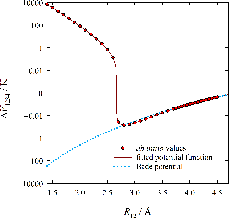
Figure 5: Comparison of ab initio, extended Bade fit, and bare Bade four-body nonadditive energies for tetrahedral Ne clusters.
Path-Integral Monte Carlo and Quantum Effects
PIMC is used to compute quantum-statistical ensemble averages for C, D, and acoustic virial coefficients, with intensive Monte Carlo integration and extensive convergence testing. Isotope effects are handled via combinatorial averaging over all isotopologue compositions. Uncertainty propagation is addressed with both “rigid-shift” and absolute-integral techniques to rigorously account for ab initio uncertainties and their impact on computed virial parameters.
Results: Third/Fourth Density and Acoustic Virial Coefficients
Third Density and Acoustic Virial Coefficients
The inclusion of nonadditive three-body interactions yields corrections to C (third density virial coefficient) on the order of several cm6/mol2, dominating over quantum-statistical effects across all T.
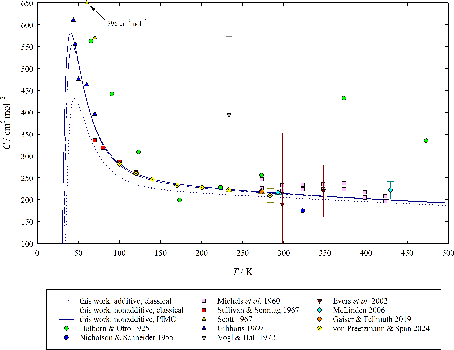
Figure 6: Temperature dependence of calculated C under various theoretical levels and contemporary experimental data for C.
A subset of experimental results, specifically the dielectric-constant gas thermometry analysis of Gaiser and Fellmuth and primary densimetric data, agrees with the current PIMC predictions within combined uncertainties. Previous theoretical studies exhibit bias owing to insufficient three-body modeling.
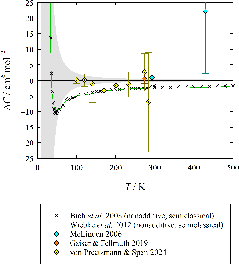
Figure 7: Deviations of C values from Bich et al. and Wiebke et al. relative to the present work, showing persistent discrepancies, especially in experimental discriminants.
RTγa (acoustic third virial coefficient) is computed fully quantum-mechanically, demonstrating systematic improvement over experiment and previous calculations. Deviations from the only high-precision experimental datasets are typically within expanded (k=2) uncertainties.
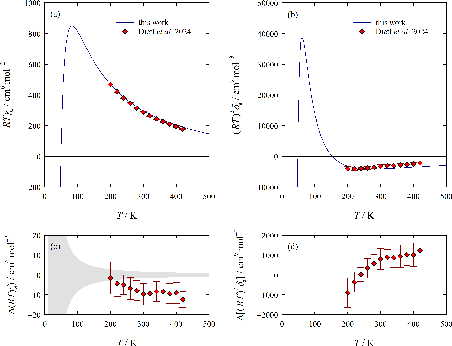
Figure 8: (a) Third acoustic virial coefficient RTγa: theory vs. experiment; (b) Fourth acoustic virial coefficient (RT)2δa; (c,d) Deviations for both coefficients.
Fourth Density and Acoustic Virial Coefficients
The fourth density virial coefficient D is predominantly determined by pair and three-body interactions, with the explicit four-body term contributing <1%, even at the lowest T.
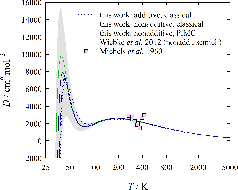
Figure 9: Calculated D vs. theory and the only (highly scattered) legacy experimental dataset; shaded area, PIMC uncertainty.
Comparisons with both experiment and previous ab initio calculations (notably Wiebke et al.) demonstrate consistency only with rigorous quantum/statistical treatment and improved many-body potentials.
Implications for Metrology and Theory
The established protocol achieves subdominant theoretical uncertainties—often exceeding experimental precision for low-density Ne—across all reported virial coefficients. This is a necessary precondition for establishing neon as a reference for primary metrology at elevated T and p, particularly given the inherent limitations of argon and the isotopic complexity of natural neon. The clear demonstration that neglect (or naive treatment) of nonadditive three-body interactions leads to non-negligible systematic error is a key conclusion.
The methodology illustrates that the principal path to further accuracy improvements—especially below 100K—lies in further advances in electronic structure for pair and three-body terms, which is resource-intensive due to the high electron count of Ne.
Practically, the provision of analytic fit parameters for B(T), C(T), D(T), and the associated uncertainties, validated against all available experimental data, enables their direct use in acoustic and thermophysical metrology and standards realization.
Conclusion
This work delivers ab initio, uncertainty-quantified third and fourth virial coefficients (density and acoustic) for neon, using state-of-the-art potentials and rigorous quantum-statistical mechanics. The data are internally self-consistent, externally validated where possible, and, in most cases, provide lower uncertainties than measured data. This positions neon for future deployment in primary-metrological applications, pending further ab initio advances in low-temperature potential construction.
Future efforts should focus on computational methodologies for accurate evaluation of potentials at higher n-body order and using explicitly correlated F12 approaches to mitigate basis set limitations for neon and heavier noble gases. The analytic fit structure and uncertainty propagation strategy established here will generalize directly to such systems and to similar studies in other atomic or molecular fluids.