- The paper introduces a geometric framework that models chess strategies as trajectories in conceptual spaces based on temporally extended feature analysis.
- It utilizes seven strategically meaningful dimensions and dual-perspective modeling to capture and distinguish opposing player strategies.
- Empirical validation on master games shows spatial regions and directional flows align with expert annotations of tactical intentions.
Geometric Modelling of Abstract Strategy Concepts in Chess: A Conceptual Spaces Approach
Introduction
"Abstract Concept Modelling in Conceptual Spaces: A Study on Chess Strategies" (2601.21771) proposes a formal geometric framework to represent and recognize abstract, temporally extended concepts—specifically chess strategies—by embedding sequences of game positions as trajectories in a conceptual space structured by interpretable, domain-grounded quality dimensions. The study demonstrates that strategic intentions such as attack, sacrifice, and domination can be realized as region-based constructs and systematically detected via trajectory analysis. This framework addresses the interpretability limitations of existing AI chess systems, where strategies remain implicit or are reduced to black-box pattern recognition, by offering explicit, cognitively plausible representations that are both interpretable and temporally grounded.
Conceptual Space Construction and Strategy Anchoring
The proposed framework operationalizes Gärdenfors’ conceptual spaces theory by selecting seven strategically meaningful dimensions from chess—Material, Mobility, Vulnerability, Control, Flow, Pressure, and Space—organized into three domains: Force, Territory, and Conflict. Each domain reflects a distinct facet of chess reasoning: Force (resources and activities), Territory (control and coordination), and Conflict (threats and risks).
Chess strategies (King Attack, Positional Sacrifice, Space Domination) are anchored as convex regions spanning multiple domains, ensuring that strategic recognition does not reduce to a single metric. The boundaries and centroids of these regions are heuristically derived from expert knowledge, consistent with the interpretability requirement and cognizant of the limitations of current data-driven alternatives for such abstractions.
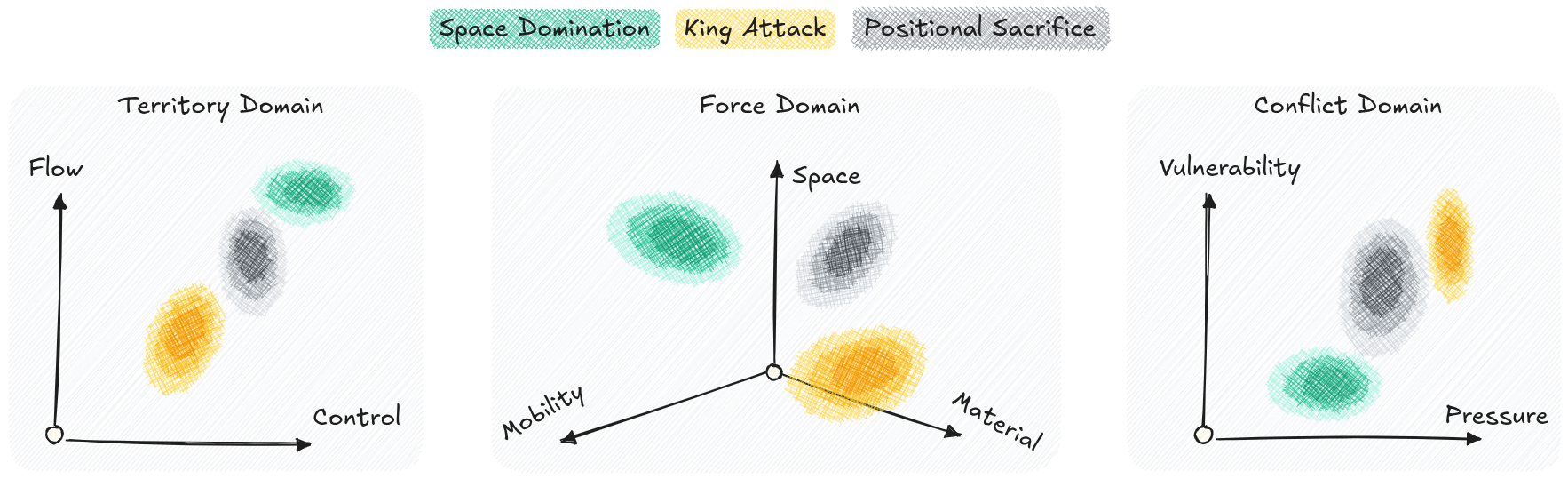
Figure 1: An illustration of the chess conceptual space, showing chess strategies anchored as regions across force, territory, and conflict domains.
Trajectory-Based Recognition and Dual-Perspective Modelling
The instantiation process involves embedding game positions as points in the normalized multidimensional space, with entire games mapped as temporal trajectories. Position encoding leverages computational primitives: piece values for material, python-chess for mobility/move availability, board influence metrics for control and space, and aggregate threat assessment for pressure and vulnerability.
Unique to this framework is the dual-perspective modeling: separate trajectories are generated for White and Black. Despite sharing board states, the dimension values reflect player-centric interpretations, enabling the recognition of competing strategic intentions from identical positions.
Trajectory analysis enables the detection of sustained entry and movement toward the strategic concept regions, capturing both regional continuity (sequence of positions within concept boundaries) and directional convergence (movement toward the centroid), in line with both cognitive prototypicality and temporal intentionality.
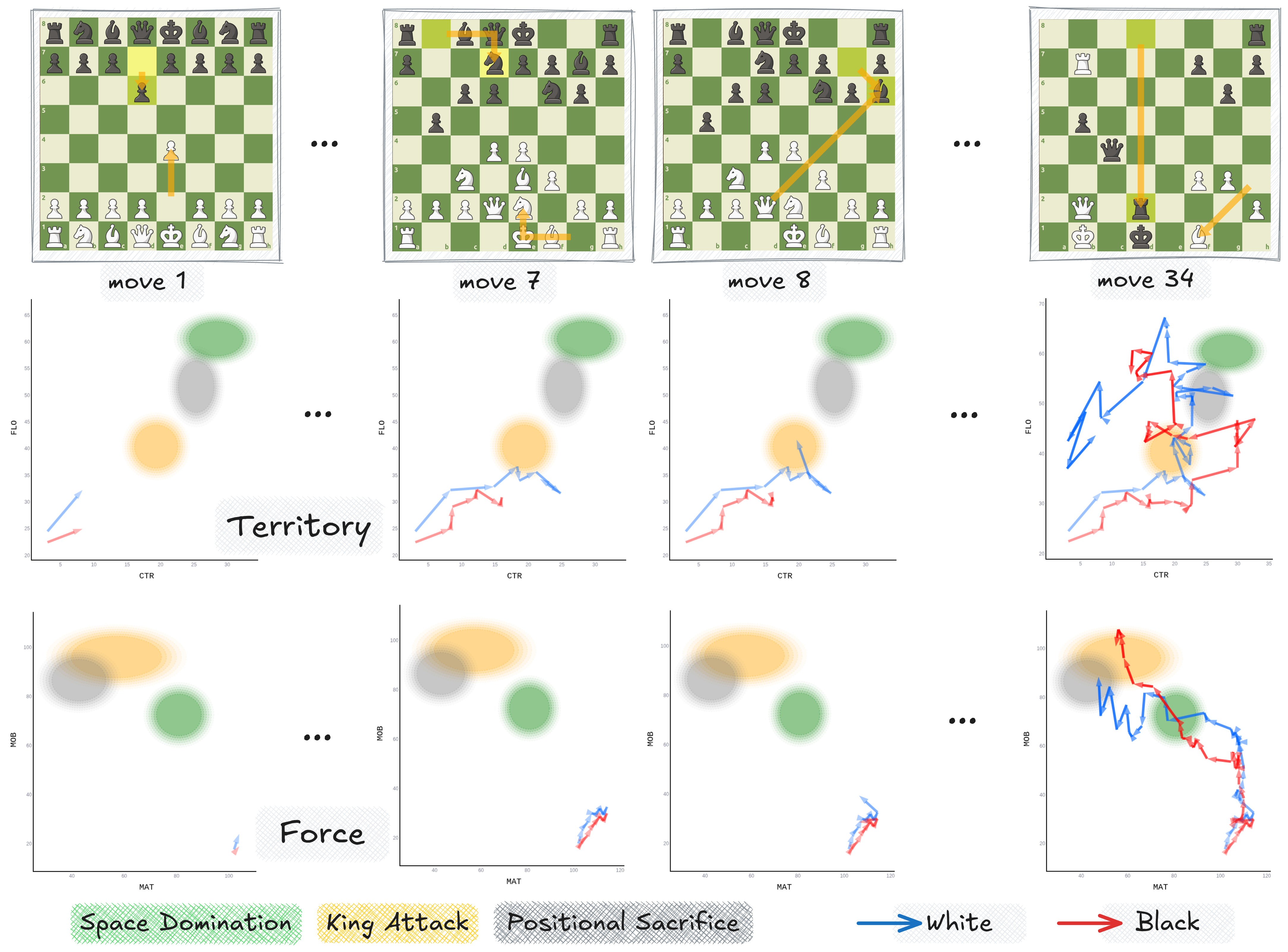
Figure 2: Dual-perspective trajectories of chess board positions in chess conceptual space.
Empirical Demonstration and Recognition Mechanism
Qualitative validation is provided through case studies on expert-annotated master games. Trajectories corresponding to recognized strategy execution—such as the buildup to a King Attack or Positional Sacrifice—are aligned with annotated strategic inflections and demonstrate that the geometric movement through the space matches human-expert tactical recognition.
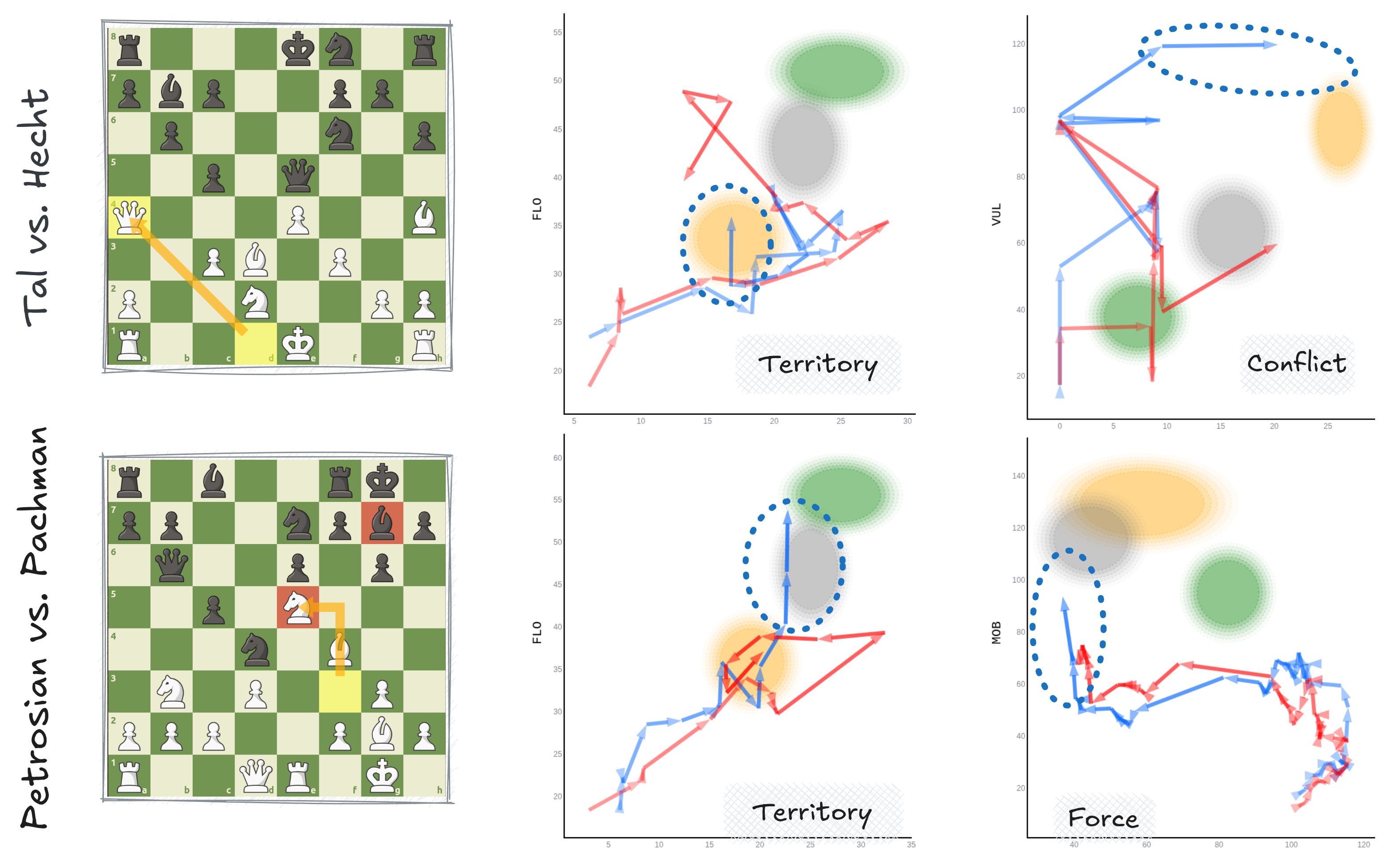
Figure 3: Strategy recognition examples aligned with concept regions in annotated master games.
The recognition criterion is stringent: strategies are recognized only when both presence within a concept region and directional progression toward the centroid are satisfied across multiple domains. This mitigates false positives due to incidental or short-term fluctuations in any individual dimension. Furthermore, the framework captures asymmetric recognition from dual perspectives—allowing for accurate modelling of simultaneous but player-relative strategic intentions.
Generalization Potential and Theoretical Implications
The methodology generalizes beyond chess to any domain involving temporally realized, goal-directed conceptual structures. The core architectural elements—quality dimension selection, region anchoring, trajectory generation, and pattern-based recognition—form a reusable template for geometric modelling of abstract concepts across human behavior, multi-agent planning, narrative understanding, and collaborative decision-making.
The work formalizes trajectory-based reasoning within conceptual spaces, offering an explicit strategy for grounding intentional concepts in interpretable geometric entities and for recognizing them as spatiotemporal patterns.
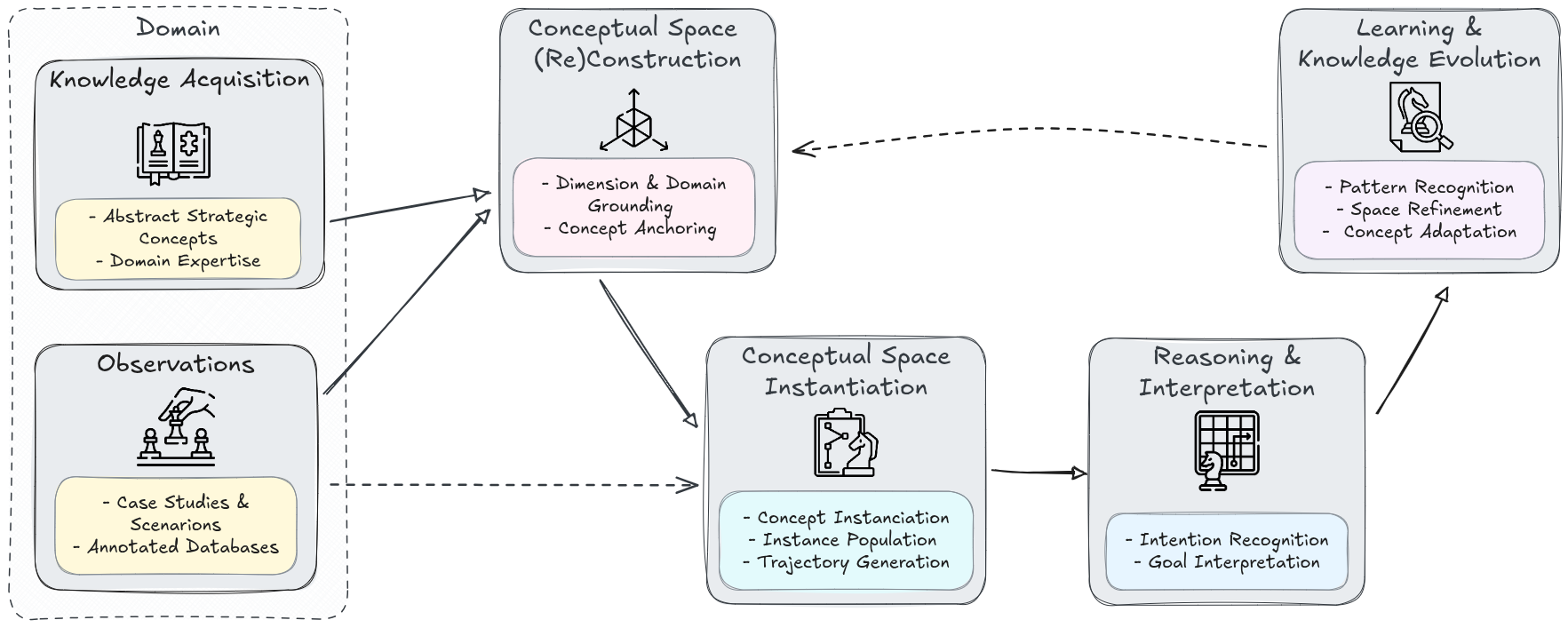
Figure 4: Proposed framework architecture for geometric modelling of abstract concepts.
Limitations and Future Research Trajectories
Despite its interpretability, the framework's reliance on heuristically determined dimensions and boundaries introduces both scalability constraints and subjective bias. Systematic, large-scale quantitative validation on annotated game corpora remains as future work to support claims of generalisability. The absence of automated, data-driven methods for quality dimension and region discovery is acknowledged as a significant limitation; progress here would enable scalable, less expert-dependent operationalization.
The authors explicitly highlight unimplemented but central modules—pattern recognition, adaptive boundary learning, and knowledge evolution—as required for practical, large-scale deployment and for capturing the full dynamism of conceptual spaces. The development of methods for the data-driven emergence of abstract concepts from large, sequential datasets is identified as a particularly rich direction, aligning with current trends in neuro-symbolic integration and interpretable sequence modelling.
Conclusion
This study extends conceptual spaces theory to temporally extended, intentionally directed concepts, offering a geometric and interpretable approach to strategy recognition in chess. By formalizing abstract strategies as spatial regions and utilizing temporal trajectories for recognition, the framework bridges a critical gap in interpretable AI for strategic domains. Future developments in data-driven boundary induction, large-scale empirical validation, and adaptive knowledge evolution will be necessary for full realization and cross-domain application. This approach lays a foundation for the integration of transparent conceptual modelling and systematic temporal reasoning in sequential decision-making AI.