On the radial velocity wave in the Galactic disk
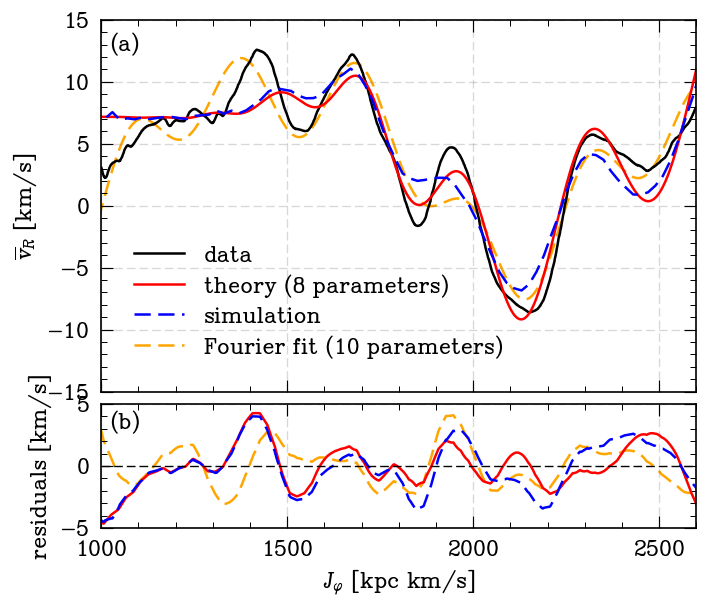
Abstract: Stars in the Galactic disk have mean radial velocities $\overline{v}R$ that oscillate as a function of angular momentum $J\varphi$. This `$J_\varphi$-${\overline{v}}R$ wave' signal also exhibits a systematic phase shift when stars are binned by their dynamical temperatures. However, the origin of the wave is unknown. Here we use linear perturbation theory to derive a simple analytic formula for the $J\varphi$-$\overline{v}R$ signal that depends on the equilibrium properties of the Galaxy and the history of recent perturbations to it. The formula naturally explains the phase shift, but also predicts that different classes of perturbation should drive $J\varphi$-$\overline{v}R$ signals with very different morphologies. Ignoring the self-gravity of disk fluctuations, it suggests that neither a distant tidal kick (e.g., from the Sgr dwarf) nor a rigidly-rotating Galactic bar can produce a qualitatively correct $J\varphi$-$\overline{v}R$ wave signal. However, short-lived spiral arms can, and by performing an MCMC fit we identify a spiral perturbation that drives a $J\varphi$-${\overline{v}}_R$ signal in reasonable agreement with the data. We verify the analytic formula with test particle simulations, finding it to be highly accurate when applied to dynamically cold stellar populations. More work is needed to deal with hotter orbits, and to incorporate the fluctuations' self-gravity and the role of interstellar gas.
Paper Prompts
Sign up for free to create and run prompts on this paper using GPT-5.
Top Community Prompts
Explain it Like I'm 14
What is this paper about?
This paper tries to explain a wavy pattern seen in how stars move in the flat disk of our Milky Way. When astronomers use Gaia data to measure stars’ average “in–out” speeds (radial velocities) and sort those stars by their spin around the Galaxy (angular momentum), the average speed doesn’t stay flat — it wiggles up and down like waves. The authors call this the “v wave.”
They build a simple physics model to figure out what kind of recent disturbance in the Galaxy (like spiral arms, the bar in the center, or the passing Sagittarius dwarf galaxy) could have created those waves.
What questions did the researchers ask?
They focused on three main questions:
- Why do the stars’ average “in–out” speed form waves when plotted against their spin around the Galaxy?
- Why do those waves shift in phase (their peaks and troughs move) depending on how “hot” or “cold” the stars’ orbits are? (“Cold” stars stay near circular paths; “hot” stars move on more wiggly, elliptical paths.)
- What kind of disturbance — a passing satellite galaxy, the central bar, or short-lived spiral arms — best matches the detailed shape of the observed v wave?
How did they study it?
Think of the Galaxy’s disk like a huge merry-go-round made of stars. If you give it a small nudge, you make ripples. The team used two main tools to understand these ripples:
- A simple physics model (linear perturbation theory): This is like saying, “if we poke the system a little, the response is small and predictable.” They derived a clear formula for how waves in average radial velocity should look as you change angular momentum. This formula connects the wave’s pattern to:
- The Galaxy’s normal properties (its rotation and how stars’ orbits behave), and
- The history of recent disturbances (how strong they were, how long they lasted, and where they were).
- Computer experiments (test particle simulations): They “released” millions of virtual stars into a realistic Galactic potential and applied different kinds of disturbances (a quick tidal tug, a rotating bar, or transient spiral arms). Then they measured the resulting v wave and compared it to their formula.
They also used an MCMC fit (Markov Chain Monte Carlo), which is a clever way of trying many possible disturbance settings to find the ones that match the observed wave best. Think of it as rolling the dice many times but steering the rolls toward values that fit the data.
Along the way, they explained tricky terms in everyday ways:
- Radial velocity: a star’s speed moving toward or away from the center of the Galaxy.
- Angular momentum: how much a star “spins” around the Galaxy (related to its guiding radius — the average distance it orbits from the center).
- “Hot” vs “cold” orbits: cold = nearly circular, hot = more elliptical; hot stars drift in angle compared to cold stars, which shifts the wave’s phase.
For clarity, their main tests ignored “self-gravity,” meaning they didn’t let the stars’ collective pull change the disturbance itself. That keeps the math simpler, but it’s something they plan to add later.
What did they find, and why does it matter?
Here are the key results, stated simply:
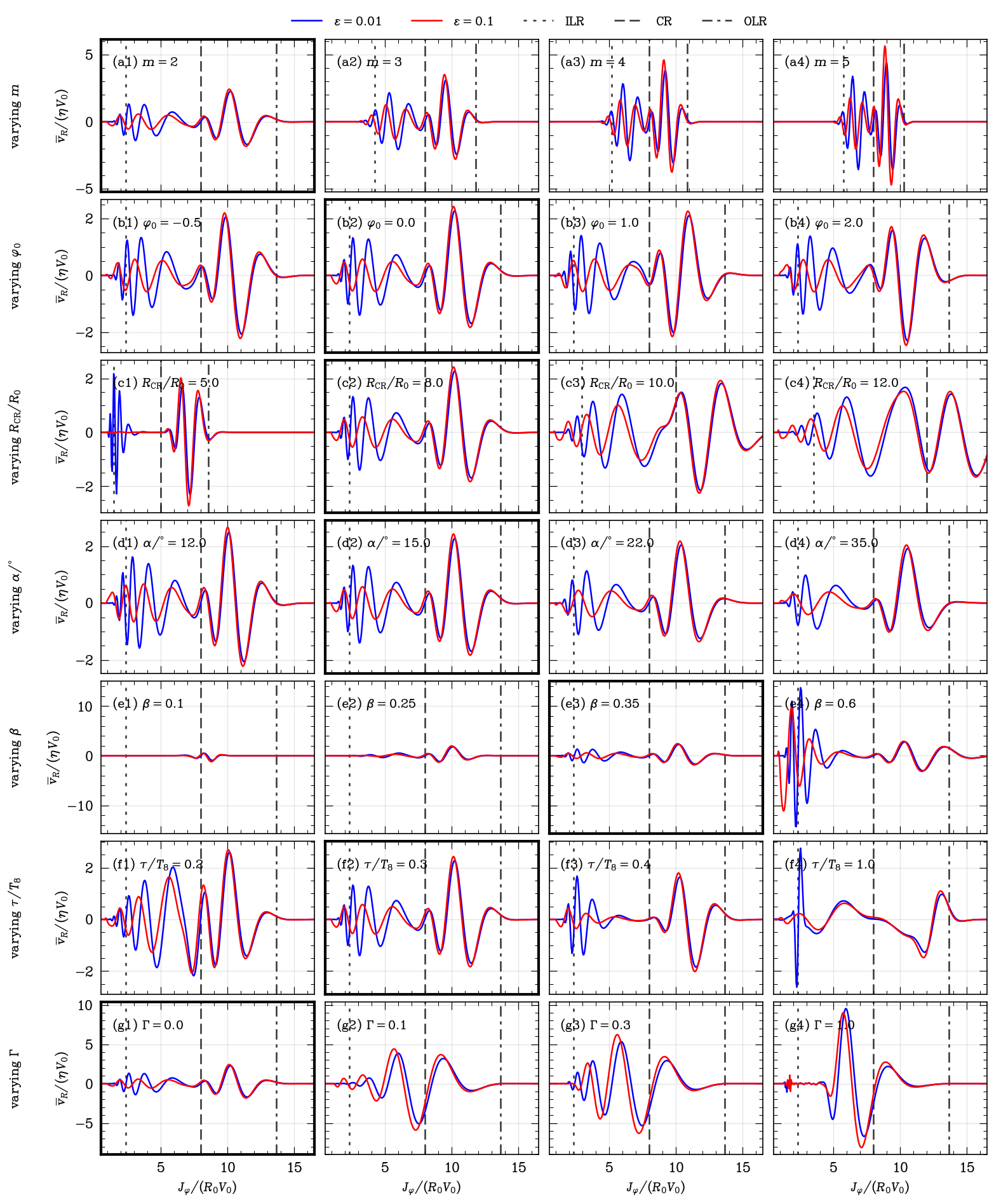
- Their formula naturally explains the phase shift: waves from hotter star populations lag behind waves from colder ones (the peaks move to the right in the plot). That’s because hotter stars drift in angle compared to cold stars, which shifts the timing of the wave.
- Different disturbances make different wave shapes:
- A quick, distant tidal kick (like from the Sagittarius dwarf galaxy) mostly makes one strong wave and one weak one. That doesn’t match the data, which looks like several waves with similar strengths.
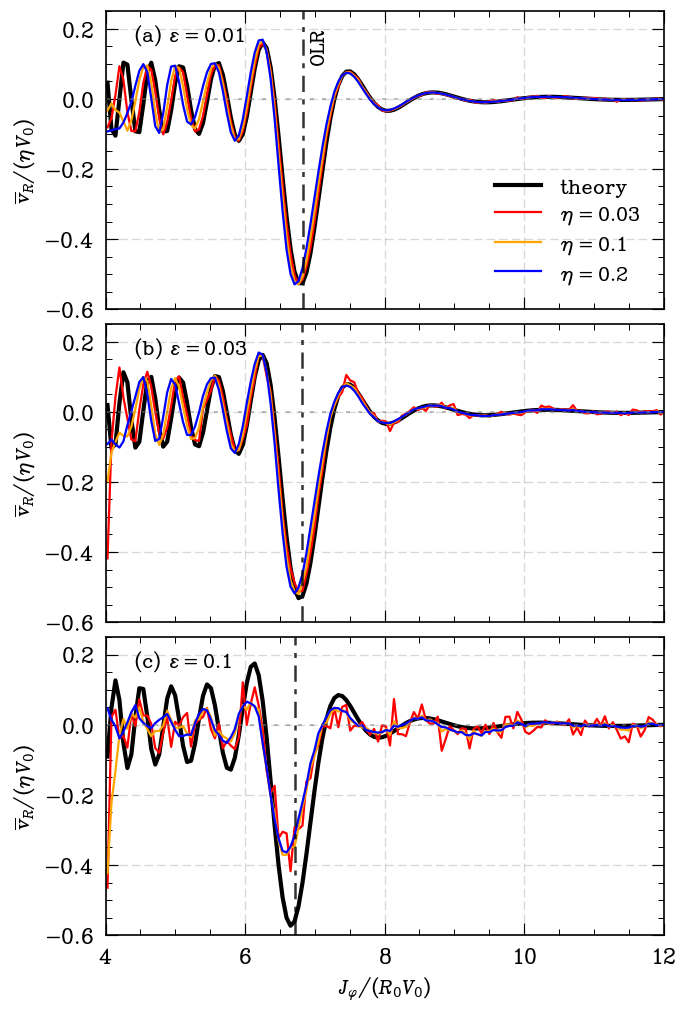
- A rigidly rotating central bar mainly produces one dominant wave and a sharp feature near a resonance. Again, this doesn’t match the observed “multi-wave” pattern.
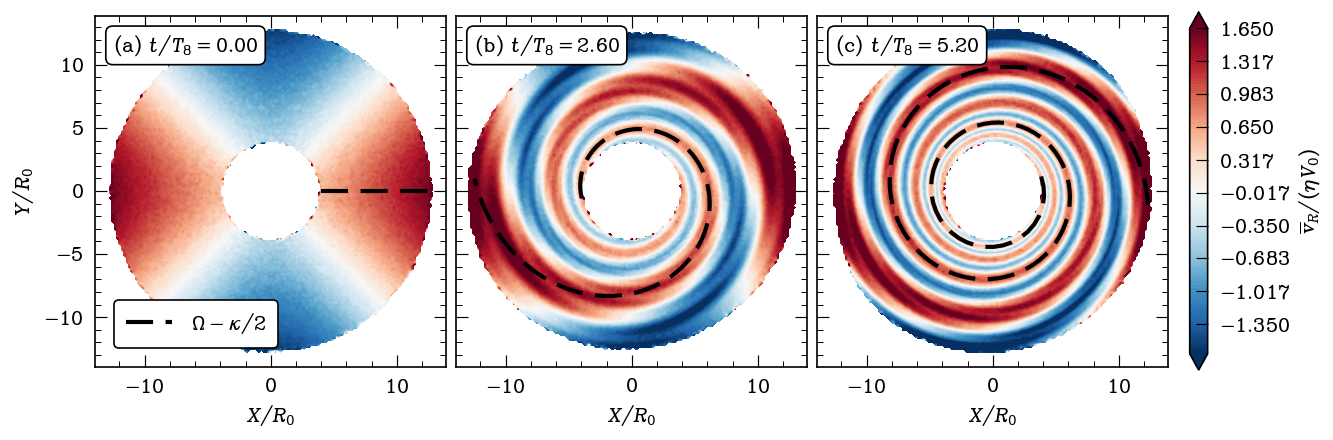
- Short-lived (transient) spiral arms can make several wave components with comparable sizes and the right phase behavior. This looks much more like what Gaia sees.
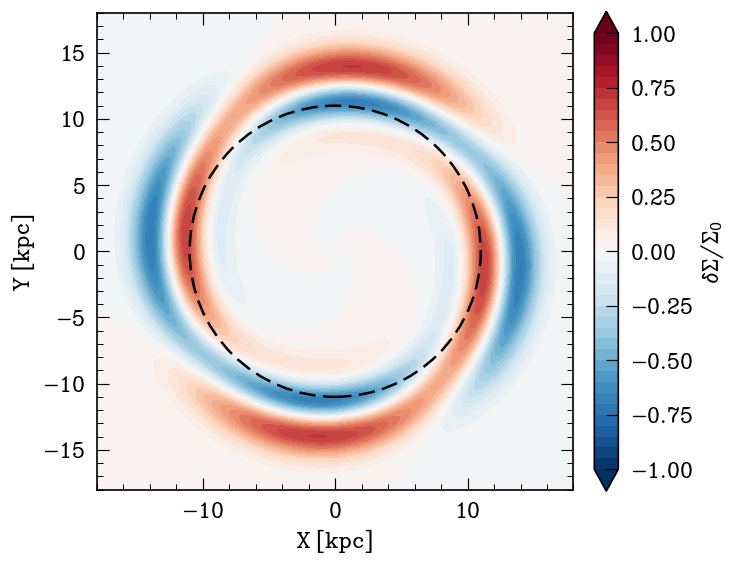
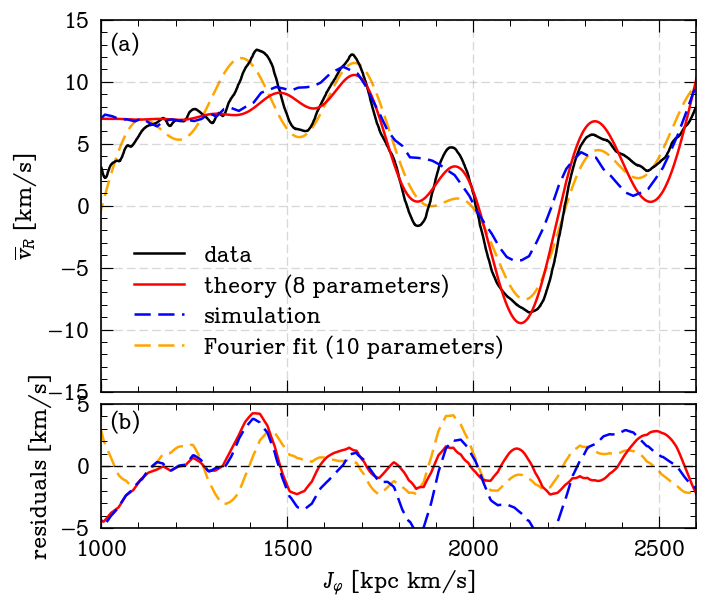
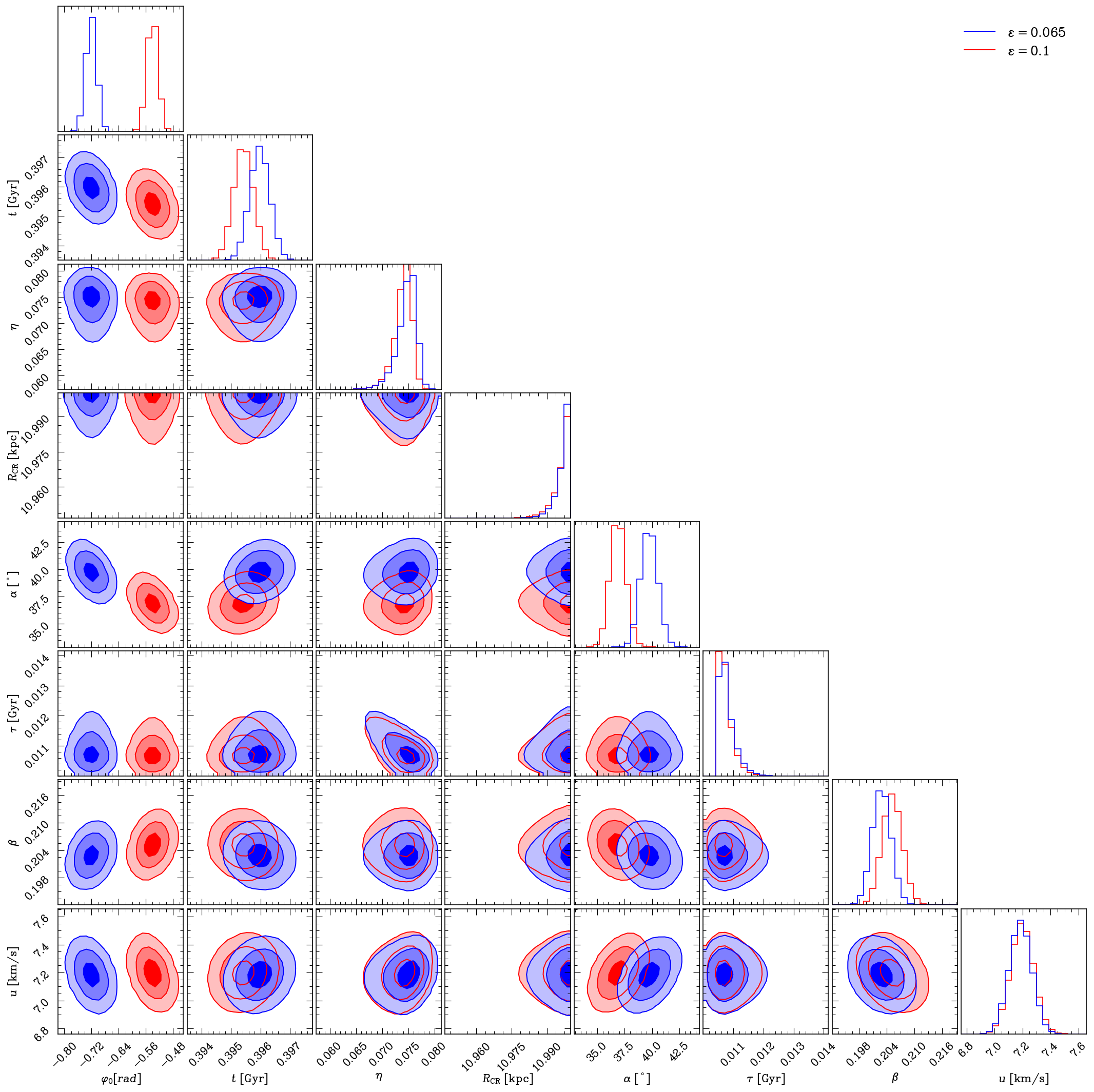
- Using MCMC fits, they found a transient, two-armed spiral disturbance that produces a v wave reasonably close to the real data.
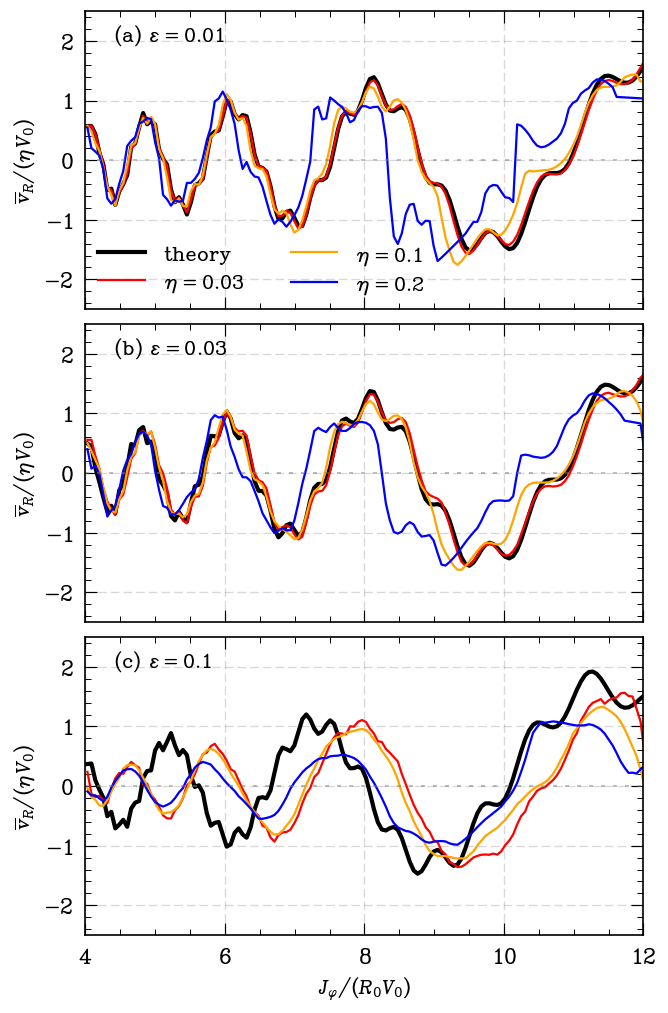
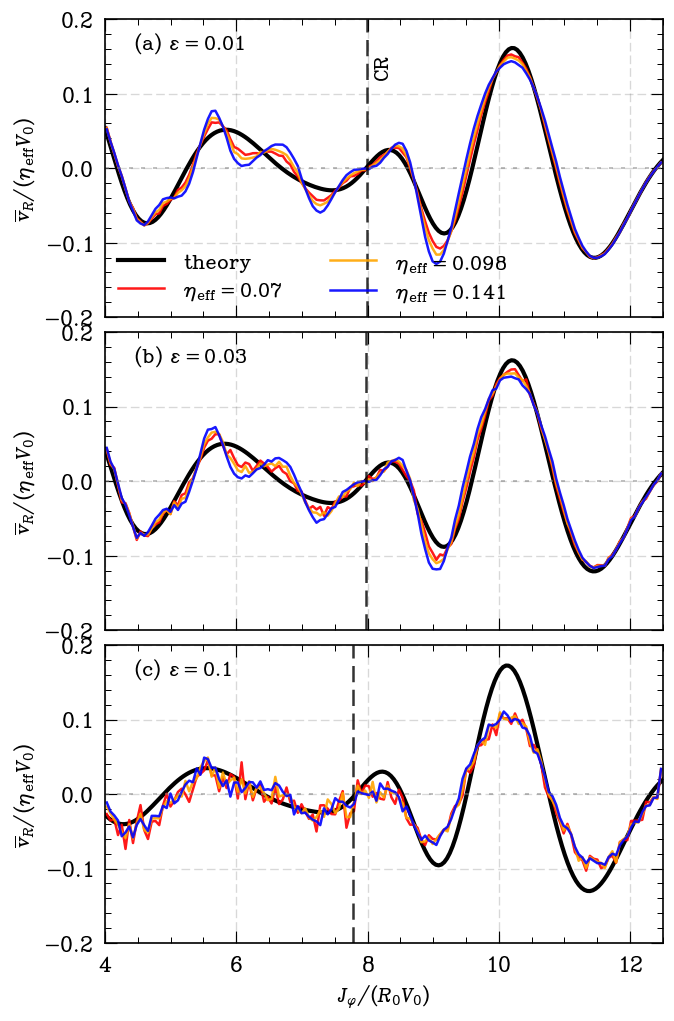
- Their formula and the simulations agree really well for “cold” stars (near-circular orbits). For “hotter” stars (more elliptical orbits), the simple formula starts to lose accuracy — they need to include more detailed effects.
- The wavelengths of the waves suggest the disturbance happened only a few orbits ago (in Galactic terms, relatively recently). That helps build a timeline of the Milky Way’s recent history.
This matters because it gives astronomers a kind of “fingerprint tool”: by looking at the v wave’s shape, we can tell what kind of event shook the Galaxy and when.
What’s the bigger picture and what comes next?
The study points strongly to short-lived spiral arms (rather than a single tidal kick or the central bar alone) as the main cause of the v wave. That means the Milky Way has likely had active, transient spiral structure in the recent past.
Next steps include:
- Adding self-gravity: letting the stars’ collective pull shape the disturbance, which could change the wave pattern.
- Including interstellar gas: gas responds differently than stars and can change how spiral arms grow and fade.
- Handling hotter star populations more carefully: improving the theory beyond the very simple approximations.
- Exploring combinations of disturbances: for example, spiral arms triggered by a small tidal tug or influenced by the bar.
Overall, the paper shows how simple, clear physics can decode the complex dance of stars in our Galaxy, turning a mysterious pattern into a clue about the Milky Way’s recent activity.
Knowledge Gaps
Knowledge gaps, limitations, and open questions
Below is a single, consolidated list of concrete gaps, limitations, and unresolved questions that emerge from the paper. Each item is written to be actionable for future research.
- Self-gravity is neglected: perform fully self-consistent calculations (e.g., DF + Poisson) to test whether including the disk’s gravitational response changes the v-wave morphology enough to rehabilitate tidal-kick or bar scenarios, or to refine spiral-based fits.
- Gas dynamics are ignored: incorporate the interstellar medium (ISM) and its coupling to stellar perturbations (e.g., via hydrodynamics or two-fluid models) to assess its impact on the amplitude, phase, and resonance localization of the v-wave.
- Long-wavelength approximation limits accuracy for hotter populations: derive and validate a theory beyond the long-wavelength limit (including additional Fourier components in the linear response) and quantify error as a function of for .
- Nearly-epicyclic, 2D midplane approximation: extend the analytic and numerical frameworks to 3D, including vertical actions () and coupling between vertical and in-plane motions, and quantify how finite excursions affect .
- Constant assumption: allow for realistic and profiles; re-derive the phase-lag predictions and refit the data with spatially varying kinematic temperatures.
- Flat rotation curve in modeling vs. MWPotential2014 in data: recompute with a realistic Galactic potential (including non-constant and ) and propagate frequency-derivative uncertainties into the predicted wavelengths and phase shifts.
- Single-perturbation assumption: test composite models (e.g., bar + transient spiral, repeated spirals, tidal trigger plus internal response) to assess whether multiple events better explain the observed multi-component v-wave.
- Spiral pattern choice in the fit: compare rigidly rotating spirals with shearing (kinematic density wave, material arm) models; allow time-dependent pitch angle and shear rate (), and evaluate how these alter resonance structure and the radial localization of the response.
- Fixed arm number (): test whether or mixed-arm-number perturbations produce better agreement with the observed multi-mode v-wave; use morphology to constrain .
- Phase shift between hot and cold populations: move beyond the short-lived-perturbation estimate by modeling realistic dispersion and resonance detuning; fit phase offsets across multiple dynamical-temperature bins to constrain and Dehnen drift contributions.
- Data systematics and processing choices: quantify sensitivity of the v-wave to distance estimators (e.g., StarHorse), the assumed Galactic potential, azimuthal wedge width/center, and selection function; incorporate survey selection effects and measurement errors into the likelihood.
- Ad hoc velocity offset (): investigate physical origins (e.g., asymmetric drift corrections, local streaming, velocity ellipsoid tilt, wedge geometry biases), and determine whether should be modeled rather than fitted as a free offset.
- Azimuthal variation: verify the predicted rotation of v-wave phase with azimuth () and test the model across multiple wedges to check consistency and break parameter degeneracies (e.g., between , , and ).
- Timing inference: replace the heuristic “few orbits old” estimate by formal posterior inference of (with uncertainties); study degeneracies of with , , and .
- Tidal-kick viability with self-consistency: reassess whether the Sgr-induced scenario could produce multiple comparable-amplitude components once the disk’s self-gravity and gas are included (the test-particle result favored a dominant single component).
- Neglected terms in the derivation: quantify the impact of terms and those proportional to (omitted under approximations); provide correction schemes or error bounds across .
- Physicality of the fitted spiral density: systematically check that the inferred transient spiral potential corresponds to a physically plausible (no negative or divergent total surface density) given the assumed vertical structure and radial envelope.
- MCMC robustness: publish posterior diagnostics (e.g., corner plots), assess prior sensitivity, and rerun fits using multiple azimuth wedges and alternative data pipelines to gauge parameter degeneracy and reproducibility.
- Validation at the fitted parameters: run test-particle and self-consistent simulations with the best-fit spiral parameters and realistic distributions to verify the analytic prediction in the regime where long-wavelength and linear assumptions are marginal.
- Chemo-chronology: stratify the v-wave by stellar age/abundance to constrain the timing and origin of the perturbation and to check whether different populations exhibit consistent phase shifts and amplitudes.
- Bar–spiral resonance interplay: explore whether interaction near the OLR (or other resonances) between a slowing bar and transient spirals can produce the observed multi-mode structure, especially with a non-flat rotation curve.
- Time-dependent : explicitly include time-varying radial wavenumbers for transient/shearing spirals in the analytic formula (beyond the current approximation) and test the impact on amplitude and phase.
- Vertical bending/corrugation modes: although recent work finds no clear correlation, evaluate potential coupling pathways that could translate vertical modes into in-plane signatures in full 3D models with gas.
- Solar position and local biases: examine whether the Sun’s location relative to the spiral/bar patterns biases the measured v-wave in the chosen wedge and whether global azimuthal coverage changes the inferred parameters.
- Uncertainty in estimation: propagate errors from distances and velocities into and to produce uncertainty bands on the v-wave and robust parameter posteriors.
Practical Applications
Immediate Applications
Below are concrete, deployable use cases that leverage the paper’s analytic model, diagnostics, and verification workflow. Each item notes the relevant sector(s), potential tools/products/workflows, and key assumptions/dependencies.
- Analytic emulator for Milky Way disequilibrium kinematics
- Sectors: academia (galactic dynamics), software for astronomy, space agencies/observatories
- What: Implement the paper’s closed-form linear-response model for the mean radial velocity signal v̄R(Jφ, φ, t) as a lightweight emulator to predict and interpret the “v wave” under specified perturbations (transient spirals, bars, tidal kicks).
- Tools/workflows: Python library with a simple API; integration with galpy for actions/frequencies; emcee for posterior sampling; wrappers to match survey selection functions (azimuth wedge, cold/hot subsamples).
- Assumptions/dependencies: Linear perturbation regime; nearly-epicyclic (2D) approximation; long-wavelength limit; dynamically cold populations best (ε ≲ 0.03); short lookback times (≲1 Gyr); adopted Galactic potential and distance/velocity systematics (e.g., Gaia DR3, StarHorse); ignores self-gravity and gas.
- Rapid hypothesis testing of perturbation origins (bar vs tidal kick vs transient spiral)
- Sectors: academia, observatories
- What: Use the model’s diagnostic signatures (wavelength scaling with time, amplitude ratios of “fast/slow” modes, resonance-localized structure, hot–cold phase lag from Dehnen drift) to rule out or favor classes of perturbations without running full N-body simulations.
- Tools/workflows: Template library of predicted v̄R morphologies; likelihood-based model comparison; goodness-of-fit dashboards per sky wedge.
- Assumptions/dependencies: Same as above; relies on accurate conversion to actions J; sensitivity to the adopted rotation curve and κ, Ω profiles.
- Inverse modeling of recent spiral activity from survey data
- Sectors: academia, software for astronomy, survey pipelines
- What: Fit transient spiral parameters (pattern speed, pitch angle, lifetime, corotation radius, envelope width, phase) to v̄R(Jφ) using MCMC; produce posteriors and predictive checks across subpopulations (cold/hot) and sky wedges.
- Tools/products: Turn-key “fit_v_wave” module; priors informed by the paper’s scaling ηeff ~ 2π η m|cotα| τ/T; automatic report generation (best-fit, uncertainties, diagnostic plots).
- Assumptions/dependencies: Valid for dynamically cold samples; selection-function handling; cross-calibration between data products (Gaia proper motions, radial velocities, distances); potential-dependent action calculation.
- Survey strategy and target selection optimization
- Sectors: observatories/surveys (e.g., WEAVE, 4MOST, SDSS-V), space agencies (ESA/NASA)
- What: Use emulator forecasts to identify Jφ-ranges and azimuthal wedges with maximal discriminating power between perturbation scenarios; prioritize spectroscopic follow-up where resonance-driven features should peak.
- Tools/workflows: Sensitivity maps vs. (Jφ, φ), “feature importance” of wave components; allocation aids for fiber surveys.
- Assumptions/dependencies: Requires forecasted uncertainties per field; depends on prevailing systematics and the adopted Galactic potential.
- Quality control and systematics auditing for kinematic pipelines
- Sectors: survey pipelines, data QA/QC
- What: Compare observed v̄R(Jφ) against emulator envelopes; flag fields where deviations exceed model-consistent bounds as possible calibration or selection-function issues.
- Tools/workflows: Residual heatmaps; automated anomaly detection thresholds; nightly/DR-level QC hooks.
- Assumptions/dependencies: Deviations may reflect real physics (self-gravity, gas response, hotter populations), so flags should trigger hierarchical checks rather than hard rejections.
- Educational and outreach resources
- Sectors: education, public outreach
- What: Interactive notebooks/animations for phase mixing, resonance localization, and transient spiral signatures; reproducible “from paper to plot” tutorials with Gaia DR3 subsets.
- Tools/products: Jupyter notebooks, minimal-dataset bundles, classroom exercises comparing bar vs spiral predictions.
- Assumptions/dependencies: Simplified potentials and cold-population limits; emphasis on conceptual fidelity over exhaustive realism.
Long-Term Applications
These applications require further research, scaling, or methodological development (e.g., self-gravity, gas, hotter orbits, full selection modeling) before operational deployment.
- Self-consistent chemo-dynamical reconstructions of the Milky Way’s recent history
- Sectors: academia, space science programs
- What: Extend the analytic framework to include self-gravity of disk fluctuations, gas dynamics, vertical coupling, and hotter orbit treatments; perform hierarchical Bayesian inference that combines v̄R with other disequilibrium tracers (phase spirals, bending waves, gas streaming).
- Tools/workflows: Hybrid emulator–simulation pipelines (analytic core + fast response kernels + targeted N-body/hydro validation); joint likelihoods across multiple data sets; rigorous selection-function modeling.
- Assumptions/dependencies: Requires robust mappings between perturber histories (e.g., Sgr’s last passages, bar evolution) and multi-tracer responses; careful treatment of degeneracies and priors.
- Timeline and cartography of transient spiral episodes
- Sectors: academia, observatories
- What: Use the wavelength–time scaling and resonance localization to build a chronology of spiral transients over the last ~1 Gyr, possibly distinguishing rigidly rotating vs shearing morphologies across radii.
- Tools/workflows: Tomographic fits by azimuth, radius, and population hotness; cross-check with open cluster ages, star formation bursts, and gas kinematics.
- Assumptions/dependencies: Requires uniform handling of systematics across large spatial volumes; improved action calculations in non-axisymmetric backgrounds.
- Mission design and science-justification inputs for next-generation surveys
- Sectors: policy/mission planning (e.g., GaiaNIR, future astrometry/spectroscopy), space agencies
- What: Translate sensitivity to transient features into instrument requirements (velocity precision, distance accuracy, sky coverage, cadence); quantify the marginal science gain of improved proper motion or RV floors on discriminating perturbation classes.
- Tools/workflows: End-to-end performance simulators using the analytic response as a forward model; cost–benefit analyses for design trades.
- Assumptions/dependencies: Forecasts contingent on how well self-gravity and gas are incorporated; depends on the adopted Galactic potential and population selection.
- Cross-domain transfer of the linear-response/inverse-modeling approach
- Sectors: software/analytics, energy/transport/finance research (signal and resonance detection in complex systems), plasma/space physics
- What: Adapt the “perturbation → response → inverse inference” pipeline to other nearly collisionless or weakly nonlinear systems (e.g., Vlasov plasmas, planetary rings, certain traffic or power-grid wave phenomena), where phase mixing and resonance features encode recent perturbations.
- Tools/workflows: Domain-specific linear-response kernels + MCMC/variational inference; emulator-assisted hypothesis testing to reduce the cost of full simulations.
- Assumptions/dependencies: Requires analogous action–angle formulations or surrogate coordinates; careful validation of linear regimes and long-wavelength applicability in each domain.
- Data-driven classifiers and simulators trained on analytic templates
- Sectors: software/ML for astronomy
- What: Use large banks of analytic v̄R templates to train ML models that classify perturbation types and estimate parameters from survey summaries; accelerate Bayesian evidence evaluations via learned surrogates.
- Tools/workflows: Simulation-based inference, normalizing flows, amortized posteriors; uncertainty calibration against test-particle and N-body suites.
- Assumptions/dependencies: Requires comprehensive coverage of parameter space and careful control of domain shift when moving from analytic to real data.
- Joint constraints on the bar and satellite interactions with the disk
- Sectors: academia
- What: Combine v̄R-based inferences with independent constraints on the bar’s pattern speed/history and Sgr’s mass/orbit to disentangle multi-perturber contributions; test for subtle, time-overlapping signatures.
- Tools/workflows: Multi-perturber forward models; time-dependent pattern-speed priors; global fits across multiple radii and azimuths.
- Assumptions/dependencies: Complexity and degeneracy management; need for self-consistent responses and improved treatment of hotter populations.
- Standards and reproducibility frameworks for galactic-dynamics inference
- Sectors: policy for scientific software and data
- What: Establish community standards for action computation, selection-function encoding, and uncertainty propagation in disequilibrium studies; registries of validated potentials and emulator versions.
- Tools/workflows: FAIR-compliant model/spec repositories; CI-tested codebases; benchmark datasets and “challenge” problems.
- Assumptions/dependencies: Community buy-in; versioning and long-term maintenance support.
Notes on key assumptions and dependencies underpinning feasibility:
- Linear perturbation theory and long-wavelength approximation: highly accurate for dynamically cold populations and weak perturbations; accuracy degrades for hotter orbits unless extended beyond current approximations.
- Short-timescale sensitivity: observable wavelengths imply events within a few orbital periods; inference is most robust for ≲1 Gyr lookback.
- Background potential and actions: results depend on the adopted Galactic potential (e.g., MWPotential2014) and on accurate distances/velocities (Gaia systematics, radial velocities).
- Neglect of self-gravity and gas: current analytic formula treats test particles in externally prescribed fields; incorporating self-consistent responses will change amplitudes/morphologies and is an active area for development.
- Selection functions and systematics: different processing choices (distance estimators, wedge definitions, population cuts) shift amplitudes at the few km s−1 level; robust applications need explicit selection modeling and cross-calibration.
Together, these applications enable a practical, fast, and interpretable pathway to extract recent dynamical events from Milky Way data today, while outlining the developmental steps needed to scale to fully self-consistent, multi-tracer reconstructions of the Galaxy’s dynamical history.
Glossary
- Action-angle variables: A canonical coordinate system in orbital dynamics where periodic motions are described by angles and conserved quantities (actions). "mapping from position and velocity to angles and actions ."
- Azimuthal frequency: The rate at which a star orbits around the galactic center in angle; here modified by drift. "The azimuthal and radial frequencies are and "
- Azimuthal mode number (m): The integer that specifies the number of arms or symmetry in a perturbation. "a perturbation with -fold azimuthal symmetry wants to launch two distinct radial velocity signals"
- Azimuthal wedge: A narrow angular sector of the disk used for data selection or averaging. "within a narrow azimuthal wedge centered on the Sun ( rad)."
- Bending mode (corrugation wave): A vertical oscillation of the galactic disk that produces a corrugated structure. "another possibility is that it is related to a Sgr-induced corrugation wave (bending mode) that wraps up at about about half the angular rate of the tidally-induced spiral arms"
- Corotation resonance: The radius where the pattern speed of a bar/spiral equals the local circular frequency. "distance between the corotation resonance and the Lindblad resonances."
- Dehnen drift: A correction to the azimuthal frequency due to radial action and gradients in epicyclic frequency. ", with the prime denoting a derivative with respect to , is the Dehnen drift"
- Distribution function (DF): A function giving the phase-space density of stars as a function of coordinates and momenta. "We multiply by the distribution function (DF) of stellar orbits"
- Epicyclic amplitude: The amplitude of a star’s small radial oscillations around its guiding center. "with the epicyclic amplitude"
- Epicyclic approximation: An approximation where nearly circular orbits are treated as small epicycles around a guiding radius. "a nearly-epicylic approximation for stellar orbits"
- Epicyclic frequency (κ): The frequency of radial oscillations of a star’s orbit in the galactic potential. "The azimuthal and radial frequencies are and "
- Flat rotation curve: A rotation profile where circular velocity is approximately constant with radius. "In the second line we assumed and a flat rotation curve"
- Fourier components: Harmonic components in angle used to analyze periodic structure in the DF or potential. "Those integrals pick out particular Fourier components of the DF"
- Guiding radius (): The radius of the circular orbit with the same angular momentum as the star. " the guiding radius"
- Inner Lindblad resonance (ILR): A resonance where the combination of orbital and pattern frequencies equals the negative of the epicyclic frequency. "The inner Lindblad resonance (ILR) tends to sit inside the bar radius"
- Isothermal profile: A vertical density structure with constant velocity dispersion, often approximated by a simple functional form. "assume the spiral's vertical structure follows an isothermal profile with scale height $300$ pc"
- Kinematic density wave (Lindblad–Kalnajs): A wave pattern in a stellar disk produced primarily by orbital kinematics rather than self-gravity. "corresponds to a Lindblad-Kalnajs kinematic density wave"
- Linear perturbation theory: A method that computes system response assuming small perturbations about equilibrium. "Here we use linear perturbation theory to derive a simple analytic formula"
- Lindblad resonances: Resonances where combinations of orbital and pattern frequencies match the epicyclic frequency (inner and outer). "wants to drive two signals () localized near the Lindblad resonances"
- Long-wavelength approximation: An assumption that the perturbation varies slowly over the epicyclic scale, simplifying the response calculation. "we can use the long wavelength approximation from \cite{hamilton2026galactokinetics}"
- Markov Chain Monte Carlo (MCMC): A stochastic sampling technique used to infer model parameters from data. "by performing an MCMC fit we identify a spiral perturbation that drives a v signal in reasonable agreement with the data."
- Outer Lindblad resonance (OLR): The outer resonance where orbital and pattern frequencies satisfy a matching condition with the epicyclic frequency. "the combined v response of these waves will have a peak near the outer Lindblad resonance (OLR) "
- Overdensity: An excess in mass density relative to the local mean or background. "Dimensionless overdensity corresponding to our best fit shearing spiral transient potential perturbation at ."
- Pattern speed: The angular rotation rate of a non-axisymmetric pattern such as a bar or spiral. "the only surviving wave is that tied to the pattern speed of the bar"
- Phase mixing: The process where coherent signals diminish as phase differences accumulate due to frequency spread. "the rest of the signal has phase-mixed away in the infinite time taken for the bar to switch on."
- Phase shift: A shift in the phase (or effective location) of a signal between different stellar populations. "the phase shift between v signals present in stellar populations with different dynamical temperatures"
- Pitch angle: The angle that quantifies how tightly wound a spiral arm is. " is its pitch angle"
- Poisson noise: Statistical fluctuations arising from finite sampling of a distribution. "we do not choose a physically-motivated ... , but rather one proportional to in order to suppress Poisson noise at larger angular momenta."
- Quadrupolar perturbation: A perturbation with two-fold symmetry (m=2), producing a four-lobed potential pattern. "impulsive quadrupolar perturbation \eqref{eqn:deltaphi_impulse}"
- Radial wavenumber (): The spatial frequency of radial variation in the perturbing potential. "radial wavenumber (defined in Eq.~(64) of \citealt{hamilton2026galactokinetics})"
- Resonance detuning: The reduction in response when the driving frequency is offset from exact resonance. "Physically, it stems from resonance-detuning"
- Resonant driving: Forcing at a frequency that matches a natural frequency, enhancing the response. "as well as the factor that picks out any resonant driving."
- Rigidly-rotating bar: A bar-shaped potential that rotates at a constant pattern speed. "nor a rigidly-rotating Galactic bar can produce a qualitatively correct v signal."
- Rigidly-rotating spiral: A spiral pattern that rotates as a solid structure with a fixed pattern speed. "we replace the rigidly-rotating spiral of Eq.~\eqref{eq:spiral_potential} with a shearing one"
- Schwarzchild form (DF): A commonly used exponential-in-action distribution function for disk stars. "we further assume that the initial DF has a Schwarzchild form"
- Self-gravity: The gravitational influence of the disk’s own mass distribution, including perturbations. "Ignoring the self-gravity of disk fluctuations"
- Shearing sheet: A local, Cartesian model of a differentially rotating disk used to study dynamics like swing amplification. "we can approximate the “shearing sheet” model of swing amplification"
- Shearing spiral: A spiral pattern whose pitch angle evolves due to differential rotation (winding). "we replace the rigidly-rotating spiral ... with a shearing one"
- Surface density (): Mass per unit area in the disk. "would have corresponded self-consistently to a nearly-logarithmic surface density perturbation with an envelope "
- Swing amplification: A mechanism that amplifies spiral disturbances in a sheared disk. "the “shearing sheet” model of swing amplification"
- Test particle simulations: Simulations where stars are treated as non-self-gravitating tracers responding to prescribed potentials. "We verify the analytic formula with test particle simulations"
- Tidal kick: An impulsive gravitational disturbance from a passing massive object. "neither a distant tidal kick (e.g., from the Sgr dwarf) ... can produce a qualitatively correct v signal."
- Transient spiral: A short-lived spiral perturbation that grows and decays over a finite time. "a single, two-armed transient spiral wave"
- Vertical actions (): The action variable associated with vertical oscillations away from the disk plane. "vertical actions kpc km s"
Collections
Sign up for free to add this paper to one or more collections.