Seeing Page Curves and Islands with Blinders On
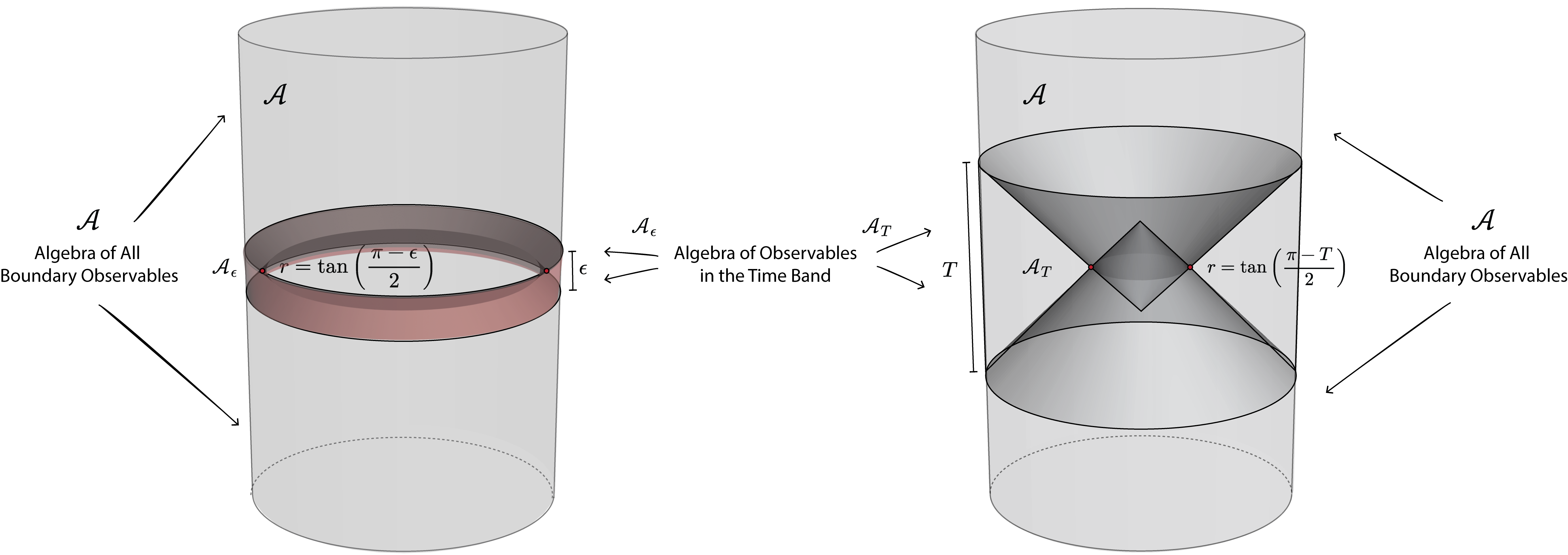
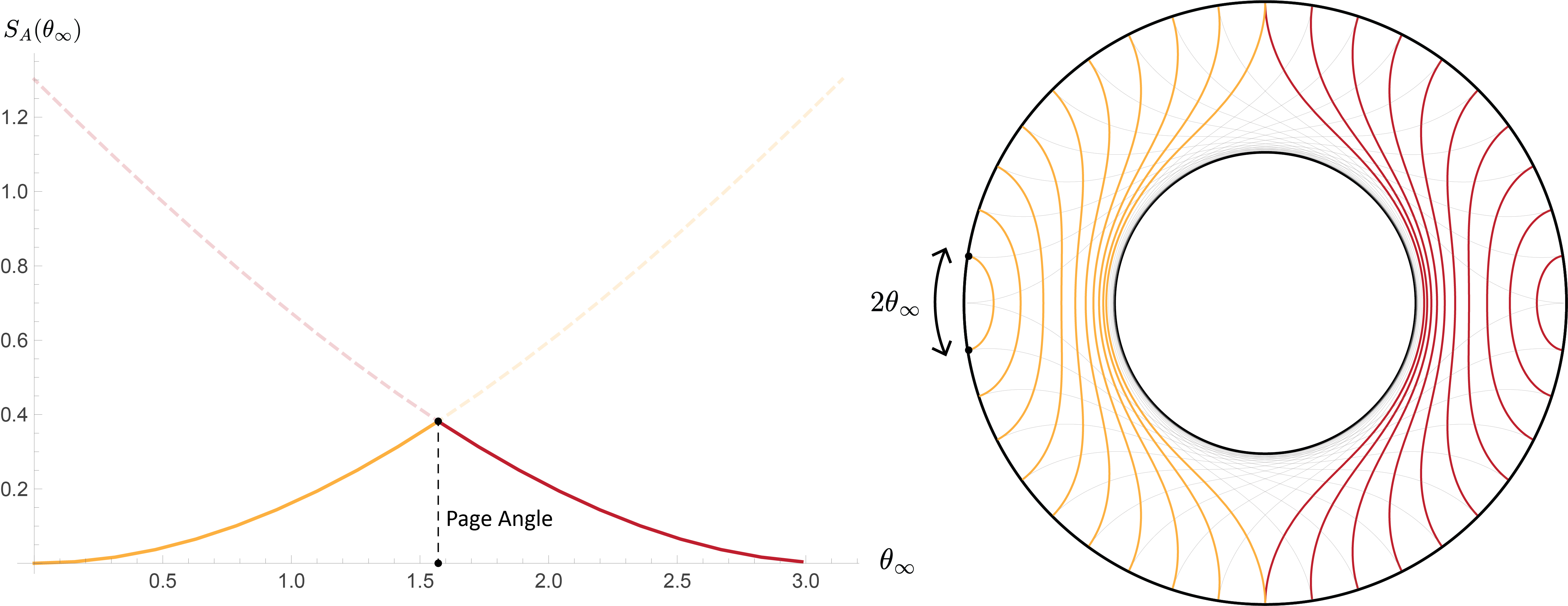
Abstract: This paper summarizes recent discussions of the Page curve and the information paradox, and responds to the reasoning and examples from arXiv:2506.04311. We review arguments demonstrating that in quantum gravity the algebra of observables at infinity is complete, both in AdS and in asymptotically flat space. This completeness implies that the bulk Hilbert space in quantum gravity does not factorize along the radial direction, undermining a key common assumption in Hawking's argument for information loss and in initial derivations of the Page curve. As a consequence, in a standard theory of gravity, information does not emerge'' from a black hole in the manner suggested by the Page curve; rather, it is already encoded in asymptotic observables. Relatedly, the full black hole interior, and not just anisland'', can be reconstructed from exterior data. Page curves and islands can be obtained by removing the Hamiltonian from the exterior algebra. This may be implemented operationally by restricting access to part of the asymptotic region (a detector with a ``blind spot'') or, in the special case of null infinity in asymptotically flat spacetimes, by formally discarding the Hamiltonian from the set of observables despite its physical accessibility. Such Page curves describe only the redistribution of information between measured and unmeasured degrees of freedom, rather than fundamental information recovery. Finally, Page curves and islands also arise when a black hole is coupled to a nongravitational bath, a setup that yields a nonstandard theory of gravity. We show how, even in this setting, the unusual localization of information in gravity provides a concrete physical mechanism for information transfer from the gravitational system into the bath.
Paper Prompts
Sign up for free to create and run prompts on this paper using GPT-5.
Top Community Prompts
Explain it Like I'm 14
Overview
This paper is about a famous puzzle in physics called the “black hole information paradox.” The paradox asks: if a black hole evaporates by emitting radiation, does the information about what fell into it get lost forever? Many papers use “Page curves” and “islands” to argue that information comes out of a black hole over time. The authors of this paper explain why, in normal gravity, that picture isn’t quite right. Instead, they argue that the information is already accessible from far away, without needing it to “emerge” later.
What questions does the paper ask?
The paper focuses on a few simple questions:
- Can we really split the world around a black hole into two independent parts: “inside” and “outside”?
- Do “Page curves” (a curve that first rises and then falls, measuring how entangled the outside is with the inside) really show information leaving a black hole?
- Are “islands” (special hidden regions that count as part of the outside for information) actually present in ordinary gravity?
- If Page curves do show up in calculations, what are they really measuring?
How do the authors approach these questions?
The authors use ideas from quantum gravity and some general facts about how gravity works at the edges of spacetime. A few key ideas, explained in everyday terms:
- Think of spacetime like a huge stage with a faraway “boundary” where you can set up the best possible detectors. In gravity, those boundary measurements are incredibly powerful—like having perfect security cameras all around a building that also record when everything happened.
- The “Hamiltonian” is the physics tool that keeps time and measures energy. In gravity, it can be read off from the boundary—so the “outside” observer has a built‑in rewind/fast‑forward knob for the whole system.
- Because of this, the outside doesn’t just see the surface—it can, in principle, reconstruct everything that happened inside too. In math terms, the outside observables are “complete.”
- The authors carefully review earlier arguments (including Hawking’s and Page’s) and show where a common assumption—splitting the world cleanly into independent inside and outside parts—breaks down in gravity.
They also analyze situations where researchers do see Page curves and islands, and explain what special choices or limitations led to those results.
What did they find?
Here are the main findings, explained with simple analogies.
- The outside already knows the inside
- In ordinary (standard) quantum gravity, measurements made very far away—the “asymptotic region”—are enough to capture all the information, including what’s inside a black hole. It’s like being able to reconstruct the contents of a locked room from perfect footage at the building’s windows and doors.
- The usual split into “inside vs. outside” doesn’t work
- Many classic arguments, including Hawking’s information loss and Page’s Page curve, assume you can neatly split the system into two independent parts—what’s inside and what’s outside the black hole. In gravity, that split is not valid. The “outside part” isn’t independent; it already encodes the inside.
- What about Page curves?
- A Page curve normally tracks how the outside becomes more informed over time as a black hole evaporates. But if the outside already encodes everything, there’s no need for information to “come out.”
- So how do Page curves show up in some papers? The authors show you can get a Page‑shaped curve if you put on “blinders”—for example:
- Only look at part of the faraway boundary (like using a detector with a “blind spot”).
- Or (in flat spacetime) deliberately throw away the Hamiltonian from your measurement set, even though it’s physically accessible.
- In these cases, the Page curve isn’t tracking information leaving the black hole. It’s just tracking how information is split between the parts you choose to look at and the parts you’re ignoring.
- What about “islands”?
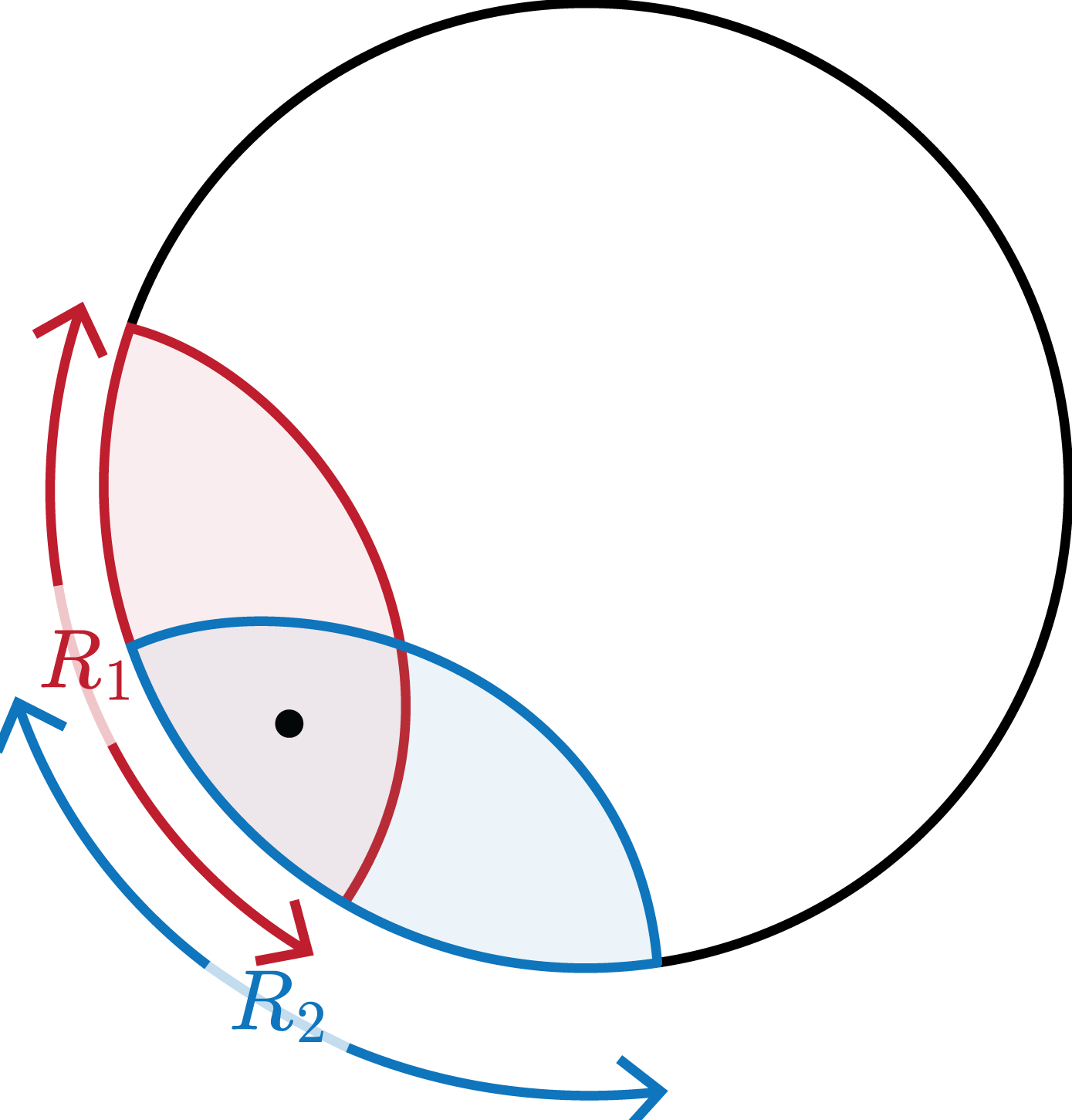
- “Islands” are compact bulk regions that get counted as part of the outside for entropy calculations. The authors argue that such islands don’t appear in standard gravity when the whole system is in a pure state, because the outside already captures the whole interior—not just a small compact piece.
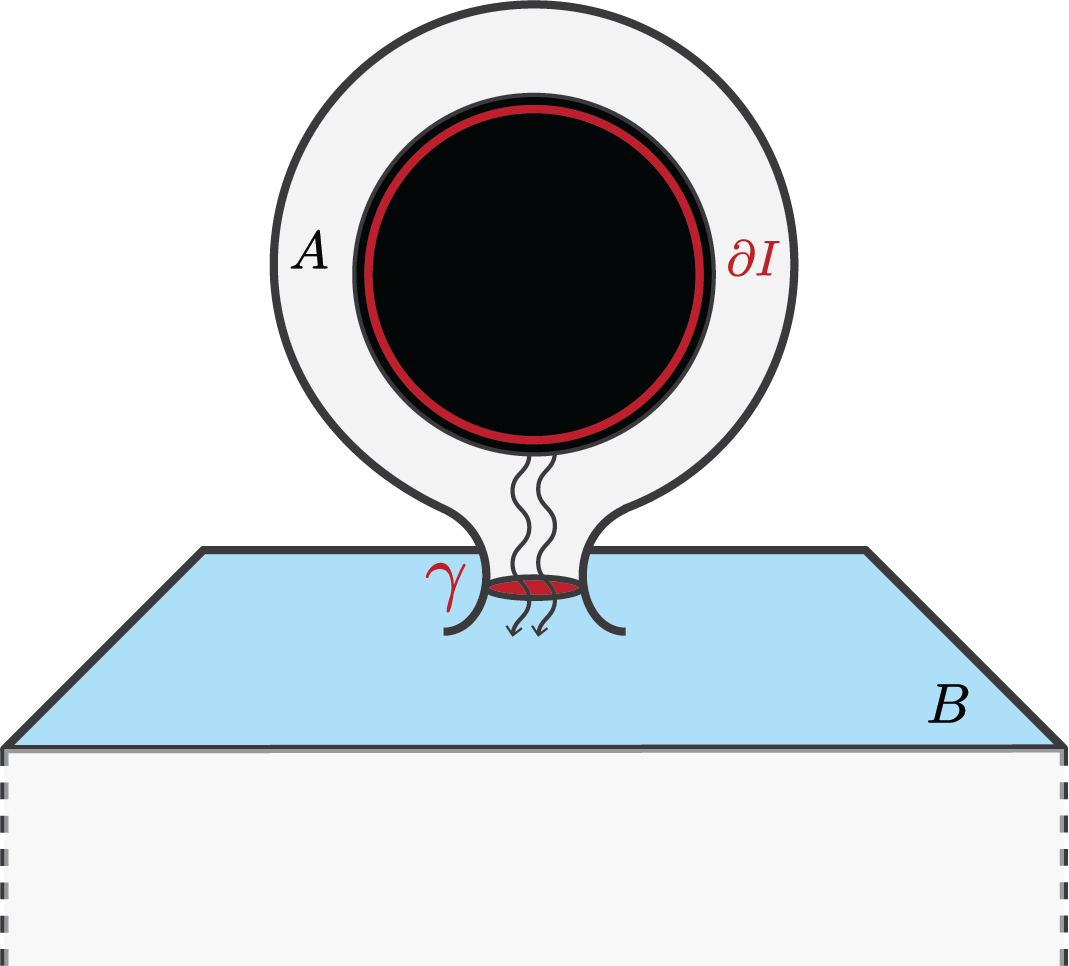
- Islands do appear in special, nonstandard setups—like when you couple the black hole to a non‑gravitational “bath” (an outside system that does not gravitate), or in situations with double horizons. In these cases, the rules change, and islands can make sense.
- Even with a bath, there’s a clear physical story
- When a black hole is connected to a non‑gravitational bath, a Page curve can genuinely track information moving into the bath. The authors explain a physical mechanism for this transfer: gravity localizes information in a special way at the boundary, which then lets that information flow into the non‑gravitational system.
Why does this matter?
- It offers a clean resolution of the information paradox in standard gravity: information isn’t lost, and it doesn’t need to “escape” later. It’s already encoded in what you can measure far away.
- It clarifies what Page curves and islands are really telling us. In ordinary gravity, seeing a Page curve often means we ignored or removed some accessible measurements (we put on blinders). Those curves then measure how information is shared between “what we looked at” and “what we chose not to look at,” not information emerging from a black hole.
- It shows that some widely used assumptions—like splitting the system into inside and outside as independent—don’t hold in gravity, and that’s the root of both Hawking’s and Page’s original conclusions.
In short: the big picture
- Standard gravity is “holographic” in the following simple sense: carefully chosen measurements far away are enough to reconstruct everything, including the black hole’s interior. Because of that, the usual inside/outside split doesn’t apply.
- Page curves and islands become meaningful in special, nonstandard setups (like adding a non‑gravitational bath) or when we choose to ignore certain measurements. In those cases, they describe how information is redistributed between what’s measured and what’s not, rather than information magically appearing outside the black hole.
- This perspective ties together many recent results and helps prevent confusion about when Page curves and islands really solve the paradox—and when they’re just artifacts of how we choose to measure.
Knowledge Gaps
Knowledge gaps, limitations, and open questions
Below is a concise list of unresolved issues and limitations highlighted or implied by the paper that future work could address:
- Precise conditions for completeness of asymptotic algebras:
- Formalize and prove the “holography of information” result beyond the stated assumptions (existence of a gapped vacuum, bounded-below Hamiltonian, well-defined asymptotic operators), especially in settings with:
- Asymptotically flat spacetimes including full BMS structure and IR issues (soft modes, memory).
- Time-dependent, non-stationary, or cosmological asymptotics.
- Nontrivial topology, higher-derivative gravity, or matter sectors with long-range gauge fields.
- Operator-algebraic rigor in gravity:
- Provide a fully rigorous algebraic-QFT treatment (domains of unbounded operators, type of von Neumann algebras, edge/dressing degrees of freedom) that justifies the use of Reeh–Schlieder-type arguments and ensures the boundary time-band algebra is indeed complete in gravity.
- Clarify the role of superselection sectors (global charges, different asymptotics) and whether they obstruct completeness for physically relevant sectors.
- Operational accessibility vs in-principle accessibility:
- Quantify resource constraints (time, energy resolution, complexity) required to reconstruct interior observables from asymptotic data, and identify practical regimes where “in-principle” completeness fails operationally.
- Determine the timescales and precision needed to access the Hamiltonian as a boundary integral and to implement the needed evolutions for reconstruction.
- Natural, physically motivated subsystem splits:
- Identify or rule out “natural” detector-based partitions of the asymptotic region that yield a Page-like curve without explicitly discarding the Hamiltonian or imposing ad hoc blind spots.
- Characterize general obstacles to such partitions (e.g., unavoidable mixing of Hamiltonian information into local curvature observables).
- Small AdS black holes:
- Resolve the “important open question” noted by the authors regarding Page curves for small AdS black holes (e.g., with reflecting boundary conditions), including whether any robust and physically motivated Page-like behavior can arise without algebra truncations.
- Islands in standard gravity:
- Provide a definitive, general no-go theorem (with minimal assumptions) for compact islands in pure states in standard gravity that directly confronts semiclassical replica-wormhole/QES calculations.
- Identify precise conditions (beyond “double horizons” and mixed global states) under which compact islands can emerge, and characterize their (in)accessibility to infalling or exterior observers.
- Relational observables and fine-grained entropy:
- Either construct a relational-observable framework that yields a well-defined fine-grained entropy for the exterior (tracking a Page curve) in standard gravity or prove impossibility results showing why any relational construction must fail at the needed precision.
- Quantify the approximation errors in concrete relational schemes (e.g., Papadodimas–Raju type constructions and their generalizations) and show whether these errors can be made parametrically small for the purposes of Page-curve diagnostics.
- Entropy and algebra factorization in gravity:
- Provide a precise algebraic definition and computation of the “exterior entropy is always zero” claim, compatible with Type III algebras, modular theory, and without assuming a naive Hilbert-space factorization.
- Relate these definitions to operational tasks (e.g., hypothesis testing or distillable entanglement) to make the “zero entropy” statement experimentally meaningful.
- Flat-space null infinity:
- Construct a physically natural subalgebra at future null infinity that isolates (or justifies dropping) the Hamiltonian while respecting BMS symmetries and soft sectors, or demonstrate that no such subalgebra can be operationally justified.
- Analyze how finite-radius detectors (with backreaction and IR dressing) map onto asymptotic algebras and whether Page-like behavior remains once these effects are included.
- Massive gravity/nongravitational baths:
- Provide explicit dynamical models (beyond toy JT or simplified holographic setups) where information transfer into a nongravitational bath can be computed from first principles and traced to gravitational constraints.
- Quantify transfer rates, channels, and parameter dependence (coupling strength, bath dimensionality, interface geometry) and test the proposed mechanism against alternative transfer mechanisms.
- Robustness to higher-curvature corrections and quantum effects:
- Test whether Hamiltonian-as-boundary-term arguments and completeness survive in the presence of higher-derivative corrections, quantum anomalies, or loop-induced boundary terms.
- Reconciling with semiclassical island computations:
- Pinpoint exactly where standard island/QES calculations implicitly drop or effectively “hide” the Hamiltonian in “standard gravity” setups, and propose concrete checks (e.g., commutator calculations) that would differentiate the two pictures in solvable models.
- Quantitative boundaries of the “QFT limit”:
- Provide clear, quantitative criteria delineating when gravitational holography of information is negligible (so QFT intuition applies) versus when it dominates (e.g., as a function of G, system size, and energy scales).
- Explore crossover regimes and observable signatures of leaving the QFT limit in controlled models.
- Double-horizon and cosmological contexts:
- Systematically classify when compact wedges/islands behind multiple horizons exist (e.g., charged/rotating black holes, dS cosmological horizons) and determine their reconstructability, operational meaning, and potential observational consequences.
- Typicality and fine-grained diagnostics:
- Bridge the gap between coarse correlator agreement (thermal spectra) and fine-grained state purity by identifying observables or protocols that can feasibly discriminate pure vs mixed radiation in gravitational settings without requiring exponentially precise measurements.
- Boundary subregion algebras in gravity:
- Develop a gauge-invariant, dressing-aware definition of boundary subregion algebras that tracks how “edge modes” and gravitational constraints affect entanglement wedges when the Hamiltonian cannot be measured on subregions.
- Topology change and baby universes:
- Assess how baby-universe sectors or ensemble-averaging effects could alter asymptotic algebra completeness or factorization, and whether they can reintroduce Page-like behavior in “standard” gravity without explicit algebra truncations.
- Numerical/analytic exemplars:
- Produce explicit, non-perturbative or controlled perturbative examples (in higher dimensions) that compute commutators and reconstruction maps demonstrating full-interior recoverability from exterior asymptotic data, beyond qualitative arguments.
- Measurement protocols:
- Specify concrete, implementable measurement protocols (including error models) that extract interior information from asymptotic observables, and evaluate their stability against backreaction, noise, and finite-time windows.
- Greybody and state-dependence effects:
- Determine whether greybody factors, time dependence in collapse, or state-dependent dressing produce any subtlety in the asymptotic completeness or in attempts to define Page-like entropies for partial asymptotic regions.
Practical Applications
Immediate Applications
The paper’s findings on the completeness of asymptotic observables in gravity, the role of the Hamiltonian as a boundary term, and the observer-dependence of Page curves can be applied right away in research workflows, tooling, and educational practice. The following items describe concrete use cases, each noting sector linkages and feasibility assumptions.
- Academic (theoretical physics): Build and use computational libraries that explicitly implement “asymptotic-algebra completeness” and “time-band algebra” to test whether proposed Page-curve setups are observer-dependent (i.e., achieved by dropping accessible boundary operators).
- Sector: Software for academic physics.
- Tools/workflows: Python/Mathematica packages to:
- Compute entanglement with/without the Hamiltonian in the boundary algebra.
- Reproduce “blind spot” Page curves by restricting the angular support of boundary operators.
- Validate consistency of entanglement wedges (detect when “islands” include an asymptotic piece vs. compact wedges).
- Assumptions/dependencies: Access to symbolic/numerical AdS and asymptotically flat models; acceptance of the paper’s definition of islands; standard gravity dynamics.
- Academic (quantum information and holography education): Integrate modules clarifying that “Page curves” in standard gravity are observer-dependent metrics of information redistribution (measured vs. unmeasured modes), not fundamental information recovery from the black hole.
- Sector: Education.
- Tools/workflows: Lecture notes, problem sets comparing:
- Entropy of full asymptotic algebra vs. restricted time-band/angle support.
- “Relational observables” and their limits vs. fine-grained entropy claims.
- Assumptions/dependencies: Availability of educational time; acceptance of asymptotic completeness/Hamiltonian boundary term.
- Academic (numerical relativity): Update boundary-condition and diagnostic modules to explicitly include global boundary integrals that represent the Hamiltonian, avoiding “blind spot” analyses that could be misinterpreted as information emergence.
- Sector: Scientific computing.
- Tools/workflows: Boundary-integral routines for ADM charges in asymptotically flat simulations; checks that data pipelines do not inadvertently discard Hamiltonian-sensitive components.
- Assumptions/dependencies: Simulations with well-controlled asymptotics; admission that global charges constrain interior reconstructions.
- Industry (observability and monitoring analogs): Apply the “blinders” concept to system observability: build diagnostics that flag when monitoring pipelines drop “global signals” (analogous to boundary Hamiltonians) leading to misleading “emergent” behavior in metrics.
- Sector: Software/DevOps/observability.
- Tools/workflows: Observability-completeness checks; dashboards highlighting coverage gaps that change inferred entropy or information flow in distributed systems.
- Assumptions/dependencies: Mapping of “global signals” to domain-relevant aggregates (e.g., system-wide invariants); buy-in from reliability teams.
- Policy (scientific reporting standards): Encourage disclosure of which observables are included/excluded in Page-curve-like analyses (e.g., whether boundary Hamiltonian-equivalents are dropped), to prevent misinterpretation of observer-dependent results as fundamental physics.
- Sector: Science policy and publishing.
- Tools/workflows: Journal reviewer checklists; data-sharing standards requiring explicit algebra specification.
- Assumptions/dependencies: Editorial and community adoption; alignment with existing open-science norms.
- Daily life (scientific literacy): Teach the difference between coarse-grained signals and fine-grained, global constraints; emphasize that “emergence” can be a measurement artifact of blind spots rather than intrinsic dynamics.
- Sector: Education/outreach.
- Tools/workflows: Public-facing infographics and short demos showing how excluding a global signal creates a tent-shaped “Page curve” in everyday datasets.
- Assumptions/dependencies: Availability of outreach platforms; interest in science literacy.
Long-Term Applications
The paper’s principles (holography of information, non-factorization, and the operational meaning of Page curves under restricted algebras) suggest future directions requiring more research, scaling, and development before deployment.
- Astrophysics instrumentation and data analysis: Design multi-detector strategies and inference pipelines that better approximate full-sphere boundary integrals to capture Hamiltonian-sensitive features, thus enhancing interior-state reconstruction from asymptotic observations (e.g., gravitational waves, electromagnetic signatures).
- Sector: Astrophysics, instrumentation.
- Tools/products: Next-generation networks and data fusion frameworks targeting “global charge” reconstruction; algorithmic bias checks for angular coverage (“blind spots”).
- Assumptions/dependencies: Improved detector coverage; high-precision asymptotic measurements; mature inversion/reconstruction algorithms grounded in the paper’s algebraic framework.
- Quantum information inspired protocols: Develop error-correction and inference schemes that leverage global constraints to reconstruct “interior” states from “boundary-only” access, analogous to holography of information.
- Sector: Quantum computing and communications.
- Tools/products: Boundary-access protocols; compression schemes using global invariants; testing suites that separate observer-dependent entropy from intrinsic device behavior.
- Assumptions/dependencies: Rigorous mapping between gravitational algebraic structures and quantum code constructions; experimental platforms for validation.
- Open-system engineering: Use the gravitational-bath analogy to design controlled information transfer between a system and its environment by engineering locality or accessibility constraints (i.e., creating “nongravitational baths” in lab systems to study island-like phenomena).
- Sector: Experimental physics, quantum simulation.
- Tools/products: Synthetic baths in cold atoms/photonic systems; protocols to tune information localization; measurement strategies that reveal redistribution vs. genuine recovery.
- Assumptions/dependencies: Ability to emulate the key nonlocal constraints; stable simulation environments; theoretical-to-experimental mapping.
- Formal theory development: Extend algebraic QFT and gravitational constraint frameworks to rigorously codify “asymptotic completeness” both in AdS and asymptotically flat spacetimes, including refined treatments of small AdS black holes and mixed-state double-horizon wedges.
- Sector: Academia (theoretical physics).
- Tools/workflows: Mathematical proofs, no-go theorems for compact islands in pure states, constructive bulk-from-boundary operator identities.
- Assumptions/dependencies: Progress in UV-complete quantum gravity; collaborative cross-field advances (mathematical physics, holography).
- Numerical relativity and simulation platforms: Create boundary-first simulation suites where the Hamiltonian is a first-class observable and bulk reconstructions are validated against asymptotic algebra completeness.
- Sector: Scientific computing.
- Tools/products: Boundary-to-bulk reconstruction solvers; validation benchmarks showing how dropping global integrals fabricates Page-like curves; noise-robust data assimilation.
- Assumptions/dependencies: Scalable HPC resources; improved numerical stability near asymptotia; community adoption.
- Metrology and sensing networks: Engineer sensor arrays that perform approximate “global” integrals to avoid interpretive blind spots, enabling more reliable inference of hidden states in complex systems (e.g., geophysics, climate monitoring).
- Sector: Sensing and geospatial analytics.
- Tools/products: Distributed sensor fusion implementing global invariant checks; calibration procedures that quantify information loss due to coverage gaps.
- Assumptions/dependencies: Sufficient sensor density and synchronization; robust data integration pipelines.
- Curriculum and workforce development: Create advanced training spanning holography, algebraic observables, and open-system dynamics to build interdisciplinary expertise needed for the above programs.
- Sector: Education.
- Tools/workflows: Graduate courses, MOOCs, cross-disciplinary workshops linking gravitational physics with information theory and systems engineering.
- Assumptions/dependencies: Institutional support; sustained demand for cross-trained talent.
Glossary
- ADM Hamiltonian: The gravitational Hamiltonian defined at spatial infinity encoding total energy; in this paper, certain Page curves are obtained by omitting it from the observable set. "dropping the ADM Hamiltonian from the set of allowed observables"
- AdS (Anti-de Sitter): A spacetime with constant negative curvature used for gravitational setups and holography. "In asymptotically AdS spacetimes, the Hamiltonian can be made inaccessible by dividing the boundary into two parts"
- AdS/CFT correspondence: A duality relating gravity in AdS to a conformal field theory on its boundary. "This should not be surprising from the point of view of AdS/CFT"
- Algebra of observables: The set of all operators representing measurable quantities; its completeness at infinity implies no interior–exterior factorization in gravity. "the algebra of observables at infinity is complete"
- Asymptotic boundary: The boundary at infinity of a spacetime where conserved charges and boundary observables are defined. "They all include a portion of the asymptotic boundary."
- Asymptotically AdS spacetimes: Spacetimes that approach AdS geometry at large radius. "In asymptotically AdS spacetimes, the Hamiltonian can be made inaccessible"
- Asymptotically flat spacetimes: Spacetimes that approach Minkowski space at large radius. "In asymptotically flat spacetimes, since the algebra in the strict asymptotic limit at future null infinity () becomes free, one can formally drop the Hamiltonian from the algebra"
- Cauchy slice: A spacelike hypersurface whose data determine the entire spacetime evolution. "an observer making measurements on the asymptotic part of a Cauchy slice can reconstruct only part of the bulk"
- Coarse-grained entropy: Thermodynamic entropy that ignores microscopic details, contrasted with fine-grained entropy. "The coarse-grained entropy of the radiation increases with time"
- Commutant: The set of operators that commute with a given algebra; in gravity, certain boundary algebras have no commutant. "In a gravitational theory, the algebra of a time band has no commutant."
- Commutator: The operator [A,B]=AB−BA indicating non-commuting observables; nonzero commutators obstruct consistent compact wedges. "a nonzero commutator between observables inside the putative compact wedge and observables outside (including the Hamiltonian) makes the wedge inconsistent."
- Double horizons: Configurations with two horizons (e.g., inner and outer) that can allow compact entanglement wedges in mixed states. "compact entanglement wedges can appear behind double horizons"
- Entanglement entropy: A measure of quantum correlations between subsystems, often used to define Page curves. "The entanglement entropy of a part of the boundary obeys a Page curve"
- Entanglement wedge: The bulk region reconstructible from a boundary subregion in holography. "a compact entanglement wedge called an ``island'' plays a key role."
- Extrapolate dictionary: The holographic rule relating bulk fields to boundary operators via asymptotic limits. "The ``extrapolate dictionary'' tells us that boundary observables are limits of bulk observables."
- Fefferman–Graham gauge: A coordinate gauge for asymptotically AdS metrics used to express boundary gravitational charges. "In the Fefferman-Graham gauge, we have"
- Fine-grained entropy: The von Neumann entropy capturing exact microstate information, sensitive to the full state. "insufficient to define a fine-grained entropy for the black hole exterior that follows the Page curve"
- Future null infinity (): The asymptotic boundary reached by outgoing light rays, where radiation is measured. "future null infinity ()"
- Gaussian sphere at infinity: A spherical surface at large radius used for boundary integrals of conserved quantities. "over a Gaussian sphere at infinity."
- Greybody factors: Frequency-dependent transmission probabilities due to potential barriers around black holes modifying Hawking spectra. "depends on the greybody factors that arise from the scattering of radiation in the black hole geometry."
- Haar measure: The uniform probability measure on the unitary group, used to define typical random states. "using the ``Haar measure''"
- Hamiltonian (boundary term in gravity): The generator of time translations expressible as a boundary integral, accessible from infinity. "the Hamiltonian is a boundary term in gravity."
- Hilbert space factorization: Decomposition of the total quantum state space into tensor-product subsystems; it fails in gravity due to asymptotic completeness. "the bulk Hilbert space in quantum gravity does not factorize along the radial direction"
- Holography of information: The principle that asymptotic observables encode all bulk information, enabling reconstruction of interiors. "a feature called the ``principle of holography of information.''"
- Island: A compact entanglement wedge disconnected from the asymptotic region of the gravitating spacetime. "we define islands as entanglement wedges that do not extend to the asymptotic region of the gravitating spacetime."
- Massive theory of gravity: A nonstandard, open-system gravitational setup (e.g., with a bath) where bulk dynamics is modified. "we will refer to this as a massive theory of gravity"
- Microcanonical density matrix: An equal-weight mixture over all states within a fixed energy band. "compare the microcanonical density matrix drawn from the same band of energies"
- Nice slice: A smooth spacelike slice through a black hole used for semiclassical analyses of evaporation. "A nice slice in a black hole geometry."
- Nongravitational bath: An external non-gravitational system coupled to gravity to study information flow and Page curves. "coupled to nongravitational baths"
- Page curve: The characteristic rise-and-fall of entanglement entropy for radiation in unitary black hole evaporation models. "The Page curve \cite{Page:1993df,Page:1993wv} describing the entanglement between two parts of the bath"
- Projector: An operator satisfying that gives measurement outcome probabilities in quantum mechanics. "for any projector "
- QFT Limit: The regime where quantum field theory approximations are valid and holographic gravitational effects are negligible. "which we term the ``QFT Limit''."
- Riemann tensor: The fundamental curvature tensor of spacetime encoding gravitational degrees of freedom. "natural observables such as the Riemann tensor simultaneously encode information"
- Relational observables: Approximately local operators defined relative to physical reference frames, used to model locality in gravity. "Relational observables lead to approximately-local algebras of observables that can be identified with a compact region."
- Time band: A restricted interval of boundary time supporting an operator algebra; in gravity it still reconstructs the bulk. "the algebra of a time band has no commutant."
- Trace distance: A metric on quantum states quantifying distinguishability of density matrices. "The trace distance \eqref{tracedistance}, like the entanglement entropy, is a fine-grained observable"
- von Neumann entropy: The quantum entropy measuring fine-grained uncertainty. "a tent-shaped Page curve for the von Neumann entropy on "
Collections
Sign up for free to add this paper to one or more collections.