Impossible by Degrees: Cohomology & Bistable Visual Paradox
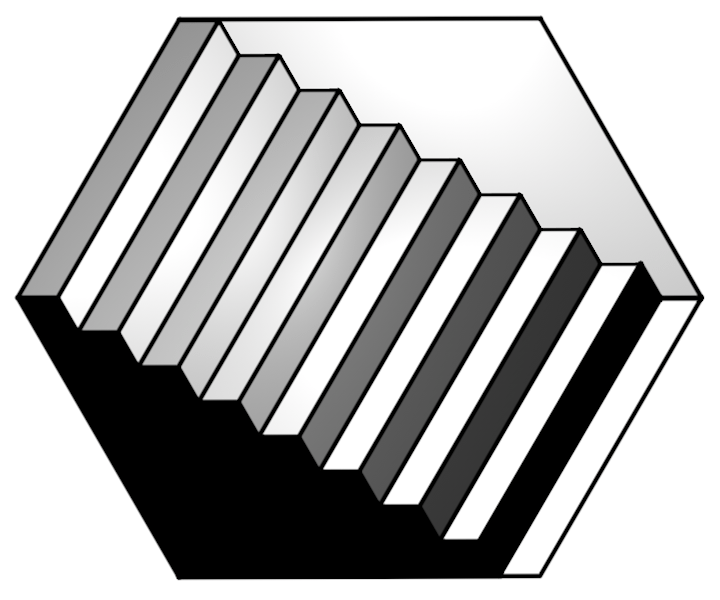
Abstract: The Penrose triangle, staircase, and related ``impossible objects'' have long been understood as related to first cohomology $H1$: the obstruction to extending locally consistent interpretations around a loop. This paper develops a cohomological hierarchy for a class of visual paradoxes. Restricting to systems built from \emph{bistable} elements -- components admitting exactly two local states, such as the Necker cube's forward/backward orientations, a gear's clockwise/counterclockwise spin, or a rhombic tiling corner's convex/concave interpretation -- allows the use of $\mathbb{Z}_2$ coefficients throughout, reducing obstruction theory to parity arithmetic. This reveals a hierarchy of paradox classes from $H0$ through $H2$, refined at each degree by the relative/absolute distinction, ranging from ambiguity through impossibility to inaccessibility. A discrete Stokes theorem emerges as the central tool: at each degree, the connecting homomorphism of relative cohomology promotes boundary data to interior obstruction, providing the uniform mechanism by which paradoxes ascend the hierarchy. Three paradigmatic systems -- Necker cube fields, gear meshes, and rhombic tilings -- are studied in detail. Throughout, we pair cohomology with imagery and animation. To illuminate the underlying structure, we introduce the \emph{Method of Monodromic Apertures}, an animation technique that reveals monodromy through a configuration space of local sections.

Paper Prompts
Sign up for free to create and run prompts on this paper using GPT-5.
Top Community Prompts
Explain it Like I'm 14
Overview
This paper is about understanding “impossible” pictures and animations—like the Penrose triangle or the Necker cube—using a simple kind of math. The authors focus on images made from parts that each have exactly two possible states (like a light switch that can be on or off). They show how to sort these paradoxes into levels using a counting method (odd/even) called cohomology. Their big idea is that what you force at the edges of a picture shows up inside it—like pushing on the rim of a drum makes the skin bulge somewhere—so they can predict where and why paradoxes happen.
The Main Questions
The paper asks:
- How can we organize visual paradoxes made of “two-state” parts into a clear hierarchy (levels) using simple math?
- What makes some pictures just ambiguous (you can read them in two ways), some conflicting (the edges demand different answers), and some truly impossible (no answer works)?
- Can we move up to a higher level where edge constraints force “defects” inside the picture?
- How do we show these hidden mathematical effects so people can see them?
How They Studied It
The authors study three familiar systems:
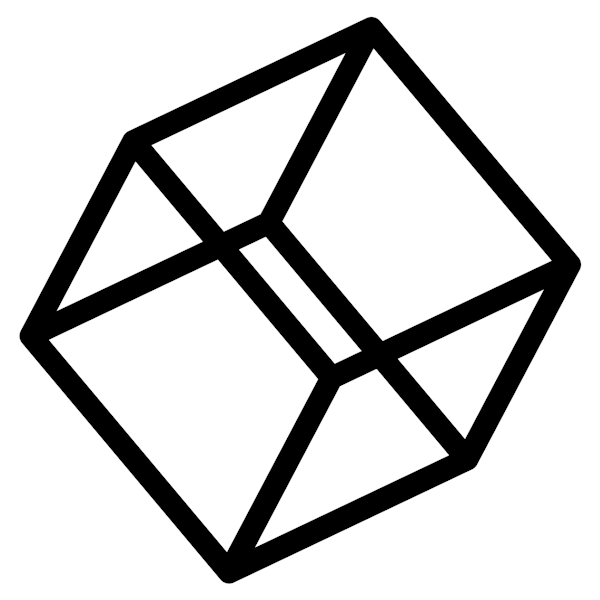
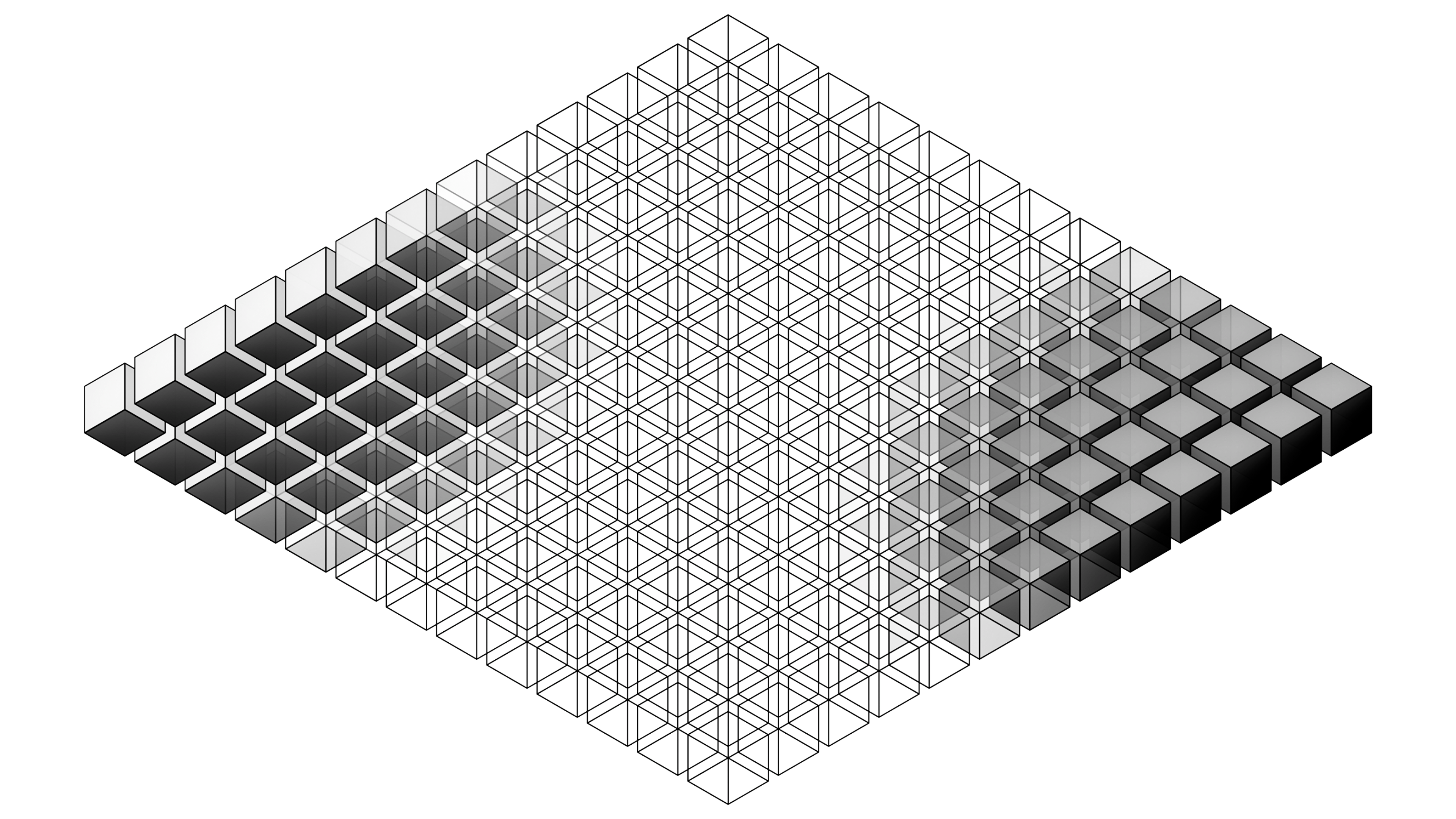
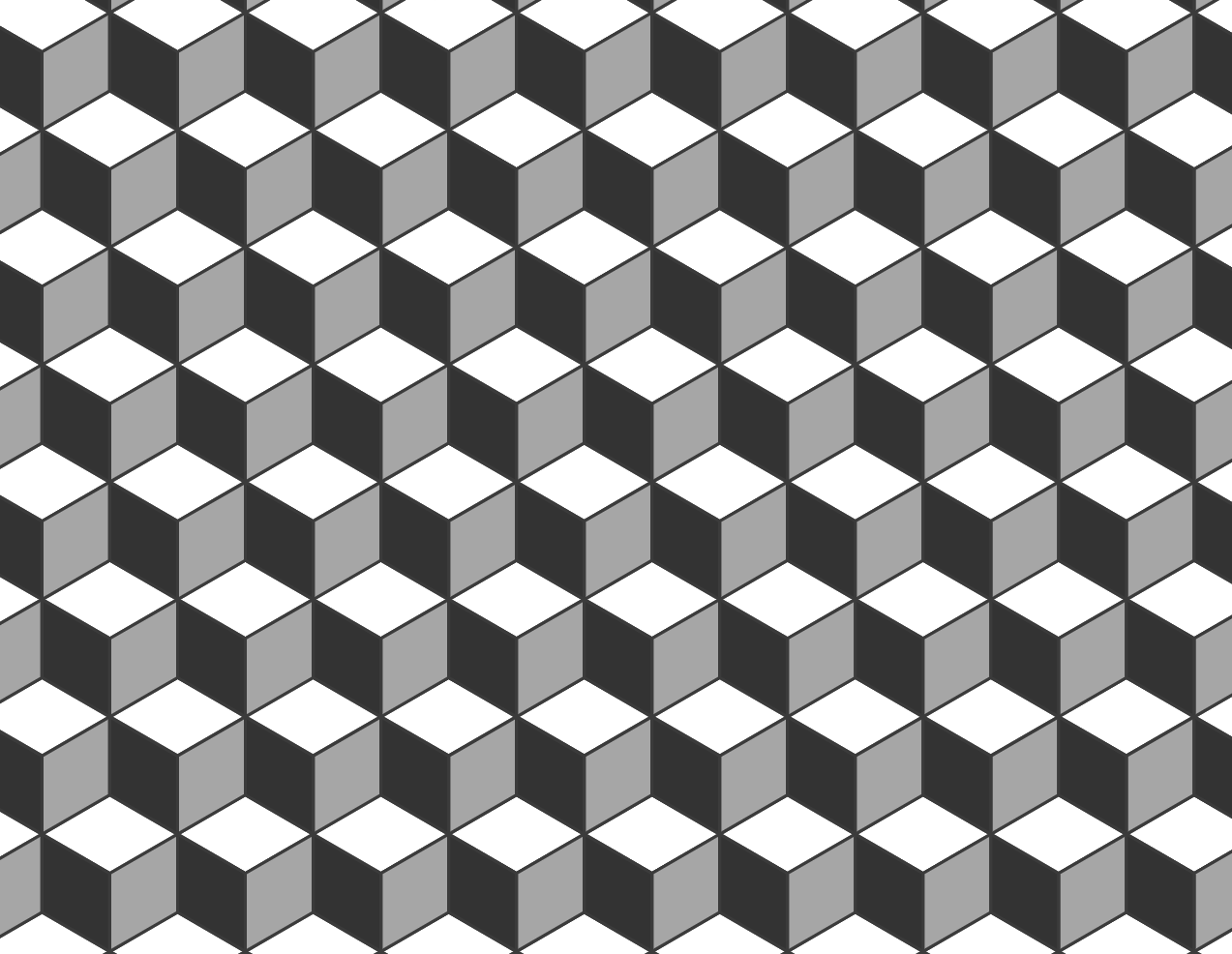
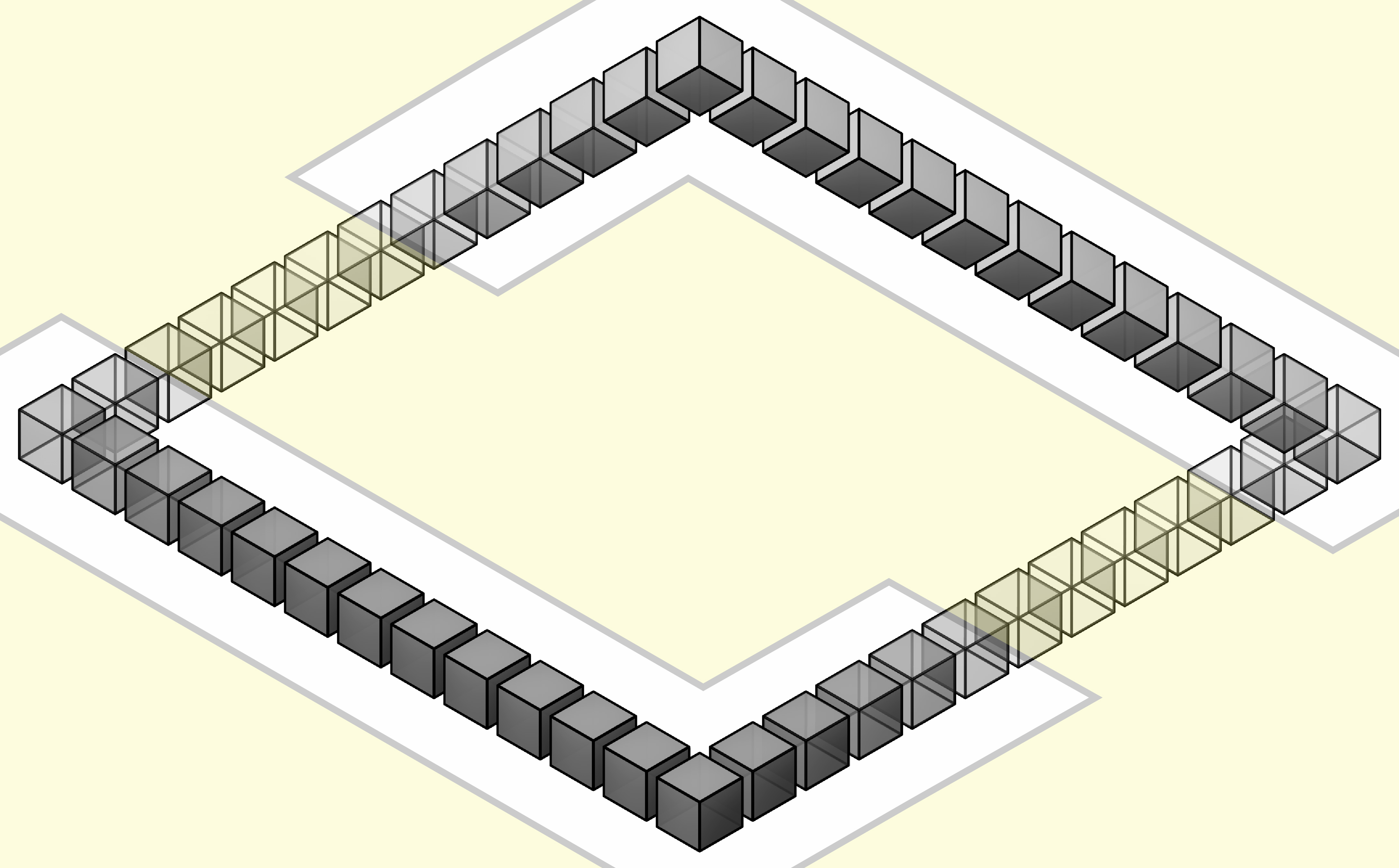
- Necker cube fields: wireframe cubes that can look “forward” or “backward.”
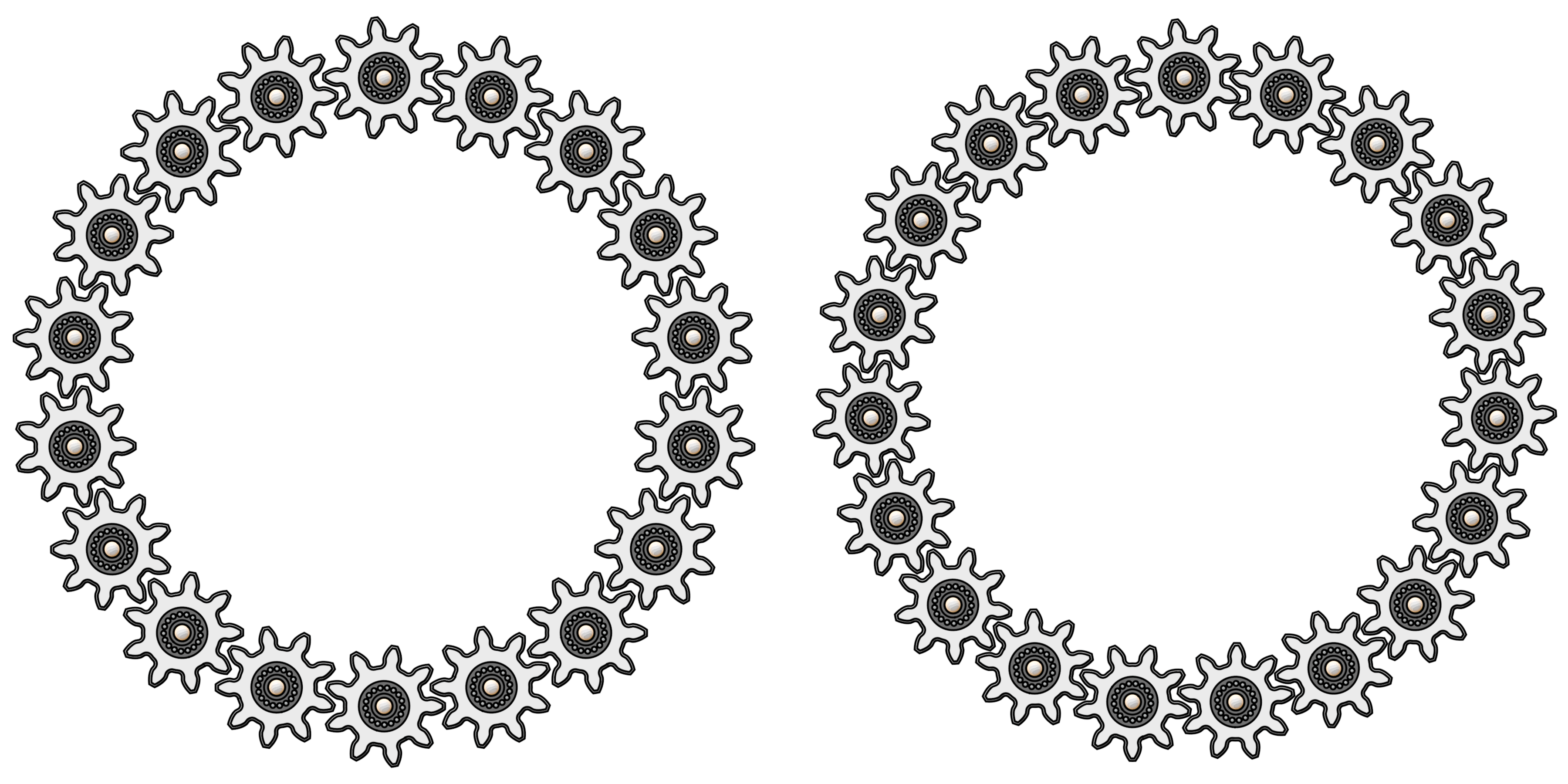
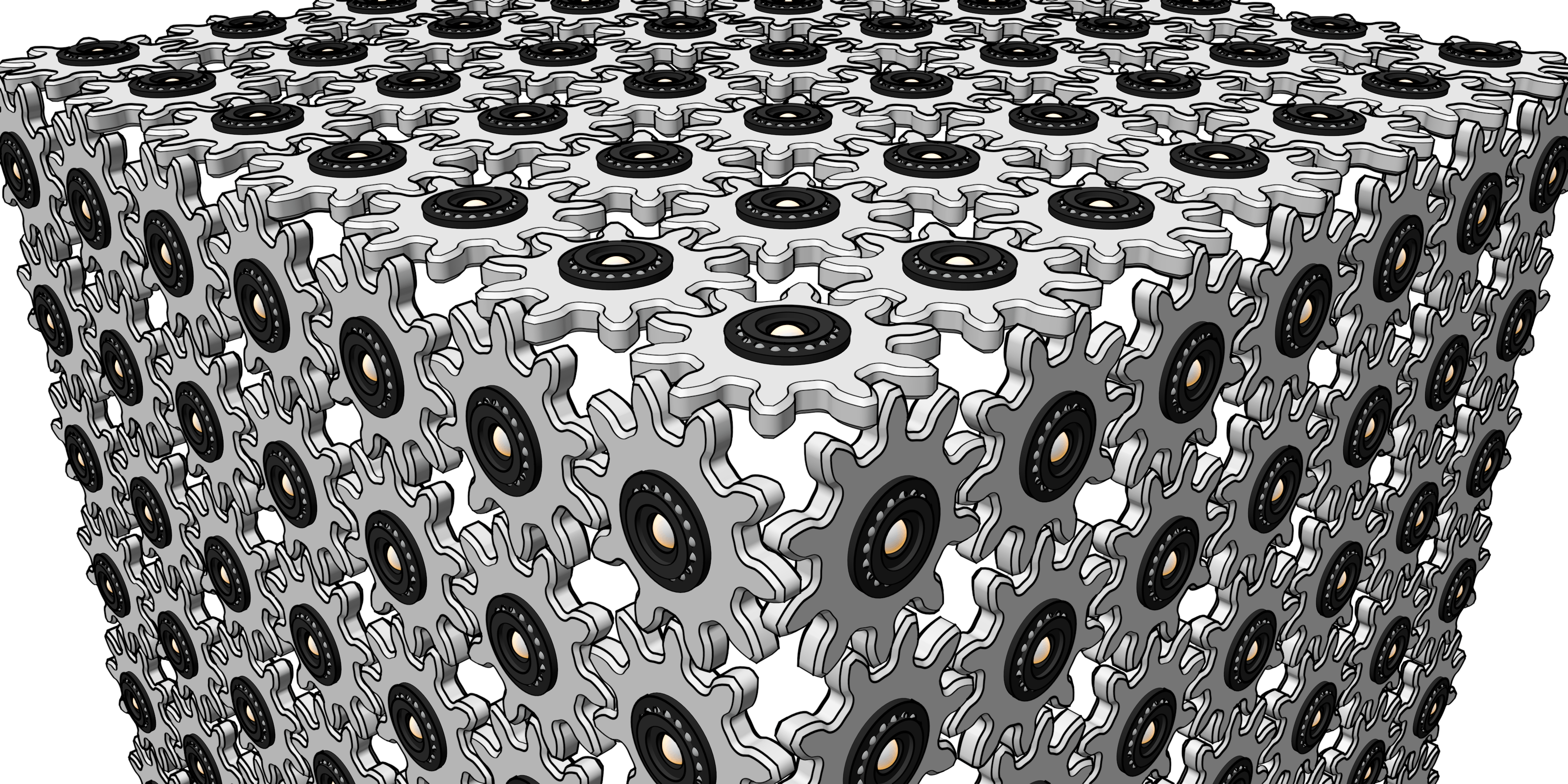
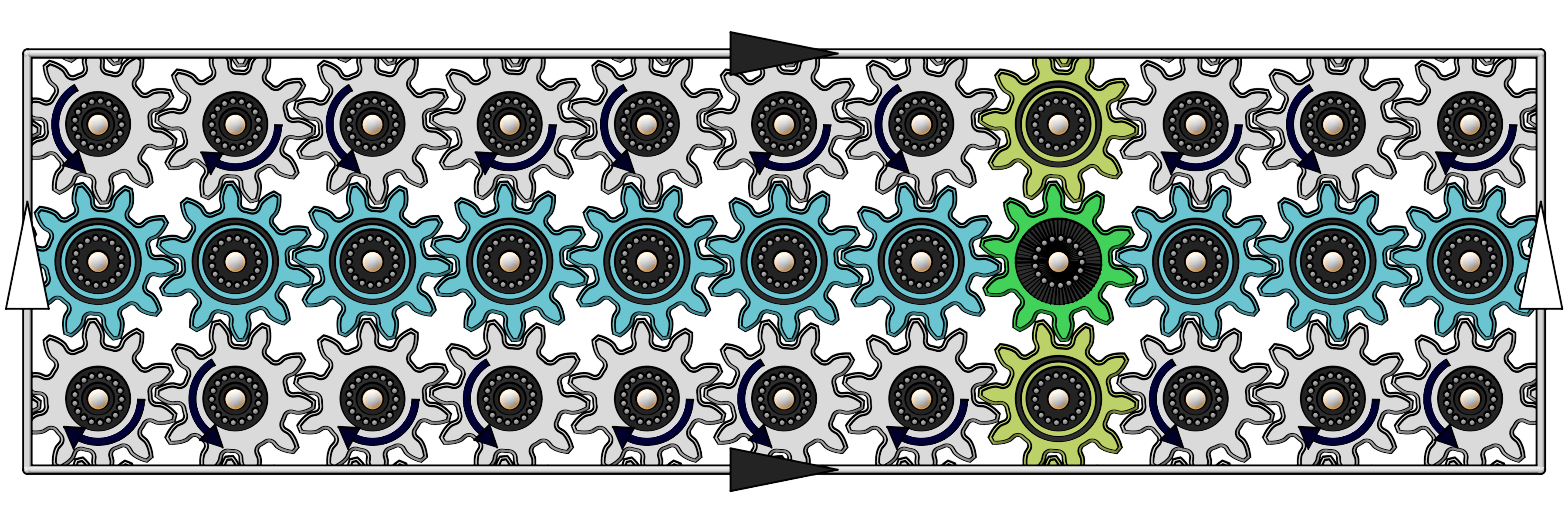
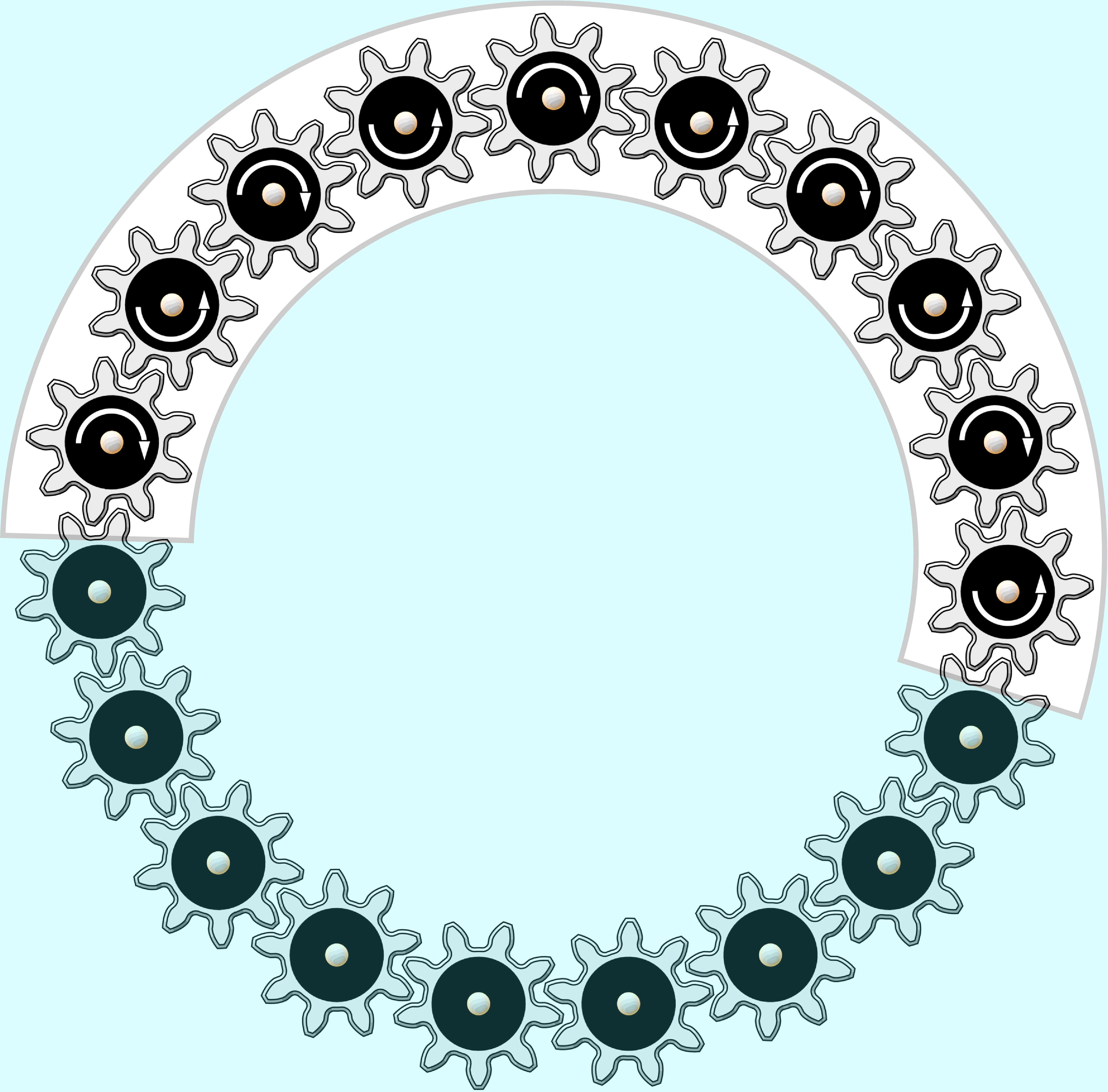
- Gear meshes: gears that spin either clockwise or counterclockwise and often force neighbors to spin the opposite way.
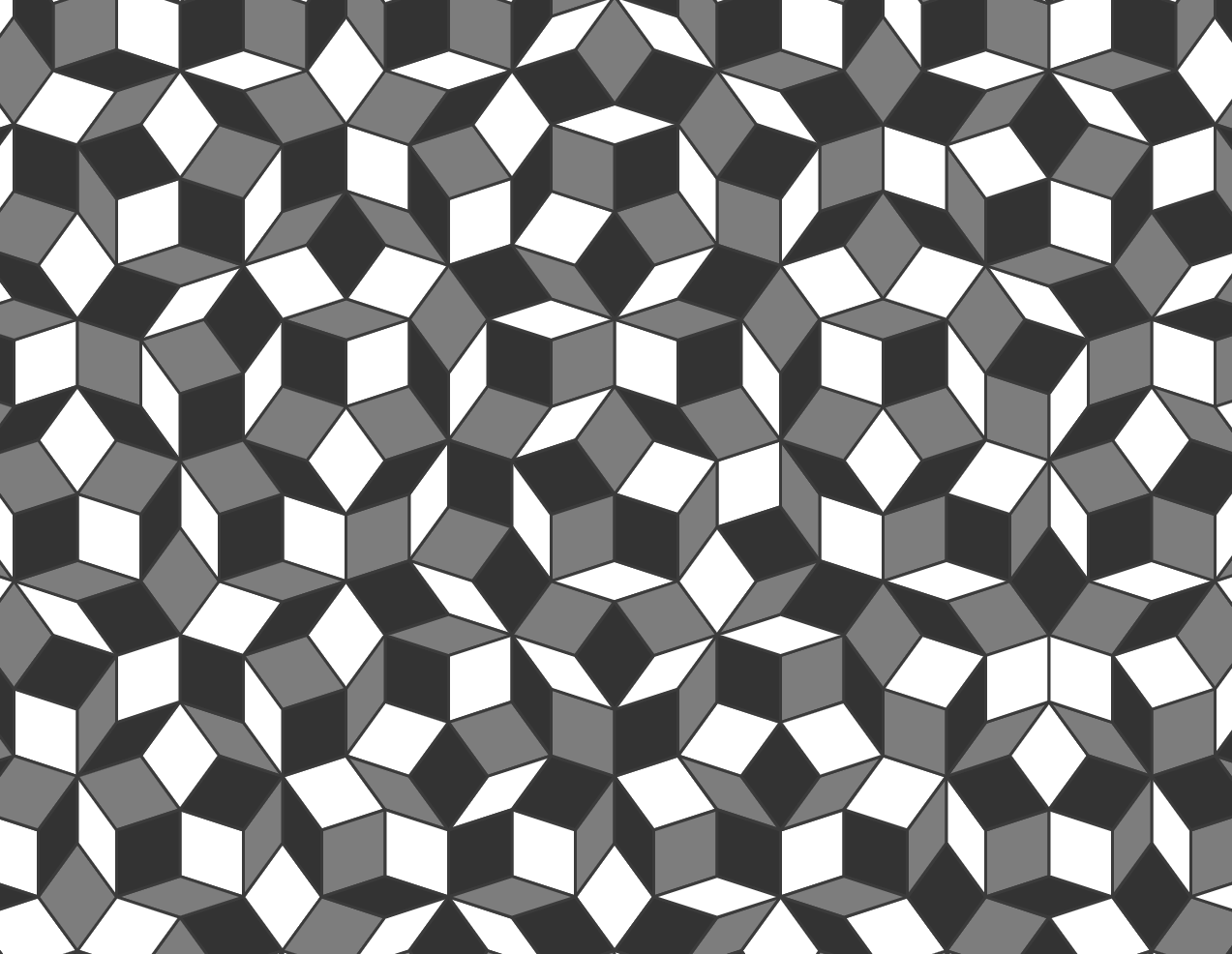
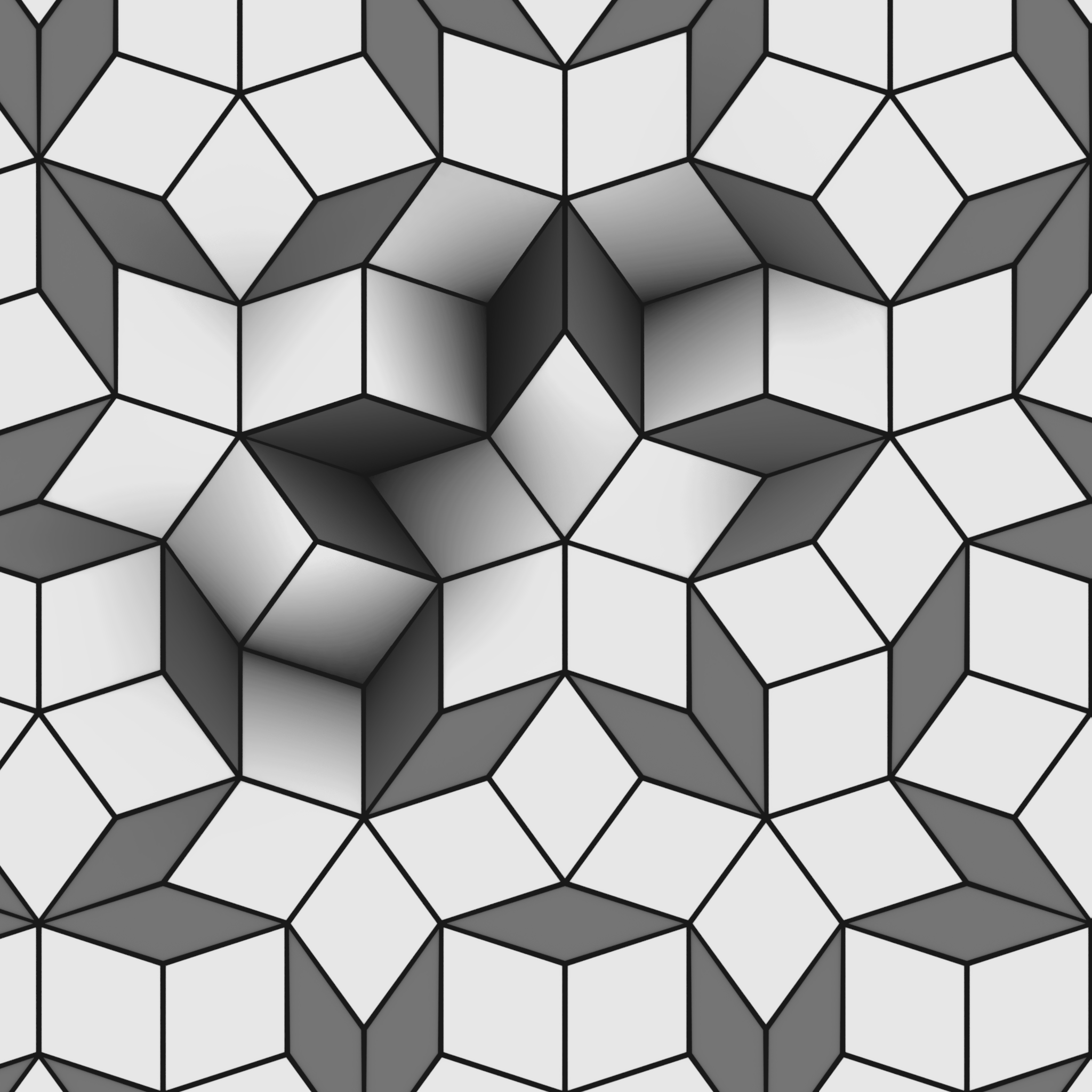
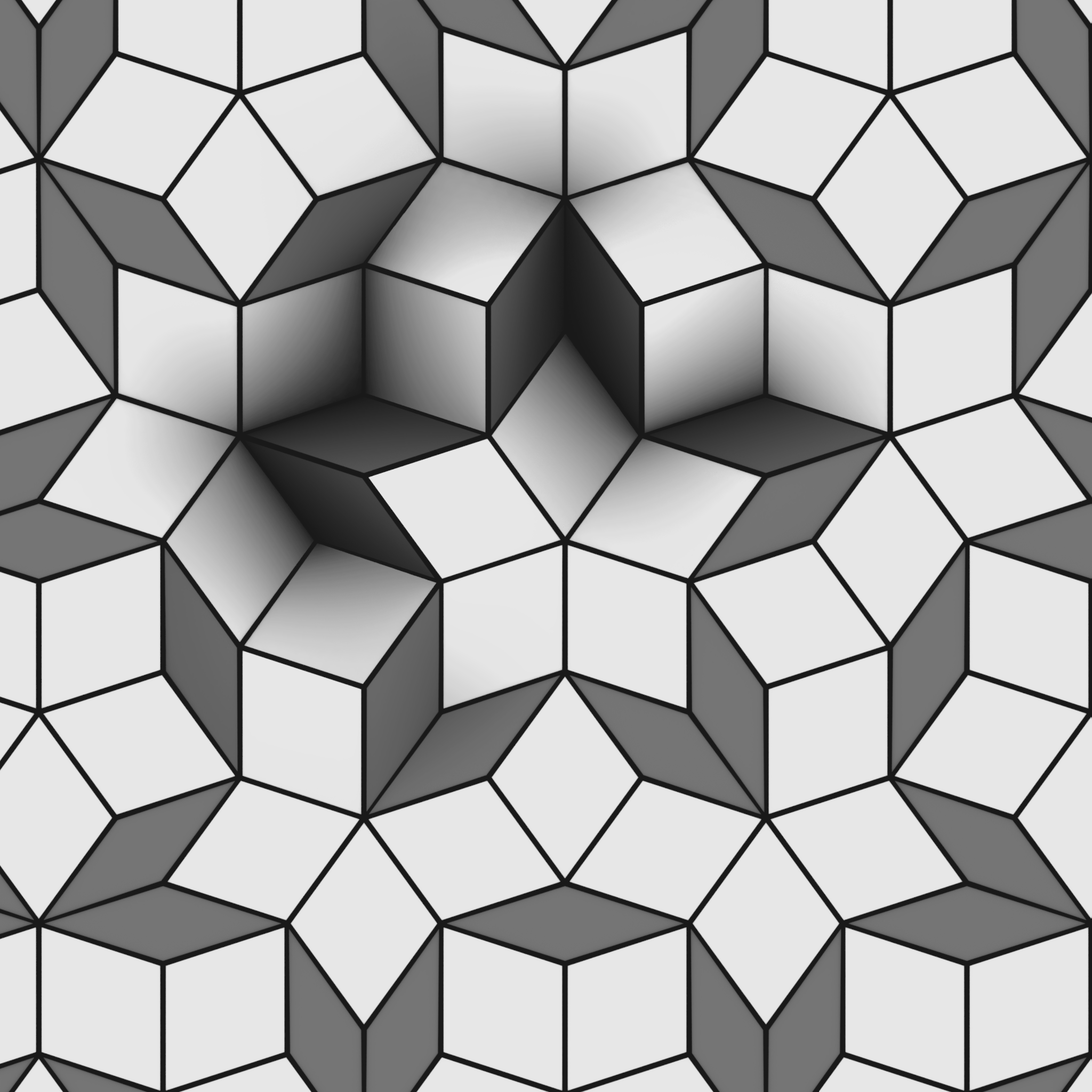
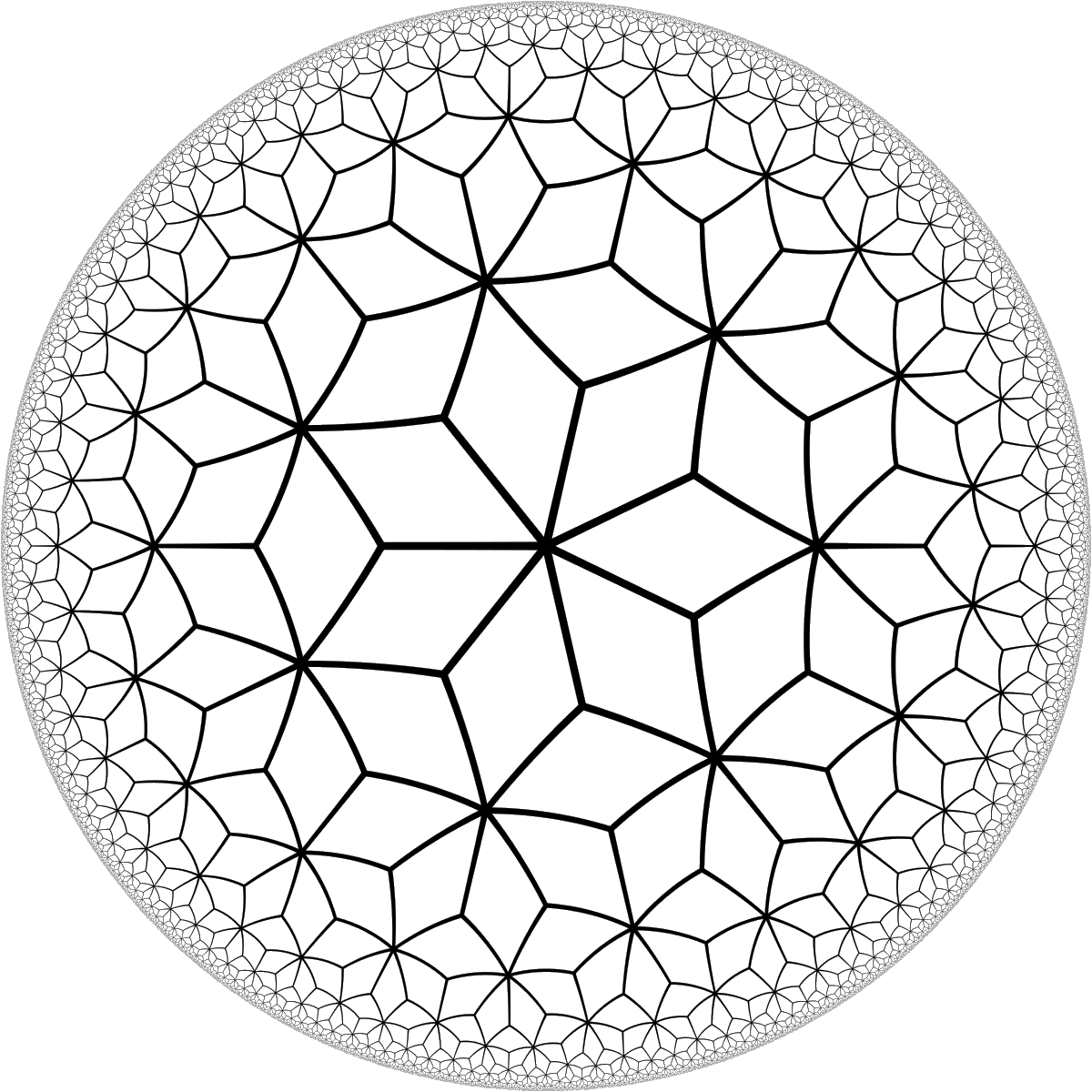

- Rhombic tilings: patterns of diamond-shaped tiles whose corners can look “convex” (popping out) or “concave” (dipping in).
They model each system with everyday ideas:
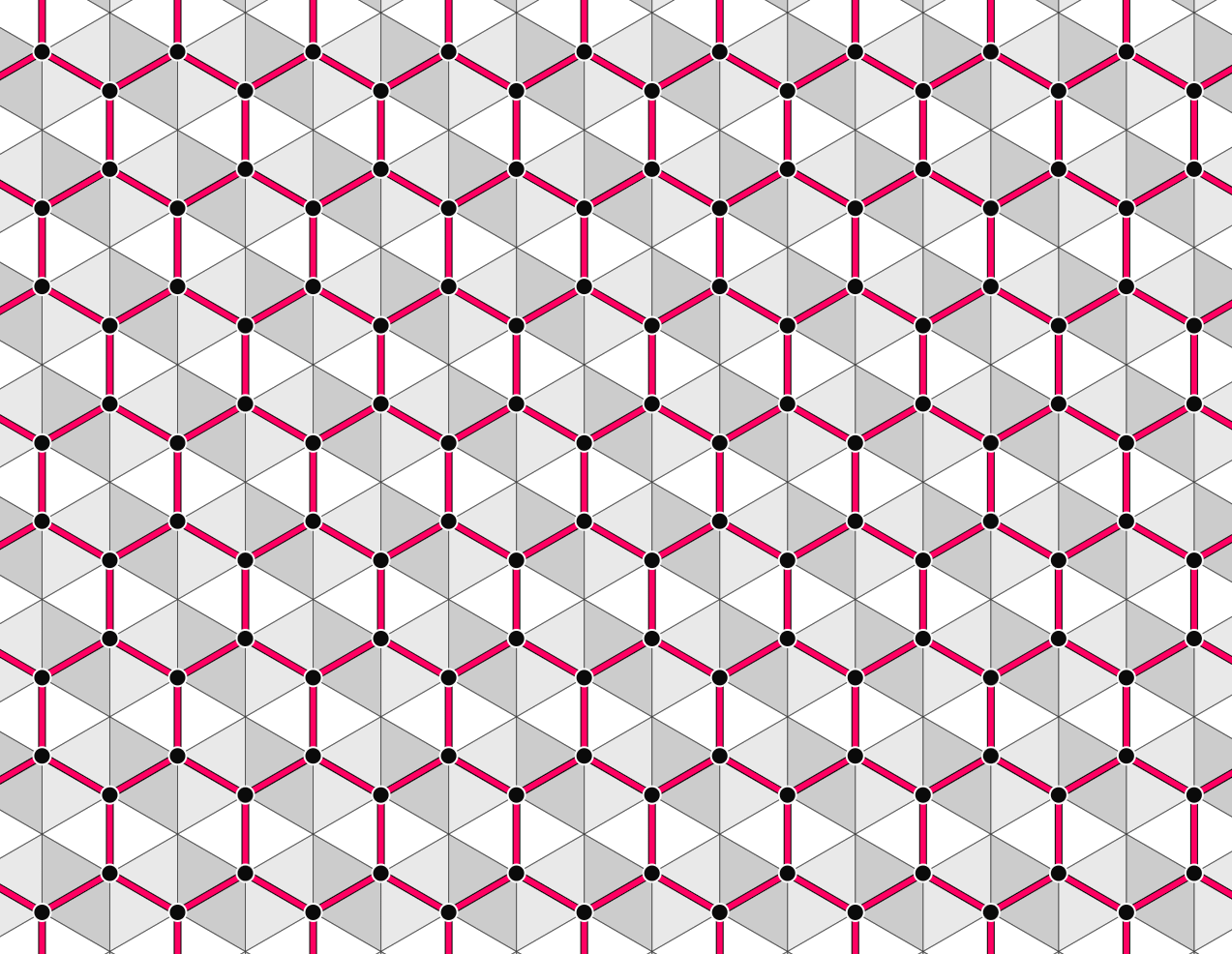
- Think of each part (cube, gear, corner) as a dot in a network. Dots are connected by lines to show “who influences whom.”
- Each connection carries a rule: either “same” (the two ends must match) or “opposite” (the two ends must differ). In their math, “same” is 0 and “opposite” is 1. Adding 0s and 1s means “even or odd” (mod 2), like counting heads up or down in coins.
- To test consistency, they walk around a loop in the network and add the rule labels on each edge. If the total is even, the loop can be satisfied. If the total is odd, the loop is impossible—something must break.
- When they “fill in” the network with faces (like turning a wireframe into panels), they can measure frustration inside a region. A simple version of Stokes’ theorem (a big idea from calculus) says:
- What the boundary of a region demands equals the total “defect” inside. In plain terms: if the edges around a patch insist on a flip, the patch must hold a defect somewhere.
They also introduce the Method of Monodromic Apertures (MoMA), an animation trick: slide a small viewing window around a loop. If the picture flips when you return, you’ve made the hidden math (called monodromy) visible.
What They Found
They build a five-step hierarchy of paradoxes (from easiest to most “stubborn”), all using simple odd/even counting:
- H0: Ambiguity
- The whole picture can be read in two consistent ways (like a Necker cube). Nothing is wrong—there’s just no reason to prefer one reading.
- Relative H1: Conflict
- The edges force opposite choices (like pinning one end of a row of Necker cubes to “forward” and the other end to “backward”). The inside becomes a tug-of-war zone with fading certainty.
- Absolute H1: Impossibility
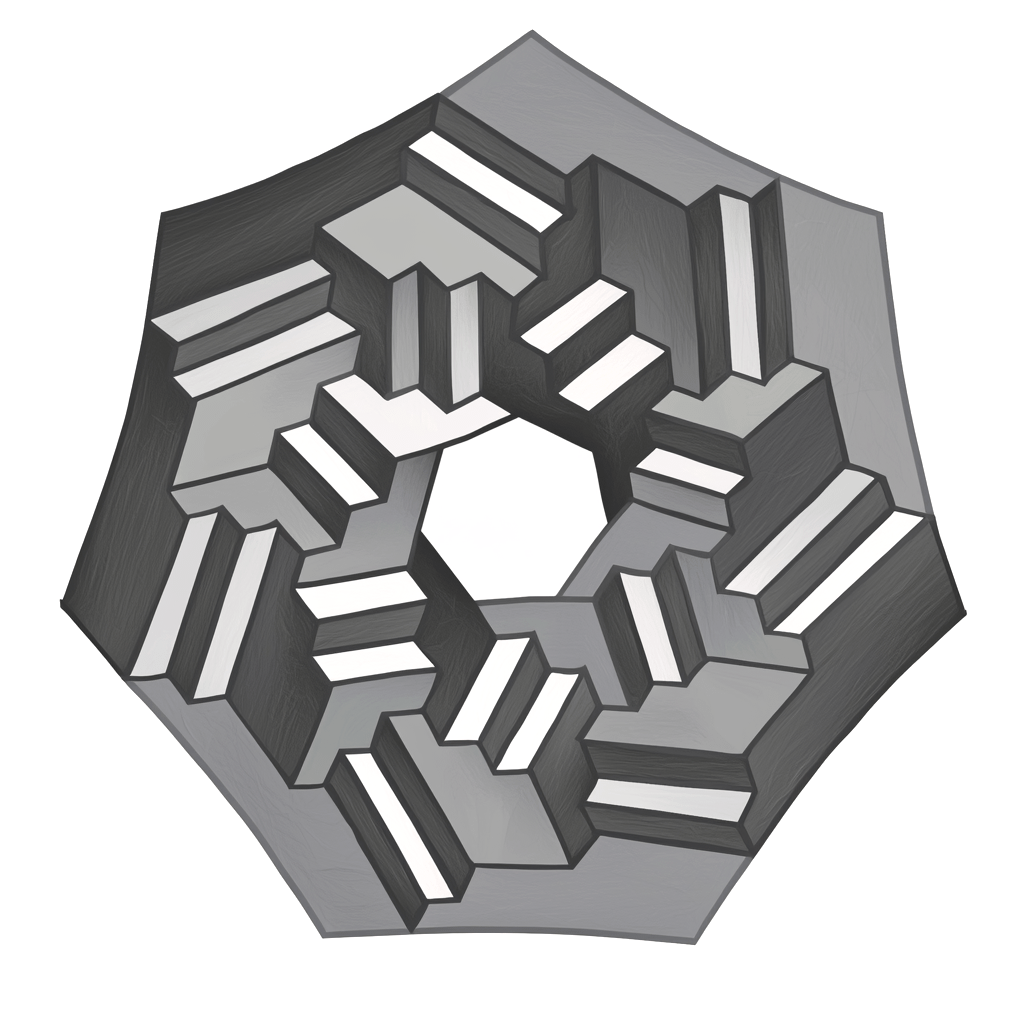
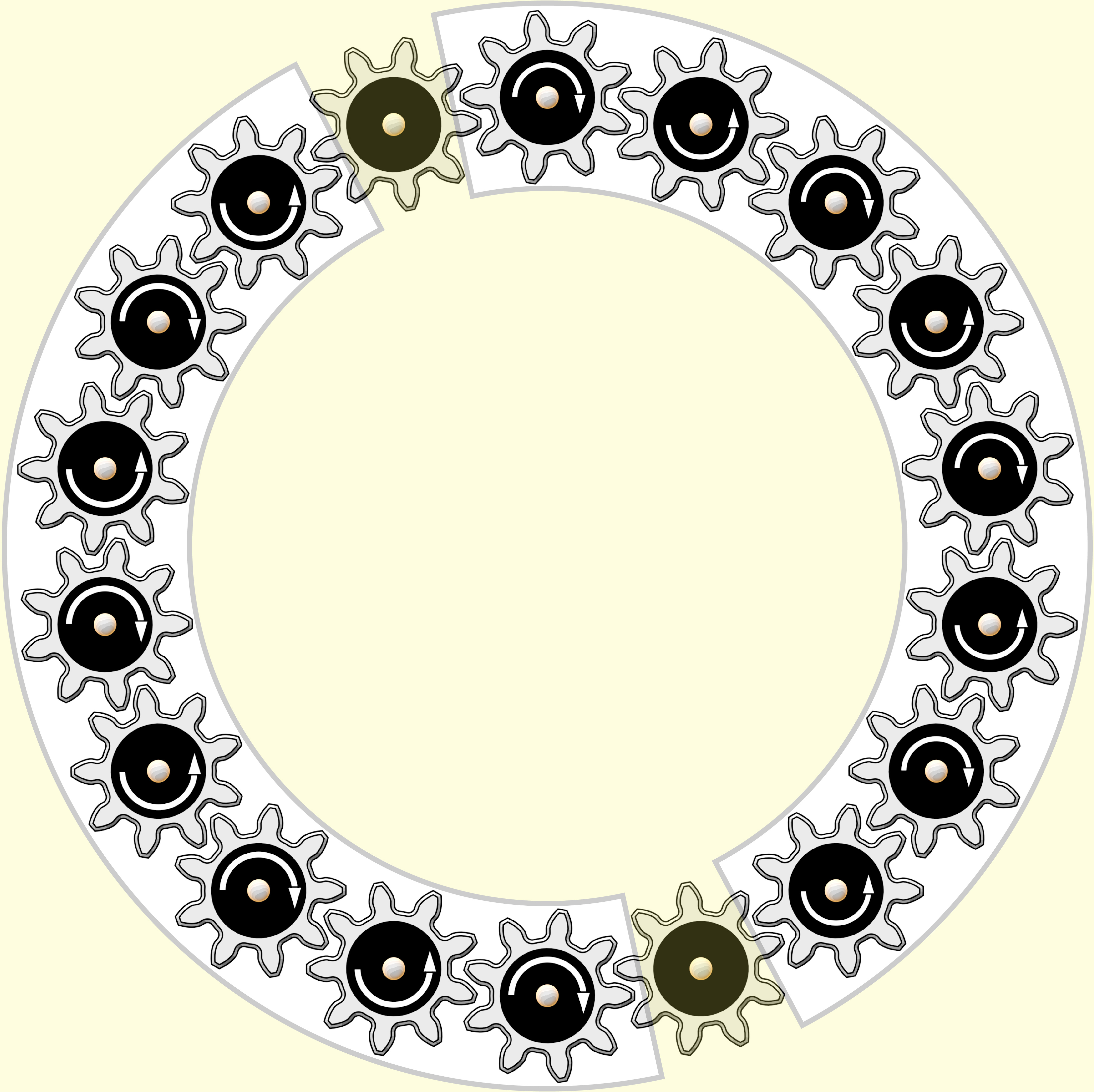
- The structure itself is impossible, with no boundary help needed. Classic example: a ring of gears with an odd number of gears that all force neighbors to turn the opposite way. You can’t assign clockwise/counterclockwise around the loop without breaking a rule.
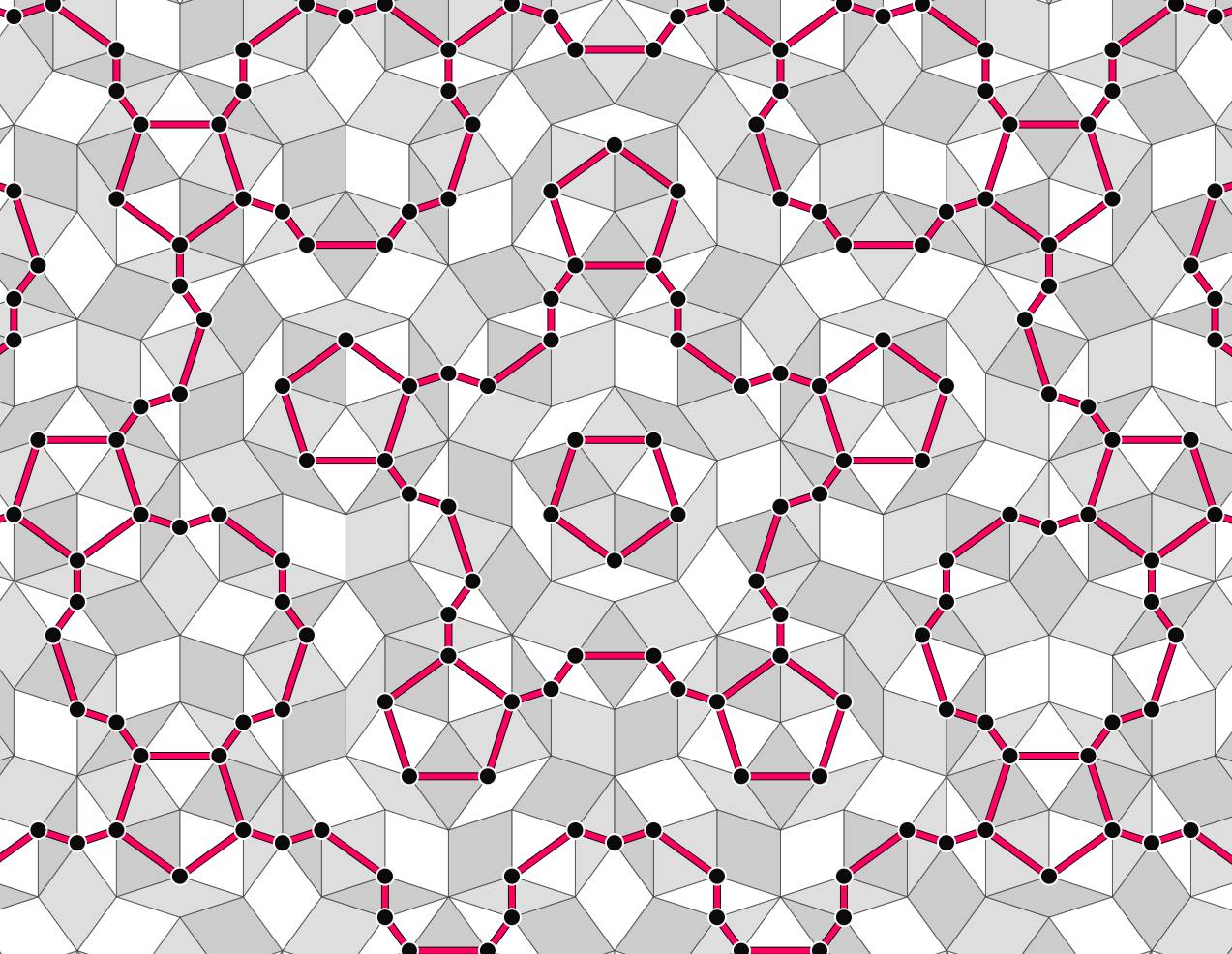
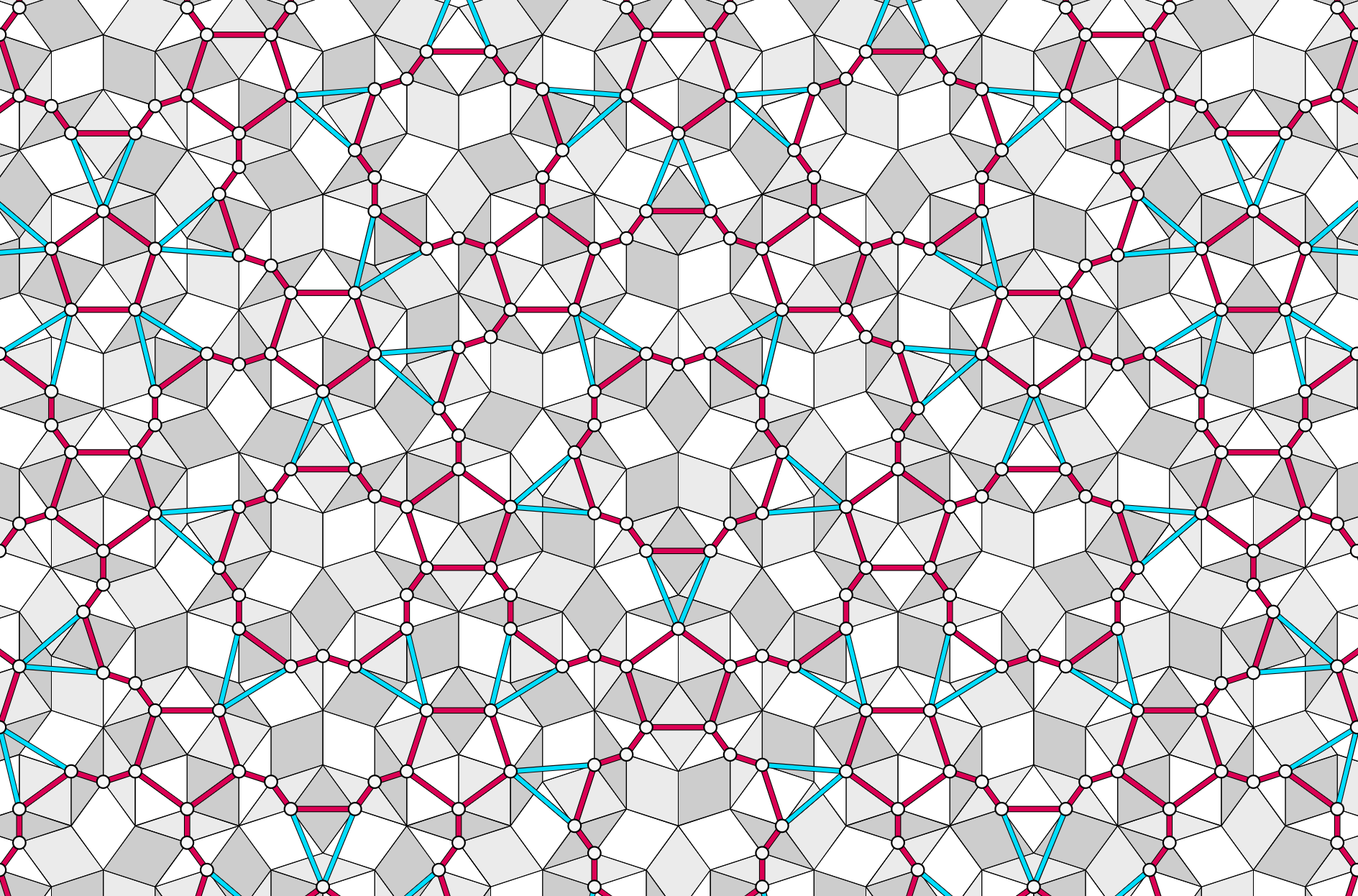
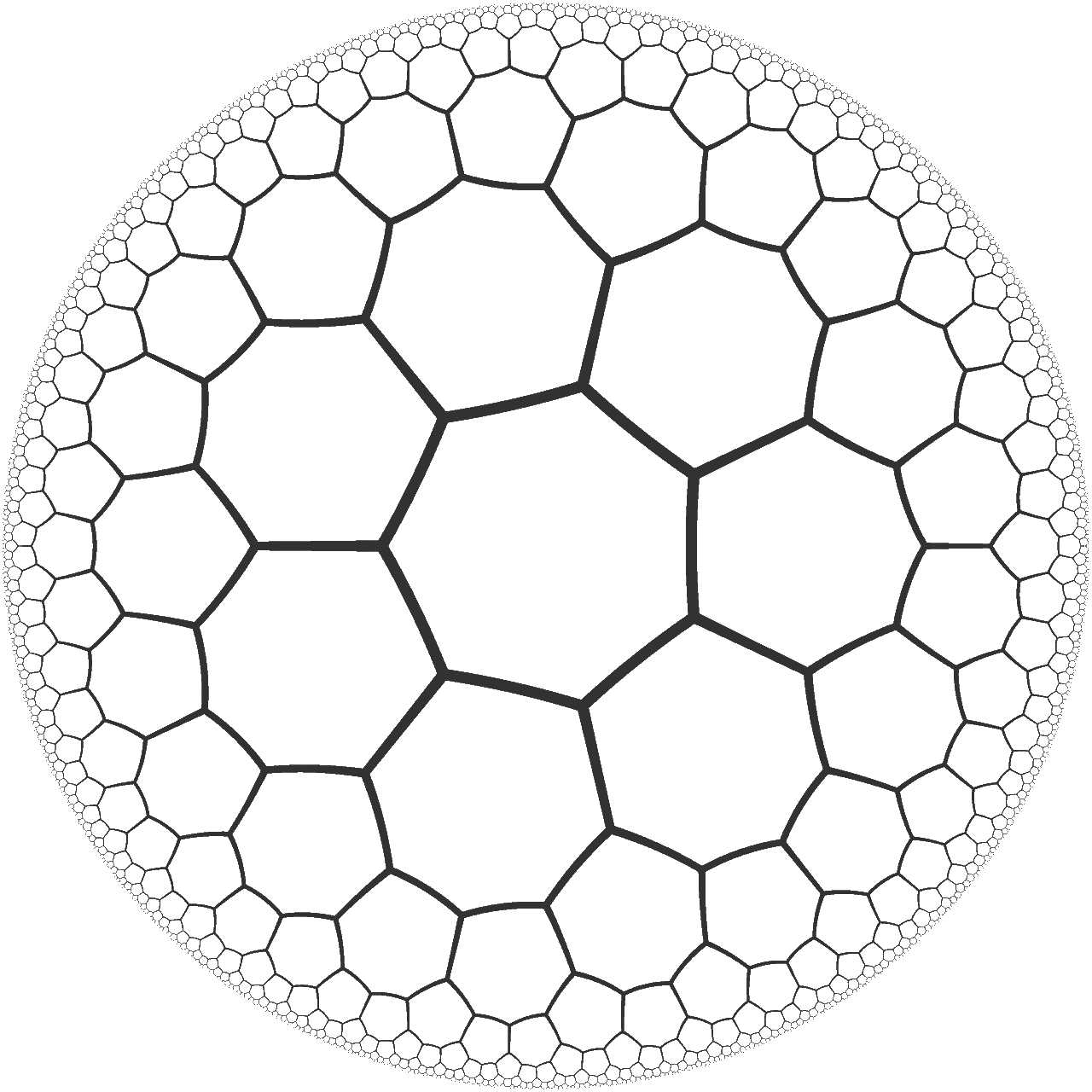
- In rhombic tilings (like Penrose’s P3 tiling), odd cycles of “opposite” corners (pentagons) cause impossibility for the same reason.
- Relative H2: Curvature (localized defects)
- If the boundary of a region insists on an odd flip overall, the interior must contain a defect somewhere—frustration that can move around but cannot vanish. This is the discrete version of “boundary holonomy becomes interior curvature.”
- Absolute H2: Inaccessibility
- Even when local moves are allowed, some global states are unreachable because of topological barriers (think of “sectors” of configurations you can never enter by small changes).
Key examples and insights:
- Odd vs. even matters:
- A ring of gears with an even count can alternate spins and turn freely. With an odd count, it locks—impossible.
- In Penrose’s P3 tiling, five-corner rings (pentagons) force impossibility; six-corner rings (hexagons) are fine.
- Twisting can help or hurt:
- If the rotation axes of parts (like spinning cubes or gears on a band) twist by a half-turn around the loop, the meaning of “clockwise” effectively flips once. This “twist class” can cancel or create impossibility:
- Möbius gear ring: the twist cancels the usual odd-ring lock, letting an odd number of gears rotate.
- Twisted Necker ring with “agree” rules: the twist creates impossibility where none existed with parallel axes.
- Animation makes hidden math visible:
- MoMA shows that carrying a local view around a loop can come back flipped—an immediate, visual proof of an obstruction.
Why This Is Important
- A simple, unified language: The paper shows that many different visual paradoxes—depth flips, gear locks, tiling illusions—share the same basic math: odd/even counts on loops and a boundary-to-interior law (Stokes).
- Predicts where paradoxes must appear: If you know the boundary demands, you can predict the interior defects. If you see an odd loop of “opposite” constraints, you know it’s impossible.
- Bridges art, vision, and math: It explains classic illusions and “impossible objects” with crisp, accessible rules, and offers tools to design new ones.
- Connects to deeper science: The ideas match up with how physicists think about fields and curvature (gauge theory) and how quantum experiments show context-dependent outcomes (contextuality), but here everything reduces to simple parity arithmetic.
The Big Picture Impact
By reducing complex-looking paradoxes to “flip or not flip” rules and odd/even counts, the paper gives artists, engineers, and scientists a clear roadmap:
- Design: Want an object that’s truly impossible? Build an odd loop of “opposite” rules. Want a controllable conflict zone? Impose opposite boundary choices.
- Diagnose: If the boundary flips overall, expect a defect somewhere inside—you can’t remove it, only move it.
- Visualize: Use animation (MoMA) to reveal hidden flips when you traverse loops.
In short, the paper turns exotic visual paradoxes into a friendly, organized toolkit, making the invisible logic behind “impossible by degrees” both understandable and usable.
Knowledge Gaps
Knowledge gaps, limitations, and open questions
The paper presents a clear Z2-based framework and a hierarchy through relative/absolute and sketches pathways to . The following unresolved issues identify concrete directions for further research:
- Generalization beyond bistable () elements:
- How does the hierarchy (ambiguity → conflict → impossibility → curvature → inaccessibility) change for multistable elements (, nonabelian groups), and which higher-categorical tools (e.g., gerbes) are minimally necessary to capture obstructions in those settings?
- Can the discrete Stokes mechanism and connecting homomorphism be formulated and visualized for nonabelian torsors with path-ordered holonomy?
- Canonical construction of the ambient 2-complex:
- For rhombic tilings (and other cases where the constraint graph is not naturally cellular), provide a canonical, algorithmic method to construct the ambient 2-complex (the “blue edges”) and analyze how different choices affect curvature placement, visualization, and numerical stability, while preserving extension-independence of total curvature inside .
- Explicit exemplars and detection:
- Supply concrete, reproducible examples and animations of relative (curvature) and absolute (inaccessibility) paradoxes, including cup-product obstructions and degree-shifted flux models, together with rigorous detection/verification procedures.
- Cup-product obstructions in practice:
- Develop explicit constructions where two independent classes have nontrivial cup product, specify how “seams” (Poincaré duals) can be designed to necessarily intersect, and link those intersections to concrete visual/kinematic paradoxes and measurable monodromies.
- Degree-shifted flux models:
- Formalize “edge-state + flux” models whose obstructions sit in (e.g., discrete gauge potentials with prescribed flux), provide worked examples, and detail algorithms that compute these obstructions from combinatorial data.
- Computation from data (robust, scalable algorithms):
- Create robust pipelines that extract constraint graphs, compute obstructions (including twist classes) from images/meshes/point clouds, and remain stable under noise, occlusion, and discretization artifacts; release open-source libraries and benchmarks.
- Quantitative, soft-constraint models and perception:
- Couple the hard cohomological obstructions to energy-based or probabilistic models (e.g., antiferromagnetic Ising on the constraint graph) to predict graded ambiguity/“conflict zones,” and validate these predictions via psychophysical experiments.
- Axis twist class computation:
- Provide general algorithms to compute the axis-field twist class (first Stiefel–Whitney class) from geometric data on curves/surfaces, and evaluate how composes with varying coupling to create or cancel holonomy in complex assemblies (beyond Möbius rings).
- Beyond external spur gears:
- Extend the framework to belts, internal/ring gears, and bevel gears (3D contact), where constraints may mix agreement/opposition or depend on geometry, and characterize how these variations modify the cohomological classification.
- Rhombic/quasicrystal tilings:
- Systematically classify and quantify odd cycles in Penrose P3 and related quasicrystal tilings (density, distribution, scaling), and develop fast algorithms to detect all obstruction cycles in large finite patches under varying boundary conditions.
- Higher-degree phenomena:
- Identify conditions and explicit constructions in (possibly 3D) bistable systems that genuinely require (or higher) for obstruction detection, clarifying the minimum categorical machinery needed in the case.
- Curvature transport and control:
- Formalize local “gauge move” rules that move curvature (frustration) within a domain, characterize conservation/annihilation constraints, and design strategies to steer curvature to desired locations for controllable paradoxes.
- Choosing and in empirical settings:
- Provide principled guidelines for selecting the boundary subcomplex and ambient complex from natural images/meshes so that relative vs absolute obstructions are meaningfully interpreted; analyze sensitivity to these choices.
- Refining invariants beyond visibility:
- Since misses geometric features like linking in 3D Necker fields, develop refined (co)sheaf-theoretic or geometric invariants that capture spatial arrangement and distribution of conflict zones beyond existence of obstructions.
- Formalization and evaluation of MoMA:
- Precisely define the configuration space of local sections used by the Method of Monodromic Apertures, give general algorithms to synthesize apertures for arbitrary torsors, and empirically assess perceptual efficacy across tasks and parameter ranges.
- Continuous and curved settings:
- Extend the discrete framework to smooth manifolds and continuous images (e.g., via cellular approximations or differential forms with coefficients), and study discretization effects on computed obstructions.
- Real-world mechanical constraints:
- Analyze how friction, compliance, backlash, and manufacturing tolerances affect the observability and robustness of cohomological paradoxes in physical gear/tiling prototypes; establish tolerance bounds preserving the obstruction.
- Design/synthesis problems:
- Given a target cohomology class (e.g., specified holonomy or cup product), develop optimization methods to synthesize minimal images/meshes realizing that class with maximal perceptual salience.
- Connections to quantum contextuality:
- Construct explicit correspondences between visual paradox instances and contextuality scenarios (measurement covers, empirical models), transfer cohomological invariants across domains, and propose joint experimental tests.
- Data and reproducibility:
- Provide datasets (meshes/tilings), code for computing cohomological invariants, and complete animation scripts for all figures to enable replication and further exploration by the community.
Glossary
- Absolute H1: The degree-one cohomology of the whole space (not relative to a boundary), used here to capture intrinsic impossibility. "Absolute detects impossibility: no valid global reading."
- Ambient cell complex: A 2D (or higher) cell complex that contains the constraint graph as a subgraph, providing faces for curvature and Stokes computations. "For some systems, the constraint graph embeds naturally in an ambient cell complex "
- Čech cohomology: A cohomology theory based on open covers, used by Penrose to formalize impossible figures. "recast these figures in the language of \v{C}ech cohomology"
- Cochain: A function on cells (vertices, edges, faces, ...) of a complex; here 0-cochains are states and 1-cochains encode couplings. "A {coupling} encodes pairwise constraints"
- Coboundary: The cochain-level operator δ that measures differences; it maps k-cochains to (k+1)-cochains. "where the coboundary computes the parity of states across each edge."
- Cocycle: A cochain whose coboundary is zero; boundary-compatible data that may or may not extend. "Given a cocycle on "
- Cohomology group H1: The first cohomology, classifying 1-cocycles modulo coboundaries; used to detect holonomy-based impossibility. "classifying the triangle by the cohomology group of an annulus"
- Configuration space: The space of local sections/configurations; used to make holonomy visible as monodromy via animation. "by constructing torsors over configuration space."
- Connecting homomorphism: The map in the long exact sequence of a pair that promotes boundary data to interior obstructions. "The connecting homomorphism {\em is} both Stokes and the obstruction"
- Constraint graph: The graph whose vertices are bistable elements and whose edges indicate pairwise constraints. "The constraint graph has bistable elements as vertices"
- Cup product: A bilinear product on cohomology that combines degree-one classes to detect degree-two interactions. "The {cup product} measures interference between independent classes;"
- Curvature: The 2-cochain (δ of the coupling) measuring local frustration; interior obstruction detected by Stokes. "The coupling is a discrete connection with curvature as field strength."
- Degree-shifting: Moving variables from vertices to edges so that the obstruction naturally lands in a higher cohomology group. "Alternatively, {degree-shifting} places bistable variables on edges rather than vertices, with prescribed flux playing the role of coupling; the obstruction to finding a potential then lives directly in ."
- Discrete Gauss law: A conservation law for curvature/defects in the discrete setting. "Curvature (relative ) is localized frustration ... conserved by a discrete Gauss law."
- Discrete Stokes theorem: The equality pairing coboundaries with boundaries in the discrete setting, turning boundary holonomy into interior curvature. "A discrete Stokes theorem emerges as the central tool"
- Double cover: A 2-to-1 covering space; in this context a Z2-torsor classified by H1. "-torsors (double covers, principal -bundles) are classified by "
- Field strength: Gauge-theoretic term for curvature (δ of the connection) in the discrete model. "The coupling is a discrete connection with curvature as field strength."
- First Stiefel–Whitney class: A Z2-valued cohomology class detecting orientability of line bundles (axes); used here as the twist class. "it is the first Stiefel-Whitney class of the line bundle L → γ"
- Gauge transformation: A change of local trivialization that adjusts the cochain by a coboundary without changing cohomology classes. "A gauge transformation replaces by the cohomologous "
- Gerbe: A higher-categorical bundle-like object whose classes live in H2 or H3, generalizing principal bundles/torsors. "so gerbes provide the next categorical level, classified by or depending on the structure"
- Holonomy: The accumulated constraint around a cycle; nonzero holonomy signals an H1 obstruction. "The sum is the {holonomy} of around ."
- Holonomy criterion: The test for solvability of constraints: all cycle holonomies must vanish. "The holonomy criterion (Criterion~\ref{crit:holonomy}) provides the test"
- Line bundle: A rank-1 vector bundle; here the bundle of unoriented rotation axes over a cycle. "of the line bundle L → γ spanned by the unoriented rotation axes."
- Local system: A sheaf-like assignment with locally constant structure; here describing depth labels carried consistently along the space. "The depth labels form a trivial local system"
- Long exact sequence (of a pair): The exact cohomology sequence relating a space, a subspace, and the pair; source of the connecting homomorphism. "The long exact sequence of a pair captures this precisely"
- Method of Monodromic Apertures (MoMA): An animation technique that visualizes monodromy by sliding local sections around loops. "we introduce the Method of Monodromic Apertures, an animation technique that reveals monodromy through a configuration space of local sections."
- Monodromy: The change (often a flip) in a local section after transport around a loop, visible via MoMA. "an animation technique that reveals monodromy through a configuration space of local sections."
- Penrose P3 tiling: A quasiperiodic tiling by rhombi with 5-fold features, used here to produce odd-cycle constraints. "The {Penrose P3 tiling} is different."
- Poincar e-dual seams: Intersecting 1-dimensional representatives dual to cohomology classes, used to explain nontrivial cup products. "their Poincar e-dual seams must intersect regardless of cocycle representatives."
- Principal homogeneous space: A torsor; a set with a free and transitive group action and no distinguished origin. "acts freely and transitively on the solution set, which therefore forms a principal homogeneous space with no distinguished element."
- Principal Z_2-bundle: A principal bundle with structure group Z2; equivalent to a double cover and classified by H1. "-torsors (double covers, principal -bundles) are classified by "
- Relative H1: Degree-one cohomology relative to a boundary, capturing boundary-forced conflicts. "Relative detects conflict: boundary-forced incompatibility."
- Relative H2: Degree-two cohomology relative to a boundary, capturing boundary-forced curvature/defects. "Relative detects curvature: localized defects forced by boundary holonomy."
- Sheaf-cohomological: Pertaining to cohomology built from sheaves; used here to relate to contextuality in quantum foundations. "This circle of ideas connects to sheaf-cohomological approaches to quantum contextuality"
- Stokes Principle: The paper’s guiding maxim that boundary inconsistency promotes to interior obstruction via the connecting homomorphism. "Stokes Principle. \emph{Boundary inconsistency becomes interior obstruction.}"
- Torsor: A set acted on freely and transitively by a group (no preferred origin); models ambiguity classes and holonomy. "which posited torsors as the mathematical structure underlying impossible figures"
- Twist class: A Z2-valued class measuring axis-orientability (a half-turn gives 1), adding to constraint holonomy. "Define the {twist class} "
- Z_2 coefficients: Working over the two-element field so counts reduce to parity, simplifying obstructions. "allows the use of coefficients throughout, reducing obstruction theory to parity arithmetic."
- Zonohedron (rhombic): A convex polyhedron all of whose faces are rhombi; used to realize tiling constraints on closed surfaces. "via {rhombic zonohedra} — convex polyhedra whose faces are all rhombi"
Practical Applications
Immediate Applications
The following applications can be deployed now, leveraging the paper’s Z2-based framework for bistable systems, the discrete Stokes principle (boundary holonomy → interior curvature), and the Method of Monodromic Apertures (MoMA) for visualizing monodromy.
- Gear-train parity checks and CAD/CAE validation
- Sectors: robotics, manufacturing, automotive, mechanical engineering
- Use cases: Automatically flag locking conditions in gear chains and meshes (odd cycles under opposition constraints) during design; suggest Moebius twists or topology changes to resolve parity-induced impossibility; validate toroidal belt/gear layouts by checking fundamental cycles for holonomy.
- Tools/products/workflows: CAD plugins for SolidWorks/Fusion 360/Rhino to build a constraint graph from gear contacts, compute parity on cycles, and annotate “lock risk” regions; lightweight Python library to compute holonomy and recommend fixes.
- Assumptions/dependencies: Idealized external spur gears (pure opposition constraints); neglects tolerances/backlash/friction; requires accurate contact graph extraction and axis-orientation metadata (for twist class).
- Illusion creation and detection in visual computing
- Sectors: media, education, software (graphics/AR/VR)
- Use cases: Design impossible objects and graded-ambiguity illusions by prescribing relative boundary conditions ( conflict) or odd cycles ( impossibility); automatically detect scenes with nontrivial holonomy that preclude a consistent 3D reading.
- Tools/products/workflows: Graphics libraries that build constraint graphs from meshes or line drawings and compute cohomological obstructions; MoMA animation modules (Unity/Blender) to reveal monodromy by sliding apertures along loops.
- Assumptions/dependencies: Reliable extraction of bistable elements (e.g., Necker-like wireframes, rhombic tilings); Z2 modeling (two-state elements) matches intended percept; cell structure available for curvature visualization.
- Architecture and pattern feasibility checking
- Sectors: architecture, structural engineering, computational design
- Use cases: Validate rhombic tilings and stepped-surface interpretations to avoid paradox-laden assemblies (e.g., P3 rosette pentagons with opposition constraints); use shading/lighting to intentionally create perceptual effects while preserving constructibility.
- Tools/products/workflows: Grasshopper/Rhino components that derive constraint graphs from facade/tiling patterns, check bipartiteness and odd-cycle obstructions, propose local pattern modifications to regain feasibility.
- Assumptions/dependencies: Planar projections and degree-3 vertex modeling; mapping “convex/concave” labels to fabricable geometry.
- Perception research stimulus design
- Sectors: academia (cognitive science, vision science, neuroscience)
- Use cases: Generate controlled stimuli that isolate ambiguity, relative conflict gradients, and absolute impossibility; compare measured perceptual uncertainty gradients with predicted conflict localization.
- Tools/products/workflows: Open-source toolkit to construct Necker fields and rhombic tilings with tunable boundary conditions; MoMA-based loops to elicit and measure monodromy effects.
- Assumptions/dependencies: Bistable percept reliably induced; soft-constraint perceptual dynamics not modeled by hard constraints require empirical calibration.
- Educational modules for topology and cohomology
- Sectors: education (secondary, undergraduate), outreach
- Use cases: Teach cohomology through visual paradoxes; demonstrate discrete Stokes via boundary holonomy forcing interior curvature; make torsors and monodromy tangible with animations.
- Tools/products/workflows: Interactive web modules with MoMA animations; classroom worksheets linking odd cycles to impossibility and relative boundary assignments to conflict.
- Assumptions/dependencies: Curriculum alignment; simplified setting suffices for learning goals.
- Game and puzzle design with cohomological mechanics
- Sectors: entertainment, serious games
- Use cases: Create levels where players resolve conflicts or navigate inaccessibility sectors; validate puzzles by checking to ensure intended impossibility or reachable goals.
- Tools/products/workflows: Level validators computing cycle holonomy; visualization overlays showing “frustration” faces (curvature defects) in grid-based games.
- Assumptions/dependencies: Game mechanics map to bistable constraints; player comprehension of parity-based rules.
- Media forensics and scene consistency checks
- Sectors: media integrity, digital forensics
- Use cases: Detect doctored images/videos that create global inconsistency (nonzero holonomy) despite locally plausible content; localize “curvature defects” implied by boundary holonomy via discrete Stokes.
- Tools/products/workflows: Computer vision pipelines that build simplified constraint graphs from line-art/edges and flag cohomological inconsistencies.
- Assumptions/dependencies: Robust scene parsing and abstraction to bistable elements; tolerance for false positives in complex natural scenes.
- Distributed configuration sanity checks
- Sectors: software engineering, DevOps, IoT
- Use cases: Model binary feature flags or device modes as states with pairwise constraints; detect relative conflicts induced by boundary assignments (e.g., staged rollouts that produce incompatible regions); ensure loops in dependency graphs do not encode impossible constraints.
- Tools/products/workflows: Graph-based validators for configuration systems; cohomology checks integrated into CI/CD to prevent deployment states that cannot be reconciled.
- Assumptions/dependencies: Binary-state abstraction appropriate; constraint definitions accurate; ignores asynchronous timing issues.
- Robotics and control consistency diagnostics
- Sectors: robotics, multi-agent systems
- Use cases: Encode pairwise mode constraints (agree/oppose) across robot teams or modular devices; detect cycles with nontrivial holonomy that prevent consistent assignments; use boundary forcing to test robustness of mode coordination.
- Tools/products/workflows: Middleware library to compute obstructions on mode graphs; dashboards showing conflict distributions.
- Assumptions/dependencies: Binary modes sufficient; communication/sensing errors not modeled; requires accurate coupling cochains.
- Art installations and exhibit design using MoMA
- Sectors: galleries, museums, public art
- Use cases: Build kinetic sculptures (Necker rings, Moebius gear loops) whose perceived state flips after closed traversal; use pentagonal rosettes to evoke intrinsic impossibility.
- Tools/products/workflows: Design scripts to plan loops and aperture paths; on-site displays explaining monodromy and holonomy.
- Assumptions/dependencies: Mechanical feasibility and safety; viewer engagement with bistable perception.
Long-Term Applications
These applications will require further research, scaling, or development beyond the current Z2-focused framework and proof-of-concept animations.
- Generalized cohomology engines for CAD/CAE
- Sectors: mechanical/electrical engineering, energy systems
- Use cases: Move beyond bistable () constraints to multistate and nonabelian torsors; integrate (gerbe-level) checks for mechanisms with phase, timing, or orientation bundles; co-design topology and constraints to eliminate global inconsistencies.
- Tools/products/workflows: Cohomology solvers embedded in PLM suites; automated redesign suggestions (edge rewiring, topology changes).
- Assumptions/dependencies: Scalable algorithms for larger state groups; accurate physical modeling; standards for constraint specification.
- Real-time monodromy visualization in AR/VR
- Sectors: XR platforms, training/simulation
- Use cases: Automatically detect loops in complex scenes and overlay MoMA windows that reveal monodromy; train operators to recognize and avoid globally inconsistent interpretations in dynamic environments.
- Tools/products/workflows: Scene parsing + graph extraction + on-device cohomology; GPU-accelerated loop detection and aperture animation.
- Assumptions/dependencies: Robust, real-time scene understanding; user interface design for minimal cognitive load.
- Clinical diagnostics via conflict gradients
- Sectors: healthcare (ophthalmology, psychiatry, neurology)
- Use cases: Use controlled relative conflict stimuli to quantify perceptual stability/ambiguity handling in conditions affecting visual processing; track therapy progress via sensitivity to graded conflict.
- Tools/products/workflows: Standardized test batteries with calibrated Necker/tiling stimuli; analysis software correlating perceptual reports with cohomological structure.
- Assumptions/dependencies: Clinical validation; ethical approvals; individual variability in bistable perception.
- Computer vision for global consistency
- Sectors: autonomous systems, surveillance, graphics
- Use cases: Build models that infer constraint graphs from natural scenes and check global consistency; prevent misinterpretations (e.g., mirror/self-shadow illusions) by flagging nontrivial or required curvature.
- Tools/products/workflows: ML pipelines combining geometric parsing, graph construction, and topological consistency checks; dataset curation with labeled paradox classes.
- Assumptions/dependencies: Robust graph extraction from noisy data; probabilistic versions of cohomology for uncertainty.
- Topological control in multi-agent coordination
- Sectors: robotics, networked systems
- Use cases: Design controllers that avoid inaccessibility sectors (absolute ) and interference between independent modes (cup products); guarantee consensus under topology changes by monitoring cohomological invariants.
- Tools/products/workflows: Control synthesis with cohomology constraints; runtime monitors of classes on evolving interaction graphs.
- Assumptions/dependencies: Formal links between invariants and performance; scalable computations on dynamic networks.
- Metamaterials and frustrated-lattice design
- Sectors: materials science, mechanical metamaterials
- Use cases: Engineer lattices with programmable frustration (relative curvature) to localize energy or defects; exploit parity-controlled pathways to create sectors that are mechanically inaccessible (absolute ).
- Tools/products/workflows: Design platforms mapping couplings to physical joints; simulation of curvature redistribution under gauge changes.
- Assumptions/dependencies: Physical realizability of idealized constraints; coupling between cohomological frustration and material properties.
- Standards and policy for illusion labeling
- Sectors: policy, media platforms
- Use cases: Establish guidelines to disclose impossible-figure content (e.g., advertising/AR) and to distinguish creative illusions from deceptive manipulations; promote educational context for cohomology-informed media.
- Tools/products/workflows: Audit procedures using scene-consistency checks; certification labels based on detectable holonomy/curvature.
- Assumptions/dependencies: Stakeholder adoption; clear thresholds for “impossible” classification.
- Quantum contextuality pedagogy and experiment design
- Sectors: physics (quantum foundations), education
- Use cases: Use the visual-paradox analogy to teach sheaf-cohomological contextuality; design tabletop experiments mapping to obstructions for intuitive engagement.
- Tools/products/workflows: Curriculum and visualization tools connecting torsors/monodromy with contextuality; outreach exhibits.
- Assumptions/dependencies: Careful translation from visual to quantum contexts; avoidance of misleading analogies.
- Configuration-space diagnostics for complex software
- Sectors: large-scale software, cloud systems
- Use cases: Map feature interactions to cochains on configuration graphs; detect unreachable sectors (absolute inaccessibility) and interference (cup product) that block desired global states.
- Tools/products/workflows: Static analyzers computing cohomological invariants on dependency graphs; refactoring guidance to remove obstructions.
- Assumptions/dependencies: Accurate modeling of dependencies as pairwise constraints; extension to multivalued states.
- Energy network and power-grid consistency
- Sectors: energy, smart grids
- Use cases: Encode binary phase/permission constraints (e.g., switching states) and detect cycles with nontrivial holonomy that prevent consistent operation; plan topology and switching sequences to avoid forced curvature (localized overloads).
- Tools/products/workflows: Planning tools integrating cohomology checks with traditional flow models; operator training with MoMA-like visualizations.
- Assumptions/dependencies: Mapping operational constraints to models; integration with continuous power-flow equations.
Notes on cross-cutting assumptions
- Bistable restriction: The framework assumes exactly two local states (). Multistate systems require generalization (long-term).
- Constraint graph fidelity: Practical deployment depends on reliably building the graph of interacting elements and specifying coupling types (agreement/opposition).
- Boundary selection: Relative obstructions depend on how boundary subsets are chosen; application-specific rules are needed.
- Axis orientation and twist class: Applications involving rotation require consistent axis data to compute the twist class (first Stiefel–Whitney).
- Hard vs soft constraints: Cohomology certifies existence or impossibility; perceptual gradients and physical tolerances need complementary models (energy, noise, dynamics).
Collections
Sign up for free to add this paper to one or more collections.