Linking Solar Magnetism, Extreme Solar Particle Events and Stellar Superflares
Abstract: The magnetic field of the Sun drives a wide range of eruptive phenomena, from small-scale nanoflares to large flares and coronal mass ejections (CMEs). While direct observations of solar activity cover only the past few decades, indirect evidence indicates that the Sun can occasionally produce events orders of magnitude stronger than any recorded ones in the modern era. Two complementary lines of evidence exist. First, extreme solar particle events (ESPEs) have been inferred from prominent spikes in cosmogenic isotope concentrations preserved in precisely dated natural archives such as tree rings and ice cores over the past 15 millennia. Second, high-precision space-borne photometry has revealed superflares on thousands of stars similar to the Sun. Whether these solar and stellar extremes are physically related remains an open question. We summarise the present state of understanding and discuss physical mechanisms that may link them. Although superflares and ESPEs are both extremely energetic manifestations of magnetic energy storage and release, their relationship does not appear to be one-to-one. Their occurrence and energetics likely depend on how magnetic flux and topology govern the partitioning of released energy between radiation, mass ejection, and particle acceleration.
Paper Prompts
Sign up for free to create and run prompts on this paper using GPT-5.
Top Community Prompts
Explain it Like I'm 14
What this paper is about
This review explains how the Sun’s magnetic field can power extremely energetic outbursts, and how those outbursts show up in two ways:
- as rare “particle storms” that reach Earth (extreme solar particle events, ESPEs), and
- as huge bright flares seen on other Sun‑like stars (superflares).
The authors ask whether these two kinds of extremes are connected and what limits how powerful the Sun’s eruptions can be.
The big questions
In simple terms, the paper tackles three main questions:
- How often does the Sun create rare, extreme particle storms, and how strong are they?
- Do stars like our Sun produce “superflares,” and how often could the Sun do something similar?
- Are extreme particle storms and superflares two versions of the same thing, or do they depend on how the Sun’s magnetic field releases its energy?
How the researchers studied it
The authors combine evidence from Earth, the Moon, and space telescopes, and they explain the physics of the Sun’s magnetic field. Here’s how, in everyday language:
- Reading Earth’s “time capsules” (tree rings and ice cores)
- High‑speed particles from the Sun (or space) hit our atmosphere and make tiny amounts of special atoms called “cosmogenic isotopes” (like radiocarbon, C, and beryllium‑10, Be).
- These atoms get locked into tree rings and ice layers, year by year—like a cosmic “fingerprint.”
- Short, sharp spikes in these atoms (called “Miyake events”) show that the Sun sometimes blasts Earth with far more particles than in modern times. Using several isotopes together (a “multi‑proxy” approach) lets scientists estimate how strong and how energetic those particle storms were.
- Lunar rocks add another clue: the Moon has no air or magnetic field, so particles bury their signatures in the top layers of rocks. Measuring those layers shows how much particle radiation the Sun has averaged over very long times.
- Watching thousands of stars at once
- Space missions like Kepler and TESS recorded tiny changes in star brightness for years, like a giant “security camera.” Sudden, spike‑shaped brightenings are flares; the biggest ones are “superflares.”
- A tricky part is making sure the flare really comes from the target star and not a neighbor in the same pixel. New image‑level methods (like pinpointing which “light bulb” flashed in a blurry photo) reduce mix‑ups.
- Another challenge is choosing truly Sun‑like stars. The authors explain why past studies sometimes picked stars that rotate faster and are more active than the Sun, which can make superflares look more common than they are. Newer work matches the Sun’s temperature, slow rotation (~25 days), and low variability to get a fairer comparison.
- Linking it all to solar magnetism
- Think of the Sun’s magnetic field like a tangle of stretched, twisted rubber bands. When they snap and reconnect, they release energy fast:
- A flare is the “flash” of energy (lots of light and heat).
- A coronal mass ejection (CME) is like throwing off a chunk of the Sun’s outer atmosphere.
- A particle event is like a spray of high‑speed “bullets” (protons and other particles) hurled into space.
- How the energy gets split—light vs. mass ejection vs. particle acceleration—depends on the magnetic “wiring.” Big, complicated active regions (sunspot areas) store more energy and can drive larger events. Sometimes strong overlying magnetic fields “lid” an eruption, making a bright flare without a big CME.
What the researchers found (in plain language)
Here are the main takeaways:
- The Sun has produced rare, extreme particle storms
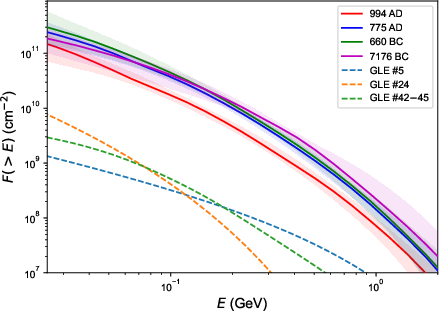
- Tree rings and ice cores show several extreme events over the last ~15,000 years—roughly one every 1,000–2,000 years.
- These ESPEs had particle doses far beyond anything recorded with modern instruments and could equal or exceed what the Sun typically delivers over many centuries of “normal” activity.
- Lunar rock data back this up: over very long times, a big fraction of the Sun’s particle output comes from these rare extremes.
- Superflares happen on Sun‑like stars, but the Sun’s rate is still being pinned down
- Kepler and other missions have seen flares much stronger than typical solar flares on many stars similar to the Sun.
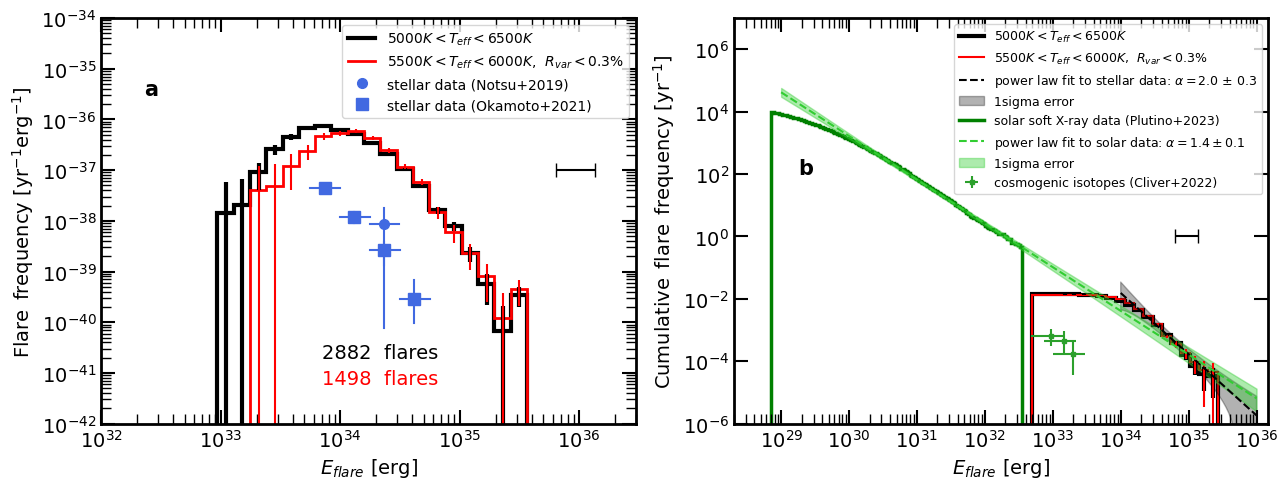
- Different studies have estimated very different rates because of selection and detection biases. When scientists carefully pick truly Sun‑like stars and confirm flares are really on‑target, one recent study suggests events around erg might happen about once per century on Sun‑like stars. Other studies suggest rarer rates for stricter “Sun‑twin” samples.
- Physics and historical sunspot records suggest the Sun could reach up to several × erg in rare cases, but most big solar flares are lower (e.g., the 2003 “Halloween” flares were a few × erg; the 1859 Carrington event was likely around erg).
- Superflares and extreme particle storms aren’t a simple match
- A huge flare doesn’t always mean a huge particle storm. Particle storms are strongest when an eruption launches a fast CME and opens magnetic field lines so particles can escape.
- On very active stars, strong overlying magnetic fields may hold CMEs in, producing bright superflares with little mass ejection—so fewer particles escape.
- Bottom line: these extremes are related to the same magnetic engine, but how the energy is split (light vs. mass ejection vs. particles) depends on the magnetic setup, not just the flare’s brightness.
Why this matters
- For everyday life
- Earth’s air and magnetic field protect people on the ground, so ancient extreme events didn’t harm past societies directly. But today, satellites, astronauts, GPS, radio, and power grids can be vulnerable to big space storms.
- If an ESPE happened now, many spacecraft could be damaged in minutes. The risk is higher during rare periods when Earth’s magnetic field weakens.
- For science and forecasting
- Knowing how often the Sun can “go big” helps engineers and governments plan and protect technology.
- The work shows we need better models of how the Sun’s magnetic field stores and releases energy, and better ways to combine clues from Earth archives, lunar rocks, and star surveys.
- What’s next
- More precise isotope measurements may reveal smaller or more frequent past events and fill gaps in our records.
- New space missions (like PLATO) and detailed spectroscopy will improve superflare statistics on true Sun‑like stars.
- Better, broader solar observations (especially in the ultraviolet) will sharpen our understanding of where flare energy goes.
The simple take‑home
The Sun is a magnetic, restless star. Its tangled magnetic fields can release energy in different ways: bright flares, giant ejections, and particle storms. Rarely—perhaps every thousand years or so—the Sun fires off particle storms far stronger than anything we’ve seen in modern times. Stars like the Sun can also produce superflares, and the Sun might do so, though not often.
Superflares and extreme particle storms are powered by the same engine but are not always two sides of the same event. Whether we see blinding light, a huge ejection, or a burst of fast particles depends on how the Sun’s magnetic “wires” snap and reconnect. By reading Earth’s ancient records and watching many stars at once, scientists are piecing together how extreme our Sun can be—and how to prepare for it.
Knowledge Gaps
Knowledge gaps, limitations, and open questions
Below is a concise list of what remains missing, uncertain, or unexplored, framed to guide concrete future research.
- Physical linkage between ESPEs and stellar/super-solar flares:
- Quantify how flare bolometric energy, CME properties, and magnetic topology jointly determine SEP fluence and spectral hardness at >100–200 MeV.
- Establish whether ESPEs require superflares on the Sun, or whether “moderate-energy” flares with highly efficient CME/shock acceleration can suffice.
- ESPE temporal structure and duration:
- Resolve whether Miyake events reflect one impulsive episode, multiple closely spaced events, or prolonged high-flux phases; current archives lack sub-annual resolution to distinguish these scenarios.
- ESPE spectral reconstructions:
- Reduce uncertainties from assumed SEP spectral shapes (scaled from modern events) and limited sensitivity windows of C, Be, and Cl; expand to additional isotopes and cross-validate spectral hardness beyond the Cl/Be ratio.
- Intermediate-strength events “detection gap”:
- Identify and quantify events between instrumental-era SEPs and ESPEs; this requires higher-precision AMS, more sensitive archives, and multi-isotope, multi-site confirmation protocols.
- Production, transport, and deposition systematics in cosmogenic records:
- Better constrain nuclear cross-sections, atmospheric transport, and carbon-cycle attenuation (for C) to tighten ESPE fluence uncertainties and avoid climate/meteorology confounders in Be/Cl.
- Geomagnetic field effects on ESPE inferences:
- Systematically correct ESPE strengths for paleo–geomagnetic intensity and geometry at event times using co-registered high-resolution paleomagnetic reconstructions.
- Globality and anisotropy of ESPE irradiation:
- Test whether inferred ESPEs were globally uniform by acquiring synchronized Be and Cl records from both hemispheres and multiple longitudes per event; model how SEP anisotropy and Earth connectivity map into globally averaged production.
- Lunar regolith constraints and modeling:
- Reduce uncertainties in SEP/GCR separation, regolith gardening, sample provenance, and depth-profile inversion; expand to multiple isotopes (e.g., Be, Mn, Ca) and more sites to refine long-term SEP spectra and ESPE contributions.
- Cycle-phase dependence of ESPEs:
- Determine whether ESPEs preferentially occur during high activity by improving event dating to sub-annual accuracy and statistically linking events to reconstructed cycle phase and amplitude.
- Maximum solar flare energy:
- Reconcile divergent upper limits from MHD simulations (~6×1033 erg) and empirical ribbon/AR scaling (several×1034 erg) via data-driven coronal models of extreme historical ARs, explicitly including AR nesting and overlying field constraints.
- Energy partition in extreme eruptions:
- Quantify how the fraction of energy in radiation, CME kinetic/magnetic energy, and particle acceleration varies with AR size/complexity, reconnection flux, and confinement; develop predictive partition models.
- Solar flare bolometric energetics:
- Close the flare spectral energy budget—especially 10–200 nm and near-UV/visible—through coordinated broadband observations (e.g., SUIT, TSI, EUV) and radiative-hydrodynamic modeling to calibrate bolometric energy against X-ray proxies.
- Mapping flare/CME properties to high-energy SEP fluence:
- Build joint statistics for >200 MeV SEP fluence as a function of reconnection flux, CME speed/width, shock geometry, seed populations, and magnetic connectivity; current correlations are weak and not predictive at ESPE scales.
- CME association and suppression at superflare energies:
- Test whether CMEs are systematically suppressed by strong overlying fields in superflare stars (as models suggest) using stellar CME diagnostics (Type II-like radio bursts, Balmer asymmetries, X-ray/EUV dimming) for Sun-like, slowly rotating stars.
- Superflare occurrence rates on Sun-like stars:
- Resolve inconsistent rates by applying image-level vetting (PSF fitting), uniform flare pipelines, and robust completeness corrections across Kepler and TESS; extend with PLATO to increase baseline and improve statistics at E≳1034 erg.
- Bolometric energy calibration of stellar flares:
- Reduce factor-of-few uncertainties from assumed flare SEDs (e.g., 9000–10000 K blackbody) via simultaneous multi-band photometry and time-resolved spectroscopy to constrain continuum temperatures and Balmer contributions.
- Representativeness of “Sun-like” samples:
- Match not only and , but also Rossby number, metallicity, inclination, Ca II S-index, and faculae/spot balance; quantify how these affect activity regime and flare statistics relative to the present Sun.
- Rotation-period incompleteness and facular compensation bias:
- Develop methods to include aperiodic/low-modulation stars (typical of Sun-like variability) using spectroscopic , spot/faculae-informed variability metrics, or machine-learning classifiers to avoid bias toward large, stable spots.
- Solar–stellar rate reconciliation:
- Cross-calibrate solar SXR peak-flux statistics with solar bolometric energies and with stellar bolometric flare energies through a large solar sample with bolometric measurements; unify observables to compare return times consistently.
- AR nesting and “active longitudes”:
- Establish robust, cycle-spanning metrics for nesting persistence and quantify its effect on the probability of extreme flares and clustered SEP fluence that could mimic ESPEs in cosmogenic records.
- Event-by-event association between ESPEs and solar eruptions:
- For historical epochs amenable to multi-proxy dating (e.g., AD 774/775), integrate auroral reports, cosmogenic spikes, and modeled solar activity to constrain the likely flare/CME drivers and magnetic configurations.
- Low-energy SEP contributions to isotope production:
- Determine how uncertainties below ~60–80 MeV (where Cl is most sensitive) influence inferred spectra and totals; explore additional proxies or modeling to better constrain the low-energy tail relevant for production and space weather impacts.
- Space weather risk under geomagnetic excursions:
- Quantify ESPE dose rates and technology impacts during reduced dipole moments; forward-model isotope signatures during excursions to assess detectability and biases in the paleo-record.
- Small-number statistics of ESPEs:
- Increase the event sample beyond 7 confirmed cases by targeted high-precision (1‰) annual-resolved C and multi-isotope campaigns in diverse archives (tree species, ice cores, varved sediments, speleothems), with interlaboratory cross-checks and Bayesian event detection.
Practical Applications
Practical applications derived from the paper
Below is a consolidated set of actionable, real-world applications that draw on the paper’s findings, methods, and innovations. Items are grouped by deployment horizon and mapped to relevant sectors. For each item, key assumptions or dependencies that affect feasibility are noted.
Immediate Applications
- Space mission design and operations (space industry)
- Use updated ESPE fluence spectra (e.g., F200, F30 from multi-proxy reconstructions and lunar regolith constraints) as design inputs for radiation hardening, fault tolerance, and safe-mode thresholds across LEO/GEO/HEO interplanetary missions.
- Incorporate event-rate priors (ESPE ~1 per 1–2 millennia; superflare ≥1034 erg ~1 per century on Sun-like stars) into reliability analyses and mission risk acceptance (e.g., for megaconstellations, GEO assets, crewed vehicles).
- Deploy onboard particle monitors and adjust autonomous fault-management playbooks to recognize and ride through ESPE-class particle storms.
- Assumptions/dependencies: Uncertainty in spectral hardness (36Cl/10Be ratio) and fluence scaling across energies; energy partition into CME vs radiation/particles; shielding efficacy varies strongly by orbit inclination and altitude.
- Aviation radiation safety (healthcare, aviation)
- Integrate ESPE scenarios into airline radiation dose calculators, flight-planning systems, and dispatcher decision rules (e.g., preplanned polar-route reroutes, altitude adjustments, crew duty-time dose budgeting).
- Update medical surveillance protocols for frequent flyers and aircrew with contingency procedures for extreme SEP exposures.
- Assumptions/dependencies: ESPE nowcasting/alerting remains difficult; ground-level exposure is generally low, but high-latitude, high-altitude exposure can spike; real-time SEP anisotropy matters for routing.
- Satellite insurance and capital planning (finance, space industry)
- Adjust underwriting models and premiums using ESPE-aware loss curves (SEP-driven single-event effects, solar array degradation, TID, prompt dose) and correlated loss risk for constellations.
- Explore reinsurance/catastrophe-bond structures for low-frequency high-severity space weather.
- Assumptions/dependencies: Sparse empirical tail data; dependence on operator mitigation (shielding, spares, de-orbit/replace strategies).
- Grid and GNSS continuity planning (energy, telecommunications)
- Incorporate joint flare–CME–SEP scenarios into space-weather operating procedures: cross-triggering between SEP alerts, CME arrival modeling, and GIC risk for HV networks; proactive GNSS integrity monitoring and fallback positioning (eLoran, inertial).
- Assumptions/dependencies: ESPEs alone do not cause GIC; major impacts often come from CME-driven geomagnetic storms that may or may not coincide; local ground conductivity and transformer susceptibility dominate GIC outcomes.
- Open-source methods for clean stellar flare statistics (software, academia)
- Operationalize image-level PSF-fitting pipelines for Kepler/TESS-like data to disambiguate on-target superflares from contaminants; publish reusable libraries and benchmarking datasets.
- Construct Sun-like stellar samples using combined constraints (Teff, Prot ≈ 20–30 d, low Rvar) to reduce activity bias and generate better priors for solar extrapolation.
- Assumptions/dependencies: Catalog completeness (Gaia, binary vetting), rotation-period detectability for low-variability stars, photometric noise floors.
- Cosmogenic isotope multi-proxy workflows (academia, analytical labs)
- Adopt joint 14C–10Be–36Cl inversion codes to reconstruct ESPE spectra and resolve spectral hardness via 36Cl/10Be ratios; standardize lab protocols and inter-lab cross-calibration for AMS.
- Build shared, versioned repositories for ESPE candidates with reproducible pipelines and explicit uncertainty propagation.
- Assumptions/dependencies: Dating precision for archives, carbon-cycle attenuation corrections, AMS throughput and detection limits for intermediate events.
- Flare energy potential estimation tools (academia, software)
- Package empirical “ribbon-scaling” calculators that map active-region area/ribbon flux to estimated bolometric flare energy (with uncertainty), supporting historical reconstructions and real-time risk triage.
- Assumptions/dependencies: Transferability of SDO-era scalings to historical records; nesting and magnetic complexity introduce variance; partition into CME vs radiation affects downstream hazards.
- Space-weather preparedness playbooks (policy, emergency management)
- Update national and agency-level space-weather plans to explicitly include ESPE-class particle storms (asset triage, satellite fleet mode transitions, airline coordination, GNSS degradation advisories, public communications).
- Assumptions/dependencies: Interagency coordination; sustained funding for monitoring networks (neutron monitors, space-borne particle sensors).
- Public-facing education and decision aids (education, daily life)
- Provide clear guidance in space-weather apps on the distinct risks of SEP/ESPE vs CME storms, with practical advice for aviators, HF radio users, and high-latitude communities.
- Assumptions/dependencies: Avoid over-warning given the rarity of extremes; ensure messaging aligns with aviation and utility operator procedures.
Long-Term Applications
- Human exploration storm-shelter design (space industry, robotics)
- Size and test lunar/Martian habitat storm shelters, EVA protocols, and vehicle “safe havens” using ESPE-level fluence spectra and worst-case spectral hardness; develop adaptive shielding (e.g., water, regolith, hydrogen-rich materials).
- Assumptions/dependencies: ESPE spectral shape at >100 MeV drives shielding choices; mission architectures must trade mass vs risk.
- Resilient mega-constellations and autonomous recovery (space industry, software)
- Develop constellation-level resilience strategies (plane diversity, phased asset hardening, autonomous crosslink re-routing, rapid replenishment logistics) tuned to ESPE-correlated failure modes.
- Assumptions/dependencies: Supply chain capacity for rapid replacement; standardized interfaces for autonomous cross-operator coordination are nascent.
- Next-generation monitoring networks and archives (policy, academia)
- Expand neutron monitor and space-based particle sensor networks; establish a global “ESPE observatory” spanning cosmogenic archives with standardized sample curation, continuous AMS capacity, and near-real-time data assimilation.
- Assumptions/dependencies: Long-term funding; interlaboratory QA/QC; agreement on metadata and open-data standards.
- Predictive models linking magnetic complexity to ESPE hazard (academia, software)
- Build data-driven/MHD hybrid models that use active-region flux, complexity, and nesting to forecast energy partition (flare radiation vs CME vs particles) and resultant SEP fluence spectra.
- Assumptions/dependencies: High-quality vector magnetograms, robust metrics for complexity/nesting, validation against rare extremes.
- PLATO/SUIT-enabled flare energy budget closure (academia)
- Use PLATO’s long-baseline photometry of bright Sun-like stars and Aditya-L1/SUIT UV–optical data to constrain flare spectral energy distributions and refine Sun ↔ star scalings for occurrence rates and energetics.
- Assumptions/dependencies: Mission data availability and calibration; cross-mission photometric harmonization.
- Standards and regulations for space-weather resilience (policy, industry)
- Codify ESPE-aware design standards akin to seismic codes for satellites and avionics (radiation test levels, shielding minima, single-event effect tolerance); incorporate geomagnetic-excursion scenarios into national risk registers.
- Assumptions/dependencies: International standards alignment (ISO/IEC), cost impacts on SMEs, evolving evidence base.
- Finance and systemic risk instruments (finance, policy)
- Develop space-weather catastrophe models and risk-transfer products (e.g., parametric triggers keyed to SEP fluence thresholds, CME metrics) to stabilize financing for critical space infrastructure.
- Assumptions/dependencies: Transparent indices (e.g., International GLE Database augmented with space-borne flux), regulatory acceptance, basis risk management.
- Intermediate-event discovery to close the observation gap (academia, analytics)
- Invest in higher-sensitivity AMS and improved dating to detect sub-ESPE events, enabling a continuous tail distribution from modern SEPs to ESPEs and tightening design margins.
- Assumptions/dependencies: Technological progress in AMS, archive availability, statistical deconvolution of overlapping signals.
- Education and workforce development (education)
- Create curricula and training programs for cross-disciplinary “space-weather engineers” fluent in heliophysics, reliability engineering, and risk modeling; citizen-science programs for tree-ring and ice-core sampling logistics.
- Assumptions/dependencies: Academic–industry partnerships; sustained research funding.
- GNSS-independent timing and navigation backstops (telecom, critical infrastructure)
- Develop robust, space-weather-tolerant PNT alternatives (terrestrial eLoran revival, fiber-based timing networks, inertial augmentation) for continuity during severe ionospheric disturbances that often accompany major eruptions.
- Assumptions/dependencies: Investment cases vs low-frequency risk; regulatory and spectrum cooperation.
- Materials and device R&D for radiation hardness (semiconductors, aerospace)
- Advance processes and materials for high-LET resilience (SOI, wide-bandgap, error-correcting architectures) targeted at ESPE-class proton fluences and spectra; validate with representative spectral testing informed by multi-proxy reconstructions.
- Assumptions/dependencies: Access to relevant particle beams/sources; accurate spectral surrogates for test campaigns.
These applications leverage the paper’s core contributions: robust ESPE identification in cosmogenic archives; multi-proxy spectral reconstruction (14C, 10Be, 36Cl); lunar regolith constraints on long-term SEP flux; bias-controlled stellar superflare occurrence estimates using PSF-based flare attribution and Sun-like sample curation; empirical scaling of active-region/ribbon properties to flare energies; and a physically grounded understanding of energy partition between radiation, CMEs, and particle acceleration. Each application’s feasibility improves as uncertainties are narrowed by upcoming observations (PLATO, SUIT), expanded monitoring, improved AMS sensitivity, and better models of magnetic complexity and energy partitioning.
Glossary
- Active longitudes: Long-lived longitudinal zones on a star where magnetic activity preferentially recurs. "Some authors interpret long-lived concentrations of activity as ââactive longitudesââ"
- Active regions (ARs): Concentrations of magnetic flux on the solar surface hosting sunspots, faculae, and plage where eruptions originate. "Flares, in turn, are rooted in active regions (ARs)~-- concentrations of magnetic flux on the solar surface that manifest themselves as sunspots, faculae or plage"
- Autocorrelation-function method: A time-series technique to recover periodic signals like stellar rotation from light curves. "the standard autocorrelation-function method recovers the correct rotation period in only 3\% of cases"
- Balmer continuum: A blue continuum emission component from hydrogen recombination in the Balmer series seen in flares. "a 9000â10000\,K blackbody plus Balmer continuum, with strong Balmer and Ca\,II line emission"
- Bolometric energy: Total energy radiated across all wavelengths during an event. "the bolometric energy of the Carrington flare could have reached about \,erg"
- Carrington event: The first observed solar flare and related geomagnetic superstorm in 1859. "the so-called Carrington event of 1859"
- Chromospheric activity: Magnetic activity indicators originating in the chromosphere, often enhanced on active stars. "enhanced chromospheric activity"
- Chromosphere: A layer of the solar atmosphere above the photosphere, key to flare ribbons and plage. "plage is a chromospheric counterpart of faculae observed in the photosphere"
- Confined flare: A flare without a CME where energy remains trapped in closed magnetic fields. "Flares accompanied by CMEs are usually called eruptive, while those without are termed confined"
- Convection zone: The outer layer of the Sun where convective motions help drive the magnetic dynamo. "a dynamo operating in the convection zone"
- Coronal mass ejection (CME): A large-scale eruption of magnetised plasma expelled from the solar corona. "coronal mass ejections (CMEs)"
- Cosmogenic isotopes: Isotopes produced by cosmic rays in Earth’s atmosphere and recorded in natural archives. "Cosmogenic isotopes are produced by energetic particles (cosmic rays) in the Earth's atmosphere"
- Differential rotation: Latitude- and depth-dependent rotation that helps generate solar magnetic fields. "where differential rotation and convective motions convert kinetic energy into magnetic energy"
- Dynamo (solar dynamo): The mechanism by which plasma motions generate the Sun’s magnetic field. "The magnetic field of the Sun underlies all manifestations of solar activity. It is generated by a dynamo operating in the convection zone"
- Eruptive flare: A flare accompanied by a CME, enabling efficient particle escape and mass ejection. "Flares accompanied by CMEs are usually called eruptive"
- Extreme Solar Particle Event (ESPE): A rare, exceptionally intense solar particle event inferred from cosmogenic records. "extreme solar particle events (ESPEs)"
- Faculae: Bright magnetic features in the photosphere commonly accompanying sunspots. "sunspots, faculae or plage"
- Facular-to-spot area ratio: The relative area contribution of faculae compared to spots, linked to activity level. "with increasing magnetic activity, a larger fraction of the flux emerges in big, dark spots while the facular-to-spot area ratio decreases"
- F_{30} (SEP flux >30 MeV): The average flux of solar energetic particles above 30 MeV energy. "the average flux of SEP with energy 30 MeV, , was cm s"
- Flare occurrence rate: The statistical frequency of flares above a given energy threshold per star per time. "Flare occurrence rates are given for events with energies "
- Flare ribbons: Elongated bright chromospheric structures marking footpoints of newly reconnected field lines. "Flare ribbons are elongated bright structures in the chromosphere that mark the footpoints of newly reconnected coronal field lines"
- Fluence: Event-integrated particle flux over an energy threshold. "the integral fluence (event-integrated flux) of SEPs with energy above 200 MeV, "
- G-type dwarfs: Sun-like main-sequence stars of spectral type G. "“white-light” flares) on G-type dwarfs"
- Galactic cosmic rays (GCRs): High-energy particles from outside the solar system contributing to background radiation. "above the background of omnipresent galactic cosmic rays (GCRs)"
- Geomagnetic excursion (or reversal): A temporary weakening or reorientation of Earth’s magnetic field. "geomagnetic excursions or reversals, when the geomagnetic shielding is greatly reduced"
- Ground-level enhancement (GLE): SEP event intense enough to be detected by ground-based instruments. "ground-level enhancements (GLEs)"
- Heliosphere: The Sun’s extended plasma bubble permeated by solar wind, affecting space weather. "CMEs are a key driver of space weather throughout the heliosphere"
- Magnetohydrodynamic (MHD) simulations: Numerical models of magnetised plasma dynamics combining fluid and electromagnetic physics. "Three-dimensional Magnetohydrodynamic (MHD) simulations scaled to the largest sunspot group observed in 1947"
- Main-sequence: The stellar evolutionary phase where stars fuse hydrogen in their cores. "F8--G8 main-sequence stars"
- Miyake events: Short, strong radiocarbon production spikes attributed to ESPEs. "Now, such strong and short spikes in radiocarbon production are collectively known as `Miyake events'"
- msh (millionths of the solar hemisphere): A unit of sunspot area used in historical records. "over 6100~msh (millionths of the solar hemisphere)"
- Nesting: Clustering of magnetic flux emergence in time and space, enhancing regional activity. "Nesting implies that new flux is more likely to emerge near existing active regions than at random locations on the disc"
- Neutron monitor: Ground-based detector instrument measuring cosmic ray intensity. "polar neutron monitor count rate"
- Photometric variability R_var: A metric quantifying stellar brightness variability across light curves. "photometric variability "
- Plage: Bright chromospheric regions associated with magnetic activity, often surrounding sunspots. "plage is a chromospheric counterpart of faculae observed in the photosphere"
- Point-spread function (PSF): The imaging system’s response to a point source, used for precise event localisation. "via point-spread-function (PSF) fitting at sub-pixel spatial resolution"
- Power law (occurrence distribution): A scale-free statistical distribution where frequency scales as a power of energy. "Their occurrence distribution follows a power law"
- Regolith: Loose lunar surface material where cosmogenic isotopes are produced and stored. "producing isotopes inside its soil (regolith) or rocks"
- Reconnection (magnetic reconnection): Process where magnetic field lines reconfigure and release stored energy. "the rapid reconfiguration of magnetic fields in the solar atmosphere through reconnection"
- Soft X-ray (SXR): Lower-energy X-ray emission band commonly used to monitor solar flares. "Based on GOES soft X-ray (SXR) observations"
- Solar energetic particles (SEPs): High-energy particles accelerated by solar eruptions. "solar energetic particles (SEPs)"
- Spallation: Nuclear fragmentation process producing cosmogenic isotopes when high-energy particles strike nuclei. "Be & 1.39 Myr & spallation & N, O"
- Starspots: Dark magnetic regions on stars analogous to sunspots, influencing variability and flares. "large starspot coverage"
- Sunspot number (SN): An index quantifying sunspot activity levels over time. "decadal sunspot numbers "
- Toroidal fields: Azimuthal magnetic field component generated by the solar dynamo. "large-scale toroidal fields become buoyant"
- Unsigned magnetic flux: Total absolute magnetic flux in a region, irrespective of polarity sign. "flare productivity increases with the total unsigned magnetic flux"
- White-light flares: Stellar or solar flares observed as broadband optical brightenings. "impulsive, flare-like brightenings (``white-light'' flares)"
- CME-driven shocks: Shock waves associated with CMEs that efficiently accelerate particles. "CME-driven shocks are generally considered the dominant accelerators of the high-energy particles"
Collections
Sign up for free to add this paper to one or more collections.