Single-minus gluon tree amplitudes are nonzero
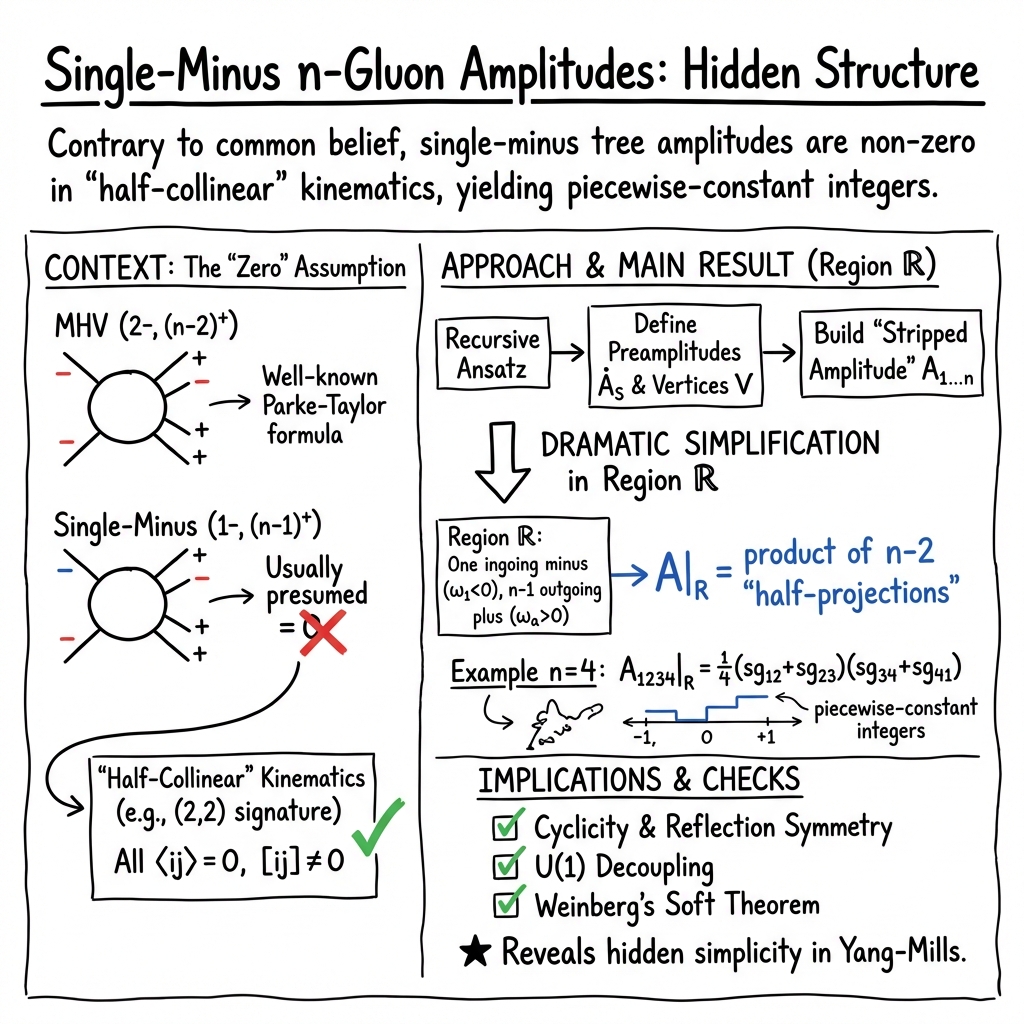
Abstract: Single-minus tree-level $n$-gluon scattering amplitudes are reconsidered. Often presumed to vanish, they are shown here to be nonvanishing for certain "half-collinear" configurations existing in Klein space or for complexified momenta. We derive a piecewise-constant closed-form expression for the decay of a single minus-helicity gluon into $n-1$ plus-helicity gluons as a function of their momenta. This formula nontrivially satisfies multiple consistency conditions including Weinberg's soft theorem.
Paper Prompts
Sign up for free to create and run prompts on this paper using GPT-5.
Top Community Prompts
Explain it Like I'm 14
Overview
This paper studies how likely certain particle collisions are in a simple version of quantum physics. The particles are gluons, which are the “force carriers” that hold quarks together inside protons and neutrons. Scientists use “scattering amplitudes” to describe the chances of different outcomes when particles crash into each other. A common belief was that a particular kind of gluon collision—where exactly one gluon has “minus” helicity and all the others have “plus” helicity—always has zero chance at the simplest level (called tree level). This paper shows that belief is not always true: under special conditions, these “single-minus” amplitudes do not vanish, and the authors even give a neat, compact formula for them in certain situations.
Key Questions
The paper focuses on two main questions:
- Can single-minus gluon amplitudes (one “minus” and the rest “plus”) be nonzero at tree level?
- If they can, can we write down a clear, simple rule (a formula) to calculate them for any number of gluons?
Methods and Approach
To keep things understandable, here’s the strategy in everyday terms:
- Explaining “helicity”: Think of helicity like the direction a tiny spinning arrow points along the particle’s motion. “Plus” and “minus” are two possible directions.
- The usual “it’s zero” argument and the loophole: There’s a standard counting trick that says single-minus amplitudes vanish. The authors show that this trick breaks down when the gluons’ directions become very special—basically lined up in a way called “half-collinear.” In this special setup (possible in a mathematical spacetime called Klein space or with complex numbers), the usual argument doesn’t apply, and the amplitude can be nonzero.
- The “half-collinear” regime: Imagine all particle directions lying on the same straight line on a special kind of geometric boundary. In that case, certain parts of the math simplify, and the amplitude can “live” there (it’s supported only in this regime).
- A step-by-step recipe (recursion): Instead of summing a huge number of diagrams, the authors use a recursive procedure (like breaking a big problem into smaller pieces and solving each piece) called the Berends–Giele recursion. It builds the amplitude from smaller “blocks” in a systematic way.
- A special kinematic region R: The authors then focus on an especially simple situation inside the half-collinear regime, called region R, where one gluon is “incoming” and the others are “outgoing” with a certain sign choice for their frequencies. In this region, the math simplifies dramatically: the final answers only depend on whether certain sums are positive or negative (like checking if a number is above or below zero), not on the exact values.
- Simple sign-based formula: In region R, the amplitude becomes a product of simple “yes/no” tests (sign functions). Each test just checks whether one quantity is larger or smaller than another. The whole amplitude is then a product of these tests, making the result a small integer (+1, 0, or −1) depending on which side of certain boundaries you’re on.
Main Findings
Here are the key results in plain language:
- Single-minus amplitudes do not vanish in the half-collinear regime. That means there are real situations where a single minus-helicity gluon can “decay” into many plus-helicity gluons with a nonzero chance at tree level.
- Piecewise-constant behavior: The amplitude is an integer that stays constant within “chambers” of the kinematic space (regions separated by boundaries). It only changes when you cross a boundary where certain combinations of the gluons’ momenta switch sign.
- A simple all-n formula in region R: The authors present a compact, closed formula for any number of gluons in region R. It’s a product of simple sign checks, each giving 0, +1, or −1, so the whole amplitude is easy to compute once you know which side of each boundary you’re on.
- Consistency checks passed: The new formula satisfies several important physics rules:
- Cyclicity (the amplitude doesn’t change if you rotate the ordering of the gluons),
- Reflection symmetry,
- U(1) decoupling and Kleiss–Kuijf relations (technical identities about how different orderings relate),
- Weinberg’s soft theorem (it behaves correctly when one gluon becomes extremely low energy).
- Verified by multiple methods: The formula was first guessed by a model (and then proved by another), checked by hand using the recursion, and tested against known identities and the soft theorem.
Why This Matters
- Rethinking what’s “allowed”: This overturns the common assumption that single-minus tree-level gluon amplitudes must vanish. It reveals new structure in how gluons interact, especially in special geometric setups.
- Simpler building blocks: Just as the famous Parke–Taylor formula simplified two-minus (“MHV”) amplitudes, this work provides a similar simplification for single-minus processes in special kinematics. Simple formulas can make big calculations much more manageable.
- Links to self-dual Yang–Mills (SDYM): SDYM is a simplified sector of the theory with deep mathematical structure. Previously, tree-level results in SDYM seemed too trivial to match the richness of its classical solutions. These single-minus amplitudes may help resolve that mismatch.
- Broader impact: The approach extends to gravity (graviton amplitudes), supersymmetric versions, and even fits into modern frameworks like celestial holography, where transforms of these amplitudes connect to special functions (Lauricella functions). All of this hints at a cleaner, deeper picture of how scattering amplitudes are organized.
In short, the paper shows single-minus gluon amplitudes do exist in special, well-defined situations, gives a clear recipe to compute them, and opens doors to simpler, more powerful ways of understanding particle interactions.
Knowledge Gaps
Knowledge gaps, limitations, and open questions
The paper makes significant progress on single-minus gluon tree amplitudes in a restricted kinematic regime but leaves several concrete issues unresolved. Future research could address:
- Extension beyond Klein signature and half-collinear support:
- Provide an explicit analytic continuation from Klein space to Minkowski signature and determine whether single-minus amplitudes remain as distributions or vanish identically in physical kinematics.
- Construct and analyze single-minus amplitudes for complexified momenta (beyond statements of belief), including the appropriate notion of “half-collinear” support in complex momentum space and its contours.
- Completeness of the amplitude outside region
R:- Deliver the promised “longer general formula” for the single-minus amplitude on the full half-collinear locus (all ⟨ij⟩=0) beyond the special kinematic region
R, including a systematic algorithm to assign chamber values and a classification of all chambers and their walls for generic n. - Characterize the combinatorics/topology of the chamber decomposition (e.g., adjacency, connectivity, and wall-crossing rules) on the celestial torus.
- Deliver the promised “longer general formula” for the single-minus amplitude on the full half-collinear locus (all ⟨ij⟩=0) beyond the special kinematic region
- Behavior on chamber walls and multi-wall intersections:
- Specify the amplitude’s definition on codimension-one walls where sign changes occur (e.g., prescriptions on
sg(0)), and at higher-codimension intersections; analyze regulator dependence, order-of-limits issues, and distributional interpretations.
- Specify the amplitude’s definition on codimension-one walls where sign changes occur (e.g., prescriptions on
- Rigor and generality of the vanishing of
Vin regionR:- Provide a complete, rigorous proof of the “weighted-variance” step ensuring at least one Θ-factor kills
Vfor all n inR, including conditions under which the argument might fail (e.g., degenerate or limiting configurations). - Clarify whether analogous vanishing statements hold in more general regions or for non-consecutive partitions.
- Provide a complete, rigorous proof of the “weighted-variance” step ensuring at least one Θ-factor kills
- Factorization and collinear limits beyond the soft theorem:
- Verify multi-particle factorization properties on on-shell poles and standard collinear limits within the half-collinear regime, and determine how residues relate to lower-point single-minus amplitudes.
- Assess compatibility with known no-go arguments (e.g., Grisaru et al.) under these constrained kinematics and complex continuations.
- Gauge and reference-spinor independence:
- Give a fully gauge-invariant derivation (independent of specific reference spinors and frames) that the final results do not depend on these choices beyond the δ-function support arguments.
- Color-algebra constraints:
- Test whether the amplitudes satisfy BCJ relations (beyond Kleiss–Kuijf and U(1) decoupling) in this degenerate kinematic sector; if not, characterize the obstruction and its implications for color-kinematics duality.
- Twistor-space interpretation:
- Make precise the support of single-minus amplitudes in twistor space (noted to be point-supported by Witten), relate the chamber structure to twistor geometry, and investigate whether the product formula admits a simple twistor-string or ambitwistor-string derivation.
- Connection to SDYM classical solutions:
- Explicitly demonstrate how single-minus tree amplitudes reconstruct nontrivial self-dual Yang–Mills classical fields (e.g., via perturbiner expansions) and clarify the resolution of the stated SDYM “puzzle.”
- Loop-level generalization and unitarity:
- Determine whether an analogue of single-minus amplitudes persists at one loop and beyond in YM/SDYM within , and how IR/UV divergences and the prescription interact with the half-collinear support.
- Analyze unitarity cuts and optical-theorem implications for piecewise-constant stripped amplitudes (±1 or 0 factors) in this kinematic regime.
- Gravitational and supersymmetric extensions:
- Provide explicit formulas for graviton and supersymmetric single-minus counterparts, verify leading and subleading soft theorems (e.g., soft graviton subleading terms), and analyze how the product structure lifts under double copy.
- Celestial holography and algebraic structures:
- Compute explicit Mellin transforms of the single-minus amplitudes (beyond “some sectors”), confirm when Lauricella functions arise, and demonstrate transformation properties under the -algebra and (including supersymmetric extensions).
- Prescription dependence and regularization:
- Assess robustness of the results to alternative propagator prescriptions in Klein signature and different normalizations of distributions; prove that final chamber assignments are prescription-independent.
- Independent derivations and compact representations:
- Explore alternative constructions (e.g., CHY integrals on the half-collinear locus, BCFW-like shifts adapted to , or ambitwistor/twistor strings) that could yield more compact or manifestly invariant expressions, possibly beyond region
R.
- Explore alternative constructions (e.g., CHY integrals on the half-collinear locus, BCFW-like shifts adapted to , or ambitwistor/twistor strings) that could yield more compact or manifestly invariant expressions, possibly beyond region
- Algorithmic and scalability aspects:
- Develop an efficient, reference-frame-invariant algorithm to evaluate
sg_{…}inputs from kinematic data{ω_i, \tilde z_i}, classify chamber membership for large n, and benchmark against Berends–Giele recursion outputs for n≫6.
- Develop an efficient, reference-frame-invariant algorithm to evaluate
- Analytic continuation and contour choices:
- Specify the analytic-continuation path(s) from Klein to Minkowski or complexified kinematics, identify which singularities are crossed, and determine whether the product formula survives or deforms under these choices.
- Other helicity sectors with constrained kinematics:
- Investigate whether analogous nontrivial amplitudes emerge for other helicity configurations (e.g., few-minus/mostly-plus) under related collinearity constraints, and whether product-form formulas generalize.
- Master identity foundations:
- Strengthen the distribution-theoretic footing of the master identity used to derive the recursion (domain of validity, boundary terms, and regularity assumptions), and explore extensions to other integrand structures.
- Normalization and dimensional analysis:
- Clarify the amplitude’s mass dimensions under the chosen polarization conventions and map to standard normalization to ensure consistent comparisons with conventional MHV amplitudes.
- Double-copy and CK duality:
- Examine whether the single-minus gluon amplitudes can be arranged to satisfy color-kinematics duality and whether their double copy yields consistent gravitational single-minus amplitudes in the same kinematic regime.
- Subleading symmetry constraints:
- Test subleading soft-gluon constraints and large-gauge-symmetry implications (e.g., celestial Ward identities) in the half-collinear setting beyond the leading Weinberg soft theorem.
Practical Applications
Immediate Applications
Below is a concise set of actionable use cases that can be deployed now, given the paper’s results, constraints, and methods.
- AI-assisted theorem discovery pipelines in theoretical physics (Software, AI/ML, Academia)
- Description: Formalize the workflow used in the paper—an LLM conjectures a closed-form amplitude; a specialized proof-assistant model or CAS verifies via recursion and consistency checks (soft theorem, KK relations, U(1) decoupling).
- Tools/products/workflows: Implement a “Conjecture–Verify” loop integrated with amplitude packages (e.g., SymPy, Mathematica, S@M/Spinney) and custom modules for Berends–Giele recursion and on-shell Parke–Taylor factors.
- Assumptions/dependencies: Requires reliable symbolic APIs and access to trusted amplitude-check routines; the result is specific to tree-level Yang–Mills and special signatures (Klein space) or complexified momenta.
- Chamber-aware unit tests for amplitude codes (Software, HEP computation, Academia)
- Description: Use the paper’s piecewise-constant single-minus amplitudes (±1, 0) in region R to build robust unit tests and debugging benchmarks for sign-function handling, iε prescriptions, and soft limits.
- Tools/products/workflows: Add “R-region test suites” to MadGraph/SHERPA/BlackHat-like environments and symbolic amplitude libraries; include automated detection of codimension-one chamber walls.
- Assumptions/dependencies: Tests are valid in half-collinear, (2,2) or complexified momentum regimes; results are color-ordered and tree-level; mapping to physical Minkowski kinematics is nontrivial.
- Educational and visualization resources for scattering amplitudes (Education, Academia, Software)
- Description: Create interactive visualizations of the chamber structure and half-collinear loci; show how sign functions and projection operators control amplitude discontinuities and soft behavior.
- Tools/products/workflows: Web apps/notebooks that animate “walls” in kinematic space; Jupyter/Observable notebooks demonstrating the master identity and LSZ reduction steps.
- Assumptions/dependencies: Depends on simplified frames (spinor-helicity in (2,2) signature); pedagogical rather than predictive for collider observables.
- Consistency-check modules for amplitude identities (Software, Academia)
- Description: Bundle routines that verify cyclicity, reflection symmetry, Kleiss–Kuijf relations, U(1) decoupling, and Weinberg’s soft theorem for single-minus amplitudes in special kinematics.
- Tools/products/workflows: “Amplitude Identity Checker” add-on for existing CAS; CI integration for research code.
- Assumptions/dependencies: Applies to color-ordered, tree-level Yang–Mills in special half-collinear or complexified regimes; generalization to loops requires further work.
- Master identity deployment in time-ordered perturbation calculations (Software, Academia)
- Description: Use the paper’s generalized master identity to simplify iε handling and delta-function algebra in time-domain perturbation computations.
- Tools/products/workflows: Numerical/analytic modules that translate energy denominators into sign/step-function products for faster evaluation of specific classes of tree-level diagrams.
- Assumptions/dependencies: Most effective in controlled regimes (tree-level, structured partitions); extrapolation to loop integrals is nontrivial.
- Self-Dual Yang–Mills (SDYM) diagnostics (Academia)
- Description: Apply the nontrivial single-minus tree amplitudes to probe and reconcile the tension between SDYM’s rich classical solution space and previously presumed trivial scattering sector.
- Tools/products/workflows: Construct SDYM form-factor tests and solution-matching benchmarks; compare with twistor methods.
- Assumptions/dependencies: SDYM sector; tree-level equivalence to classical solutions assumed; relies on half-collinear support and specialized polarizations.
Long-Term Applications
The following use cases require further research, scaling, or development to be practical or impactful beyond specialized settings.
- Improved event-generation and resummation in collider physics via new amplitude structures (HEP, Software)
- Description: Integrate half-collinear single-minus sectors and related identities into event generators and resummation frameworks to reduce computational overhead in specific kinematic regions.
- Potential outcomes: Faster sampling over specialized phase-space boundaries; more stable handling of soft/collinear singularities.
- Assumptions/dependencies: Needs robust analytic continuation from (2,2) or complex momenta to physical Minkowski space; extension beyond tree-level; validation against data.
- Gravitational analogs and classical GR observables (Astrophysics, Gravity, Academia)
- Description: Extend the construction to graviton amplitudes; explore whether simplified single-minus-like structures help compute classical observables (e.g., radiation fields, post-Minkowskian expansions).
- Potential outcomes: Streamlined computation of tree-level gravitational scattering pieces used in waveform modeling or scattering-based derivations in GR.
- Assumptions/dependencies: Mapping special kinematics to physically relevant regimes; beyond-tree loop corrections; careful handling of signatures and reference frames.
- Celestial holography toolkits and Mellin-space amplitude libraries (Academia, Software)
- Description: Build libraries that produce Mellin transforms of special sectors (e.g., giving Lauricella functions) to automate celestial amplitude computations and symmetry analyses.
- Potential outcomes: Standardized celestial basis representations; automated symmetry actions from S-algebra and w1+∞.
- Assumptions/dependencies: Requires systematic cataloging beyond region R; stable numeric Mellin libraries; deep symmetry infrastructure.
- New bases/variables for full Yang–Mills simplification (Academia, Software)
- Description: Leverage insights from piecewise-constant single-minus amplitudes to seek global bases or analytic continuations that simplify more general amplitudes beyond the restricted decay channel.
- Potential outcomes: Reduced complexity in multi-leg tree amplitudes; potential handles on loop-level structures.
- Assumptions/dependencies: Discovery of suitable analytic continuations/coordinates; extension of master identities; proof of equivalence to standard S-matrix results.
- AI governance and strategy for symbolic scientific discovery (Policy, Academia, Industry)
- Description: Develop best practices, benchmarks, and governance frameworks for LLM-driven conjecture-and-proof workflows demonstrated in the paper (GPT-5.2 Pro conjecture; internal model proof).
- Potential outcomes: Funding and standards for AI-in-the-loop research; reproducibility protocols; shared datasets/models for amplitude discovery.
- Assumptions/dependencies: Community agreement on evaluation standards; reliable model access; integration with formal proof systems.
- Formal verification of amplitude computations (Software, Academia)
- Description: Combine recursion relations, master identities, and soft-theorem checkers with proof assistants (Lean/Isabelle/Coq) for verifiable amplitude derivations.
- Potential outcomes: Auditable pipelines for key results in quantum field theory; reusable certified libraries for amplitudes.
- Assumptions/dependencies: Encoding of spinor-helicity and distributional calculus into proof frameworks; scalable automation for nontrivial partitions.
- Cross-domain mathematical identity discovery (Software, Finance/Engineering, Academia)
- Description: Adapt the master-identity and partition-based derivation methods to other domains where sign/step-function decompositions and piecewise structures matter (e.g., risk modeling with regime switches, control systems with discontinuities).
- Potential outcomes: Faster computation of piecewise models; improved stability in systems with threshold behaviors.
- Assumptions/dependencies: Transferability of identities to domain-specific measure-theoretic setups; appropriate analogs of the iε prescription and distribution handling.
- Enhanced pedagogy for advanced QFT and amplitudes (Education, Academia)
- Description: Develop curricula/modules using the paper’s recursion and chamber decomposition to teach modern amplitude methods, twistor insights, and celestial holography.
- Potential outcomes: Training resources for next-generation researchers; standardization of teaching materials with interactive computation.
- Assumptions/dependencies: Institutional adoption; further examples beyond region R; integration with CAS and visualization platforms.
Glossary
- Berends–Giele recursion: A recursive relation for off‑shell currents that generates tree‑level gauge‑theory amplitudes. "Berends--Giele recursion"
- celestial holography: A framework relating 4D scattering amplitudes to 2D conformal correlators on a celestial manifold. "In the context of celestial holography, the Mellin transform of the amplitudes in some sectors is given by Lauricella functions."
- celestial torus: The toroidal boundary manifold (in (2,2) signature) on which celestial kinematics are organized. "a one-dimensional null circle on the celestial torus at the boundary of Klein space."
- color-ordered amplitude: A gauge-theory amplitude with color factors stripped and a fixed cyclic ordering of external legs. "color-ordered tree amplitude"
- Feynman propagator: The standard causal Green’s function with the +iε prescription used in perturbation theory. "Throughout this paper, we use the standard Feynman propagator ."
- half-collinear regime: A kinematic locus where all angle brackets vanish while square brackets remain nonzero in (2,2) signature. "The kinematic locus we call the half-collinear regime is defined by"
- iε prescription: The infinitesimal imaginary shift that specifies contour deformation and causal boundary conditions in propagators. "we have to be careful about the prescription."
- Klein signature: The (2,2) spacetime signature used here, allowing real spinor variables with independent angle and square brackets. "real spinors in Klein signature."
- Klein space: Spacetime with (2,2) signature, sometimes denoted R{2,2}, used for analytic properties of amplitudes. "existing in Klein space"
- Kleiss–Kuijf relations: Linear relations among color‑ordered tree amplitudes that reduce the number of independent orderings. "Kleiss--Kuijf"
- Lauricella functions: A class of multivariate hypergeometric functions that can represent Mellin‑transformed amplitudes. "Lauricella functions."
- little group: The subgroup of the Lorentz group that leaves a null momentum invariant and governs helicity scaling. "little-group scaling"
- LSZ reduction: The procedure relating time‑ordered correlators (or form factors) to S‑matrix amplitudes by amputation and on‑shell limits. "LSZ reduction procedure"
- maximally helicity violating (MHV): Amplitudes with two negative‑helicity and the rest positive‑helicity gluons that admit compact formulas. "MHV (maximally helicity violating) tree amplitudes"
- Mellin transform: An integral transform mapping energy dependence of amplitudes to conformal dimensions in celestial setups. "the Mellin transform of the amplitudes"
- off-shell: Refers to states with momentum not satisfying the mass‑shell condition, used internally in recursion/form factors. "off-shell current"
- on-shell: Refers to external states satisfying the mass‑shell condition (e.g., p2=0 for massless particles). "on-shell Parke--Taylor"
- open chain Parke–Taylor factor: The “incomplete” Parke–Taylor product appearing when one leg is off‑shell and the cyclic product is opened. "open chain Parke-Taylor factor"
- Parke–Taylor factor: The product of inverse kinematic invariants that appears in compact MHV amplitude formulas. "Parke-Taylor factor"
- preamplitude: An auxiliary building block in the recursion that assembles into the stripped amplitude via vertex rules. "preamplitude"
- reference spinors: Auxiliary spinors used to define polarization vectors in spinor‑helicity gauge choices. "reference spinors"
- S-algebra: A symmetry algebra (arising in celestial contexts) under which the constructed amplitudes are expected to transform. "the -algebra"
- Self-dual Yang–Mills (SDYM): The sector of Yang–Mills with self‑dual field strength, admitting integrable structures and special amplitudes. "Self-dual Yang--Mills theory (SDYM)"
- single-minus amplitude: An amplitude with one negative‑helicity gluon and the rest positive, studied here at tree level. "Single-minus tree-level -gluon scattering amplitudes"
- soft theorem (Weinberg’s soft theorem): A universal factorization describing the behavior of amplitudes when a particle’s momentum becomes soft. "Weinberg's soft theorem."
- spinor-helicity variables: A representation of massless momenta in terms of two-component spinors that simplifies helicity amplitudes. "spinor-helicity variables"
- stripped amplitude: The kinematics‑only part of an amplitude after removing universal delta functions and helicity factors. "stripped amplitude"
- time-ordered perturbation theory: A formulation of perturbation theory organizing contributions by time orderings, used here for identities. "time-ordered perturbation theory"
- twistor space: A geometric space where certain amplitudes localize (e.g., MHV or single-minus) and simplify. "twistor space"
- U(1) decoupling identities: Identities implying that abelian generators decouple from nonabelian color‑ordered amplitudes. " decoupling identities"
- w_{1+∞} algebra: An infinite‑dimensional symmetry algebra expected to act on celestial amplitude data. "the algebra"
- Yang–Mills theory: The nonabelian gauge theory of gluons underlying QCD and the amplitudes studied here. "Yang--Mills theory"
Collections
Sign up for free to add this paper to one or more collections.