- The paper demonstrates that infinitesimal perturbations (~10^-40) in smooth initial conditions can result in entirely different turbulent states.
- It employs high-precision Clean Numerical Simulation with a 1024×1024 Fourier grid to rigorously eliminate numerical artifacts.
- The findings challenge classical views on solution uniqueness in fluid dynamics and have major implications for turbulence predictability.
Non-Uniqueness of Smooth Navier-Stokes Solutions from Near-Identical Initial Data
Introduction
This paper addresses the uniqueness of smooth solutions to the Navier-Stokes (NS) equations—a pivotal open problem in mathematical fluid dynamics. Focusing on two-dimensional incompressible Kolmogorov flow, the authors leverage Clean Numerical Simulation (CNS) to deliver numerical evidence that the NS equations can generate distinct global solutions from almost indistinguishable initial conditions. Specifically, the distinction in initial data is reduced to orders as small as 10−40, yet yields fundamentally different turbulent dynamics, symmetry breaking, and statistical properties. These findings challenge conventional expectations regarding the uniqueness of NS solutions for smooth, finite-energy initial data and bear directly on the Millennium Prize Problem.
Methodology and Numerical Framework
The study utilizes the 2D NS equations in stream function formulation under Kolmogorov forcing, subject to periodic boundary conditions. To rigorously evaluate sensitivity to initial data, two classes of initial conditions are employed:
- ψ1(x,y,0) features maximal symmetry under rotation and translation.
- ψ2(x,y,0)=ψ1(x,y,0)+δsin(x+y) perturbs only the translation symmetry, where δ is as small as 10−10, 10−20, or 10−40.
CNS—implementing multiple-precision arithmetic and high-order temporal Taylor expansion—is employed to eliminate numerical artifacts that typically contaminate trajectories in chaotic, turbulence-resolving simulations. The settings include a 1024×1024 Fourier pseudospectral grid, adaptive time stepping, and precision parameters elevated up to 260 significant digits. This methodology ensures that computational error remains rigorously negligible over extended intervals (t∈[0,300]), a regime sufficient for robust statistical analysis.
Non-Uniqueness from Minimal Data Perturbations
The simulations reveal that vanishingly small perturbations in the initial condition prompt significant divergence in flow dynamics after sufficient evolution time. Despite indistinguishable early behavior, the perturbed solutions (Flows CNS1′, CNS2′, CNS3′) depart from the reference (Flow CNS), breaking the additional rotation symmetry and converging to statistically distinct turbulent states.
The time history of the spatially averaged kinetic energy dissipation rate, ⟨D⟩A, exhibits notable bifurcation across trajectories stemming from nearly identical initial conditions. For t>100, the unperturbed Flow CNS can yield mean dissipation almost twice as high as the perturbed solutions.
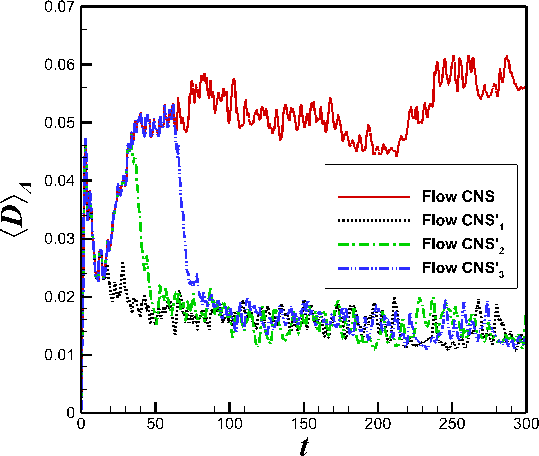
Figure 1: Time evolution of spatially averaged kinetic energy dissipation rate ⟨D⟩A showing marked separation between solutions that originate from initial data differing by as little as 10−40.
Further evidence of solution disparity is furnished by the vorticity fields at t=200. The symmetry group of the initial conditions is manifest in the late-time state: the base flow preserves both rotation and translation symmetries, while the minimally perturbed flows preserve only translation symmetry. The vorticity fields display clear qualitative as well as quantitative divergence, confirming distinct flow realizations.
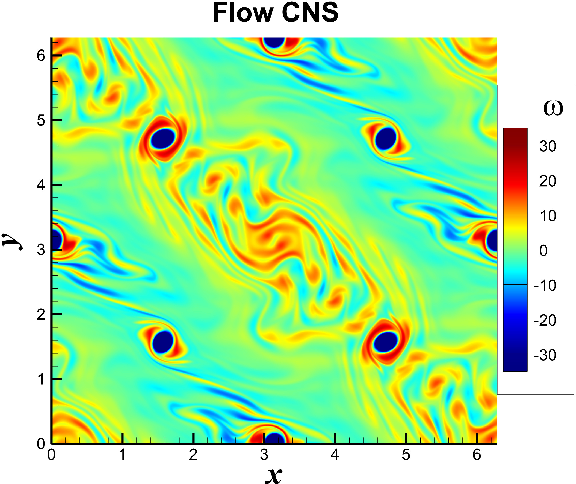
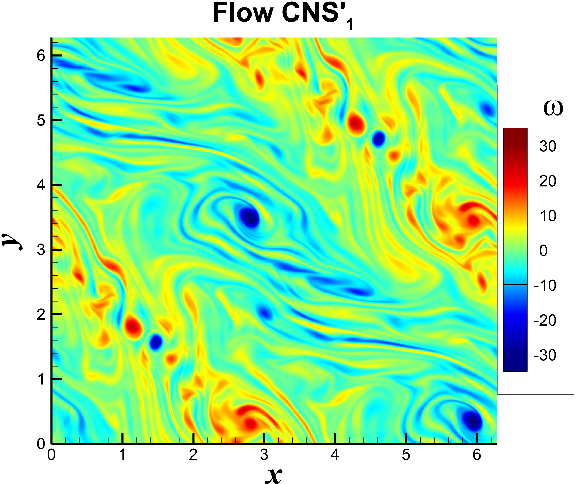
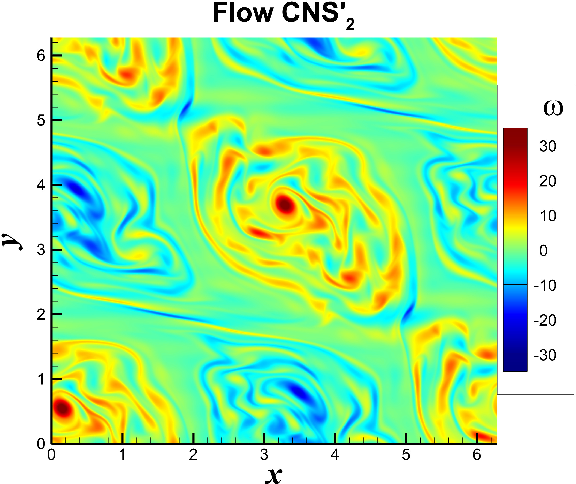
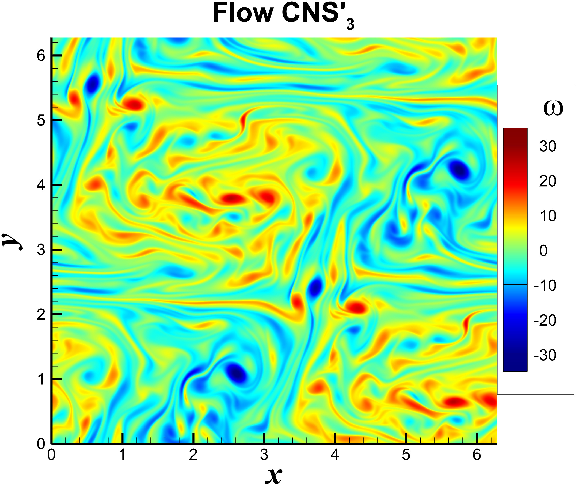
Figure 2: Vorticity fields ω(x,y) at t=200, contrasting the symmetry and structure for flows from almost identical initial data.
Statistical differences are additionally established through kinetic energy dissipation rate PDFs and spatial-temporal means. The distributions and profiles for the perturbed and unperturbed cases are disjoint, signifying that the long-time statistical state is not uniquely determined by the initial condition; rather, it is qualitatively altered by an infinitesimal perturbation.
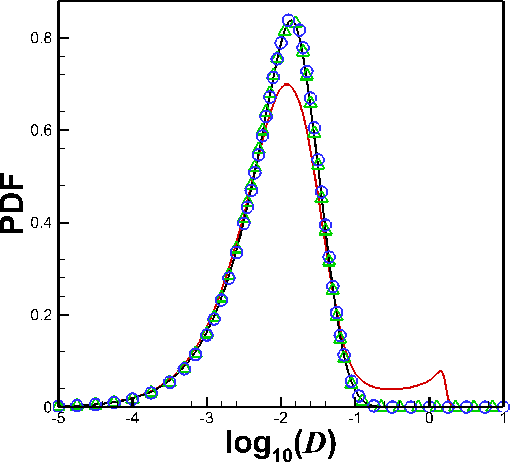
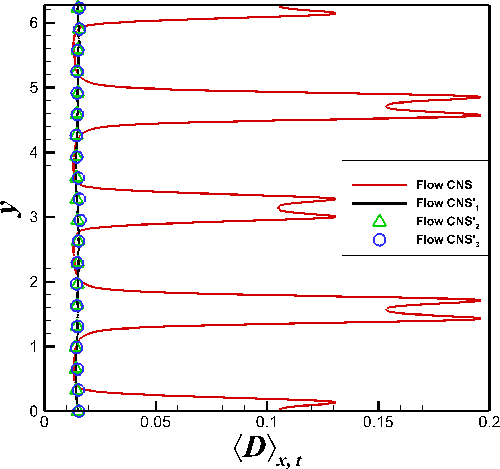
Figure 3: Comparison of (a) PDFs of local dissipation rate D(x,y,t) and (b) spatio-temporally averaged dissipation ⟨D⟩x,t(y), demonstrating statistical non-uniqueness stemming from micro-level initial differences.
Theoretical and Practical Implications
These results demonstrate that the NS equations, even for smooth initial data of finite energy and under numerical noise below physical relevance, can evolve to multiple, mutually exclusive solution trajectories. The study’s explicit computation yields strong numerical counter-examples to smooth uniqueness, complementing recent rigorous analytical constructs for critical Besov space initial data with infinite energy (BMO−1).
From the perspective of dynamical systems, the findings resonate with the presence of noise-expansion cascades and sensitive dependence on symmetry structure in turbulence. They also raise critical questions regarding the nature of attractor selection in high-dimensional NS dynamics and the operational meaning of predictability in turbulence modeling and simulation, especially given that high-fidelity DNS is intrinsically limited by computational noise—except when super-exponential elimination of such artifacts is ensured, as in CNS.
Practically, this signifies that—even absent numerical artifacts—predictability of macroscopic features (such as mean dissipation or large-scale vorticity structure) cannot be warranted for extended times, and that turbulence statistics derived from NS equations may not be uniquely determined by arbitrarily precise initial conditions. This has direct implications for both theoretical investigations of the Millennium Prize Problem and for the interpretation and reliability of computational experiments in turbulence.
Speculation on Future Developments
This numerical evidence suggests that uniqueness may fail for smooth, finite-energy solutions of NS at arbitrarily small perturbations—possibly signaling that the set of initial conditions leading to solution multiplicity is not just pathological or measure zero but generically accessible in practical settings. This may drive efforts to rigorously classify the bifurcation structure of the NS initial value problem and could motivate a generalized framework for statistical solution concepts beyond deterministic uniqueness.
From an applied perspective, these results challenge the traditional approach to turbulence quantification in climate, oceanographic, and engineering contexts, and suggest the need for probabilistic (ensemble or measure-valued) descriptions even when the governing equations and numerical algorithms are maximally precise.
Conclusion
By employing CNS to eliminate all significant numerical artifacts, the authors establish that the NS equations, under periodic Kolmogorov forcing, admit distinct smooth, global-in-time solutions from initial conditions differing by less than 10−40 in norm. The resultant flows diverge both dynamically and statistically on all relevant physical measures, including mean dissipation rate, vorticity field symmetry, and distributional properties. This work presents robust numerical evidence of non-uniqueness for the classical NS problem with finite-energy data and opens fundamental questions for both mathematical theory and simulation practice in fluid dynamics.