Hidden Risks and Optionalities in American Options
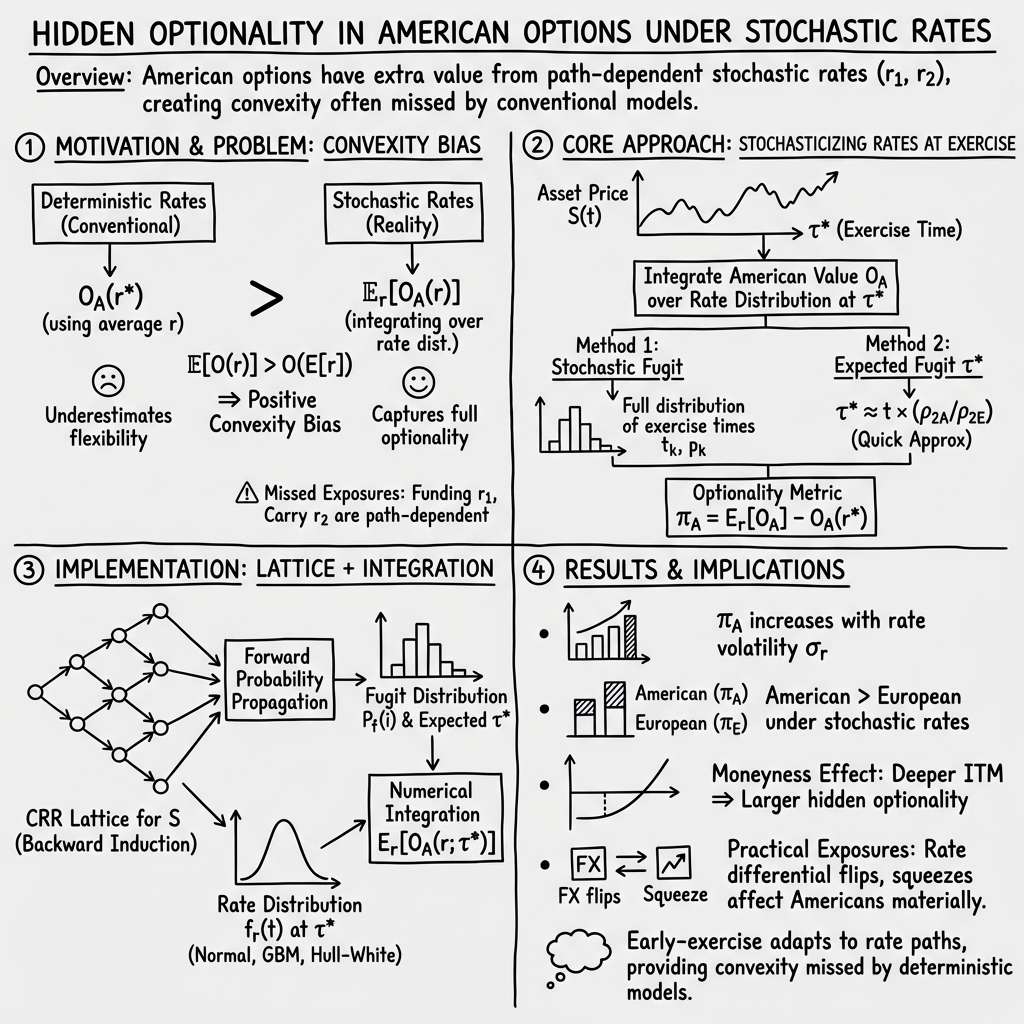
Abstract: We develop a practical framework for identifying and quantifying the hidden layers of risks and optionality embedded in American options by introducing stochasticity into one or more of their underlying determinants. The heuristic approach remedies the problems of conventional pricing systems, which treat some key inputs deterministically, hence systematically underestimate the flexibility and convexity inherent in early-exercise features.
Paper Prompts
Sign up for free to create and run prompts on this paper using GPT-5.
Top Community Prompts
Explain it Like I'm 14
Overview
This paper looks at a common type of financial contract called an “American option.” An American option is special because you can choose to use it early, not just at the end. The authors show that most standard pricing tools miss important “hidden” benefits and risks that come from this early-use feature—especially when interest rates (the cost of borrowing money) can change over time. They build a practical way to include that randomness, so we can see the true value and risks more clearly.
Key Questions
To make the topic easier, here are the main questions the paper asks in simple terms:
- Do standard models underestimate the extra flexibility of American options?
- What happens to American option values when interest rates (and dividends/foreign interest) are not fixed but can wiggle up and down?
- How can we measure the “hidden optionality” (extra built-in advantages) that American options have?
- Can we build a simple, workable method that risk managers and traders can use?
How the researchers approached it
Think of an option like a voucher with a deadline. A European option is a voucher you can only use on the final day. An American option is a voucher you can use any day up to the final day. That “use-anytime” flexibility has value, but most models only treat the stock price as random and keep other inputs (like interest rates) fixed. That leaves out a lot.
Here’s the simple idea they use:
- Interest rates and dividends/foreign interest ( and ) are allowed to move randomly, not just the stock price .
- Because American options can be used early, the best time to use them depends on how these rates move. So the option’s value reacts in a curved (nonlinear) way to those inputs—this is called convexity. Curves behave differently than straight lines: if inputs bounce around, a curved response can push the average result up or down compared to plugging in a single “average” input.
- They measure the “convexity bias”: the difference between 1) averaging the option’s value across many possible interest-rate paths, and 2) valuing the option once using only the average interest rate. If the option’s value responds nonlinearly, those two answers won’t match, and the gap is the hidden optionality.
To handle early exercise, they use a practical shortcut called the “fugit”:
- The fugit is the “effective time-to-exercise.” It’s like asking: “On average, when will I likely use my American option?” Not in calendar time, but in “discounted” time that accounts for interest rates.
- With that expected exercise time in hand, they take the American option’s price (computed with standard tools like a binomial tree) and integrate it over a realistic distribution of interest rates at that time.
- They also use the full distribution of possible exercise times, not just the average, to keep the time-based convexity.
They test this idea with computer simulations:
- Use binomial lattices (a standard grid method) that handle early exercise properly.
- Plug in different interest-rate models: normal “random walk” (Bachelier), mean-reverting (Vasicek/Hull–White), and lognormal (rates that grow proportionally).
- Numerically average the option’s value over those interest-rate distributions at the likely exercise times.
Analogy: Imagine you’re planning a picnic (exercising the option) and the weather (interest rates) is random. A European picnic forces you to go only on the last day, rain or shine. An American picnic lets you go on any day. If forecasts change a lot, having flexibility is extra valuable because you can pick the sunny day. Their method quantifies that extra value.
What they found and why it matters
Main findings in plain language:
- American options are more valuable than European options when interest rates or dividends/foreign rates can swing around, because you can choose to act when conditions are favorable.
- The “extra value” from that flexibility grows as rate uncertainty grows. In other words, the more rates wiggle, the more hidden optionality you have.
- If you price an American option using just an average rate, you usually underestimate its true value. Averaging over the whole distribution of possible rates at the likely exercise time gives a higher, more realistic value.
- This pattern holds across different kinds of options (equity puts, currency puts, currency calls) and across different interest-rate models (normal, lognormal, Hull–White).
- The “moneyness” matters: deeper in-the-money options (ones where exercising looks good right now) tend to have stronger hidden optionality because early exercise is more likely and more sensitive to rate moves.
- The shape of the yield curve (how rates differ across dates) also matters. If there are “kinks” or spikes at certain times, an American option can lock in value at those moments, while a European option cannot.
- In head-to-head comparisons under random rates, American options consistently came out less vulnerable to bad rate swings than European options.
Why it matters:
- Many trading desks and risk systems treat key inputs as fixed and ignore early exercise under changing rates. That can lead to painful surprises, mispricings, and bad hedging.
- The early-exercise feature is not just a convenience—it is a real, quantifiable source of protection and opportunity that should be priced and managed.
Short real-world examples from the paper
The authors share three practical stories:
- Currency interest-rate flip: Traders priced American and European currency options as if early exercise didn’t matter. When interest-rate differences flipped direction, the values diverged. American calls had hidden optionality that standard systems missed, leading to losses.
- Stock squeeze: A trading desk was short a stock that suddenly became hard to find. Because they held American calls, they could exercise early to get the stock and avoid very large losses. If those had been European calls, they could not exercise early.
- Equity index squeeze: During market stress, carrying positions became expensive, and options with long maturities were oddly discounted. American-style rights helped cap how bad mark-to-market could get; European-style did not.
Implications and potential impact
- Better pricing and risk management: If you manage money or set up hedges, you should treat interest rates (and dividend/foreign rates) as random and account for early exercise properly. Otherwise, you will undervalue American options and under-hedge your risk.
- Scenario-based thinking: Because the response is nonlinear (convex), precise point estimates matter less than exploring realistic scenarios. The fugit-based method is practical and informative even if you don’t build heavy multi-factor models.
- Policy and systems design: Banks, funds, and software tools should update their models to include these effects. This helps avoid “hidden fragility” when market conditions change suddenly.
- General lesson: Flexibility (the option to act early) is powerful when the world is uncertain. If your model treats uncertain inputs as fixed, it will miss that power—and misprice it.
In short, the paper shows that American options have extra “built-in insurance” against changing interest rates, and it provides a straightforward way to measure and manage that advantage.
Knowledge Gaps
Knowledge gaps, limitations, and open questions
The paper proposes fugit-based heuristics and rate-stochastic integrations to surface hidden optionality in American options. The following unresolved items identify what remains missing, uncertain, or unexplored, and suggest concrete directions for future work:
- Benchmarking against multi-factor “ground truth”: Quantitatively validate the fugit-based integration against full two-factor (or multi-factor) American pricers (e.g., PDE/free-boundary methods, least-squares Monte Carlo with stochastic rates and correlated underlying). Map the bias and variance of the heuristic across moneyness, maturity, volatility, and rate parameters.
- Correlation structures: Systematically study how correlation between the underlying and rates (S–r1, S–r2), and between r1 and r2, affects pricing, the exercise boundary, and the magnitude of hidden optionality. Provide calibrated empirical estimates and sensitivity analyses.
- Full fugit distribution vs expected fugit: Most numerical implementations rely on the expected fugit τ. Implement and compare the integration over the full fugit distribution (as conceptually outlined) to assess time convexity effects; quantify when using τ materially misstates price and Greeks.
- Rate-model calibration and measure consistency: Move beyond moment-matching of mean/variance at maturity; calibrate Vasicek/Hull–White (or HJM) models to the observed term structure, under a consistent risk-neutral measure and numeraire choice. Explicitly specify market prices of risk and drift adjustments to ensure coherence between S and rate dynamics.
- Early-exercise boundary characterization under stochastic rates: Derive or numerically estimate the free boundary when rates are stochastic (single and two-rate cases). Provide comparative statics (monotonicity with σ_r, mean-reversion κ, and correlations) and practical exercise rules.
- Analytical bounds and monotonicity proofs: Establish rigorous upper/lower bounds for the American–European price gap with stochastic rates and prove (or characterize conditions for) the observed monotonic increase of “extra optionality” with rate volatility. Identify potential counterexamples.
- Numerical error and convergence: Quantify discretization and quadrature errors (lattice step n=2000, quadrature order, time discretization), report convergence rates, and provide confidence intervals for π_A. Assess robustness to grid choices and algorithmic parameters.
- Two-rate integration with correlation: Implement the proposed double integration with correlated r1 and r2. Evaluate computational tractability, accuracy, and the incremental optionality attributable to joint stochasticity relative to single-rate models.
- Term-structure curvature and transient carry peaks: Replace single-terminal-rate approximations with full, dynamic yield curves. Use short-rate/HJM frameworks to quantify the value captured by early exercise at curve “kinks.” Provide case studies showing when the American premium becomes economically material.
- Data calibration and out-of-sample validation: Calibrate models to real American option markets (equities with dividends, FX, commodities) and evaluate out-of-sample pricing errors versus standard pricers. The current reliance on a short recent 1-year Treasury sample (Jan 2022–Mar 2025) is insufficient for regime diversity.
- Funding, margin, and liquidity constraints: Formally model funding spreads, margining (futures-style settlement), borrow availability, and liquidity squeezes as stochastic processes and embed them in valuation/exercise decisions. Quantify their impact on hidden optionality and PnL protection.
- Dividends and foreign rates as stochastic processes with jumps: Treat r2 and dividends as stochastic (including discrete announcements/jumps/regime shifts). Assess how discrete dividend uncertainty alters early exercise and the American premium; include jump-diffusion or regime-switching models.
- Hedging implications and fugit-weighted Greeks: Derive and test Greeks (delta, rho, theta, vega) under stochastic rates with fugit-weighted exposures and provide practical guidance for allocating forward delta across the curve. Compare hedging error versus conventional terminal-forward-based practice.
- Extensions to stochastic volatility and basis dynamics: Add stochastic volatility and futures basis dynamics to quantify higher-order convexities and interactions with rate stochasticity. Measure the incremental contribution of each factor to π_A.
- Negative rates, rate floors/caps: Address modeling under negative rates, floors/caps, and lognormal constraints. Examine how these features alter the hidden optionality and feasibility of the proposed distributions.
- Exercise-time estimation methods: Compare the lattice-based fugit pmf computation to alternatives (LSMC exercise-time histograms, PDE hitting-time approximations). Analyze biases, convergence, and computational efficiency.
- Generality across maturities, moneyness, and vol: Expand the parameter sweep beyond 1-year maturity and a single high vol (40%). Identify regions (maturity/strike/vol) where hidden optionality is negligible or dominant, and provide practical decision thresholds.
- Closed-form or semi-analytic approximations: Develop tractable approximations (e.g., perturbation or convexity corrections) for the American premium under stochastic rates to enable rapid desk-level adjustments without full integrations.
- Liquidity-adjusted valuation: Incorporate transaction costs, bid–ask spreads, execution delays, and capital constraints into the valuation to determine whether π_A is tradable or merely offsets frictions.
- Market implementation and reproducibility: Release code, datasets, and parameterization details for the fugit pmf algorithm and rate integrations. Standardize inputs (curve, vol surface, correlations) to facilitate peer verification and adoption.
- Practical decision rules: Translate findings into implementable desk policies (e.g., early-exercise triggers under rate volatility, hedging allocation rules, stress test scenarios) and evaluate their performance in live or simulated environments.
- Impact of regime shifts and crises: Quantify hidden optionality during rate differential flips, funding squeezes, and crisis regimes. Backtest regime-switching/jump-to-default scenarios using historical episodes (e.g., 1987, 1998–1999, currency crises).
- Calibration of rate–FX/equity correlations: Empirically estimate and incorporate realistic S–r correlations for FX and equities; evaluate their effects on early exercise and pricing errors relative to independence assumptions.
- Bermudan and path-dependent exotics: Extend analysis to Bermudans, barriers, callable/putable bonds, and futures-style options where termination interacts with rate paths. Determine whether the heuristics generalize or require bespoke treatments.
- Formal treatment of the Omega heuristic: Provide a rigorous derivation, dimensional analysis, and error bounds for the Ω-based stopping-time approximation (ratio of rhos). Identify conditions under which it is accurate or fails.
- Risk metrics beyond pricing: Design scenario-based metrics (e.g., convexity VaR, stress tests) focused on hidden optionality and model fragility due to rate uncertainty, enabling better portfolio-level risk governance.
Glossary
- American option: An option contract that allows exercise at any time up to expiration. "American options differ from their European counterparts in allowing early exercise."
- Arbitrage-free trade: A trade that should yield no riskless profit under correct pricing. "executing an arbitrage-free trade"
- Bachelier process: A normal (additive) diffusion model for a variable such as an interest rate. "it follows a Bachelier process"
- Barrier option: A path-dependent option that activates or extinguishes when the underlying hits a level. "resembles that of a barrier option with an uncertain trigger"
- Bermudan exercise: Exercise rights at discrete times before expiry (between American and European). "from a Bermudan exercise histogram"
- Binomial lattice: A discrete-time recombining tree used to price options via backward induction. "The binomial lattice is used to compute the American option price"
- Carry: The net yield from holding an asset, often reflected as a rate like dividends or foreign rate. "r_2 the ``carry'' of the underlying"
- Continuation value: The expected discounted value of continuing (not exercising) an option at a node. "the continuation value is given by"
- Convexity: Curvature of the payoff or value with respect to inputs, amplifying effects of uncertainty. "underestimate the flexibility and convexity inherent in early-exercise features."
- Convexity bias: The valuation bias arising when convexity and parameter uncertainty interact. "The convexity bias becomes"
- Cox–Ross–Rubinstein (CRR) parameters: The up/down multipliers and risk-neutral probability in the CRR binomial model. "Construct the CRR parameters , , and "
- Delta (hedge ratio): Sensitivity of option value to the underlying; ratio used to hedge. "short the corresponding delta amount (hedge ratio)"
- Domestic rate: The local (funding) interest rate in a currency pair context. "only the domestic rate increases to 10\%"
- Early exercise: Exercising an option before its maturity date. "allowing early exercise."
- Equivalent martingale measure: The risk-neutral probability measure under which discounted asset prices are martingales. "the risk-neutral (equivalent martingale) measure."
- Finite-difference method: A grid-based numerical scheme for solving PDEs in option pricing. "binomial, finite-difference, or least-squares Monte Carlo"
- Forward (price): The agreed future price for an asset, often expressed via spot and carry. "the forward "
- Forward curve: The set of forward prices across maturities. "point on the forward curve"
- Forward delta exposure: Sensitivity of an option position with respect to forward rather than spot. "forward delta exposure"
- Fragility to model error: Susceptibility of valuations to parameter/model misspecification, often worsened by convexity. "Fragility to model error has been mapped in terms of convexity"
- Fugit: The (risk-neutral) expected discounted time to optimal exercise for an American option. "the fugit is defined as"
- Gauss–Hermite quadrature: A numerical integration technique for expectations under normal distributions. "the Gauss-Hermite quadrature"
- Geometric Brownian motion: A lognormal (multiplicative) diffusion model commonly used for prices or rates. "under a local rate following Geometric Brownian motion"
- Hedge horizon: The (uncertain) time period over which a hedge will be required. "uncertainty of the hedge horizon"
- Hull–White model: An interest-rate model with mean reversion (extended Vasicek). "under a Hull-White distributed local interest rate"
- Interest rate differential: The difference between two interest rates (e.g., domestic minus foreign). "volatility in the rate differential would amplify the hidden optionality"
- Intrinsic value: The immediate exercise value of an option. "below their intrinsic value relative to the forward"
- Jump (in financing rate): A discontinuous change in the funding rate used in modeling shocks. "modeled with a jump in the financing rate."
- Least-squares Monte Carlo: A regression-based Monte Carlo method to handle early exercise. "least-squares Monte Carlo"
- Liquidity constraints: Limits on funding/market capacity that impede trades or hedging. "model error, and liquidity constraints."
- Lognormally distributed rate: A rate modeled as lognormal, implying multiplicative random changes. "a lognormally distributed local interest rate"
- Mark-to-market: Valuing positions at current market prices. "mark-to-market values diverged dramatically."
- Mark-to-model: Valuing positions using a model’s outputs rather than observable prices. "mark-to-model valuations appeared profitable"
- Moneyness: The relative position of the underlying to the strike (e.g., S/K) indicating ITM/ATM/OTM. "adjusts automatically to the option's moneyness."
- Moment matching: Choosing model parameters so moments (mean/variance) match target values. "obtained by moment matching"
- Monte Carlo methods: Simulation-based numerical methods for pricing and risk. "conventional Monte Carlo methods are ill-suited"
- Path dependence: When an option’s value depends on the history of the underlying, not just the terminal value. "Owing to the path dependence of American options"
- Partial differential equation (PDE): The differential equation governing option prices under continuous models. "PDE"
- Recombining lattice: A tree where states merge, reducing computational complexity. "Build the recombining stock-price lattice"
- Rho (Greek): Sensitivity of option value to interest rate changes. '"Rhos", the sensitivities of the American and European options to changes in the underlying nominal carry yield.'
- Risk-neutral dynamics: The evolution of variables under the risk-neutral measure used for pricing. "according to the risk--neutral dynamics"
- Risk-neutral measure: The probability measure under which expected discounted payoffs yield fair prices. "the risk-neutral probability measure"
- Short-rate dynamics: Models describing the evolution of instantaneous interest rates. "canonical short-rate dynamics"
- Stochastic fugit: The full distribution of exercise times for an American option. "The Stochastic Fugit: Distribution of Exercise Times"
- Stochasticity: Treating a parameter or variable as random rather than fixed. "introducing stochasticity into one or more of their underlying determinants."
- Stopping time: A random time determined by the evolution of a process (e.g., optimal exercise time). "the set of all stopping times"
- Synthetic carry: The effective carry realized via financing or derivatives rather than cash holdings. "transient peaks in synthetic carry."
- Term structure: The schedule of rates/prices as a function of time to maturity. "non-flat term structure"
- Two-factor PDE: A pricing PDE involving two stochastic drivers (e.g., underlying and rate). "full two-factor PDE."
- Vasicek model: A mean-reverting short-rate model with normally distributed rates. "Vasicek / Hull--White world."
- Yield curve: The curve of interest rates across maturities. "When the yield curve contains inflection points"
Practical Applications
Immediate Applications
Below are actionable use cases that can be deployed with existing models and systems by extending current pricing, risk, and workflow practices.
- Upgrade American-option pricers with fugit-weighted rate stochasticity
- Sectors: Finance (sell-side and buy-side trading desks), Software vendors
- Action: Integrate the paper’s “fugit-weighted integration” to price American options by averaging deterministic-rate prices over the distribution of funding/carry rates at the expected stopping time
τ*(or a discrete distribution of exercise times). - Tools/workflow: Add a fugit computation to existing binomial/FD grids; perform Gauss-Hermite quadrature (or similar) over the short-rate distribution (e.g., Bachelier, Hull–White, lognormal); output the convexity bias
π_Aas a model-risk metric. - Assumptions/dependencies: Short-rate model choice and calibration; availability of robust deterministic American pricing; acceptance that this is a first-order, risk-focused heuristic (not an exact two-factor PDE solution).
- Add carry-path stress tests for American options
- Sectors: Finance (risk management, market risk), Policy (supervisors conducting stress tests)
- Action: Run scenario analyses where
r1,r2, and their differential flip sign, steepen/flatten, or experience volatility spikes; compare valuations when rates are treated deterministically vs stochastically to quantify hidden optionality. - Tools/workflow: Extend existing stress engines with stochastic rate distributions at
τ*; reportπ_Aas a “convexity-to-carry” exposure. - Assumptions/dependencies: Scenario library for
r1,r2paths; calibrated distributions; governance to incorporate non-terminal (pre-maturity) rate kinks.
- Correct FX-American vs European mispricings under volatile rate differentials
- Sectors: Finance (FX options desks, corporate treasury hedging)
- Action: Stop using European-equivalence shortcuts for American FX calls/puts when
r1 − r2is unstable; apply the fugit-based adjustment to avoid selling superior optionality (American) at equal price to inferior (European). - Tools/workflow: Update pricing sheets to include stochastic rate differential at
τ*; add guardrails/flags when sign flips or largeσ_rregimes are detected. - Assumptions/dependencies: Accurate forward curve and short-rate vol estimates; desk training on early-exercise sensitivity to carry.
- Hedging playbook for funding/locate squeezes (“exercise-to-source”)
- Sectors: Finance (equity derivatives, prime brokerage, securities lending), Daily life (sophisticated retail with margin accounts)
- Action: Use American call early exercise to obtain stock and neutralize hard-to-borrow buy-ins or borrowing failures; codify procedures to switch from delta hedging to exercise when liquidity/funding conditions deteriorate.
- Tools/workflow: Real-time checks on borrow availability/cost; decision rules for early exercise vs holding; integration with stock loan systems.
- Assumptions/dependencies: American-style rights; operational readiness for same-day exercise; cost-benefit thresholding (dividends, carry, and tax considerations).
- Risk-capital and limit-setting adjustments for hidden optionality
- Sectors: Finance (CRO, model risk), Policy (IMF-style scenario reviews)
- Action: Incorporate
π_Ainto model-risk and capital add-ons for desks heavily exposed to American options; use the convexity-to-carry metric to prioritize limit reviews and hedging buffers. - Tools/workflow: Model-risk dashboards flagging products with high
π_Asensitivity toσ_r; limit frameworks that cap “carry-path convexity.” - Assumptions/dependencies: Agreement on threshold levels and backtesting; clear documentation of the heuristic’s purpose (risk illumination vs price exactness).
- Clearing/margin models that respect early-exercise caps
- Sectors: Market infrastructure (CCPs, clearing), Finance (collateral management)
- Action: Adjust initial/variation margin methodologies for American options to reflect that early exercise can cap exposure during rate or funding dislocations.
- Tools/workflow: Add path-dependent rate scenarios into exposure-at-default computations; stress
r1,r2jointly with stopping-time distributions. - Assumptions/dependencies: Availability of exercise-time histograms; regulator acceptance; conservative overlays to offset model uncertainty.
- Vendor platform enhancements and APIs
- Sectors: Software (pricing libraries, OMS/RMS, analytics providers)
- Action: Implement the fugit-PMF algorithm and rate-integration routines; expose toggles for different short-rate dynamics and dependencies between
r1andr2. - Tools/workflow: Add “American (stochastic rate)” pricers; deliver
π_Aand fugit distributions; provide batch scenario APIs. - Assumptions/dependencies: Backwards compatibility; computational performance and caching for production usage.
- Training and governance updates
- Sectors: Academia (quant finance programs), Finance (trader/risk education)
- Action: Incorporate case-based modules (currency flips, squeezes, curve kinks) into curricula and internal training; lab assignments replicating the paper’s tables/figures.
- Tools/workflow: Teaching notebooks (binomial lattices + GH quadrature) and sample datasets; checklists for early exercise under rate uncertainty.
- Assumptions/dependencies: Access to basic numerical libraries; acceptance that the focus is risk prioritization.
- Corporate hedging policy for options with dividend/foreign-rate uncertainty
- Sectors: Corporate treasury, Insurance ALM
- Action: Prefer American-style contracts where dividend policies, foreign yields, or funding are uncertain; embed early-exercise governance around dividend dates or policy events.
- Tools/workflow: Playbooks for early exercise pre-ex/div or ahead of rate policy shifts; pricing comparisons using stochastic-rate adjustments.
- Assumptions/dependencies: Contract availability and liquidity; tax/accounting implications.
- Model validation by American–European differential under stochastic rates
- Sectors: Finance (model validation), Academia (benchmarking)
- Action: Compute
π_A^(2) = Ẽ[O_A(r)] − Ẽ[O_E(r)]across products to establish whether the system is blind to carry-path optionality; use as a diagnostic for model fragility. - Tools/workflow: Batch comparison jobs; standardized test suites by moneyness and
σ_r. - Assumptions/dependencies: Consistent calibration for both American and European engines; governance to act on findings.
Long-Term Applications
These opportunities require further research, scaling, systems integration, or broader industry/regulatory adoption.
- Full two-factor early-exercise pricers (S + stochastic
r1,r2)- Sectors: Finance (sell-side, quant R&D), Software
- Action: Develop and deploy production-grade, two-factor PDE/LSMC models for American options with correlated stochastic rates; deliver fast Greeks and risk.
- Tools/workflow: Variance-reduced LSMC, PDE with free boundaries, adjoint/algorithmic differentiation, GPU acceleration.
- Assumptions/dependencies: Significant engineering; robust calibration to joint spot–rate dynamics; comprehensive backtesting.
- XVA that depends on stochastic exercise horizons (FVA/MVA/KVA)
- Sectors: Finance (XVA desks), Market infrastructure
- Action: Incorporate stochastic
τdistributions and rate paths into funding and margin valuation adjustments for American-style products. - Tools/workflow: Path-wise XVA engines coupled to fugit PMFs; intraday updates under liquidity stress.
- Assumptions/dependencies: Data on funding spreads under stress; computational scaling; alignment with accounting and regulatory frameworks.
- Regulatory guidance on rate-path-aware risk for American derivatives
- Sectors: Policy/regulation (central banks, prudential regulators, CCP oversight)
- Action: Require carry-path stress tests for American options and related instruments; add disclosure of
π_Aand exercise-time distributions in ICAAP/CCAR submissions. - Tools/workflow: Standardized scenario sets for
r1,r2, correlation shocks, and sign flips; templates for model-risk reporting. - Assumptions/dependencies: Industry consultation; phased implementation; harmonization across jurisdictions.
- Machine-learning surrogates for stochastic-rate American pricing
- Sectors: Software, Finance (front-office risk)
- Action: Train neural surrogates on high-fidelity two-factor pricers to deliver real-time pricing and Greeks in volatile-rate regimes.
- Tools/workflow: Physics-informed networks or operator-learning approaches; uncertainty quantification layers for model-risk control.
- Assumptions/dependencies: High-quality training datasets; guardrails for extrapolation risk.
- Cross-asset extensions: callable bonds, mortgages, and insurance surrender
- Sectors: Fixed income, Mortgages/real estate, Insurance
- Action: Apply fugit-based heuristics to rate-sensitive early-exercise products (prepayment, calls, surrenders) to quantify hidden convexity under rate-path uncertainty.
- Tools/workflow: Adaptation to hazard models and policyholder behavior; hybrid models linking behavioral exercise to rate distributions.
- Assumptions/dependencies: Rich behavioral/prepayment data; careful mapping of “carry” analogs (e.g., refinancing spreads, credited rates).
- Energy and commodities: swing/storage options with stochastic carry
- Sectors: Energy, Commodities trading
- Action: Treat convenience yield, storage costs, and financing as stochastic “carry”; use exercise-time distributions to capture optionality from transient curve kinks.
- Tools/workflow: Fugit-style treatment for Bermudan/Swing rights; integration with inventory/physical constraints.
- Assumptions/dependencies: Robust modeling of convenience yield dynamics; operational constraints (ramp rates, inventories).
- Intraday margining that recognizes early-exercise exposure caps
- Sectors: Market infrastructure (CCPs), Prime brokerage
- Action: Evolve IM/VM frameworks to dynamically recognize that American rights can be exercised to reduce exposure under stress.
- Tools/workflow: Real-time monitoring of
τdistributions; scenario-dependent margin relief logic with conservative overlays. - Assumptions/dependencies: CCP system readiness; operational and legal clarity on exercise windows.
- Data pipelines and calibration standards for
r1/r2at exercise horizons- Sectors: Data providers, Finance (quant/data engineering)
- Action: Build and maintain datasets for short-rate distributions at relevant fugit horizons; standardize calibration (moments, term structures, correlations).
- Tools/workflow: Curve construction with uncertainty bands; historical and forward-implied
σ_rlibraries; governance for model-data coupling. - Assumptions/dependencies: Market depth across the curve; transparent methodologies.
- Systematic PnL attribution for carry-path optionality
- Sectors: Finance (risk, finance/control)
- Action: Add a dedicated PnL explain bucket for “carry-path convexity” separating terminal carry effects from path effects due to early exercise.
- Tools/workflow: Daily attributions linking rate-path changes, exercise-time shifts, and
π_Adeltas; controls for model-risk sign/size. - Assumptions/dependencies: Stable analytics pipeline; stakeholder education.
- Product design: liquidity-resilient or funding-aware American structures
- Sectors: Finance (structuring), Corporate treasury
- Action: Create options that explicitly price and disclose funding/borrow optionality (e.g., hard-to-borrow adjustment clauses; early-exercise incentives around policy dates).
- Tools/workflow: Term sheets with carry-path parameters; back-to-back hedging with stochastic-rate pricers.
- Assumptions/dependencies: Client appetite; regulatory and accounting treatment; hedging capacity.
Notes on key assumptions and dependencies (common across applications)
- Parameter and model uncertainty dominate method differences; the approach is a first-order, risk-oriented heuristic designed to reveal fragility (not to replace full-scale models in all settings).
- Accurate estimation of short-rate dynamics (
r1,r2) and potential correlations is crucial; different choices (Bachelier, Hull–White, lognormal) can alter results but empirical monotonicity inπ_Avsσ_ris robust in tests. - Data availability (term structures, rate volatilities, dividend policies, convenience yields) and governance are required to implement carry-path-aware analytics.
- Operational readiness for early exercise (timing, settlement, tax, and accounting impacts) can materially affect the realized benefit of the optionality.
Collections
Sign up for free to add this paper to one or more collections.