Subluminal and superluminal velocities of free-space photons
Published 19 Feb 2026 in quant-ph and physics.optics | (2602.17576v1)
Abstract: We consider rectilinear free-space propagation of electromagnetic wavepackets using electromagnetic field theory, scalar wavepacket propagation, and quantum-mechanical formalism. We demonstrate that spatially localized wavepackets are inherently characterized by a subluminal group velocity and a superluminal phase velocity, whose product equals $c2$. These velocities are also known as the 'energy' and 'momentum' velocities, introduced by K. Milton and J. Schwinger. We illustrate general conclusions by explicit calculations for Gaussian beams and wavepackets, and also highlight subtleties of the quantum-mechanical description based on the 'photon wavefunction'.
The paper shows that spatially confined electromagnetic wavepackets inherently have a subluminal group velocity (v₍g₎ < c) and a superluminal phase velocity (v₍ph₎ > c) while maintaining v₍g₎ × v₍ph₎ = c².
It employs rigorous electromagnetic field theory, Gaussian beam analysis, and quantum formalism to derive explicit velocity expressions and validate the conservation laws governing photon propagation.
The study highlights implications for optical and quantum systems, underscoring that transverse localization is key in shaping practical photon dynamics and experimental outcomes.
Subluminal and Superluminal Velocities of Free-Space Photons
Introduction
The propagation dynamics of localized electromagnetic wavepackets in free space have long raised questions regarding the relationship between the velocities characterizing light: group velocity, phase velocity, signal, and energy-transfer velocities. This paper rigorously addresses the rectilinear propagation of spatially confined wavepackets, utilizing electromagnetic field theory, classical scalar wave analysis, and quantum formalism. It is demonstrated that such wavepackets are necessarily associated with a group velocity below c (subluminal) and a phase velocity above c (superluminal), where their product remains c2. The study provides explicit results for Gaussian beams, discusses the connection to earlier electromagnetic conservation laws, and critically examines the quantum mechanical description, including the subtleties of photon wavefunction definitions.
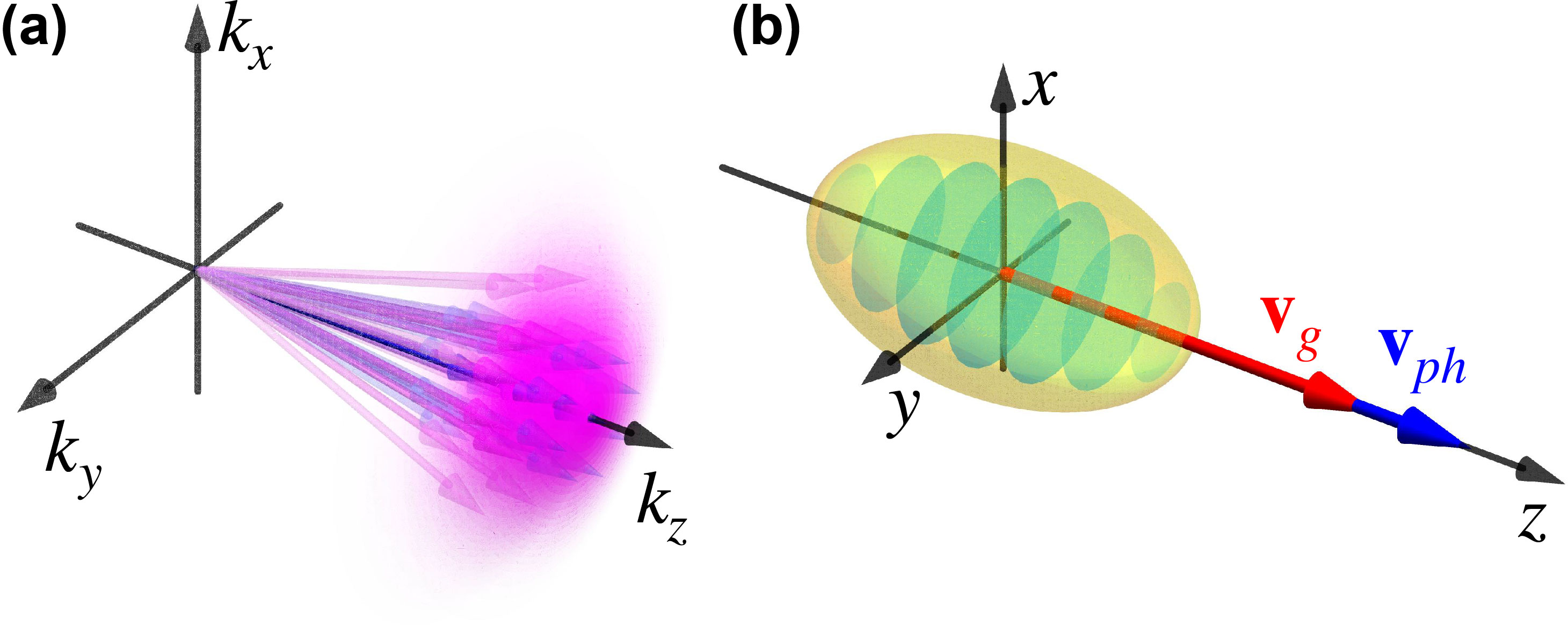
Figure 1: A localized electromagnetic wave packet propagating along z with a subluminal group velocity vg<c and superluminal phase velocity vph>c, the product vgvph=c2.
Electromagnetic Field-Theoretical Framework
The analysis begins by formulating wavepacket dynamics within relativistic electromagnetic field theory, focusing on conserved quantities: energy density U and momentum density P (the Poynting vector), with total integrals conserved by Noether's theorem. Of particular interest is boost-momentum conservation, which governs the evolution of the energy centroid. This leads to a key result: for any physically localized electromagnetic wavepacket, the energy centroid (and thus the group velocity) must satisfy ∣vE∣≤c, with equality only for non-localized, pure plane waves. The simultaneous consideration of "momentum velocity", defined via a momentum centroid, reveals that its component along the propagation direction must be strictly superluminal for finite wavepackets, as dictated by the relation vgvph=c2.
The physical root of this finding lies in the necessity of a non-zero transverse wavevector spread for localization, hence a nontrivial momentum-space structure; the result holds regardless of the specific electromagnetic pulse but derives from basic field conservation and the structure of Maxwell's equations.
Classical Wavepacket and Gaussian Beam Analysis
The field-theoretic findings are corroborated and quantified using explicit Gaussian wavepackets as representative localized solutions. Detailed calculation of the group velocity for paraxial Gaussian beams shows that the wavepacket centroid advances at vg≲c, quantifiably retarded as a function of beam waist w0 and Rayleigh range zR:
⟨vg,z⟩≃c(1−2kzR1)
Superluminal phase velocity is simultaneously demonstrated:
⟨vph,z⟩≃c(1+2kzR1)
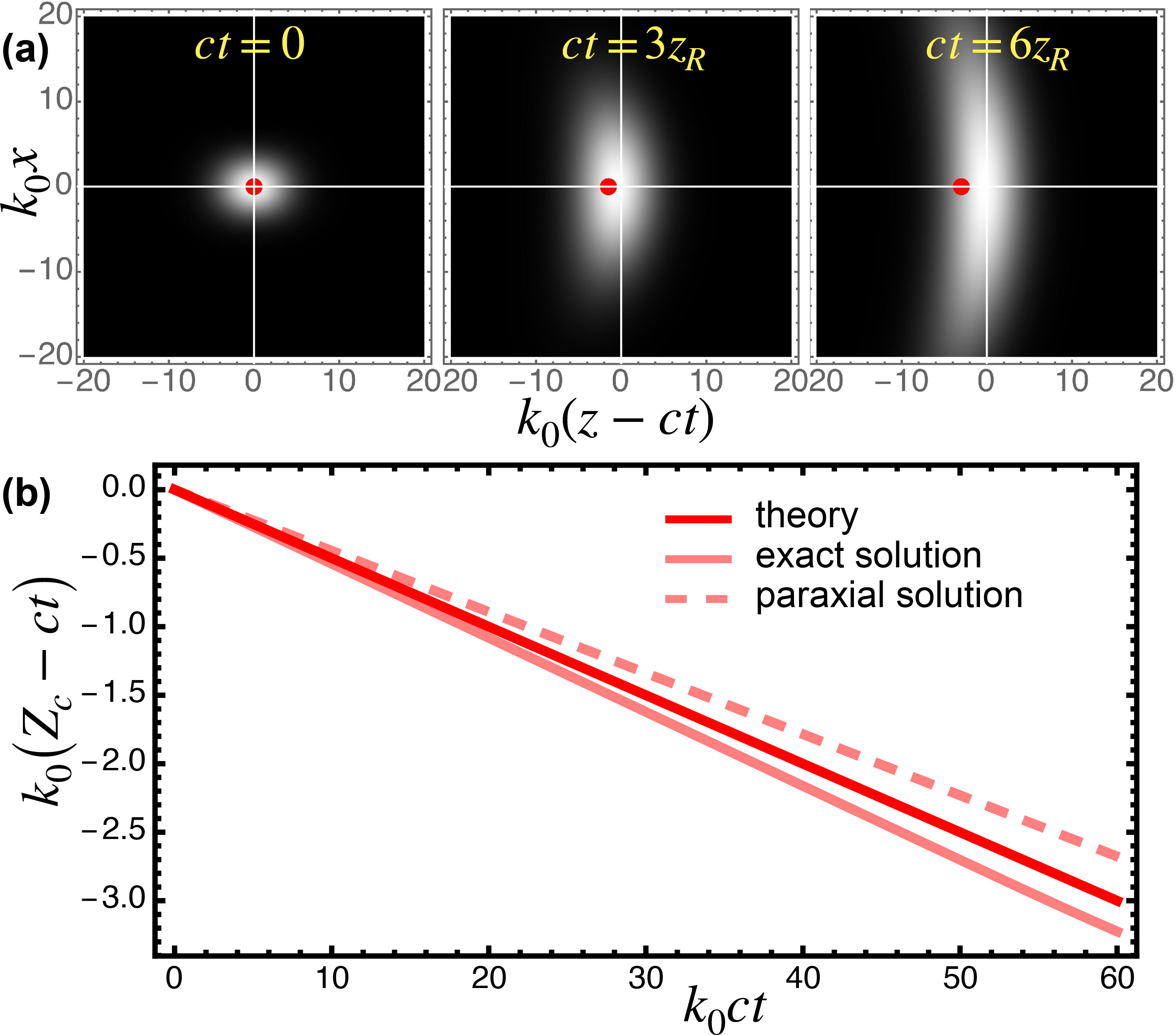
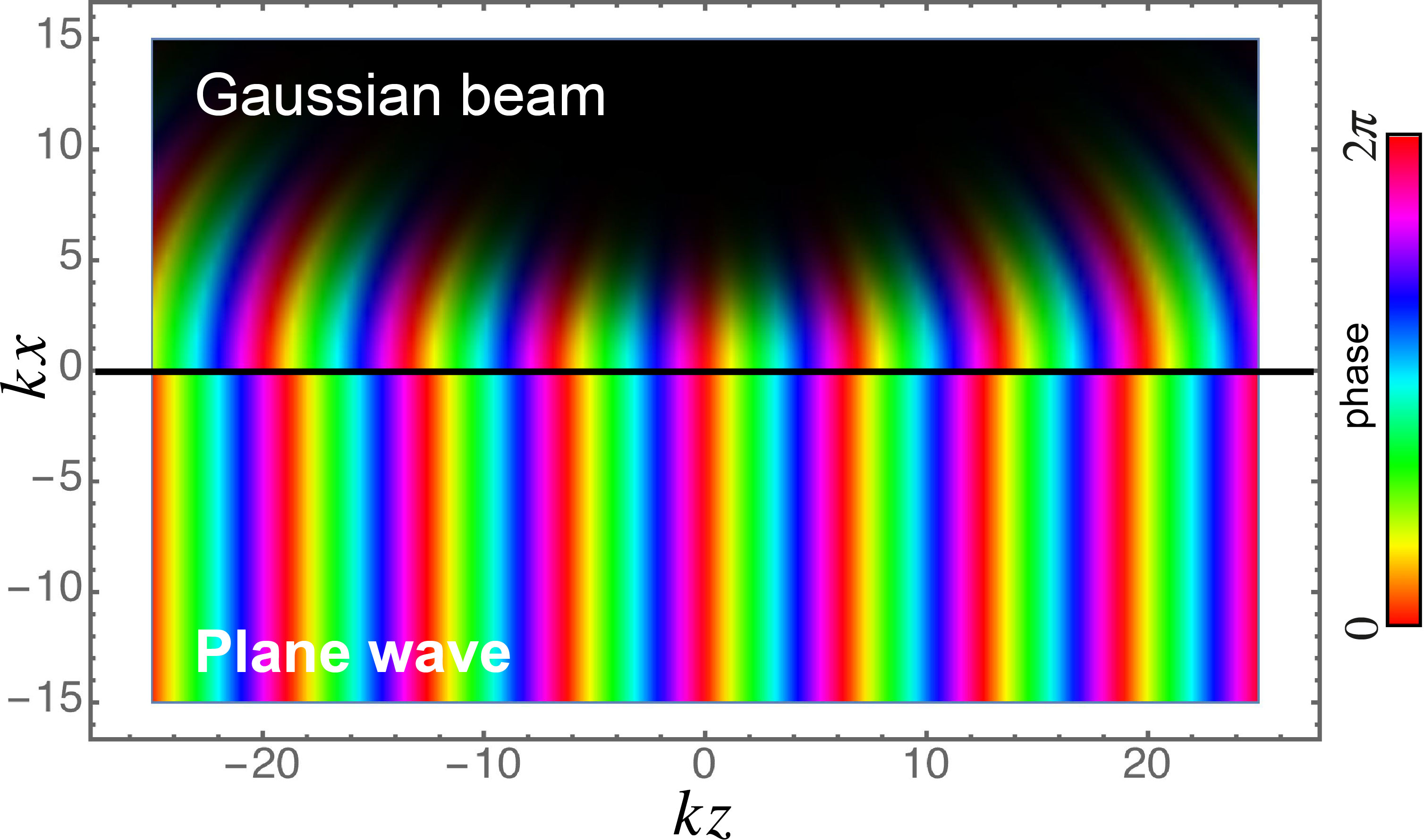
These formulas, together with their interpretation via the transverse confinement scale, clarify that the origin of subluminal group velocity is entirely due to the transverse momentum content resulting from localization. The figures illustrate the resulting time-dependent propagation and centroid retardation, as well as the direct observation of enlarged phase front separation within the beam, evidenced by comparison to an ideal plane wave.
Figure 2: (a) Spatio-temporal evolution of a Gaussian-like wavepacket showing centroid propagation at subluminal velocity. (b) Numerical and analytic comparison of centroid retardation relative to light speed as a function of propagation distance.
Figure 3: Phase distribution in a z-propagating Gaussian beam (x>0) versus a plane wave (x<0); increased wavefront spacing denotes superluminal phase velocity.
Quantum-Mechanical Formalism and Photon Wavefunction Properties
From a quantum perspective, the photon position and velocity operator definitions — particularly in the Riemann-Silberstein representation — present subtle challenges, primarily due to the non-existence of a standard position operator for massless fields constrained by Maxwell's equations. The analysis here shows that the energy centroid velocity derived from quantum expectation values of the appropriate operators coincides with the classically defined group velocity.
The Riemann-Silberstein vector's squared modulus is identified with energy density, not photon probability density. Properly, the physical photon wavefunction in momentum space is ψ~=F~/ω, so that expectation values with respect to this object recover, in the paraxial limit, the earlier group/phase velocity results. Discrepancies in operator ordering or choice of field variable (energy vs. probability density centroids) are examined, and practical equivalence for the group velocity and interpretation of centroid measurements are established for sufficiently localized pulses.
Implications and Perspectives
This work rigorously formalizes the nontrivial velocity effects that arise purely from free-space localization, independent of material interactions or engineered dispersion. The findings establish and quantify that all spatially factorizable, localized photon states must experience group velocity decrease and phase velocity increase, with a precise connection set by their product equaling c2. These implications affect any optical or quantum protocol or experiment where photon arrival times or local phase measurements in confined geometries are relevant.
From a theoretical standpoint, the results connect electromagnetic conservation laws (energy, momentum, boost) with practical quantities such as centroid and phase front propagation, and clarify the precise meaning of photon velocities in field versus quantum formalisms. The formal analysis also highlights the importance of using proper wavefunction definitions in quantum electromagnetic theory and identifies the limits of real-space interpretations due to the Weinberg–Witten theorem.
Potential future avenues include examination of how these effects impact spatio-temporal shaping of single photons for quantum communication, as well as their interplay with engineered or structured light fields where nontrivial angular momentum or transverse phase gradients are present.
Conclusion
The paper provides a comprehensive, multilevel analysis demonstrating that spatial confinement in free space induces unavoidable subluminal group velocity and superluminal phase velocity for photon wavepackets, consistent across electromagnetic field theory, classical wave analysis, and quantum mechanics. Contradictory to some naive expectations, these results are not paradoxical but emerge from the fundamental demands of localization and the mathematical structure of Maxwell's equations. The analysis has significant ramifications for understanding and modeling photon dynamics in both classical and quantum optical systems.